Mailbag

The Mailbag: Potpourri (Teaching hubby the Bible… Generational sin… Blood moons… God honors women preaching?… Remarriage forbidden)

Welcome to another โ€œpotpourriโ€ edition of The Mailbag, where I give short(er) answers to several questions rather than a long answer to one question.

I like to take the opportunity in these potpourri editions to let new readers know about my comments/e-mail/messages policy. Iโ€™m not able to respond individually to most e-mails and messages, so here are some helpful hints for getting your questions answered more quickly. Remember, the search bar (at the very bottom of each page) can be a helpful tool!

Or maybe I answered your question already? Check out my article The Mailbag: Top 10 FAQs to see if your question has been answered and to get some helpful resources.


A comment left on my Rock Your Role FAQs article…

How would this apply within marriage? My husband does not read the Bible..he claims to believe in God, but I donโ€™t actually see him seeking. Is it wrong for me to share with him what I learn or read in my Bible? Thank you for your advice!!

I know that having an unsaved or less spiritually mature husband can be really difficult. I’m sure this is a question many of my readers are struggling with.

When you say, “How would this apply within marriage?” I’m not really sure if “this” means a specific question and answer within that article or if “this” means the biblical prohibition against women teaching men, in general. I’m going to go with the latter since I can’t guess the former. :0)

The biblical prohibition against women teaching the Bible to men has a very specific context: the gathering of the church body. Your marriage is not the gathering of the church body.

It is perfectly fine and biblical for you to share what you’re learning from the Bible with your husband if he is open and receptive to it. But, and this is important, it is also perfectly fine and biblical for you not to share what you’re learning from the Bible with him if he is not open and receptive to it, if it makes him angry, or if he tells you to stop nagging or preaching at him.

A lot of women in the New Testament church were in the very same position. They were saved, and their husbands were not. First Peter 3:1-6 was written just for them, and for you. I would recommend studying that passage as well as 1 Corinthians 7:16, Ephesians 5:22-33, and Proverbs 31:10-31 to guide your own behavior as a godly wife. And, if you think it would be helpful, you may want to work through my Bible study on biblical womanhood.

My article The Mailbag: Can I share the gospel with my unsaved husband? is another good resource. If you need help presenting the gospel to your husband, check out the What must I do to be saved? tab in the blue menu bar at the top of this page.

One more suggestion: Think about making an appointment with your pastor for some biblical counsel on being a gospel influence on your husband. You may want to also ask him to point you to (or you may already know) a godly older woman in your church who has walked faithfully through the situation of having an unsaved husband, and who can disciple you through this.


Do you have any information about the generational sin/curses teaching? Iโ€™d love to understand if this is a false teaching and if it isโ€ฆunderstand what the Bible really says. I donโ€™t buy into the fact my great great grandma was sinful and that is why someone in the family is messed up.

You’re correct, this idea is diametrically opposed to what Scripture teaches. Certainly our children can be hurt or negatively impacted by the sins we commit. They can learn sinful behavior from watching us sin. And we are all sinners by nature. But children don’t genetically inherit a particular sin(s) – say, for example, profanity or adultery – from their parents. And God doesn’t punish us for the sins of our parents or ancestors.

The absolute best resource for refuting this false idea is Ezekiel 18. It is so beautifully clear and such a wonderful picture of the gospel smack dab in the middle of the Old Testament. Give it a good study.

Additionally, we released a podcast episode a while back called What Do We Do with the Guilt of Generational Sin? that may help.


Does โ€œThe moon turning to bloodโ€ refer to what we consider a โ€œblood moonโ€?

Not as it pertains to being a sign of Jesus’ return, no. I think you’ll find this article and this article to be helpful.


Do you think it’s possible for God to “honour” a women’s preaching that is bringing people to Christ?

This is really two separate questions about women preaching. Let’s break it down:

1. Can God graciously save someone, despite the fact that he’s sitting under a woman who’s sinning by pretending to be a pastor? Yes. He also saves people who are currently Mormons, currently being abused, etc. God can save anyone despite someone else’s sin.

2. Does the fact that God saves someone who’s under the influence or authority of someone who’s sinning mean that God approves of or honors the sin being committed? No. God doesn’t honor people for sinning.

God doesn’t honor or approve of Mormon false teachers just because someone happens to hear enough actual Bible to get saved while still in Mormonism. Mormonism is still idolatry, and that Mormon leader is still committing the sin of teaching false doctrine. Or, let’s say a pastor is secretly abusing his son. If the son gets saved during one of Dad’s sermons does that mean God honors or approves of the abuse? Of course not. It’s a display of God’s mercy and grace that God still saves people despite other people’s sin.

The same applies to someone who gets saved despite sitting under a woman who’s sinning by pretending to be a pastor.

Additionally, granting for argument’s sake that she’s actually preaching the biblical gospel, the fact that the woman “pastor” got that part right doesn’t excuse or make up for her sin of rebelling against God’s Word. If I work in a soup kitchen all week long, but every Saturday I go out and murder somebody, we know that my good works during the week don’t outweigh, excuse, or make up for the sin of murder. I still need to repent of being a murderer, and the woman “pastor” still has to repent from rebelling against God’s Word regarding her role in the church.


I was widowed a year ago, and a divorced man asked me to marry him but my pastor said it was absolutely forbidden. Can you please help me with this issue? The entire world is divorced!

Let me first offer my condolences for the loss of your husband. I can’t imagine how difficult that must be.

Have you asked your pastor to explain why* he said this? I’m not exactly sure of his reasoning, so let me just offer a few general thoughts.

One reason your pastor might have said this is that he holds to what’s called the permanence view of marriage. This view essentially says there are no biblical grounds for divorce (for anyone) and, thus, no biblical allowance for remarriage.

On the other hand, he may believe (as I, and many other Christians do) that, while reconciliation of a marriage is always the first and best goal, and that, in most cases, divorce is a sin, there are certain circumstances (chiefly adultery and abandonment) in which the Bible allows for divorce as a last resort. If that’s the case, depending on the circumstances of your gentleman friend’s divorce, your pastor may be saying that his divorce was not biblical, and, therefore, the two of you should not marry.

Finally, your pastor may have reasons aside from the divorce that would cause him to tell you not to marry this gentleman. Perhaps your pastor knows that he isn’t saved, that he is cheating on you, that he’s engaging in criminal activity, etc. I hope that’s not the case, but that’s the only other possibility I could think of.

I would suggest you talk to your pastor about this, hear him out on his reasoning, and compare his reasoning to rightly handled, in context Scripture. It could very well be that he’s offering you good, biblical counsel. Or…not.

*Readers, I’m not faulting anyone for asking me a question like this, but I often receive questions about why a certain person – whether it’s a false teacher, your husband, your pastor, a friend, whoever – did or said something, or what he meant by what he said or did. Generally speaking, I have no way of knowing why a particular person said or did a particular thing or what it meant. I can only speculate. If you want to know why someone did or said something, or what he meant, it’s best to go to that person and ask him or her directly.


If you have a question about: a Bible passage, an aspect of theology, a current issue in Christianity, or how to biblically handle a family, life, or church situation, comment below (Iโ€™ll hold all questions in queue {unpublished} for a future edition of The Mailbag) or send me an e-mail or private message. If your question is chosen for publication, your anonymity will be protected.

Complementarianism

Sammiches of Oppression and Subjugation

Obviously, there are many, many serious issues in the church and world today, and if youโ€™ve followed the blog for any length of time, you know I have a good track record of dealing with those issues on a regular basis in a serious way: Bible study…the gospel…sin…obedience to Scripture…discernment…and so on.

But sometimes, as human beings, we just need a momentary break from the serious to be silly and laugh. Ecclesiastes 3:4 says that just as there is a time to weep, there is an equally valid, and righteous, and good time to laugh. Sometimes I talk to Christians who seem to believe that weโ€™re supposed to have our sense of humor amputated when we get saved, and thatโ€™s just not true. Proverbs 17:22 says:

A merry heart doeth good like a medicine: but a broken spirit drieth the bones. Proverbs 17:22

We need to laugh. We need moments of of refreshing.

If you disagree with any of that, or you just don’t like, or are easily offended by humor for whatever reason, this would be a good time to stop reading and go do something you enjoy, or tackle that “to do” list, or whatever. You’ve been warned. No complainies.

In case you’ve somehow managed to avoid them, there are feminists out there who can’t wrap their tiny little closed minds around the fact that godly women actually find joy in loving and serving our husbands and families. They seem to think – out loud, vociferously, and frequently, particularly on social media – that the only reason a woman might do such a thing is because she’s been brainwashed, downtrodden, or forced to.

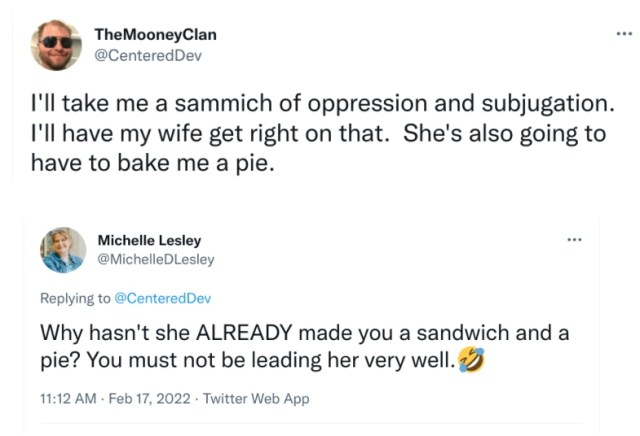
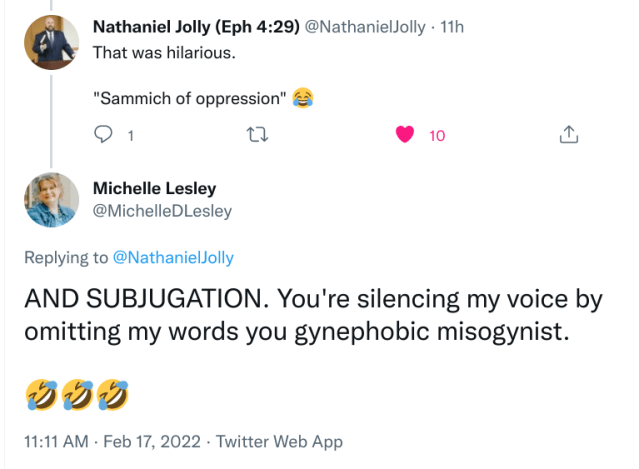
So, I did a thing on Twitter the other day, and I thought it might give you a smile…

Everything – I mean, everything – has to be caveated and explained to death these days (are y’all as sick of that as I am?)…

I kid you not, somebody asked me what my motive was for saying, “I *are* one,” instead of, “I *am* one.” Humor, my friend. Humor.

Of course, then everybody had to get in on the act. Back off, people. Can’t you tell I’m a humor professional?

Men. They’re just lost without a helper.

Leslie is usually so on the ball with these sorts of things. It’s not like her to leave out an ingredient.

I started to say, “That heifer is out of the barn,” but I’m sure that’s sexist…to somebody.

These men will never learn…

That’s right, just keep on wallowing in your wrongy-wrongness of manhood.

Yes, three slices. That’s why you’re still aspiring, honey.

Everybody’s a comedian. But since he’s a MAN, I’ll let him have the last word, as is fitting.

Now get in the kitchen and make your man a sammich of oppression and subjugation, ladies. (My husband said it was OK for me to say that. :0)

Holidays (Other), Marriage

Love and Marriage

Love is in the air….

It’s almost Valentine’s Day, and you’re probably getting bombarded from every angle with the world’s idea of love, romance, and marriage. But what does the Bible have to say about that? And how about some “been there, done that” godly counsel from your older sisters in Christ?

Between us, my A Word Fitly Spoken podcast co-host, Amy Spreeman and I have over 60 years experience as wives. We recently sat down and recorded Love and Marriage, an episode about biblical love and godly marriage. Have you listened yet?

You might also enjoy some of my articles on marriage:

A No-Bull Marriage: Four Lessons from Mr. & Mrs. Samson

The Mailbag: I โ€œfeel ledโ€ in a different direction from my husband

9 Ways NOT to Fight with Your Husband

My Husband Brought Me Flowers Today

Marriage: Itโ€™s My Pity Party and Iโ€™ll Cry if I Want To ~ 7 Ways to Take Your Focus Off Yourself and Put it Back on Christ

Thinking about going to a romantic movie with your sweetie? Check out my review: Redeeming Love: Rants, Raves, and Reviews.

And, if you’re looking for some sentimental classic CCM love songs1 for V-Day (my husband and I had the first four in our wedding :0) …

(My husband and I recorded this duet together before our wedding
and had it played during our unity candle.)

1I’m not recommending or endorsing any of these musicians. Some of them are fine. Some aren’t. Vet anybody you’re considering following.

Holidays (Other), Marriage

Throwback Thursday ~ My Husband Brought Me Flowers Today

Originally published June 27, 2014

โ€œIโ€™m so tired of flowers,โ€ sighed the elderly woman in the TV commercial as my jaw hit the floor. She had just described how her husband of fifty years, seated next to her, brought her flowers on their first date, and every year since had given her the same bouquet on that day.

And she was tired of flowers.

It wasnโ€™t enough that she had a husband who stayed with her for fifty years. Or that he actually remembered the day of their first date every year. Or that he was caring enough to send her flowers on that date. Or that he was sentimental and romantic enough to send her the same flowers every year.

No. She was tired of flowers. She wanted the product the commercial was trying to sell.

I wanted a shoe to throw at the TV.

My husband brought me flowers today. I know, in the picture they look rather more like birthday candles than flowers. Thatโ€™s because, technically, my flowers were birthday candles.

I was getting ready for our youngest sonโ€™s birthday party. I had already made a trip to the store and thought I had everything I needed. Until I discovered I was nearly out of baking powder. My husband was out running errands, so I sent him a text asking if he could pick some up for me. He did. No problem. Until I remembered I didnโ€™t have any candles for the birthday cake. And he had already left the store. And it was raining.

โ€œAnd it was raining.โ€ I say that like itโ€™s just so pedestrian, like itโ€™s some normal, everyday thing, which, in south Louisiana in June, I assure you, it is not. Every day, yes. Normal, no. Remember that scene in one of those โ€™90โ€™s โ€œasteroid crashes into the earthโ€ movies where the asteroid has just hit and the man and his daughter are standing on the beach watching the huge resulting tidal wave roll in to engulf them? Well if, instead of the beach, you can imagine yourself trying to navigate a WalMart parking lot with a buggy full of groceries and four kids in tow in the middle of that tidal wave, youโ€™ll have some idea of what monsoon season is like down here.

And you know what my husband did when I asked him to go get birthday candles in that mess? He did it gladly. No complaints. No asking, โ€œWhy didnโ€™t you think about this sooner?โ€ He just walked in the house, soaked and smiling, and handed me the candles.

No bouquet could have been better.

Ladies, my husband has a lot of faults. Iโ€™ll bet yours does too. Because just like us, theyโ€™re sinful human beings. Often, like the lady in the commercial, we trample over a dozen roses to plant our feet in a briar patch. We overlook the ways our husbands are a blessing to us and focus only on our complaints.

Maybe he didnโ€™t get you exactly what you wanted for your birthday, but does he work hard every day to support your family? So, he didnโ€™t notice your new haircut right away. Does he give the kids their bath every night? Yes, his dirty socks are constantly on the floor in front of the hamper, but didnโ€™t he change the oil in the car yesterday?

1 Thessalonians 5:16-18 says:

Rejoice always, pray without ceasing, give thanks in all circumstances; for this is the will of God in Christ Jesus for you.

The next time youโ€™re tempted to complain about your husbandโ€™s shortcomings, why not praise God instead for a way that he has blessed you or done something admriable? And letโ€™s make sure to thank our husbands for those little โ€œflowersโ€ they bring us every day.


This article was originally published at Satisfaction Through Christ.
Mailbag

The Mailbag: Husbands, pastors, and mentors- Which roles do they play in a Christian woman’s life?

Originally published January 20, 2020

I have three questions that are kind of related to each other:

1 Corinthians 14:35 says women should ask their husbands questions at home; how does this fit with women mentoring other women in Titus 2?

Where does a husbandโ€™s role end and where does the role of a godly older woman begin in terms of teaching younger women?

Are there areas where a pastorโ€™s authority trumps a husbandโ€™s authority?

Thank you for your help.

These are really awesome questions. I love it when women ask questions that demonstrate that they’re digging into Scripture and thinking deeply about the things of God. It’s so exciting to me!

(Before I begin answering, let me just stipulate, as I usually do in articles about marriage, that the following statements assume a normal, relatively healthy, average marriage, not abusive marriages, extremely aberrant marriages, etc. Also, it’s not my intent to leave out my single sisters, but the reader asked specifically about married women, so that’s how I’m answering the questions.)

So let’s take each question separately…

1 Corinthians 14:35 says women should ask their husbands questions at home; how does this fit with women mentoring other women in Titus 2:3-5?

The first thing we need to do when we’re addressing questions like this is to look at each of these passages in context. This is a very simple study skill that will clear up nearly all instances of supposed contradictions in Scripture.

Read 1 Corinthians 14:26-40. What is the venue for Paul’s instructions in this passage? In other words, is he telling people how to behave at home? At work? At the movies? Look at the key phrases in verses 26 (“when you come together”) and 28,33b-35 (“in church”). Paul is giving instructions for how an orderly worship service is to be conducted. He is not making a blanket statement that any time any woman wants to know anything about Scripture or God or life in general that the only person she can ever ask questions of is her husband. What he’s saying is that in order to avoid chaos in the worship service, women are to sit down and be quiet during the preaching and teaching, rather than interrupting to comment or ask questions (one of the reasons Paul says this is that the women in the Corinthian church were doing just that – interrupting the preaching and teaching with questions and comments). If you read further in chapter 14, you’ll notice he places similar restrictions on prophesying and speaking in other languages to prevent chaos and confusion during the worship service. I’ve discussed this passage in further detail in my article Rock Your Role ~ Order in His Courts: Silencing Women?

Now read Titus 2. What’s the main idea of this chapter? Is it the same as the main idea of 1 Corinthians 14 – instructions for an orderly worship service? No. Verse 12 gives a nice summary of chapter 2: “renounce ungodliness and worldly passions, and to live self-controlled, upright, and godly lives in the present age.” That’s what this chapter is about. “Titus, here’s what your church members (and you) are to do and how they’re to conduct themselves as they go about the business of living as Christians in this world and in community with one another.” The older women teaching and training the younger women in verses 3-5 is not taking place during the worship service, but as these women go about daily life with one another. Today, this kind of teaching and training takes place in women’s Bible study classes, women’s fellowship groups, and in one on one discipleship, not in, nor instead of, the gathering of the whole church for worship.

So as we can see when we examine the context of both passages, 1 Corinthians 14:35 and Titus 2:3-5 are not in conflict, they’re actually in harmony, addressing two distinct ways women are to conduct themselves in two completely different venues.

Where does a husbandโ€™s role end and where does the role of a godly older woman begin in terms of teaching younger women?

I don’t think it’s really that discrete and linear, i.e. the husband teaches this list of topics the wife needs to be taught about and the godly older woman teaches that list of topics she needs to be taught about, and never the twain shall meet. It’s a much more informal and “whatever is needful at the moment” type of thing. Additionally, it’s going to vary from marriage to marriage. Some women have unsaved husbands. Some women are newly saved with husbands who have been saved for decades. Some husbands and wives are very private about everything, some are very open to others. So the balance between who (husband or older woman mentor) teaches what, and how much, and when, is going to look different in every marriage.

I would just offer a few guidelines:

โ€ข After your relationship with Christ, if you’re married, your highest allegiance is to your husband. He should be your best friend and first confidant, not a woman who’s mentoring you (or even your mother, sister, or female best friend). He should never feel like he’s in competition for your time, interest, or affinity with the woman who’s mentoring you, or that you esteem her on the same (or, perish the thought, higher) level of loyalty or emotional intimacy with him. If you’ve gotten that close to your mentor, you’re too close. Turn your attention toward your husband.

โ€ข Along those same lines, always keep in mind that God instructs you to submit to your husband, not your mentor. The only time you should ever follow your mentor’s advice over your husband’s desires is if your husband is asking you to do something the Bible clearly calls sin and your mentor is advising you to obey Scripture instead. (But even in that case, you’re not really choosing your mentor over your husband, you’re choosing to obey God rather than to sin.)

โ€ข There are some things that are private between a husband and wife that shouldn’t be shared with anyone, including a mentor. Which things? Again, that’s going to vary from marriage to marriage, but a few no no’s might include the private details of your sex life, your finances, and anything your husband would be embarrassed for someone else to know. Talk with your husband and ask if there’s anything he would rather you didn’t share with your mentor.

Are there areas where a pastorโ€™s authority trumps a husbandโ€™s authority?

It really depends on what you have in mind when you ask that question.

If you’re talking about personal decisions made between a husband and wife, let’s say, for instance, whether or not to move to a certain part of town or whether or not the wife should take a part time job, it is not the pastor’s place to step in and overrule the husband’s decision, nor should the pastor have any expectation that the couple would obey any edicts he issues. If the couple goes to him for counseling or asks for his advice, he can certainly give it, but we never see any place in Scripture where a pastor has authority over another family’s decisions. The husband is responsible before God for leading his family, not the pastor.

But if you’re talking about a situation in the church, then yes, a pastor’s (or the elders’) authority – assuming he’s abiding by Scripture – trumps a husband’s authority, and pretty much every other church member’s authority as well. For example, a husband does not have the authority to walk up to the pastor and say, “I’m going to let my wife preach the sermon next Sunday,” or “My wife is going to take over this Sunday School classroom and use it as her personal office.”. If a husband were to say something like that, the pastor is well within his authority as shepherd of the church to say, “Oh no she’s not.”. The buck stops with the pastor when it comes to how the church runs, and he is responsible before God for making godly decisions for the church.

I’m aware that there are aberrant, fringe “churches” (many of them are some stripe of New Apostolic Reformation or extreme legalism/fundamentalism) out there in which the “pastor” has ultimate authority over every decision a family makes: where they live, how many children they have, what to name their children, whether and where each spouse should work, etc. If you’re in a so-called church like that, leave immediately and find a doctrinally sound church to join. A church doesn’t plunge to that depth of spiritual abuse without succumbing to other dangerous false doctrines along the way.


If you have a question about: a Bible passage, an aspect of theology, a current issue in Christianity, or how to biblically handle a family, life, or church situation, comment below (Iโ€™ll hold all questions in queue {unpublished} for a future edition of The Mailbag) or send me an e-mail or private message. If your question is chosen for publication, your anonymity will be protected.