Movies

Movie Tuesday: Making Sure Kids Stay in Church as Adults

Children who sit with their parents in “big church” are more likely to
stay in church as adults than those who spend the
worship hour in children’s activities.

It’s more detrimental to youth to have a series of youth pastors than to have no youth pastor at all.

These are just two of the fascinating statistics included in Dr. Steve Parr’s recent seminar for the Louisiana Baptist Convention’s ReGroup small group leader training workshop. It’s great information for those in children’s, youth, or student ministry, and if you’re a parent with children still in the home, or a grandparent, you’ll definitely want to watch and give some thought to your church’s programs and how your own family worships.

(Disclaimer: I am not familiar enough with Dr. Parr to recommend or warn against following him. I screened him very briefly for associations with several major false teachers and did not find any with the exception that he quotes John Maxwell – whom I do not recommend – occasionally in his writing. The video above is the only material of Dr. Parr’s I have viewed. As always, please compare all media you consume to Scripture and reject anything that is out of line with God’s word.)

Faith, Old Testament, Parenting, Prayer, Sunday School, Trust

Meet the Parents (of Samson) ~ Sunday School Lesson ~ 4-6-14

sunday school

These are my notes from my ladies’ Sunday School class this morning. I’ll be posting the notes from my class here each week. Click here for last week’s lesson.

Through the Bible in 2014 ~ Week 14 ~ Mar. 30-Apr. 6
Judges 1-18
Meet the Parents (of Samson)

In this week’s reading, we said goodbye to Joshua and met up with a variety of Israel’s lesser known judges. We also read about three better known characters in Israel’s history, judges Deborah, Gideon, and Samson. Often, when we come to passages like this, it’s like a treasure hunt. We focus on the valuables that are in plain sight. But, if we dig just a little, we can find more gems just beneath the surface. Today, we’re taking a look at two godly people who had a profound impact on Samson’s life: his parents.

Judges 13-14

Mr. and Mrs. Manoah
It’s always interesting to me that, just as we saw last week with the two spies, some of the most faithful of God’s servants are ordinary people like you and me serving God as they go about their daily tasks. And, just as with the two spies, in many cases, we never find out their names.  Samson’s mother was just this kind of nameless, faithful servant. Though we know little about her husband, Manoah, the most important thing about him—his faith—comes through loud and clear.

Barrenness (13:2-3)
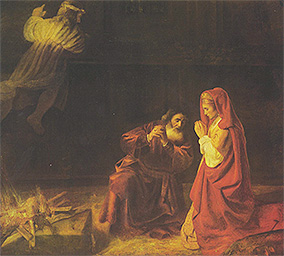
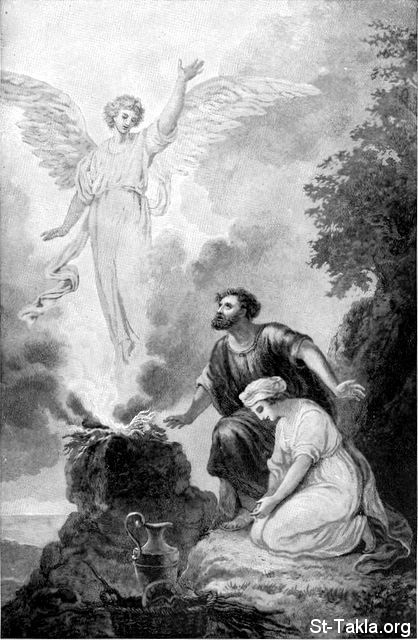
Mrs. Manoah was barren. Have you ever noticed how many “big names” in the Bible had mothers who were previously barren or who conceived miraculously? Joseph (Rachel), Samuel (Hannah), John the Baptist (Elizabeth), even Jesus (Mary), just to name a few. Things are different today, but, in manoah-wife-angel-offering the Bible, a miraculous conception was often a sign that the child would grow up to be a mighty man of God.

Barrenness was usually seen by others in the community as a curse by God or a punishment for sin (and sometimes it was: 2 Samuel 6:23). During that time in history, the only way for women to achieve status and be considered successful was by marrying and having children- particularly sons. A woman’s entire self-worth—in her own eyes, her husband’s eyes, and the eyes of her community—was at stake. So it’s easy to see why women and their husbands would have spent a great deal of time crying out to the Lord in prayer and seeking to be obedient to Him in hopes that He would grant their request for a child. We see this most clearly in the case of Hannah (1 Samuel 1), and it’s reasonable to surmise that this was likely also the case for Manoah and his wife.

Belief, Not Doubt (13:3-8)
It’s interesting that both times the angel of the Lord appeared to deliver His message, He initially appeared, not to the man, Manoah, but to the woman, his wife. Was it because she was praying at the time, or because her faith was stronger than her husband’s? This passage doesn’t tell us, so we don’t know. But, notice Mrs. Manoah’s reaction to the news that she would conceive. Did she laugh in disbelief like Sarah and Abraham did (Genesis 17:17,18:12)? Did she doubt like Zechariah (father of John the Baptist: Luke 1:18)? No, Mrs. Manoah believed. And, as a godly wife should, the first person she shared the news with and sought direction from was her husband.

Now let’s consider the reaction of Manoah to his wife’s news. Did he think her desire for a child had sent her over the edge or that she was making this up? No. He believed her without question. What does this tell us about the character, faith, and influence on her husband of Mrs. Manoah? “The heart of her husband trusted in her” (Proverbs 31:11) because she was a godly, trustworthy woman.

A Household of Faith (13)
In addition to spending time praying for a child, Mr. and Mrs. Manoah probably prayed regularly, like many other faithful Israelites, for deliverance from the Philistine oppressors, and here, we find them in prayer again.

Manoah not only trusted his wife, he had faith that the Lord would fulfill His promise. His first reaction was to believe and ask God the best way to obey Him. “And God listened to the voice of Manoah…” and answered his prayer of faith. He came back—to Manoah’s wife. Again, Manoah believed her without question and followed her out to meet the angel of the Lord.

When they met up with the angel, we see further evidence of this couple’s godliness. Though the angel had appeared and spoken twice with Mrs. Manoah, she, as a godly wife, does not take control of the situation or assert superiority over her husband. She takes a step back and, as a godly husband and leader of his home, Manoah steps up to the plate to assume the responsibility for his family and receive God’s instructions.

Manoah’s conversation with the Lord is fraught with faith. He doesn’t ask how or why they’re suddenly being blessed with a miracle child even though they’re just ordinary people. He simply accepts that it will happen. Manoah is confident that God is telling the truth and will keep His promise when he says, “When [not if] your words come true…” (12, 17). He believes God’s word that Samson will “begin to save Israel from the hand of the Philistines,” (5) when he asks about “the child’s manner of life, and…his mission” (12) so that he and Mrs. Manoah could prepare him to do so. He trusted in the www-St-Takla-org--12-Angel-Visits-Manoah-and-His-Wifecharacter of God, “the one who works wonders,” (19) and worshiped Him as such. He and Mrs. Manoah feared and trusted in God’s holiness as they fell on their faces at His departure (20).

Without a total grasp of the situation (22), Manoah believed God’s word that, “no man can see Me and live” (Exodus 33:20). Only later (21) did Manoah understand that He had been speaking with the angel of the Lord (Jesus – theophany: an appearance of the pre-incarnate Christ – {“My name…is wonderful” (18)- see Isaiah 9:6}—this is how people could “see God and live” even though God had said, “you cannot see Me and live.” They could not live through seeing God the Father, but they could live through seeing God the Son. Also a piece of supporting evidence for the Trinity). Jesus, the true deliverer and judge came personally to announce the birth of this temporal deliverer and judge who would point ahead to Christ.

Finally, we come full circle to Mrs. Manoah’s quiet trust in the Lord. Even with a strong faith like Manoah had, there can be moments of confusion. How could God say to Moses –the greatest leader Israel had ever known, the friend of God!—“you cannot see My face, for man shall not see me and live,”—yet here he and his wife were, having seen Him, but somehow still unscathed? How could anyone understand this?

But Mrs. Manoah shows us that faith means trusting God’s word even when we don’t fully understand His actions. Yes, it was true that God had said that people couldn’t live through seeing Him, but it was also true that He had visited them and told them they were going to have a son who would be a deliverer for Israel. How could both of those things be true at the same time? She probably couldn’t understand it either, but she encouraged her husband to trust God even in their confusion (23). And God kept His promise (24-25)

Trusting Despite the Circumstances (14:1-10)
Kids grow up, and as broken, sinful human beings, they sometimes make foolish decisions despite being raised in a godly home. That’s what Samson seems to have done here. While the Philistines were not one of the seven nations the Israelites were specifically forbidden to intermarry with, the principle behind God’s forbidding of intermarriage with those other nations was the same for the Philistines: they were idolaters and enemies of God and His people.

As godly parents, Mr. and Mrs. Manoah tried to steer their adult son to a godly choice of a wife. They reminded him that he was one of God’s people, and surely wanted him, as a leader in Israel, to set a good example for the people. Once again, they were seeking to be faithful to God.

thInstead of honoring his parents, Samson chose poorly. Or so it seemed. Either Samson was operating solely on lust and God sovereignly used the situation to His own advantage, or Samson, moved by God, was intentionally trying to infiltrate the Philistines by marrying in. The passage doesn’t make this precisely clear to us.

And, it wasn’t clear to Samson’s parents, either. So, perhaps thinking that they could influence the girl’s family or hoping Samson would change his mind, they went along with his decision and accompanied him to meet the new in laws. Once again, though the circumstances were worrisome and hard to understand, Mr. and Mrs. Manoah trusted that the God who had already worked so many wonders in their lives could handle this situation. They had faithfully obeyed what God had asked them to do and raised Samson in a godly home. Now, they had to sit back and watch God take care of the rest. And He did. Again, God kept His promises.

And we know that for those who love God all things work together for good,
 for those who are called according to his purpose. Romans 8:28

Parenting

The 10 Commandments of Parenting- 7

7.

Thou shalt consistently and lovingly
discipline thy children.

Whoever spares the rod hates his son,
but he who loves him is diligent to discipline him. Proverbs 13:24

These kids today! Every generation since Adam and Eve has probably said it. Certainly today, you can’t throw a rock out the window without hitting half a dozen ill-behaved brats. We’ve all cringed at the temper tantrum-throwing child seated at the next table in the restaurant, or watched a mom in the store tell her little sweetie “no” a dozen times, only to finally give in to his demands. Heck, most of us have probably been that mom on occasion.

Hundreds of books, both Christian and secular, have been written on the topic of how to discipline children, but much rarer are the writings about why we should discipline them. As always, the easy answer to that question for the Christian is: “because God said so”. But why does God tell us to discipline our children? Because discipline teaches our children that we love them.

The most important way we can love our children is to lead them to salvation. Learning obedience to parents not only teaches them about sin, law breaking, punishment, and repentance, it also teaches them the concept of setting aside their own desires in favor of submitting to the authority that has been placed over them. This has direct application to the spiritual construct of salvation. Salvation does not take place until, through faith in Christ, we repent of our sin and submit our will to the authority and Lordship of Christ and commit to follow and obey Him.

First John 4:20 says: “If someone says, “I love God,” and hates his brother, he is a liar; for the one who does not love his brother whom he has seen, cannot love God whom he has not seen.” I really believe this principle generally applies to obedience as well. One of the things I tell my kids when I discipline them is that, although I don’t enjoy punishing them or letting them suffer the consequences of their actions, I have to do it because I want them to start learning, through obeying me, how to obey God. I’m flesh and blood standing right in front of them, clearly telling them what to do and what will happen if they don’t obey. If they can’t obey me, how in the world are they going to learn to obey God, whom they can’t see or hear with their eyes and ears? Conversely, if a child has been lovingly and consistently disciplined, how much easier will it be to introduce him to the concept of submission to God’s authority?

Another vital spiritual principle that discipline helps teach is an understanding of sin, its consequences, and punishment. A child who has been disciplined knows what it means to be guilty of breaking the rules. He also knows that because he has broken a rule, some sort of undesirable consequence will follow swiftly. A child who has not been disciplined believes he does no wrong and that the world around him should be catering to his wants and demands. Which child will be able to grasp the idea that he is a sinner in need of salvation? Which one will understand contrition, eternal punishment, and eternal reward?

Teaching obedience also teaches our children that we are concerned about how they fare with others. My children have come to me in the past and told me that they don’t like being around certain friends of theirs who constantly misbehave. On these occasions, I very carefully (to ensure that they don’t become critical or develop an attitude of superiority) explain to my children that this is one of the reasons Daddy and I teach them good behavior. We don’t want them to experience the sadness that misbehaving child is sure to feel when he realizes that people don’t want to be around him. We teach them that we love them enough to want others to delight in them.

Discipline shows love for our children through concern for their safety. If my child doesn’t obey me when I tell him not to run into the street, he could be killed by an oncoming car. If he runs into the street and then stands there and argues with me when I tell him to get back on the sidewalk, he could also be killed.

Many years ago, when I was teaching school, a kindergarten student of mine was killed in a house fire. He didn’t die because he was unable to get out of the house. He was rescued unharmed, and was told not to go back into the house. This little boy, notoriously disobedient, went back into the house. He died as a result of lack of discipline.

I have told my children these stories on occasion, not to scare them unnecessarily, but to show them just how serious the consequences of disobedience can be. All the spiritual principles in the world won’t matter if a child isn’t alive to learn them.

Love your children by disciplining them. Show them love through their physical safety; show them love through their social well-being; and show them love through their eternal security