Mailbag, New Apostolic Reformation

The Mailbag: Should Christians listen to “Reckless Love”?

Should Christians listen to the song Reckless Love? Should churches use this song in their worship services or other activities? Aren’t songs like this OK if they point people to Jesus and the lyrics don’t blatantly contradict Scripture?

Goodness, I have never seen so much buzz over whether or not a particular song is OK to listen to or use at church. Regardless of your opinion of the song itself, I think we could all agree that one awesome thing that has come out of the Reckless Love debate is that it has encouraged Christians to actually look at the lyrics of, and think theologically about, the songs they listen to on the radio or sing in their worship services.

That’s phenomenal. We should be analyzing every song we sing that way whether it comes to us via a dusty antique hymnal or Pandora. There are hymns, and gospel songs, and CCM songs, and CHH songs that need to be thrown out because they contain poor, or outright heretical, theology. Here’s hoping we will continue to be as meticulous in examining every song we hear as we have been about examining Reckless Love.

So what about the song itself? Is it OK?

I’m going to start off my answer by drawing from a previous article, Godโ€™s Not Like โ€œWhatever, Dude,โ€ About The Way Heโ€™s Approached in Worship:

Such was the case recently when Christian social media was up in arms (and rightly so) about Cory Asburyโ€™s worship song Reckless Love, and whether or not churches should use it in their worship services. Discussion centered around the use of the word โ€œrecklessโ€ to describe Godโ€™s love for us and whether or not that was a semantically and theologically appropriate adjective. โ€œRelentlessโ€ was suggested as an alternative lyric. โ€œRecklessโ€ was defended as an appropriate lyric. And then Cory Asburyโ€™s explanation of the song came to light and did further injury to his doctrinal cause…

…Focusing on the word โ€œrecklessโ€ missed the point โ€“ at least the big picture point. You see, Reckless Love was produced by Bethel Music. And Cory Asbury is a โ€œworship leader, songwriter and pastorโ€ with the Bethel Music Collective. Prior to joining Bethel, he spent eight years as a worship leader with the International House of Prayer (IHOP).

Why is this important? Because Bethel โ€œChurchโ€ in Redding, California, and IHOP are, functionally, ground zero for the New Apostolic Reformation  heresy. Heresy. Not, โ€œThey just have a more expressive, contemporary style of worship,โ€. Not, โ€œItโ€™s a secondary theological issue we can agree to disagree on.โ€ Heresy. Denial of the deity of Christ. Blasphemy of the Holy Spirit. Demonstrably false prophecy that the head of IHOP, Mike Bickle, has publicly rejoiced in (He estimates that 80% of IHOPโ€™s โ€œpropheciesโ€ are false.) And thatโ€™s just the tip of our metaphorical ice berg when it comes to the NAR.

If you claim to be a Christian, and denying the deity of Christ (saying that Christ was only human, not God) and blaspheming the Holy Spirit aren’t enough for you, please take a moment right now to do some soul searching and ask yourself why that is. These people are blaspheming your Savior and you’re going to defend them? Denying the deity of Christ alone is enough to put a “church” outside the camp of Christianity. It is one of the damnable “another gospels” Paul refers to in Galatians 1:6-9.

But maybe seeing more of the fruit of the poisonous NAR tree will help:

“Holy” Laughter. The NAR blasphemously attributes this to the Holy Spirit, disregarding the fact that one of the fruits of the Spirit is self-control and that God demonstrates throughout Scripture that He is not a God of chaos, craziness, and confusion, but of orderliness and peace.

Fake and delusional prophecies. Pick any biblical prophet and read his prophecies in comparison with this. And don’t forget what the Bible says about false prophets.

Fake “glory clouds” of “gold dust” and “angel feathers” (glitter and feathers placed into the ventilation system) released during the worship service as a supposed sign of the presence of the Holy Spirit. I guess Jesus’ promise of the Holy Spirit and the many promises of His presence in the New Testament aren’t good enough.

Raising the dead. Oddly enough in this age of everyone making videos of everything and cutting edge medical technology, there’s never been a single medically verified, video evidenced resurrection.

Being “drunk in the Spirit”. This is not how you do Acts 2:13-21 or Ephesians 5:18-19, two of the passages the NAR mangles to support this demonic activity, which they blasphemously attribute to the Holy Spirit. (By the way, the guy in this video, Todd Bentley, was commissioned as an “apostle” by Bill Johnson, lead “pastor” of Bethel. And shortly after Todd cheated on his first wife, divorced her, and married the woman he was cheating with, Bill Johnson “restored” him to ministry. You can see video evidence of both of these things here and here.)

And if that’s still not enough for you, there’s fake faith healing (language warning- this was written by a non-Christian who, by the way, did not hear the gospel when she went to Bethel) including kicking people in the face and other forms of assault to “heal” people, grave sucking, and demonic tremoring. Then there are the incidents from overseas that you hear of from time to time such as the South African “pastor” who made his congregation crawl around on the lawn eating grass and drink gasoline to be closer to God, or the Kenyan “pastor” who ordered women to remove their bras and panties before coming to church so God could enter their bodies more easily, or the Zambian prophet who took it a step further and removed a woman’s panties in front of the entire congregation so he could pray over them for her infertility, or the South African woman who died because her “pastor” placed a heavy speaker on top of her and then sat on it to demonstrate God’s power.

You may not see this kind of craziness in every service at every NAR “church” but every single one of these incidents and practices (and so many more) springs from the same unbiblical theology of the New Apostolic Reformation.

Including Cory Asbury’s choice of the word “reckless” when he wrote the song Reckless Love. Cory is a product of the theology he’s been immersed in for so many years.
And that’s the main problem with churches using songs in their worship services from groups like Bethel Music, Jesus Culture, and Hillsong, which teach “another gospel”. In the same way that marijuana use can serve as a “gateway drug” to more dangerous and addictive narcotics, Reckless Love itself might not do too much damage, but…well, as I explained to another reader in a previous Mailbag article False Doctrine in Contemporary Christian Music:

Itโ€™s imperative for churches to be discerning about the CCM they use in worship. If Jane Churchmember hears a CCM song in church and likes it, sheโ€™s likely to Google the song (probably right there in church- Iโ€™ve done it!), find out who sings it, and begin following that artist. Worship pastors who use CCM have a responsibility to vet the artists who perform the songs they select for the worship service to make sure theyโ€™re not sending Jane into the arms of a heretic. Additionally, music costs money, and you donโ€™t want your churchโ€™s offerings supporting false doctrine.

A common objection I see Christians make to this concept is:

Well, [insert name of hymn writer here] wrote lots of perfectly biblical hymns, but he had some theological problems too, and you’re not recommending we get rid of all of his hymns.

Well, first of all, maybe we should more closely examine the theology of some of our most prolific hymnists and stop using their music because of what they believed. Quick – off the top of your head, name the three we should start with…

…And that’s what separates the errant hymnist from Bethel, et al. Most Christians, even those who prefer hymns over CCM, could probably not name three people who wrote hymns, let alone tell you anything about their theology. But if you ask the average Christian to name three top Christian artists, she could rattle them off in a second.

Most hymn writers have been dead for up to hundreds of years. They don’t have Facebook pages you can follow, nobody’s playing their stuff on KLOVE, they’re not on tour to promote their latest album, and they don’t have thousands of followers worldwide. If you wanted to follow their errant theology, you’d have to hit the books to research and study it. The NAR musicians’ theology is only a click away on YouTube, social media, live streamed concerts and conferences, and on their web sites. Nobody is following dead hymnists’ false doctrine, but hordes are following NAR musicians’ heresy.

And as for music that springs from heretical theology pointing people to Jesus? Ask this wiccan young lady who went to Bethel and was told by someone “prophesying” (supposedly speaking what she heard God say) over her:

“I feel the Lord saying to you that He is very pleased with you. You have been so faithful to Him. You have been faithful to His Word, even when though there are many people telling you that you are now going the wrong way. But God knows it isnโ€™t true. He wants you to know that He is proud of you. God knows that you are walking with Him and He is so proud of your faithfulness.”

She wasn’t pointed to Jesus. Nobody explained the gospel to her or told her she needed to repent of her sin. Instead, she was affirmed in her sin and told that she was, in fact, “walking with God” and “faithful” to Him when she was living in witchcraft (which earned the death penalty in the Old Testament) and had never put her faith and trust in Christ for salvation. And all of this by someone who was claiming to speak for God Himself. The Bible says it’s impossible to please God without faith in Christ.

This kind of music doesn’t point people to Jesus. It points them to the NAR version of Jesus, which, as evidenced above, is not the Jesus of the Bible. If someone puts her faith in the NAR version of Jesus, she’s not going to be saved, and she’s going to spend an eternity in hell. The Jesus of the Bible said, “I am the way, and the truth, and the life. No one comes to the Father except through me.” Nobody is getting to Heaven through any other version of Jesus except the Jesus of the Bible.

OK, now I’m aware of what the NAR teaches and I’m definitely not getting sucked into any of that! What about just listening to Reckless Love when I’m alone in the car? I believe what Cory said about why he used the word “reckless” and I’m OK with that.

That’s between you and God, but let me ask you a question as you prayerfully consider what would be pleasing to Him. What if, instead of the word “reckless”, Cory had chosen the words, “f—ing awesome”? And what if he had explained that, to him, that phrase just meant “really awesome” or “super duper awesome”? That, in his song, it didn’t have the vulgar meaning most people think of when they hear the f-word? Would you, based on his explanation, still sing that song?

Of course not. Because words mean what they mean, not what we want them to mean.

Cory can offer explanations about what he intended by the word “reckless” until he’s blue in the face. That doesn’t change the actual meaning of the word, which is what most people understand it to mean when they hear it. And, furthermore, Cory isn’t following the song around to every single person who hears it and explaining what he meant by it, so most people will hear “reckless” and assume it means what it actually means, not that Cory used the word “reckless” and meant something else by it. That’s not how human language works.

In considering whether or not to listen to this song, spend some time in God’s Word studying the way God wants to be approached by people (rather than how you want to approach Him) and how He reacted when they approached Him improperly. Remember, everything we do should be governed by Scripture, not our opinions and preferences, or whether we happen to like a particular song or not.

The NAR is a dangerous heresy that is sending people to an eternity in hell. People are getting saved out of “churches” like Bethel, not getting saved by them. Consider carefully, prayerfully, and according to Scripture whether God would be pleased by you having anything to do with NAR organizations. “What partnership has righteousness with lawlessness? Or what fellowship has light with darkness?”


If you have a question about: a Bible passage, an aspect of theology, a current issue in Christianity, or how to biblically handle a family, life, or church situation, comment below (Iโ€™ll hold all questions in queue {unpublished} for a future edition of The Mailbag) or send me an e-mail or private message. If your question is chosen for publication, your anonymity will be protected.


Mailbag

The Mailbag’s Top 5


While I’m out of town this week, let’s recapย The Mailbag’sย greatest hits. Here are the five most popular Mailbag articles:


Should Churches Use Praise Teams?

Itโ€™s a decision each individual pastor has to prayerfully make as he seeks to do what is
best, wisest, and most godly for his particular church.


What is Calvinism? Semi-Reformed?

Itโ€™s OK to hold those things in tension while weโ€™re here on earth. We believe what Scripture says God does, but, where the Bible is silent as to how He does it, His reasons for doing it, etc.,
well, we trust God and believe Scripture there, too.


Should Christians Do Yoga?

The reason the question โ€œShould Christians do yoga?โ€ is even being asked is because thereโ€™s doubt in the minds of the Christians asking the question that yoga is kosher with God.
Thatโ€™s a healthy doubt because yoga is a Hindu worship practice.


False Doctrine in Contemporary Christian Music

Are there any CCM groups, artists, or songs I should avoid?
Can you recommend any specific doctrinally sound artists or groups?


What is the New Apostolic Reformation?

Since thereโ€™s no official NAR creed or statement of faith, beliefs and practices can vary from church to church, but, loosely speaking, the NAR takes the Word of Faith (prosperity gospel) heresy andย kicks it up a notch with outlandish โ€œsupernaturalโ€ manifestations, blasphemously attributed to the Holy Spirit.


If you have a question about: a Bible passage, an aspect of theology, a current issue in Christianity, or how to biblically handle a family, life, or church situation, comment below (Iโ€™ll hold all questions in queue {unpublished} for a future edition ofย The Mailbag) or send me anย e-mail or private message. If your question is chosen for publication, your anonymity will be protected.

Mailbag

The Mailbag: Potpourri (Female officiant, JMac attack, Google 101…)


Welcome to another “potpourri” edition of The Mailbag, where I give short(er) answers to several questions rather than a long answer to one question. I also like to take the opportunity in these potpourrri editions to let new readers know about my comments/e-mail/messages policy. Iโ€™m not able to respond individually to most e-mails and messages, so here are some helpful hintsย for getting your questions answered more quickly. Remember, the search bar can be a helpful tool!


I noticed you’ve written lists of recommended teachers and false teachers. Just curious if you could help in the same way with Contemporary Christian music and artists.

I took a stab at that in my articleย False Doctrine in Contemporary Christian Music. I will add any CCM artists I stumble across in the future that I think need to be warned against or recommended, but I’m afraid that article is going to be the extent of any “list” of doctrinally sound or unsound Christian musicians. It’s not an issue I research much, and CCM isn’t a music genre I enjoy listening to. I’m really more of a podcast gal. I would, however, highly recommend the Additional Resources I’ve listed at the end of that article as well as the comments section.


I was recently invited to a wedding where the officiant will be a female “pastor”.ย I’m not close to the bride, but I honestly can’t bear the thought of attending even if we were close. Your thoughts, please?

This is really less of a biblical question than it is an etiquette question. Fortunately for all of us, I have read a lot of Miss Manners in my day :0)

Since you’re not close to her, that makes things a lot easier than if it were a family member or close friend. If the invitation contains an RSVP card, you can just send it back with “regrets” or “will not attend” (or whatever) marked and not say anything else about it.

If it’s a situation like she’s a co-worker you see face to face frequently and she asks point blank if you’re coming, you could say something, like “I’m so sorry, but I have a conflict that prevents me from attending.” It’s not necessary to go into any further detail.

If she’s pushy and presses you about it, you could either say something like, “I’m sorry, it’s personal,” or you could kindly, gently, and briefly get into the actual theology of why a woman shouldn’t be serving in the position of pastor, explain that this conflicts with your beliefs as a Christian, and that you wouldn’t feel comfortable attending. Ask God to give you wisdom as to what is the best approach with this particular person.

Just bear in mind, a social invitation isn’t a subpoena and it’s really nobody’s business why you won’t be attending.


Can a church use Hillsong or Bethel/Jesus Culture music in the worship service as long as the lyrics of the particular songs that are selected don’t conflict with the Bible?

If I were queen of the evangelical world and it were up to me to make a binding law about this, my answer would be no. No church would use any music by any heretical organization or doctrinally unsound musician. I briefly addressed my reasons for this in my articleย False Doctrine in Contemporary Christian Music:

Itโ€™s imperative for churches to be discerning about the CCM they use in worship. If Jane Churchmember hears a CCM song in church and likes it, sheโ€™s likely to Google the song (probably right there in church- Iโ€™ve done it!), find out who sings it, and begin following that artist. Worship pastors who use CCM have a responsibility to vet the artists who perform the songs they select for the worship service to make sure theyโ€™re not sending Jane into the arms of a heretic. Additionally, music costs money, and you donโ€™t want your churchโ€™s offerings supporting false doctrine.

I think the principles and Scriptures in this article generally apply to this question as well:ย Four Reasons Why It Matters Who We Share, Pin, and Re-Tweet


Today on Facebook, I saw a post saying John MacArthur is a false teacher. Can you enlighten me please? After being part of your blog and being more discerning of who I read, I’m bummed. I even purchased the John MacArthur ESV Study Bible on your recommendation and also read the Grace To You blog.

Let me start by saying this: Just because someone (including me) says a certain teacher is a false teacher doesn’t mean you should automatically believe her.

I can assure you that John MacArthur is not a false teacher. In fact, he is one of the finest and most doctrinally sound teachers out there today, and I highly recommend him. But you shouldn’t just blindly take my word for that any more than you should just blindly take the word of the Facebook post you saw that says he is a false teacher. You shouldn’t believe anything in Christianity because a person says so, but because the Bible says so. Every Christian should be discerning about every sermon she listens to, every book she reads, and every pastor or teacher she follows, including the pastor at her own church. Weย must each practice biblical discernment for ourselves, comparing everything to rightly handled Scripture and discarding anything that doesn’t match up to what the Bible says in context.

I’m not familiar with the Facebook page you mentioned by name in your e-mail, but my guess is that it is a group that incorrectlyย and unbiblically believes that Reformed theology (or Calvinism) is false doctrine. John MacArthur is a Calvinist, so naturally they believe he is a false teacher. They’re judging his sound doctrine by their own false doctrine. That’s what people who hold to false doctrine do. Extreme anti-Calvinists believe Calvinists are false teachers, New Apostolic Reformationists believe doctrinally sound cessationists are false teachers, Catholics believe that Protestants are false teachers, and so on. It helps to know what kind theology (or false theology) someone is coming from when he labels a person as a false teacher.

I would encourage you to do the biblical work of discernment for yourself. Compare John MacArthur’s materials to Scripture and be convinced by God’s written Word whether or not you should follow him.

Here are a couple of articles I think you will find helpful on this issue:

Clinging to the Golden Calf: 7 Godly Responses When Someone Says Youโ€™re Following a False Teacher

Is She a False Teacher? 7 Steps to Figuring it Out on Yourย Own


You had this Google result that talks about Kelly Minter supporting gay marriage:

I have searched the Internet and your website and I can’t find it. I’m thinking of doing her Bible study on Nehemiah but don’t want to do it if this information is true so I need to see her exact quote myself in order to decide.

This is the first time I’ve received a question like this, but it concerns me that a lack of understanding of how Google works might lead someone to think I’ve said something I haven’t, and if there are others out there who are drawing the same kinds of conclusions as this reader just because they need a little help understanding the mechanics of Google, I’m glad to give a little tutorial.

It looks like you may have Googled something like “Does Kelly Minter support homosexual marriage?” but didn’t click on my article that popped up.

(Here’s the top result I got when I Googled the phrase “Does Kelly Minter support homosexual marriage”.)

When you Google something, Google pulls the key words from your search and that’s what it displays in boldtype in the result. You have to click on the article and read it to get the full picture.

Here is the direct link to my article that contains information about Kelly Minter. My article doesn’t say Kelly Minter supports homosexual marriage, but there is another teacher in the article who does. Your Google result pulled Kelly Minter’s name from the section on her and the “supports homosexual marriage” phrase from the section on Rachel Held Evans.

To my knowledge, Kelly Minter does not support homosexual marriage, however, I would still urge you not to use her materials for the reasons given in the article. Just because someone doesn’t support homosexual marriage doesn’t mean everything else she’s teaching is biblical, and this is certainly the case with Kelly Minter. Her materials would be detrimental to your spiritual growth. I would strongly recommend that you simply pick up the Bible and study it for yourself rather than relying on someone else’s book.

You might find the “Popular False Teachers” tab, “Recommended Bible Teachers” tab, and “Bible Study” tab (all at the very top of this page) helpful.


If you have a question about: a Bible passage, an aspect of theology, a current issue in Christianity, or how to biblically handle a family, life, or church situation, comment below (Iโ€™ll hold all questions in queue {unpublished} for a future edition of The Mailbag) or send me an e-mail or private message. If your question is chosen for publication, your anonymity will be protected.

Mailbag

The Mailbag: False Doctrine in Contemporary Christian Music

This article is kept updated as needed.

I’ve noticed that false doctrine is not just restricted to sermons, conferences, and Bible studies, but that I have to watch out for it in the contemporary Christian music (CCM) I listen to as well. Are there any CCM groups, artists, or songs I should avoid? Can you recommend any specific doctrinally sound artists or groups?

You’re absolutely right that we need to be careful about what we listen to that wears the label “Christian.” There is a lot of beautiful, doctrinally sound, theologically rich music of all genres out there, and there’s a lot of junk as well.

I’d like to offer a couple of caveats before diving into the answer for this question:

1. I plead extreme ignorance when it comes to CCM. With rare exception, it’s not a genre I enjoy, I don’t listen to it, and the worship service I attend uses “traditional” (mostly hymns) music, so I’m not often exposed to it. I’m all in favor of doctrinally sound CCM for those who like that genre, it’s just not my personal cup of tea or an area I research.

So, in this article I’m going to tell you what little I know, point you to people and resources better equipped to answer this question, and lean heavily on you discerning CCM listeners for help (more on that in a bit).

2. There is lousy theology in every genre of music. There are lousy hymns, lousy Christian rap, lousy CCM, lousy gospel, lousy Southern gospel, etc. This question was asked specifically about CCM, so that’s what the answer is going to focus on. It’s not a debate about hymns or exclusive psalmody versus CCM.

3. Depending on music from currently popular musicians is a lot like depending on Bible studies from currently popular evangelical authors. The majority of them aren’t doctrinally sound, and even the few that are seem to be apostatizing at an alarming rate. My recommendation to churches? Either go back to using tried and true doctrinally sound hymns, sing the Psalms, or find some talented musicians and lyricists in your own (doctrinally sound) church and put them to work writing songs for your worship service.


Why is it important to be discerning about Christian music? Because the music we use in church and listen to at home teaches us theology, and it sticks in our memories (which is why a lot of Scripture memory programs set Bible verses to music to help with memorization). You probably couldnโ€™t recite verbatim a quote from last Sundayโ€™s sermon, but Iโ€™ll bet you know the lyrics of a lot of songs by heart. Itโ€™s important that those lyrics contain good theology.

It’s imperative for churches to be discerning about the CCM they use in worship. If Jane Churchmember hears a CCM song in church and likes it, she’s likely to Google the song (probably right there in church- I’ve done it!), find out who sings it, and begin following that artist. Worship pastors who use CCM have a responsibility to vet the artists who perform the songs they select for the worship service to make sure they’re not sending Jane into the arms of a heretic. Additionally, music costs money, and you don’t want your church’s offerings supporting false doctrine.

Now, every time I address the subject of being discerning about worship music and that churches should not use worship music from heretical sources (such as Bethel, Hillsong, and Elevation, see below) someone who’s defending using music from these heretical sources will invariably pipe up with this well worn canard1:

Well, [insert name of hymn writer here] wrote lots of perfectly biblical hymns, but he had some theological problems too, and youโ€™re not recommending we get rid of all of his hymns.

Well, first of all, maybe we should more closely examine the theology of some of our most prolific hymnists and stop using their music because of what they believed. Quick โ€“ off the top of your head, name the three we should start withโ€ฆ

โ€ฆAnd thatโ€™s what separates the errant hymnist from Bethel, et al. Most Christians, even those who prefer hymns over CCM, could probably not name three people who wrote hymns, let alone tell you anything about their theology. But if you ask the average Christian to name three top Christian artists, she could rattle them off in a second.

Most hymn writers have been dead for up to hundreds of years. They donโ€™t have Facebook pages you can follow, nobodyโ€™s playing their stuff on KLOVE, theyโ€™re not on tour to promote their latest album, they donโ€™t have thousands of followers worldwide, and their music is in the public domain, so your church isn’t financially supporting them or their work. If you wanted to follow their errant theology, youโ€™d have to hit the books to research and study it. Contemporary musiciansโ€™ theology is only a click away on YouTube, social media, live streamed concerts and conferences, and on their web sites. Nobody is following dead hymnistsโ€™ false doctrine, but hordes are following contemporary musiciansโ€™ heresy.

๐Ÿ”ดArtists to Avoid
Cory Asbury
Audrey Assad (Catholic)
Ray Bolz (homosexual)
Bethel Music
Lauren Daigle
Elevation Music
Charity Gayle
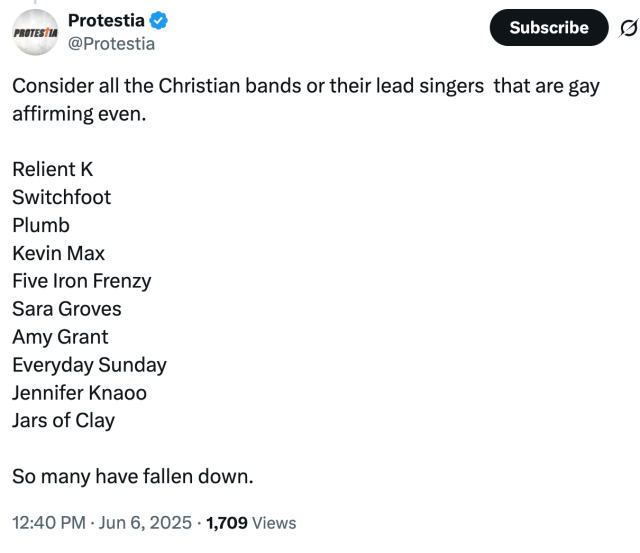
Amy Grant (homosexuality affirming)
Hillsong
Jesus Culture
Kari Jobe

Jennifer Knapp (homosexual)
Brandon Lake (close ties with Bethel, Maverick City Music {see below})
Matt Maher (Catholic)
Maverick City Music (woke, homosexuality affirming, partners with Elevation)
Nichole Nordeman (Nichole has extensive ties to a plethora of false teachers and was recently very vocal in her support of Jen Hatmaker’s embrace of homosexuality in the church.)
Michael Tait
Phil Wickham (in the NAR camp, close ties to Bethel)

These from Protestia.

And anyone else who closely associates with any of the above (performing together, co-writing songs, Bethel Music produces their albums, etc.)

Let’s Talk About the Worship Music at the [Charlie Kirk] Memorial Service… with Dawn Hill

๐ŸŸกArtists I Don’t Proactively Recommend (i.e. Use Caution or Avoid)

Casting Crowns has toured with Hillsong. Hillsong – not CC – pulled out of their 2022 tour due to the scandals with Brian Houston.

CityAlight is the music ministry of St. Paul’s Anglican Church, which occasionally allows women to preach and has a few ties to Hillsong (covering Hillsong songs, also this video was recorded at Hillsong studios, see info. section).

Selah member, Todd Smith, is the husband of Angie Smith.

Shane and Shane uses mostly Bethel, Hillsong, and Elevation music (along with music by other problematic artists) in their Worship Initiative ministry. They have also performed with Bethel.

Doctrinally Sound Artists:
The Corner Room
Keith and Kristyn Getty
Hymnology
Indelible Grace Music
Brian Sauvรฉ
Sovereign Grace Music

*(January 2021- Keep an eye on the Gettys. They’re still doctrinally sound as far as I know, but over the past couple of years, they have been platforming some biblically problematic personalities at their events. Jon Harris discusses this on the Russell Fuller reveals more, The Getty’s invited who?, & SEBTS prof. takes on The Gospel Coalition episode of Conversations that Matter, ~28:04)

There are probably many others that belong on all three of these lists, but those are the only names I personally know to give you.

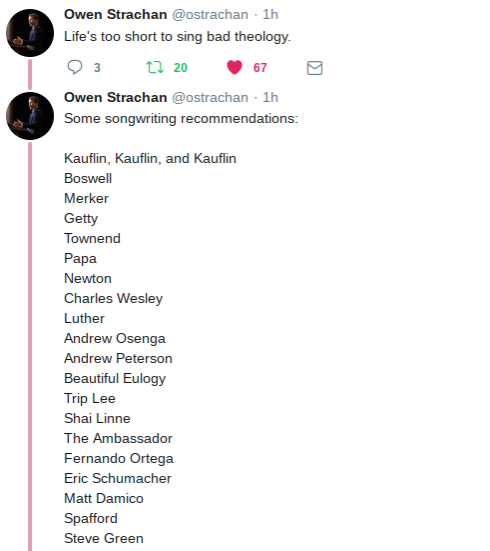
Owen Strachan recently made some recommendations of songwriters, though they’re not all contemporary, on Twitter: (others also responded with suggestions, click here to see):

(I’m not familiar with all of these, but in case you need their first names to look them up: Bob Kauflin, Stuart Townend, Matt Papa, John Newton, Martin Luther, Horatio Spafford.)

You will, of course, need to vet for yourself the theology and associations of any musician or group you decide to follow. It’s not quite the same as vetting a teacher or pastor, but several of the principles in my article Is She a False Teacher? 7 Steps to Figuring it Out on Your Own can be adapted for vetting musicians. Additionally, I would recommend three things when deciding whether or not to listen to someone:

1. Look up the lyrics of about half a dozen of her latest songs and examine the lyrics against Scripture. It’s helpful to look at the words in front of you without hearing the music so you can really think about them without being emotionally influenced by the music. Are they biblical?

2. Look to see who the artist associates with and admires. The easiest way to do this is to check their Facebook and Twitter feeds. Do you see scads of re-tweets and shares of posts from false teachers? Is she on tour with, co-writing songs with, or having her albums produced by a musician you know should be avoided?

3. Go to the artist’s web site, and examine her statement of faith (if she has one) and the venues she’ll be playing. Does she frequently play at places like Bethel? Lakewood? The Potter’s House? Is she the worship leader at a lot of conferences featuring false teachers? You might also want to look at her bio to see if she mentions her home church. If she’s a member of a church headed up by a false teacher, that’s definitely a red flag.

Below you’ll find some helpful additional resources relating to specific songs, artists, and the CCM industry. I’d also like to solicit the help of you discerning listeners of CCM:

Are there CCM songs or artists you would recommend avoiding due to biblically demonstrable sin or false doctrine? Please comment below with the exact name of the artist/song, the reason to avoid said artist/song, and a link(s) providing lyrics and/or objective support for your reason.
Unsubstantiated accusations will not be published.
Are there doctrinally sound artists you would recommend? Please comment with the name of the artist (and preferably a link to his/her web site) below.


1From my article The Mailbag: Should Christians Listen to Reckless Love?


Additional Resources

Why Your Church Should Stop Playing Bethel, Hillsong, Elevation, and Jesus Culture

The Mailbag: โ€œI Speak Jesus,โ€ Charity Gayle, and How to Vet Christian Music

Let’s talk about the worship music at the memorial service… at The Lovesick Scribe

The Discernment in Music Archive at Faithful Stewardship

Sound in Worship by Justin Rea

Christian Music Review from Reformed Fellowship Church

Worship Song Ratings by Sandy Simpson

What’s So Bad About Christian Radio by Gabe Hughes

Psalms, Hymns, and Spiritual Songs: Putting Popular Church Music to the Test by Gabe Hughes

In Response to Putting Popular Church Music to the Test by Gabe Hughes

Psalms, Hymns, and Spiritual Songs (vol. 2) by Gabe Hughes

Once Again, Critiquing the Most Popular Praise and Worship Songs by Gabe Hughes

Let’s Talk About the Worship Music at the [Charlie Kirk] Memorial Service… with Dawn Hill


If you have a question about: a Bible passage, an aspect of theology, a current issue in Christianity, or how to biblically handle a family, life, or church situation, comment below (Iโ€™ll hold all questions in queue {unpublished} for a future edition of The Mailbag) or send me an e-mail or private message. If your question is chosen for publication, your anonymity will be protected.

Church, Discernment

Build the Wall and Station a Guard: A Plea for Pastors to Protect 6 Areas of the Church Vulnerable to False Doctrine

Pastors, your church is vulnerable to false doctrine in these 6 areas. Here's how you can protect it.

The Great Wall of China

The Wailing Wall

The walls of Jericho

Walls. Sometimes they go up, and sometimes they come a tumblin’ down. When I was a kid it was, “Mr. Gorbachev, tear down this wall!” Now it’s, “Elect me and I’ll build a wall between the United States and Mexico.”

There was a time in history when it was common practice for a city to have a wall built around its perimeter. Walls have historically been built for protection, to keep inhabitants safe from attacking marauders. When Israel returned to Jerusalem after Babylonian captivity, their first priority was to rebuild the altar – their focal point of worship. Next came the temple – to consecrate, or set apart, their worship. And, finally, the city wall – which protected everything, including their worship.

Today, when Christians plant a church, we start off with our focal point of worship, the author and finisher of our faith, Jesus Christ. He is the foundation of the church, the center of our worship, our rallying point.

As the church grows, we consecrate it, setting it apart from other organizations and gatherings by buying or constructing its own special building. It’s not a store or an office or a restaurant. It’s a church. It’s where believers gather to worship, fellowship, and be trained in God’s word.

But somehow we never get around to protecting our churches from enemy attack. Indeed, it hardly ever occurs to most pastors and church members that there’s a need for a wall.

But there is. A huge need. And for some churches, it’s already too late.

Pastor, I plead with you- it’s time to build a wall around your church. A “walls of Jericho”-high wall. A chariot races on top- thick wall. And an armed guard posted at the gate. Not to keep out visitors or people who might look or act differently from your congregation- God forbid! It’s to keep out the false doctrine that’s infiltrating and attacking the Body in so many ways. And some areas of your wall are going to need extra fortification because they’re protecting these six vulnerable areas.

1. The Preaching of the Word

Pastor, the buck starts and stops with you. Are you preaching the Word? In season and out of season? Are you rightly handling God’s word? Preaching sound doctrine and rebuking those who contradict it? Declaring the whole counsel of God? Or is your focus on preaching to entertain, to keep people happy, to encourage giving, or to keep from rocking the boat? Only you can answer these questions. Strong preaching is the first step in building a strong wall to protect your church.

2. The Teaching of the Word

How much do you know about how, and what, your Sunday School, Bible study, or other small group leaders teach? Have you ever observed, evaluated, or interviewed any of your teachers? Does your church have any formal qualifications for teachers? Are they required to go through any sort of training? Who are their spiritual influencers? Which celebrity pastors and authors are they recommending to their classes?

A teacher who is listening to or reading materials by false teachers during the week is going to have her theology shaped by those false teachers, and she’s going to bring that warped theology into the classroom where it will infect the students. A teacher whose main discussion questions are, “How do you feel about this verse?” or “What does this verse mean to you?” is not handling God’s word properly and, thus, not properly training her students. Find out what’s going on in your Sunday School classrooms, and strengthen your wall by strengthening your teachers.

3. Sunday School/Small Group Curricula

Because so few teachers are properly trained, churches tend to rely heavily on the Sunday School curricula to do the actual teaching. Have you examined your curricula lately? Are the lessons anchored in copious amounts of rightly exposited Scripture or are they mainly comprised of inspirational stories and illustrations? Are the discussion questions watered down pablum or do they challenge people to think and search the Scriptures for understanding? Does the curriculum recommend supplementary materials or music from doctrinally sound, or questionable, sources? Does the curriculum recommend “homework assignments” that include unbiblical practices such as contemplative prayer or yoga? Build a solid wall with solid curricula.

4. Women’s Bible Study

This is an area of your wall which needs major fortification. In many churches, it is the primary avenue through which false teaching infiltrates the Body. Is your women’s ministry using studies or materials by a best selling author like Beth Moore, Priscilla Shirer, Christine Caine, Joyce Meyer, Lysa TerKeurst (Proverbs 31), Jen Hatmaker, Lisa Harper, Lisa Bevere, Victoria Osteen, Jennie Allen, Rachel Held Evans, Ann Voskamp, Sheila Walsh, or anyone with “Jakes” in her name? Are they attending conferences, retreats, or simulcasts headlined by any of these people? Then the women of your church are being taught false doctrine. Your men’s Bible study curriculum also needs to be examined, but women’s Bible study is a major foothold of false doctrine.

5. Music

If your church uses KLOVE’s playlist to formulate its worship set, you’re probably importing false doctrine right into your worship service. You’ve got to vet both the lyrics (hymns don’t get a pass on this, by the way) and the artists for sound theology. When it comes to contemporary worship music, the most popular and common sources of false doctrine are Hillsong, Elevation, and Bethel/Jesus Culture. Here’s another good resource.

6. Ecumenism

Is your church partnering or fellowshipping with other local churches outside your own denomination? Are you thoroughly familiar with their beliefs and practices? Are those beliefs and practices biblical? Where do they stand on female pastors, elders, and teachers? Homosexuals as church members or leaders? Abortion? The inerrancy, infallibility, and supremacy of Scripture? Extra-biblical revelation? Signs and wonders? Works righteousness? Do they have a biblical statement of faith “on paper” but stray from it in practice? Not every organization that calls itself a Christian church actually is one by biblical standards, and we are not to partner or fellowship with those whose beliefs and practices do not line up with Scripture.

That’s a lot of vetting to do for a pastor who’s probably already overwhelmed and stretched thin. May I make a suggestion? Don’t try to do it alone. After all, those cities with protective walls hired soldiers to guard the gates. Is there an associate pastor who could take on vetting curricula and fellow churches and conference speakers? Is there a mature, discerning layman or woman you trust who would be willing to lend a hand with researching your music or women’s Bible study books? Do you have a “master teacher” capable of training your Sunday School and small group teachers? Ask your people for help. Use the able. Train the willing. Get that wall built to shut out false doctrine, and station your armed guards at the gates to check out everything that comes in.

The enemy is out there, dear pastor. Let’s make sure that’s where he stays.