
Discernment, Mailbag

The Mailbag: Potpourri (Intend to offend?… Right Now Media… Jesus died for YOU?)

Welcome to another “potpourri” edition of The Mailbag, where I give short(er) answers to several questions rather than a long answer to one question.

I like to take the opportunity in these potpourri editions to let new readers know about my comments/e-mail/messages policy. I’m not able to respond individually to most e-mails and messages, so here are some helpful hints for getting your questions answered more quickly. Remember, the search bar (at the very bottom of each page) can be a helpful tool!

Or maybe I answered your question already? Check out my article The Mailbag: Top 10 FAQs to see if your question has been answered and to get some helpful resources.


This reader’s question is in reference to my article In Defense of Offense: Why Christians Need to Stop Worrying About Offending People.

Would you say offending with the purpose to offend with the truth is the same as what you are saying? So should we ever purpose to offend when we speak the truth from the Bible?

Great question! (And let me take this opportunity to say to all of my readers and followers that if you’re ever unclear about something I’ve written or posted – especially if it seems unbiblical or out of character for me – please, please, please just ask me about it politely, like this reader did, and I will be happy to explain if I’m able. I would much rather you ask than attack me, jump to the wrong conclusion, or worse, assume I’ve apostatized. Genuine, polite questions are always welcome!)

Hon, when you say “purpose to offend,” I’m thinking of a person who gets out of bed in the morning with the primary goal of offending people, making them angry, or upsetting them, not with the primary goal of sharing the gospel or restoring someone from sin.

I’m not sure why a Christian would have the desire, goal, or motive of offending people, regardless of his reason for doing so. That goes against the grain of everything Scripture teaches us both about Christian character and the ineffectiveness of provoking people. The Bible says:

A brother offended is harder to win over than a strong city,
And contentions are like the bars of a citadel.
…if possible, so far as it depends on you, being at peace with all men…

Proverbs 18:19, Romans 12:18

Fathers are told not to provoke their children to anger. One of the qualifications for pastors and elders (which we’re to emulate) is that they not be pugnacious (i.e. “looking for a fight”), but peaceable and considerate. (If not, they’re disqualified from ministry.) We’re not to place a stumbling block or offense before anyone – saved or lost, in order to protect our ministry and so that people might be saved. You’ll recall that Paul devotes significant ink to the idea that if it would offend people for him to eat meat sacrificed to idols, he’ll never eat meat again. We’re told not to be quarrelsome, but kind, patient, and gentle in our teaching and correction so that people can be saved. Titus 3:2 reminds us “to slander no one, but to be peaceable, considerate, demonstrating all gentleness to all men”.

The Scriptures go on and on about this. We’re not only forbidden from trying to offend people, we’re instructed to bend over backwards trying not to offend people. The Bible is offensive enough all on its own. That’s more than enough offense for sinners to try to deal with without us making things harder and piling on personal offensiveness.

And that’s the whole point of my article. Not that we should intentionally be personally offensive in our demeanor, but that we shouldn’t refrain from kindly, yet firmly speaking the truth in love so that sinners might be saved, and saints might be sanctified, just because we’re afraid that biblical truth will offend them.


What do you think about churches using Right Now Media?

I drop in on the RNM website from time to time, and from what I can see, it’s almost all (if not all) false teachers.

Scripture is clear that churches shouldn’t support (financially or otherwise) false teachers, and certainly not those, like RNM, who profit from platforming them and spreading their false doctrine. In fact, if your pastor welcomes false teachers into the church – in person, through their books and materials, via video platforms like RNM, etc. – instead of rebuking them and their false doctrine, he is participating in their wickedness, he is disqualified from pastoral ministry, and he needs to be under church discipline.

Yeah, it’s that serious to God.

And from a stewardship point of view, even if there are a few doctrinally sound teachers sprinkled in at RNM, I don’t see how it could possibly be worth the monthly subscription price for whatever few good teachers they might* carry.

*Visiting the RNM site, I get the impression that they want your money before they give you access to the names of all the teachers they platform. I clicked on several pages, and the teachers they did disclose fell into two categories for me: people I know to be false teachers, and people I’ve never heard of. I didn’t see the name of anyone I know to be a doctrinally sound teacher.

Since it’s a subscription service, not a “pay for the specific video you’re using” kind of thing, there isn’t even the option for pastors to say something like, “We feel like this particular R.C. Sproul video is the best one available on the theology of shoelaces, but it’s only available from RNM. We are recommending ONLY this video at RNM. Avoid everything else.”. No, you’re either in (and paying for everything) or you’re out.

Because RNM is primarily a source of false doctrine and false teachers, and because your church’s offering money would be going to support that – in disobedience to the commands of Scripture – you should be very concerned if your church subscribes to RNM. I would recommend that you and/or your husband set up an appointment with the pastor to discuss it. There’s an underlying issue here in subscribing to RNM – either the pastor is not exercising proper oversight over whoever subscribed the church to RNM, or the pastor is not discerning or diligent enough to know that he’s unleashing false teachers on his sheep.


🚨FRIENDLY WARNING🙂: The following question is related to Calvinism/Reformed theology. Please be reminded that we do not do Calvinism vs. Arminianism arguments here, on any of my social media platforms, or via email. Argumentative comments and messages will be deleted. Please see my Statement of Faith tab in the blue menu bar at the top of this page if you have any questions.

My wife and I just finished watching the taped version of your talk [from the Resolute Conference on Answers TV] and we both agreed that it was extremely helpful! Thank you for pouring your time and effort into what was a clearly well-researched message.

Thank you so much. Yes, some of the teaching sessions (including mine) from Answers in Genesis’ Answers for Women 2025 Conference, Resolute, have been posted to Answers TV. I’m sure the rest will be posted soon, so if you have a subscription, you can watch! If you don’t have a subscription, give it some consideration! It’s only $4.99 a month or $39.99 a year, plus they offer a seven day free trial to get you started! If you’d like to watch my session on the New Apostolic Reformation (NAR), here’s the handout that goes along with it.

I do have one question, however. During your gospel presentation you specifically said that Christ died for “you” (i.e., the listener). But if you are saying that to an unregenerate person who has not been predestined to eternal life (according to the “U” in TULIP), how does that work with limited atonement (“The atonement for sin that Christ made on the cross applies only to those who are, or will, in the future be, saved”)?

Respectfully, how could you truthfully say that Christ died for “you,” if that person hasn’t been elected for life? Considering that you [are Reformed] your presentation of the gospel seems to be inconsistent with the doctrine of limited atonement.

I’d like to get your thoughts on this apparent discrepancy between the two. Thank you for your time and consideration!

You’re welcome. I’m glad to explain. I was speaking to about 3000 people that week (plus however many will watch the video, now), the vast majority of whom were already saved. So it is true for those people – Jesus did die for them.

When I gave the gospel presentation, I was addressing it to the elect in the audience – to those who would listen and believe the gospel, either right then, or later in life. (So it was true for them, too. Jesus died for them.) I was not speaking to those who would reject the gospel for the rest of their lives and spend an eternity in Hell – those who aren’t elect (if there were any like that in the audience), even though they could also hear me.

The thing is -and I know I’m not telling you anything new, here – you and I don’t know who’s elect and who’s not. That’s above our pay grade and none of our business. That’s God’s purview. The only way we can know for sure that someone is elect is after she gets genuinely saved and perseveres to the end. If she’s genuinely saved, that means she’s elect. But we can’t know before someone gets saved whether or not she’s elect, so, like the sower, we scatter the seed of the gospel with wild abandon, trusting God’s sovereignty as to what kind of soil it lands on and leaving everything after our gospel presentation up to Him.

I would also appeal to Scripture:

In Peter’s sermon in Acts 3, he’s preaching an evangelistic sermon and says -without knowing whether or not any of his audience is elect:

For you first, God raised up His Servant and sent Him to bless you by turning every one of you from your wicked ways.

Was everyone he was preaching to elect? Probably not.

In 1 Corinthians 15:1-4, Paul hearkens back to the gospel he proclaimed to these brothers when they were lost and says he told them that “Christ died for our sins”. At the time he originally said that, he had no way of knowing whether or not everyone he was preaching to would believe.

But all of that being said, I did read back through all of the sermons in Acts and some other evangelistic encounters in Scripture (and also discussed this on Sunday with one of our {unofficial} lay elders at church), and the general approach seemed to be: You’re a sinner, here’s what Jesus did so salvation and the forgiveness of sin could take place, repent, believe it, and be saved. The personal appeal was placed on the “you must repent and believe” part, not on the “Jesus died” part.

So, sure, I’ll tweak things and try to pattern my gospel presentation more in the style of the Apostles, not because of Calvinism as a framework, but because, as Christians – all Christians – we do always want to be as closely aligned with Scripture as we can get. So, thanks for bringing that to my attention. I appreciate the sharpening.

But I’m not going to quibble with anyone who says, “Jesus died for you,” when she shares the gospel accurately with someone. If the person she’s talking to gets saved, it’s true. If the person she’s talking to doesn’t get saved, she’s technically made a good faith, optimistic mistake while earnestly appealing to him to repent and believe the gospel, but she hasn’t sinned, it doesn’t matter to that person, and she hasn’t sent that person to Hell by saying so. And … you know … she’s sharing the gospel.


If you have a question about: a Bible passage, an aspect of theology, a current issue in Christianity, or how to biblically handle a family, life, or church situation, comment below (I’ll hold all questions in queue {unpublished} for a future edition of The Mailbag) or send me an e-mail or private message. If your question is chosen for publication, your anonymity will be protected.

Mailbag

The Mailbag: Potpourri (Confessing past sin… Too much Calvinism?… “Fake it til you make it”)

Welcome to another “potpourri” edition of The Mailbag, where I give short(er) answers to several questions rather than a long answer to one question.

I like to take the opportunity in these potpourri editions to let new readers know about my comments/e-mail/messages policy. I’m not able to respond individually to most e-mails and messages, so here are some helpful hints for getting your questions answered more quickly. Remember, the search bar (at the very bottom of each page) can be a helpful tool!

Or maybe I answered your question already? Check out my article The Mailbag: Top 10 FAQs to see if your question has been answered and to get some helpful resources.


I confessed and repented of a certain sin after I got saved, but my husband doesn’t know about it. Do I need to confess that sin to my husband in order to receive God’s blessings or be considered a Proverbs 31 wife? And should he also confess his past sins to me? By the way, my husband is a pastor.

What a beautiful heart you have – wanting to be clean before the Lord and wanting to please Him!

There might be a few very specific scenarios in which it would not be wise to bring up a past sin to your husband, but, generally speaking, in a Christian marriage yes, you should be able to talk to your husband about your past sins (and he should also be able to discuss his past sins with you). But not to get God’s blessings or to be a Proverbs 31 wife.

Marriage is about trust. In the same way that Christian husbands and wives should trust each other enough to feel comfortable being physically naked around one another, we should also trust each other enough to feel comfortable “baring it all” when it comes to our past sins.

It sounds like this is a sin you simply haven’t told him about, but it should go without saying that you should not be lying to him about it or trying to cover it up. Those are direct sins against him, and if you’re doing that, you definitely need to confess and repent to him.

All of that being said, there can be more helpful / wise ways and times to talk to your husband about your past sin and less helpful / wise ways and times to talk to him about it, and you may want to get some help figuring that out from someone who can be more objective about it than you can.

Normally, I would suggest setting up an appointment with your pastor to get some pastoral counsel about it, but since your husband is your pastor, I would suggest locating an ACBC certified Biblical Counselor (not the same thing as a “Christian counselor/therapist”) who is not a member of your church (you don’t want your husband to be embarrassed or make it difficult for the counselor to sit under her pastor’s leadership) and set up an appointment.

Some denominations offer counseling services to pastors and their families, so you may want to contact your denominational leadership to find out about that. (I’m not sure what to tell you about other denominations, but if you’re Southern Baptist, contact your local SBC association or state convention.)


Hello! I found your website while trying to see if a Christian singer was a false teacher. I started reading over your beliefs to make sure that you weren’t a false teacher (I don’t mean that in a rude way, it’s just that I have to be really careful especially since I am only a teenager). I agree with everything except Calvinism. I was just wondering if our beliefs would still align enough to where your positions on whether or not people are false teachers would align with my beliefs. I can always ask my parents afterwards, but I just wanted to know basically if you talk about or reference Calvinist beliefs a lot. Thank you!

Wow. Just, WOW. Honey, your parents must be so proud of you. I know I would be if you were my daughter. I am thrilled – hear me: THRILLED – that you checked me out to make sure I’m not a false teacher before reading my stuff. Do you know how many adults don’t do that before following people? Most of them. I wish I had been as discerning as you are when I was your age.

Calvinism is not a factor when I sit down to evaluate whether or not someone is a false teacher, so that isn’t something you would need to worry about. In fact, there are some people on both my Popular False Teachers page and on my Recommended Bible Teachers page about whom I have no idea whether or not they’re Calvinists. There are even Calvinists I recommend against (such as Matt Chandler), or decline to proactively recommend (such as John Piper). I will say this, though – and, understand, this is a very general statement – having studied dozens of teachers, I find that those who adhere to Calvinism / Reformed theology are less likely, on the whole, to be false teachers than non-Calvinists.

I guess it depends on what you mean by talking about or referencing Calvinism “a lot”. From my perspective, I hardly ever mention it directly, but I’m sure it does come across indirectly in some of the terminology I use and the way I handle Scripture.

This is kind of humorous, but, probably about once a month or so, I get a message or an email from somebody saying, “Why don’t you talk about the false teaching of Calvinism?” or “I see you recommend John MacArthur. Don’t you know he’s one of those [gasp!] Calvinists?”. So I guess I’m not exactly beating people over the head with it if they didn’t know and I have to tell them straight out, “Yeah, I’m a Calvinist, too.”

I don’t know, I’m probably not the most objective person to answer this question. Let’s turn it over to my regular readers and you can see what they have to say in the comments section.

Readers – do you think I talk about
Calvinism “a lot” on the blog?

Answer in the comments, and help out this charming and discerning young lady.


Could you tell me where Scripture teaches “fake it till you make it” ?

“fake it ’til you make it”. A phrase easier said than done. But where stands it written? I would say this is not true. Michelle I trust your wisdom and knowledge, but this phrase…not so much. I asked sarcastically where I could find it in Scripture knowing it’s not written. I was hoping to have a response to my previous email, but no reply as yet. God’s word is based on truth not feelings. Trusting feelings when it comes to “fake it ’til you make it” I find is not sound wisdom. Allowing the Holy Spirit to change me is trusting in Him not myself…whether it’s fear or feelings.

These two comments (from the same commenter) were left on my article Fear Not: 9 Biblical Ways to Trade Worry for Trust regarding the phrase “fake it til you make it” in this paragraph:

Those worries may start creeping in, but you don’t have to set the table and turn down the bed for them. Push them right out of your mind, slam the door behind them, and say (out loud is helpful), “No. I’m not going to worry. I’m going to trust the Lord.” You’ll still feel worried at first, but “fake it ’til you make it.” Your feelings will eventually follow.

I’d like to address two issues regarding these comments, first the commenter’s attitude, then the content.

Attitude: First, I did not receive an email from you about this, so I can only assume “email” in your second comment actually refers to your first comment. However, if you had sent me an email, you would have to have obtained my email address here, where I clearly state (in bold type, no less):

I regret I am unable to answer most e-mails
unrelated to speaking engagements…”

So if you had emailed me, you shouldn’t have expected a reply at all, much less on your timetable.

Since you commented, you should have read – in large font directly above the comment box:

“Before commenting please see the ‘Welcome’ tab in the blue menu bar at the top of this page. Comments are handled manually, so there will be a delay before approved comments are posted.”

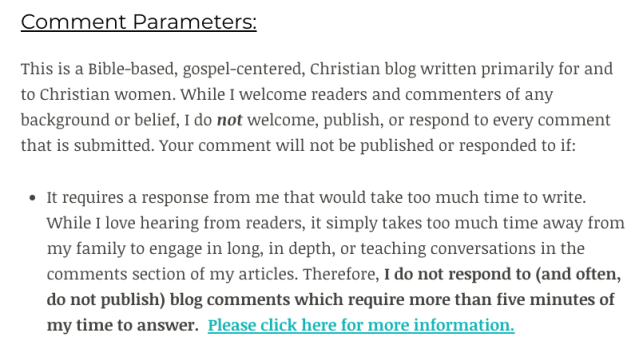
So, a) you should have expected some sort of delay, and b) if you had clicked on the Welcome tab as instructed, you would have seen this:

The “Please click here…” hyperlink goes to an article further explaining my email and comments policy and why emails and many comments usually go unanswered. I have bent over backwards to make it clear to my readers that I can’t answer most correspondence and why, even though I really wish I could.

Furthermore, you sent your first comment three weeks ago and your second comment a week later. To give you a little perspective, the first question I answered in this article was sent in almost a year ago. The second one, a month ago. Some people don’t get their questions answered for months. Others never get their questions answered, because I simply don’t have enough hours in the day to get to everyone’s questions. I hate that, but that’s just the way it has to be.

Not realizing your initial question was sarcastic, I had saved it in order to answer it in a Mailbag article, but I’ll be honest, when I got your second comment, my gut level reaction was to just delete both of them. Being impatient, demanding, and snarky when you’re asking someone else to do something for you (i.e. answer your question) is neither becoming of a Christian nor very effective.

But since I had already decided to address the content of your question, I decided to go ahead and do that and also add the part about your attitude as a teaching moment for you and anyone else to whom it might apply.

Content: I thought most people in my audience would be familiar with the phrase “fake it til you make it” (and, indeed, in the four times this article has run on my blog, you’re the only one who has commented objecting to it), but I can see where it might not be the clearest wording in the world, especially for people who aren’t familiar with the common usage of the phrase.

No one who has read the entire article could surmise that I was saying that “God’s word is based on feelings,” or that I was saying people should “[Trust] feelings when it comes to ‘fake it ’til you make it’”. (I’m not really even sure what that means since the theme of that paragraph, that section, and the entire article is that we should not trust or be controlled by our feelings.)

“You’ll still feel worried at first, but ‘fake it ’til you make it.’ Your feelings will eventually follow,” simply means that we should obey Scripture (in this case the Scriptures that tell us to trust God) regardless of how we feel about it and trust God to eventually line our feelings up with His Word. I thought that was clear from the context, but if it was not, I sincerely apologize. I have added a footnote to the article with this explanation in case it’s unclear to any other readers.

UPDATE (9/8/21)

I received what I thought was a very gracious response from this reader. With her permission, I share it here:

Dear Michelle,

“fake it ‘til you make it”…here…

I ask your forgiveness. I had no intention of appearing impatient, nor demanding, nor snarky. Thank you for your very frank response and clarifying your answer to my question.

I am grateful for the knowledge and wisdom God has given you. My question was sincere as were my comments. And again I’m sorry if you took them as you did, as I had no intention to raise your ire in responding. I did indeed read the “welcome”, and again didn’t expect a response from your busy schedule and many emails you receive.

My heart was to speak as one sister to another. I have been told this phrase before. Words have consequences, and quite honestly for me, as I filter words and phrases through God’s Word, I am reminded to speak truth in love, not snarky, or demanding. We can all learn to be effective in our walk with the Lord by not jumping to conclusions that are incorrect, being teachable and gracious.

Blessings on you and your ministry.


If you have a question about: a Bible passage, an aspect of theology, a current issue in Christianity, or how to biblically handle a family, life, or church situation, comment below (I’ll hold all questions in queue {unpublished} for a future edition of The Mailbag) or send me an e-mail or private message. If your question is chosen for publication, your anonymity will be protected.

Mailbag

The Mailbag: Potpourri (Home churches, Non-Calvinist authors, Memes from false teachers, Contrarian commenter?)

Welcome to another “potpourri” edition of The Mailbag, where I give short(er) answers to several questions rather than a long answer to one question. I also like to take the opportunity in these potpourri editions to let new readers know about my comments/e-mail/messages policy. I’m not able to respond individually to most e-mails and messages, so here are some helpful hints for getting your questions answered more quickly. Remember, the search bar (at the very bottom of each page) can be a helpful tool!

In these potpourri editions of The Mailbag, I’d also like to address the three questions I’m most commonly asked:

“Do you know anything about [Christian pastor/teacher/author] or his/her materials? Is he/she doctrinally sound?”

Try these links: 
Popular False Teachers /
 Recommended Bible Teachers / search bar
Is She a False Teacher? 7 Steps to Figuring It Out on Your Own
(Do keep bringing me names, though. If I get enough questions about a particular teacher, I’ll probably write an article on her.)

“Can you recommend a good women’s Bible study?”

No. Here’s why:
The Mailbag: Can you recommend a good Bible study for women/teens/kids?
The Mailbag: “We need to stop relying on canned studies,” doesn’t mean, “We need to rely on doctrinally sound canned studies.”.

“You shouldn’t be warning against [popular false teacher] for [X,Y,Z] reason!”

Answering the Opposition- Responses to the Most Frequently Raised Discernment Objections


What is your view of home/house churches?

My approach to home churches – small groups of Christians who meet in someone’s home to have a worship service together rather than attending an established local church- is:

  • I urge extreme caution when considering a home church
  • Start/attend a home church only as a last resort when you can’t find an established, doctrinally sound church within achievable driving distance of your home.
  • View the home church as a church plant (the home church will grow into an official, established church, rather than staying a home church)
  • Have a proper, biblical ecclesial structure (a biblically qualified pastor/elders/deacons, conduct worship gatherings according to biblical parameters, etc.)

I elaborated on this issue a little more in my article Six Ways Not to Forsake the Assembly:

I want to be clear that I advise [starting a home church] only as a last resort after exhausting every possibility of joining a biblical established church. I have known of people who withdrew from established churches because of doctrinal problems, and instead of searching for a sound, established church, decided to form a house church, which then fell into other doctrinal problems of its own. House churches can be very vulnerable to doctrinal error.

If you must meet with other believers outside of an established church, make sure whoever is pastoring the group is biblically qualified to do so, and that your home church carries out all of the components of a biblical church: Bible teaching, worship, prayer, care for members, the Lord’s Supper, baptism, and church discipline. There are many wonderful, trustworthy resources such as sermons, Bible teaching, and Bible study lessons available on line for free. Take advantage of them. You may also wish to contact your denomination’s headquarters, a reputable missions organization, or a doctrinally sound church planting organization and ask about the possibility of a missionary or church planter coming to plant a new church in your area.

In countries with governments which outlaw Christianity, underground home churches are the only option. That is not the case in America and most Westernized countries yet, though we are headed down that road. Until that time, I would strongly urge Western Christians to join with an established, doctrinally sound local church (keeping in mind that no church is perfect, and most won’t meet all your preferences), and if there isn’t one in your area, either contact a church planting organization or move to an area where there is an established, doctrinally sound church.

Basic Training: 7 Reasons Church is Not Optional and Non-Negotiable for Christians


Are there any non-Calvinist/Reformed authors you would consider solid?

There are probably scads of them, but – and it might surprise you to hear this – I don’t check to see whether or not someone is Calvinist/Reformed before deciding whether or not to read or listen to his materials, and consequently, I often don’t even know which soteriological label he wears. All I care about is whether or not he rightly handles Scripture and behaves in submission to Scripture.

I’m frequently on the receiving end of the accusation, “You just think anybody who’s not a Calvinist is a false teacher!”. It’s simply not true. That’s not something I consider an automatic litmus test of someone’s doctrinal soundness. The vast majority of the churches I have personally been a member of have not even had a Calvinist/Reformed pastor.

I’m sorry I can’t provide you with any specific names. Read people who handle Scripture correctly. That’s the best counsel I can give.

(Just a reminder, readers, I don’t allow Calvinism vs. Arminianism arguments in the comments sections of my articles. Comments like this won’t be posted.)


Just wondering how you respond to quotes/memes, etc from unbiblical teachers when it appears there’s nothing wrong with the quote/meme? A family member of mine often posts memes like this on Facebook. Most of them deal with being kind to each other, or continuing to trust God and rather simplistic things. I don’t disagree with that particular message but don’t want her to get caught up in false teaching.

I’m taking this to mean something like Lysa TerKeurst sharing a Bible verse meme or Beth Moore sharing a meme that says, “Prayer is a vital part of the Christian life,” or something like that. In other words, the content of the meme itself is in line with Scripture, but it has the name of a false teacher attached to it, and that’s what makes it problematic.

There could be a couple of different things happening here. It could be that your family member follows and is a fan of the false teacher she’s reposting. Or it could be that a Facebook friend of hers or some sort of “inspirational quotes” page she follows shared the meme and she is just re-sharing it having no idea who the false teacher is or what she teaches.

I would suggest contacting her privately in an e-mail or private message on Facebook (even if this is someone you see face to face regularly, because an e-mail or message is less confrontational and emotional, and also allows you to provide information more easily) and very lovingly, gently, and briefly say something like this:

Hi Laurel-

Hope you’re having a great day.

I just wanted to drop you a quick note to let you know how much I appreciate your heart for encouraging people on Facebook with the memes you post. So many people are hurting these days and are in need of a kind word.

I’m sure you didn’t realize it, but you’ve posted a couple of memes from Priscilla Shirer and Christine Caine, both of whom teach and do some very unbiblical things. As a Christian, I know you would never want to lead anyone astray from Scripture, even accidentally, so I thought I’d pass along this information on them to fill you in on where they’re coming from. If you have any questions or want to chat about it, just let me know.

Priscilla Shirer: https://michellelesley.com/2015/09/18/going-beyond-scripture-why-its-time-to-say-good-bye-to-priscilla-shirer-and-going-beyond-ministries/

Christine Caine: https://michellelesley.com/2016/03/04/chhave-no-regard-for-the-offerings-of-caine/

Love,
Kristy

And then I would leave it at that unless she brings it up and wants to talk. You can lead a horse to Living Water, but only the Holy Spirit can make him drink. :0)

Four Reasons Why It Matters Who We Share, Pin, and Re-Tweet

Words with Friends by Amy Spreeman

Words with Friends at A Word Fitly Spoken (several great resources in the show notes)


Several years ago I had a falling out with a friend when I warned her about a false teacher and she vehemently disagreed. Since that time, she has begun following more and more false teachers, and has started a blog which centers around extra-biblical revelation. Recently, she asked me to subscribe to her blog. Is it proper for me to get involved with a blog with which I will be in total disagreement and arguing theology probably constantly? Should I join and be the only voice of Biblical reason?

It’s interesting, knowing your disagreement with the false teacher you initially warned her about, that she would ask you to subscribe to her blog. Is it possible she just sent out a blanket invitation to everyone on her e-mail list or to all her Facebook friends, forgetting that you were on that list? If you think that’s the case, and she wasn’t really inviting you personally, I would just ignore the invitation and go on my merry way.

If, however, this really was a personal invitation to you, my counsel would be to drop her a note (similar in tone to the one in the section above) saying that you really appreciate the invitation to subscribe to her blog, but that you find much of the subject matter of her blog to be unbiblical. So if you do subscribe, you will feel compelled – fairly often – to comment with biblical arguments against what she has written. And because of that constant state of argument, you don’t think it would be a good idea for you to subscribe to her blog.

As a blogger, I can tell you that I don’t like it when a person takes it upon herself to constantly argue against or attempt to correct my theology, and if that person keeps it up after being warned, she usually gets blocked or banned. My thought is, “If you’re so diametrically opposed to what I write, why in the world are you following me? Go find a blogger to follow whom you agree with and enjoy, or start your own blog for sharing your opinions.” So, since I know what that feels like, I try to extend that same courtesy to others. I don’t generally* follow blogs, social media accounts, etc., that I strongly disagree with and constantly argue with them. It rarely does any good or changes anyone’s mind. Better to hang on to your pearls and stay out of the pig pen.

You may find some of my thoughts in my article The Mailbag: Should I attend the “Bible” study to correct false doctrine? to be helpful since this is a similar situation, but I would still lean toward encouraging you not to follow your friend’s blog and argue constantly.

*(In the interest of full disclosure there is one Twitter account I follow – LifeWay Women – which I strongly disagree with most of the time because they promote false teachers. This is an agency of my denomination, not an individual, and I occasionally tweet refutations to/about them in order to make my fellow Southern Baptists on Twitter aware of the false teachers/doctrine their own denomination is promoting, and because my previous attempts to contact LifeWay privately have either been ignored or rebuffed. Still, I try not to constantly barrage them with argumentative tweets.)

If you have a question about: a Bible passage, an aspect of theology, a current issue in Christianity, or how to biblically handle a family, life, or church situation, comment below (I’ll hold all questions in queue {unpublished} for a future edition of The Mailbag) or send me an e-mail or private message. If your question is chosen for publication, your anonymity will be protected.

Mailbag

The Mailbag: Potpourri (Benny repents?, Brother Lawrence, Why the Calvinist label?…)

Welcome to another “potpourri” edition of The Mailbag, where I give short(er) answers to several questions rather than a long answer to one question. I also like to take the opportunity in these potpourri editions to let new readers know about my comments/e-mail/messages policy. I’m not able to respond individually to most e-mails and messages, so here are some helpful hints for getting your questions answered more quickly. Remember, the search bar can be a helpful tool!

In these potpourri editions of The Mailbag, I’d also like to address the three questions I’m most commonly asked:

“Do you know anything about [Christian pastor/teacher/author] or his/her materials? Is he/she doctrinally sound?”

Try these links: 
Popular False Teachers /
 Recommended Bible Teachers / search bar
Is She a False Teacher? 7 Steps to Figuring It Out on Your Own
(Do keep bringing me names, though. If I get enough questions about a particular teacher, I’ll probably write an article on her.)

“Can you recommend a good women’s Bible study?”

No. Here’s why:
The Mailbag: Can you recommend a good Bible study for women/teens/kids?
The Mailbag: “We need to stop relying on canned studies,” doesn’t mean, “We need to rely on doctrinally sound canned studies.”.

“You shouldn’t be warning against [popular false teacher] for [X,Y,Z] reason!”

Answering the Opposition- Responses to the Most Frequently Raised Discernment Objections


I saw this video making the rounds on social media. It appears as though Benny Hinn is repenting of teaching the prosperity gospel. Is this true, or too good to be true?

Briefly, it is not true, and his behavior and teaching bears this out. He has made similar claims in the past and continues to teach the same old lies from the same old pit of Hell. The YouTube video making the rounds is 4½ minutes long. What it doesn’t show is that for an hour and a half prior to this 4½ minute snippet Benny conducted one of his regular “healing” services. Furthermore, prosperity teaching is not the only heretical aspect of Benny’s theology, so even if he had repented of teaching the prosperity gospel, he would remain a heretic to avoid.

Repentance doesn’t just mean a blase admission that something is wrong. Repentance is a total change of lifestyle. If Benny were to repent, what we would see would be genuine, long lasting grief over his sin. He would step down from, and dismantle his “ministry,” cancel all of his tours, crusades, and speaking engagements, take all of his books out of print, shut down all of his online platforms and do everything in his power to scrub the internet of his false teaching (at the moment, he has said he’s planning to keep his “most popular” teachings available online for those who want them), return the money he has scammed from people, and park himself in a solid church so he can learn the gospel, be saved, and be discipled in sound doctrine.

If you’d like to believe Benny has repented, OK. Check back up on him in about six months and see if he has done any of the things above to “bear fruit in keeping with repentance.”

For the longer version of the answer to this question, see the resources below.

Benny Hinn and the Fruit of True Repentance at A Word Fitly Spoken

(Be sure to get and read both of Costi’s books if you haven’t already.)

WWUTT 1030 Q&A Benny Hinn, Couples Studies, Christian Fiction? at WWUTT

No, Benny Hinn Has Not Repented by Gabe Hughes

Benny Hinn’s nephew ‘encouraged’ by uncle’s rejection of prosperity gospel, calls for ‘genuine repentance’ at The Christian Post

Benny Hinn and the Fruit of True Repentance at Voice of Reason Radio

Benny Hinn Renounces His Selling of God’s Blessings. Critics Want More. at Christianity Today


[In your “Welcome” tab,] you describe yourself as…….A genuinely regenerated Protestant, Southern Baptist, Calvinist/Reformed Baptist…I am just getting in on the Reformed Baptist conversation. As a Southern Baptist, why do I need to add all the other titles. Why or what did you reform? I am confused. Why can’t you just be Southern Baptist?

You don’t need to use a bunch of labels if you don’t want to, I just want to be specific and clear to my readers what my theology is in case they’d like to know, and so they will know what to expect when they read my articles.

Reformed Baptist theology is different from Arminian (or what Southern Baptists like to call “Traditionalist” theology). If you are Southern Baptist and unfamiliar with Calvinism, you are most likely in a Traditionalist church (you may want to ask your pastor). I think you’ll find the answers to many of your questions in this article (be sure to read the additional resources at the end, too.) I’d also encourage you to read the 1689 London Baptist Confession of Faith.

(Just a reminder to my regular readers, I don’t engage in or allow Calvinism/Arminianism debates and arguments in the comments sections of my articles or on social media. Please review my comment parameters at the “Welcome” tab at the top of this page before commenting.)


I am, for now, the choir director at my church. I lead the choir and my husband leads the congregational hymn singing. In one question I read [on your blog], I should not be doing that- the answer to the question of whether woman should serve as worship leaders or music ministers was a simple “no”. It would help a great deal to have an extended answer, and then I’ll know whether to tender my resignation and find another way to serve. I can happily go back to just singing in the choir. Thank you for your insight.

It’s so encouraging when I hear from women who want to do the biblical thing! I’m not sure which of my articles you were reading where I simply said “no” to the question of whether or not women should serve as worship leaders, but I have addressed that question in greater length in this article (see #4).

Of course, this article doesn’t address a woman only directing the choir, but rather, serving as the minister of music. I can see some situations in which it might be biblically OK for a woman to only direct the choir.

For example, if it’s an emergency situation like the minister of music getting sick at the last moment on Sunday morning and he has been the one to lead the choir through rehearsals, explain the text of the music to them, etc., and the only person capable of stepping in and directing the choir that morning (just the choir, not the congregation) is a woman, I don’t think that would be a problem. Another example: At my church, the choir occasionally does anthems that center around a tenor solo, which our minister of music (who directs the choir) will sometimes sing. He will step up to the pulpit to sing the solo, and a lady in the choir will direct the choir part of the anthem. I don’t think that’s problematic, either.

Of course, you will need to pray about it and talk it over with your husband and pastor, but, for what it’s worth, my thought on your situation is that if your husband is Scripturally qualified (as well as musically qualified) to step into the pastoral role of minister of music (because men should not hold positions of leadership they’re not biblically qualified for either), and he is overseeing the choir – selecting the music, leading rehearsals, etc. (all the pastoral type things mentioned in the article), then it would not be a problem for you to simply direct them on Sunday morning. Especially if, as it sounds like might be the case, the two of you are temporarily filling in until a permanent minister of music can be found and hired. But, really, the best case scenario would be for your husband (and/or another biblically qualified man to) lead the congregation and the choir. And it would probably be a load off your shoulders!


I have a question that I haven’t been able to find a clear answer to including in your blog. Can women teach men in Bible study say on a Thursday night?

The 1 Tim 2:12-13 Scripture points to Adam being created first then Eve therefore, therefore I would deduct that women should not teach or exercise authority over a man whether it be in church, Sunday School or in a Thursday night Bible study. Am I wrong?

DING! DING! DING! You are absolutely RIGHT! Tell her what she’s won, Johnny! :0)

Yes, you’re correct. You’ll notice in 1 Timothy 2:11-15 that there’s no exception for any day of the week. The prohibition against women teaching men is for any day ending in a Y.

And, you didn’t say where this Thursday night Bible study is meeting, but those types of gatherings of the Body often meet in homes, and there’s no exception for meeting in a home (or anywhere else) versus meeting inside the four walls of a church building, either. When 1 Timothy was written, there were no church buildings. The church was largely meeting in people’s homes. I say “the church was meeting,” because the church is the gathering of Believers, not the building in which they meet. So it’s not OK for women to teach Scripture or preach to a co-ed gathered body of Believers, whether that’s in a church building during worship service or a smaller class or group, or at a Christian conference, retreat, parachurch event, or at a Bible study at someone’s home on a Thursday night.

You’re also correct that I’ve never addressed this specific question directly, but I have touched on it here, here (2nd question), and here (#7 – I just hopped over to this article and added home, workplace, and coffee shop Bible studies to question 7). So let me grab the salient points from those articles and put them together in a more helpful way:

“Teaching” includes any situation in the gathering of the body of Christ in which women would be giving instruction to men in the Scriptures and/or on spiritual matters (which, in a biblical church gathering, would necessarily include Scripture), whether in an official position of teacher (pastor, teaching elder, Sunday School/Bible study teacher, or other leadership position) or any other situation requiring exhorting, teaching, or explaining of the Scriptures.

We need to remember what the definition of “church” is. The church is not a building, it is a body of born again believers gathered for the purpose of worship, prayer, the ordinances, and/or the study of God’s word. Those things can take place in a church building, a home (as with the first century churches in Acts), in a campus or office building, outdoors, in a conference center, in a sports arena, or anywhere else. So, when a body of believers comes together for these purposes, regardless of the building in which they meet, or whether you call it “church” or not, they are the church, and the biblical parameters about women teaching and holding authority over men applies.

I don’t mean this to sound facetious or anything, but sin is sin no matter what time of day or day of the week it takes place on.


Today, I came across a book I had purchased in the past – Practicing the Presence of God from Brother Lawrence. Taking a quick look at the book, I’m inclined to throw it away. It reminds me of Buddhist thinking or New Age garbage. As a monk, Brother Lawrence’s Catholic theology conflicts with biblical Christianity.

Before I became a Christian, I was into New Age thinking and practices. Just reading bits and pieces of this book makes me think New Age thinking instead of what I know from the Bible. I’m going to throw it away…I don’t see any redeeming Christian theology in it thus far. I don’t want to expose anyone else to wrong theology. Just wondered if you have any thoughts on this book?

Unlike the vast majority of books I’m asked about, I have actually read this one. However, it has probably been ten years ago or more since I read it. All I remember is that it was fairly short (which is probably why I read it), and that one of his main points was keeping our thoughts focused on God at all times. And I mean all times. Every waking moment of the day, we are to be consciously, actively thinking about God or we’re not pleasing Him. I remember trying to put that into practice. Even while doing something as mindless as washing the dishes, it was impossible and exhausting. (It did, however demonstrate to me how much of the time our brains are on auto-pilot.)

You’re correct in your assessment of the theology of the book. Brother Lawrence was a Roman Catholic mystic. Roman Catholic doctrine – as it is laid out in their own documents – is patently unbiblical, as is mysticism. Christians should not receive any sort of spiritual teaching from someone with that theological pedigree.

Thank you for throwing the book out instead of passing bad theology on to others.


If you have a question about: a Bible passage, an aspect of theology, a current issue in Christianity, or how to biblically handle a family, life, or church situation, comment below (I’ll hold all questions in queue {unpublished} for a future edition of The Mailbag) or send me an e-mail or private message. If your question is chosen for publication, your anonymity will be protected.

Calvinism/Arminianism, Mailbag

The Mailbag: God loves everybody?


You stated that God loves each and every one of us. Can you help me understand that in terms of election? I had understood that He loves His elect, although it is His desire that each one be saved. I’m having trouble reconciling those two things! Thank you!

That is a super question. I love it when women dig into the deep questions of theology!

I’m not sure if I can help you understand that or not, because I’m not sure anybody out there has a complete grasp of that concept. God’s ways and His thoughts are much higher than our ways and our thoughts, and there are things He chooses not to reveal fully to us. This is one of those things. So if you ask this question of several different people, you’ll probably get several different answers. And anybody who thinks she’s got this completely figured out…well, I’d be a bit concerned.

All I can do is give you my perspective and the Scriptures (click the hyperlinks) I base that perspective on. My perspective isn’t based on Reformed theology treatises, but rather on my understanding – limited and flawed by sin as it is – of the nature and character of God as I’ve come to know it from the Bible. I’m sure I’ll get plenty of disagreement from both my Calvinist/Reformed brethren and my Traditionalist/Arminian brethren, and that’s fine. (I would just remind you to please review my comment parameters before commenting. In addition to those parameters, I don’t participate in debates over Calvinism in the comments sections of my articles or anywhere else. Ever. It’s fruitless.)

Let me start by saying that in the discussion of God’s love for people, my understanding is that people are talking about, for lack of a better way of saying it, God’s heartfelt feelings towards people. His emotional affections toward people. Not any way He might act toward them, position them, bless or not bless them, etc. So as I talk about God’s love in the remainder of this article, that’s what I mean, because that’s what I understand the question to mean.

Do I believe that God loves all people without regard to whether or not they’re elect? Yes. But I don’t believe God loves all people in the same way. Why? Because I’m a parent. And because God frequently and intentionally reveals Himself to us in Scripture as Father, and because we, being made in His image, demonstrate His communicable attributes, there are some things we can observe in our own relationships with our children that reflect – albeit through a glass dimly – God’s posture toward both sinners and saints.

My husband and I have six children. (For the purposes of the point I’m about to make, we will stipulate that he and I created all of them.¹) I love all the children I have created. Some of them are saved, and some of them are not, but I still love all of them regardless of their spiritual state.

But my love for my children who are saved is qualitatively different from my love for my children whom I know are not saved. There is a deeper bond between my saved children and me because we are not only familially mother and child, we are also spiritually brothers and sisters. We’re not just related by flesh and blood, we’re also related by the blood of Christ.

My unsaved children and I only have the love of familial affection between us. And not only that, while there is nothing in my saved children that wars against the Holy Spirit who resides within me, the sinful nature of my unsaved children does. Furthermore, there is the burden and longing in my heart for my unsaved children to know Christ. With my saved children, that burden and longing is replaced with joy that they are walking with the Lord. But none of that means I don’t love my unsaved children. It just means I love them in a different way than the way I love my saved children.

God personally created every human being in His image. So, strictly in that broad, creative sense – reflected in the way that when a man sires offspring he is their father and they are his children – God is the Father of all people, and all people are His children. And in the same sense that I love all of my children though in different ways, I believe God loves all of His created children though in different ways. Those who are saved (elect) are doubly His children, in the creative sense and in the spiritual sense, so there is a special bond and intimacy there that is higher and qualitatively different from those who are unsaved (not elect), because God is only “related” to them as Creator. Additionally, as with the way I love my own children, though God already knows who will and won’t be saved, the longing of His heart is for His unsaved children to repent and be saved, and the joy of His heart is His saved children who are walking with Him.

We see part of this idea a bit in the parable of the prodigal son (and remember, Jesus is the one who came up with this story). Let’s peel back the main spiritual point of the parable for just a moment and look at the structural elements of the story from an earthly perspective. Jesus intentionally chose a father and his two sons to build this story around. The father represents God. The older son represents “righteous” people, and the younger son represents “sinners”. Both boys are the father’s sons in the sense that he created both of them.²  Nothing in the story indicates that the father only loves the older, righteous son and doesn’t love the younger, sinful son. I would argue that this father loves the younger son in the same way I described loving my unsaved children, and I believe the father’s reaction to the younger son’s return (starting in verse 20) supports this. You don’t hate your own child for months or years on end and then, in a split second, show this kind of heartfelt love toward him. This is a dad – representing God – who loved his kid without regard to his spiritual state.

There seems to be a line of thought among some Calvinists that starts with taking mainly Romans 9:13 – “Jacob I have loved, Esau I have hated” – at least a little bit out of context and understanding it to mean that God feels the emotion of hatred toward (detests, is passionately hostile toward, dislikes to the ultimate degree – that’s the way most of us define the word “hates”) everyone who isn’t elect. I have a few thoughts on that:

• If you read Romans 9:13 in context, it’s obvious that the “love” and “hate” mentioned in verse 13 are not about God’s emotional feelings toward the elect and non-elect. The whole point of the passage is that God is sovereign and He decides, based on His own reasons that have nothing to do with our behavior, who is elect and who is not, and that He draws a very clear line between the two. He uses the words “love” and “hate” for contrast very much like we would say, “this is a black and white issue”. What this verse means is “This group over here (Jacob), I have set apart and chosen. This group over here (Esau), I have not.” If you read the cross-references for this verse, it becomes even more obvious that God is not talking about emotions here, but about His right to set apart for salvation whomever He chooses, as well as the position of the elect versus the position of the non-elect, which He metaphorically compares to the positions of Jacob and Esau respectively.

• God chose Jacob and Esau to illustrate this point. Isaac was Jacob’s and Esau’s father. Isaac didn’t demonstrate any sort of feelings of hatred toward Esau even though he knew Jacob was the “chosen one”. In fact, Scripture tells us it was Esau, not Jacob, whom Isaac “loved”. (Remember, we’re still talking feelings, here.)

• Compare Romans 9:13:

As it is written, “Jacob I loved, but Esau I hated.”

with Luke 14:26:

“If anyone comes to me and does not hate his own father and mother and wife and children and brothers and sisters, yes, and even his own life, he cannot be my disciple.

The same Greek word translated “hate”, μισέω (miseó), is used in both verses. Is Jesus saying that we have to despise our closest and most beloved family members and even our own lives in order to be His disciple? Of course not. Again, it’s a contrast statement He’s using to make a point.

The way this verse is usually explained is that the love we have for Christ is to so far eclipse our love for anyone or anything else that our love for them seems like hatred in comparison to our love for Him.

But the love we have for Christ involves far more than mere feelings of affection. Loving Christ enough to follow Him means your loyalties lie with Him regardless of the cost. You cast your lot with Him to the exclusion of anyone or anything else that gets in your way. It’s almost like the part of the wedding vows that says, “…and forsaking all others, keep thee only unto him as long as you both shall live.” It’s not like you completely cut everybody out of your life except your husband and decide to feel hatefully toward them. It means your highest earthly loyalty, love, dedication, priority, and commitment are reserved for him. The same way our highest spiritual loyalty, love, dedication, priority, and commitment are reserved for Christ. Which is the same sort of way that God’s highest loyalty, love, dedication, priority, and commitment are reserved for His elect in Romans 9:13.

The question then arises, “But the Bible says God’s wrath abides upon the unsaved, and He is going to send them to Hell. Doesn’t that mean He hates them?”. Again, going back to our parent-child motif, my answer would be no. Let me proffer some examples: I can be extremely angry or wrathful toward my children for defying me and yet still love them. If I have a prodigal child who sins in every imaginable way, shakes his fist at me, curses me, and whatever other abominable behavior we could imagine, I could tell my child he’s no longer welcome in my home or at family gatherings unless he repents. But it would be heartbreaking to do because I would still love him. If I have a child who is constantly and unrepentantly breaking the law, and I have an opportunity to turn him in to the police, knowing that he’s going to go to jail, I’m going to turn him in. And I’ll do it with tears streaming down my face, because I love him.

I’m just a finite, sinful parent living in a fallen world. God is our perfect Heavenly Father. His heart is much bigger than mine. His character is much holier than mine. And He is able to be perfect in all ways simultaneously. He can be perfect in wrath and perfect in love, perfect in judgment and perfect in compassion, toward the same person at the same time. We may not be able to completely understand how He loves, but we can trust that however He loves, He loves perfectly.


¹For the purposes of being accurate, our two oldest children are my step-sons.
²Some will argue that both were sons in the sense that both were elect – the older son being saved at an early age, and the younger son saved later in life. I’m not sure we could use that argument because, while the younger son (the “sinner”) becomes a Believer in the story, the older son mainly represents the scribes and Pharisees, and when we see Jesus interacting with the scribes and Pharisees in the gospels, He generally regards them as unbelievers. And since Jesus is God, He knows whether or not they’re elect.

If you have a question about: a Bible passage, an aspect of theology, a current issue in Christianity, or how to biblically handle a family, life, or church situation, comment below (I’ll hold all questions in queue {unpublished} for a future edition of The Mailbag) or send me an e-mail or private message. If your question is chosen for publication, your anonymity will be protected.