1&2 Peter Bible Study

Living Stones: A Study of 1 & 2 Peter ~ Lesson 2

Previous Lessons: 1

Read 1 Peter 1

Questions to Consider

1. Briefly review the housekeeping/helpful hints section and “Introduction to 1 Peter” section from lesson 1 (link above). Pull up the link to the maps for 1 Peter in that lesson, and locate the areas mentioned in verse 1. Who were “the elect exiles of the Dispersion” (1) and why were they dispersed?

2. Is the end of verse 1 the end of Peter’s sentence? (Take note of where sentences begin and end in this book to make sure you’re understanding what Peter is saying in context. Have you noticed he sometimes uses very long sentences?). Read the remainder of the sentence in verse 2, and examine the phrases “according to,” “in,” and “for”. How is each member of the Trinity (2) connected back to “the elect exiles of the Dispersion” (1)? What do the words “foreknowledge,” “sanctification,” and “sprinkling” mean or signify?

3. A word to watch for: imperishable. Peter uses this word three times in this brief letter, two of which are in chapter 1. Identify the verses in chapter 1 containing the word “imperishable”. What is being described as imperishable, and why does Peter emphasize its imperishability? As we work through 1&2 Peter, be on the lookout for the theme of imperishability.

4. Read verses 3-9. Now let’s take a closer look at verses 3-5 (which is all one sentence). What does the phrase “born again” (3) mean, and how does the rest of 3-5 revolve around this phrase? Who has caused us to be born again? (3) How would you use this verse to explain to someone that salvation is all of God? That we do not “decide” to be saved nor play even the smallest part in saving ourselves? What are we born again “to” (3)? “Through” (3)? “To” (4)?

Now focus on 6-9. What does the word “this” in verse 6 refer back to? What does this passage teach us about trials and testing? (6-7) What is the purpose of trials/testing? (7a) What is the goal or anticipated result of trials/testing? (7b)

How do verses 3-9 encourage Christians to “keep our eyes on the prize,” and what is that “prize”? How does this passage explain that our eternity in Heaven is the culmination or “outcome” (9) of our faith, the fulfillment of our salvation (5,9). What circumstances in the life of his audience would cause Peter to keep directing their focus to eternity? How could focusing on your eternity with Christ help you to endure suffering or persecution?

5. Read verses 10-12, and compare the ideas in these verses to Hebrews 1:1-2 and 2 Timothy 3:16. Who are the prophets Peter refers to in verse 10? Explain in your own words the idea this passage conveys. What does “they were serving not themselves but you” (12) mean?

6. Read verses 13-25. In two words, what is the main idea of this passage? (15)

What does it mean to “prepare your mind for action” and “be sober-minded” (13) with regard to being holy and pursuing holiness?

How are we to “be holy”? Make a list of the ways these verses mention: 13-15, 17, 22

Why are we to “be holy”? List the reasons these verses describe: 16, 18-21, 23-25

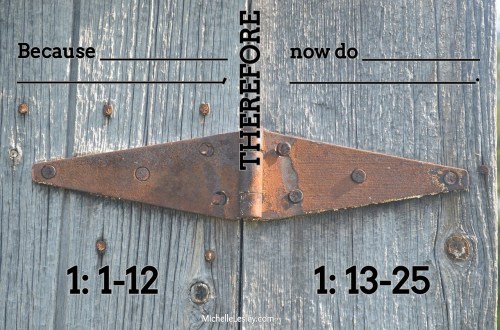
7. Verse 13 starts with the pivot word “therefore,” which means, “Because of all that stuff I just told you, here’s what you need to do.” (“So,” or “So then” at the beginning of a passage mean basically the same thing. Always watch for transitional or pivot words at the beginning of a sentence to help you tie the first part of the passage to the subsequent part of the passage.) The old adage, “Whenever you see the word ‘therefore’ in Scripture, you need to find out what it’s ‘there for’,” is a great little hermeneutical rule of thumb.

Summarize chapter 1 in a “hinge sentence”:

Homework

Think about an area of your life in which you need to “be holy.” Spending more time in prayer? Cleaning up your language? Being patient with other drivers? Write out a plan for pursuing holiness in this area of your life this week (and beyond).

1. List 2-3 specific ways you can “prepare your mind for action” and “be sober-minded” (13) to lay a foundation for holy thoughts, attitudes, and actions.

2. How can you “be holy” in this area? Review verses 13-15, 17, 22, think about how they apply to your situation, and list 2-3 specific holy thoughts, attitudes or actions you can employ.

3. Why should you “be holy” in this area? Review verses 16, 18-21, 23-25, and explain why you should pursue holiness in this area of your life.


Suggested Memory Verse

(Every week of our study, you’ll see a suggested memory verse like the one above. You are welcome to grab the memory verse pic to use as your screensaver or wallpaper on your phone or computer, print it out and stick it somewhere you’ll see it frequently, or use it in any other way you wish to help you memorize the verse.)
1&2 Peter Bible Study

Living Stones: A Study of 1 & 2 Peter ~ Lesson 1- Introduction

Welcome to our new study, Living Stones: A Study of 1 &2 Peter!

How can we live lives of holiness as the world, and even the church, become increasingly unholy? For the next several weeks we’ll work our way through the books of 1 & 2 Peter, and learn how Jesus is the Living Stone – our perfect example of holiness – that we are to build our lives and churches upon.

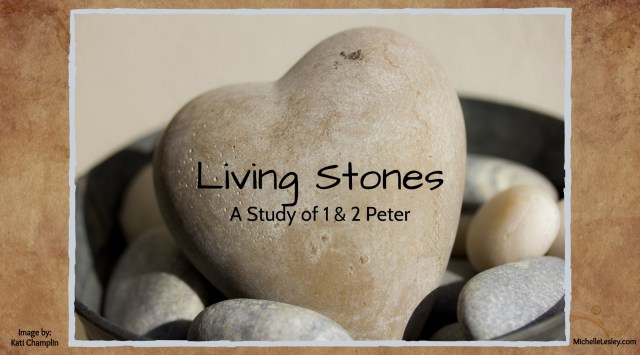
Our lovely title pic for the study was designed by Kati Champlin, who is a pastor’s wife in Montana. Many thanks to all of those who worked so hard on their entries for our title pic contest. You ladies were very creative and did some beautiful work! 

Terri Mobley


Lesley Hazen


Carey


Clare McNaul
 

(Clare pointed out the crosses etched into the rock. Can you see them?)

Debra Gartland

If you’re new to using my Bible studies, just a few housekeeping items and helpful hints:

The studies I’ve written (you can find all of them at the Bible Studies tab in the blue menu bar at the top of this page) are like “training wheels”. They’re designed to teach you how to study the Bible for yourself and what kinds of questions to ask of the text so that, when you get the hang of it, you won’t have to depend on other people’s books and materials – even mine – any more. To that end, I do not provide answers for the study questions in the studies I’ve written.

My studies are meant to be extremely flexible and self-paced so that you can use them in the way that works best for you. You can do an entire lesson in one day or work on the questions over the course of the week (or longer). You do not need to feel obligated to answer all (or any) of the questions. If the Holy Spirit parks you on one question for several days, enjoy digging deep into that one aspect of the lesson. If He shows you something I haven’t written a question about that captures your attention, dive in and study it! Those are ways the Holy Spirit speaks to us through His Word. This is your time to commune with the Lord, not a school assignment or work project you are beholden to complete in a certain way by a certain deadline.

I will post a new lesson on the blog every Wednesday, so there is nothing to sign up for or commit to. Simply stop by the blog each week, or subscribe to the blog via e-mail to have the lessons delivered to your inbox.

I use hyperlinks liberallyThe Scriptures for each lesson will be linked at the beginning of the lesson and in the lesson questions. As you’re reading the lesson, whenever you see a word in a different color text, click on it, and it will take you to a Scripture, article, or other resource that will help as you study.

All of the studies I’ve written are suitable for groups or individuals. You are welcome to use them as a Sunday school or Bible study class curriculum (for free) with proper attribution.

You are also welcome to print out any of my Bible studies (or any article I’ve written) for free and make as many copies as you’d like, again, with proper attribution. I’ve explained more about that in this article (3rd section).


Introduction to 1 Peter

Before we begin studying a book of the Bible, it’s very important that we understand some things about that book. We need to know…

Who the author was and anything we might be able to find out about him or his background.

Who the audience of the book is: Jews or Gentiles? Old Testament Israelites or New Testament Christians? This will help us understand the author’s purpose and approach to what he’s writing.

What kind of biblical literature we’re looking at. We approach books of history differently than books of wisdom, books of wisdom differently than books of prophecy, etc.

What the purpose of the book is. Was it written to encourage? Rebuke? Warn?

What the historical backdrop is for the book. Is Israel at war? At peace? In exile? Under a bad king? Good king? Understanding the historical events surrounding a piece of writing help us understand what was written and why it was written.

When the book was written. Where does the book fall on the timeline of biblical history? This is especially important for Old Testament books which are not always arranged in chronological order.

So this week, before we start studying the actual text of the book of 1 Peter, we need to lay the foundation to understanding the book by finding the answers to these questions.

Read the following overviews of the book of 1 Peter, taking notes on anything that might aid your understanding of the book, and answer the questions below:

Bible Introductions: 1 Peter at Grace to You

Overview of the Book of 1 Peter at Reformed Answers

Book of 1 Peter at Got Questions

1. Who wrote the book of 1 Peter? How do we know this?

2. Approximately when was 1 Peter written? What is the geographical setting of the book of 1 Peter? Here are some maps (scroll down to “1 Peter”) that may be helpful as you study through the book of 1 Peter.

3. Who is the original, intended audience of the book of 1 Peter? Describe the historical setting (historic events, politics, sociology of the time, etc.) of 1 Peter.

4. Which genre of biblical literature is the book of 1 Peter: law, history, wisdom, poetry, narrative, epistles, or prophecy/apocalyptic? What does this tell us about the approach we should take when studying this book versus our approach to books of other genres?

5. What is the theme or purpose of the book of 1 Peter?

6. What are some of the major topics of instruction in the book of 1 Peter? How do these topics relate to the theme of 1 Peter?

7. What are some ways 1 Peter points to and connects to Jesus?

8. What else did you learn about 1 Peter or the setting of this book that might help you understand the text of the book better?

Take some time in prayer this week to begin preparing your heart for this study. Ask God to grow you in holiness and in following the example of Christ as we study together Living Stones: A Study of 1&2 Peter.

1&2 Peter Bible Study

New Bible Study Kickoff and Title Pic Contest

Happy Wednesday, Ladies!

Today, we’re kicking off our new study..…with a fun title pic contest!


As you come to him, a living stone rejected by men but in the sight of God chosen and precious, you yourselves like living stones are being built up as a spiritual house, to be a holy priesthood, to offer spiritual sacrifices acceptable to God through Jesus Christ. 1 Peter 2:4-5

This passage captures the heart of 1 & 2 Peter. Jesus is the living stone. The solid rock. The strong and mighty foundation of our faith. As His children, we are to be built up into a spiritual house – little living stones upon the Chief Cornerstone. In these two epistles, Peter (a living “stone” himself in more ways than one) shows us how to be holy as I am holy – “chips off the old Rock,” you might say – individually, in our families, in our churches, and in the world.

But before we get started studying, how about a little fun?

You’ve probably noticed that I design a title picture for each Bible study I write. Here are a few past title pics:

(You can see the rest of them at the Bible Studies tab, if you like.)

Y’all have sent in some beautiful and creative entries in our past title pic contests, so, once again, I wanted to get some of you involved in the design process for our new study.

Do you enjoy and have a knack for photo editing? Know someone who does? If so, I’m accepting submissions for title pictures for the Living Stones study. If your submission is chosen it will be used each week of the study, and you’ll be credited (name or website) by watermark. I’d love to be able to offer a huge cash prize, but, hey, we’re small potatoes here. This is just for fun and maybe a little publicity for your site, if you have one.

Contest Guidelines

 You must use images that don’t require attribution. Pictures you’ve taken yourself are fine, as are images from sources such as Pixabay, Pexels, Freely, Unsplash, StockSnap, or other free stock photo web sites. Please include the image source web sites you use along with your submission. (You cannot just grab and use any old picture off the internet. Photographers own their images and usually require permission, attribution, and often a fee, for their use.)

Title pics should be landscape (a horizontal rectangle) with a width of 1000-2000 pixels and proportionate height. I prefer JPG images, but PNG is fine, too, if necessary.

 Your title pic must contain the full title of the study: Living Stones: A Study of 1 & 2 Peter. (Be sure to double check your spelling). 

 If your submission is selected, I’ll be glad to watermark it with your website address (please submit your picture without any watermarks) as long as your web site doesn’t conflict with my statement of faith or my beliefs outlined in the Welcome tab.

 Deadline for submissions is 11:59 p.m. Monday, January 20, 2020

E-mail your title pic submission along with your full name, web site address (if any), and the source(s) you used for your image(s) to MichelleLesley1@yahoo.com. You are welcome to submit as many images as you like.

 Please don’t be offended if your submission isn’t selected. If I peruse all the submissions and I’m just not “feeling it,” I may still elect to design one of my own.

Feel free to share this around with friends who have an interest in photo editing. If you want to take a whack at it for fun but don’t know where to start, play around with Be Funky, PicMonkey, or Canva and see which one works best for you. Think about God’s heart for holiness for the Believer and try to capture the theme of 1 & 2 Peter in your image.

Happy designing!

Favorite Finds

Favorite Finds ~ January 14, 2020

Here are a few of my favorite online finds…

“How can I know with certainty what the Bible is saying? How can I be certain what books really belong in the Bible? How can I be sure that my interpretation of any text is correct, and, still more, what its proper application is…?” Have you ever tried to explain a biblical principle to someone only to hear the retort, “But That’s Just Your Interpretation!“? D.A. Carson has some helpful words for us in the latest issue of Themelios.

 

“Pastors, I have a plea for you. Please, love your women enough to warn them against false teachers. It isn’t enough to simply teach the good stuff; if they don’t know what is out there that is not good and why it isn’t good? They will continue to fall for it.” Check out Amy Spreeman’s article, When Seemingly Solid Pastors Fail to Protect Women.
 

“Christianity is sexist!” “The Bible is patriarchal and just wants to keep women down!” We hear these tired arguments trotted out again and again, but are they really true? No, Eric Davis explains in his excellent article over at Cripplegate, 10 Reasons Why the Bible Regards Women Higher than All Other Systems, “The fact is…the Bible regards women higher than any other ideology, religion, philosophy, or system in history. Nothing teaches a higher view of women than biblical Christianity.”

 

Crossway has an interesting infographic for us on a study they conducted on prayer: “Over 14,000 people recently shared about various aspects of their prayer lives with us…we invite you to dig into the data, looking at established prayer habits, common pain points, and useful practices and tools for prayer.” Take a look at Infographic: How Is Your Prayer Life?.
 

Hermeneutics is the lens through which we view Scripture. Dr. Dane Ortlund helpfully explains some right and wrong lenses to use when studying Scripture in 6 Ways Not to Read the Bible (a brief excerpt from a longer seminar). Are you handling Scripture correctly?


The resources listed above are not to be understood as a blanket endorsement for the websites on which they appear, or of everything the author or subject of the resource says or does. I do not endorse any person, website, or resource that conflicts with Scripture or the theology outlined in the Statement of Faith and Welcome tabs at the top of this page.
Bible Study

Nine Helps for Starting and Sticking to Daily Bible Study

We’ll be getting started on our new Bible study next week.
In the meantime, I thought this might be helpful.

Originally published March 31, 2015

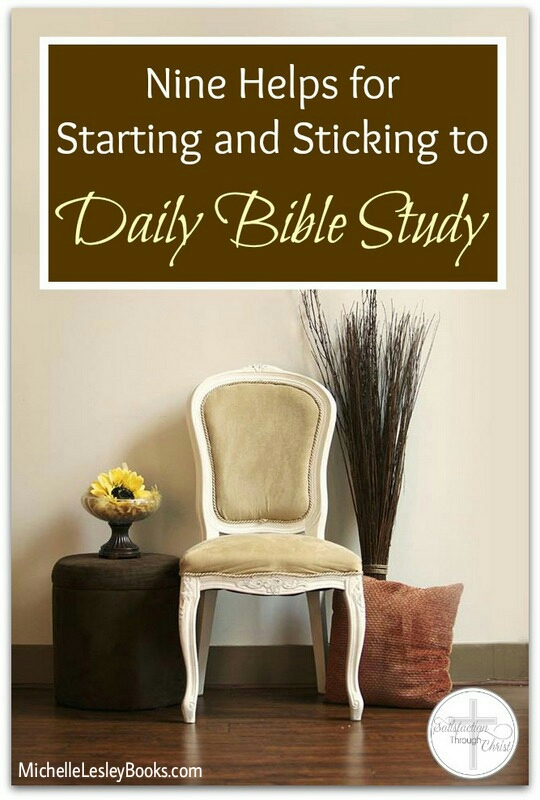
9 helps daily bible study

It seems to be a common dilemma among new Christians, Christians who have never developed the habit of daily Bible study, and even those whose current Bible study methods or materials just don’t seem to be “working.” You know you need to be studying God’s word efficiently and effectively every day, but you aren’t quite sure how to get the ball rolling.

Let me just say right off the bat that getting over that ginormous hurdle between knowing you ought to study your Bible today and actually doing it is normal. Every Christian goes through that at least occasionally. So don’t worry that your flesh balking initially when it’s time to open your Bible means you aren’t saved or you don’t have enough faith, or whatever. But don’t let it stop you either. There are some things you can do to get off to a good start with setting up and sticking to a daily Bible study time. What can you do to set yourself up for success?

Prioritize It

Take a little time to get alone with the Lord, and be honest with Him and yourself. Is daily Bible study actually important to you – something you want to do? Why or why not? Do you feel like you should be studying, but you don’t really have a desire to? Ask God to help you understand your motivations and submit them to Him. Ask him to give you a passion for His word. Ask Him to help you to be obedient to Him in making His word a priority in your life.

Pair It

Pair your study time with something you already do faithfully, and at roughly the same time, every day. Study while you’re eating lunch, during the baby’s nap time, right after you exercise, as soon as you get up in the morning, etc. Piggybacking onto something that’s already built in to your schedule helps you stay faithful and keeps you from forgetting.

Plan for It

Do your best to block off your schedule for your Bible study time and guard that time from interruptions. Turn your phone off and get away from social media. Don’t schedule other appointments or activities that might run long and impinge on your study time. Take care of any possible contingencies that could come up before you get started.

Be Purposeful About It

The Bible should be studied in an orderly way so you can understand and apply it properly. I usually recommend simply picking up the Bible and studying it rather than using Bible study books and workbooks, and having a systematic plan of study is essential, not only to proper understanding and application of God’s word, but also to keep you from wasting time trying to figure out what to study each day. Choose a book of the Bible, start at the beginning, and work your way through it, or choose a plan for working your way through the New Testament, Old Testament, or whole Bible.

Pare It

Bible reading plans are great, but some of them can simply require so much daily reading that you don’t have time to slow down, take it all in, and linger over what you need to linger over. You don’t have to read the whole Bible in a year, but if a plan interests you, you could tweak the timing of it or pare it down in some way so you’re not biting off more than you can chew. Go for quality rather than an overwhelming quantity. Many beginners find that a chapter a day (unless it’s Psalm 119!) is just about right.

Partner with Someone

Check in regularly with a friend or your husband and discuss what each of you is learning from God’s word and how He’s using what you’re studying to make you more like Christ. It’s great fellowship and will help keep you both accountable to staying in the Word.

Positively Reinforce It

It’s true that studying God’s word is its own reward, but sometimes disciplining yourself to stick to a schedule needs a little extra boost of incentive, especially when you’re just starting out. How about making a deal with yourself that you can get on social media, watch TV, have dessert, etc., only after you’ve had your Bible study time? Or that if you don’t miss any days of studying your Bible for a whole week, you’ll reward yourself with an ice cream cone, a bubble bath or some other small treat?

Pursue It

Realize from the get go that there are going to be some days when you’re going to forget to study your Bible, or oversleep, or have an emergency, or just plain old give into temptation to skip it. Take a breath. It’s OK. If there was sin involved, repent and ask God’s forgiveness. If there’s still time left in the day, and you’re able, go ahead and pull your Bible out, even if it’s not your regularly scheduled time. If not, just get back up on that horse tomorrow. God’s mercies are new every morning (Lamentations 3:22-23).

Prize It

Above all, whether it’s a day when you’ve had a fantastic time in God’s word or a day when you’ve messed up royally, keep your eyes on the prize and see the long term value in spending time in the Scriptures each day. God is using His word to grow you in holiness and make you more Christlike.

All Scripture is breathed out by God and profitable for teaching, for reproof, for correction, and for training in righteousness, that the man of God may be complete, equipped for every good work.
2 Timothy 3:16-17


THIS ARTICLE WAS ORIGINALLY PUBLISHED AT SATISFACTION THROUGH CHRIST.