Sermon on the Mount Bible Study

The Sermon on the Mount ~ Lesson 6

Previous Lessons: 1, 2, 3, 4, 5

Matthew 5:27-32

Questions to Consider

1. Briefly review the “middle parts” (ex: merciful, poor in spirit) of the Beatitudes, the “salt and light” passage, and the “heart of the law” passage in Matthew 5:1-12, 13-16, 14-20. Now read 27-32 in light of those passages.

Summarize, in your own words, the main idea of 27-32.

In the Beatitudes, Jesus lists the traits that define Christian character. In much of the rest of the Sermon on the Mount He fleshes out what many of these character traits look like when walked out in “real life”. Which of the traits (the “middle parts” – there could be several) listed in the Beatitudes is Jesus expanding on in 27-30 and 31-32? How?

How do lust, adultery, and unbiblical divorce bland your saltiness? (13-16) How can crucifying your lust and being faithfully devoted to your husband make you saltier and brighter?

2. Review from our previous lessons (links above) the idea that the Sermon on the Mount is to the New Testament / new covenant what the Ten Commandments were to the Old Testament / old covenant.

How does Jesus refer back to the Ten Commandments in verse 27? How do Jesus’ phrases “You have heard it said…but I say to you…” verbally transition the people from their focus on outward obedience to the letter of the law to zeroing in on the attitude of their hearts and the spirit of the law? Explain how refraining from lust and being faithful and committed to your marriage is the heart of the law (17-20) behind the seventh and tenth Commandments. Connect these passages with 27-32. Where should our outward, behavioral obedience to Christ spring from?

3. Review: Examine again the “You have heard it said…but I say to you…” proclamation. Who had the people heard it (the law) said by? Who taught them the law? How does Jesus saying, “But I say to you…” establish Jesusโ€™ supremacy over the Pharisees, scribes, priests, etc. Imagine you’re one of these Jewish leaders and you’re hearing Jesus say this. What might your initial reaction be?

Recalling our Sermon on the Mount / Ten Commandments motif, how might Jesus’ “You have heard it said…but I say to you…” proclamation have evoked images of Moses as lawgiver, and signaled to the Jewish leaders and people that the better Moses was here?

4. What is โ€œlustful intentโ€? (28) Make the connection between lust, adultery, and divorce. How could lusting after someone else eventually culminate in divorcing your spouse?

5. Notice the progression from temptation to commission of outward sin in 28-30:

  • Sin of the e_____(28a, 29) leads to…
  • Sin of the h_____(28b) leads to…
  • Sin of the h_____(30)

Which sexual sins does this progression apply to? Which other sins does this progression apply to? Is it fair to say that this progression applies to all sin? Explain what Jesus means by gouging out your right eye and cutting off your right hand as it applies to this progression from temptation to commission of outward sin. How can removing things in your life that are conducive to temptation and sin stop this progression?

6. Using your cross-references for verse 31, what were the Old Testament parameters for divorce? Why, according to Jesus, was this allowance made?

A spouse’s “sexual immorality” (usually adultery) (32) is one of the biblically permissible reasons for divorce. What is the other? Study these passages. How is marriage symbolic of God’s relationship with His people? If marriage symbolizes how God (the “husband”) cares for His people (His “bride”), what does divorce (for unbiblical reasons) say about God? About His people?

Compare 32 to Matthew 19:3-9. Why is divorce so closely tied to adultery? Who joins two people together and makes them one in marriage? Besides divorce due to adultery and abandonment1, what is the only other way God considers a marriage dissolved? Do man’s scribblings on a piece of paper (“certificate of divorce” for unbiblical reasons) change the fact that God still considers those two people married? How does this better help you understand Jesus’ statement in Matthew 19:6: “What God has joined together, let not man separate.”? How does this concept help you understand why, in unbiblical divorces, God considers remarriage to be adultery?


1I know at this point many of you have “Yeah, but…” and “What if…” questions about abusive marriages and/or your own divorces. We can’t deal with those properly here. I would encourage you to use your cross-references and concordance to search the Scriptures about divorce and rightly apply them to your questions, and to get wise counsel from your pastor. If you are currently being abused: please get to a safe place and reach out to your pastor, the police, or another appropriate person for help. Getting to a safe place is not a sin, and it is not the same as an actual divorce.


Homework

  • Read my article The Mailbag: Is Lust a Sin for Women, Too? and study the Scriptures therein.
  • Think of one pernicious sin in your life in which you can see the progression of: sin of the eye>>sin of the heart>>sin of the hand. Explain how each of these steps are fleshed out in your particular sin. What is something you could remove from or add to your life that would make it more difficult for you to be tempted to commit this sin? Prayerfully develop a plan or strategy to “cut off your right hand / gouge out your right eye” (metaphorically speaking) in this area and begin implementing it this week.

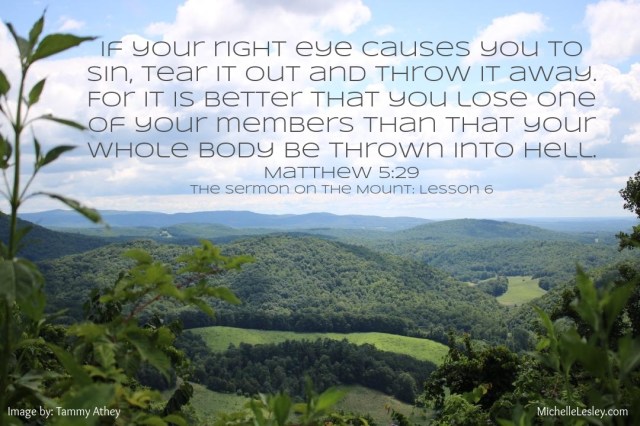
Suggested Memory Verse
Christian women

Throwback Thursday ~ Evangelical Misogyny and the Spiritual Oppression of Christian Women

Originally published September 16, 2016woman-1246571_20160915144847652

background-1434679_1280

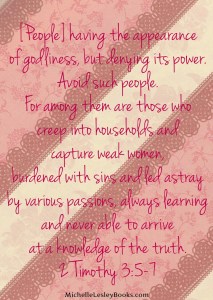
Weak women- always learning and never able to arrive at a knowledge of the truth. Captives to false teachers. Led astray by their feelings. There is hardly a better way to describe a significant portion – dare I say, the majority – of evangelical women today.

There’s plenty of blame to go around. Satan dresses himself up like a Christian and deceives as many as he can. Women (and men, too) give in to the temptation to seek out false teachers who will tell them what they want to hear. Pastors fail to fight off, and in many cases, welcome with open arms, the false doctrine and false teachers creeping into their churches.  And the false teachers themselves are out to make a fast buck on false doctrine.

And the result of it all is a generation of evangelical women held prisoner by Satan in the gilded cage of biblical illiteracy and feel-good “Christianity.” And most of them don’t even know they’re inmates.

It’s bad enough that evangelical women are largely feeding their souls on the anti-biblical poison churned out by the smorgasbord of divangelistas lining the shelves of most “Christian” bookstores- poison that, at worst, will leave them doomed to an eternity in hell, and, at best, will stunt their growth in Christ. But there’s another insidious aspect of this issue: theololgical misogyny against evangelical women.

The Bible knows nothing of women as second class citizens. Throughout recorded history, God, and his obedient children, have been the ones to regard women as precious and valuable people with a crucial role to play in the Kingdom, the family, and society. God elevates women while the world degrades us.

Perhaps one of the best examples of this is in an often overlooked phrase in 1 Timothy 2:11: “Let a woman learn.” The pastors and elders of the first century church – in the midst of a culture that devalued and disregarded women – were to proactively make sure women learned the gospel and sound doctrine. The Holy Spirit goes on in that passage to explain how first century, as well as twenty-first century, women should conduct themselves in a godly way while we’re learning, but there’s no watered down, Barbie doll, “pink is for girls” version of theology that women are to be taught while the real thing – serious Bible study and theology – is reserved for men.

Yet that’s exactly what modern day evangelicalism and Christian retailing are doing. They’re establishing a subtle theological segregation in the name of marketing and meeting felt needs. How? Here’s just one example:

screenshot_2016-09-14-11-39-55_kindlephoto-22263756

This post, from a major Christian retailer, appeared in my Facebook feed recently. They’re holding “Bible art journaling” workshops to teach women how to color in their Bibles- something we usually teach three year olds not to do.

When was the last time you heard of a Christian retailer or an average evangelical church holding a workshop – aimed at women – on biblical hermeneutics, Christology, pneumatology, church history, discernment, evangelism, or any other serious biblical topic?

Never mind how to properly handle and study God’s word, ladies, here’s a coloring book1! It’s insulting to the intelligence, capabilities, and quest for spiritual maturity of Christian women. And it’s sexist, too. Don’t believe me? Think about it:

How many Christian men do you see taking Bible art journaling classes or sharing about it on social media?

Have you ever seen a men’s ministry share a picture like this in order to reassure men of how special and wonderful they are?

woman-570883_1920_kindlephoto-22633156

Over the summer, the hot fad aimed at women was using henna to tell Bible stories. How many men do you think participated in that?

sou-hennabklt-m

Contemporary Christian radio intentionally markets to a specific female demographic, resulting in a playlist that’s overwhelmingly comprised of ooey-gooey, salve my feelings, emasculated songs. That’s their perspective of us. That’s what they think we want and can handle.

And it doesn’t stop there. Walk into your local Christian retailer and compare the fluff and false doctrine in the women’s ghetto department to what’s offered in the general (or men’s) area of the store. Christian retailing has been so successful with their marketing plans that they have fairly brainwashed evangelical women into thinking that:

  • only what’s in the women’s section of the store is for them
  • serious theology isn’t for them (because it’s nowhere to be found in the women’s department)
  • women can’t just pick up the Bible and study it for themselves – they have to buy a “canned” study written by someone else
  • that “someone else” has to be a woman (nearly always a woman who teaches false doctrine)

Take all of that, throw it into your gumbo pot, stir it around a little, and what do you get?

Well…you get weak women who are captivated by false teachers and false doctrine, led astray from the truth of God’s word by their passions and emotions, flitting from study to study and event to event, always “learning” but ever biblically ignorant. And you get a church that not only views Christian women this way, but perpetuates this sexist spiritual oppression.

Christian women, you are better, more valuable, and more capable than that. God has more for you and expects more from you than sitting in a corner coloring in your Bible and playing with a theological Barbie Dream House. Like your first century sisters, He wants you to learn.

Strive for more than evangelicalism expects from you and thinks you’re capable of, ladies. Be a strong, healthy student of God’s Word. There are women out there who desperately need you: lost women who need to hear the gospel properly presented so they might know Christ, saved women who need someone to teach them the truth of God’s Word, women who need biblical hope, comfort, and answers about the trials they’re going through.

Buck the system. Challenge the assumptions. Cast off the shackles, and refuse to be that weak woman any more. Be the full grown, spiritually mature woman God has always wanted you to be.


1Some women are artistically talented and enjoy Bible art journaling as a hobby in their spare time. If that’s you, and you’re already a serious student of God’s word, knock yourself out. But if the majority of your Bible “study” time is spent painting or coloring in your Bible, then this might be a tight, uncomfortable shoe, but the shoe fits.

Sermon on the Mount Bible Study

The Sermon on the Mount ~ Catch Up Week

Previous Lessons: 1, 2, 3, 4, 5

Iโ€™m out of pocket this week, so you get a catch up week!

Catch up on any lessons you might be behind on, go back and do any of the homework you may not have had time for, review your memory verses, or if youโ€™re already caught up, you could even read ahead in the Sermon on the Mount a little. Itโ€™s your week to use as you see fit. Happy studying!

Sermon on the Mount Bible Study

The Sermon on the Mount ~ Lesson 5

Previous Lessons: 1, 2, 3, 4

Matthew 5:21-26

Questions to Consider

1. Briefly review the “middle parts” (ex: merciful, poor in spirit) of the Beatitudes, the “salt and light” passage, and the “heart of the law” passage in Matthew 5:1-12, 13-16, 14-20. Now read 21-26 in light of those passages.

Summarize, in your own words, the main idea of 21-26.

Divide this passage into two sections, 21-22 and 23-26. Who is experiencing anger in the first section? The second? Who is responsible for doing something regarding the anger in both sections? Can you control or change the behavior of the person you’re angry at or the person who’s angry at you? How does this passage take the focus off what the other person has done (and whether she is right or wrong), and put the focus on you and your responsibility to act in a godly way regardless of the circumstances?

In the Beatitudes, Jesus lists the traits that define Christian character. In much of the rest of the Sermon on the Mount He fleshes out what many of these character traits look like when walked out in “real life”. Which of the traits (the “middle parts” – there could be several) listed in the Beatitudes is Jesus expanding on in each of these sections (21-22, 23-26)? How?

How does ungodly anger, or a brother having something against you dim your light, and bland your saltiness? (13-16) How can crucifying your sinful anger or reconciling with an offended brother make you saltier and brighter?

2. Review from our previous lessons (links above) the idea that the Sermon on the Mount is to the New Testament / new covenant what the Ten Commandments were to the Old Testament / old covenant.

How does Jesus refer back to the Ten Commandments in verse 21? How do Jesus’ phrases “You have heard it said…but I say to you…” verbally transition the people from their focus on outward obedience to the letter of the law to zeroing in on the attitude of their hearts and the spirit of the law? Explain how refraining from sinful anger and reconciling with an offended brother is the heart of the law (17-20) behind the 6th Commandment. Connect these passages with 21-26. Where should our outward, behavioral obedience to Christ spring from?

3. Examine again the “You have heard it said…but I say to you…” proclamation. Who had the people heard it (the law) said by? Who taught them the law? How does Jesus saying, “But I say to you…” establish Jesusโ€™ supremacy over the Pharisees, scribes, priests, etc. Imagine you’re one of these Jewish leaders and you’re hearing Jesus say this. What might your initial reaction be? How does this passage on anger inform how you should respond to Jesus’ proclamation?

Recalling our Sermon on the Mount / Ten Commandments motif, how might Jesus’ “You have heard it said…but I say to you…” proclamation have evoked images of Moses as lawgiver, and signaled to the Jewish leaders and people that the better Moses was here?

Who created and gave the Ten Commandments? How did Jesus’ proclamation and the judgments He declares in verse 22 demonstrate to the Jews His authority as God and His equality with God?

4. Using your cross-references, what kind of court / prison situation is 25-26 referring to? Can you see how this type of situation fits with the situation in 23-24? Does verse 23 say you’ve actually sinned against your brother, or that you’re actually guilty of the the civil action or accusation of debt being brought against you in 25? Could these be situations in which there has been a misunderstanding, a miscommunication, or a false accusation on the part of the offended party? Why is it still your responsibility to take the initiative to make things right with the offended party?

What does making things right with others have to do with our worship (23)? Why does God basically say, “Go to your brother before you come to Me.”?


Homework

  • What is the difference between righteous anger (which is not sinful) and sinful anger? How can you tell the difference between the two? Is it possible to express righteous anger in an unrighteous / sinful way? Give an example. This week, pray that each time you get angry God will help you distinguish whether you are experiencing righteous or sinful anger and whether you are expressing that anger righteously or sinfully. If you are sinfully angry, repent.
  • Is there anyone in your life who has something against you (23-26)? Even if your conscience is clear that you haven’t actually sinned against her, be a peacemaker, take the initiative, and do everything you can to reconcile with her this week.

Suggested Memory Verse
Sermon on the Mount Bible Study

The Sermon on the Mount ~ Lesson 4

Previous Lessons: 1, 2, 3

Matthew 5:13-20

Questions to Consider

1. Briefly review the Beatitudes in Lesson 3 (link above).

2. Read verses 13-16. Remember that when the Bible was written, there were no chapter and verse markings and no separation between sections. The passage we know as verses 1-12 flowed directly into verses 13-16.

Make the connection between the Beatitudes and 13-16. In what ways could 13-16 be considered the culmination of the Beatitudes? How does God shaping you into all the character qualities in the Beatitudes make you into, or equip you to be, the salt of the earth and the light of the world?

Do verse 13 and verses 14-15 describe the state of saltiness and light in the positive (“Be like this.”) or in the negative (“Do not be like this.”)? List the negative and/or positive statements about each. How could someone who claims to be a Christian lose her saltiness or her light? Is Jesus talking about false converts or genuine Believers who stray into a season of sin, or both? Why?

Carefully examine verse 16. Could this apply to saltiness as well as light? If a friend asked you what this verse meant, how would you explain it to her? What if your friend then directed your attention to 6:1-4, and said, “Aha! The Bible contradicts itself! 5:16 says to let others see your good works and 6:1-4 says not to practice your good works before others.”? How would you explain to her what these two passages mean and why they are different?

3. Read 17-20 in light of 1-16, and in light of the concept from our last lesson that Jesus preaching Sermon on the Mount and the Beatitudes probably evoked comparisons to Moses coming down from the mountain and giving the Ten Commandments.

What three word phrase do most of the Ten Commandments start with? How many of the Ten Commandments end with a blessing? Compare this with the Beatitudes. Which two word phrase does each Beatitude begin with? How many of the Beatitudes end with a blessing? Compare the hard edge specificity of the Commandments (lying, murdering, idolatry, etc.) with the more open ended, less specific Beatitudes (poor in spirit, merciful, etc.) Are the Ten Commandments stated in the negative or the positive? The Beatitudes?

Imagine you’re a law and order Pharisee with all of the above on your mind. You’ve been a “no no” guy all your life. You’re worried Israel might fall back into the sins that sent them into exile in the Old Testament. And now you’re listening to this new guy on the scene preach what sounds like it might be a softer and gentler, love and peace, “hippie” version of the Ten Commandments. You have questions for Jesus. What are those questions?

How does Jesus answer your questions in 17-20? Is He preaching license or that obedience to God does’t matter? Using your cross-references in this passage, what is Jesus trying to convey to the people and to the Pharisees about righteousness and obedience? What is the heart of the Law?

Some people incorrectly think 17-20 mean that New Testament Christians must keep the Old Testament civil laws (no shellfish or mixed fabrics, put a parapet around your roof, etc.) and ceremonial laws (feasts, festivals/holidays, etc.). How would you refute that idea? What are some other passages of Scripture you might bring to bear on this question? When Jesus originally spoke these words, was He talking to Christians under the new covenant or Jews under the old covenant?

How was Jesus the fulfillment of the Law and Prophets? How had legalism so corrupted Judaism that many of the Jews, scribes, and Pharisees were unable or unwilling to accept Jesus as the Messiah – the fulfillment and culmination of the old covenant?


Homework

Consider this thought:

The prevalent false teaching of Jesus’ day was legalism, and the false teachers (Pharisees) accused Jesus and His followers of antinomianism when they taught obedience to God and His Word. The prevalent false teaching today is antinomianism, and today’s false teachers accuse Jesus’ followers of legalism when they teach obedience to God and His Word.

Do you agree or disagree? Why? How can Christians avoid both legalism and antinomianism and follow Christ obediently from a heart of love?


Suggested Memory Verse

Each week, I’ll provide a suggested memory verse from that week’s study passage. I encourage you to copy, save, or screenshot it. Use it for your screensaver or wallpaper, your social media cover photo, or print it out and stick it somewhere you’ll see it often.