Baskin Robbins is one of my favorite places to get ice cream. Not only is their ice cream good, but they boast a plethora of flavors to choose from. I love to start at one end of the counter and work my way through all their offerings, getting a little “taste spoon” here and there if a particular flavor piques my interest.
Photo courtesy of BaskinRobbins.com.
Having a myriad of options is great when it comes to ice cream, but when it comes to studying the Bible, the tsunami of materials, methods, and other choices out there can be overwhelming. Where do I start? How do I know if a certain Bible study book or teacher is doctrinally sound? Is the study method I’m using in line with good hermeneutics?
It can be enough to make you throw your hands up in the air and head for your local Thirty One Flavors to drown your sorrows in Peanut Butter ‘N Chocolate.
Sometimes it can help to get back to plain old, simple, vanilla Bible study. I’ve been saying for a while now that Christian women should, for the most part, put all the “canned” Bible study books, workbooks, and DVDs aside and simply pick up their Bibles and study them in a systematic way. After all, up until somewhere near the latter half of the 20th century, that’s generally how people studied the Bible. And it worked. People grew in their faith to godly maturity just fine. So, why can’t it work today?
It can. It does. It will.
Unfortunately, the blessing of lots of options, methods, resources, and information, and the marketing of that blessing by celebrity Christians and Christian retailing, has bred a generation of Christian women who are fearful that they aren’t as smart or as capable of reading and understanding God’s Word as all the “experts” out there. They look at the simplicity of picking up their Bibles and studying them like calves looking worriedly at a new gate.
“What does that mean?”
“How do I do that?”
“I’m scared I’ll get it wrong!”
It absolutely breaks my heart to hear this angst from women who, I’m certain, genuinely want to study God’s Word correctly so that they can know Him better and grow in their faith. And it makes me livid at the churches who haven’t trained them properly, the plantation-style women’s “Bible study” marketing that has kept them ignorant and dependent slaves to Christian retailers, and whatever other forces have conspired to keep these precious ladies away from the pure milk of the Word.
So let’s reboot, get back to basics, and get as many women digging into the Word as possible.
First, it’s important to start out with a biblical perspective:
1. God is kind, and He loves you.
Yeah, I know, that’s pretty basic. But it’s worth bringing to the forefront for this discussion. This is a God who loves you and wants you to know Him. He has revealed Himself to you through creation, through Christ, and through His written Word. He has indwelt you as a Believer with the Holy Spirit to help you understand Scripture. He has told you that you can ask for wisdom and promises to provide it. In His kindness God has bent over backwards to provide you with ways to know Him. He is not some mean ogre sitting up there just waiting for you to get something wrong so He can chastise you. He wants you to understand His Word.
2. The Perspicuity of Scripture
There’s this really great, comforting, reassuring doctrine called the perspicuity of Scripture. The gist of it is that Scripture is, for the most part, clear and understandable, especially for Believers, because of the aforementioned indwelling of the Holy Spirit. But even lost people tend to understand a lot of what Scripture says (that’s why you hear so many of them arguing against it – they couldn’t do that if they didn’t at least partially understand it).
So, by and large, if you’re reading the Bible in an orderly way you should be able to understand it fairly well. You don’t have to have a seminary degree or be an “expert.” There are dirt farmers and country preachers out there who have a better grasp of Scripture than some celebrity pastors in multi-million dollar churches with thousands of congregants, and a string of seminary degrees behind their names.
OK, now that we have a biblical perspective on studying the Bible, how do we do it in a systematic or orderly way?
3. Pray
Don’t see this as childish or unimportant and skip it. Start your Bible study time by asking God to help you understand His Word, to learn what He wants you to learn from it, and to obey its instruction. Even if you’re pretty well versed in the Scriptures, praying like this before opening God’s Word will remind you of its holiness and your proper place of humility and submission to it.
4. Read the Bible the way you would any other book.
When you pick up a novel, do you read one sentence out of the middle of chapter 4, followed, the next day, by a paragraph from chapter 37, and, the next day, a couple of lines from chapter 1? Of course not. You wouldn’t know what was going on and what the characters meant by what they were saying. If you wouldn’t read something as inconsequential as a novel this way, why would you read the Bible in such a haphazard manner? Yet this is precisely the way people often approach daily Bible study.
My pastor said something awesome about this in his sermon the other day:
The Bible isn’t Google for self-help.
And he’s so right. We don’t just parachute in to a random passage, hoping to glean a nugget of truth. Pick a book of the Bible (maybe Genesis or one of the gospels if you’re new to all this), start at the beginning, and read a little each day until you reach the end. It’s really that simple.
5. Context, context, context
It’s important to read and understand Scripture in its context: how a verse fits with the verses immediately surrounding it, within its chapter, within its book, and within the overarching narrative of the Bible. This is really the biggest key to comprehending Scripture. Fortunately, the main way to do this is by reading the Bible in an orderly way (see #4- You did already read #4, right?)
Another invaluable practice is to make use of the cross-references and footnotes in your Bible. Cross-references will help you get a better idea of how the passage you’re reading fits together with other, related passages. Footnotes are there to add a touch of clarity to particular words and passages.
6. Get a plan, Fran.
If structure helps you, choose a good Bible reading plan. For the beginner, start off with one of the shorter plans so you won’t get overwhelmed. When you’re ready, I highly recommend the chronological plan. It is extremely helpful for learning the big picture of Scripture.
If you decide to choose a reading plan, though, hold its schedule loosely and don’t be beholden to its time frame. Work through the readings at your own pace. Take the time to let the Scriptures sink in and spend as long as you need to on any given section. God doesn’t give gold stars for finishing the Bible in a year.
7. Understand the background and setting.
There are some passages in Scripture that are a little more difficult to understand if you don’t know the customs of the time or what was going on historically and politically. In these cases a good study Bible, commentary, and other resources can be beneficial. I’ve touched on the specifics of some of these resources here and here. Many of these helpful materials can be found on-line for free.
8. Take notes on the text.
Hmm…an orderly method of reading…footnotes…extra resources…taking notes…this is starting to sound like…well…studying! Yep, that’s the idea. Isn’t it interesting that we often take a more serious and scholarly approach to studying for a class or a test than we do to studying our Bibles?
If you were a better student than I was in high school and college, you probably took notes on your text books as you read them. You wrote down things you wanted to remember, things that seemed important, things you didn’t understand and wanted to work on more later, things that were especially meaningful, even questions that occurred to you. Those are all good things to write down as you study your Bible, as well.
9. Listen to good preaching.
As a Christian, you should already be doing this at least weekly at the church you’re a member of. But try to sneak in some extra listening – to your own pastor or another doctrinally sound pastor – as often as you can during the week. Listening to someone rightly handle and explain God’s Word helps you to understand it and trains you to rightly handle it yourself as you study.
I once read that children who read a lot are better spellers. Not because they study spelling more, but because they’re exposed to more words and have the correct spelling of words constantly in front of their eyes. They sort of soak up good spelling by osmosis, and when it’s time for the spelling test, they simply write down what they’ve absorbed. Listening to good, expository preaching can have the same kind of helpful impact on your Bible study skills.
10. Practice makes perfect.
Studying the Bible is just like any other skill. You’ll probably fumble around a good bit when you’re first getting started, but if you stick to it, you’ll find that it gets easier and you get better at it as time goes by. Don’t be afraid to start. Jump right in there and try. Nothing ventured, nothing gained, right?
Ladies, simply picking up the Bible and studying it each day is such a joy. I have been doing it for years, and I love it. The excitement of “digging for buried treasure” in God’s Word and uncovering the truths of Scripture for myself has been far more meaningful to me and has grown me so much more than any workbook or curriculum I’ve ever used. I hope you’ll put aside your book studies and devotionals, and give it a try yourself!
Foreword: I re-run this article every year in late winter / early spring. And every year, there are a handful of my followers who get mad that I don’t simply say, “No. It is not OK for Christian women to wear bikinis.”
If you’re one of those people, you’re missing the point of this article.
It’s easy to throw out a hard and fast law. It’s not so easy – especially for new Christians and those who come from a background of legalism – to practice biblical decision-making, a skill all Christians need to hone and implement in every area of our lives.
This article is a teaching moment. It’s an opportunity for women to take a fairly easy question that they pretty much already know the answer to and learn how to go through the steps to arriving at a biblical answer.
Remember back in school when your math teacher would make you show your work? She did that because getting the right answer is only a part of problem solving. Understanding and correctly doing all the steps – in order – to arrive at the right answer is the bulk of what she was trying to teach you. This is a “show your work” kind of article.
Summer is just around the corner, so a lot of women will soon be shopping for swimwear. With regard to modesty- do you think it’s OK for Christian women to wear bikinis?
I’m trying to remember back to the days when I might have actually considered – without doubling over in laughter – wearing a bikini. It was a really long time ago. Young, svelte sisters, if I may bring you a bit of comfort- you won’t have to grapple with this question for the rest of your life. As your other older sisters and I can attest, one day, age-appropriateness, your figure, sun exposure, and the desire not to frighten people will make this decision for you long before you have to consider modesty as part of the equation. It’s one of the blessings of getting older.
Just to make sure we’re all on the same page here, let’s quickly define our terms. When I say “bikini,” I’m talking about the fabric equivalent of a bra and panties, not swimwear that covers a lot more yet comes in two pieces.
bikini
not bikinis
Generally speaking, I don’t think bikinis are wise in public unless you’re wearing a shirt or some kind of cover up over it. I’m reluctant to make a hard and fast law about it, though, because, as I’m sure you’re aware, the Bible doesn’t say “Thou shalt not wear a bikini.” (My husband would like to chime in here and says, “However, if you and your husband have a private place for just the two of you to swim or sunbathe, go for it!” You’re welcome, guys.)
A law is a fast and easy “yes” or “no” answer to our question- which is often what our flesh wants, because our flesh is lazy.
As with various other issues, the Bible gives us a general principle (in this case about dressing modestly) and we work out our own salvation in our own cultural context according to all pertinent biblical principles and our own consciences. A law is a fast and easy “yes” or “no” answer to our question- which is often what our flesh wants, because our flesh is lazy. But what God wants Christians to do is study His Word about the issue, pray, and ask Him for wisdom to make a godly decision. When we work through this process, it helps us to develop a greater desire to be conformed to the image of Christ and to be obedient to Him.
What God wants Christians to do is study His Word about the issue, pray, and ask Him for wisdom to make a godly decision.
Let’s take a look at just one passage of Scripture that could be helpful in this regard:
3Do nothing from selfish ambition or conceit, but in humility count others more significant than yourselves. 4Let each of you look not only to his own interests, but also to the interests of others. 5Have this mind among yourselves, which is yours in Christ Jesus, 6who, though he was in the form of God, did not count equality with God a thing to be grasped, 7but emptied himself, by taking the form of a servant, being born in the likeness of men. 8And being found in human form, he humbled himself by becoming obedient to the point of death, even death on a cross.
Philippians 2:3-8
So, at first glance, you might wonder, “What in the world does this passage have to do with wearing a bikini?” It doesn’t have anything to do with the bikini itself, it zeros in on your heart (Why do you want to wear a bikini?) and your sanctification (Will wearing a bikini make me more Christlike?).
Verse 3a:
Examine your heart- could your motive for wearing a bikini be classified as selfish ambition or vain conceit? Is it possible you want to show your body off to men to appear desirable, or to women to make them jealous?
Verse 3b-4:
Is this a situation in which you should humble yourself and put the interests of those men who might be tempted to lust or those women who might be tempted to covet ahead of your own desire to appear attractive?
Verse 5:
Do you truly desire to have the same mindset as Christ- about this issue and all others?
Verse 6-8:
How did Jesus approach life, according to these verses? He set aside His own rights and privileges (6), He took on the role of a servant (7), He humbled Himself and was obedient to the point of death (8).
When it comes to wearing a bikini, are you willing to have the same mindset as Christ? To set aside your own rights and privileges, be a servant to others, humble yourself, and obey Christ even to the point of death?
These are not questions God wants me to answer for you. These are questions He wants you to come to Him and answer, because He wants your heart. And He wants you to examine your heart and see if it belongs to Him in this area.
If you’re looking for modest swimwear – even swim dresses – there are several online companies, such as Calypsa, that may have what you’re looking for. Try searching “modest swimwear”. Have you already found a great company you love? Suggest it in the comments below!
If you have a question about: a Bible passage, an aspect of theology, a current issue in Christianity, or how to biblically handle a family, life, or church situation, comment below (I’ll hold all questions in queue {unpublished} for a future edition of The Mailbag) or send me an e-mail or private message. If your question is chosen for publication, your anonymity will be protected.
Beheadings of Christians by ISIS. Crosses forcibly torn off churches by the Chinese government. Pastors imprisoned. Believers tortured for leaving Islam or sharing the gospel.
The treatment our brothers and sisters across the globe receive at the hands of pagans is nearly unfathomable. They are made to suffer – simply for claiming the name of Christ – by those who openly hate God and want nothing more than to stamp out Christianity.
This is how we, as the American church, have come to define persecution. Outsiders, non-Christians, and the government, all on the attack against the Bible, our faith, our practices, and other beliefs we have long held dear. It’s a correct definition, but it’s not a complete definition.
While we already see a “light” form of this type of persecution in the U.S. – mainly over the issue of homosexuality – there’s another kind of Christian persecution that is mushrooming right under our noses, which most church members either seem oblivious to, or are actually participating in. It’s the persecution in the pew.
If you’re a Christian who has ever dared to vocally take a stand on the truth of God’s Word against the false teaching so prevalent in today’s pop Christianity, you’ve almost certainly experienced this type of persecution at the hands of people who call themselves “Christians.”
Don’t believe me?
Try posting a Facebook status that says the Bible prohibits women from being pastors or teaching men.
Discuss the Bible’s account of Creation with someone from your church who has embraced Darwinian evolution.
Certainly, there are new and immature Christians who simply don’t know these things are unbiblical and are still struggling to embrace God’s Word in these areas. And there are those who know what God’s Word says, but rebel against it in these areas, who silently ignore Christians who espouse biblical truth, or can politely discuss why their “Christian” views differ from Scripture. However, the willfully biblically ignorant, “screaming banshee” contingent is growing, both in volume and in number.
Surprised? Me too. I’ve been on the receiving end of verbal abuse (and I do mean abuse – name calling, swearing, mocking, the questioning of my salvation, and any number of other nasty and condescending remarks) from “Christians” defending these and other unbiblical views numerous times and I still can’t get over my shock every time it happens.
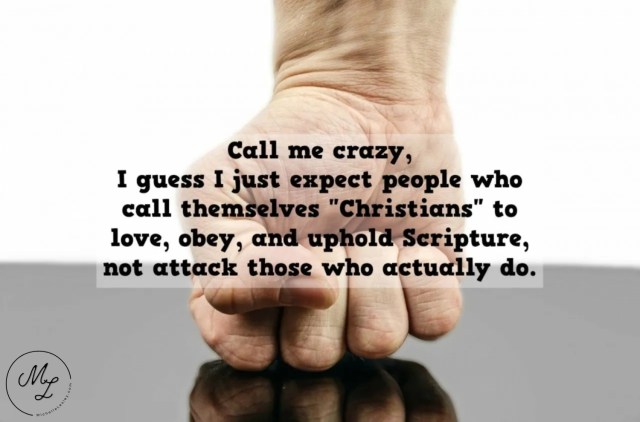
Call me crazy, I guess I just expect people who call themselves “Christians” to love, obey, and uphold Scripture, not attack those who actually do.
But this kind of thing really shouldn’t be cause for wonder and amazement. We should expect it. Persecution of God’s people by those who claim to be God’s people has been happening since the Old Testament.
Jeremiah: Now Pashhur the priest, the son of Immer, who was chief officer in the house of the Lord, heard Jeremiah prophesying these things. Then Pashhur beat Jeremiah the prophet, and put him in the stocks that were in the upper Benjamin Gate of the house of the Lord. Jeremiah 20:1-2
Amos: Then Amaziah the priest of Bethel sent to Jeroboam king of Israel, saying, “Amos has conspired against you in the midst of the house of Israel. The land is not able to bear all his words… And Amaziah said to Amos, “O seer, go, flee away to the land of Judah, and eat bread there, and prophesy there, but never again prophesy at Bethel, for it is the king’s sanctuary, and it is a temple of the kingdom.” Amos 7:10, 12-13
Isaiah: For they are a rebellious people, lying children, children unwilling to hear the instruction of the Lord; who say to the seers, “Do not see,” and to the prophets, “Do not prophesy to us what is right; speak to us smooth things, prophesy illusions, leave the way, turn aside from the path, let us hear no more about the Holy One of Israel.” Isaiah 30:9-11
Perhaps Jesus had in mind some of these instances of Israel’s persecution of the prophets when He said in the Sermon on the Mount:
Blessed are those who are persecuted for righteousness’ sake, for theirs is the kingdom of heaven. “Blessed are you when others revile you and persecute you and utter all kinds of evil against you falsely on my account. Rejoice and be glad, for your reward is great in heaven, for so they persecuted the prophets who were before you. Matthew 5:10-12
The balance of the New Testament is rife with examples of Christians, and even Jesus Himself, being persecuted by those who claim to be God’s people:
Stephen was martyred by “the people and the elders and the scribes,” while Paul, “circumcised on the eighth day, of the people of Israel, of the tribe of Benjamin, a Hebrew of Hebrews; as to the law, a Pharisee;” who went on to be a zealous “persecutor of the church” held their coats.
It was the “high priest, the senate of the people of Israel, and the Pharisees” who imprisoned and flogged the apostles and “charged them not to speak in the name of Jesus” in Acts 5:17-42.
Peter and John were arrested by “the priests and the captain of the temple and the Sadducees” and threatened by “Annas the high priest and Caiaphas and John and Alexander, and all who were of the high-priestly family.”
Even Jesus “came to his own, and his own people did not receive him.” He was nearly stoned twice by Jewish leaders. And, even though it was the Romans who actually carried out the crucifixion, it was only because it was illegal, under current Roman law, for the temple authorities to execute their own criminals.
We may think of these people as Jews, scribes, and Pharisees, but they were the “church people” of their day. It was these “church people” – as much, if not, at times, more so than pagans – who were the ones shouting down, threatening, persecuting, and murdering Jesus and Christians who upheld the truth of His Word.
Jesus knew this would happen. In John 16:2-4 He warned the disciples:
They will put you out of the synagogues. Indeed, the hour is coming when whoever kills you will think he is offering service to God. And they will do these things because they have not known the Father, nor me. But I have said these things to you, that when their hour comes you may remember that I told them to you.
And so it goes today. Deceived, self-proclaimed “Christians”, those inside the church who are often just as unsaved as the pagans outside the church, those who prove that they don’t belong to Christ by fighting against His Word instead of loving and obeying it, these “church people” are the ones viciously attacking Christians who dare to stand on and for the truth of Scripture. And they think they’re doing God a favor by acting this way.
Continue to cling to Christ and His Word and you’ll be one of their victims. It’s inevitable. Jesus said, “If they persecuted me, they will also persecute you.” But keep your eyes on Jesus, not on your circumstances, and remember He also said, “Blessed are those who are persecuted…theirs is the kingdom of heaven.” When you’re persecuted, even by “Christians” you can “rejoice and be glad, for your reward is great in heaven!”
“In this unique documentary, produced entirely in Israel, a Christian and a Mormon sit down to dialogue about one of the most important questions of faith: How do we know if a prophet is speaking the truth? Listen in on their fascinating discussion and follow along as they travel throughout the Holy Land in search of the facts. They will put Biblical prophets and Mormon prophets to the test in order to find out if their predictions actually took place in history. If even one prediction fails to come true, then that prophet fails the test!”
First John 4:1 says, “Beloved, do not believe every spirit, but test the spirits to see whether they are from God, for many false prophets have gone out into the world.” How do Mormonism’s prophecies stack up to the Bible’s prophecies? Watch as both are put to the test and find out!
Happy New Year! Do you make resolutions or set goals you’d like to accomplish during the new year? A lot of people resolve to read the Bible more often or read it through in a year. If that’s you but you’re not quite sure where to start, here are some awesome and unique reading plans that can help. (Click titles for links to each plan.)
(Please note- I do not necessarily endorse all of the content of the websites linked below. These links are provided for Bible reading plans only. I do not endorse anything at any of these sites which conflicts with the theology outlined at my “Statement of Faith” and “Welcome” tabs at the top of this page. Should you choose to explore these sites beyond the linked Bible reading plans, please do so discerningly and reject anything that conflicts with Scripture.)
I cannot recommend this plan strongly enough. You’ll read through the entire Bible in a year, following the events as they happened chronologically. I have been through this plan several times (I even took my ladies’ Sunday school class through it in 2014). It is wonderful for helping you see the big picture of the Bible as well as how all the little pieces of the biblical puzzle fit together.
For this perpetual plan, you’ll need six ribbons or book marks to mark off six sections of your Bible: Law (Genesis – Job), Psalms, Proverbs, Prophets (Ecclesiastes – Malachi), NT Narrative (Matthew – Acts), NT Letters (Romans – Revelation). Each day, in each section, read from the beginning of the first full chapter on the left hand page, through the right hand page. Then turn the page and stop reading at the end of whatever chapter you’re in. Or you could read a different pre-determined amount each day. The object is to advance each ribbon at least one page each day.
“This plan has 4 readings per day, intended for two separate reading times: first two links in the morning, second two in the evening. The Proverbs are spread out throughout the year for deeper inspection. You’ll read through the entire Bible in one year.” Have the daily readings emailed to you, use schedule on the web page (with a link to each day’s reading), or screenshot or print out the PDF to keep in your phone or Bible.
“In 2009, I created a plan that calls for reading all the books of the Bible in canonical order in one year. A couple years ago, I revised this plan to make the daily readings more evenly distributed.” The plan is available in Word, PDF, or app format.
New to daily Bible reading and don’t want to bite off more than you can chew? Try Back to the Bible’s 21-Day Challenge. Each day, you’ll read one chapter in the book of John, and in three weeks, you’ll be finished. It’s a great way to get your feet wet.
“This plan is set up for two years, five days a week; to allow one to catch-up if necessary, on the weekend. The daily reading allocation is based upon the number of words in a chapter to provide a better average daily reading time.”
Read through the New Testament in a year, approximately one chapter a day, Monday through Friday, or read through the whole Bible in a year, 3.25 chapters a day, every day.
Take time to slowly savor God’s word with this relaxed pace plan. Readings alternate between the Old and New Testament to keep you from getting bogged down in some of the more difficult sections. You’ll read through the whole Bible, one to two chapters per day, in three years.
“The plan is called 5122 (five-one-two-two), which helps you remember its structure. Every day you read:
5 Psalms
1 chapter of Proverbs
2 chapters of the Old Testament
2 chapters of the New Testament
You read straight through each section in linear fashion. When you reach the end of a book (like Psalms), you start over from the beginning…In just over a year, you’ll have read Psalms and Proverbs twelve times each, the New Testament twice, and the Old Testament once.”
You can use this year long, 5 days a week plan individually or with the whole family. It “focuses only on the narratives [stories] of Scripture, along with all of the psalms and proverbs,” and includes a 52 week catechism, a weekly hymn, and a study guide for each day’s reading. You can access the plan online, in CSV format, in Google Calendar, and via daily email notifications.
“This plan reads through the Gospels in the New Testament in one month: three chapters each day.” Have the daily readings emailed to you, use schedule on the web page (with a link to each day’s reading), or screenshot or copy/paste/print the schedule to keep in your phone or Bible.
“Each day read a passage from the Scripture Reading List, then follow it up by working through the daily [journaling-style] Bible study page. This will take approximately 10+ minutes.”
“This 6 month Bible reading plan is designed to provide a comprehensive and balanced approach to reading the Bible. It includes three daily readings, each from different sections of the Bible. The first reading is taken from a Psalm, Proverb, or Ecclesiastes, providing wisdom and reflection. The second reading is from the New Testament, exploring the teachings and life of Jesus and the early Christian community. The third reading alternates between an Old Testament passage and a Gospel, creating a harmonious understanding of God’s teachings throughout history. By overlapping readings, such as pairing Hebrews with the Law and prophets with Revelation, the plan encourages a holistic understanding of God’s Word and its consistent message. If you are able to set aside the time to read the Bible through in 6 months you won’t regret it.”
“This Bible reading plan will take you through the entire Bible in an historical linear timeline order with the first events first to the last.” Organized into 365 daily readings, but undated, so you can take as long as you like.
Possibly the simplest plan of all: Read one Psalm per day for 150 days (Be sure to set aside plenty of time on Day 119!). Set up an account to track your progress and receive email reminders.
This 9-week plan designed by John MacArthur is a weekly, rather than daily plan. You are given a block of Scripture at the beginning of each week, and you decide how to break it up into manageable daily chunks that fit your schedule. Readings alternate between the Old and New Testaments. In 9 weeks, you’ll read through Mark, Luke, John, Romans, Proverbs, and part of Psalms.
“Read the Bible cover to cover by investing as little as 30 minutes a day.
In 90 days (two “grace days” are included) you’ll see the big picture of God’s great story unfold before you.” Can’t be done, you say? Think of it as binge-reading the greatest story ever told.
How about reading through the Bible in a year with your spouse or family (you could also do this one individually)? With the M’Cheyne plan you’ll read through the Old Testament once, the New Testament and Psalms, twice. Each day, you’ll read an OT chapter and a NT chapter as a family and another OT chapter and NT chapter on your own (“in secret”). Free Daily Bible study offers suggestions for making this a two or three year plan if one year seems too daunting.
And for my followers with reading difficulties, or if you’d just like to add more Bible into your day via audio, my friend, Justin Peters, read aloud through the M’Cheyne plan a couple of years ago. Here’s the play list.
This handy dandy little algorithm allows you to design your own Bible reading plan. You choose the start date, the length of the plan, your language, your favorite format, which books of the Bible you want to read, which days of the week you want to read, and several other options, and the Bible Reading Plan Generator creates a custom designed plan just for you.
Bible Reading Plans for Children
(Need recommendations for children’s Bibles? Click here.)
Depending on the age and maturity of your child (especially teens), I would certainly recommend any of the plans above or in the “Collections” section below. Perhaps you would want to start off with one of the shorter plans or one of the plans designed for new Believers or those who are new to reading the Bible. That being said, here are a few plans that are billed as being designed specifically for children:
Through the Bible in 20 Days– “…intended to be a child’s first exposure to regular Bible reading…geared toward ages 8 to 10. It includes twenty days of reading to be spread over one month, with five readings done per week.”
Through the Bible in 60 Days– “…designed to be a child’s second exposure to regular Bible reading,” this plan builds on the 20 day plan (above). “…geared toward ages 11 to 13. It includes sixty days of reading. This could be spread over three months, with five readings done per week.”
100 Day Summer Reading Plan– Though dated for the summer of 2021, this plan could be used at any time of the year. It breaks down the main plot points of Scripture into seven sections in case your child needs a break between sections. More info. here. (Please note I have not vetted, and thus, am not recommending anything on this page except the reading plan. Zondervan’s theology has been sketchy at times.)
Children’s & Teens’ Bible Reading Plans– Dozens of plans of varying lengths that will take your child through various books of the Bible, Bible overviews, topics, etc. Several of the plans have a few reading comprehension style questions for your child to answer at the end of each day’s reading. I was not able to vet all of these due to the sheer number of plans, but the several I checked appeared to be doctrinally sound. There are also helpful hints for encouraging your child to habitually study the Word. Carefully vet any of the additional or supplementary resources recommended before using them. I am recommending the reading plans only.
Be sure to thoroughly vet (for sound doctrine) any plan or website before assigning it to your child.
Collections of Reading Plans
Need more suggestions? Check out these collections of Bible reading plans:
Ligonier– A wide variety of plans, most available in PDFs.
ReadingPlan– There are literally hundreds of plans to choose from (there was no way I could vet even a fraction of them, so be very discerning) in this great little app. Download the one you like (Settings>>Reading Plan>>View Available Plans), set your start date, link up your favorite online Bible, and start reading. You can even sync and share your progress and set a daily reminder for reading.
Bible Study Tools– Some awesome “start any day you like” plans, ranging in length from ninety days to two years.
Bible Gateway– Several great plans, especially if your church uses the Revised Common Lectionary or the Book of Common Prayer and you want to follow along at home. Log in each day and the selected text is displayed on your screen, or subscribe to your plan via e-mail. (Note: I would not recommend the Daily Audio Bible plan. It uses several different “translations,” which is an interesting idea, but while some are accurate, reliable translations (ESV, HCSB), others are faulty paraphrases (The Message, TheVoice). However, many translations on Bible Gateway have an audio option, so pick another plan with a good translation and listen away!)
Into Thy Word– A number of diverse plans, including one in large print, from 31 days to one year in length. Available in PDF or Microsoft Word formats.
Heartlight– Five different one year plans that will take you through all or parts of the Bible. Daily passages are linked so you can read online, but translations are limited, so you might want to use the printable PDF guides with your own Bible.
Blue Letter Bible– Several one and two year plans that cover the whole Bible. Available in PDF format.
Bible Plan– Yearly and monthly plans, one chapter per day plans, and a few miscellaneous plans. Sign up for daily reminders for your plan via e-mail. These plans are available in many different languages.
Not Recommended:
While there are untold numbers of wonderful Bible reading plans out there, unfortunately, there are some I would not recommend due to their affiliation with certain unbiblical ministries or teachers. It’s certainly not unbiblical to use a mere Bible reading schedule (Day 1: read this passage, Day 2: read that passage, etc.) no matter where it comes from, but plans from the ministries below also have accompanying teaching or commentary that conflicts with Scripture: