Mailbag

The Mailbag: Potpourri (Heretical church music, Mistranslating 1 Tim. 2:12, Books for women…)

Welcome to another “potpourri” edition of The Mailbag, where I give short(er) answers to several questions rather than a long answer to one question. I also like to take the opportunity in these potpourri editions to let new readers know about my comments/e-mail/messages policy. I’m not able to respond individually to most e-mails and messages, so here are some helpful hints for getting your questions answered more quickly. Remember, the search bar can be a helpful tool!


I need guidance in approaching the worship director of the church I started attending 6 months ago (haven’t joined yet) due to his frequent use of Bethel/Jesus Culture/Hillsong/Elevation Church music. I stand there in silence most of the worship time because I just don’t feel comfortable singing those songs. I don’t want to meet with him and be that person who is critical and legalistic but I feel convicted that someone needs to. Should I go talk to the pastor first (we have somewhat of a relationship since I’ve met with him a couple times and agree with his theology)?

It’s awesome that you are discerning enough to know that music from these heretical and New Apostolic Reformation organizations shouldn’t be used by any church. I encourage you to keep having those “powers of discernment trained by constant practice” of distinguishing good from evil (Hebrews 5:14).

I also want to encourage you that inquiring about the theology of a church or its music – especially as someone who is deciding whether or not to join that church – is not being “critical and legalistic”. That is what scoffers say about discernment issues, but it is not the biblical way of viewing “contending for the faith”. Do not allow ungodly people with their unbiblical personal opinions to deter you or even make you feel bad for doing what is right and good and godly.

I agree with you that someone needs to address the issue of the music. It is possible that’s why God put you into this church at this time – to pray for the church, the minister of music, and the pastor about this, and to lovingly explain the issues.

Since I’m not personally involved in the situation, I can’t offer any advice as to whether to approach the minister of music or the pastor first. I would suggest you pray and ask God to give you the wisdom to know which one of them to speak to first, and trust Him to direct your paths. You might want to consider which of these men you feel will be more receptive to what you have to say. If you go to the minister of music first and he brushes you off, I would encourage you to go to the pastor next. I think both of their responses will help you decide whether or not you want to join this church.

Here are some resources that may help:

The Mailbag: How should I approach my church leaders about a false teacher they’re introducing?

Hillsong’s Theology of Music and Worship

The Mailbag: Should Christians listen to “Reckless Love”?

Popular False Teachers (further information on Hillsong, Bethel, Jesus Culture, Steven Furtick)


A popular Christian apologist I follow says that the prohibition against women preaching, teaching Scripture to men, and holding authority over men in the church in 1 Timothy 2:12 is translated incorrectly.

I do not permit a woman to teach or to exercise authority over a man; rather, she is to remain quiet.

He says it should not be translated as “woman” and “man” “but as “wife” and “husband”, and that he believes Bible translators mainly translate it as man woman due to tradition (i.e. men have historically been the pastors and teachers in the church).

This is why linguists – professional experts in the biblical languages – are hired to translate Scripture, not apologists.

Bible translators (of reliable translations) are true to the text, not church tradition or personal convictions. Furthermore, when translators are working on the text, it is not a lone individual who writes down what he thinks the Greek words say and that’s the Bible you end up reading. There are teams of translators, linguists, editors, and even computer experts who work on the text. They check, and double check, each other’s work. So even if one translator was translating according to tradition or opinion, it would be caught by others and not allowed to slip through the cracks.

All of the most reliable English translations translate the words as “man” and “woman”, not “husband” and “wife”.

And just for kicks, I checked this verse in about a dozen of the less reliable translations, and every single one of them translates it “man” and “woman”. Even versions that got other parts of verse 12 incorrect still use “man” and “woman.” For goodness sake, even The Message and The Passion “Translation” possibly the two worst English versions of the Bible (They’re not even translations. The Message is a paraphrase, written by someone who endorsed the heresy-laden book The Shack and has made statements affirming homosexuality. And Passion is the new New Apostolic Reformation version of the Bible, based, supposedly, on new revelation directly from God.) both say “man” and “woman”. And the NAR is totally OK with female preachers, so you know they’re not using “man” and “woman” due to tradition.

So we’ve got one apologist who’s of the opinion that it should be “husband” and “wife” against scads of translators who are experts in their fields and whack job NAR “translators” who approve of female pastors, who all use “man” and “woman”. You would think someone out of all of those people would have translated it “husband” and “wife” if that was the correct translation. It’s telling that even “translators” who push the egalitarian agenda won’t go so far as to change it to “husband” and “wife”. I think the apologist is somewhat out of his depth here.

A few more quotes from said apologist:

Verse 11 and following is directed at women in the context of their relationship with a man to whom they are supposed to be entirely submissive. That is a marriage relationship…1 Timothy 2 talks about the relationship between husband and wife; it’s chapter 3 that talks about church leadership.”

No, verse 11 is not directed at women. Neither are any of the other verses in chapter two or the rest of the book. First Timothy is a pastoral epistle. It was directed at Timothy by the Holy Spirit via Paul as sort of a “policy and procedure manual” for the church. This passage is not talking to women about their marriages, it is talking to pastors and elders about how to run the church. Verses 11-12 are talking about the role and behavior of women (all women, not just wives) in the church setting. They are not to instruct men in the Scriptures or exercise authority over men. That  definitely “talks about church leadership” by excluding women from leadership roles that place them in authority over, or instructing, men.

And keep in mind that when 1 Timothy was written, there were no chapter and verse markings. The text was one continuous flow. If you begin reading in 2:11 and go through 3:13 (try reading it here, adjusting the settings to remover chapter and verse markings), I believe there’s a strong case to be made that 2:11-15 is actually the introduction to the qualifications for pastors, elders, and deacons. The passage (2:11-3:13) starts by stating who is disqualified from those positions and why (2:11-15) and then moves on to who is qualified and how (3:1-13).

Furthermore, if you’ll take a look at verses 8-10 of chapter two, which immediately precede the verses in question (11-12) and provide context, you’ll see more instructions to both men and women. Are only husbands to pray? Are only wives to dress modestly and respectably and adorn themselves with good works? What about single men and women, divorced men and women, widows and widowers?

No other place in Scripture teaches that all women should be under the authority of all men in the church. If this passage is to be interpreted the traditional way, this makes a new and unusual pattern of submission.

And this passage (1 Timothy 2:12) doesn’t teach that either. The statement that women are not to have authority over men doesn’t flip around to mean that all men are in authority over all women. That’s fallacious logic, silly reasoning, and patently unbiblical. The text says what it says and that’s it. You can’t turn it inside out and make an inference from an incorrect converse. That’s being a poor workman and mishandling Scripture.

It’s abundantly clear that “man” and “woman” are the correct translation in 1 Timothy 2:12. If anyone is being more loyal to an agenda than to the text here, it’s the apologist, not the translators.

Rock Your Role: Jill in the Pulpit (1 Timothy 2:11-12)

I Know Greek, So That Verse Is Wrong!


What do you recommend as daily devotionals for children, ages 2 and 10? I am looking to start daily Bible time with the kids before we start school.

I don’t recommend “canned” Bible studies and devotionals, but rather teaching straight from Scripture itself. I’ve explained this more, including a few suggestions for teaching your children, in my article The Mailbag: Can you recommend a good Bible study for women/teens/kids?

If you’re looking at a 5-10 minute time frame, you might want to work your way through Proverbs one verse at a time, or possibly some of the shorter Psalms. I usually set aside a 30 minute block of time and read through a book with my boys one chapter a day, asking questions and explaining things along the way. If you’d like, feel free to use any of my studies at the “Bible Studies” tab at the top of this page, selecting and simplifying the questions you feel are most appropriate for your children.


How can I subscribe to your blog via e-mail?

If you’re on a computer, there’s a little box in the left sidebar where you can enter your e-mail address:

Inline image

I don’t know if your phone is the same as mine or not, but here’s what the e-mail sign-up on my phone looks like:

Inline image


I was wondering if you had a list of recommended books for women. I’m trying to offer an alternative to an NAR book that has nice ideas and some good thoughts but also strays into Spiritual Formation and, of course, really off-base hermeneutics. 

I don’t really know of any off-hand along those lines that I would recommend. The problem with “Christian” books for women by women is that most of them contain false doctrine. A couple of suggestions:

1. The Bible. If you’re looking for a book with nice ideas and good thoughts, Psalms might be a good place to start. Getting grounded in God’s Word and digging deep into Scripture itself is the best way to guard your ladies against the false doctrine you’re describing.

2. There’s no reason women can’t read books authored by men. If you already have a particular doctrinally sound book in mind that was authored by a man, go right ahead and use that one. I would recommend any of the male authors under my “Recommended Bible Teachers” tab (as well as any of the female authors listed there). You might also find the kind of book you’re looking for at GTY or Ligonier.


If you have a question about: a Bible passage, an aspect of theology, a current issue in Christianity, or how to biblically handle a family, life, or church situation, comment below (I’ll hold all questions in queue {unpublished} for a future edition of The Mailbag) or send me an e-mail or private message. If your question is chosen for publication, your anonymity will be protected.

Mailbag

The Mailbag: Potpourri (Orange Curriculum, Jesus went to hell?, 1 Tim. 2:12 only for Ephesus?…)

Welcome to another “potpourri” edition of The Mailbag, where I give short(er) answers to several questions rather than a long answer to one question. I also like to take the opportunity in these potpourrri editions to let new readers know about my comments/e-mail/messages policy. I’m not able to respond individually to most e-mails and messages, so here are some helpful hints for getting your questions answered more quickly. Remember, the search bar can be a helpful tool!


In the Apostles Creed, there is a section that states Christ descended into hell and was resurrected. Isn’t that what Joyce Meyer teaches? What about the part about the “holy catholic church: the communion of the saints”? Is that talking about Catholicism and the mass?

These are very common questions (I threw in the second part about Catholicism and the mass, since that’s also commonly asked.), and it’s good to ask, because if you’re confused, other people probably are, too.

The Apostles’ Creed says:

I believe in God, the Father Almighty,
the Creator of heaven and earth,
and in Jesus Christ, His only Son, our Lord:
Who was conceived of the Holy Spirit,
born of the Virgin Mary,
suffered under Pontius Pilate,
was crucified, died, and was buried.
He descended into hell.
The third day He arose again from the dead.
He ascended into heaven
and sits at the right hand of God the Father Almighty,
whence He shall come to judge the living and the dead.
I believe in the Holy Spirit, the holy catholic church,
the communion of saints,
the forgiveness of sins,
the resurrection of the body,
and life everlasting.
Amen.

It’s a beautiful, basic reiteration of the gospel which many churches and ministries use as part of their official statement of faith. Some churches even recite the Apostles’ Creed during their worship services.

The earliest written record of the creed is from AD 390, in Greek, so you can imagine that some of the terminology used had different connotations back then than those terms have in 21st century America.

Providentially, my friend, Pastor Gabe Hughes, was also recently asked this same question and addressed it both on his podcast and in a WWUTT video, so I’m going to let him do the “heavy lifting” of Scripture and history in the resources below and just give you the short and sweet version:

📜 You’re quite right in saying that Joyce Meyer teaches that Jesus went to hell between His death on the cross and His resurrection. The Bible doesn’t say this anywhere, and this is a heretical teaching. Just one of the multiple reasons no Christian should follow Joyce Meyer.

📜 The word “hell” in the Apostles’ creed is based on a mistranslation or confusing translation. The literal meaning of the phrase is that he descended into the grave or was buried.

📜 You might have noticed that the word “catholic” in the creed starts with a lowercase “c” rather than a capital “C”. The noun “catholic” with a lowercase “c” simply means the universal church – all genuinely regenerated Believers across the globe, past, present, and future. Roman Catholicism is (or at least by rules of grammar is supposed to be) denoted by a capital “C”.

📜 “Communion” in the creed does not refer to the Roman Catholic mass or even to the Protestant Lord’s Supper. A clearer word to us today would be “fellowship” or “unity”. The sense is that Believers commune with on another. 

Some churches have modernized and clarified the creed by replacing these phrases with “He descended into the grave” or “He descended to the dead” and “the holy Christian church.”

Additional Resources:

WWUTT Podcast #645– Gabe expands on the above video at the 30:15 mark

The Apostles’ Creed: Its History and Origins at Faithlife Blog


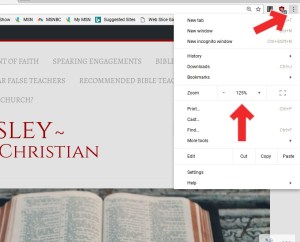
I was wondering if you could post your articles in a larger font. I have an old computer that messes up when I try to make the font bigger. My old eyes are a real struggle.

At first, I thought I was the only one having this problem, but I’ve gotten this question a couple of times, so I know it’s not just my own aging eyes :0)

I’m going to play around with the font a little bit and see if I can find one that’s bigger. Just a few things to understand as I’m working on it: WordPress gives me a limited number of fonts to choose from, and the sizes of those fonts are pre-set. In other words, I can’t set it to 12 point or 18 point, I can only choose from tiny, small, normal, large, and huge. (Right now it’s set on “normal” if you can believe that. “Tiny” is virtually invisible.)

Additionally, when I change the font size, it doesn’t just change the size of the font in the body of my articles, it also changes the size of things like the tags (to the immediate upper left of every article), the sidebar (far left of the page), and the tab titles (top of the page), which, as you can see, are already much larger than the font in the article body. When the font of those texts gets larger, it throws the layout of the whole page out of whack. You might not notice it on a desktop computer with a large monitor, but it can be problematic for people who are viewing the blog on a phone or tablet.

Like I said, I’ll play around with it and see what I can do, but if I’m not able to enlarge the font, there are two workarounds that may help:

1. The reader said she’s unable to change her screen magnification, but it works for me and might work for others. Here’s what it looks like on my computer. Maybe yours is similar:

2. If worse comes to worst, you can highlight and copy the body of the article, paste it into your word processing program, and enlarge the font accordingly.


I have been leading a women’s small group at our church for a couple of years now. My husband and I have decided to leave the church because, even after confronting leadership about the direction the church is being led doctrinally, they continue to espouse unsound doctrine. What do you think is a wise way to tell the ladies I will no longer be teaching? Do I tell them we are leaving? If so, do I tell them why? What do you think you would do?

It’s hard to say exactly what I would do because every situation and every church is different. But I can tell you that the first thing I would do is talk it through with my husband and ask his advice. There have been many times when he has had very good ideas about how to address (or not address) certain issues, and he will sometimes bring out an aspect of the situation that I hadn’t thought of before. I would encourage you to do that first, and also to make sure you’re submitting to your husband in whatever ways might be applicable in this situation.

My inclination is to advise you to take the “the less said, the better” route with regard to the whole class. (There may be other venues, such as you and your husband meeting with the elder board, in which you’ll need to clearly spell out all the problems, but let’s just focus on the class right now.)

I would probably wait until the end of the very last class and say something generic, like, “I’ve really enjoyed leading this class, but I wanted to let you know I won’t be teaching any more. I encourage you to continue studying God’s Word and growing in Christ. Class dismissed.” Then, go home fairly quickly.

The next level is going to be women coming up to you individually and asking why you won’t be teaching any more. Unless she’s a very close friend, I’d still keep it pretty generic: “We love our brothers and sisters at this church, but we’re finding we disagree with some of the doctrine that’s being taught here, and we’ll be going to a new church.”

For very close friends, you might wish to disclose more about the doctrinal problems, but do so wisely, making sure your focus is on doctrine, not on personal conflicts with the pastor or others. You don’t want people jumping to the wrong conclusion about why you’re leaving.

I really would not talk to people about leaving other than discreetly informing those who need to know. If you give details or talk about it a lot there could be an ugly blow up, and most people will make wrong assumptions about why you’re leaving.


Do you have any information on the Orange Curriculum for children’s Sunday School?

The main thing I know about the Orange Curriculum (or Orange Strategy) is that it is put out by Andy Stanley’s “church”. That’s enough for me to warn people to stay far, far away from it. Andy Stanley is a Scripture-twisting false teacher. You don’t want your children being taught by him or his disciples.

My friend Amy Spreeman over at Berean Research was asked the same question by a reader. I refer you to her article, Parents: If your church is “Turning Orange…” for more details.


How would you respond to someone’s who says that [1 Timothy 2:12] was meant only for that time and culture?

It’s one of the most common arguments made by people who are looking for an acceptable way to rebel against God’s clear command, “I do not permit a woman to teach or to exercise authority over a man; rather, she is to remain quiet.” I have never had a woman who was humbly seeking to deny herself and obey Scripture make this argument, only those who stubbornly want to have their own way despite what the Bible says, yet simultaneously want to cloak themselves in the appearance of obeying Scripture.

God gave us His exact reasons for this command in verses 13 and 14 (almost as if He somehow knew this argument was coming!), and those reasons weren’t restricted to the women in the first century Ephesian church. The first reason was the Creative order – Adam was formed first, then Eve. The second reason is that Eve was deceived. Both of those reasons are universal (applying to all women and churches everywhere regardless of era or culture). It makes no sense that these two reasons related to Eve would apply only to first century Ephesus any more than it would make sense for them to apply only to tenth century Damascus or seventeenth century Paris.

Next, examine the context of 1 Timothy 2. There are all sorts of instructions to the church in that chapter. Was the instruction to pray for governmental leaders (1-2) limited to the first century Ephesian church? Were only the men of the first century Ephesian church to pray without quarreling (8)? Was modesty (9-10) only required of women in the first century Ephesian church? Then why pick out this one instruction in verse 12 and claim it was limited to that time and culture?

Finally, look at the overall general pattern of male headship and leadership in Scripture. First human created? A man. The Patriarchs? As the word implies – all men. Priests, Levites, Scribes? Men. Heads of the twelve tribes of Israel? Men. Major and minor prophets? Men. All kings of Israel and Judah? Men. Noahic, Abrahamic, Mosaic, and Davidic Covenants? All established between God and men. Authors of Scripture? Men. The forerunner of Christ? John the Baptist – a man. Messiah? A man. All of the apostles? Men. All of the pastors, elders, and deacons of churches in the New Testament? Men. Founder and head of the church? Christ – a man. Leader and head of the family? Men. Now which fits better with this pattern, women preaching to, teaching, and exercising authority over men in the church, or women not preaching to, teaching, and exercising authority over men in the church?

But the truth is, you can have all the biblical evidence in the world, and it’s not going to convince someone who’s in rebellion against Scripture because self is reigning on the throne of her heart. She’s not concerned with actually obeying God’s Word, she just wants to be able to claim that Scripture supports what she wants to do, either to look good to others or to attempt to drown out the Holy Spirit’s conviction of her sin.

Additional Resources:

Jill in the Pulpit 

Ten Things You Should Know About 1 Timothy 2:11-15 and the Relationship Between Men and Women in the Local Church at The Council on Biblical Manhood and Womanhood (CBMW) This is a refutation of the most common egalitarian arguments against the plain meaning of 1 Timothy 2:11-15.


If you have a question about: a Bible passage, an aspect of theology, a current issue in Christianity, or how to biblically handle a family, life, or church situation, comment below (I’ll hold all questions in queue {unpublished} for a future edition of The Mailbag) or send me an e-mail or private message. If your question is chosen for publication, your anonymity will be protected.

Complementarianism

Seven Reasons 1 Timothy 2:12 Isn’t the Crazy Aunt We Hide in the Closet when Company Comes Over

A while back I was scrolling through my Twitter feed and happened to catch part of an interaction between two women discussing a false teacher. I couldn’t come close to the exact wording if I tried, but the gist of it was…

Discerning Christian Woman: Divangelista X is a false teacher and preaches to men.

Non-Discerning Christian(?) Woman: How can you say she shouldn’t be preaching to men? So what! She’s out there helping so many people and charitable causes! People love her! I think she’s great!

Discerning Christian Woman: Well, I’m really not as concerned about the fact that she preaches to men as I am about the false doctrine she teaches.

I didn’t butt in because neither of them was talking to me, but what I wanted to say was, “Why?” Why, Discerning Christian Woman, did you back off the completely biblically valid point that this false teacher is rebelling against Scripture by preaching to men? If you had been discussing a male false teacher who was running around on his wife, you probably would have led your argument against him with his sin of adultery, with the false doctrine he teaches relegated to a level secondary importance.

Ladies…pastors…why are we so embarrassed to stand up boldly and say that women who preach to men are in unrepentant sin and disqualified from teaching regardless of what their doctrine might be?

It’s a simple little thing called the fear of man. Or, more specifically, fear of woman. We’ve seen women whose feminist ideals are challenged. Even feminists who call themselves Christians have been known to fly into a demonic rage, bent on destroying any person, pastor, or church who dares to topple their golden “I am Woman, Hear Me Roar” calf. No one wants to be on the receiving end of that kind of vitriol.

We’re more afraid of the wrath of woman than the wrath of God.
And shame on us for that.

God doesn’t call us to be wimps, people. He calls us to stand on His Word no matter the cost. The great men and women of the faith who have gone before us have done just that, giving their lives rather than renouncing Christ, refraining from sharing the gospel, compromising the Lord’s Supper, quitting work on translating of Scripture into the language of the people.

And we’re worried that feminazis might yell at us or make trouble at church.

We need to stop blushing ashamedly at crazy Aunt 1 Timothy 2:12’s socially unacceptable brazenness and stand unapologetically firm when it comes to denouncing female teachers who preach to men. Here are seven reasons why:

1.
Women preaching to men is personal sin.

When a woman takes it upon herself to disobey Scripture by preaching to men, she is sinning. If we’re the Christians we claim to be, how can we see someone mired in sin and not want to rescue her? It is not loving to ignore someone’s sin, or worse, affirm her in it. To do so is the ultimate act of selfishness, because we’re more concerned about the the consequences for confronting her and how that will affect me than we are about her soul and her relationship with Christ. John 15:13 says, “Greater love has no one than this, that someone lay down his life for his friends.”. Sometimes laying down your life means dying to self and confronting sin out of love for someone else.

2.
Women preaching to men is public rebellion.

When a woman stands up in front of a group of men and women and unashamedly preaches to them, she is initiating a public act of aggression against Christ and His church.

I don’t care how sweet and pretty and “aw, shucks” she is – that’s what she’s doing. She is leading a rebellion against God’s clear command for all the world, and the church, to see. This is a blot on the reputation of Christ’s Bride whom He wishes to be “holy and without blemish“.  Christians are people who submit to and obey Christ, not leaders of rebellions against Him.

3.
Women preaching to men is itself false doctrine

She may not say it with her lips, but when a woman preaches to men in defiance of Scripture, she’s teaching false doctrine through her behavior. What is the false doctrine she’s teaching? “I don’t have to obey God’s Word, and neither do you. If there’s a part of the Bible you don’t like, you’re free to disregard it.” If your pastor stood up in the pulpit on Sunday morning and said that in words, you’d run him out of town on a rail, and rightly so. Neither should a woman be able to teach that same false doctrine via her actions. Call it antinomianism. Call it whatever you like. But it’s one of the oldest and most fundamental false doctrines.

4.
Women preaching to men undermines
the authority of Scripture.

Christians are “people of the Book.” We are to live under the authority of the written Word of God breathed out by the Holy Spirit. Those who truly love Christ love His Word and want to be obedient to it. When a woman preaches to men in defiance of God’s Word, she is stating with her actions that Scripture has no authority over her. That she can do whatever she wants regardless of what God has spoken. Those who follow her learn, “I am the authority in my life, not God.”

5.
Women preaching to men is God’s
judgment on the church.

My people—infants are their oppressors,
    and women rule over them.
O my people, your guides mislead you
    and they have swallowed up the course of your paths.
Isaiah 3:12

The fact that God allows a thing to take place in no way indicates that He is pleased with it. When God allows people to persist in sin, it’s not that he’s blessing that person or church, but that He’s giving them over to sin in judgment.

And since they did not see fit to acknowledge God,
God gave them up to a debased mind to do what ought not to be done.

Romans 1:28

(To the church at Thyatira)
But I have this against you, that you tolerate that woman Jezebel, who calls herself a prophetess and is teaching and seducing my servants to practice sexual immorality and to eat food sacrificed to idols. I gave her time to repent, but she refuses to repent of her sexual immorality. Behold, I will throw her onto a sickbed, and those who commit adultery with her I will throw into great tribulation, unless they repent of her works, and I will strike her children dead. And all the churches will know that I am he who searches mind and heart,
and I will give to each of you according to your works.
Revelation 2:20-23

6.
Women preaching to men undermines
God-ordained male authority.

Jesus Christ is the head of the church. That means He gets to make the rules for it, not us. And one of His rules is that men are to be the pastors, elders, and those in authority, not women. When women try to push themselves into positions designed for men, it waters down and cheapens the beauty of male leadership the way God designed it, just as it would if men tried to push their way into the roles God has designed for women. And just as a woman would feel disenfranchised if a man tried to usurp her position as an older woman teaching younger women (Titus 2:3-5), biblical pastors perceive the threat to their God-given authority as more and more women take the pulpit.

7.
Women preaching to men is
an indicator of further false doctrine.

I have researched dozens of female teachers, and every single one of them who unrepentantly preaches to men also teaches other forms of false doctrine (usually Word of Faith {prosperity gospel} or New Apostolic Reformation). Every. single. one. If you see a woman unrepentantly preaching to men, that is God’s warning signal to you to stay away before you’re engulfed in even more false doctrine. Refusing to speak out against women preaching to men is to put fellow Christians in a gasoline-doused house of straw without a fire detector. It forces them to stop and search for the fire or examine it to see if it really is a fire – which could end up getting them killed – whereas, if they had a fire detector they would know to make an immediate exit.

First Timothy 2:12 is not the “crazy aunt” of the family of God.

Every family has that one crazy relative that you just pray will act normal for once – or that you could lock her in the closet – when company comes over. (In my family, I’m pretty sure that’s me.) First Timothy 2:12 is not the “crazy aunt” of the family of God. There’s no need to be embarrassed about putting her front and center for the world to see. She is beautiful and precious and serves an important purpose for God’s glory and our good. Let’s let her out of the closet and be proud of her.

Christian women, Complementarianism

Women Teaching Men: My Thoughts on Aimee’s and Mary’s Articles

aimee mary

UPDATE: Please note, this article was written in 2016. It should not be construed to be a current endorsement of either Aimee or Mary.

My friends and readers are the best. They are so sweet and helpful when it comes to making sure I stay up to date on what’s happening out there in Evangelicaland. It’s like having a little army of really smart co-laborers who are great at research.

Last week, a couple of articles about women teaching men appeared on the Reformed complementarian women’s landscape, and several folks were kind enough to send them to me and ask for my reaction. I e-mailed the readers back with my responses, which I’ve posted below.

What is Sunday School? What Does it Appear to Be? And Who Can Teach It?
by Aimee Byrd
May 18, 2016

I have loved and respected Aimee’s work as a writer and podcaster for a while. This article was apparently written to clarify some things that had been said on a Mortification of Spin podcast.

“I didn’t catch the podcast, but I did read the article. I was disappointed with what Aimee said, because Steve’s comments [Steve Cooley’s comments in the comment section following the article] are correct. Also, if we look at the broad pattern of male headship in Scripture…

man was created first, then woman
woman was created to be helper to man
women are to submit to their husbands
women are not to serve in the office of elder or pastor
women are not to preach to men
women are not to exercise authority over/lead men in the church

…which fits better with this pattern, women teaching men in co-ed Sunday School or women not teaching men in co-ed Sunday School? I think it’s pretty clear that women not teaching men in co-ed Sunday School fits best. Why would God set this pattern of male headship in motion and then turn around and contradict it when it comes to women teaching men in Sunday School?

Furthermore, the gathering of a body of believers for studying the Bible is the gathering of the church, whether it is in someone’s home (like the first century church), a sanctuary, or a Sunday School classroom. We’re the ones who have invented all these lines of delineation between Sunday School, worship service, Christian conferences, revival meetings, etc., and then tried to go back and figure out which of these man-made distinctions 1 Timothy 2:12 applies to. When 1 Timothy was written, they didn’t have all that. The church was just the gathering of the believers for worship, study, etc. So 1 Timothy 2:12 applies to the gathered body of believers without respect to all these artificial lines we’ve drawn.”

Again, I have great respect for Aimee, but I disagree with her on this particular issue. It’s possible that the differences in our denominational viewpoints of Sunday School play a big part in this, and that if we ever had the chance to sit down and hash it out over coffee or something, we might find more common ground.

Women Teaching Men- How Far is Too Far?
by Mary Kassian
May 21, 2016

I’m not as familiar with Mary as I am with Aimee, but I’ve read and enjoyed a few of her articles. This one may have been a response to Aimee’s article above.

“Good stuff! I agree with her about 90%. I love that she brought out the part about “teaching under a man’s authority.” I wrote about that not long ago. It’s nice to hear somebody with a bigger platform say it. I hope people will listen to her!

I also love what she says about what we love versus following a set of rules. So true! Another aspect of this that I run into frequently with women who want to preach is that they’re so focused on leading they forget about Jesus’ example of humility in servanthood. We’re supposed to be focused on serving, not gaining notoriety.

My main disagreement with her would be the line she (and most others who address this issue) draws between the worship service and things like Sunday School and Christian conferences. Those are really man made lines of distinction rather than biblical ones. The “church” is the gathered body of believers for worship and biblical instruction. So whenever believers are gathered for those purposes – whether we call it Sunday School or worship service or a Christian conference, and whether it’s in a sanctuary, Sunday School classroom, or conference center – that’s the church, and the Scriptural mandate for women not to teach or hold authority over men applies.

I also think it’s interesting that in the second paragraph under “Can Women Teach Under Male Authority” she rightly points out, “The text doesn’t say, ‘A woman may teach men if…'”. But then later in the article she talks about how she feels it’s OK for her to teach men if they’re much younger than she is. Well, just like the text doesn’t say a woman can teach men if she’s doing so under male authority, it also doesn’t say it’s OK for a woman to teach men if she’s much older than they are. It just says “don’t”. Curious.”

Mary’s position on this issue is much more similar to mine. I hope to hear more from her about this in future articles.

Complementarianism

Fencing Off the Forbidden Fruit Tree

Often, with regard to 1 Timothy 2:12, husbands and pastors will reassure a woman that it’s OK for her to teach that co-ed Sunday School class or step into a church leadership role reserved for men because she’ll be doing so “under his [husband’s or pastor’s] authority.”

But is that biblical?

When God tells us (in context, rightly handled, of course) not to do something and we do it anyway, that is sin. Only God has the authority to say what is sin and what is not. No one – not your pastor, your husband, your parents, your best friend, the Pope, nobody – has the authority to tell you that it’s OK to do something God has said is sin. That authority belongs to God alone.

Try inserting any other sin into that situation. Does your husband, pastor, or anyone else have the authority to tell you it’s OK to lie? Cuss? Covet? Of course not. And why would they even consider doing such a thing?

My point exactly.

The issue here is that this particular sin (teaching/exercising authority over men) has become so acceptable in the church that we no longer even see it as sin. If your husband or pastor gave you the go ahead to preach to or teach men in the gathered assembly of the church body, and you were to ask him to show you in Scripture where God says it’s OK for him to allow you to do that, he would quickly realize that he is not basing his decision on Scripture (because there is no Scripture that allows him to give you that permission), but on his own personal opinion that it’s OK. And that opinion has been heavily influenced by the fact that this sin is now so widely acceptable in the church at large.

Beth Moore is a perfect example of why husbands and pastors should not allow or encourage women to violate God’s word by teaching men. Beth Moore started out teaching a women’s Sunday school class in her home church. It grew. Men wanted to attend the class (a problem I’ve addressed here). She was hesitant, so she talked to her husband and pastor about it. They both told her it was OK because she would be teaching the men “under their authority” (despite the fact that there’s no passage of Scripture that allows them to say that or gives them the right to lay some sort of “mantle of authority” on her) That initial compromise led to another and another. Fast forward to today, and this is still the argument Beth Moore – in all of her false doctrinal glory – uses for preaching to men if she bothers to defend herself at all. And she has influenced thousands of women (and their husbands and pastors) to do the same.

But it doesn’t matter how sound our doctrine is, when women stand in front of co-ed groups and teach (or accept positions of authority over men in the church) we are teaching more than just what’s coming out of our mouths. We’re teaching that group of people by example that it’s OK for women to teach men. That God’s Word can be ignored and disobeyed in this area while we stand there urging them to obey it in other areas. How can a woman exhort a group to obey God while she is standing there disobeying Him herself?

It’s my prayer that we’ll begin to see more husbands and pastors uphold God’s Word and protect their wives and female church members from sinning by encouraging them to fulfill all of the wonderful roles God has for women in the church and by fencing off that one tree in the garden that bears the forbidden fruit of teaching and exercising authority over men.

Adapted from a Facebook mini-blog.

Additional Resources:

Rock Your Role

Rock Your Role: Jill in the Pulpit

Rock Your Role FAQs

The Mailbag: Counter Arguments to Egalitarianism

The Mother of All Rebellions: Having a Woman Preach on Mother’s Day