It’s almost the new year! Are you making a resolution to start having a personal, daily Bible study time? Would you like to improve on the way you study your Bible? Maybe you’re looking for a Bible reading plan, or maybe you’re just looking to change things up a little?
If that sounds like you, give a listen to this December 2020 episode of A Word Fitly Spoken:
Amy and I discuss what our own Bible study times look like, plus some other helpful methods and resources. We also discuss false doctrine and false teachers to avoid as you’re studying your Bible.
This episode is a great way to kick off the new year. And don’t forget to subscribe to A Word Fitly Spoken on your favorite podcast platform!
Remember Anna? She’s one of our often overlooked sisters from Scripture. As with Elizabeth, we don’t usually hear much about Anna, except sometimes, once a year, at Christmas.
When Jesus was about a month old, Mary and Joseph took Him to the temple to fulfill the requirement of the Levitical law of purification. And that’s where they encountered Anna.
Now, just a little lagniappe here, the purification ceremony where we meet Anna was completely separate from Jesus’ circumcision ceremony.
Circumcision took place when the baby was eight days old, probably in the parents’ home or possibly in the local synagogue (the synagogue was sort of a “branch campus” of the temple in towns that were outside of Jerusalem). Mary would not have been able to enter the synagogue in Bethlehem or the temple in Jerusalem for Jesus’ circumcision since she would still have been ceremonially unclean from His birth.
The purification ceremony that made her ritually clean again took place when Jesus was 33 days old at the temple in Jerusalem. A sacrifice was offered for Mary’s cleansing and Jesus was dedicated to the Lord. (see Leviticus 12)
I spell this all out because, if you’re like me, and you hear the Luke 2 account of Jesus’ birth every year, you tend to let it wash over you without really thinking about it. I never really gave much thought to the fact that these were two different events in two different places until I was studying about Anna.
And Luke 2 presents all of these events in kind of a machine gun fashion so it can practically feel like everything in that chapter is happening on the same day, and we can conflate things we shouldn’t. For example, many people think that Simeon and Anna were married just because their stories appear back to back in Luke 2. As we’re about to see, that wasn’t the case.
Let’s take a look at Anna’s story:
And there was a prophetess, Anna, the daughter of Phanuel, of the tribe of Asher. She was advanced in years, having lived with her husband seven years from when she was a virgin, and then as a widow until she was eighty-four. She did not depart from the temple, worshiping with fasting and prayer night and day. And coming up at that very hour she began to give thanks to God and to speak of him to all who were waiting for the redemption of Jerusalem.
Luke 2:36-38
Anna had a lot of strikes against her in life:
She was a woman. In Anna’s day, women were “low man on the totem pole” so to speak. They were regarded as less than men in practically every way- intelligence, abilities, worth, and so on. They couldn’t testify in court because their testimony wasn’t considered credible. And, maybe you’ve even heard of the daily prayer that Jewish men still say today, thanking God for not creating them a gentile…a slave…or a woman.
She was a widow, and possibly childless. A woman of that time without a husband or grown children to take care of her would have been in very real danger of poverty.
She was old. Average life expectancy in Anna’s day was 55. She was 84. When you’re 84 in ancient times with no modern medicine, you’re feeling it.
So, Anna was a woman, she was a widow, and she was old. She had some disadvantages. But Anna didn’t let those things stop her from serving the Lord full throttle. In fact, she took some of those supposed disadvantages and put them to work for her.
Anna didn’t let disadvantages stop her from serving the Lord full throttle. In fact, she took some of those supposed disadvantages and put them to work for her.
If Anna had had a husband to care for or children to raise, she wouldn’t have had the time or the energy to serve the Lord full time. And she wouldn’t have had the opportunity either, because no one in that culture would have thought it appropriate for a woman with a husband and children to abandon them to stay in the temple.
Also, in a culture that respected its elderly, it’s likely that more people – especially younger women – would have listened to her than if she had not been so advanced in years.
So Anna turned these disadvantages into opportunities. And what did she do with those opportunities? She used them to serve God and to tell people about Jesus.
That’s what the Christian life is all about – serving God and telling others about Jesus – whatever your station in life.
Maybe you’re single like Anna, and God has blessed you with the time and freedom to serve Him full time – or at least fuller time than you’d otherwise be able to.
Maybe you do have a husband and children- and God has given you the opportunity to serve Him by serving them: pouring the gospel into your children, being a godly helpmate to your husband, and being a faithful, serving member of your church.
Maybe you’re older, and instead of using your golden years for travel or hobbies or shopping, God is leading you to teach younger women or throw yourself into ministry in some way.
Anna’s example to us is to bloom where God plants us and grab hold of every opportunity to serve Him and tell others about Jesus.
Anna’s example to us is to bloom where God plants us and grab hold of every opportunity to serve Him and tell others about Jesus.
As Christian parents, is it OK for us to tell our children about Santa Claus?
Christmastime can be so much fun when you have children. Many of us remember the excitement of Santa, the Christmas tree, and presents from our own childhood. They’re happy memories, and we want to recreate those for our children.
But as Christian parents, our first priority isn’t fun, it’s obedience to Scripture. Yet is there a way to make Christmas merry for our children while still upholding God’s Word? Is Santa patently unbiblical?
No, he doesn’t have to be, as long as he keeps his sleigh parked inside the parameters of Scripture. Let’s take a look at some of the ways Santa can be unscripturally naughty, and how godly parents can keep him nice and biblical.
Santa Claus isn’t real. If you tell your children he is, or that he is the one who brings their presents, or that he knows whether they’ve been naughty or nice, you’re lying. The Bible says that lying is a sin, period. There’s no exception for jolly old elves who pass out toys (or for tooth fairies or Easter bunnies, either, for that matter). And not only is lying a sin, it is extraordinarily hypocritical to lie to your children about Santa Claus and then turn around later and punish them when they lie about something. Lying to your children about Santa Claus teaches them that it’s OK to lie (i.e. sin) when you want to or when it would be to your advantage.
Don’t lie to your children about Santa Claus. Tell them the truth: he’s a fun, fictional character that we can enjoy reading stories and singing songs about, just like Goldilocks or Superman or Old MacDonald. As for the presents, maybe you’d like to handle it similarly to the way my husband and I did with our children. When they were very small, my husband or I would don a Santa hat on Christmas Eve and say something like: “You know how you like to play pretend? Well, mommies and daddies like to play pretend, too, especially at Christmas! Now it’s time for you to go to bed so we can pretend to be Santa Claus.”
Santa Claus isn’t omniscient.
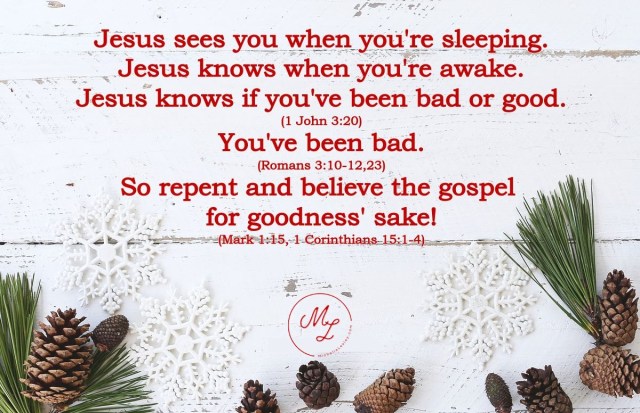
He sees you when you’re sleeping He knows when you’re awake He knows if you’ve been bad or good So be good, for goodness’ sake!¹
Uh uh. No way. Omniscience is an incommunicable attribute of God. He is the only One who has the power to see and know all things, and it is an insult and an affront to Him to even suggest that a mere mortal – let alone a fictional character – has the same power and knowledge that He has. In reverence and awe for God’s preeminence, we should never ascribe to others the things that belong to God alone.
Teach your children about the attributes of God. When you read your children stories about Santa Claus or hear Santa Claus Is Comin’ to Town on the radio, it’s a perfect opportunity to teach them about God’s omniscience and power. “Did y’all just hear that? That song said Santa Claus can see you and knows how you’re behaving. Is that true? Who is the only One who always sees you, cares for you, and knows what you’re doing and thinking? Can anybody else besides God do that?”
Santa Claus teaches works righteousness. In St. Nick’s economy, good behavior earns a reward (presents). Bad behavior earns punishment (coal). If you’ve ever shared the gospel with anybody, that will probably sound familiar. Most lost people think that’s what Christianity is. If you’re a “good person” God is happy with you and you’ll go to Heaven. Hell is the punishment for “bad people”: Hitler, murderers, and rapists. This is not what the Bible teaches, either about salvation, or about why children should obey their parents.
Teach your children the gospel. Again, this whole “naughty or nice” part of the Santa Claus narrative is a perfect gospel-teaching opportunity. Take advantage of it! Ask your child to be “nice” for one whole day. At bed time, take a few minutes to talk about the times she messed up and was “naughty” when she was supposed to be trying to be “nice.” Nobody can be nice and obedient all the time, no matter how hard we try. We are all naughty – sinners with coal black hearts deserving the punishment of Hell. Jesus came and lived a life of perfect “niceness” (obedience), died on the cross to take the punishment for our naughtiness, was buried, and rose again. He did that, not because we earned it with good behavior, but because of His mercy and grace. And then He gave us the greatest gift ever. A gift we naughty people don’t deserve: salvation and eternal life in Heaven. And it is because of our love and gratitude to Christ for saving us that we obey Him, not so that He will give us what we want. Indeed, the Bible tells us that the more obedient to Christ we are, the more persecution we will face.
Santa Claus doesn’t automatically have to be on the Christian parent’s naughty list. There are lots of ways to enjoy the fun of Santa and even turn him into an opportunity to teach your child biblical truth, all while being obedient to Scripture. But if Santa makes you biblically uncomfortable in some way, then by all means, don’t go against your conscience. Whichever way you decide – after prayer, study of the Scriptures, and discussing it with your spouse – do not judge other Christian parents by your personal convictions about Santa Claus.
Any advice for grandparents about Santa? Our son wants our grandchildren to believe in Santa. How do we respond to a grandchild who asks of the reality of Santa? I will not lie, but I want to keep peace with my son.
Thank you for being a godly grandma!
I think the solution to this dilemma is going to start with being a godly mom. Is your son a Believer? If so, you might want to show him all of the information above and talk to him about any Scriptures he’s violating. Let’s pray that will be convicting to him and he’ll decide to handle Santa in a godly way with your grandchildren.
But if he’s not convinced, or if he’s not a Believer, talk to him about your convictions about not lying to his children. Explain the difficult position he’s putting you in. He’s essentially asking you to choose between pleasing him by sinning (lying) or pleasing God by not sinning.
If he still won’t relent, the only solution I can see that keeps you from sinning yet doesn’t go against your son’s wishes is to put it back on him. When your grandchild comes to you and asks, “Grandma, is Santa Claus real?” you reply, “That’s a great question, but I think you should ask your mom and dad about that. How about some hot chocolate?”.
Your son made this bed. You shouldn’t have to lie in it.
¹Santa Claus Is Comin’ to Town. John Frederick Coots and Haven Gillespie, 1934.
If you have a question about: a Bible passage, an aspect of theology, a current issue in Christianity, or how to biblically handle a family, life, or church situation, comment below (I’ll hold all questions in queue {unpublished} for a future edition of The Mailbag) or send me an e-mail or private message. If your question is chosen for publication, your anonymity will be protected.
Do you know of any Biblically sound books that will help teach a 3 yr old how to have a grateful heart? My daughter is trying to cultivate that in my 3 yr old grandson.
Awww, how sweet! What a blessing that he has a godly mommy and Grammy (or Mimi or Mamaw or…).
My youngest child is 18 so I’m not familiar with whatever is currently popular and available, although I’m sure there are some good, doctrinally sound children’s books out there. (Readers, if you have any suggestions, let this sister know in the comments.)
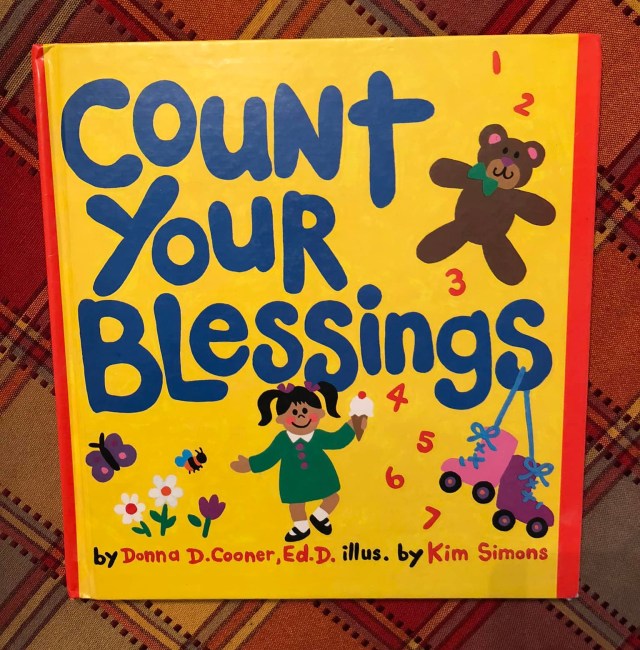
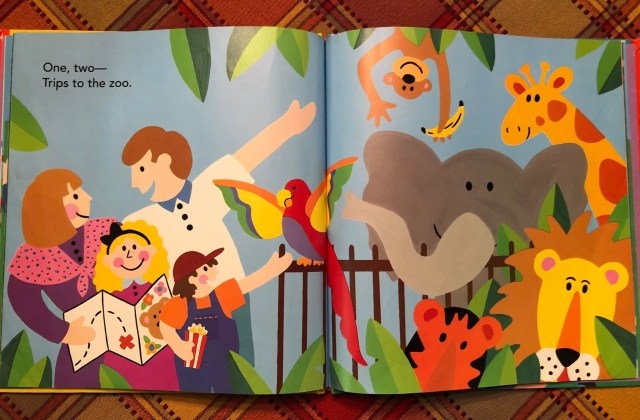
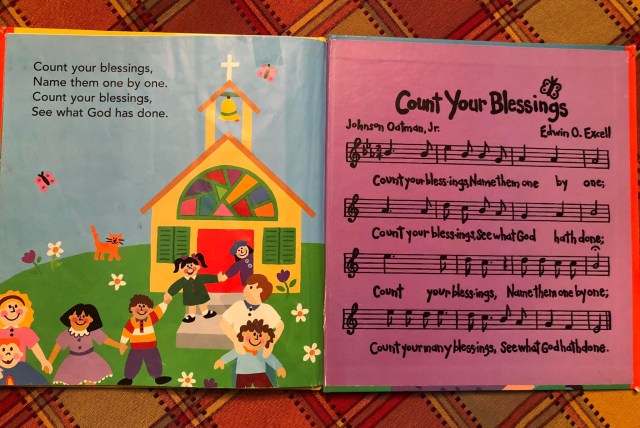
But if you’ll indulge me a trip down memory lane to wallow in sentimentality for just a moment, this was my daughter’s favorite book when she was a toddler (and all her little brothers loved it too!). It combines counting skills, thankfulness, and a hymn – pretty great, if you ask me!
Count Your Blessings by Donna D. Cooner, 1995
Now, it’s just sitting in my closet waiting for my grandchildren to enjoy it…❤
If you decide to buy some toddler books on gratitude, I would just caution you to vet the authors of any book you’re considering just like you would vet the author of a book for adults. There are many false teachers – Priscilla Shirer, Sarah Young, and Sheila Walsh just to name a few off the top of my head – who have branched out into writing children’s books.
But honestly, I think this is a great opportunity for you and your daughter to start teaching your grandson the Bible, Scripture memory, and prayer as it relates to being grateful to God.
This is a great opportunity to start teaching your child the Bible, Scripture memory, and prayer as it relates to being grateful to God.
Read some stories about people in the Bible who were thankful – the thankful leper, Zacchaeus, Noah, Daniel, rebuilding the temple…really any story in which God acts, provides, or protects and people thank Him for it – and ask a few simple questions.
What did the main character in the story need or ask God for? What did God do?
What did the main character say or do when God acted, provided, or protected?
Has God ever acted, provided for, or protected you like that? How can we tell Him thank you?
Grab your concordance and look up some words and phrases like “give thanks“. Find a simple verse(s), talk about what it means, and practice saying it together. You might be surprised at just how quickly he can memorize those verses! The Bible verse memes in my article Top 10 Bible Verses on Giving Thanks are perfect for printing out or copying to your phone or tablet for this.
Another way to reinforce giving thanks to God is through music. You may find something helpful at Seeds Kids Worship, or just create your own playlist on your favorite music platform.
One way I helped my children remember to be thankful (and let me tell you, it didn’t just help my children!) was with a simple little game I called The Gratitude Game. It’s kind of like playing “I Spy.” Just look out the window when you’re driving around in the car, or look around as you’re taking a walk, and take turns thanking God for what you see: “Thank You, God, for making birds.” “Thank You for ice cream.” “Thank You for police officers who help us.”
Be sure to model thankfulness, too. When you or your daughter say bedtime prayers or the blessing before meals with your grandson, be sure to spend some time thanking God for things and acknowledging Him as provider, protector, the Giver of blessings, and so on. Remark thankfully on various things throughout the day: “I’m so thankful God gave us a warm day to play outside,” “Thank you, God, for sending the ice cream truck our way!” Also make sure you’re showing gratitude to people. Set the example for your grandson of saying “Thank you,” sending thank you notes or gifts, and demonstrating appreciation for others.
Books can be fun and helpful, and I hope you find a good one for your little sweetie, but you can’t beat stories and activities that center on Scripture itself.
When it comes to teaching your little ones gratitude, you can’t beat stories and activities that center on Scripture itself.
If you have a question about: a Bible passage, an aspect of theology, a current issue in Christianity, or how to biblically handle a family, life, or church situation, comment below (I’ll hold all questions in queue {unpublished} for a future edition of The Mailbag) or send me an e-mail or private message. If your question is chosen for publication, your anonymity will be protected.
1. Was there anything new God taught you in this study that particularly impacted you? What was it, and why was it so significant?
2. How is your walk with the Lord different after this study than it was before?
3. What are the reasons for, and the consequences of, “Everyone did what was right in his own eyes”? What are the implications of this mindset and posture of heart for God’s people, both individually and as the church, today?
4. What did you learn about idolatry and syncretism from this study, and how can you apply this to the church and Christian organizations?
5. What did this study teach you about trusting and obeying God?
6. Have there been any passages or concepts in this study that God used to convict you of disobedience and lead you to repentance? How will you walk differently in this area from now on?
7. What did this study teach you about the character of those who lead God’s people?
8. What have you learned about God and His nature and character from this study?
Homework
Spend some time in prayer this week asking God to show you how to put into practice one thing you learned from this study.
Recite all of your memory verses from this study. Which one is most meaningful to you right now?