It’s almost Valentine’s Day, and you’re probably getting bombarded from every angle with the world’s idea of love, romance, and marriage. But what does the Bible have to say about that? And how about some “been there, done that” godly counsel from your older sisters in Christ?
Between us, my A Word Fitly Spoken podcast co-host, Amy Spreeman and I have over 60 years experience as wives. We recently sat down and recorded Love and Marriage, an episode about biblical love and godly marriage. Have you listened yet?
You might also enjoy some of my articles on marriage:
“I’m so tired of flowers,” sighed the elderly woman in the TV commercial as my jaw hit the floor. She had just described how her husband of fifty years, seated next to her, brought her flowers on their first date, and every year since had given her the same bouquet on that day.
And she was tired of flowers.
It wasn’t enough that she had a husband who stayed with her for fifty years. Or that he actually remembered the day of their first date every year. Or that he was caring enough to send her flowers on that date. Or that he was sentimental and romantic enough to send her the same flowers every year.
No. She was tired of flowers. She wanted the product the commercial was trying to sell.
I wanted a shoe to throw at the TV.
My husband brought me flowers today. I know, in the picture they look rather more like birthday candles than flowers. That’s because, technically, my flowers were birthday candles.
I was getting ready for our youngest son’s birthday party. I had already made a trip to the store and thought I had everything I needed. Until I discovered I was nearly out of baking powder. My husband was out running errands, so I sent him a text asking if he could pick some up for me. He did. No problem. Until I remembered I didn’t have any candles for the birthday cake. And he had already left the store. And it was raining.
“And it was raining.” I say that like it’s just so pedestrian, like it’s some normal, everyday thing, which, in south Louisiana in June, I assure you, it is not. Every day, yes. Normal, no. Remember that scene in one of those ’90’s “asteroid crashes into the earth” movies where the asteroid has just hit and the man and his daughter are standing on the beach watching the huge resulting tidal wave roll in to engulf them? Well if, instead of the beach, you can imagine yourself trying to navigate a WalMart parking lot with a buggy full of groceries and four kids in tow in the middle of that tidal wave, you’ll have some idea of what monsoon season is like down here.
And you know what my husband did when I asked him to go get birthday candles in that mess? He did it gladly. No complaints. No asking, “Why didn’t you think about this sooner?” He just walked in the house, soaked and smiling, and handed me the candles.
No bouquet could have been better.
Ladies, my husband has a lot of faults. I’ll bet yours does too. Because just like us, they’re sinful human beings. Often, like the lady in the commercial, we trample over a dozen roses to plant our feet in a briar patch. We overlook the ways our husbands are a blessing to us and focus only on our complaints.
Maybe he didn’t get you exactly what you wanted for your birthday, but does he work hard every day to support your family? So, he didn’t notice your new haircut right away. Does he give the kids their bath every night? Yes, his dirty socks are constantly on the floor in front of the hamper, but didn’t he change the oil in the car yesterday?
1 Thessalonians 5:16-18 says:
Rejoice always, pray without ceasing, give thanks in all circumstances; for this is the will of God in Christ Jesus for you.
The next time you’re tempted to complain about your husband’s shortcomings, why not praise God instead for a way that he has blessed you or done something admriable? And let’s make sure to thank our husbands for those little “flowers” they bring us every day.
Welcome, ladies! Just a reminder, please do not skip Lesson 1 from last week (link below). Not only will it answer any questions you may have about the study itself, but if you want to study Psalm 119 properly, you must do the background work contained in Lesson 1.
1. Review your notes from last week’s introductory lesson. What are some things to keep in mind as you begin to study the text of Psalm 119 today?
As you study, it will probably help you grasp and absorb the psalmist’s meaning better if you read in complete sentences instead of stopping at the end of each verse. For example, notice the comma at the end of verse 2. Verse 2 is not the psalmist’s complete thought. Read all the way through to the period at the end of verse 3, and consider verses 2 and 3 together as the complete thought.
2. List all the synonyms for “Scripture” in this text. How many of the verses in this passage contain a term that means “Scripture”? How would you define each of these terms? Are there subtle shades of difference in what these various terms mean? (You may wish to use a lexicon such as Strong’s to check your work after you have defined these words.) Why would the psalmist choose so many different words that all essentially mean “Scripture”?
3. Do verses 1-3 remind you of another passage of Scripture? How are these verses structurally different from those verses? Why, how, and for what is a person blessed in verses 1-3? What does it mean for a person’s way to be “blameless”? (1)
4. What is the orientation of the psalmist’s heart toward keeping God’s law? Does he view it as a drudge and a burden? Does he want to obey God’s Word, or does he grudgingly do it because he has to? Which words and phrases from today’s passage support your answers? How does this compare to the New Testament’s view of obedience to Scripture? What is the orientation of your heart toward obeying Scripture?
5. How does the psalmist’s love for Scripture, and for obeying Scripture, impact his worship of God (7,12) and his love for God? Which words and phrases from today’s passage support your answers? How does this compare to the New Testament’s view of obedience to Scripture being an indicator of one’s love for God? What does your level of obedience to Scripture and your attitude toward obeying Scripture say about your love for God? Is your love for God reflected by your obedience to Scripture? Explain, in your own words, the relationship between loving and obeying Scripture and loving and obeying God.
6. Which parts of today’s passage can you accomplish in a way that’s pleasing to God withoutthe indwelling and empowering of the Holy Spirit? Is it possible for a lost person to truly love and obey God’s Word? Is it possible for a saved person not to truly love and obey God’s Word? What does this tell you about people who claim to be Christians, yet live in unrepentant sin, or have an unbiblical worldview?
7. Notice the verses that mention body parts (eyes, heart, etc.). How does the psalmist use or relate each of those body parts to his love for Scripture? How does this reflect the idea that love for God isn’t just a private feeling we have internally, but that we use our bodies to love God externally by acting in obedience?
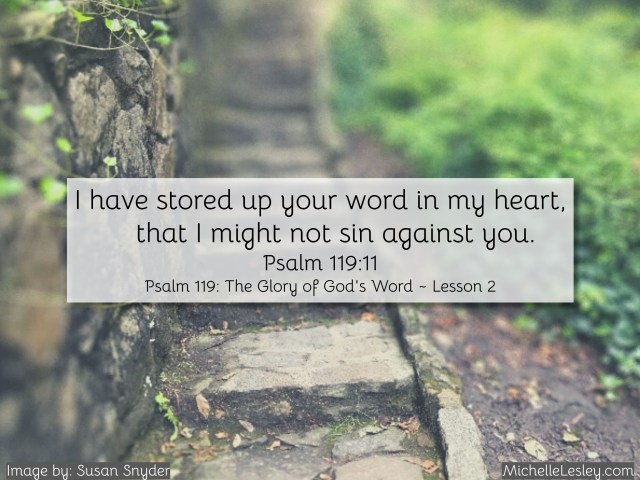
8. How does storing up God’s Word in our hearts guard us against sin? (11) How can we be intentional, purposeful, and proactive about storing up God’s Word in our hearts?
Have you ever tried praying the psalms? I want to encourage you to try praying part of Psalm 119 back to God each week of this study. (If you’re familiar with my other studies, this will take the place of the weekly “Homework” section.)
The psalms are uniquely suited for praying back to God, both verbatim and conceptually, because they are often written as prayers – as though the psalmist is talking to God. Did you notice that about today’s passage? In which verses?
What is a concept or thought for your own life that the Holy Spirit impressed on your heart or convicted you about from today’s passage? Is there a particular verse(s), or maybe the whole passage, that you would like to pray back to God verbatim? Whatever your “prayer point” from today’s lesson, pray it at least daily until we get to the next lesson.
Can you stand one more piece on Redeeming Love? I don’t often jump on evangelical bandwagons, because, usually, by the time I’ve taken time to research and give serious thought to whatever the bombshell du jour is, other people have already said everything that needs to be said about it, and they’ve said it better than I can. Why add to the noise, right?
This time, even with everybody and her dog reviewing Redeeming Love, I’m not necessarily finding that to be the case. In fact, I’ve read, listened to, or watched half a dozen or so reviews of Redeeming Love from sources that seem to be trustworthy, and I’ve been disappointed in many of them.
But before I get too far ahead of myself, give me just a sec to set the stage…
All the Disclaimers and Caveats…
❦ This article contains spoilers. The book has been out since 1991 (longer than some of you have been alive), the movie has been in theaters since January 21, and the internet is glutted with reviews, so I’m not going to worry about spoilers, and this article is geared toward those who are at least familiar with the story line of Redeeming Love. If you have somehow managed to escape the details of the book and/or movie and you don’t want to know what’s in it, stop reading now.
❦ I am not recommending that you see the movie or read the book. I’m going to say some things in this article that are critical of some who have criticized the book and movie. I’m going to say things that you might see as less than a complete and total anathematizing of the book and movie. That doesn’t mean I think the book and movie are wholesome and good and that I’m telling you to read/watch it. I’m not. If you come away from this article thinking I’m making an affirming recommendation of the book or movie, you’re believing your own opinions that you’ve eisegeted into what I’ve written. And if you tell other people I affirm or recommend the book or movie, you’re lying, because I am flat out telling you right now, I’m not.
Whether or not you read the book or see the movie is an issue of conscience between you and God. What I’m trying to do is provide information and Scripture so your conscience can be biblically informed and you can prayerfully make a wise decision for yourself.
❦ This article describes and speaks frankly about sex, body parts, and profanity. I’m obviously not going to be lurid, graphic, or gratuitous, and I’m not going to completely spell out profane words, but I’m not going to euphemistically beat around the bush, either. The movie contains profanity, and sex is a major theme of both the book and movie and the reviews. Neither are topics Christians should be ashamed of discussing with proper language and in the light of Scripture. Still, you know yourself. If you know you can’t handle partially redacted profanity, mentions of body parts, or a discussion of sex in a biblical context, stop reading now.
❦ Men, I’d like to remind you that this is a blog for women. I know there are a few of you out there who use this blog as a tool for ministering to the women of your church or your family, and I’m totally fine with that. However, as I mentioned above, this article speaks frankly about sex, to women. I’m not a man. I don’t think with a man’s brain or visualize with a man’s imagination. I don’t know how this article’s descriptions of the sex scenes in the book or movie – while something mature Christian women ought to be able to handle – might impact a man. If there is any chance whatsoever that reading such descriptions might tempt you to sin, please stop reading now.
❦ I have both read the book in its entirety and seen the movie from beginning to end. I read the book in early January 2022 (recently – not 20 or 30 years ago) and saw the movie when it was released in theaters in late January 2022. In most of the reviews I imbibed, the reviewer clearly said he or she had either not read the book, had not seen the movie, or both. Because of this, many of these reviews contained inaccuracies, and many others have repeated those inaccuracies ad infinitum online. I am giving you first person, eyewitness testimony to what I’ve read and seen.
Additionally, the reason I read the book and watched the movie was not for personal entertainment (I don’t like romance novels, “Christian” or not.), but because I was getting questions about them and hearing criticisms of them. Ergo, when I read the book and watched the movie I did so with a critical eye, taking copious notes, and looking for the problematic issues I was hearing about. If you read something in this article that conflicts with another review you’ve read, I would encourage you to consider, and weigh heavily, whether or not that reviewer actually read the book and/or watched the movie, and whether or not he or she may have made a mistake or unintentional misstatement.
It is my understanding that Francine Rivers originally wrote Redeeming Love as a relatively new Christian, and that, over the ensuing years, it has been edited and revised several times to take out a lot of the raciness and add in more godliness. I say this because the version of the book I read was the 1997 edition. If you read an earlier or later edition that was more or less objectionable that the one I read, your impression of the book may be different from mine. However, I can only comment on what I’ve read.
❦ It’s back, and it brought friends. Since the original publication of Redeeming Love, both a “companion guide” and a devotional based on the book have been released (neither of which are covered in this article). Y’all, Redeeming Love is not the Bible or a Bible study – it is a novel. Please don’t purchase these books and think you’re doing a “Bible study”. You’re not. Bible study is studying the Bible. If you want to do a Bible study on Hosea, pick up your Bible, turn to the book of Hosea, and study it.
The Backstory
Redeeming Love is categorized as a Christian fiction romance novel. Written by Francine Rivers, the book was originally published in 1991, and the movie version of the book was released in January 2022. It has been described as a “retelling” or “modernization” of the story of Hosea and Gomer from the Old Testament book of Hosea.
Set during the California Gold Rush of the mid 1800’s, the story centers around main characters Michael Hosea, a godly Christian farmer, and Angel, the local boomtown’s most sought after prostitute. In the book, Michael hears God telling him to marry Angel. He pursues her and they eventually marry. During the first few years of their marriage, Angel leaves Michael on multiple occasions for a variety of reasons, sometimes returning to her life as a prostitute. Eventually, she realizes that Michael truly loves her and that she loves him. She returns to him for good, and they live happily ever after. (If you’d like a more detailed summary of the book, this one is accurate and concise.)
What’s in the Book and the Movie?
A few positives…
There are a few positive things about the book, and this wouldn’t be a fair review if I didn’t at least mention them:
❦ A few minor vocabulary errors aside, Francine Rivers is an engaging and skilled writer. Even though I don’t enjoy reading romances, she drew me in and made reading this book a pleasant experience.
❦ There is one aspect of the book I think everyone can agree is wholesome. Unless I accidentally missed something, I did not notice one use of profanity in the entire book. I wish I could say the same of the movie.
❦ Another wholesome aspect of both the book and movie is that it’s made abundantly clear that sex prior to and outside of marriage is wrong. Obviously, prostitution and sexual abuse were portrayed as immoral, but both the book and the movie show Michael going to great lengths on multiple occasions to fight sexual temptation, and he refuses to have sex with Angel before they are married, even when she pushes him to. In the book, Paul similarly restrains himself from Miriam (this scene isn’t in the movie). I think that’s needed and praiseworthy in Christian fiction (not to mention in church) these days.
❦ In our society, marriage is often viewed as practically disposable. One of the themes of Redeeming Love is that a marriage, a spouse, is worth fighting for. We don’t cut and run when things get hard. We stick with it. We die to self. We try harder.
❦ The book is leaps and bounds better than the movie in nearly every regard. The movie is essentially a hollow shell of the book (and not in a good way). Normally, when people make a movie adaptation of a book, they cut out all but the most essential parts of the book in order to focus on and give weight to the central story line. With Redeeming Love, it felt like they tried to cram everything in and give every part of the book at least a cameo appearance, almost as though they used the CliffsNotes of the book for a script. Thus, a scene in the book that takes three years’ time, allowing you to feel the distress, pining, and heaviness of the situation takes about ten seconds on the screen, and you get virtually nothing substantive out of it.
Redeeming Love is NOT a “retelling” of the story of Hosea.
This is the thing that bothered me the most about the book and movie, and to be brutally honest, I’m disappointed that more Christians aren’t making this point. It’s not a “retelling,” an “adaptation,” a “modernization,” or any of the other descriptors I’ve read, any more than Jack and the Beanstalk is a “retelling” of the story of David and Goliath or Cinderella is a “modernization” of the story of the woman at the well. Redeeming Love is fiction “inspired by” Hosea like Mormonism is fiction “inspired by” Christianity.
Francine Rivers borrowed the name “Hosea” and the barest of bones from the skeleton of the book of Hosea and wove her own story from her own imagination around them. There are numerous differences between the two actual stories:
Gomer wasn’t necessarily a prostitute. Angel was.
Gomer was willfully adulterous, not a victim as Angel was.
God doesn’t give any apparent reason to Michael for why he’s to marry Angel, but immediately explains to Hosea why he’s to marry Gomer.
Angel was rendered unable to conceive, then miraculously had four children, while Gomer was never infertile
Gomer’s children were vital to the plot of Hosea, and Angel’s only get a brief mention in the epilogue
…and so on. But that’s just window dressing.
Redeeming Love is not any sort of “retelling” of Hosea because Hosea is not a story about the love between Hosea and Gomer. Hosea is about God’s people whoring (His word, not mine) after idols, and God warning them of the wrath to come if they don’t repent and turn back to Him. Hosea and Gomer are an illustration – an object lesson – to Israel of their unfaithfulness to the Lord. Gomer and Hosea themselves, and their marriage, are barely mentioned in the book of Hosea.
When the Lord first spoke through Hosea, the Lord said to Hosea, “Go, take to yourself a wife of whoredom and have children of whoredom, for the land commits great whoredom by forsaking the Lord.”
Hosea 1:2
And there’s another major structural and thematic difference between Redeeming Love and Hosea that renders them two different stories rather than one a retelling of the other. Angel starts off as a child conceived in adultery, unwanted and rejected by her father. Angel’s mother then becomes a prostitute – unable to properly care for her – and dies, functionally abandoning Angel. Next, Angel is sold into sex slavery, and when she escapes, becomes a prostitute. She’s never had someone who loves her, provides for her, protects her, and is out for her flourishing until Michael comes along. She’s never had it good, and she doesn’t know anything different.
That’s not Israel’s story. Israel had a good Father who lovingly created them and wanted them. He cared for them deeply, providing everything they needed, protecting them, and blessing them. He is the Father who says, “I will never leave you nor forsake you.”. Israel had it good – as good as it gets – and they knew it. And they threw it away with both hands to prostitute themselves to idols.
Redeeming Love is not the story of Hosea. Not by any stretch of the imagination.
Extra-biblical revelation
One thing present in the book that was noticeably absent from the movie was God speaking directly to Michael, (and, near the end of the book, to Angel). Theologically speaking, as far as I’m concerned, the less public promotion of extra-biblical revelation, the better. But from a literary standpoint, I thought the absence of God telling Michael to marry Angel was a gaping plot hole. I mean, what honorable guy just ups and decides, “I think I’ll marry a prostitute who hates my guts,” for no particular reason, right? What’s his motivation for marrying her?
But getting back to the theology…It was appropriate and biblical for God to speak to Hosea. Hosea was an Old Testament prophet. Michael is a 19th century New Testament Christian. God doesn’t speak to Christians today like He spoke to Old Testament prophets.
“[God] talks to you personally?“
“He talks to everyone personally. Most people just don’t bother to listen.“
Redeeming Love, chapter 10, page 132
But, then again, extra-biblical revelation does fit right in with the rest of the fiction in this story.
Profanity
As I mentioned, there isn’t any profanity in the book. There is in the movie, although I don’t recall any of the reviews I read/listened to/watched mentioning that. Why not? Isn’t profanity just as sinful to our ears as sex scenes are to our eyes? Or have we just become jaded to it? It’s something for all of us (including me) to think about.
In case you are interested in knowing such things, in the movie, I noted the following instances of profanity: SOB (once), b–ch (twice), the p-word for “urinate” (twice), and a** (once) all by various unsaved characters. No f-words, no s-words, no BS. It was not a constant barrage of foul language, but rather seemed as though they sprinkled just enough profane words in (along with other things) to attain a PG-13 rating. (And that’s something else we should be thinking about – A so-called “Christian” movie trying for a more evil rating, so that more pagans will attend and supposedly hear the gospel? {see Francine Rivers’ quote below} How warped is that? And speaking of pagans hearing the gospel…)
Redeeming Love can’t redeem anybody because there’s no gospel in it.
I hope people flood into theaters to see how God brings beauty from ashes and that faith in Him alone, whose love changes us from the inside out, will sustain us through whatever comes.
Beginning on page 465 of the book, in an appendix entitled “Why I Wrote Redeeming Love,” Rivers describes her own conversion experience at some length, then says,
Too many have awakened one day to discover they are in bondage and they have no idea how to escape. It is for people such as these that I wrote Redeeming Love – people who fight, as I did, to be their own gods, only to find in the end that they are lost, desperate, and terribly alone. I want to bring the truth to those trapped in lies and darkness, to tell them that God is there, He is real, and He loves them – no matter what.
It’s a very nice sentiment, but this sentiment is not the gospel, nor does she clearly present the gospel in this appendix nor anywhere else in the text of the book. (And the movie didn’t even come that close to the gospel.) The closest thing I found to the gospel in the book was this scene near the end when Angel supposedly gets saved in the little church she has been attending (this scene is not in the movie):
“Do you believe that Jesus is the Christ, the Son of the living God?“ the pastor asked her. “I believe,“ she said with grave dignity and closed her eyes briefly. Oh God, forgive my unbelief. Make my faith larger than a mustard seed, Jesus. Let it grow. Please. “And do you give your life to Jesus now before these witnesses? If so, would you signify by saying I do?“…She needed God. She wanted Him… and now that she knew He really was there, He was holding out his hand to her and making a proposal.… Turning her toward congregation, [the pastor] said, “This is Angel. A new sister in Christ.”
Redeeming Love, chapter 32, p. 428-429
This is a perfectly fine scene if all you’re trying to do is communicate to a Christian audience, that already knows the gospel, that a character in the story got saved. But if you’re depending on this to convert a real life sinner whose very real eternity hangs in the balance…no. This is not a “gospel” capable of saving anybody.
The gospel is this: You are a sinner. You have rebelled against the holy God of the universe, breaking his law by nature and by choice, and you are on your way to an eternity in Hell as punishment for your sin. But God, in His mercy and grace, loved you so much that He didn’t want you to have to take the punishment for your own sin. So He sent His only Son, Jesus, to live the perfect life you could never live and die for your sins in your place on the cross. Then, he rose from dead on the third day, to guarantee the salvation of all who bow the knee to Him. If you will repent of your sin and place your faith in Christ’s death, burial, and resurrection as the payment for your sin, He will forgive you, make you clean, and give you eternal life.
That’s the gospel. Not, “God is there, He is real, and He loves you – no matter what.” Not even, “Do you believe that Jesus is the Christ, the Son of the living God?” because we know even the demons believe that – and shudder. If you want people to get genuinely born again, you have to spell out the entire biblical gospel for them: sin, repentance, faith, Jesus, the cross, the resurrection. These veiled allusions to some nebulous, generic concept of God’s love, or wishing and hoping that someone will sneeze in God’s general direction is not the gospel, and it doesn’t save anyone.All it does is create people who think they’re saved but are still on their way to Hell.
These veiled allusions to some nebulous, generic concept of God’s love, or wishing and hoping that someone will sneeze in God’s general direction is not the gospel, and it doesn’t save anyone.
Could the book or movie remind someone of her own sin and be used by God as part of the conviction process in her life? Sure. But she’s going to have to get the actual gospel that saves from the Bible, a Christian friend, or the preaching of the Word, because she’s not going to get it from Redeeming Love.
As much as Francine Rivers has talked about how she wants Redeeming Love to lead people to Christ, she has done nothing in the book or movie to help make that happen. What a incredibly huge waste of a gospel opportunity.
Relationship Lust
It doesn’t come across nearly as much in the movie as it does in the book, but Michael is the impossibly perfect man. I summed it up in my notes thusly: “Michael is too perfect and their life on the farm is too romanticized. You’re not thrilled with each other every moment of the day.”
I think even Francine Rivers realized Michael was too perfect because one of the themes in the latter part of the book is that Angel had come to regard Michael as her savior and that she needed to stop that idolatry and turn to God instead. But instead of developing that theme (which could have been a phenomenal segue into an actual gospel presentation), Francine shoots herself in the foot by continuing to present Michael as perfectly loving, patient, understanding, self-sacrificing, never sinning, never leaving his socks on the floor or tracking mud into the house. Why wouldn’t Angel idolize the perfect man?
And why wouldn’t you? We would all like for the men in our lives to be more like Michael, wouldn’t we? And I believe that aspect of Redeeming Love – the perfect man, the perfect romance, the perfect relationship – is much more dangerous to Christian women than sex scenes in the movie or any sexual innuendo in the book. Because, generally speaking, women are far more prone to lusting after a man’s heart than lusting after his body. We covet love more than we covet sex.
Generally speaking, women are far more prone to lusting after a man’s heart than lusting after his body. We covet love more than we covet sex.
I would also caution women away from…Christian romances if they cause you to create an idol in your heart of the “ideal” man that no real life man can measure up to. If you’re married, read a lot of romances, and find yourself increasingly dissatisfied (in any way) with your husband because he can’t hold a candle to the leading men in the books you’re reading, you need to put those books down and walk away from them. That’s coveting.
Sex Scenes in the Book
As I mentioned, I decided to read the book because I was hearing from my followers about problematic issues with it. One of those issues was “graphic,” “explicit,” or “pornographic,” (words that were used by multiple people) “sex scenes” in the book (I’m not talking about the movie right now).
To describe any of the sex scenes in the book… I’m sorry, but I can’t, in good conscience really even call them “sex scenes,” because the author didn’t really paint any “scenes” for the reader. There was no clear description of any sex acts, sexual responses, or body parts. It was more like sex was hinted at, alluded to, or implied. It was up to the reader to assume that sex had taken place, and up to the reader’s imagination to paint (or not – I opted for “not”) the “scene”.
To describe any of the sex “scenes” in the book as “graphic,” “explicit,” or “pornographic” can only mean a) a person doesn’t have a good grasp of the actual definitions of those words (the sex “scenes” in the book were implicit, not explicit), b) a person thinks any mention of sex outside the Bible or the confines of her marriage is graphic, explicit, or pornographic (see “a”. The Bible actually does talk about sex graphically and explicitly in places – much more graphically and explicitly than Redeeming Love does.), or c) you’re eisegeting into the text of the book the graphic, explicit, and pornographic pictures your own mind painted.
That being said (if you skipped the “disclaimers and caveats” section at the beginning), none of this means I’m saying the book was wholesome, beneficial, or good, nor does it mean I’m recommending that you read the book. I’m not.
What I’m trying to do is cut through the hyperbole on the internet (which, again, is often coming from people who didn’t even read the book or watch the movie) and give you a more accurate, objective picture of what is actually in the book so you can reject it on the basis of fact, not hype. “Suggestive” is, in reality, not the same thing as “pornographic,” but “suggestive” can still cause you to sin, and the Bible clearly says:
“You have heard that it was said, ‘You shall not commit adultery.’ But I say to you that everyone who looks at a woman with lustful intent has already committed adultery with her in his heart.If your right eye causes you to sin, tear it out and throw it away. For it is better that you lose one of your members than that your whole body be thrown into hell.And if your right hand causes you to sin, cut it off and throw it away. For it is better that you lose one of your members than that your whole body go into hell.
Flee also youthful lusts…
[Potiphar’s wife] caught [Joseph] by his garment, saying, “Lie with me.” But he left his garment in her hand and fled and got out of the house.
Matthew 5:27-30, 2 Timothy 2:22a, Genesis 39:12
There’s no difference between watching (actual) pornography on a screen and watching pornography in your head that was created by your own imagination. If “suggestive,” “implied,” or “innuendo,” starts up the projector in your head, you shouldn’t be reading or watching Redeeming Love or any other book or movie like it. You need to flee from it like Joseph fled from Potiphar’s wife. You need to gouge out that right eye or cut off that right hand by staying away from it.
Nudity and Sex Scenes in the Movie
The nudity and sex scenes in the movie were much more objectionable than the innuendo in the book, and I certainly understand, support, and stand in solidarity with Christians who are biblically convicted about and reject viewing such things. I don’t like them myself.
But again, there’s misinformation flying around out there because people are reviewing or talking about a movie they haven’t seen. People have said the movie has “numerous” and “lengthy” sex scenes. That’s not what I observed. People have talked about nudity in the movie as though images of male and/or female full frontal and/or full rear nudity occurs in the film. It doesn’t. People have equated the movie with pornography. Y’all, I’m sorry I’m able to say this, but I have had the misfortune of having seen instances of pornography with my own eyes. The only way you can put this movie on the same level as pornography is if you’ve been blessed (and I hope you have) never to have seen pornography in your life. But if you haven’t, then you really don’t know what you’re talking about and you should choose a different word for comparison.
Here’s what is actually in the movie as far as sex and nudity are concerned:
Nudity:
There is no nudity, male or female, from the waist down. None. You do not see any bottoms, penises, or vaginal areas. The only male “nudity” in the movie at all is a few scenes in which one of the male characters is shirtless. Whether or not that causes you to lust, most people don’t consider male shirtlessness to be “nudity,” so I didn’t make any notes on that.
There are a few scattered instances in which it’s obvious Angel is topless, but you don’t actually see her full bare breasts (and believe me, I was looking carefully since this was one of the major complaints about the movie – but do remember I was watching this in a theater and didn’t have the ability to pause, rewind, or use slow motion).
The first instance of “nudity” occurs when Angel is still a prostitute, during Michael’s first visit to her. There is a direct shot of Angel from the back, standing up, with her long hair hanging down. The camera cuts off at waist level. There is a direct shot of Angel from the front, standing up, with her long hair hanging down and completely covering her breasts. Literally no part – top, bottom, side, or front – of her breasts was visible. (I have seen women in public wearing dresses and swimsuits with plunging necklines that covered less breast.) Again, the camera cuts off at the waist.
In a scene that takes place after Angel has left Michael and gone back to prostitution, Angel is topless, but clothed from the waist down. She is sitting sort of sideways and backwards in a chair in such a way that her long hair and the back and arm of the chair completely cover her breasts.
In a sex scene between Angel and Michael, it is obvious that they are both unclothed, but you do not see any bare sexual body parts. They are either covered from the waist down or the camera cuts off at waist level. Angel’s breasts are either covered or blocked from the camera by Michael’s arm.
Finally, there’s a scene in which Angel is bathing in a creek and scrubbing herself vigorously because her sin has made her feel dirty and she wants to feel clean. In that scene, the camera is not square on with her back, but slightly off to the side, about halfway between square on to her back and square on to her right profile. She is standing in waist high water, which is opaque from that angle, so you don’t see anything below the waist. Her long hair and arms are covering her breasts, but, at one point, as Angel is scrubbing, she moves her right arm in such a way that you do see a split second of the side of her breast from armpit to near the front of the breast. (It happened extraordinarily fast, but as far as I could tell, her nipple wasn’t visible.)
That was the extent of the nudity I observed in the movie. Again, I’m not saying this was appropriate or good, I’m just saying it wasn’t nearly as bad as some have implied or made it out to be.
Sex Scenes
First let’s define our terms. Much like the difference between “implicit” and “explicit” sex “scenes” as I touched on above regarding the book, in the movie, there are “sex scenes” and scenes in which sex is implied. Let me first give you an example of the latter: When two fully clothed characters, who maybe aren’t even touching each other, walk into a bedroom together and shut the door between themselves and the camera, and that’s the end of the scene, but you’re supposed to infer that sex has taken place – that’s not what the overwhelming majority of people in our culture would consider a “sex scene.” That is a scene in which sex has been implied. When two characters are ripping each other’s clothes off, rolling around in the bed, and, even if covered, look like they’re actually having sex, that’s a “sex scene.” You may personally find both types of scenes objectionable, and that’s fine, but it’s unfair and confusing to others (especially in a movie review) to equate or conflate the two.
There were two (not “many,” not “numerous” – two) sex scenes in the movie. They both take place between Angel and Michael after they are married. The fact that they’re married doesn’t magically change the actual content of what you see on the screen (and we’ll get to that in a sec), but it should make a difference in how you perceive the morality of the story. Married people have sex. Young, hormone-crazed newlyweds have a lot of sex. It is healthy, right, and good for Christian married couples to have vigorous, enthusiastic, and joyful sex to the glory of God. That shouldn’t be news to anybody. (In fact, it might interest you to know that studies have shown that Christian married couples report having a better, more frequent, and more satisfying sex life by a long shot than either single people or non-Christian married couples. But I digress…)
It is healthy, right, and good for Christian married couples to have vigorous, enthusiastic, and joyful sex to the glory of God. That shouldn’t be news to anybody.
The first sex scene is the one most Christians will find the most objectionable (not because of the morality of the story line – this is between a husband and wife – but because of what you actually see on the screen). Here’s what you see:
Michael slides his hand up the side of Angel’s leg. The camera cuts away when his hand reaches her upper thigh. Angel is wearing what amounts to a floor-length nightgown when he does this, so all you see is the side of her leg between her knee and upper thigh.
Angel unbuckles Michael’s belt, and he unbuttons her top. You don’t see any body parts during this part. Everything is still covered.
Next, you see Angel on her back on the bed with Michael poised over her. As mentioned above, it’s obvious you’re to infer that she’s nude, but she’s covered from the waist down, and you don’t see her breasts because Michael’s arm is between them and the camera. All you see of Michael’s body is his bare back (below the waist is covered or cut off by the camera).
There is some writhing and and a bit of moaning.
All of the above took about 15-20 seconds of screen time. The whole scene, from the time they enter the bedroom to the time when the camera cuts to another scene, took maybe 60-90 seconds total.
In the second sex scene, Angel and Michael have gone out to a romantic spot on the hillside. The are both fully clothed throughout the entire scene. In fact, they are so fully clothed, it’s hard to imagine how they’re actually physically able to have sex (I’m assuming they were supposed to be having sex, but even now I’m not 100% positive.). You don’t see any of the necessary clothing being removed or even loosened.
Michael is lying on his back, and Angel straddles his pelvis. She is wearing a long, full skirt, so the straddling movement is covered. After that, everything else you see is from the waist up (again, fully clothed). There is a bit of kissing, writhing, and some moaning. In my estimation, the entire scene lasted about one minute.
The reason I’ve given you a time estimate on each of these scenes is that I’ve seen reviewers and others describe these sex scenes as “lengthy,” and “long and drawn out.” Unless you define those terms as “it shouldn’t be in the movie at all, so any appearance of it whatsoever is too long” (which is not the definition of “lengthy” or “long and drawn out”), I don’t think most people would say that one to two minutes of a two hour and fifteen minute movie is “lengthy” or “long and drawn out.”
The scenes were objectionable, and a lot of people are going to be offended by them. I make no excuses for those parts of the movie. But if it gives you any sort of comparative perspective, I’ve seen as bad or worse sex scenes on network TV…and quickly flipped the channel. (And, yes, I realize that’s not saying much. Network TV is a sewer these days.)
Abuse
You know how some people faint or throw up at the mere sight of a drop of blood? I’m not sure why, but my reaction to abuse scenes (physical or sexual) in movies is almost that strong. For example, I will never watch the movies I Can Only Imagine or Shawshank Redemption again because I can’t handle the abuse scenes in those movies. In fact, when I heard reviewers saying there were numerous and graphic scenes of abuse in the movie, I started feeling anxious and considered not seeing it.
I tell you all of this as a foundation for saying that even as someone who is very sensitive to that sort of thing, my impression of the physical and sexual abuse scenes in both the book and the movie is that they were implied and understated, not graphic.
In the movie, you see things like little girls (fully clothed) milling around in the common areas of a brothel. You hear a little girl crying in one of the rooms of the brothel. You see Angel telling the clientele in the brothel, “Duke fancies little girls,” and then leading those little girls out of the brothel to their rescue. You see men going into or coming out of prostitutes’ rooms, paying prostitutes, or getting dressed. You know what’s going on – not because you’re seeing the sex acts acted out on the screen – but because hints have been dropped and your brain has filled in the blanks. That can be really sad and scary, but that is not the movie being graphic. That is what your imagination is conjuring up.
For the most part, the book was even more tame than the movie. If you did not already know what sexual abuse was, you probably wouldn’t have understood what the book was alluding to in most of those scenes. However, the scene in the book in which Magawan severely beats Angel is moderately descriptive, whereas the movie doesn’t show the actual beating (the camera shifts off of them and you see things like furniture jostling around).
I don’t think most people, even if you’re sensitive like me, would find Redeeming Love’s allusions to abuse graphic. However, if you or your child have ever been physically or sexually abused you will probably find Redeeming Love (both the book and the movie) triggering, and in my estimation, it’s not worth putting yourself through that kind of pain and anxiety for no greater return than the possible enjoyment of a work of fiction.
Notable Quotes and Miscellaneous Thoughts
There’s a line in the movie (it’s not in the book) during the scene in which Paul tells Angel she has to “pay” him with sex for giving her a ride back to town that begins, “I never made it upstairs in the Palace [the brothel where Angel worked]…”. I can’t even bring myself to type the rest of the line, I was so nauseated by it. It was not graphic, but it was a gross double entendre.
I found the part of the book (and the scene in the movie that implies it) in which Angel admitted that, as a prostitute, she had sex with her father (to get back at him for rejecting her) to be very stark. It wasn’t that the scenes themselves were graphic, but rather the weight of evil I felt at the thought of someone sinking so far into depravity. There are real, flesh and blood people walking around out there today, drowning in the depths of that blackness. They desperately need Jesus. We must share the biblical gospel with them that Redeeming Love fails to share.
Ch. 33, p. 454- “Some Catholic priests [the ones who helped Angel set up Magdalena House] were a lot like Michael. Devoted to God, humble, patient, and loving.” Francine Rivers apparently doesn’t know this, but Catholicism is antithetical to Christianity and to Scripture. A Catholic priest could never be biblically described as “devoted to God.”
Ch. 33, p. 461- When Angel arrived home to Michael: “Weeping, Angel sank to her knees. Hot tears fell on [Michael’s] boots. She wiped them away with her hair.” This is an obvious reference to the sinful woman who anointed Jesus’ feet with her tears and dried them with her hair. Personally, it struck me as borderline blasphemous.
I absolutely despise actors faking Southern accents, and the actor playing Michael is one of the worst fakers I’ve ever had the nerve-grating displeasure of enduring.
In the book, Michael considers “Angel” to be Angel’s “prostitute name,” so he calls her by a variety of other names – Mara, Tirzah, Amanda – before he learns hear real name (on the last page of the book). I found that distracting and slightly annoying. Michael did not do this in the movie, which was good, because as fast as the movie moved, it probably would have been very confusing for anyone who had not read the book.
I liked the scene in the book in which Angel, escaping the brothel, steps onto the stage and sings Rock of Ages. I thought that was really impactful and powerful and I was sorry that scene did not make it into the movie.
Surprise, surprise…Roma Downey, who has been working on “Bible-ish” and “Christian-like” movies since 2013’s The Bible miniseries on The History Channel, was the executive producer of Redeeming Love. How sad that none of these movies have shared the gospel with her.
Francine Rivers stated that she wanted the book and the movie to bring readers and viewers to Christ. I have to wonder – what kind of impression of the Bible, the gospel, Christians, Christianity, and Jesus did Redeeming Love make on all of the lost people who starred in or helped make the movie?
What do they think of a Jesus whose followers say to actors and actresses, “Take off your clothes in front of these dozens of cast members, directors, camera men, makeup people, and other staff so we can make a movie about God’s love.”? What does it say to them when two actors who aren’t married to each other are told – by Christians who supposedly want to bring people to Jesus – to simulate sex in order to create a “retelling” of a book of the Bible – the same Bible that would say that very simulation is sin?
Is this not spiritual abuse and a subtle form of sexual abuse? Something is very wrong with this. It’s so much worse than pragmatism, I’m not sure there’s a word for it. And, honestly, I think this aspect of the movie (or any movie or TV show) is a much better, more powerful, and more profound reason for rejecting it and refusing to fund it by paying the price of admission than seeing a split second of side boob or being subjected to a sex scene.
Reviewing the Reviews, Commenting on the Comments
Read or watch if you’re going to review. If you think a book or movie is going to be so objectionable that you can’t, in good conscience, read or watch it, then by all means, you should absolutely not sin against your conscience by reading or watching it. But you know what else you should absolutely not do? Write or record a review of it. I was quite dismayed to find that many of the people offering their opinions on Redeeming Love, both reviewers and everyday folks on social media, had not read or watched it. And in many cases they were offering their opinions on faulty information or assumptions because they had not read or watched it. If you’re going to offer an opinion, endorsement, or warning about something, don’t rely on hearsay. Go to the source and know what you’re talking about.
Redeeming Love isn’t a theology book. Some of the critical reviews and comments I read seemed to expect Redeeming Love to be a theological treatise, commentary, or Bible study on the book of Hosea. It’s not, it doesn’t pretend to be, and blasting it for not being one is an unfair judgment to make. A hamburger is not a steak. They’re both good in their own ways and in their appropriate venues, but it’s unfair to walk into Burger King and lambaste a Whopper for not being a T-bone. Redeeming Love is fiction. It is a novel. Judge it in its own category, and if you want to study the real book of Hosea, pick up your Bible and study it.
Don’t be an idolater. Some of the comments – both pro and con – I’ve seen about Redeeming Love have been pretty extreme. “It’s just a book! If you say anything negative about it, you’re a legalist, a Pharisee, and a prude!” or “This movie is so horrible I don’t see how you can be a Christian if you watched it!”. People, come on. Don’t make loving or hating this book or movie an idol or a weapon of unbiblical judgment against your sisters in Christ. Love it or hate it, it’s a matter of conscience. Don’t sin against yours. Don’t bind others’.
That’s my story and I’m sticking to it.
There were some good points about Redeeming Love. There were some unbiblical points about Redeeming Love. But at the end of the day, it’s a work of fiction. Get your theology from Scripture, not movies. Get the story of Hosea from the Bible, not a novel. Share the biblical gospel with your friends and loved ones, don’t depend on pop-evangelical entertainment to do the job Christ has called you to do. Get your focus off Redeeming Love and back on loving your Redeemer.
Get your focus off Redeeming Love and back on loving your Redeemer.
What a joy it was to fellowship and share with the ladies of Agape Bible Church and several sister churches, last week in charming Willits, California, at the Women’s Advance Conference!
It was a little frosty!
This lovely mural is on the wall just outside the sanctuary.
I arrived in Willits late Thursday night and checked in to the lovely Baechtel Creek Inn. Now, I wouldn’t normally take the time to recommend a hotel to you, but I travel a lot and I stay in a lot of hotels, and two things most of them don’t have is good water pressure in the shower and decent lighting in the bathroom for applying makeup. Baechtel Creek Inn has both in spades. So if you’re ever in the area and need a place to stay, I highly recommend it.
Friday’s festivities started off with lunch with the conference organizers at a cute little sandwich boutique called The Loose Caboose Cafe.
In addition to great food, The Loose Caboose has an homage wall to Seabiscuit, the famous racehorse. Seabiscuit retired to Willits, and is buried at Willits’ own Ridgewood Ranch. (The Baechtel Creek Inn has a Seabiscuit themed room, too, if you’re a fan and want to visit.)
Friday night, it was time to get down to the business of teaching and studying God’s Word.
I love the big posters a lot of the conferences are using lately for signage and to decorate. Here’s some of the print work that greeted conference attendees.
The theme of Women’s Advance 2022 was Finding Hope, Peace, and Victory in Times of Suffering. In our first session Friday night, we studied Isaiah 53, exploring how and why Christ suffered. I don’t know whether or not the audio from the conference sessions will be made public, but if not, you might enjoy reading my article, Christ- the Suffering Servant, on which session 1 was based.
Each session started with worship music led by these sweet ladies: Kelly, Cindy, and Julie.
Next up was a delicious lunch of hearty soups, salad, and dessert, followed by our last conference session – a super Q&A where some very astute ladies asked some very good questions!
Aren’t these great centerpieces? They went along with the conference theme.
I got “hope” and “victory,” but neglected to get a shot of “peace”.
ABC’s Pastor Paul Henebury was so kind to make sure that before I left, I was given an autographed copy of his latest book, The Words of the Covenant. It looks like a great read! Thank you, Pastor Paul!
Many thanks to Julie, Cindy, Chris, and all of the other ladies and gentlemen of Agape Bible Church who worked so hard to make Women’s Advance 2022 a great conference, took care of all my needs, and made me feel so welcome. If you’re ever in the Willits area, be sure to stop in to ABC for a visit!
If your church or organization is ever in need of a speaker for a women’s event, I’d love to come share with your ladies as well. Click herefor more information.
Photo Credits
Photo of Baechtel Creek Inn courtesy of HotelGuides.com.