Easter, Suffering

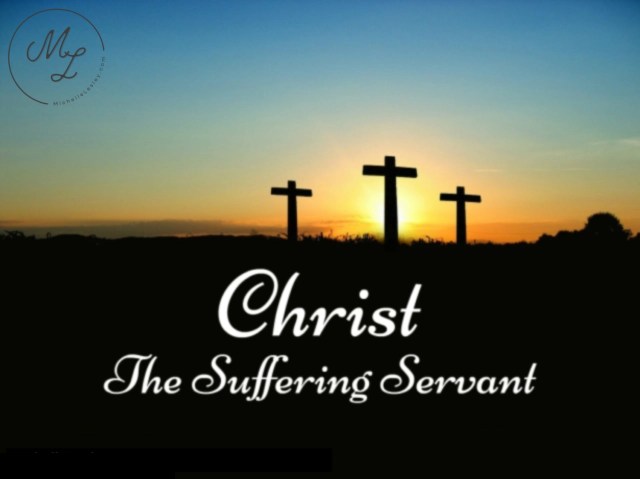
Christ- the Suffering Servant


Who has believed what he has heard from us?
And to whom has the arm of the Lord been revealed?
2 For he grew up before him like a young plant,
and like a root out of dry ground;
he had no form or majesty that we should look at him,
and no beauty that we should desire him.
3 He was despised and rejected by men,
a man of sorrows and acquainted with grief;
and as one from whom men hide their faces
he was despised, and we esteemed him not.
4 Surely he has borne our griefs
and carried our sorrows;
yet we esteemed him stricken,
smitten by God, and afflicted.
5 But he was pierced for our transgressions;
he was crushed for our iniquities;
upon him was the chastisement that brought us peace,
and with his wounds we are healed.
6 All we like sheep have gone astray;
we have turnedโ€”every oneโ€”to his own way;
and the Lord has laid on him
the iniquity of us all.
7 He was oppressed, and he was afflicted,
yet he opened not his mouth;
like a lamb that is led to the slaughter,
and like a sheep that before its shearers is silent,
so he opened not his mouth.
8 By oppression and judgment he was taken away;
and as for his generation, who considered
that he was cut off out of the land of the living,
stricken for the transgression of my people?
9 And they made his grave with the wicked
and with a rich man in his death,
although he had done no violence,
and there was no deceit in his mouth.
10 Yet it was the will of the Lord to crush him;
he has put him to grief;
when his soul makes an offering for guilt,
he shall see his offspring; he shall prolong his days;
the will of the Lord shall prosper in his hand.
11 Out of the anguish of his soul he shall see and be satisfied;
by his knowledge shall the righteous one, my servant,
make many to be accounted righteous,
and he shall bear their iniquities.
12 Therefore I will divide him a portion with the many,
and he shall divide the spoil with the strong,
because he poured out his soul to death
and was numbered with the transgressors;
yet he bore the sin of many,
and makes intercession for the transgressors.

Isaiah 53:1-12

Surely he has borne our griefs and carried our sorrows; yet we esteemed him stricken, smitten by God, and afflicted. Isaiah 53:4

What a beautiful passage describing Christโ€™s suffering for us. Usually, when we think about suffering, we think about suffering weโ€™ve personally experienced, things loved ones have been through, newsworthy events from around the globe, and natural disasters. And, as normal human beings in a broken, sinful world, thatโ€™s what we tend to do- we think of people, topics, and circumstances in light of our experiences with them or how they affect us. But as Christians, it’s imperative that, when we think of suffering, we look first to Christ, the Suffering Servant, and see all other suffering in light of His suffering.

Certainly, Isaiah 53 doesnโ€™t cover every aspect or incident of Christโ€™s suffering, but letโ€™s take a look at a few of these verses that prophesy – over 700 years before He was ever born – about the suffering of Christ.

Letโ€™s take a look at a few of these verses that prophesy – over 700 years before He was ever born – about the suffering of Christ.

Christ suffered physically
Most have read the Bibleโ€™s account of the crucifixion. But in the same way a verbal description of abortion doesnโ€™t really capture the horror of the act the way a video can, our English words used in Isaiah 53 canโ€™t adequately express the extreme physical suffering Christ endured on the cross. The cross was such an agonizing experience we had to invent a new word for that kind of suffering: excruciating. Ex– out of, cruciare– the crucifixion. Suffering drawn out of the cross.

The cross was such an agonizing experience we had to invent a new word for that kind of suffering: excruciating. Suffering drawn out of the cross.

So, how did Christ suffer physically?

Verse 5 says He was pierced, crushed, chastised, and wounded. Letโ€™s take a closer look at those words:

Pierced– The Hebrew word means: โ€œto wound (fatally), bore throughโ€ We see this with the crown of thorns that “bore through” Jesusโ€™ head and the nails that pierced His hands and feet.

Crushed– The Hebrew means: โ€œto be broken, shattered, beat to piecesโ€ Interestingly, it can also mean โ€œcontriteโ€- He was contrite for our iniquities.

Chastisement– The Hebrew means: โ€œdisciplineโ€ as you would discipline a naughty child

Wounds/stripes– The Hebrew means: โ€œa welt, blueness, bruise, hurtโ€

The flogging. The thorns. The pummeling He took from the soldiers. And carrying the cross to Calvary after all of that. Nails through His wrists, nails through His feet, the agony of trying to breathe, and, finally, the spear through His side. Jesusโ€™ physical body took some of the worst abuse thatโ€™s ever been doled out by professional torturers.

Christ suffered emotionally
Jesus was a human being, just like you and me. That means he had feelings and emotions just like you and I do, and people and circumstances hurt Him just like they hurt us.

He was a man of sorrows and acquainted with grief. Jesus had loved ones die and friends betray Him and turn their backs on Him. He wasnโ€™t immune to the hurts of life.

We esteemed him stricken, smitten by God, and afflicted. Stricken, smitten, afflicted- those arenโ€™t words we use very often. What do they mean? Stricken is to reach out and touch someone. Itโ€™s the same idea as God striking someone down or striking someone with leprosy. Smitten by God– same idea, but with more of a judgment or punishment angle: โ€œsmite, chastise, send judgment upon, punish, destroy.โ€ To be afflicted is to be โ€œoppressed, humiliated, be bowed down.โ€

This phrase in verse 4 carries the idea that people thought Jesus had done something(s) that so displeased God that that Godโ€™s punitive hand of judgment was upon His life. Of course, that wasn’t true. Yet, there were people who thought of Him that way and treated Him that way- at the cross, certainly, but also, to some extent, during His life.

And yes, that grieved Him as the God who loved and wanted to save these people, but, on the human side, well, we all know how it feels to be misunderstood and misrepresented. Christ felt those slings and arrows of the heart.

We all know how it feels to be misunderstood and misrepresented. Christ felt those slings and arrows of the heart.

Christ suffered spiritually
When I say Christ โ€œsuffered spirituallyโ€ I want to be clear that I do not mean anything ever happened to Christ that marred His sinless perfection or in any way diminished His deity. What I mean is that He suffered due to fallen manโ€™s sinfulness regarding theological or spiritual issues. For example:

He was despised and rejected by men…he was despised, and we esteemed him not. We see this constantly in the gospels. The Pharisees were always trying to trick Jesus and trap Him with difficult questions. They repeatedly accused Him of โ€œworkingโ€ on the Sabbath by healing people, picking grain and eating it, and so on. They plotted against Him. They tried to stone Him. Even at the end, when He was on the cross, Scripture says โ€œthey hurled insults at Him.โ€

And why? These arenโ€™t just playground bullies picking on a random kid for no reason. They had a reason. And those insults the chief priests and scribes and elders hurled at Jesus in Matthew 27:42-43 sum up that reason pretty neatly:

He saved others; he cannot save himself. He is the King of Israel; let him come down now from the cross, and we will believe in him. He trusts in God; let God deliver him now, if he desires him. For he said, โ€˜I am the Son of God.โ€™

Jesus was God. He was their Messiah. Yet these men didnโ€™t want to humble themselves and admit it and bow the knee to Him. They looked Jesus in the eye – the God who loved them, created them, and breathed the breath of life into them – and said: We will not have this King reign over us! They despised and rejected the core of who Jesus was: Savior, King, Son of God.

They looked Jesus in the eye – the God who loved them, created them, and breathed the breath of life into them – and said: We will not have this King reign over us!

But Jesus suffered in other spiritual ways, too…

The Lord has laid on him the iniquity of us all.
[He was] stricken for the transgression of my people
His soul makes an offering for guilt
He shall bear their iniquities
He bore the sin of many

Christ carried our sin. He himself bore our sins in his body on the treeโ€ฆ (1 Peter 2:24). Thereโ€™s no way we could begin to fathom what it was like for Christ to carry every single sin of billions of people in His body. But He didnโ€™t just have the weight of that sin on His shoulders, He also propitiated Godโ€™s wrath toward every single one of those sins. God poured out the cup of His wrath for our sin and Jesus drank every last drop of it.

God poured out the cup of His wrath for our sin and Jesus drank every last drop of it.

Jesus suffered tremendously. How did He respond to all that suffering?

Christโ€™s Response to Suffering
Hebrews 2:17 tells us: Therefore he had to be made like his brothers in every respect.

One of the ways Jesus was made like us, His brothers, was that He suffered. He suffered physically, He suffered emotionally, and He suffered โ€œspiritually,โ€ just like we do. In fact, He suffered far more in each of these respects than any of us ever have or ever will.

But whatโ€™s even more amazing to me than the actual extent of Jesusโ€™ suffering was the fact that He endured all of it, from the moment of His birth to the moment of His death without ever sinning. Not even once. Not even in His thoughts or the attitude of His heart.

He endured all of it, from the moment of His birth to the moment of His death without ever sinning. Not even once. Not even in His thoughts or the attitude of His heart.

Thatโ€™s huge. Think of the suffering youโ€™ve experienced in your life and how you responded to it. Iโ€™ve retaliated against people who have hurt me, or at least harbored bitterness against them. During times of calamity, Iโ€™ve yelled at God, Iโ€™ve questioned His love for me, Iโ€™ve not trusted Him, Iโ€™ve been angry at Him.

But Jesus never had a sinful response to suffering. How did He respond?

He was oppressed, and he was afflicted, yet he opened not his mouth; like a lamb that is led to the slaughter, and like a sheep that before its shearers is silent, so he opened not his mouth.

When he was reviled, he did not revile in return; when he suffered, he did not threaten, but continued entrusting himself to him who judges justly. 1 Peter 2:23

In some cases, Jesus just didnโ€™t respond at all to the person or situation causing the suffering. He communed with God instead. Jesus knew that He was in Godโ€™s hands and God would mete out judgment at the proper time.

But this is the same Jesus who instructed us to โ€œLove your enemies and pray for those who persecute you,โ€ turn the other cheek, go the extra mile, give your cloak as well as your tunic. And Jesus certainly embodied these responses to those who caused Him suffering.

Let’s look at Jesusโ€™ response to Pilate in John 18:33-38. But before we do, bear in mind that Jesus has the power to call down any number of angels to destroy Pilate, the courtyard where Heโ€™s about to be flogged, Calvary, Jerusalem, the whole world, if He wants to, in order to avoid the suffering Heโ€™s about to endure, and Jesus is fully aware of that. But watch how He responds to Pilate:

So Pilate entered his headquarters again and called Jesus and said to him, โ€œAre you the King of the Jews?โ€ Jesus answered, โ€œDo you say this of your own accord, or did others say it to you about me?โ€ Pilate answered, โ€œAm I a Jew? Your own nation and the chief priests have delivered you over to me. What have you done?โ€ Jesus answered, โ€œMy kingdom is not of this world. If my kingdom were of this world, my servants would have been fighting, that I might not be delivered over to the Jews. But my kingdom is not from the world.โ€ Then Pilate said to him, โ€œSo you are a king?โ€ Jesus answered, โ€œYou say that I am a king. For this purpose I was born and for this purpose I have come into the worldโ€”to bear witness to the truth. Everyone who is of the truth listens to my voice.โ€ Pilate said to him, โ€œWhat is truth?โ€ After he had said this, he went back outside to the Jews and told them, โ€œI find no guilt in him.

Jesus took the time to, essentially, share the gospel with this horrid man, whose next move was to have Jesus taken out and beaten to a bloody pulp. Jesus not only refused to retaliate against Pilate, He blessed him with the gospel instead.

When Jesus was on the cross, how did He respond to those who had crucified Him and those who were mocking and insulting Him? Did He yell back? Tell them they were all going to burn in Hell? No, He prayed for them: Father forgive them, for they know not what they do.

Every time Jesus suffered, He responded to it in exactly the right, godly way. He trusted Himself, the situation, and everyone involved to God, He loved His enemies, and He said or did whatever would best proclaim the gospel or glorify God in that situation.

It’s difficult to wrap our minds around all of the ways Jesus suffered, and more difficult still to comprehend that He never responded sinfully to His suffering. But perhaps the most baffling aspect of Jesus’ suffering is that He willingly chose to endure it all for rebellious, thankless, undeserving sinners like you and me. To serve us. To purchase the salvation we could never earn. To live the life we could not live. To die the death we could not die. And to conquer the grave that, for us, was unconquerable.

Perhaps the most baffling aspect of Jesus’ suffering is that He willingly chose to endure it all for rebellious, thankless, undeserving sinners like you and me.

All hail King Jesus- the Suffering Servant.

Ruth Bible Study

Ruth: Lesson 5

Previous Lessons: 1, 2, 3, 4

Ruth 4

Now Boaz had gone up to the gate and sat down there. And behold, the redeemer, of whom Boaz had spoken, came by. So Boaz said, โ€œTurn aside, friend; sit down here.โ€ And he turned aside and sat down.2ย And he took ten men of the elders of the city and said, โ€œSit down here.โ€ So they sat down. 3ย Then he said to the redeemer, โ€œNaomi, who has come back from the country of Moab, is selling the parcel of land that belonged to our relative Elimelech. 4ย So I thought I would tell you of it and say, โ€˜Buy it in the presence of those sitting here and in the presence of the elders of my people.โ€™ If you will redeem it, redeem it. But if you will not, tell me, that I may know, for there is no one besides you to redeem it, and I come after you.โ€ And he said, โ€œI will redeem it.โ€ 5ย Then Boaz said, โ€œThe day you buy the field from the hand of Naomi, you also acquire Ruth the Moabite, the widow of the dead, in order to perpetuate the name of the dead in his inheritance.โ€ 6ย Then the redeemer said, โ€œI cannot redeem it for myself, lest I impair my own inheritance. Take my right of redemption yourself, for I cannot redeem it.โ€

7ย Now this was the custom in former times in Israel concerning redeeming and exchanging: to confirm a transaction, the one drew off his sandal and gave it to the other, and this was the manner of attesting in Israel. 8ย So when the redeemer said to Boaz, โ€œBuy it for yourself,โ€ he drew off his sandal. 9ย Then Boaz said to the elders and all the people, โ€œYou are witnesses this day that I have bought from the hand of Naomi all that belonged to Elimelech and all that belonged to Chilion and to Mahlon. 10ย Also Ruth the Moabite, the widow of Mahlon, I have bought to be my wife, to perpetuate the name of the dead in his inheritance, that the name of the dead may not be cut off from among his brothers and from the gate of his native place. You are witnesses this day.โ€ 11ย Then all the people who were at the gate and the elders said, โ€œWe are witnesses. May the Lord make the woman, who is coming into your house, like Rachel and Leah, who together built up the house of Israel. May you act worthily in Ephrathah and be renowned in Bethlehem, 12ย and may your house be like the house of Perez, whom Tamar bore to Judah, because of the offspring that the Lord will give you by this young woman.โ€

13ย So Boaz took Ruth, and she became his wife. And he went in to her, and the Lord gave her conception, and she bore a son. 14ย Then the women said to Naomi, โ€œBlessed be the Lord, who has not left you this day without a redeemer, and may his name be renowned in Israel! 15ย He shall be to you a restorer of life and a nourisher of your old age, for your daughter-in-law who loves you, who is more to you than seven sons, has given birth to him.โ€ 16ย Then Naomi took the child and laid him on her lap and became his nurse.17ย And the women of the neighborhood gave him a name, saying, โ€œA son has been born to Naomi.โ€ They named him Obed. He was the father of Jesse, the father of David.

18ย Now these are the generations of Perez: Perez fathered Hezron, 19ย Hezron fathered Ram, Ram fathered Amminadab, 20ย Amminadab fathered Nahshon, Nahshon fathered Salmon, 21ย Salmon fathered Boaz, Boaz fathered Obed, 22ย Obed fathered Jesse, and Jesse fathered David.


The Holy Bible, English Standard Version. ESVยฎ Permanent Text Editionยฎ (2016). Copyright ยฉ 2001 by Crossway Bibles, a publishing ministry of Good News Publishers.


Questions to Consider

1. Briefly refresh your memory onย Deuteronomy 25:5-10ย (Godโ€™s instructions for levirate marriage),ย and read Leviticus 25:23-28ย (God’s instructions for selling and redeeming property). Compare the actions of Boaz and the other redeemer (1-10) to these two passages. Did both of them obey the law? Since Boaz is a type of Christ, how does his fulfillment of this law point us to Christ’s fulfillment of the Law? Compare Boaz’s obedience to the law in order to redeem Ruth to Christ’s obedience to the Law in order to redeem sinners.

2. Why do you think Boaz first proffered the sale of the property to the other redeemer rather than mentioning Ruth first? (3-5)

3. Compare the other redeemer’s unwillingness to bear the cost of redeeming Ruth (6) with Boaz’s willingness to endure great cost to himself to redeem Ruth (9-10). How does this point us to Christ’s willingness to empty Himself of the riches of Heaven to redeem sinners?

4. Examine verses 9-10. Would you characterize this business transaction more as an investment for financial gain or the purchase of a debt? Who stood to gain materially from this transaction, Ruth or Boaz? How? When Christ redeemed us by purchasing us with His blood, who stood to gain from that transaction, Him or us? Read these passages, and examine Christ’s purchase of our sin debt and the benefit we receive at salvation by His righteousness being imputed to us.

5. Notice the impact Ruth and Naomi’s story had on the women of the town who had been watching these events transpire. (13-17) How were Ruth’s, Naomi’s, and Boaz’s godly behavior a witness to these women of God’s goodness and faithfulness? Consider your own life. How could your godly words and actions point watching women to Christ and open a door for you to share the gospel with them?

6. Why did the women say,ย โ€œA son has been born to Naomi,โ€ (17) when Obed was Ruth’s baby? (10)

7. Compare verses 18-21 with these passages. How do the people mentioned in verses 18-21 fit into the family line of Christ? How does the story of Ruth and her family line showcase God’s sovereignty and the way – centuries in advance – He was setting events in motion and working out His plan for the coming of Christ?


Homework

Just as Ruth was living in poverty and needed someone to redeem her out of that life, someone you know is living in the poverty of sin and needs Jesus to redeem her from eternal death to eternal life. She needs Jesus to purchase her sin debt and give her the riches of His righteousness in exchange. This week, share the gospel with someone. Tell her about Jesus our Redeemer.

Bible Study, Mailbag

The Mailbag: We Want Bible Study Answers


Why don’t you provide the answers to the questions you ask in your Bible studies?

If you’ve been around the blog for any length of time you’ve noticed (I hope) that Wednesday is Bible study day. We’ve been through several books, including Jonah, Colossians, Ezra, and our current study of Ruth. We’ve done two topical studies: one on the Ten Commandments (Exodus 20:1-17) and one on assurance (1 John). And there are 66+ (every book of the Bible and then some) one lesson stand-alone studies. If you’re looking for a Bible study for group or personal use, they’re allย here,ย and they’re all free (all I ask is that you don’t plagiarize).

The format I’ve developed for my studies is to present the biblical text, provide several study questions, and finish off with a homework assignment- action you can take to apply one of the truths of the passage to your own life.

But I intentionally refrain from providing a list of answers to the study questions. Why?

Because the purpose of my Bible studies is not for you to get the “right answers.” My goal is to demonstrate for you the kinds of questions you should be asking of any passage of Scripture you approach. The purpose is to teach you (or your small group)ย how to study the Bible on your own so you won’t need to depend on a “canned” study written by somebody else, even me.ย I’m trying to work myself out of a job. You know- teach a woman to fish rather than giving her a fish.

In my own private study time as well as in Sunday School classes and other small group Bible studies, I’ve found that diving into the text and studying it for myself – or with my group – is far more meaningful and memorable than looking at the passage through the eyes of a third party. Approaching Scripture without a “middle man” lends itself to an intimacy with God that just isn’t there otherwise. It’s the difference between a private, behind closed doors, conversation with your husband and a conversation with your husband while out on a double date with friends. You get that “double date conversation” every Sunday when your pastor preaches, but God is a personal God, and you need some time alone with Him during the week.

But I’m afraid that if I study on my own, I’ll get something wrong! What if I misunderstand Scripture and end up believing false doctrine?

Bible study is a skill. And just like every other new skill you learn, you’re probably going to make some mistakes when you’re first starting out. When you first learned to read, you pronounced some words incorrectly. When you were learning to ride a bike, you fell down a few times. But you didn’t let those mistakes stop you. You kept practicing until you learned the skill. Bible study is the same way. You probably will make some mistakes along the way. But God has provided a lot of “training wheels” to help you out:

His Goodness and Trustworthiness
God is a good God. Heย wants you to study His word, get to know Him, and grow in Christ. It would be evil and cruel of God to tell you this, and then lead you – His child, who wants to draw near to Him through the study of His word – into false doctrine. And God is not evil and cruel. He is good, He is a God of truth, and His word is truth. Trust Him as you open His word to study.

What father among you, if his son asks for a fish, will instead of a fish give him a serpent;ย or if he asks for an egg, will give him a scorpion?ย If you then, who are evil, know how to give good gifts to your children, how much more will the heavenly Father give the Holy Spirit to those who ask him!โ€
Luke 11:11-13

The sum of your word is truth, and every one of your righteous rules endures forever.
Psalm 119:160

Sanctify them in the truth; your word is truth.
John 17:17

The Holy Spirit
If you are a genuinely regenerated Believer, you are indwelt by the Holy Spirit, the author of Scripture. Because God does not contradict Himself and He does not lie, the Holy Spirit indwelling you will not lead you to believe what is contrary to the words of Scripture He inspired. Ask Him to give you wisdom and understanding as you study.

And I tell you, ask, and it will be given to you; seek, and you will find; knock, and it will be opened to you. For everyone who asks receives, and the one who seeks finds, and to the one who knocks it will be opened. What father among you, if his son asks for a fish, will instead of a fish give him a serpent; or if he asks for an egg, will give him a scorpion? If you then, who are evil, know how to give good gifts to your children, how much more will the heavenly Father give the Holy Spirit to those who ask him!โ€
Luke 11:9-13

When the Spirit of truth comes, he will guide you into all the truth, for he will not speak on his own authority, but whatever he hears he will speak, and he will declare to you the things that are to come. He will glorify me, for he will take what is mine and declare it to you.
John 16:13-14

Tools
God has blessed us with a number of helps for learning how to study His word, from instructions on handling the text to commentaries, Bible dictionaries, Bible atlases, and the like. Many are online and available for free. I’ve included some of those hereย (be sure to scroll down). And don’t forget your (doctrinally sound) pastor, elders, and Sunday School teachers as invaluable resources. I’ve never met one who wouldn’t be delighted to help someone understand a passage of Scripture.

Easter Eggs
If you’ve worked through any of my studies, you’ve probably noticed that, if you read carefully, Iย doย provide answers to some of the study questions.

Hyperlinks– If you see a hyperlink in a question, try answering the question on your own first. Then, click the link. It will take you either to related Scriptures that will help you answer the question or to an article or resource you can read for more information.

Follow Up Questions– Each study “question” is usually a series of questions. Try to answer them one at a time. But, if you’ll notice, I sometimes provide the answer to one question in a subsequent question. For example (from Ezra, Lesson 11):

What was Israelโ€™s hope? Compare Israelโ€™s hope for Godโ€™s mercy and forgiveness of sin in response to true repentance with 1 John 1:9.

God loves you and wants you to dive into the treasure chest of His word. Trust Him. Use the resources He has provided. And if you fall off your bike in the process, pick yourself up, dust yourself off, and keep practicing.


Additional Resources

Bible Study resource articles

Bible Studies by Michelle Lesley

10 Simple Steps to Plain Vanilla Bible Study

Youโ€™re Not as Dumb as You Think You Are: Five Reasons to Put Down that Devotional and Pick Up the Actual Bible

10 Bookmarkable Biblical Resources for Christian Women

Rightly Dividing: 12 Doโ€™s and Donโ€™ts for Effective Bible Study


If you have a question about: a Bible passage, an aspect of theology, a current issue in Christianity, or how to biblically handle a family, life, or church situation, comment below (Iโ€™ll hold all questions in queue {unpublished} for a future edition of The Mailbag) or send me an e-mail or private message. If your question is chosen for publication, your anonymity will be protected.

Speaking Engagements

Report Back: Cape Cod

Last weekend, I had the privilege of speaking at a Christian women’s conference in Cape Cod, Massachusetts. It was a wonderful time of fellowship with a lovely group of godly women, and, since many have asked about it and prayed for me, I wanted to share a little about the trip.

I arrived in Boston Thursday evening and was met by Maria, one of the women’s ministry leaders. She and her husband were kind enough to open their home to me the first night of my trip.

You know you’re in a good host home
when you find these on the night table!

Friday morning I finally got to meet my precious Twitter friend, DebbieLynne, in person. DebbieLynne is actually the one who recommended me as speaker for this conference. Thanks, Deb! (If you don’t already follow her blog, The Outspoken Tulip, check it out!)

This is what it looks like when, instead of “cheese,”

you say, “Everybody say ‘false teachers’!”
to a couple of discernment divas.

Friday afternoon, we arrived at the hotel in Cape Cod and got settled in. Then the women’s ministry leaders took me out for a lovely dinner. When I travel, I always like to try whatever dish that area is best known for, so, of course I ordered some clam chowder. It was great!

When this restaurant says a “cup” of soup,

that’s exactly what they mean!

After dinner, we went back to the hotel, and I taught the first of four sessions on the topic of suffering:ย Christ, the Suffering Servant.

Something pretty amazing happened Saturday after the morning session onย The Theology of Suffering.ย I was standing near the exit door as closing announcements were being made, and a hotel worker (I’ll call her “Linda”) opened the door a few inches and motioned for me to come out into the hall with her. Linda asked me what who this group was and what was going on, so I explained that it was a group of ladies from a nearby church who had come to the hotel for a conference.

Linda then began to pour out her heart to me, that, in addition to her father’s recent death, her daughter’s medical problems, and her own health issues, she had been struggling with alcoholism. She felt too shy to go to a group recovery meeting and wanted to know if there were someone in our group who could help her one on one. I stepped back into the conference room and retrieved Julie, the pastor’s wife, hoping she might have some resources that could help Linda.

After hearing Linda’s story, Julie stepped back into the conference room and retrieved Maureen. Guess what? Maureen and her husband have a long standing ministry of one on one discipleship for people with substance abuse problems! We were able to pray and share the gospel with Linda and get her connected to Maureen for follow up.

Oh, and that talk I’d just been giving on the theology of suffering? My closing point was that one of God’s good purposes for suffering is that suffering can cause lost people to cry out to God for salvation. Lost people like Linda.

I was overwhelmed by God’s sovereignty in this situation. These ladies could have chosen a different weekend or a different hotel for this conference. Maureen could have skipped the conference. Linda could have called in sick that day or been too shy to stick her head in the door. My talk could have been about some other topic. But God kindly pulled back the veil a little and let us see how He orchestrated all of these things to bring the gospel to a suffering soul who needed Jesus.

Saturday afternoon, Maria and Julia graciously took me on a drive to see the sights around Cape Cod. Even though it was rainy, windy, and cold, the view from the coast was beautiful, as you can see.

ย ย 

I also got to see Nobska Lighthouse, which was constructed in 1876…

…and the oldest Episcopal church in Cape Cod, Church of the Messiah.

The church was founded in 1852,
with this stone structure being built in 1889.


Some people collect stamps.
I collect pictures of the steeples of churches I’ve visited.ย 

Unfortunately, this “church” now touts itself as “inclusive” (read: homosexuality affirming), committed to “environmental justice,” and is led by the “Reverend” Deborah.

After another awesome seafood dinner (I LOVE SEAFOOD!), we returned to the hotel, where I taught session 3 of the conference:ย Rejoicing in God’s Promises During Suffering.

Sunday morning was a sweet time of worship and fellowship, and the final session of the conference:ย The Christian’s Response to Suffering.

After a quick check out from the hotel, it was back to the airport in Boston for the ride home.

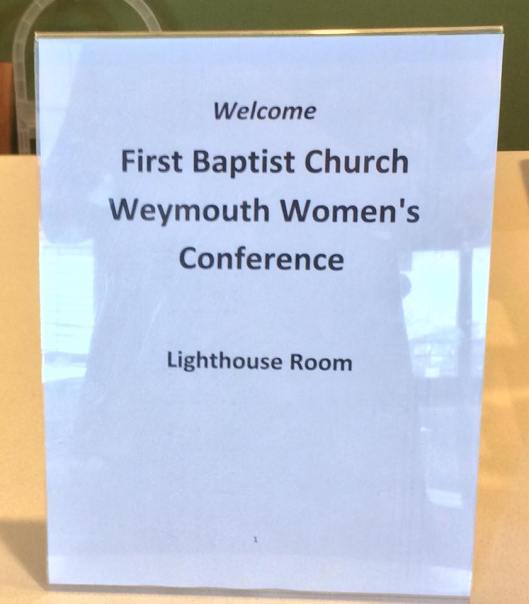
What a lovely weekend! When I’m teaching a group of ladies, I can always tell whether or not they sit under a good pastor, and this group certainly does. If you live in the Boston area and are looking for a good church, I could not recommend First Baptist Church, Weymouth, more highly.

If your church is ever in need of a speaker for a womenโ€™s event, Iโ€™d love to come share with your ladies as well. Click here for more information.


Sanctification, Throwback Thursday

Throwback Thursday ~ Going to Pot

When the wine ran out, the mother of Jesus said to Him, “They have no wine.”ย Now there were six stone waterpots set there for the Jewish custom of purification, containing twenty or thirty gallons each.ย Jesus said to them, “Fill the waterpots with water.” So they filled them up to the brim.ย And He said to them, “Draw some out now and take it to the headwaiter.” So they took it to him.ย When the headwaiter tasted the water which had become wine, and did not know where it came from (but the servants who had drawn the water knew), the headwaiter called the bridegroom,ย and said to him, “Every man serves the good wine first, and when the people have drunk freely, then he serves the poorer wine; but you have kept the good wine until now.”
John 2:3-10

Much has been said, and many words written, about Jesus’ first miracle– the turning of the water into wine at the wedding of Cana. Why was this first miracle a miracle that put Jesus in the position of a caterer? Why not a healing? What did the disciples think? Was it really wine or just grape juice? And so on.

But I don’t believe I’ve ever heard anybody look at this account from the perspective of the waterpots.

What was it about those waterpots that made Jesus decide to use them? People used the water in them for washing their hands and possibly their dishes. They were common. Utilitarian. Probably not very clean. Why didn’t Jesus call for golden pitchers or silver goblets for the fine wine He was making?

The waterpots were close to Jesus.

The wedding Jesus was attending was in a small town, in an average home. It was likely that the hosts didn’t even own goblets or pitchers made of silver or gold. If they did, they certainly didn’t own enough large ones to hold all the wine Jesus was about to make. Gold and silver containers would have been far away in a palace or a wealthy home. The waterpots were close to Him, ready and available.

The waterpots had a great capacity for being filled.


We’re talking 120-180 gallons here. Your bathtub holds about 60 gallons when completely filled, so this would have been the equivalent of two to three completely full bathtubs of wine. Pitchers and goblets wouldn’t cut it.

The waterpots were willing to get dirty so others could get clean.

(Ok, so I realize I’m anthropomorphizing, but just go with me for a minute.) Those waterpots stood there year after year providing clean water for dirty people. They didn’t consider themselves too good to be used for handwashing. They didn’t pick and choose how or when they were used. They just stood there and fulfilled their purpose thanklessly, without complaint that they were being used or getting dirty. They were willing to take on a humble task, and Jesus took them and did a great work through them.

The waterpots were usable.


When Jesus told the servants to fill the waterpots with water, no one said, “Oh no, that’s the good china! You can’t use those!” The waterpots themselves were accustomed to being used. That’s what they were made for.

The waterpots also didn’t put up a fuss when Jesus wanted to use them for a new purpose. They didn’t say, “We’re too old to change,” or “We’ve been doing this for years. Who are You to tell us to do somethng new?” They were at their Master’s bidding.

What about us? Sometimes we want God to do great things through us like He did with the waterpots, but we don’t want to be like the waterpots. We want to be gold pitchers or silver goblets. We want to be special, not humble. Pretty, not getting dirty. Served, not serving. Our way, not His way.

Are you close to Jesus?

Do you, through prayer and study of the Word, have a great capacity for being filled?

Are you willing to get dirty so others can be cleansed by the gospel?

Are you usable?

Maybe “going to pot” isn’t such a bad thing after all.