Prayer Bible Study

Sweet Hour of Prayer: Lesson 6

Previous Lessons: 1, 2, 3, 4, 5

Read 2 Chronicles 6:12-7:3, 7:11-22

Solomon’s Prayer at the Dedication of the Temple

Questions to Consider

1. Are you familiar with what is going on in the history of Israel and in the life and reign of Solomon at this time? If not, use this synopsisย (or anotherย Bible Book Background) to bring you up to speed. Second Chronicles 5-7 are provided in today’s passage for context and continuity. First Kings 7:51-9:9 recounts the same prayer and events we’ll be looking at in 2 Chronicles 6-7, and is provided as optional, supplementary reading. Today’s questions pertain only to Solomon’s prayer at the dedication of the temple and God’s response to his prayer in 2 Chronicles 6:12-7:3 and 7:11-22.

2. Briefly explain the recent event in Israel’s history that led to Solomon’s prayer and God’s response, and describe the venue and surroundings in which Solomon offers his prayer. Was this a private prayer or a public prayer?

3. What did Solomon’s body posture (6:12,13) indicate to himself, to God, and to the people as he prayed? Why is it important to present ourselves humbly and reverently to God when we pray, especially when leading others in prayer?

4. Let’s give a broad outline to Solomon’s prayer. What is the main focus of Solomon’s prayer in chapter 6, in each of these sections:

14-15, 18-

16-17-

19-40-

41-42

Examining each of these areas of focus, what would you say is the main focus of the whole prayer? Think about the prayers you’re familiar with in the New Testament as well as the way we pray today, individually and corporately. How much time do we spend pleading with God to hear and answer our prayers? Why do you think that is? Can you think of any New Testament passages that speak to the issue of God hearing and answering our prayers? Which of these areas of focus from Solomon’s prayer do we still include in our prayers today? What attributes of God does Solomon shine the spotlight on in his prayer?

5. In 6:16-17, especially with the phrase, “confirm Your word,” Solomon seems to be saying (reverently, of course), “God, You have promised X. We are holding you to that promise.” Does God need to be reminded of, and held accountable by us, for what He has promised? If not, what is the purpose of praying back to God what He has previously promised and asking Him to keep His Word? (Wouldn’t it be against God’s nature and character to break His word?) What does it do for us and in us, individually, and for/in God’s people, corporately, to pray His Word back to Him and ask Him to confirm it?

6. In 6:22-39, Solomon’s prayer follows the format of, “If _____ happens, then God, please do _____.” How does this format echo the and respond back to the terms of the Mosaic covenant under which Israel lived at this time? Briefly summarize each scenario Solomon presents as well as what he asks God to do in response:

22-23-

24-25-

26-27-

28-31-

32-33-

34-35-

36-39-

Why is sin a major theme of these scenarios? Do you see a common thread running through the way Solomon asks God to respond to each of these scenarios?

Since Christians are no longer under the Mosaic covenant but under the covenant of grace, how would our prayers differ from this section of Solomon’s prayer? What are some themes we see in this section of Solomon’s prayer that are still appropriate for New Covenant prayers by Christians?

7. Remember the climate (spiritual, geopolitical, cultural, etc.) of Israel at this time. Why would Solomon bring up things like future war, famine, and sin in his prayer? Do you ever pray about your future sin or about calamities that could happen in the future? What do you ask God to do if/when those things happen?

8. In his prayer, Solomon several times mentions God’s people praying “toward this place” (the temple). Does he mean this literally – that the Israelites must physically position their bodies toward the temple in Jerusalem when they pray in order for God to hear them similarly to the way Muslims must face Mecca when they pray? What does it mean in a spiritual sense for the Israelites to “pray toward this place”? Does this have any application for Christians today? How do we, in a sense, “pray toward this place” this side of the cross?

9. Does God respond to Solomon’s prayer corporately (7:1-3), privately/individually (7:12) or both? What did God do in 7:1-2 in response to Solomon’s prayer? These actions were Godย showing His answer to Solomon’s prayer. How would you put into words what God was saying by His actions in answer to Solomon’s prayer? Was God pleased with Solomon’s and the people’s prayer? How did the people react to God’s corporate response? (7:3)

10. In 7:12-22, God answers Solomon’s prayer privately, individually, and verbally (instead of with actions). Compare God’s answer with the requests Solomon had made in his prayer. Does God answer Solomon point by point, or summarize? What are each of the themes of Solomon’s prayer that God addresses? What does God include in His answer that Solomonย didn’tย pray about? How do 17-22 apply to Solomon individually, and Israel corporately? What can we learn about the nature and character of God from His answer to Solomon?


Homework

โ€ขThus far in our study, we’ve mostly been looking at private prayers offered by individuals. Solomon’s prayer is a public, corporate (Solomon leads the people, and the people pray along with him) prayer. What are some of the differences between public and private prayer? Between praying one on one with God and leading others in prayer? What are some elements of prayer you would include or not include in a public prayer versus a private prayer? Is there anything unbiblical about preparing for, or writing out, a public prayer you’ve been asked to deliver? Why or why not? Think about leading a group (your family, Bible study class, etc.) in prayer, and write out the prayer you would lead them in.

โ€ขMany American Christians believe that 2 Chronicles 7:14 is a promise to American Christians from God. Now that you have studied the context of this verse, how would you kindly and gently explain to a friend who believes this, the true meaning of this verse and that this verse is not a promise to or about America?

โ€ขAdditional Resource:ย Properly Praying the Promises


Suggested Memory Verse
Podcast Appearances

Videocast Guest Appearance with Doreen Virtue and Melissa Dougherty: What the Bible Says About Women’s Ministry


What a joy it was to sit down and chat with Doreen Virtue and Melissa Dougherty recently to discuss…well, all kinds of things! From the role of women in the church to Christian women in online ministry, from yoga to the Enneagram, I think we pretty much covered it all!

I would encourage you to watch some of Doreen’s and Melissa’s other videos, and subscribe to their YouTube channels:ย Doreen ย Melissa. You can also follow these wonderful ladies on Facebook: Doreenย  Melissa, and on Twitter: Doreenย  Melissa.

My articles mentioned or touched on in the interview:

Popular False Teachers and Unbiblical Trendsย (tab at the top of this page)

Recommended Bible Teachersย (tab at the top of this page)

Searching for a new church?ย (tab at the top of this page)

Speaking Engagementsย (tab at the top of this page)

A Word Fitly Spoken Podcastย (“Podcast” tab at the top of this page)

Rock Your Role: Jill in the Pulpit

Rock Your Role: Order in His Courts: Silencing Women? (1 Corinthians 14:33b-35)

Adam 3.0: Meanwhile, Back in the Garden, Itโ€™s Deja Vu All Overย Again

Are Female Bloggers Violating Scripture by โ€œTeachingโ€ Men?

The Mailbag: Should women give testimonies and reports, lead prayer and worship inย church?

The Enneagram

The Mailbag: Should Christians do yoga?

Answering the Opposition- Responses to the Most Frequently Raised Discernmentย Objectionsย (see #1 for info on the Matthew 18 issue)

Hillsong, Bethel/Jesus Culture, Elevation Music

The Mailbag: False Doctrine in Contemporary Christianย Music

The Mailbag: How should I approach my church leaders about a false teacher theyโ€™reย introducing?


Got a podcast of your own or have a podcasting friend who needs a guest? Need a speaker for a womenโ€™s conference or church event? Click the โ€œSpeaking Engagementsโ€ tab at the top of this page, drop me an e-mail, and letโ€™s chat!

Mailbag

The Mailbag: Resources for Pastor Appreciation Month

Do you have any suggestions for things my church can do for our pastors during Pastor Appreciation Month?

October is Pastor Appreciation Month (PAM). It always sneaks up on me, so big thank yous to the reader who recently wrote in with a question related to PAM and jogged my terrible memory. We don’t want to forget our wonderful pastors!

Normally, I rerun the articles below every year on separate days near the end of September, but because I didn’t get it in gear this year, you’re getting all of them at once. Sorry about that. But at least you have the whole month of October to implement any of these ideas that would be a fit for your pastors and your church, and most of them require very little planning time.

Top 10 Ways to Appreciate Your Pastors During Pastor Appreciation Month

“Iโ€™m so glad somebody thought up the idea of Pastor Appreciation Month and made it a thing. If youโ€™ve never been a pastor (or been married to one), itโ€™s difficult to adequately convey just how simultaneously challenging, joyful, devastating, frustrating, and fulfilling it can be. If you have a good pastor, whoย rightly divides Godโ€™s Word and is a man of godly character, you are very blessed. Here are ten ways you can show your pastors your gratitude, appreciation, and encouragementโ€ฆ”

Words Fitly Spoken:
11 Ways to Encourage Your Pastor

“Are you thankful for your pastor and a church that rightly handles Godโ€™s word? Are you telling anybody youโ€™re thankful? Are you telling your pastor? Here are eleven ways you can encourage your pastorโ€ฆ”

7 Ways to Encourage Your Minister of Music

“The pastor isnโ€™t the only person on your churchโ€™s staff who needs your support. So does your minister of music. And, having been married to one for over twenty years, I can tell you there arenโ€™t manyย articles out there letting you know how church members can encourage their ministers of music. Ready to show some love? Here are seven ways you can be an encouragement to your minister of musicโ€ฆ”


Is it OK if I print out and copy one (or more) of these articles?

Yes! You are always welcome to print out and make as many copies as you like of any article, Bible study, etc., you find here at the blog. (My article, Top 10 Ways to Pray for Your Pastor might make a nice bulletin insert during PAM.) All I ask is that you not change the content of any article, and that you stick my name (Michelle Lesley) and web address (MichelleLesley.com) on there somewhere. I’ve explained the reasons for this as well as tips for printing articles here (3rd section).

Just a few more points about PAM:

All three of these articles make this point, but I want to reiterate it here. If you’re going to do a big hoopla for PAM, please be sure all efforts are coordinated, none of your pastors are left out, and that there isn’t a huge discrepancy in the gifts you present various staff members (e.g. you get the pastor a new car and the minister of music gets a Hallmark card).

My husband was once on staff at a church as minister of music. There were only two other staff members, the pastor and the youth pastor. At the end of worship service one Sunday in October, the congregation as a whole ceremoniously presented the pastor with a gift for PAM. Then some of the youth called the youth pastor up to the front and presented him with a gift for PAM from the youth group and their parents. And nothing was said about, or done for, my husband. It was extremely discouraging to him, not because he didn’t get a gift, but because he felt ignored and unappreciated. Make sure you handle PAM sensitively and appropriately. You don’t want what started out as an act of encouragement to end up discouraging any of your pastors.

If you get your pastor a book or decide to send him to a conference, be sure to vet the author, speakers, and conference organization for sound doctrine first. I would recommend books and materials by any of the men listed at the Recommended Bible Teachers tab at the top of this page. Some super, doctrinally sound conferences you might consider: the G3 Conference,ย Shepherds’ Conference, aย Founders Conference, one of Ligonier’s Conferences, orย a smaller regional or local conference.ย (And if you do decide to send him to a conference, make sure he’s actually able to attend before purchasing anything that’s non-refundable.)

Don’t just encourage and appreciate your pastors during the month of October. They need it all year long! If your church can’t afford to do something big and expensive for PAM (or even if it can) make October the kick-off month for a year full of encouragement for your pastors – have church members commit to pray regularly for your pastors from October 2019 to October 2020 (and then have them re-up next year!), make October the dedicated month for church members to sign up to serve your pastors in some way during each of the next 12 months. (Maybe in 2019-2020 various families sign up to bring each of the pastors a meal a month. In 2020-2021, maybe it’s monthly yard work or babysitting or house cleaning, etc.)

Let’s be sure to appreciate and encourage our pastors during PAM and all year long!


If you have a question about: a Bible passage, an aspect of theology, a current issue in Christianity, or how to biblically handle a family, life, or church situation, comment below (Iโ€™ll hold all questions in queue {unpublished} for a future edition of The Mailbag) or send me an e-mail or private message. If your question is chosen for publication, your anonymity will be protected.

Special Events

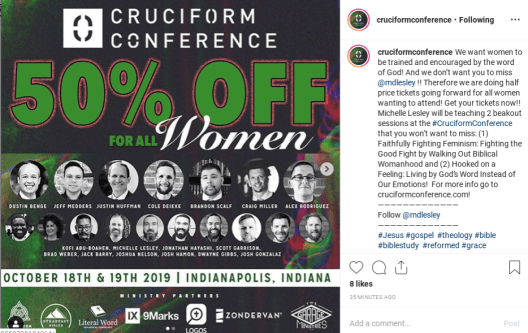
Cruciform Conference Special Discount!


Ladies,ย Cruciformย is almost upon us, and in order to encourage more women to attend, the conference organizers have graciously extended a 50% discount on tickets to you!

Grab your tickets fast, gather up your husband or your friends, and join me in Indianapolis the weekend of October 18-19. You won’t want to miss this wonderful time of cross-centered preaching and teaching and some awesome fellowship with your brothers and sisters in Christ.

And as a special treat for the ladies, I will be teaching two breakout sessions just for women:

Faithfully Fighting Feminism:
Fighting the Good Fight by Walking Out Biblical Womanhood
and
Hooked on a Feeling: Living by God’s Word Instead of Our Emotions

I hope to see you there!

Discernment

Sheila Walsh

If you are considering commenting or sending me an e-mail objecting to the fact that I warn against certain teachers, please click here and read this article first. Your objection is most likely answered here. I won’t be publishing comments or answering emails that are answered by this article.


This article is kept continuously updated as needed.

I get lots of questions about particular authors, pastors, and Bible teachers, and whether or not I recommend them. Some of the best known can be found above at my Popular False Teachers tab. The teacher below is someone I’ve been asked about recently, so I’ve done a quick check (this is brief research, not exhaustive) on her.

Generally speaking, in order for me to recommend a teacher, speaker, or author, he or she has to meet three criteria:

a) A female teacher cannot currently and unrepentantly preach to or teach men in violation of 1 Timothy 2:12. A male teacher or pastor cannot allow women to carry out this violation of Scripture in his ministry. The pastor or teacher cannot currently and unrepentantly be living in any other sin (for example, cohabiting with her boyfriend or living as a homosexual).

b) The pastor or teacher cannot currently and unrepentantly be partnering with or frequently appearing with false teachers. This is a violation of Scripture.

c) The pastor or teacher cannot currently and unrepentantly be teaching false doctrine.

I am not very familiar with most of the teachers I’m asked about (there are so many out there!) and have not had the opportunity to examine their writings or hear them speak, so most of the “quick checking” I do involves items a and b (although in order to partner with false teachers (b) it is reasonable to assume their doctrine is acceptable to the false teacher and that they are not teaching anything that would conflict with the false teacher’s doctrine). Partnering with false teachers and women preaching to men are each sufficient biblical reasons not to follow a pastor, teacher, or author, or use his/her materials.

Just to be clear, “not recommended” is a spectrum. On one end of this spectrum are people like Nancy Leigh DeMoss Wolgemuth and Kay Arthur. These are people I would not label as false teachers because their doctrine is generally sound, but because of some red flags I’m seeing with them, you won’t find me proactively endorsing them or suggesting them as a good resource, either. There are better people you could be listening to. On the other end of the spectrum are people like Joyce Meyer and Rachel Held Evans- complete heretics whose teachings, if believed, might lead you to an eternity in Hell. Most of the teachers I review fall somewhere in the middle of this spectrum (leaning toward the latter).

If you’d like to check out some pastors and teachers I heartily recommend, click the Recommended Bible Teachers tab at the top of this page.


Sheila Walsh
Not Recommended

Sheilaย is a women’s Bible study and children’s book author, speaker, and singer. Sheila formerly co-hosted The 700 Club and TBN’s Life Today with James Robison. Life Today routinely features false teachers as guests, including Joel Osteen,ย Joyce Meyer, Paula White, T.D. Jakes, Kim Walker-Smith (Jesus Culture),ย andย Beth Moore, among others. Currently, Sheila co-hosts two other TBN shows (also featuring a plethora of false teachers), Praise and Better Together.

Sheila habitually yokes in ministry and fraternizes with false and problematic teachers in other venues as well. Space does not permit me to list every incidence of Sheila doing so, but the following examples are representative.

In 2014, Sheila joined Beth Moore, Christine Caine, Priscilla Shirer, Victoria Osteen, and Lisa Harper for the Unwrap the Bible conference at Joel Osteenโ€™s Lakewood “Church.”

Sheila is aย contributor at Hillsongโ€™s web site, spoke at Hillsong’s 2015 and 2018ย Colour Conference, and has preached the Sunday sermon at Hillsong, saying, “I love ‘pastors’ Brian and Bobbie [Houston] so much…”.

She gave an enthusiastic Instagram recommendation of an event at which Bobbie HoustonChristine Caine, and Sarah Jakes Roberts (T.D. Jakesโ€™ daughter) were the featured speakers.

Sheila is one of the Women of Joy stable of speakers, which also includes Lysa TerKeurst, Lisa Bevere, Margaret Feinberg, Bianca Olthoff, Chrystal Evans Hurst, Christine Caine, Lisa Harper, Jennie Allen, Angie Smith, Karen Kingsbury, and Jennifer Rothschild. Sheila regularly speaks at WOJ conferences with these speakers.

Jennifer Rothschild’s Fresh Grounded Faith conference organization also counts Sheila as one of its featured speakers alongside Lysa TerKeurst, Angie Smith, Karen Kingsbury, and Ann Voskamp.

Sheila regularly and unrepentantly preaches to men including her aforementioned Sunday sermon at Hillsong, the Sunday sermon at another Hillsong campus, the Sunday sermon at Rick Warren’s Saddleback, a pastor’s conference she mentions in this video, the Sunday sermon at James River Church (which is co-“pastored” by a woman), the Sunday Sermon at NewHope Baptist Church, the Sunday Sermons at Emmanuel CC, and the Sunday Sermon at Transformation Church (also co-“pastored” by a woman), just to cite a few examples.

Interestingly, none of these events at which Sheila is preaching the Sunday morning sermon or otherwise preaching to or teaching men/co-ed audiences was listed on the calendar of events at Sheila’s website. She only lists women’s events she’ll be speaking at. As I continue to research evangelical women speakers, I’m seeing this trending more and more. Many only list women’s events they’re speaking at on their websites, and don’t list the events where they’ll be preaching the Sunday sermon or at co-ed events. It is only speculation on my part, so I’m not making accusations or assumptions, but as I keep seeing this happen, I can’t help but wonder if it is to hide the fact that they are preaching to men in order to maintain a semblance of being doctrinally sound, and to avoid reproof for this sin.

In addition to yoking with false teachers and preaching to men, I noticed a few other things while researching Sheila.

There is no clear statement of faith or gospel presentation on Sheila’s website, but the 2019 version of her home page of her website greets the reader in bold print withย GOD IS FOR YOUย (which she says is “her message”). Underneath, a caption says,

“Your destiny isnโ€™t determined by your history. No matter what youโ€™ve gone through or where youโ€™ve been, God is inviting you to take the next step.”

Below this caption are two clickable buttons, “About Sheila,” (which, as you might guess, links to a page with Sheila’s bio), and “Start Again.”

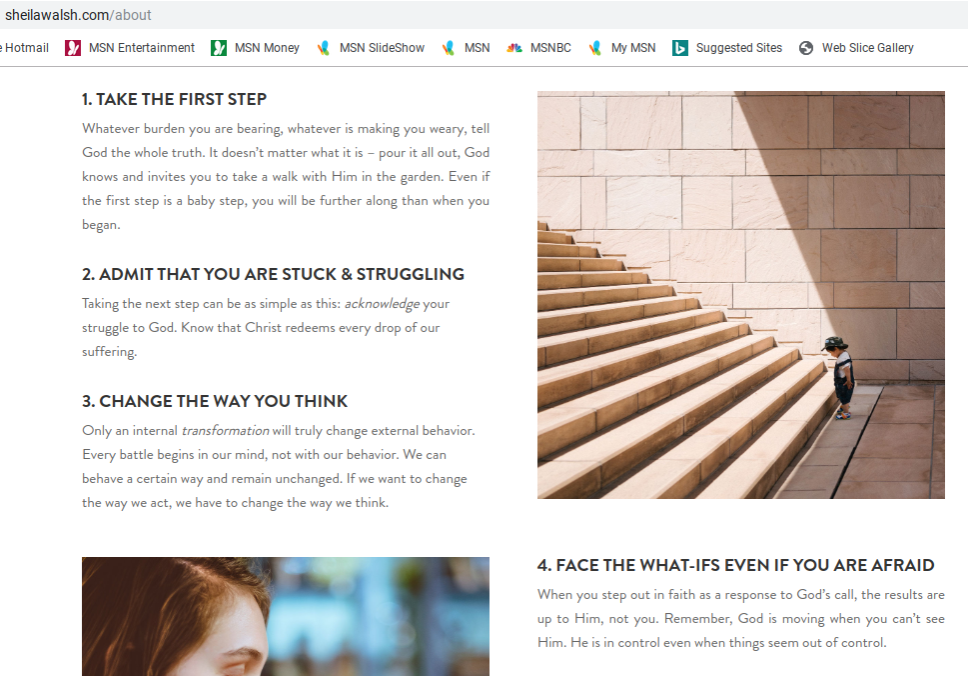
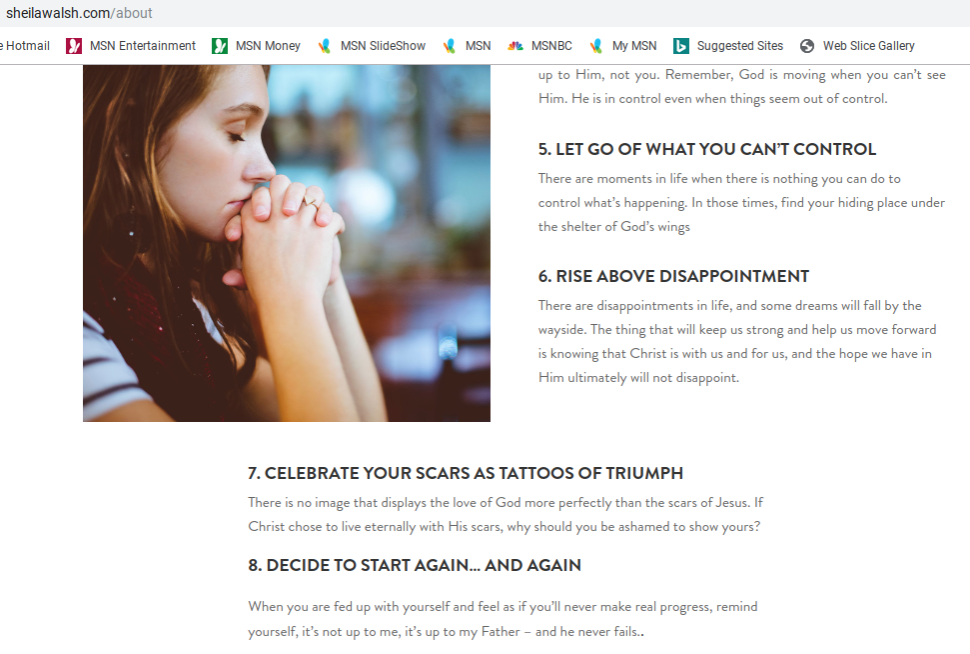
“God is for you!”, the subsequent caption, and “start again” might cause the reader to think that clicking the “Start Again” button will lead to a page outlining the plan of salvation, but it doesn’t. It links to the Aboutย page (2019 version) of Sheila’s site which gives eight steps to…I’m not sure what. It is definitely not the gospel. Nothing is mentioned about sin, repentance, faith in Christ for salvation, the cross, the resurrection, or anything else you might expect in a gospel presentation. Also, there isn’t a single Scripture cited.

I honestly don’t understand if this is supposed to be aimed at lost people or saved people (Maybe she’s addressing backslidden Christians? I can’t tell.), but either way, it’s not about what Christ did to save us or how He sanctifies us, it’s a works-righteousness litany of all the things you have to do to pull yourself up by your bootstraps and “start again” (whatever that means). And it lists all these things you need to do (“we have to change the way we think,” “step out in faith,” “rise above disappointment,” etc.) but it doesn’t explain how to do them. There’s no mention of repentance, placing your faith in Christ for salvation, studying your Bible, prayer, or joining with a doctrinally sound local church. She mentions “the hope we have in Him” but doesn’t explain what that hope is or how to get it, which, in a sad irony, leaves the reader hopeless.

What’s more, there is Christian-ish vernacular that lost people are not going to understand: “Walk with Him in the garden,” “Christ redeems every drop of our suffering,” “find your hiding place under the shelter of Godโ€™s wings”…I’m not sure I even totally understand what she means by all of these things.

And the entire “God is for you,” posture of Sheila’s message, writing, and speaking give the sense that God’s main function is to be your magic Band-Aid to make all your owies go away. Certainly, God loves us, helps us, comforts us, and wants what’s best for us, but God isn’t for us – to serve our every desire and salve our every hurt. We were made for Him – to glorify, honor, and serve Him.

Sheila’s blog posts – though they are blog posts, not Bible studies – reflect the current trend in women’s “Bible” study: personal stories from the author’s life with a few Bible verses sprinkled in here and there. Perhaps most of the Bible study books Sheila writes are in a different format and focus on the proper exegesis of Scripture (as I said, these are blog posts, not Bible studies), but if she writes all of her Bible studies in the same way and style in which she writes her blog posts, they should be avoided in favor of studying the actual Bible.

I have not had the opportunity to read all Sheila has written, but if the introduction and first chapter of her most recent book, It’s Okay Not to Be Okay,ย which is marketed as a “Bible study,” are indicative of the way she writes these studies, the style is, indeed, very similar to her blog posts: personal stories with a few Bible verses (some from the completely unreliable paraphraseย The Message) sprinkled in. (And the endorsement page of this book reads like a laundry list of contemporary false and problematic teachers such as: Lisa Bevere, Ann Voskamp, Christine Caine, Jennie Allen, Lisa Harper, Roma Downey, Bobbie Houston, and Karen Kingsbury.)

Furthermore, echoing her website’s ambiguous eight steps to…something, the first part of It’s Okay seems to muddle the line between saved and unsaved, sinner and saint. The thrust of this opening material and the theme of the book seem to be: “God’s love for you isn’t dependent on your striving for perfect behavior,” which is absolutely true, and something many Christian women need to grasp. However, in the midst of this “it’s okay to stop striving for perfection and rest in God’s love for you” talk, she refers back to the Fall:

The story continues in verse 10, when God asks Adam where he is: “He replied, ‘I heard you walking in the garden, so I hid. I was afraid because I was naked.'”

There you have it!
Shame.
Fear.
Covering up.
Hiding.
…and we’ve been doing it ever since.ยน

While a Christian striving for perfection rooted in fear of losing God’s love and a lost person’s willful disobedience may both be displeasing to God, they are not the same thing and should not be conflated in this way. It is right and good for a sinner to feel shame and guilt for rebelling against God, because she is guilty, she is covered with shame, until she repents and trusts Christ as Savior. But this is a completely different animal from someone who has already had the guilt and shame of all of her sin (including any lack of trust in God’s love for her) washed away by the blood of Christ, and who is striving to please Him, albeit imperfectly. It is concerning that Sheila does not clearly differentiate between the two.

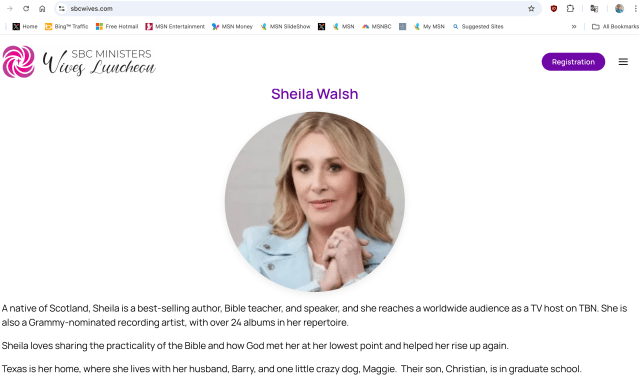
Southern Baptists should be aware that, despite the fact that Sheila unrepentantly preaches to men, yokes with false teachers, and seems to be somewhat ambiguous on the gospel, LifeWay does carry her materials (alarmingly, the three currently listed are books for children and families), and she has been the featured speaker at women’s events at the Southern Baptist Convention annual meeting, including the 2021 IMB/NAMB Send Conference, the 2025 Ministers’ Wives’ Luncheon

Sheila is a charming woman who lavishes great passion and love on her audiences, but, unfortunately, I cannot recommend her to you as a biblically trustworthy teacher you should follow.


ยนFrom chapter 1 of It’s Okay Not to Be Okay. Taken from Amazon’s free Kindle excerpt of the book, which has no page numbers. This quote looks to be a page or two before the end of the chapter.