Complementarianism

Putting on the “You Can!” of Complementarianism

It never really hit me until I started teaching the book of 1 Timothy how many instructions in the pastoral epistles pertain to women, and how weighty those instructions are. The pastoral epistles are the โ€œpolicy and procedure manualsโ€ for the church, and, far from relegating the ministry of women to nothing more than crafts and tea parties while the men do all the โ€œimportantโ€ stuff, you come away with the impression that a healthy, well-balanced church actually depends on godly women working hard to carry out the ministries that God has uniquely created and gifted us to fulfill, alongside men fulfilling their own ministries.

These epistles donโ€™t view โ€œwomanโ€™s workโ€ around the house of God as trivial or menial, but as a high and holy calling. Vital. Necessary. Honorable.

But is that the lofty perspective of the biblical role of women that the local complementarian church is conveying to its female and male members? Are we, especially those of us in womenโ€™s ministry, proactively teaching that the calling of motherhood or the task of discipling other women or serving those in need is qualitatively just as imperative and noble as the calling of pastor or elder?

Intentionally or not, the egalitarian movement has maneuvered biblical complementarians into constantly playing defense. Their offensive squad keeps moving the ball forward by offering women a no holds barred buffet of powerful and prestigious ministry positions. Our defensive line correctly and biblically pushes back with, โ€œNo, the Bible says women are not to โ€˜teach or to exercise authority over a manโ€™  in the church setting.โ€ But often, only two or three members of our offensive squad are dressed out to play, and they never get off the bench and into the game. And as any football fan knows, you have to have a good defense and a good offense if youโ€™re playing to win.

Egalitarians offer women โ€œyou can,โ€ but all too often all we complementarians have offered godly women yearning to serve is, โ€œyou canโ€™t.โ€ Where is the big, beautiful, biblical showcase of complementarian โ€œyou canโ€?

Not long ago, I was teaching a group of ladies the biblical process of putting off the old self and putting on the new self in Ephesians 4:20-32. We explored how interesting it was that every โ€œdonโ€™tโ€ in the passage was coupled with a โ€œdo.โ€ We donโ€™t just put off lying, we put on proactive truth-telling instead, and so on. Nature abhors a vacuum in the physical realm, and it would seem this is true in the spiritual realm as well. When we subtract the ungodly, we must replace it with the godly. If we donโ€™t, something will rush in to fill the void thatโ€™s been created, and that “something” isnโ€™t usually biblical or fruitful. 

So how can we shift the perspective in our churches from โ€œyou canโ€™tโ€ to โ€œyou can,โ€ and create an atmosphere, not merely of โ€œput off,โ€ but also โ€œput onโ€? How can we get our offensive team suited up, on the field, and moving the ball toward the goalpost while at the same time retaining a strong defense?

We can, so to speak, make complementarianism great again.ย 

As I studied 1 Timothy 5, I was struck by Paulโ€™s description of women who are โ€œtruly widows.โ€ These are women who have spent their lives being busy and intentional about the work of the Lord in their homes and in the church. They adorned themselves with the good works proper for women who profess godliness, and they were honored and revered for it by the church. I didnโ€™t come away from this passage with the feeling that these women were frustrated, oppressed, or seen as โ€œlesserโ€ by the church because they werenโ€™t allowed to teach or exercise authority over men. I came away from this passage thinking, โ€œThose women were awesome. Thatโ€™s the kind of woman I want to be.โ€

What would the climate in our churches look like if womenโ€™s ministries and the church at large recaptured that same reverential posture and purposefulness toward biblical womanhood? If, instead of teaching the biblical role of women strictly as, โ€œYou canโ€™t eat the fruit from this apple tree,โ€ we followed that admonition with a grand tour of the Garden, focusing on the delicious fruit of the pear tree, the cherry tree that needs a good pruning, the fig tree just waiting for the right woman to come along, harvest its fruit, and make some preserves, the banana tree that needs an expert in fertilizers, and the orange tree dying for someone to water it?

In my experience, what happens in churches of that climate is that – just like the godly widows of 1 Timothy 5 – women are so busy and fulfilled tending the other trees of the Garden, that they have neither the time nor the desire to go apple picking. 

May our churches strengthen themselves and grow to more robust spiritual health by proactively encouraging Christian women to joyfully throw ourselves into the godly โ€œgood works which God prepared beforehand, that we should walk in themโ€ – the biblical โ€œyou canโ€ of complementarianism.


Additional Resources

Rock Your Role: Jill in the Pulpit

Let Me Count the Ways: 75 Ways Women Can Biblically Minister to Others

Unforbidden Fruits: 3 Ways Women MUST Lead and Teach the Church
Servanthood

The Servanthood Survey

Prayer Bible Study

Sweet Hour of Prayer: Lesson 7

Previous Lessons: 1, 2, 3, 4, 5, 6

Read Luke 1

Zechariah’s Prayer and The Magnificat

Questions to Consider

1. To acclimate yourself to the book of Luke, you may wish to use this synopsisย (or anotherย Bible Book Background). Today’s lesson will focus on Zechariah’s and Mary’s prayers in Luke 1. The remainder of chapter 1 is provided for context and backstory.

2. In your own words, briefly summarize the events of chapter 1. What does the Latin word magnificat mean?

3. Examine Zechariah’s interaction with Gabriel (11-20).

After telling Zechariah not to be afraid (13), what is the very next thing Gabriel says to him? Where is Zechariah’s prayer for a child? Is it fair to infer from Gabriel’s statement in 13 that Zechariah and Elizabeth had, at some point in their years of barrenness (7), been praying for a child? Considering their advanced age (7,18) do you think they were still praying for a child, or is it possible they had assumed by this time that God had said “no” to their prayers?

What can we learn about the way and timing in which God answers prayer from His answer to Zechariah’s prayer? Suppose God had answered Zechariah’s and Elizabeth’s prayers for a child on their timetable: when they were young and Elizabeth had no track record of barrenness. How was God’s timing and His way of answering better? It’s often said that God typically answers prayer in one of three ways: “Yes,” “No,” and “Not right now.” Explain how God answered Zechariah’s and Elizabeth’s prayer for a child in all three of these ways over the years of their marriage.

4. Keeping Zechariah’s interaction with Gabriel in mind, examine Mary’s interaction with Gabriel (26-38). Carefully read the words Gabriel spoke. Does he say, as he said to Zechariah, that Mary’s prayers had been answered? Would it be reasonable to think, from this passage, that Mary had been praying for a child? Why not?

5. In Matthew 6:8, regarding prayer, Jesus said: “…your Father knows what you need before you ask Him.” How does this concept apply to the timing and the way God answered Zechariah’s and Elizabeth’s prayer, and how does it apply to God choosing Mary to be the mother of Jesus when she never in a million years would have thought to pray for such a thing?

6. Compare Zechariah’s response to Gabriel, and the consequences of his response (18-20), to Mary’s response to Gabriel (29,34,38). What reason did Gabriel give in 20b for “muting” Zechariah? Compare this to Elizabeth’s characterization of Mary’s response to Gabriel. (45) What part did belief play in both Zechariah’s and Mary’s response to Gabriel?

Read these verses. How do they apply to Zechariah (and his response), a mature man, and a priest educated in the Scriptures, as compared to Mary (and her response), a young, inexperienced, uneducated girl? Explain how God’s knowledge of each of their hearts and minds was reflected in the consequences He inflicted on Zechariah, versus the lack of consequences for Mary.

7. Examine Mary’s prayer in verses 46-55. Breaking it down into three sections, what does Mary focus on in each of these sections?

46-49:

50-53:

54-55:

Describe how Mary praises God for what He has done for her personally. (46-49) Which attributes of God’s nature and character does Mary shine the spotlight on in 50-53?

Using your cross-references and your knowledge of the Abrahamic and Davidic covenants, explain what Mary is referring to in 54-55. Why would this be a cause for praise for Mary and for Israel? In these verses, Mary declares God’s goodness for keeping His promises to His people. Is there a way we can biblically echo this prayer this side of the cross? What are some promises God has made the church as a whole that we can extol Him for keeping?

Think about the way you usually pray and the corporate (group) prayers you participate in at church. Which elements (ex: praise, supplication, thanksgiving, confession of sin, etc.) that you/your church usually include in your prayers are also included in Mary’s prayer? Which are absent? Does a prayer have to include supplication (asking God for something) for it to really be considered a prayer?

Explain how Mary’s prayer can serve as an example for our own prayers of praise and exultation.

8. Zechariah’s words in 68-79 are characterized as prophecy, but do you see any similarities to prayer in what he says and how he says it? Compare Zechariah’s words here to Mary’s prayer in 46-55. What are some similarities? Differences?

Even though Mary does focus part of her prayer (46-49) on what God has done for her personally, do you get a sense from both her prayer and Zechariah’s prophecy that they are focused on the bigger, more grandiose picture of what God is doing for His people in redemptive history? Compare this with the way we usually pray. It’s absolutely fine and biblical to pray about our own personal needs, but is it possible we focus too much on the personal in our prayers and not enough on the big picture of what God is accomplishing in redemptive history through the church? What are some things we could pray about, both individually and corporately, that would shift our focus in that direction?


Homework

This week, model some of your prayers after Mary’s prayer:

  • praise God for what He has done for you personally
  • extol the nature and character of God
  • praise Him for what He has done through redemptive history and the promises He has kept to His church.

Suggested Memory Verse

Bible, Bible Study

A Weeping Profit

For years now, I have urged women to read through the Bible using the chronological plan. Itโ€™s especially helpful for getting all the historical events of Old Testament history in order so you can understand what precipitated whatโ€™s happening in whichever book youโ€™re currently reading.

But thereโ€™s another reason itโ€™s helpful. A reason thatโ€™s difficult to put into the right words, but one I think is equally important as understanding the historical order of events.

Iโ€™ve read through the Bible a few times using the chronological plan, and I started it again this past January. It started out OK, like it always does. Youโ€™ve got Creation. Youโ€™ve got a bunch of godly patriarchs: Noah, Abraham, Isaac, Jacob, Joseph, Moses. Youโ€™ve got God rescuing His people from Egypt and bringing them into the Promised Land. And, of course, along the way, youโ€™ve got instances of some pretty heinous sins committed by individuals. But the overall, visceral sense you get is that God is advancing His plan through godly people. Heโ€™s working to establish His people in their land and prosper them.

Then, along about the time Solomonโ€™s wives turn his heart away from God and entice him into idolatry, you start getting this sense of foreboding. Things are changing. Something is about to happen and it isnโ€™t going to be good. And thatโ€™s exactly what comes to pass. You get slammed with a bunch of evil kings. Oh sure, thereโ€™s the occasional bright spot of an Asa, a Hezekiah, a Josiah. But the bad kings keep coming more and more frequently, each one more and more depraved. And Godโ€™s people, led by these evil kings, plunge headlong into sin and idolatry thatโ€™s worse than that of the pagan nations God had them drive out when they entered the Promised Land.

You sit in the midst of the filth and rebellion of Godโ€™s people for months – knowing that, for them, it was actually centuries – feeling your skin crawl at the evil youโ€™re reading about. You hear God cry out to Israel through the prophets, to turn around and come back to Him. You see Him pour out a little bit of His wrath on His people here and there. Just a taste of whatโ€™s to come if they donโ€™t repent and return. You sit there, helpless and frustrated, knowing whatโ€™s going to happen to these people, aching for them to just stop it! Stop sinning. Humble yourselves. Rend your hearts and not your garments.ย 

But they donโ€™t. No matter how many times you read the Old Testament hoping and pleading with Israel to change her ways so that there will be a happy ending, it never works out that way. Godโ€™s people continue to forge ahead, inventing new ways of doing evil. Whoring after idols of stick and stone. Abandoning the God who saved them and carried them.

By August (in the chronological reading plan) I’d been watching these people sink lower and lower into degradation and debauchery for the better part of a year. But then I started reading Jeremiah, and I realized another reason heโ€™s often called โ€œthe weeping prophetโ€. Yes, he was probably lonely since God didnโ€™t allow him to marry and have a family for support. Yes, he was grieved that his people wouldnโ€™t turn back from their sin. But after reading the first three chapters of his book, I had to think Jeremiah had yet another reason for weeping.ย 

The words God put in Jeremiahโ€™s mouth are the words of the broken heart of God:

I remember when you loved Me and were loyal to Me; how we enjoyed sweet fellowship. You trusted Me and I protected you. You followed me and I provided for you. You lifted up my Name, and I lifted up yours in the eyes of the nations.

Youโ€™ve never been able to say that I wronged you. I have never let you down. I have never failed you.

And despite all of My love and care for you, you have cast Me aside. You have chosen the sewer over your Savior. Evil over the Eternal One. Hell over Heaven.

I have called you back to Myself time and time again, but you keep running away from Me. Even now, if you will repent and come back to Me, despite everything you have done, I will forgive you. You can enjoy that sweet fellowship with Me once again. I want to tenderly care for you and give you every good thing.

I love you. Come home.

How could Jeremiah – how could we – not weep over the things that break the heart of our good and loving God? How can we not grieve over the things that grieve Him?

And that brings me back to why the chronological reading plan is so helpful.ย 

You need to not only understand the cold, hard historical facts that led up to this moment, you need to feel in your spirit, know in your heart the weight of sin, the blackness of evil, the depth of Godโ€™s love, compassion, patience, and righteousness. And you donโ€™t get that by randomly parachuting into OT books. You have to walk with these people – live with them – and watch what they do over time. You have to sit next to God through His words and see with His eyes, understand how He feels about His people, and stand with Him as He acts in holiness and justice.

โ€œJust the facts, maโ€™am,โ€ is not enough when it comes to Scripture. We must live it, put it on and wear it, immerse ourselves in it, if we truly want to feast on Godโ€™s Word and know Godโ€™s heart.


I used the word โ€œprofitโ€ intentionally in the title of this article as a play on words. Jeremiah is known as โ€œthe weeping prophetโ€ and I believe it will โ€œprofitโ€ us to study our Old Testament as Iโ€™ve outlined in the article.
Prayer Bible Study

Sweet Hour of Prayer: Catch Up Week

Previous Lessons: 1, 2, 3, 4, 5, 6

This week I’m preparing to speak at the Cruciform conference, so you get a catch up week!

Catch up on any lessons you might be behind on, go back and do any of the homework you may not have had time for, review your memory verses, pray through a Psalm or two, or maybe even find a prayer in Scripture to study that we haven’t looked at yet. It’s your week to use as you see fit.

Memory verses for review (there was no memory verse for lesson 1):

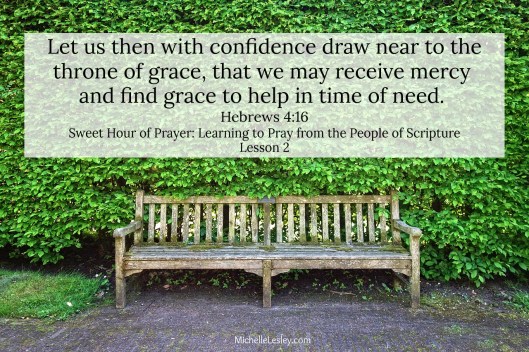
Lesson 2

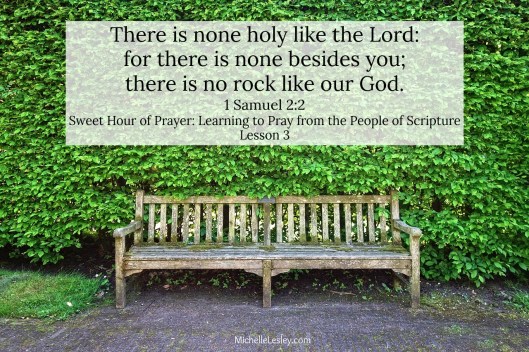
Lesson 3

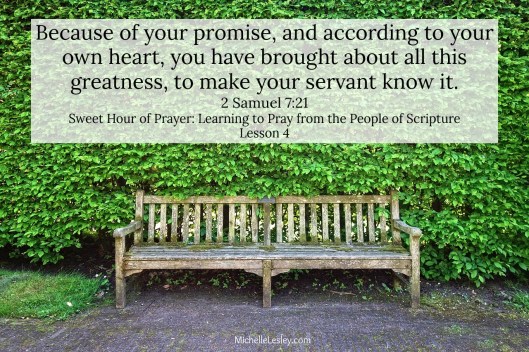
Lesson 4

Lesson 5

Lesson 6

A Word Fitly Spoken Podcast

A Word Fitly Spoken Update

In case you’re a new follower or missed this announcement the first time around, the lovely and talented Amy Spreeman and I started a podcast several weeks ago:

A Word Fitly Spoken

You can always find the link to the AWFS website at the Podcast tab at the top of this page. AWFS is available on all the major podcast platforms (and many “less major” ones, too!), and, of course, you can always listen online.

Here are the topics we’ve covered so far:

Walking Away from Christ?

On the debut episode of AWFS, Michelle and Amy share their testimonies, and discuss apostasy through the stories of Joshua Harris and Marty Sampson.

Is This Church For You?

What is a doctrinally sound church, and how can you find one?

Christians and Pornography: What goes on in your mind?

Resources for those who use pornography and for spouses of those who use pornography.

Top 7 Reasons the Enneagram is Unbiblical

What’s all the fuss about the Enneagram, and why is it unbiblical?

Benny Hinn and The Fruit of True Repentance

Did Benny Hinn really repent of the prosperity gospel? What does true repentance look like?

Doing Discernment

There are so many false teachers out there. How can we vet teachers and authors to find out whether or not we should follow them and use their materials?

Words with Friends: How to contend with loved ones

How can we approach friends who are following false teachers?

How to talk to your church leaders about false teachers

What’s the best way to approach your church leaders about false teachers they’ve introduced into the church?

Like what you hear? Be sure to leave us an encouraging comment or review.ย We have been so encouraged to hear your feedback!

In future episodes, we’d like toย answer your questions, so comment below with a question you’d like us to answer or a topic you’d like us to address, or fill out the contact form at the AWFS website.

And don’t forget to follow A Word Fitly Spoken on Facebook, Twitter, and Instagram!

Happy listening!