Welcome to another “potpourri” edition of The Mailbag, where I give short(er) answers to several questions rather than a long answer to one question. I also like to take the opportunity in these potpourri editions to let new readers know about my comments/e-mail/messages policy. I’m not able to respond individually to most e-mails and messages, so here are some helpful hints for getting your questions answered more quickly. Remember, the search bar (at the very bottom of each page) can be a helpful tool!
In these potpourri editions of The Mailbag, I’d also like to address the three questions I’m most commonly asked:
“Do you know anything about [Christian pastor/teacher/author] or his/her materials? Is he/she doctrinally sound?”
Try these links:
Popular False Teachers / Recommended Bible Teachers / search bar
Is She a False Teacher? 7 Steps to Figuring It Out on Your Own
(Do keep bringing me names, though. If I get enough questions about a particular teacher, I’ll probably write an article on her.)
“Can you recommend a good women’s Bible study?”
No. Here’s why:
The Mailbag: Can you recommend a good Bible study for women/teens/kids?
The Mailbag: “We need to stop relying on canned studies,” doesn’t mean, “We need to rely on doctrinally sound canned studies.”.
“You shouldn’t be warning against [popular false teacher] for [X,Y,Z] reason!”
Answering the Opposition- Responses to the Most Frequently Raised Discernment Objections
What are ways to help carry other Christians’ burdens? I’ve been praying for guidance in this area.
What a completely awesome question! It’s so encouraging to hear from readers who are striving to carry out God’s Word.
Galatians 6:2 tells us:
Bear one another’s burdens, and so fulfill the law of Christ.
Now, typically, we tend to think this verse means to help our brothers and sisters in Christ through difficult times in their lives: “weeping with those who weep” due to the loss of a loved one, helping out with a financial need, offering a word of encouragement to someone who’s down, etc. These are all good things that we should be doing. And the Bible does teach us to help others in these ways, it just doesn’t quite teach that in this particular verse.
Let’s take a look at the context of verse 2 and a couple of cross-references:
Brothers, if anyone is caught in any transgression, you who are spiritual should restore him in a spirit of gentleness. Keep watch on yourself, lest you too be tempted. Bear one another’s burdens, and so fulfill the law of Christ.
Galatians 6:1-2
See? Verse 2 isn’t really talking about helping the fam through the tough times. It’s talking about the obligation we have to our brothers and sisters (and they to us) to watch out for them, help them avoid temptation and sin, and, if they fall into sin, urgently, yet gently, pull them back to where they ought to be. The cross-references for Galatians 6:2 help us to see this even more clearly:
We who are strong have an obligation to bear with the failings of the weak, and not to please ourselves. Let each of us please his neighbor for his good, to build him up.
Romans 15:1-2
And we urge you, brothers, admonish the idle, encourage the fainthearted, help the weak, be patient with them all.
1 Thessalonians 5:14
So, Galatians 6:2 may have a bit of a different meaning than we thought it had, but in either of these senses – helping others through difficult times, or restoring a sinner – how do we “bear one another’s burdens”?
Pray– The most important thing you can do in either of these situations is to pray. Pray for the person you’re trying to help. Pray that God will give you the wisdom to say and do what’s godly in the situation. Pray that He will intervene and work things out as only He can. And be sure to let the person know you’re praying for her. If anyone has ever told you she’s praying for you, you know just how meaningful and encouraging that is.
Remove stumbling blocks– For example: If you’re helping someone who struggles with the temptation to drunkenness, don’t offer her a glass of wine when she comes over for dinner. Many men (yes ladies, even Christian men in your own church) fight a constant battle with lust. Help bear their burden by taking an extra look in the mirror to make sure your outfit isn’t cut too low, high, or tight before you go out or go to church. Whatever we can do on our part to avoid making things harder for someone who’s struggling with temptation is helping to bear their burden.
Ask her– No two people are alike. No two situations are alike. The only way to know how best to help another person is to ask her. If there’s something you’ve found helpful in a similar situation, you can suggest that and ask her if she feels like that would be helpful to her as well, but ask before doing it (see “Just do it./DON’T just do it.” in this article). Sometimes the things I find helpful aren’t the same things you find helpful.
Ask your pastor– In order to really pursue “bearing one anothers’ burdens” well in your own church, have a sit down with your pastor and get his guidance and counsel. He may know of a situation that’s just begging for someone like you to step in and be helpful. Just think of that – God could use you to be the answer to your pastor’s or a fellow church member’s prayers! And even if there’s not a specific situation he could assign you to, at the very least, just the fact that you asked will be a huge encouragement to your pastor.
The Mailbag: Ministering to the Bereaved
My church teaches that “man” and “woman” in 1 Timothy 2:11-15 isn’t the correct translation, that it should be “husband” and “wife,” because this passage is about marital submission, not women teaching in the church. Is this true?
I’ve answered this question before, but I’ve received it again twice in the last couple of weeks. I don’t know if that’s just coincidence, or if there’s been an uptick in this error, but if it’s the latter, I want to make sure you have the right information at hand.
The short answer to this question is no. This is eisegesis. Bible translators are hired for their expertise in the biblical languages (which is not a skill set the average pastor teaching this error has). If it were supposed to be translated as “husband” and “wife” they would have translated it that way. Check out all of the reliable English translations of the Bible. Across the board, they all translate it as “man” and “woman”. Even the unreliable versions/paraphrases of the Bible (like The Message and The Passion “Translation”) translate it as “man” and “woman”. This is just another silly and preposterous attempt to smuggle an unbiblical teaching (i.e. It’s OK for women to preach to/teach/hold authority over men) into the church.
For the longer, more detailed answer, see the second section of The Mailbag: Potpourri (Heretical church music, Mistranslating 1 Tim. 2:12, Books for women…).
I’m struggling to get a handle on how the idea that our obedience is pleasing to God fits with the idea that God is pleased with us because of Christ’s righteousness in us. I know our obedience to God doesn’t save us or keep us saved, but in what way is our obedience pleasing to God? Can you help me sort this out?
Another phenomenal question from a godly woman who’s a good student of the Bible!
You’re quite right in saying that our obedience to God cannot and does not save us or keep us from losing our salvation, so let’s box that one up and shove it out of the way. You’re also right in saying that God is pleased with us because of Christ’s righteousness that was imputed to us at the moment of salvation rather than any so called “righteousness” we have on our own. But God can be pleased with more than one thing about us, right? And He can be pleased with different things in different ways, can’t He?
So to answer your question: Yes, for Christians, our obedience, springing from our love for Christ, is pleasing to God.
Think of it like a parent-child relationship (an illustration God often uses in Scripture).
When you have a baby, you are pleased with and love that baby simply because he exists and has been born into your family. He doesn’t have to do anything spectacular to earn your good pleasure with him (In fact, he’s doing all kinds of things, like pooping and crying all night, that aren’t pleasing at all!). He’s your child. You’re pleased by that fact. End of story.
Now, if you see your child busily cleaning his room, being kind to his sister, saying please and thank you, etc., those things that he’s doing are also pleasing to you, but is that what makes him your child? Of course not. He’s your child because he was born into your family. He would be your child whether he was doing those good things or making a mess, hitting his sister, and being rude. But it’s more pleasing to you when he’s obedient out of love for you.
Being pleased with your child’s behavior is a separate matter from being pleased by the simple fact that he’s your child. It is the same way with those of us who have been born into God’s family and are now His children. He is pleased by the fact that we were born into His family and are robed in the righteousness of Christ, and He is pleased when we show our love for Him by obeying Him.
Check out these Scriptures about our obedience and good works – as Christians – being pleasing to the Lord.
What are your views on civil disobedience? Do you believe it can be a sin since it involves the refusal to submit to authority?
This question came in as a response to lesson 4 of Living Stones: A Study of 1&2 Peter, which dealt largely with submission to authority.
Civil disobedience – intentionally breaking a civil or criminal law, or disobeying the command of a governmental authority because you don’t feel you can, in good conscience, obey it – can be a sin. It also can be obedience to God. It totally depends on the situation, the law you’re contemplating breaking, and what the Bible says about it.
Submission to the authorities in our lives – including governmental authorities – is a huge theme of the New Testament. Romans 13:1-2 says:
Let every person be subject to the governing authorities. For there is no authority except from God, and those that exist have been instituted by God. Therefore whoever resists the authorities resists what God has appointed, and those who resist will incur judgment.
God has put certain people in certain positions of governmental authority. He says we are to submit to them, and that, if we don’t, we’re rebelling against Him and will incur judgment. This is a command straight from the lips of God that we are to take just as seriously as all His other commands.
The only exception to submitting to the authorities in our lives – whether it’s the government, our husbands, our pastors, or our employers (and for children, their parents)- is when that authority requests or requires that we disobey God’s (rightly handled, in context) written Word. No human being has the authority to go over God’s head, cancel His clear commands, and expect to be obeyed. God is our ultimate authority.
One of the clearest examples of this in in Acts 5. The high priest and other Jewish leadership arrest and imprison the apostles for preaching the gospel (which Jesus had commanded them to do in the Great Commission). In the middle of the night, God opens the prison doors and commands the apostles to go back to the temple and keep preaching the gospel. The high priest hauls them in again and says, “Why are you doing this? We commanded you to stop teaching this.”. And Peter says, “We must obey God rather than men.”
Our ultimate example, is, of course, Jesus, who always obeyed God even though the governing authorities eventually convicted Him of a capital offense and executed Him as a criminal as a consequence of that very obedience.
We obey God first and foremost and above all human authorities, no matter the cost.
So if you’re thinking about disobeying a human (governmental or otherwise) authority, consider these things first:
• Do you know your Bible, rightly handled, in context, inside and out on the issue at hand?
• Can you objectively differentiate between “This command clearly conflicts with Scripture,” and “I personally don’t like this command even though it doesn’t conflict with Scripture.”?
• Are you absolutely certain the human authority is requesting/requiring that you disobey clear Scripture (either ordering you to do something God has forbidden or ordering you not to do something God has commanded)?
• Do you fully understand the fact that if the human authority is not requesting/requiring that you actually disobey clear Scripture, and you refuse to comply, that you are disobeying God (sinning) by refusing to submit to the human authority He has established?
• Have you counted the cost? What will the consequences be if you disobey God? What will the consequences be if you disobey the human authority? Are you ready to “man up” and accept the consequences with grace and godliness?
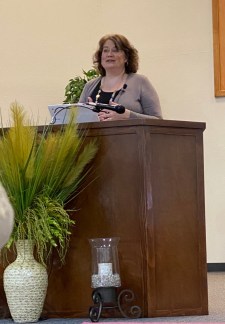
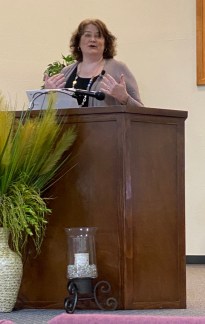
I really enjoyed reading your article about the women’s conference you just spoke at. Will you be coming to my area soon?
I hope so! There are two ways to catch an event I’m speaking at in your area:
1. Keep an eye on the “2020 Calendar” section of my Speaking Engagements tab (in the blue menu bar at the top of this page). I’ve got several more events in the works. When I get them finalized, I’ll post the details there and announce them on social media.
2. If you want to attend an event that’s really close to home, contact me to see if I’m available, and set up an event at your own church! There’s lots of great information at my Speaking Engagements tab on how to set up a women’s event at your church.
If you have a question about: a Bible passage, an aspect of theology, a current issue in Christianity, or how to biblically handle a family, life, or church situation, comment below (I’ll hold all questions in queue {unpublished} for a future edition of The Mailbag) or send me an e-mail or private message. If your question is chosen for publication, your anonymity will be protected.



 Read 1 Peter 4


 Have you ever wondered where Paul’s wife was when he was gallivanting all over the world preaching the gospel? Denny Burk explores Paul’s marital status through Scripture in this excellent article,
 “By God’s help may we not retreat from the fight for truth. May we be all the more invigorated by a love for our Lord, His truth, and His people. And may this commitment be evident to all as we discern with precision, humility, and sorrow.”