Mailbag

The Mailbag: Potpourri (Civil disobedience, Bearing one another’s burdens, Does our obedience please God?…)

Welcome to another “potpourri” edition of The Mailbag, where I give short(er) answers to several questions rather than a long answer to one question. I also like to take the opportunity in these potpourri editions to let new readers know about my comments/e-mail/messages policy. I’m not able to respond individually to most e-mails and messages, so here are some helpful hints for getting your questions answered more quickly. Remember, the search bar (at the very bottom of each page) can be a helpful tool!

In these potpourri editions of The Mailbag, I’d also like to address the three questions I’m most commonly asked:

“Do you know anything about [Christian pastor/teacher/author] or his/her materials? Is he/she doctrinally sound?”

Try these links: 
Popular False Teachers /
 Recommended Bible Teachers / search bar
Is She a False Teacher? 7 Steps to Figuring It Out on Your Own
(Do keep bringing me names, though. If I get enough questions about a particular teacher, I’ll probably write an article on her.)

“Can you recommend a good women’s Bible study?”

No. Here’s why:
The Mailbag: Can you recommend a good Bible study for women/teens/kids?
The Mailbag: “We need to stop relying on canned studies,” doesn’t mean, “We need to rely on doctrinally sound canned studies.”.

“You shouldn’t be warning against [popular false teacher] for [X,Y,Z] reason!”

Answering the Opposition- Responses to the Most Frequently Raised Discernment Objections


What are ways to help carry other Christians’ burdens? I’ve been praying for guidance in this area.

What a completely awesome question! It’s so encouraging to hear from readers who are striving to carry out God’s Word.

Galatians 6:2 tells us:

Bear one another’s burdens, and so fulfill the law of Christ.

Now, typically, we tend to think this verse means to help our brothers and sisters in Christ through difficult times in their lives: “weeping with those who weep” due to the loss of a loved one, helping out with a financial need, offering a word of encouragement to someone who’s down, etc. These are all good things that we should be doing. And the Bible does teach us to help others in these ways, it just doesn’t quite teach that in this particular verse.

Let’s take a look at the context of verse 2 and a couple of cross-references:

Brothers, if anyone is caught in any transgression, you who are spiritual should restore him in a spirit of gentleness. Keep watch on yourself, lest you too be tempted. Bear one another’s burdens, and so fulfill the law of Christ.
Galatians 6:1-2

See? Verse 2 isn’t really talking about helping the fam through the tough times. It’s talking about the obligation we have to our brothers and sisters (and they to us) to watch out for them, help them avoid temptation and sin, and, if they fall into sin, urgently, yet gently, pull them back to where they ought to be. The cross-references for Galatians 6:2 help us to see this even more clearly:

We who are strong have an obligation to bear with the failings of the weak, and not to please ourselves. Let each of us please his neighbor for his good, to build him up.
Romans 15:1-2

And we urge you, brothers, admonish the idle, encourage the fainthearted, help the weak, be patient with them all.
1 Thessalonians 5:14

So, Galatians 6:2 may have a bit of a different meaning than we thought it had, but in either of these senses – helping others through difficult times, or restoring a sinner – how do we “bear one another’s burdens”?

Pray– The most important thing you can do in either of these situations is to pray. Pray for the person you’re trying to help. Pray that God will give you the wisdom to say and do what’s godly in the situation. Pray that He will intervene and work things out as only He can. And be sure to let the person know you’re praying for her. If anyone has ever told you she’s praying for you, you know just how meaningful and encouraging that is.

Remove stumbling blocks– For example: If you’re helping someone who struggles with the temptation to drunkenness, don’t offer her a glass of wine when she comes over for dinner. Many men (yes ladies, even Christian men in your own church) fight a constant battle with lust. Help bear their burden by taking an extra look in the mirror to make sure your outfit isn’t cut too low, high, or tight before you go out or go to church. Whatever we can do on our part to avoid making things harder for someone who’s struggling with temptation is helping to bear their burden.

Ask her– No two people are alike. No two situations are alike. The only way to know how best to help another person is to ask her. If there’s something you’ve found helpful in a similar situation, you can suggest that and ask her if she feels like that would be helpful to her as well, but ask before doing it (see “Just do it./DON’T just do it.” in this article). Sometimes the things I find helpful aren’t the same things you find helpful.

Ask your pastor– In order to really pursue “bearing one anothers’ burdens” well in your own church, have a sit down with your pastor and get his guidance and counsel. He may know of a situation that’s just begging for someone like you to step in and be helpful. Just think of that – God could use you to be the answer to your pastor’s or a fellow church member’s prayers! And even if there’s not a specific situation he could assign you to, at the very least, just the fact that you asked will be a huge encouragement to your pastor.

The Mailbag: Ministering to the Bereaved


My church teaches that “man” and “woman” in 1 Timothy 2:11-15 isn’t the correct translation, that it should be “husband” and “wife,” because this passage is about marital submission, not women teaching in the church. Is this true?

I’ve answered this question before, but I’ve received it again twice in the last couple of weeks. I don’t know if that’s just coincidence, or if there’s been an uptick in this error, but if it’s the latter, I want to make sure you have the right information at hand.

The short answer to this question is no. This is eisegesis. Bible translators are hired for their expertise in the biblical languages (which is not a skill set the average pastor teaching this error has). If it were supposed to be translated as “husband” and “wife” they would have translated it that way. Check out all of the reliable English translations of the Bible. Across the board, they all translate it as “man” and “woman”. Even the unreliable versions/paraphrases of the Bible (like The Message and The Passion “Translation”) translate it as “man” and “woman”. This is just another silly and preposterous attempt to smuggle an unbiblical teaching (i.e. It’s OK for women to preach to/teach/hold authority over men) into the church.

For the longer, more detailed answer, see the second section of The Mailbag: Potpourri (Heretical church music, Mistranslating 1 Tim. 2:12, Books for women…).


I’m struggling to get a handle on how the idea that our obedience is pleasing to God fits with the idea that God is pleased with us because of Christ’s righteousness in us. I know our obedience to God doesn’t save us or keep us saved, but in what way is our obedience pleasing to God? Can you help me sort this out?

Another phenomenal question from a godly woman who’s a good student of the Bible!

You’re quite right in saying that our obedience to God cannot and does not save us or keep us from losing our salvation, so let’s box that one up and shove it out of the way. You’re also right in saying that God is pleased with us because of Christ’s righteousness that was imputed to us at the moment of salvation rather than any so called “righteousness” we have on our own. But God can be pleased with more than one thing about us, right? And He can be pleased with different things in different ways, can’t He?

So to answer your question: Yes, for Christians, our obedience, springing from our love for Christ, is pleasing to God.

Think of it like a parent-child relationship (an illustration God often uses in Scripture).

When you have a baby, you are pleased with and love that baby simply because he exists and has been born into your family. He doesn’t have to do anything spectacular to earn your good pleasure with him (In fact, he’s doing all kinds of things, like pooping and crying all night, that aren’t pleasing at all!). He’s your child. You’re pleased by that fact. End of story.

Now, if you see your child busily cleaning his room, being kind to his sister, saying please and thank you, etc., those things that he’s doing are also pleasing to you, but is that what makes him your child? Of course not. He’s your child because he was born into your family. He would be your child whether he was doing those good things or making a mess, hitting his sister, and being rude. But it’s more pleasing to you when he’s obedient out of love for you.

Being pleased with your child’s behavior is a separate matter from being pleased by the simple fact that he’s your child. It is the same way with those of us who have been born into God’s family and are now His children. He is pleased by the fact that we were born into His family and are robed in the righteousness of Christ, and He is pleased when we show our love for Him by obeying Him.

Check out these Scriptures about our obedience and good works – as Christians – being pleasing to the Lord.


What are your views on civil disobedience? Do you believe it can be a sin since it involves the refusal to submit to authority?

This question came in as a response to lesson 4 of Living Stones: A Study of 1&2 Peter, which dealt largely with submission to authority.

Civil disobedience – intentionally breaking a civil or criminal law, or disobeying the command of a governmental authority because you don’t feel you can, in good conscience, obey it – can be a sin. It also can be obedience to God. It totally depends on the situation, the law you’re contemplating breaking, and what the Bible says about it.

Submission to the authorities in our lives – including governmental authorities – is a huge theme of the New Testament. Romans 13:1-2 says:

Let every person be subject to the governing authorities. For there is no authority except from God, and those that exist have been instituted by God. Therefore whoever resists the authorities resists what God has appointed, and those who resist will incur judgment.

God has put certain people in certain positions of governmental authority. He says we are to submit to them, and that, if we don’t, we’re rebelling against Him and will incur judgment. This is a command straight from the lips of God that we are to take just as seriously as all His other commands.

The only exception to submitting to the authorities in our lives – whether it’s the government, our husbands, our pastors, or our employers (and for children, their parents)- is when that authority requests or requires that we disobey God’s (rightly handled, in context) written Word. No human being has the authority to go over God’s head, cancel His clear commands, and expect to be obeyed. God is our ultimate authority.

One of the clearest examples of this in in Acts 5. The high priest and other Jewish leadership arrest and imprison the apostles for preaching the gospel (which Jesus had commanded them to do in the Great Commission). In the middle of the night, God opens the prison doors and commands the apostles to go back to the temple and keep preaching the gospel. The high priest hauls them in again and says, “Why are you doing this? We commanded you to stop teaching this.”. And Peter says, “We must obey God rather than men.”

Our ultimate example, is, of course, Jesus, who always obeyed God even though the governing authorities eventually convicted Him of a capital offense and executed Him as a criminal as a consequence of that very obedience.

We obey God first and foremost and above all human authorities, no matter the cost.

So if you’re thinking about disobeying a human (governmental or otherwise) authority, consider these things first:

• Do you know your Bible, rightly handled, in context, inside and out on the issue at hand?

• Can you objectively differentiate between “This command clearly conflicts with Scripture,” and “I personally don’t like this command even though it doesn’t conflict with Scripture.”?

• Are you absolutely certain the human authority is requesting/requiring that you disobey clear Scripture (either ordering you to do something God has forbidden or ordering you not to do something God has commanded)?

• Do you fully understand the fact that if the human authority is not requesting/requiring that you actually disobey clear Scripture, and you refuse to comply, that you are disobeying God (sinning) by refusing to submit to the human authority He has established?

• Have you counted the cost? What will the consequences be if you disobey God? What will the consequences be if you disobey the human authority? Are you ready to “man up” and accept the consequences with grace and godliness?


I really enjoyed reading your article about the women’s conference you just spoke at. Will you be coming to my area soon?

I hope so! There are two ways to catch an event I’m speaking at in your area:

1. Keep an eye on the “2020 Calendar” section of my Speaking Engagements tab (in the blue menu bar at the top of this page). I’ve got several more events in the works. When I get them finalized, I’ll post the details there and announce them on social media.

2. If you want to attend an event that’s really close to home, contact me to see if I’m available, and set up an event at your own church! There’s lots of great information at my Speaking Engagements tab on how to set up a women’s event at your church.


If you have a question about: a Bible passage, an aspect of theology, a current issue in Christianity, or how to biblically handle a family, life, or church situation, comment below (I’ll hold all questions in queue {unpublished} for a future edition of The Mailbag) or send me an e-mail or private message. If your question is chosen for publication, your anonymity will be protected.

Speaking Engagements

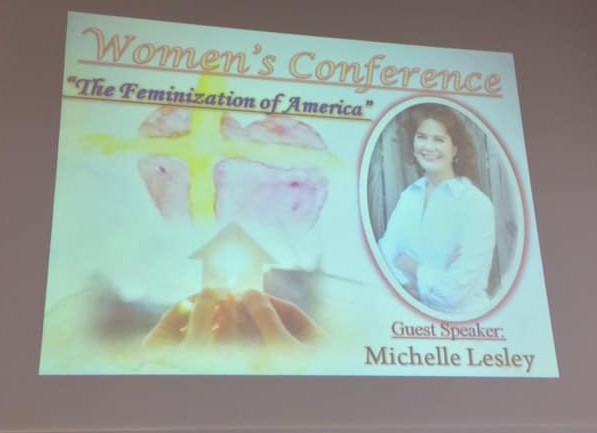
Report Back: The Feminization of America Conference


It was such a joy to serve the ladies of Nashville, Arkansas, last week at Maranatha Baptist Church’s The Feminization of America women’s conference.

Conference Program

Friday night, the men of MBC kicked things off just right by cooking and serving us a hearty dinner with a choice of bacon-wrapped chicken or pork chops. I couldn’t help but think about some of my readers who have jokingly complained that when men have a conference, they get steak, but women’s conferences serve delicate “froo froo” food that leaves you just as hungry as you started off. You ladies would have been proud…and full!

Lovely centerpieces decorated the tables at dinner.

After dinner, I taught my first two sessions. The ladies were so kind, welcoming, and receptive. (Nobody threw rotten tomatoes even though I taught what might be considered hard biblical truths!)

God’s Design for Biblical Womanhood


Encouraging & Supporting God’s Design for Biblical Manhood


Look what was in the wonderful “swag bags” attendees received! So much great reading material (and other goodies!), including The Grand Design: Male and Female He Made Them by my friends Owen Strachan and Gavin Peacock. I highly recommend it (even though I’m only on the first chapter!).

When the Friday evening sessions were over, I was whisked away to Margaret and Tom’s beautifully rustic home in the country. They were incredibly kind to me, and I can’t thank them enough for their hospitality. I’ve never stayed at a nice enough hotel that fresh flowers were among the amenities, but take a look at these gorgeous jonquils that graced my bedside table. These florist-quality beauties grow everywhere in Arkansas as wildflowers.

On Saturday morning, the men of MBC outdid themselves, serving the ladies an extensive breakfast bar. What a feast! Then it was time for sessions 3 and 4:

Fighting Feminism by Walking Out Biblical Womanhood


Rap it Up!
Wrap Up, Review, Q&A


Not everyone was able to make it back on Saturday morning,
but it was still a great group of ladies!


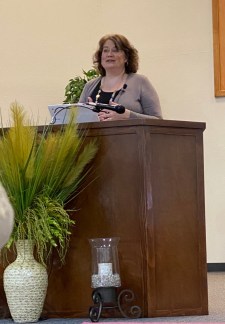
I’ve never spoken from behind a “preaching desk” style pulpit,
but now I can see why pastors love them so much. So roomy!

It’s always so great to meet online friends and the ladies attending the conference. My “tweeps,” Trina and Camille, came all the way from Texarkana to attend!

One of the ladies of MBC shared her testimony with me and gave me these precious gifts. Can you guess what’s in the ornament and the pendant jar to go along with Matthew 17:20? Hundreds and hundreds of mustard seeds! That’s a lot of faith! :0)

Some charming gifts from the conference hostesses

When the last hug had been given and the last goodbye had been said, we hit the road, and my family and I got to spend a few relaxing days with my parents, not far from from Nashville. It was a wonderful visit. One of the days we were there, I took a brief walking tour of nearby downtown Hot Springs.

Yes, that’s steam coming off the hot spring.
Can you believe this enchanting natural
area is in the middle of downtown?
I had to cross the busy main street to get to it.

These incredible murals grace the sides of two older buildings

If you saw the 1988 Tom Hanks movie, Big,
(which I’m not necessarily recommending), you know what this is.
I thought it was fun to see one in real life. After I took the picture and began walking away, it started yelling at me!

Another beautiful spot in downtown Hot Springs.
(Cherry blossoms? I’m not sure.)

I had an awesome trip to Arkansas, and it was such an honor to teach the lovely ladies of Nashville. Many thanks to Margaret, Stephanie, Jeanne, Pastor Bruce, and all the hard-working men and women of Maranatha Baptist Church for your sweet hospitality and for putting on such a wonderful conference. I highly recommend this warm and welcoming church to anyone in southwest Arkansas who is looking for a doctrinally sound body of Believers to join.


If your church or organization is ever in need of a speaker for a women’s event, I’d love to come share with your ladies as well. Click here for more information.


Photo Credits

Photo of Maranatha Baptist Church courtesy of Maranatha Baptist Church website.

Photos of Michelle speaking by Margaret Byrd.

Photo of Trina, Camille, and Michelle courtesy of Trina Armstrong.

All other photos by Michelle Lesley

1&2 Peter Bible Study

Living Stones: A Study of 1 & 2 Peter ~ Catch Up Week

Previous Lessons: 1, 2, 3, 4, 5

It’s Catch Up Week!

I’m out of pocket this week, so you get a catch up week!

Catch up on any lessons you might be behind on, go back and do any of the homework you may not have had time for, review your memory verses, or if you’re already caught up, you could even read ahead in 1 Peter a little (we got through the end of 1 Peter 3 in lesson 5). It’s your week to use as you see fit.

Memory verses for review (there was no memory verse for lesson 1):

Lesson 2


Lesson 3


Lesson 4


Lesson 5

Guest Posts

Guest Post: Be Part of the Solution – Preach the Whole Counsel of God

If your theology pretty much matches up with mine (as outlined in my “Welcome” and “Statement of Faith” tabs in the blue menu bar at the top of this page) and you’d like to contribute a guest post, drop me an e-mail at MichelleLesley1@yahoo.com, and let’s chat about it.


Be Part of the Solution:
Preach the Whole Counsel of God

by Andy de Ganahl

“If you’re not part of the solution, you’re part of the problem.”

An honest assessment of what passes for Evangelicalism today is depressing. Individual Christians are vastly ignorant of the Scriptures, churches that teach verse-by-verse are few and far between, and whole denominations are apostatizing left and right. The reason for this massive downgrade is simple: once a departure from Scripture’s authority has commenced, total destruction is imminent.

For the time will come when they will not endure sound doctrine; but wanting to have their ears tickled, they will accumulate for themselves teachers in accordance to their own desires, and will turn away their ears from the truth and will turn aside to myths. – 2 Timothy 4:3-4

We are even now living in a time when “Christians” desperately desire to have their ears tickled. They want people to tell them what they want to hear and have no stomach for anything outside of that small circle.

We conservatives are quick to point the finger at men like Joel Osteen or Steven Furtick who deny redemption from sin in favor of redemption of personal circumstances. The damning errors of Beth Moore and Rachel Hollis who preach empowerment instead of submission are easy pickings. These are ear-ticklers who have a vast following. But what are we doing about it?

The cancer of heresy is easy to spot once it manifests, but we must address the source of this sickness rather than only treating the symptoms. Generally speaking, we know the problem. We have departed from the Word of God. When you confuse the gospel of grace with personal wealth and individual independence, you’re clearly off the reservation. But where did this start? How far back do we have to go before we find the root of this problem? At what point did we become those who desire to have our ears tickled? It is my opinion that this sickness has infected many more of us than you may suspect.

What Is The Problem?

If you’re like me, you may associate that phrase “wanting to have their ears tickledwith heresy. Clearly what Paul is talking about is a gross misrepresentation of the gospel that might include things like:

  • Denying Christ’s divinity
  • Denying Christ’s humanity
  • Denying the need of repentance
  • Denying human inability in salvation

We could go on and point out the heresies of various cults and false teachers, but Paul’s point is broader than that. All that the phrase means is that people want to be told what they want to hear at the expense of everything else. This does not mean that the thing that people want to hear is necessarily contrary to Scripture.

Paul contrasts ear-tickling with sound doctrine. The Greek literally means healthy/wholesome teaching. It brings the idea of a complete and filling spiritual and theological diet. There is no room in a whole diet for sweets and fluff. But we also need more than only steak, only bread, only broccoli (Praise Him!).

Christians must hold certain convictions with an iron grip. There are many things that a true Christian will never budge on. But that iron grip must hold the totality of God’s Word and not only those convictions that we personally adore more than others.

Some beloved believers, while holding fast their biblical convictions, are ignorant to other important doctrines. Not only are they ignorant, they’re indifferent. They’ve no time for these matters nor do they desire to submit to them. They only wish to hear about the things that are most concerning to them.

We hot-blooded Protestants are eager to rally to the cry of Sola Scriptura! Yet that slogan means that we stand on the totality of Scripture alone, not that we only stand on our favorite passages and doctrines.

I’ve noticed a trend in the various posts that I write. The majority of my writing reflects a careful exposition of Scripture. I write like I preach, verse by verse. But occasionally it is necessary to address issues and topics in light of current events (case in point). Those topics are still presented and studied under the light of Scripture, but they remain topical in nature. It is these kinds of posts that receive the most attention, views, and shares on social media. This trend follows the trajectory of the larger problem. In general, the people of God are more interested in topical discussions that tickle their ears than enduring wholesome teaching. If I am honest, I find this discouraging.

If I were to write something rather controversial like the clear demonic influence of the Democratic National Convention or the apostasy of the Southern Baptist Convention, these sensational topics would likely be well circulated. But these are crumbs. The truths of these propositions are so utterly basic to the Christian faith. To feast on these things is to ensure spiritual starvation. To prefer sensational topics to steady exposition is the very definition of wanting to have our ears tickled.

Please understand me. I am not suggesting that pastors should not address topics that intersect with our surroundings. The sheep need to hear the clear voice of the Shepherd in all things. But it grieves me that there is a genuine lack of appetite for meat while the crumbs are quickly gobbled up. The true child of God loves all of the Word of God and not only the parts he finds to be sensational.

This is a problem of our own making. It has become the standard operating procedure of most churches to completely avoid vast portions of Scripture. We are grieved when we see churches adopt atheistic presuppositions about the origins of the universe and deny God’s literal creation. We marvel and shake our heads when we hear that churches no longer teach homosexuality is sin in both practice and desire. We are shocked when we see mainstream denominations promote blatant violations of 1 Timothy 2:12. But all of these are only the fruit. The root is much deeper.

We have been giving lip service to the inerrancy and sufficiency of Scripture while practically denying that “all Scripture is God-breathed and is profitable for teaching, reproof, correction, and exhortation” (2 Timothy 3:16-17).

In plain language, the problem is a departure from the totality of Scripture.

What Is The Solution?

The solution is as simple as the problem. We must cling to and submit under the totality of Scripture. But what does that simple solution look like?

As a people, we must soundly reject the false understanding of doctrinal triage. We cannot survive another decade if we continue to treat the church like a 1950’s dinner party where are certain topics are off limits. There is simply no such thing as secondary or tertiary doctrines that pale in significance or even lapse into insignificance when placed alongside “primarydoctrines. The biblical authors never divide the Word of God into degrees of significance and neither should we. The solution to biblical fidelity will never be found in arbitrary divisions of biblical teaching. If we’re not part of the solution, we’re part of the problem.

As a church, our pulpits must proclaim the full counsel of God and not only the portions that are palatable. The teaching must be only the Word and must consist of the totality of the Word. Careful verse-by-verse exposition takes a very, very, very long time. It took John MacArthur almost 50 years to preach through the New Testament. But there are still 39 books in the Old Testament that need to be taught. Precise verse-by-verse exposition is the only way to preach. But that means the church must provide more than only the pulpit ministry. The people need the whole story. Their diet must contain the totality of God’s bounty. The solution to biblical fidelity requires the totality of the Bible to be taught. If we’re not part of the solution, we’re part of the problem.

As an individual, you must feast upon the totality of Scripture on a daily basis. There are many Bible reading programs out there. I have my opinion as to how to make your daily Bible reading and communion with God most profitable, but at the end of the day you must be familiar with your ENTIRE Bible. When is the last time you read through Leviticus, or Habakkuk, or Philemon, or (heaven forbid) Revelation? If you own a Bible and possess the ability to read, there is no excuse to be biblically malnourished. This is akin to starving do death with a full pantry. The solution to biblical fidelity requires that we are familiar with our Bibles. If we’re not part of the solution, we’re part of the problem.

Helpful Suggestions

Find a church: The individual Christian is never truly an individual but a member of a larger body. If you find yourself floating from church to church, or just not going to church, then repent of your sin and attach yourself to a faithful body. But be wise to what you attach yourself. There is only one thing that should look for: does this church teach the Bible? Sequential exposition is not just an effective way to preach, it is the only way to preach. The style of music, the quality of the sound system, and the presence (or lack of) children’s church does not amount to a hill of beans. Does the pastor open up his Bible, read it, explain it, and then exhort obedience to it? Find a church that does this, attach yourself to her, bless her and be blessed by her.

Redeem the time: There are portions of our day when our minds a free to wander. Whether we are driving to work, getting in a work out at the gym, or doing some mindless chore around the house. These are fantastic opportunities to engage the mind as well as the hands. We live in a day when we have countless resources full of sound teaching at our fingertips. Many faithful ministries have apps free to download on your phone (Search for Grace to You and S.L.J Institutes in the app store). Stop wasting your time with pointless and Godless music or simply allowing your mind to wander and feast upon the Word of God.

Be selective: Make a conscious decision between what’s good and what’s best. There are many teaching resources out there that seek to teach biblical truth, but are not necessarily teaching the Bible. Is it good to learn about God’s good creation and the scientific discoveries that assume Genesis 1 is true? Is it good to listen to men discussing current events from a biblical worldview? Absolutely. But what is best is to feast on the Word itself. Why waste your time listing about the Bible when you can hear the Bible being taught?

Conclusion

Apostasy and heresy are running rampant in our land and we are partly to blame. We have the audacity to be shocked at the fruit of unbelief when the root of biblical infidelity has been growing for decades. What did Paul command Timothy before he warned him? Preach the Word! (2 Timothy 4:1-2)

He doesn’t say, preach the primary” doctrines, or when it’s convenient. Preach the whole counsel of God and preach it all the time. There’s no room here for private convictions held within small circles. He says reprove (give correction), rebuke (call out sin), exhort (call for obedience) with great patience (people need to hear it over and over again) and instruction (TEACH IT!).

The problem with the church today is that we have neglected the totality of Scripture. As a result we must be chained to, immersed in, and fully submitted under all of Scripture.

This is our battle cry. This is what Sola Scriptura means. This is the path of fidelity. This is the solution to the problem. But if we’re not part of this solution, then we’re part of the problem.


Andy de Ganahl is a graduate of The Master’s Seminary and pastor of Calvary Baptist Church in Burley Idaho. Andy’s burning desire is for the people of God to know the Word of God so that they can more accurately worship the God of the Word. You can check out If You’re Not Part of the Solution, Then You’re Part of the Problem (from which this guest post was excerpted), and other articles by Andy, at The Pastor’s Brief

1&2 Peter Bible Study

Living Stones: A Study of 1 & 2 Peter ~ Lesson 5

Previous Lessons: 1, 2, 3, 4

Read 1 Peter 3:8-22

Questions to Consider

1.  The word “finally” at the beginning of verse 8 functions in a similar way to the word “therefore” at the beginning of a verse- as a pivot word (see lesson 2, link above). “Therefore” usually indicates, “Because of all that stuff I just told you, now do this.” What does “finally” indicate? Review lesson 4 (link above). What issue was Peter dealing with before pivoting with “finally”?

2. Examine verse 8. Who is “all of you” that Peter is talking to? Recall their circumstances (review lesson 1 if needed, link above). What would each of the phrases…

Unity of mind-

Sympathy-

Brotherly love-

A tender heart-

A humble mind-

…have meant to Peter’s audience in their situation, and why are they important for the church today?

3. Compare verse 9 and 13-17 to these passages. Explain the concept of doing good to your enemies instead of taking revenge, and bearing up in a godly way when you suffer at the hands of evil men. What are the reasons God instructs us to behave this way? How does this paint a picture for unbelievers (especially the one you’re “doing good” to) of Christ’s mercy and grace toward sinners? How might acting this way open a door to share the gospel? Is taking revenge likely to open that same door?

4. Verses 9 and 14 talk about “obtaining a blessing” and “being blessed” due to suffering at the hands of evil people. Many people equate “blessings” with getting rich or with things going really well in your life. Think again about Peter’s audience, their circumstances, and what you know about “blessings” from other passages. Are blessings always monetary or circumstantial? Describe the spiritual blessings someone might receive for suffering in a godly way.

5. Examine verses 10-12. What passage of Scripture is Peter quoting? (Hint: Use your cross references) How do the instructions from this Psalm fit in with the instructions Peter is giving the church? How does pursuing holiness lead to a life with less chaos, drama, enmity, grief, and strife, than pursuing worldliness and debauchery? (Hint: Keep this thought in mind as you read #6 and verse 13.)

6. Carefully read 13-17. Do verses 14-17 contradict verse 13? After all, Peter himself was certainly “zealous for what is good,” as were all the apostles, and we know that all of them were “harmed” and eleven of them were martyred, some gruesomely. Jesus was too, and no one was more “zealous for what is good’ than He was.

7. How does verse 17 refute the Word of Faith (prosperity gospel)/New Apostolic Reformation false teaching that it is never God’s will for Christians to suffer? Let this thought lead you into verse 18. Was it God’s will for Christ to suffer? Why might it be God’s will for someone to suffer?

8. Remember how Peter sometimes uses very long sentences? Verses 18-20 are all one sentence. Read it from beginning to end without stopping at the verse markings. What is the idea Peter is trying to get across? It may help you to read this passage in several trustworthy translations. It may also help you to mentally put a period at the end of verse 18, and to begin verse 19 as a new sentence beginning with “In the spirit” instead of “in which,” and to deal with verse 18 and verses 19-20 as two separate sentences. If you give it your best shot and still have difficulty grasping what Peter is saying (and not saying) here, check out this resource and this resource.

9. Examine verses 21-22. “Baptism corresponds to this” – what is “this”? Go back to the end of verse 20. Peter is teaching us to think of the story of Noah and the ark as symbolic of new life in Christ. Compare the sinfulness of Noah’s society with the sinfulness of our society. Compare God calling Noah out of that sinful world to save him from His wrath to God calling us out of a sinful world to save us from His wrath. Compare Noah being saved out of the world, in God’s ark, through the waters of the flood to us being saved out of the world, in Christ and the cross, through the waters of baptism.

Some people believe verse 21 supports the idea of baptismal regeneration – that the act of baptism is salvific. However, Scripture is abundantly clear that salvation comes only through repentance and belief in the good news of the gospel. That being said, baptism – especially in the first century church, Peter’s audience – was so closely tied to the salvation experience that an unbaptized Christian would have been just as incomprehensible and oxymoronic to the church as an uncircumcised Jewish man would have been to the Jews. The New Testament knows nothing of unbaptized Christians just as the Old Testament knows nothing of uncircumcised Jewish men.

Think back to Old Testament circumcision. The law said Jewish males were to be circumcised on the eighth day after birth, no questions, no exceptions. It was as much a given as breathing air. So much so that if an unknown, uncircumcised Jewish man walked up to the temple and said, “Hi, I’m Jewish. I’d like to come in and worship,” no one would have believed him. They would have automatically assumed he was a liar, he would have been treated as a Gentile, and he would not have been given the worship privileges of a Jew. Even if he could have recited his genealogy of Jewish lineage, it wouldn’t have mattered much. People can say anything, and DNA, at that time, wasn’t visible. Circumcision was a man’s outwardly visible “credentials,” his proof of being a Jew.

This is the same type of mindset first century Christians had about Believers and baptism (a mindset we desperately need to recapture today). Believers were  baptized as soon as possible after their new birth, no questions, no exceptions. It was as much a given as breathing air. So much so that if an unbaptized Christian walked up to the church and said, “Hi, I’m a Christian. I’d like to come in and worship,” no one would have believed him. They would have automatically assumed he was a liar, he would have been treated as a Gentile, and he would not have been given the worship privileges of a Christian. A mere verbal profession wouldn’t have mattered much. People can say anything, and regeneration of the heart wasn’t visible. Baptism was a Christian’s outwardly visible “credentials,” his proof of being a Christian. Especially because, at that time in history, baptism publicly identified you with Christ, and that could get you killed.


Homework

Read my article Basic Training: Baptism. Have you been baptized? Why or why not? If you haven’t been baptized, make an appointment with your pastor to discuss being baptized as soon as possible.


Suggested Memory Verse