Entertainment, Mailbag, Movies

The Mailbag: Overview/Review of “The Chosen” (An Online TV Series on the Ministry of Jesus)

In the summer of 2021, Amy and I recorded a three part series of our podcast, A Word Fitly Spoken, reviewing The Chosen, which included both seasons 1 & 2. Some, but not all, of the information in this article is discussed in those episodes, and the episodes contain much more information than this article. Click here to listen, or scroll down to the Additional Resources section at the end of this article.


The overview and review below were written in April of 2020, immediately after the premier of season 1 of The Chosen. At that time, very little about Dallas Jenkins’ problematic theology and other unbiblical issues with The Chosen were publicly known. This article is honest and faithful to what I knew at the time (and demonstrates how quickly “Christian” things can turn unbiblical). Additionally, it covers only season 1. The biblical issues in season 2 of the show grew progressively worse and worse (listen to our 3-part podcast series that includes season 2), and more information came to light about off-screen biblical issues with Dallas Jenkins, actors, producers, etc. Because of the many unbiblical things that have transpired concerning The Chosen since its initial release,


I now strongly recommend against
watching The Chosen.


The “Review” section of this article contains SPOILERS.

What do you know about the TV series, The Chosen?

Overview (No spoilers):

From their website: The Chosen is the first multi-season television series about the life of Christ, as witnessed through the eyes of those He impacted. Directed by Dallas Jenkins (The Resurrection of Gavin Stone) and distributed by VidAngel Studios, The Chosen has grown to become the largest crowdfunded TV series of all time. (VidAngel is a Netflix and Amazon-based streaming service that allows you to skip distasteful content regarding profanity, nudity, sexual situations, and violence.)

In other words, if you’re familiar with the original content “TV series” Netflix creates and streams, it’s kind of like that, but it’s on VidAngel. You can also watch all eight episodes of the first season for free on The Chosen’s website, The Chosen app on Google Play or Apple (which you can also stream to your smart TV), and on YouTube. (I’ve posted the YouTube version of each of the eight episodes below in the “Review” section of this article, so you can watch them all right here if you like.)

From the extremely limited amount of information about his theology* available online, The Chosen’s writer/director Dallas Jenkins (son of Jerry B. Jenkins) seems to be fairly doctrinally sound in his beliefs. He is a Christian/inspirational filmmaker, and former Director of Visual Media and member of the Executive Leadership Team at Harvest Bible Chapel (James MacDonald’s former church), which has long had a reputation for adhering to a biblical statement of faith. Dallas was one of the leaders of HBC who attempted to bring about a biblical solution to the MacDonald debacle several years ago (read Dallas’ statement here). I spot-checked for connections between Dallas and several major false teachers and found none.

Update (7/12/20): Thank you to a kind reader who brought to my attention a recent interview of Dallas on a Mormon YouTube channel. Dallas seems to believe that Mormonism and Catholicism are both Christianity. You can listen to the short version (with Todd Friel’s commentary) here (starting at 45:00) or the entire interview here, as well as Gabriel Hughes’ 2021 thoughts on Dallas’ theology here (starting at 18:08). You may also wish to compare (fairly, objectively, and discerningly) Dallas’ comments in the interview with his comments (below) at the end of this article. It is one thing to use the products and services of a non-Christian company. It is another matter to personally believe, as a Christian, that false religions are Christianity and that adherents of those religions are brothers and sisters in Christ. If these revelations of Dallas’ beliefs prevent you from watching The Chosen, that is certainly understandable, and I would encourage you not to sin against your conscience by watching it. But just to clarify, these revelations do not somehow magically change the actual content of the episodes, nor my evaluation of said content. In other words, I biblically evaluated what I saw in the episodes, so the remainder of this review stands.

There is an accompanying devotional to the movie entitled The Chosen: 40 Days with Jesus. I’ve read the sample available at Amazon (the endorsements {Liz Curtis Higgs isn’t someone I’d recommend, I’m not familiar with any of the others}, the foreword, and the first three devotions). It’s not Bible study, so don’t expect it to be. Bible study is reading and studying the text of the Bible. It’s a devotional. It’s like having a Hershey’s Kiss for a mid-afternoon snack. It’s quick and sweet and enjoyable, but it’s not sitting down at the table and eating a substantive, well-balanced meal of Bible study. For a “Hershey’s Kiss” it’s not bad. It uses Scripture and the Bible characters in the show to point the reader to Christ. The first three entries lean heavily on Mary Magdalene, which, I would guess, is because she is one of the first characters introduced in The Chosen.

I watched all eight of the episodes in season 1 of The Chosen, and several of Dallas’ commentaries, interviews with actors, and behind the scenes videos. For the most part, I thought The Chosen was very good, biblically and cinematically. The costumes, sets, scenery, visual effects, sound editing, and acting were all top notch from my perspective. I even like the theme song. It is, overall, true to Scripture when portraying something recorded in Scripture (Although, as in nearly every Bible movie, there are minor details that are changed when it seems like it would be just as easy not to change them. For example- an episode portrays Jesus standing in Peter’s boat to preach when the biblical account clearly says He sat. When it’s right there in black and white, why not follow it?). When “filling in the blanks” (fictionalized character development and events not recorded in Scripture) it was mostly (except for a few notable issues which I’ll describe in the “Review” section below) consistent with biblical principles and practices as well as first century Middle Eastern culture.

Some things I really appreciated about The Chosen:

๐ŸŽ‰ The common vernacular. You’ll hear characters using very 21st century American words and phrases like, “I’ve got this,” “lucky guess,” “OK,” “guys,” “No kidding,” etc. It might interrupt your suspension of disbelief for a second, but it’s a good reminder that Jesus and the disciples didn’t walk around speaking stilted King James English. They spoke whatever was the first century Aramaic/Hebrew equivalent to today’s common man’s vocabulary.

๐ŸŽ‰ The characters in The Chosen look and sound Middle Eastern, as they should, rather than looking European and sounding British.

๐ŸŽ‰ I know this is hard for some Christians to accept, but Jesus, being fully human (in addition to fully God) and being made like us in every respect, probably cracked a smile and kidded around with his friends (in a totally holy and biblical way) every now and then. The disciples most likely did, too. I appreciated the moments of appropriate humor in The Chosen that serve to remind us that Jesus, Peter, James, John, and all the rest were real, normal human beings.

๐ŸŽ‰ I’ve watched a lot of Jesus movies, and I really believe that The Chosen is the best overall portrayal of Jesus – His looks, mannerisms, personality, spiritual life, teaching, relating to others, the whole ball of wax – that I’ve ever seen. “Reverently realistic” is the way I’d put it.

Overall, I would give the first season of The Chosen a B or B+.

Caveats:

๐ŸŽฅ I can only comment on what I’ve watched. As of the writing of this article, I have only seen season 1 of The Chosen, because that’s all that has been released.

๐ŸŽฅ *Dallas Jenkins is a filmmaker, not a pastor or Bible teacher. As such, I regard him, his theology, and his work more along the lines of a Christian fiction author than a pastor or teacher.

๐ŸŽฅ As with any Bible movie, you must hold The Chosen at arm’s length with the thought constantly in your mind: this is not the Bible, this is a TV show. Whatever you see in this series might be a reasonable imagining of how a biblical event happened, or how a biblical character acted, or it might have happened in a totally different way. Don’t take what you see in The Chosen as “gospel” (if you’ll pardon the pun).

Something I’ve been very concerned about as I’ve read and heard viewers’ responses to The Chosen is repeated remarks like, “I came to know Jesus better through this show.” Unless the person saying this means that the show inspired her to pick up her Bible and study it, and that’s how she came to know Jesus better, this is a very dangerous statement. The Bible is clear that we come to the knowledge of Christ and His Word through Scripture. The Chosen (as I’m sure Dallas Jenkins would agree) is not Scripture. It is not breathed out by the Holy Spirit, it is neither infallible nor inerrant, and the actor portraying Jesus in the show is not Jesus. You cannot get to know Jesus better through The Chosen because the person you’re seeing on the show isn’t Jesus. We must never derive our doctrine or practices from any source except the Bible.

๐ŸŽฅ The Chosen isn’t for you if you…

…hold to the belief that depictions of Jesus are a Second Commandment violation. (Although, in episodes 1&2, “Jesus” does not make an appearance until the last five minutes or so of the episode, if your conscience allows you to watch up until that point.)

…are offended by anything that is not straight, word for word Scripture.

…are offended by the thought of Jesus kidding around with His friends and doing other normal, non-sinful, things humans do.

…have a difficult time separating fact (the Bible) from fiction (much of The Chosen).

If you fall into any of these categories, please do not watch The Chosen.

Review (Spoilers start here):

As I said, I thought The Chosen was pretty good overall. I’ve made a few brief remarks on each episode below. Some of my remarks showcase a problematic issue in that particular episode, but that doesn’t mean I disliked the entire episode. Generally speaking, if there’s something in an episode I didn’t comment on, I either liked it, could take it or leave it, or it somehow escaped my attention. I thought the content of each episode was biblically consistent or plausible unless otherwise noted.

Every night last week, Dallas Jenkins hosted a livestream of each episode, with his commentary (and interviews and extra video features- all of which you can skip if you like) prior to and following the episode. The videos below are the YouTube videos of those livestreamed episodes. (Update, April 2021: The original 2020 livestream videos were removed from YouTube. Below are the versions re-released in 2021 January 2023: The 2021 videos were removed from YouTube. Below are the versions re-released in 2022.)

Episode 1:

This series focuses on Jesus’ ministry years, rather than being a chronological biography of His whole life. Jesus doesn’t appear until the last five minutes of episode 1 (as an adult) when He drives the demons out of Mary Magdalene (who has been living under the assumed name “Lilith”). We meet Simon and his wife Eden, Andrew, Nicodemus and his wife Zohara, Matthew, and assorted Roman soldiers and townspeople. It was nice to see the wives brought into the story, and I enjoyed the interactions between the husbands and their wives. All of the action and dialogue takes place before Jesus arrives on the scene, and no one but Mary interacts with Him in this episode, so nearly everything we see is fictionalized.

Prior to Jesus healing Mary, Nicodemus is called upon to exorcise Mary’s demons. I strenuously doubt that actually happened, but it wasn’t overtly unbiblical.

In a couple of interviews with Dallas Jenkins, he mentioned that they decided to play Matthew as having Asperger’s Syndrome – a choice which doesn’t conflict with Scripture outright, but one I find very strange as there’s no indication anywhere in the Bible that Matthew had any sort of disability. Dallas attributes this creative decision to the fact that Matthew is depicted in Scripture as a “numbers guy,” “meticulous,” and because he chose a job that made him a social outcast. Well…OK, but those things don’t automatically point to the autism spectrum. The majority of people with those traits are not autistic.

If you’re familiar with Asperger’s, you’ll recognize the characteristics. If you’re not, the actor underplays it enough that Matthew just comes off as a high strung, socially awkward germophobe. I could be way off base here, but it feels like the Asperger’s aspect was added to Matthew’s character either for the purpose of manufacturing diversity to appease audience members whose worldly worldview centers around such things, or to be an inspiration to people on the autism spectrum (Dallas mentions in one interview that one of his own children is autistic). Either way, if either of those reasons are actually the case, they are spiritually inappropriate motives when it comes to portraying anything biblical, or even just a historical character. We don’t bend the Bible to make it more appealing to a particular audience.

And finally, is it just me, or does the actor who plays Matthew look exactly like actor David Krumholtz (Bernard in The Santa Clause)? Sorry if you can’t unsee that.

Episode 2:

James (Zebedee), John, James, and Thaddeus make their first appearances in this episode.

When Nicodemus questions Mary Magdalene about the identity of the man who healed her, she tells Nicodemus, “His time for men to know Him has not yet come,” implying that her healing, which was portrayed as private (only Mary and Jesus present) took place before Jesus’ first public miracle at the wedding at Cana. (This is discussed further in episode 5.) This is biblically plausible. The Bible does not indicate when Mary’s healing took place nor whether or not it was done in public. The Bible also does not preclude Jesus having performed (unrecorded) private miracles or healings prior to his first public miracle.

Jesus again shows up in the last few minutes of the episode, inviting Himself to the Shabbat (Sabbath) dinner Mary Magdalene – a single woman – is hosting in her home. Also present – James (not Zebedee) and Thaddeus – already disciples (“students”) of Jesus, and Barnaby and Shula, a man and woman who are friends of Mary’s. When they all get to the table, Jesus invites Mary to lead the ceremony prior to the meal. Mary demurs and says, “No, now that you are here, you must do it.” Jesus replies, “Thank you, but this is your home, and I would love for you to do it.” Mary reads Scripture, leads prayer, and offers the blessing. While we need to keep in mind that this is not a portrayal of a Christian woman violating the principles of 1 Timothy 2:12, I find it extraordinarily difficult to believe that this would have been consistent with first century Jewish culture and practice. Rabbis (as Jesus is referred to in this scene) were held in high regard, and the household would have considered it an honor and a blessing for a visiting Rabbi to lead the Shabbat ceremony. Furthermore, it would not have been a woman’s place, culturally, to lead men in Scripture reading, prayer, and blessing.

Episode 3:

Jesus camps out alone in the countryside prior to calling His disciples. That’s not really indicated in the Bible, nor is having a band of children coming to visit every day, but…OK. His interactions with the children are charming and realistic.

Jesus as a craftsman/carpenter is completely plausible and consistent with biblical archaeological and anthropological evidence. In fact, it is probably more accurate than the Bible’s rendering of “carpenter” due to the narrow way we define that term. Jesus likely also engaged in stone masonry as lumber wasn’t plentiful in that region, and buildings and homes were usually mudbrick or stone.

Jesus teaches the children the Lord’s Prayer, which does not conflict with Scripture, nor is it implausible. We know that as Jesus traveled around and encountered various people He repeated His teachings. We may only have a certain teaching of His recorded once in Scripture, but that doesn’t mean He only taught it once.

Episode 4:

John the Baptist is brought into the conversation, but doesn’t appear until the last few minutes (Early on, The Chosen seems to have a habit of introducing major characters in the last few minutes of an episode.). He has already been arrested and Nicodemus goes to visit him in prison. I doubt that really happened, but it’s not outside the realm of possibility/plausibility.

Jesus calls (consistent with the Luke 5 account) His next disciples: Simon, Andrew, James and John, and we see the miraculous haul of fish (you’ll probably want to watch the behind the scenes footage near the end of the video about how they accomplished this special effect – it’s fascinating). Simon’s plaintive statement, “We’ve been waiting so long for You,” brought me to tears. We’ve been waiting so long for Him too.

Matthew – perpetually recording everything in his journal – witnesses this scene at the seashore, which is not indicated in Scripture but, again, isn’t outside the realm of possibility/plausibility, either.

Episode 5:

love how Eden, Peter’s wife, is portrayed when he tells her he’s going to quit fishing and follow Jesus full time. This is a godly woman who loves and supports her husband and wants nothing more than for him to follow the Messiah.

Mary Magdalene – a single woman unaccompanied by a close male relative – traveling with a bunch of men to the wedding at Cana is unlikely in the extreme. It would have been completely culturally, if not morally, inappropriate and her virtue – and Jesus’ intentions – would have been impugned by others.

One of the objections I had to The Bible miniseries several years ago was that the writers felt the need to appease a feminist American (and, sadly, evangelical) culture by elevating Mary Magdalene to the same position and level of personal and ministerial intimacy with Jesus as the twelve disciples – in essence making her the “13th disciple”. I am concerned that as The Chosen progresses, it may attempt to do the same thing, and this is the major reason I rated this series as low as I did.

See what I mean?
This is the banner pic for The Chosen’s social media pages.

Having Mary constantly hovering around with the Twelve is not the way either she or the disciples are presented in the gospels (if she had been as close to Jesus as she is portrayed in The Chosen, we would likely hear more about her in the text of Scripture). There was the “inner circle” of intimacy with Jesus: Peter, James, and John. Then came the next closest circle, the remainder of the Twelve. Finally, there was a larger crowd of men and some women who followed Jesus regularly. This last group is the group Mary and the other women who followed Jesus would have fallen into, not in the circle with the twelve disciples.

Certainly Jesus elevated the general prestige and worth of women, but He did not elevate them to the position of social and cultural equality with men as American culture does. That would have been a stumbling block to nearly anyone observing or interacting with Jesus and would have been a major distraction from His ministry.

All of that being said, The Chosen does depict Mary Magdalene as being soft-spoken, humble, and meek, befitting a woman of her time and culture, not as a brash, raging femi-nazi.

Toward the end of the episode, Simon and Jesus kid around about Andrew’s lack of grace when it comes to dancing. (There’s certainly nothing wrong with that. It was brotherly and endearing.) Simon then asks Jesus if He would change Andrew into a better dancer, and the words the writers put into Jesus’ mouth were, “Some things even I cannot do.” Now, in that context, the writers may have meant to convey that Jesus was just making a witty remark and that, in fact, it was not part of His mission to transform Andrew from klutz into Fred Astair. But I think that was a poor choice of wording. It’s contextually untrue (because Jesus was certainly capable of making Andrew graceful), and it’s understandably going to offend Christians to hear “Jesus” say He’s unable to do something.

The wedding at Cana is beautifully, and as far as I can tell, authentically portrayed, and the depiction of Jesus changing the water into wine is consistent with Scripture.

Episode 6:

Again, Mary Magdalene is traveling on an overnight trip with what appears to be about six or eight of the Twelve. As I mentioned in my remarks on episode 5, this would have been completely culturally inappropriate and is not consistent with the way Mary and the disciples are presented in Scripture.

In the portrayal of story of the men who bring the paralytic to Jesus, while men are the ones actually carrying the paralytic on a litter, Tamar, a woman (a self-described friend of the paralytic), leads the way, and it’s made clear this is all her idea. When Simon attempts to stop the entourage from pushing their way through the crowd to Jesus, Tamar is the one who pleads with him, and Mary Magdalene reproves him (which would not have been her place in that culture). Moments later, Tamar is the one who comes up with the idea of going up to the roof, and Mary Magdalene assists her. Once the hole is made in the roof, Tamar calls down to Jesus and asks Him to heal her friend, and Jesus says to her, “Your faith is beautiful.”

As with the insertion of Asperger’s into Matthew’s character, this clunky insertion of women into the biblical narrative where there are none feels like a blatant attempt to play to a 21st century feminist audience. And in this instance it does conflict with Scripture. The Luke 5 account is clear that men (v.18) brought the paralytic to the place where Jesus was. Those men (v.18) were the ones “seeking to bring him in and lay him before Jesus.” When it was impossible to get through the crowd, those same men (v.19) were the ones who decided to go up to the roof and let their friend down through the hole. And when they did, Jesus looked at those men (v.20) and affirmed their faith. The writers have erased a faithful group of men from this story in order to exalt women. That’s not being faithful to Scripture, that’s pushing an agenda- whether their own, or that of the segment of their audience they hope to placate.

Let’s be clear- there’s more than one way to be ashamed of the gospel, and “modernizing” it to fit the world’s sensibilities about diversity and feminism is one of those ways. I dearly hope The Chosen’s writers will recognize that, whether they meant to or not, this is what they’re doing and that they will correct their course in future episodes.

Episode 7:

This episode starts off with a scene you might not recognize if you’re not thoroughly familiar with the Old Testament. It’s Moses crafting the bronze serpent, which Jesus later tells Nicodemus was a type and shadow of His redemptive death on the cross. The depiction of Jesus’ meeting with Nicodemus is beautifully played with utmost clarity and fidelity to Scripture – much of the dialog drawn verbatim from John 3. I was again brought to tears imagining a faithful servant of God waiting so many years for the Consolation of Israel and finally getting to meet Him face to face. For me, this was the best scene of the entire season.

When Jesus calls Matthew from the tax booth, Gaius reminds Matthew of all he’ll be leaving behind – wealth, position, protection – if he follows Jesus. It was a striking reminder that the disciples gave up everything to follow Jesus, and that we should be willing to do the same.

Episode 8:

Love, love, LOVE the opening scene in which Jacob – digging the famous “woman at the well” well – tells his new Canaanite friend about God, “We didn’t choose Him. He chose us.”. This is exactly right. Dead in our trespasses and sins, we don’t choose God. We can’t choose God. He chooses us and rescues us out of our sin. It’s great that the writers are bringing the Old Testament into this “New Testament” period of time, because, even though we encounter Him on the right side of The Book, Jesus lived His whole life and performed His entire ministry in the Old Testament mindset and milieu. Everybody was basically still living in the Old Testament – their Bible, their history, their culture, their practices, everything was still very much Old Testament.

In the scene between the woman at the well and her husband, and the scene in which the Pharisees arrived at Matthew’s house during dinner, it was helpful that The Chosen fleshed out the Jewish/cultural attitudes toward sin and sinners. I think sometimes when we read the biblical account, we don’t get how horrified and disgusted the Jews were by sin – particularly the sins of others.

Nicodemus bringing in the story about Hagar’s experience with God in the wilderness – “You are a God who sees me” – lays the foundation for Jesus to be that God who sees women (and, indeed everyone) in this episode. Jesus’ interaction with the women in this episode – Peter’s wife Eden, her mother, and the woman at the well – were lovely, consistent with Scripture, and exactly what we would imagine to be characteristic of Jesus. This type of interaction between the Jesus character and women is completely sufficient to demonstrate Jesus’ love for and value of women. There is no need to present Mary Magdalene in a culturally inappropriate, stick-out-like-a-sore-thumb way in order to prove that point.


Overall, I think The Chosen, season 1, is an enjoyable historical dramatization of Jesus’ early years of ministry. If you choose to watch it, I would encourage you to do so with an open Bible, to make sure that everything you believe comes from the text of Scripture rather than from The Chosen. Happy viewing!


Additional Resources:

A Review of โ€œThe Chosenโ€ โ€“ Part 1 on A Word Fitly Spoken

A Review of โ€œThe Chosenโ€ โ€“ Part 2 on A Word Fitly Spoken

Your thoughts about โ€œThe Chosenโ€ โ€“ Part 3 on A Word Fitly Spoken

Glad You Asked: โ€œThe Chosenโ€ with Pastor Gabe Hughes- part 1 part 2 on A Word Fitly Spoken

The Chosen (videos) on When We Understand the Text (WWUTT)

The Chosen (blog articles) by Pastor Gabe Hughes

Should Christians Choose The Chosen with Justin Peters and Gabe Hughes

False Christ Deception of The Chosen with Doreen Virtue

The Chosen: A Warning by Jon Root


If you have a question about: a Bible passage, an aspect of theology, a current issue in Christianity, or how to biblically handle a family, life, or church situation, comment below (Iโ€™ll hold all questions in queue {unpublished} for a future edition of The Mailbag) or send me an e-mail or private message. If your question is chosen for publication, your anonymity will be protected.

Discernment

Jackie Hill-Perry

If you are considering commenting or sending me an e-mail objecting to the fact that I warn against certain teachers, please click here and read this article first. Your objection is most likely answered here. I won’t be publishing comments or answering emails that are answered by this article.


This article is kept continuously updated as needed.

I get lots of questions about particular authors, pastors, and Bible teachers, and whether or not I recommend them. Some of the best known can be found above at my Popular False Teachers tab. The teacher below is someone I’ve been asked about recently, so I’ve done a quick check (this is brief research, not exhaustive) on her.

Generally speaking, in order for me to recommend a teacher, speaker, or author, he or she has to meet three criteria:

a)ย A female teacher cannot currently and unrepentantly preach to or teach men in violation of 1 Timothy 2:12. A male teacher or pastor cannot allow women to carry out this violation of Scripture in his ministry. The pastor or teacher cannot currently and unrepentantly be living in any other sin (for example, cohabiting with her boyfriend or living as a homosexual).

b) The pastor or teacher cannot currently and unrepentantly be partnering with or frequently appearing with false teachers.ย This is a violation of Scripture.

c) The pastor or teacher cannot currently and unrepentantly be teaching false doctrine.

I am not very familiar with most of the teachers I’m asked about (there are so many out there!) and have not had the opportunity to examine their writings or hear them speak, so most of the “quick checking” I do involves items a and b (although in order to partner with false teachers (b) it is reasonable to assume their doctrine is acceptable to the false teacher and that they are not teaching anything that would conflict with the false teacher’s doctrine).ย Partnering with false teachers and women preaching to men are each sufficient biblical reasons not to follow a pastor, teacher, or author, or use his/her materials.

Just to be clear, “not recommended” is a spectrum. On one end of this spectrum are people like Nancy Leigh DeMoss Wolgemuth and Kay Arthur. These are people I would not label as false teachers because their doctrine is generally sound, but because of some red flags I’m seeing with them, you won’t find me proactively endorsing them or suggesting them as a good resource, either. There are better people you could be listening to. On the other end of the spectrum are people like Joyce Meyer and Rachel Held Evans- complete heretics whose teachings, if believed, might lead you to an eternity in Hell. Most of the teachers I review fall somewhere in the middle of this spectrum (leaning toward the latter).

If you’d like to check out some pastors and teachers I heartily recommend, click theย Recommended Bible Teachers tab at the top of this page.


Jackie Hill Perry
Not Recommended

Jackie Hill-Perry is a writer, speaker, and artist…[she shares] the light of gospel truth through teaching, writing, poetry, and music as authentically as she can.” Jackie is a Christian hip hop and spoken word artist who has released two albums, and two books. She first began to gain a following with her debut book, Gay Girl, Good God, her personal testimony of God saving her out of a life of rebellion and homosexuality.

Jackie’s initial foray into public ministry had her associating with well known Reformed (or, Reformed-ish) organizations with a reputation for doctrinal soundness such as Desiring God and The Gospel Coalition. She was even featured in the film American Gospel: Christ Alone, a documentary which presented the biblical gospel juxtaposed against the prosperity gospel. And, indeed, she still maintains many of these types of ties. For example, she is a featured speaker at the upcoming 2020 TGC Women’s Conference, and she recently announced that she will be pursuing her Master’s of Divinity degree at RTS (Reformed Theological Seminary).

Over the past several years, Jackie has publicly associated herself and/or yoked in ministry with a plethora of false teachers. I believe part of this stems from the fact that Jackie, like Jen Wikin, has has been added to LifeWay Womenโ€™s stable of womenโ€™s โ€œBibleโ€ study authors which, through LifeWay ministry events, has affiliated her with a number of false and problematic teachers. In addition to my normal concerns about someone yoking with false teachers (i.e. the Bible says not to, and disobeying Godโ€™s Word is a sin), I am concerned that LifeWay is using Jackie (for her reputation for being doctrinally sound) to lend credibility to the false teachers they promote, and Iโ€™m also concerned that Jackie’s previously doctrinally sound reputation is now suffering by being associated with these false teachers.

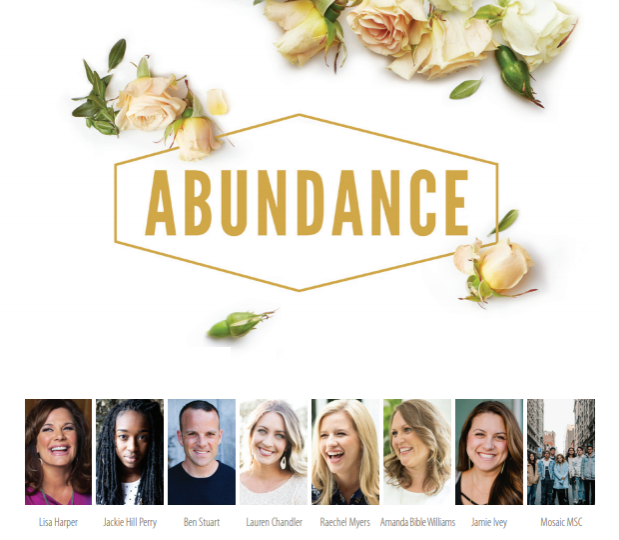
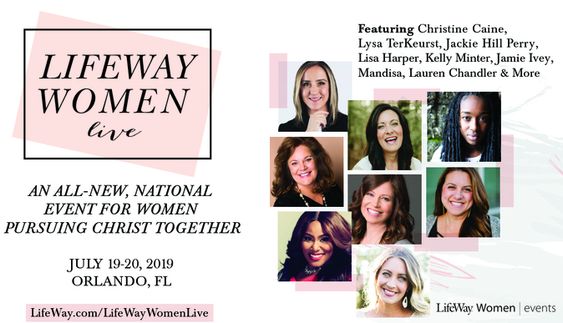
Since 2017, Jackie has partnered in ministry with Beth Moore, Priscilla Shirer, Christine Caine, Lysa TerKeurst, Lisa Harper, Lauren Chandler, and Amanda Bible Williams at various LifeWay Abundance and LifeWay Women Live conferences.

Jackie has partnered with Jennie Allen and Jamie Ivey in an IF: Equip (an arm of IF:Gathering) study, The Good Gospel.

In 2019, Jackie appeared at Rebekah and Gabe Lyons’ Q-ideas Conference,ย (see also):

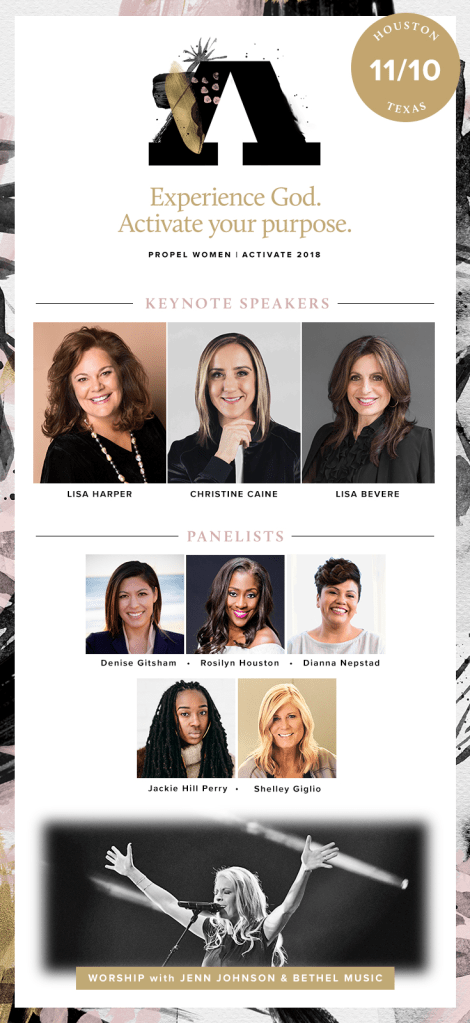
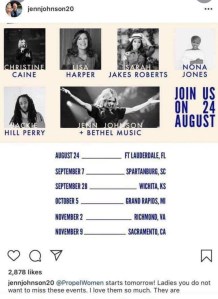
Jackie has been partnering with Christine Cane for a few years now in her Propel Women’s Activate conferences.ย Activate 2018 had her sharing a stage with Lisa Harper, Lisa Bevere,ย  female “pastor” Dianna Nepstad, and Jenn Johnson of Bethel Music. Activate 2019, partnered Jackie in ministry withย Lisa Harper (again), Sarah Jakes Roberts (daughter of modalist and prosperity heretic, T.D. Jakes, and co-“pastor” of two of his “churches”), female “pastors” Nona Jones and Oneka McClellan, and, once again, Jenn Johnson of Bethel Music.

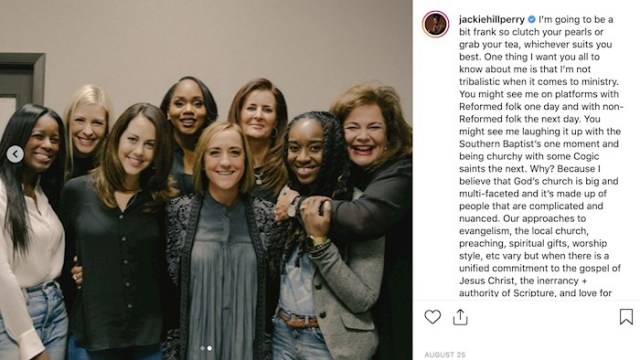
In August 2019, largely due to the fact that Jackie posted this picture calling Bethel’s Jenn Johnson her “friend”

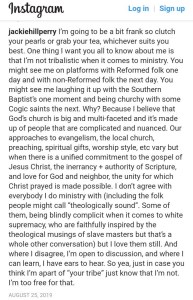
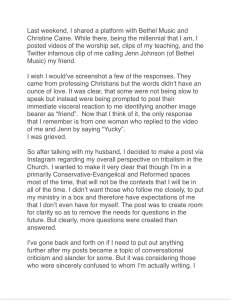
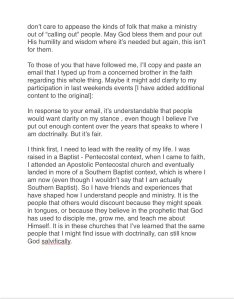
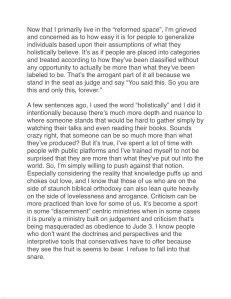
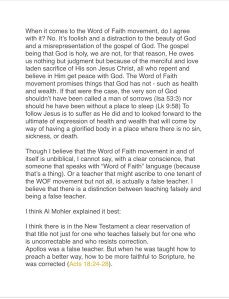
…many of Jackie’s followers were awakened, for the first time, to the fact that she has been sinfully yoking in ministry with false teachers for some time. She was rebuked by many of her followers and was even disinvited from speaking at Answers in Genesis‘ 2020 women’s conference (at which she had previously been invited to speak) when this news came to their attention. Unfortunately, instead of heeding these biblical warnings and rebukes, Jackie dug her heels in and defended both her actions and the false teachers in this Instagram post

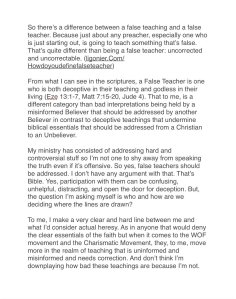
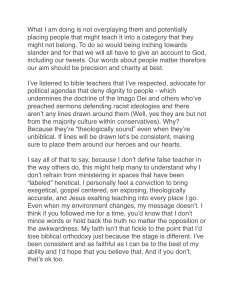
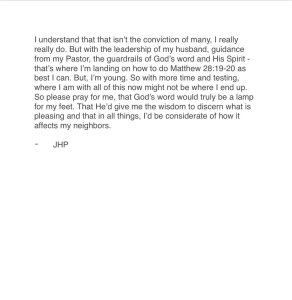
…and in this Twitter post

…disdainfully characterizing those who were biblically right to call her to account as judgmental, arrogant, slanderous, loveless, critical, etc.

You might notice that while Jackie does cite a few Scriptures in these posts, she provides none which support her yoking with false teachers (because there aren’t any). She defends her actions and perspective only with her personal opinions and experiences (note how many times she says “I think,” “to me,” etc.). “…How are we deciding where the lines are drawn?” Jackie asks. The answer should be clear to any Christian and was certainly clear to those rebuking her: the Bible. God decides where the lines are drawn between doctrinally sound and false teacher, not Jackie or anyone else, and He makes that very clear in His written Word.

Jackie repeatedly says that she believes people like Jenn Johnson are just misguided and in need of correction, which would require us to ask, “Jackie, did you correct Jenn and the others you’ve been associating with who hold to unbiblical doctrine? If they did not repent and correct their doctrine (as appears to be the case) do you now consider them false teachers? And if you now consider them false teachers, why are you still partnering with them in ministry?”.

My friend Constance over at the Truth+Fire blog wrote a thoughtful, compassionate, and Scripture-filled article responding to this incident entitled Bye…Jackie?, which I would encourage you to read, as well as Elizabeth Prata’s excellent article (in the “Additional Resources” section below).

In addition to multiple partnerships with false teachers, Jackie, unfortunately, also preaches to men. Just a few of the copious examples:

Preaching the Sunday morning sermon (June 2019) at Progressive Baptist Church:

Preaching at the (co-ed) 2017 Urban Youth Workers Institute National Conference:

Preaching at the (co-ed) Jubilee 2020 conference:

Preaching at the (co-ed) 2019 Legacy ATL conference:

In addition to the concerns about Jackie yoking with false teachers and preaching to men (either of which, as I stated in the preface to this article are sufficient biblical reason to avoid a particular teacher),ย  Jackie’s remarks and associations (particularly on Twitter) indicate that she is increasingly identifying with the social justice/critical race theory/intersectionality movement. A couple of brief examples:

In the video So…About Racism on the With the Perrys YouTube channel, Jackie and her husband discuss Robin DiAngelo’s White Fragility, white power, and de-funding the police, among other things. (In case it later gets scrubbed from YouTube, as often happens, you can find excerpts of the original video here and here.)

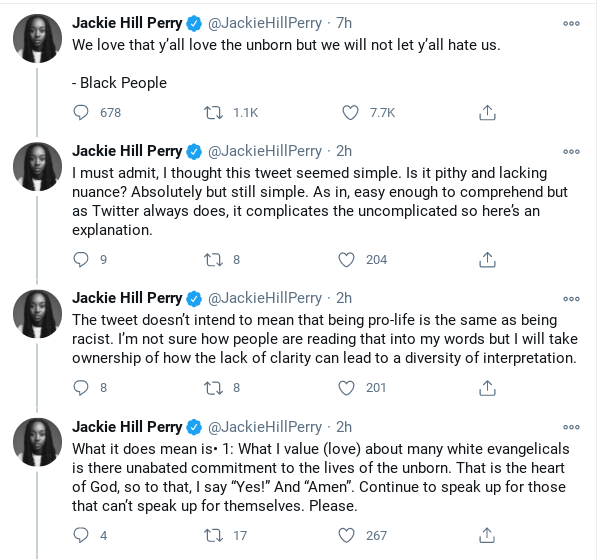
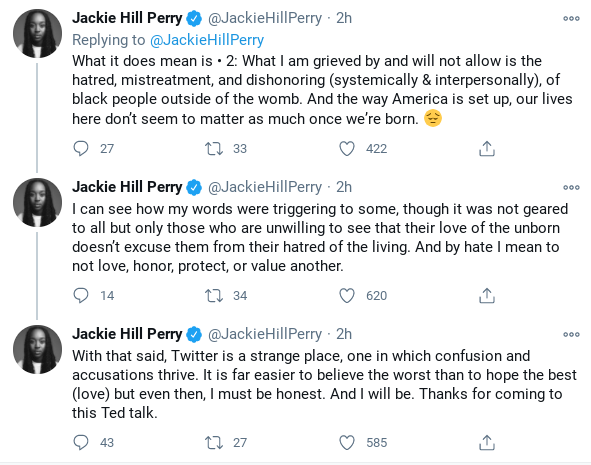
This Twitter thread speaks for itself:

Due to her numerous violations of God’s Word and false teaching I recommend that you not follow Jackie Hill-Perry or use her materials.


Additional Resources:

Jackie Hill Perry: Discernment Review by Elizabeth Prata

Jackie Hill Perry articlesย by Elizabeth Prata

A Review of Jackie Hill-Perry’s “Jude: Contending for the Faith in Today’s Culture” by Thomas Coutouzis

1&2 Peter Bible Study

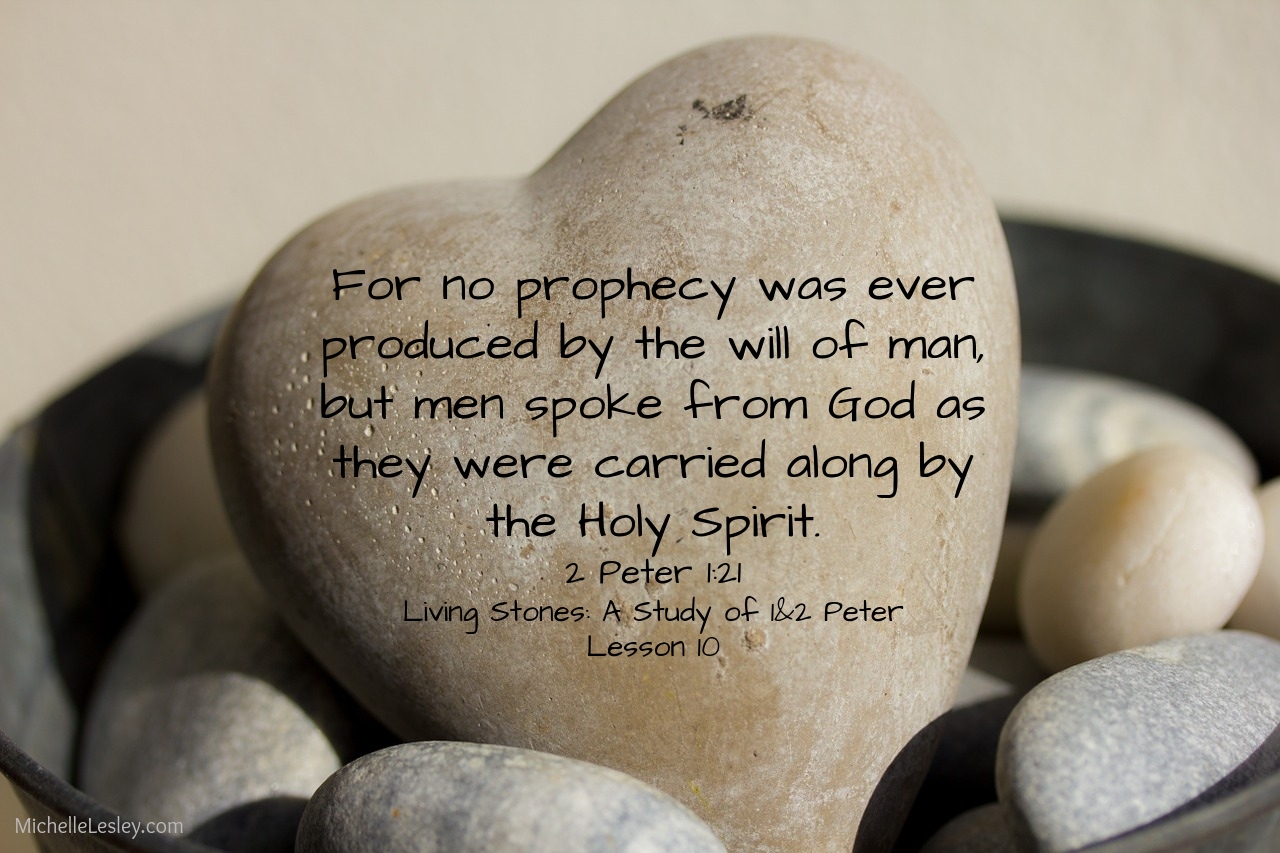
Living Stones: A Study of 1 & 2 Peter ~ Lesson 10

Previous Lessons: 1, 2, 3, 4, 5, 6, 7, 8, 9

Read 2 Peter 1:12-21

Questions to Consider

1. Briefly review lesson 9 (link above) and/or re-read verses 1-11 for context for today’s passage. Notice that the first word of verse 12 is “therefore”. What is the “therefore” there for?

2. Examine verses 12-15. What “qualities” (12) is Peter referring to? Contemplate the statement Peter makes in verse 12. Why do we, as Christians, need, so often, to be reminded of what we already know? Take a look at some of the many passages of Scripture that describe God’s people as a forgetful people. What are the dangers of being forgetful of biblical truth?

What does Peter mean by the phrases, “as long as I am in this body,” (13) “the putting off of my body will be soon,” (14) and “after my departure” (15)?

How many times, and where, do you see the words “remind” and “recall”? What methods did Peter use to remind his audience, then and now, of what he was teaching, to make sure they, and we, would be able to recall it? What does this tell you about the significance of the written Word of God and how important it is for pastors to preach the Word?

3. Study verses 16-21.

Which event during Jesus’ earthly ministry is Peter talking about in verses 16-18? (Use your cross-references, and read the entire gospel account of this event.) Who is “we” in verses 16 and 18? What did they see and hear with their own eyes and ears during this event? Put yourself in Peter’s sandals and try to imagine the weightiness of meeting two of the pillars of your current faith (Judaism), witnessing the glorified Christ, who is to be the pillar of your current/future faith, and entering into the earthly manifestation of the presence of God and hearing His voice. Let the profundity of this experience be the foundation of your understanding for what Peter is going to say about the written Word in 19-21.

What word does verse 16 start with? What does “for” refer back to? Review your answers to the final question of #2 and to question 3 from lesson 9 (link above), and view verses 16-21 through the lens and context of Peter’s emphasis on the written Word. What is Peter saying about personal experiences versus the written Word? Compare all three of these passages to 2 Timothy 3:16-17 and explain how and why Scripture – not personal experiences, feelings, opinions, dreams and visions, “God told me,” etc. – is preferable to subjective experiences and sufficient for the Christian for “all things that pertain to life and godliness.”

Personal experiences, feelings, etc. come from __________, who are sinful and fallible, but Scripture comes from __________, who is perfect and holy.

Outline the major concepts in 16-21 that Peter is trying to get across about his (and the other apostles’) teaching:

Our teaching is not based on __________ (16a) but on our own __________ (16b, 18). And even weightier and more reliable than our own eyewitness testimony is the __________ (19a)- which does not come from __________ (20-21a), but from __________ (21b).

Compare the idea in verse 19 to these verses. Explain how Jesus is the living Word that gives light to us in a dark world. We will need to commune with Jesus through the written Word until what happens (19b)? Why will we not need to depend on the written Word when Christ returns?

How do these concepts about God’s written Word give you a greater confidence in, and love for Scripture?


Homework

Re-read verses 12-15. Peter knew he was not going to live much longer. How might that knowledge have helped him focus his energies on what was most important for his children in the faith to know? Imagine your doctor told you that you only had three months to live. Write a letter to your church, your children, or someone you’re discipling emphasizing the spiritual truths you think will be most important for them to remember “after your departure”. (I really mean this only as an exercise, not that you should necessarily deliver this letter to your church, children, or disciplee, but you may choose to deliver it using biblical wisdom and discretion.)


Suggested Memory Verse

Worship

In My Humble Opinion…The One with the Modernized Hymns

I donโ€™t often share my personal, completely subjective opinions with yโ€™all. I figure thereโ€™s enough of that in the world and whatโ€™s sorely lacking is unambiguous biblical truth. So thatโ€™s what I try to share instead.

But today, I have an opinion. Iโ€™m sure itโ€™ll be wildly unpopular and generate a bunch of hate mail, but thatโ€™s in my wheelhouse, so here goes:

I donโ€™t really like most modernizations of hymns.

I didnโ€™t say, โ€œI donโ€™t like modern hymns.โ€ There are several of those I like, and contemporary hymn writers like the Gettys are doing a bang up job of writing lovely new, doctrinally sound hymns. Frankly, we needย more theologically rich contemporary hymns.

What I mean is that I donโ€™t like some well-meaning hipster to pick up How Great Thou Art and go, โ€œHey, those words – most of them anywayโ€ฆor…at least a few of them – are cool, but that melody, harmony, tempo, and syncopation? Haul out the mothballs! We canโ€™t be singing THAT in church! Itโ€™s gotta sound like something on CCM radio! Relevant! Fresh! Cutting edge!โ€. And then they proceed to put their grubby little paws all over someone elseโ€™s hard work and mangle it into something barely reminiscent of the work of art it once was.

Itโ€™s kind of the same reason I hate modern remakes of movies of yesteryear. It takes something that was great the way it was and ends up diminishing it to make it palatable and marketable to todayโ€™s consumer.

โ™ช Hymn modernizers are often melody driven. They take a melody they like and force the original hymn lyrics to fit it – leading to awkward phrasing or the need to change words – rather than letting the lyrics lead and crafting a melody around them.

โ™ช Whatโ€™s wrong with the original music? I mean it. What on earth is wrong with the original music to the hymn? Nobodyโ€™s clamoring for the modernization of Gregorian chant or classical music or big band or 50โ€™s rock, or 60โ€™s folk music, or disco. People listen to those genres and appreciate them for what they are, and if they want to listen to a different genre, they switch genres, they donโ€™t play musical Silly Putty with the current genre. If every generation of people had taken the hymn modernizersโ€™ approach, weโ€™d currently be listening to the 21st century version of Nebuchadnezzarโ€™s horn, pipe, lyre, trigon, harp, and bagpipe.

โ™ช To me, itโ€™s functionally musical plagiarism even if it doesnโ€™t fit the technical legal definition. They take an existing piece of someone elseโ€™s work, change at least 50% of it (sometimes more if they change some of the lyrics in addition to the music) and popularize it under their own name. Whatever happened to โ€œKeep your eyes on your own paper and do your own work.โ€?

โ™ช Most of the hymns now being modernized were written at a time when people sang like normal human beings, which nobody seems to know how to do any more. Today, when listening to modernized hymns, you have two choices of โ€œartistsโ€: the wispy, breathy ones who sound like a stiff breeze would knock them over, or the moany, growly ones whose vocalizations are more fit for a Barry White ditty (let the reader understand) than a hymn.

But…but…butโ€ฆ

Yes, I know all the exceptions to everything Iโ€™ve just said. I know various hymns have been modernized from time immemorial. I know lyrics of songs are often changed to fit existing melodies. I know some peopleย like modernized hymns and growly or wispy singers.

But thatโ€™s kind of the point of why I posted an opinion today. This isย my personal preference. I get to like what I like and dislike what I dislike as long as Iโ€™m within the confines of Scripture. So do you. So does everybody in the Body. And thatโ€™s OK.

Varied personal opinions and preferences – not biblical truth, mind you; we have to know the difference – are not things to divide over. We need to make sure weโ€™re listening to each other, understanding each other, and valuing the unique quirks and characteristics God created in each other. God put each of us together differently for His glory. Those differences show the kind of creativity and diversity He is capable of.

So you have your subjective opinion and Iโ€™ll have mine, and weโ€™ll love each other and have those opinions to the glory of God.

Just keep your mitts off How Great Thou Art, if you please.

Discernment, Mailbag

The Mailbag: Celebrity Christian Hot Takes (Driscoll, Graham, Groeschel, Lewis, Lucado, Piper, Vallotton)

I get lots questions about whether or not certain pastors, teachers, and authors are doctrinally sound, and whether or not I would recommend them. I mean, lots. And, can I just say- that’s really encouraging to me. When someone asks that question, it demonstrates a) that she knows there are teachers out there who wear the label of “Christian” yet teach unbiblical things, and b) that she doesn’t want to follow one of those teachers. Having interacted with scores of professing Christian women who don’t even rise to that basic level of discernment (i.e. they blindly believe everything that calls itself “Christian” actually is), that’s huge, and I love it.

If you’ve been following the blog for any length of time, you’ve probably noticed the Popular False Teachers & Unbiblical Trends tab (in the blue menu bar at the top of this page). All of the articles and entries on that page exist because someone (usually more than one person) asked whether or not that teacher is doctrinally sound. I wish I were able to write articles on every teacher I’m asked about so I could provide you with more thorough resources, but it usually takes me several days worth of research and writing to properly assemble even the shortest of those articles, and with a family to care for, and other responsibilities, there simply aren’t enough hours in the day.

All of that means that I have to pick and choose which teachers to write about (which is generally whoever is most popular and most people are asking about) and resign myself to the fact that there are teachers I’m probably never going to get around to writing about (few have heard of them, they’re not popular in my audience demographic, they’re dead, it’s uber-obvious they’re heretics {Benny Hinn, Kenneth Copeland, Paula White, etc.}).

Recently, I’ve been asked about a slew of teachers I’m probably not going to write articles about, not because they’re not important, but because they don’t influence as many people in my audience as other teachers do. So I thought what I’d do from time to time is gather up a few and just give a quick “hot take” – a thumbs up or thumbs down as to whether or not you should follow them – based on what I already know without researching them and/or no more than a five minute Google search.

I’ll be using the criteria outlined in my article Is She a False Teacher? 7 Steps to Figuring it Out on Your Own. If you ever need to know whether or not you should avoid a certain teacher, I would encourage you to use this article as a guide, and research him or her for yourself. Vetting teachers is not difficult, it’s a skill every Christian needs to develop, you shouldn’t just take my (or anyone else’s) word for it that someone is or isn’t a false teacher, and I won’t always be around. So if you’re interested in any of these teachers, consider these hot takes a jumping off point for doing more research on your own.

๐Ÿ‘ŽMark Driscoll A definite thumbs down. Mark Driscoll is demonstrably apostate. He was charged with spiritual abuse (mostly anger, treating people poorly, abuse of power – things like that) at his former church, Mars Hill. He refused to go through the biblical process of church discipline his elders tried to enact, and instead quit and fled to another state. He now associates and yokes in “ministry” with New Apostolic Reformation heretics. Chris Rosebrough has done a yeoman’s job of biblically critiquing Mark’s numerous rebellions and calling him to repentance over the years. Click here and here for detailed information.

More evidence from Justin Peters here.

More from Gabe Hughes here.

โœ‹Billy Graham– Not someone I’m going to go around proactively recommending, but not someone I’d call a false teacher, either. I would categorize him as “generally OK-ish, but there are much better, stronger teachers you could be listening to instead”. I’ve read his autobiography and listened to several of his sermons over the years. Although I think some of his methods were biblically unwise, the basic content of his sermons and the gospel he preached was biblical overall. But you need to remember that Billy Graham was an evangelist, not a pastor, which means you’ll get the basics of the gospel by listening to him, but not much else. And if you’re already saved, while you never outgrow your need to hear the gospel, that’s not all you need. You need to grow and mature in the Word, and be taught the full counsel of God.

A couple of reasons many people wonder about Billy Graham’s theology have to do with his ecumenism (he basically embraced just about everyone who wore the label “Christian” – including the Pope) and his universalist statements (most widely known via his 1997 interview with Robert Schuller). Additionally, his daughter, Anne Graham Lotz, credits her father with heavily influencing her theology. He is said to have called her “the best preacher in the family,” despite the fact that she is a false teacher who preaches to men, yokes with other false teachers, and teaches false doctrine.

๐Ÿ‘ŽCraig Groeschel– Nope. When Chris Rosebrough has done this many Fighting for the Faith segments and sermon reviews on somebody, take it to the bank- that’s not somebody you should be following. And then you’ve got things like: Craig preaching at this Hillsong conference (which also featured Bethel Music leaders), preaching with Joel Osteen at a conference hosted by Lakewood, he’s spoken at Joyce Meyer’s women’s conference, he lets women and false teachers preach at his church, including Christine Caine (whom he calls “one of the greatest preachers of all time”) and Steven Furtick (who says in this clip that Groeschel’s church has influenced Furtick’s church {Elevation} “probably more than any other church”.)

Also, if you use the YouVersion Bible App, you might want to know that it was developed by Craig Groeschel and his church, and is still owned by his church (Life.Church), which is one of the reasons it’s not one I recommend when people ask me about Bible apps. Craig and his church earn income from this app, and so do the false teachers whose materials are featured on the app, so when you use YouVersion, you’re financially supporting false teachers and false doctrine, whether directly or indirectly.

Here is a quote from Gina (see comments section) who was a member of Life.Church for about a year:

Having now spent over a year at Craig Groeschelโ€™s LifeChurch I can attest that Craig has all the marks a false teacher. I began attending with scepticism [sic], but decided to intentionally keep an open mind. However, what I found is that Craig twists Scripture, and does not teach the Bible at all. His โ€œsermonsโ€ are nothing more than self-help couched in spirituality. He touts self-improvement and life changeโ€ฆall good things in and of themselves, but does not teach Godโ€™s Word. His altar calls are given very quickly with fast talking and โ€œdo it nowโ€ sales tactics, but with very little and sometimes no explanation of the true Gospel. Yet people are declared to be a new creation, and there is no follow upโ€ฆnone. He is unabashedly self-promoting. He promotes his books, HIS church (emphasized on purpose), and other speakers and their books/churches. He has a cult following who gets very defensive if anything is said against him. He is vehemently defended for all the good things LifeChurch does (and they do), and for all the people being โ€œsavedโ€. He has plenty of ties with NAR, not to mention ARC (?) [the Association of Related Churches]. He uses manipulative and condescending tactics on his listeners, and interjects unseemly and fleshly anecdotes. There is much hype from him and his staff during the serviceโ€ฆloads of enthusiasm. In short, he is the best motivational speaker youโ€™ve ever heard. That is not a compliment. The experience is complete with โ€œWhoever finds God?โ€โ€ฆโ€Finds LIFE!โ€ at the conclusion. Iโ€™m thoroughly disgusted and disturbed to be there, and I wonโ€™t be going back. I just have to find a way to tell my precious family. They donโ€™t see it, and it saddens me. Iโ€™ve seen zero spiritual growth since our family has been attending. It bears mentioning that I have the gift of discernment, and that I find it severely lacking in Godโ€™s people today. ๐Ÿ˜ž

โœ‹C.S. Lewis For fiction, you’re probably OK. I read my children the entire Narnia series with no real problems. I know sound brothers and sisters who have found Mere Christianity and other CSL books to be helpful, but, honestly, if you really want to study theology, I’d encourage you to steer clear and find better sources. There are questions as to whether or not he believed in evolution, universalism, the inspiration of Scripture, and penal substitutionary atonement.

๐Ÿ‘ŽMax Lucado– No. He recently embraced Jen Hatmaker as a guest on her podcast. He has preached at Lakewood (Joel Osteen), affirmed Bill Johnson (Bethel), endorses Beth Moore, wrote the foreword for Christine Caine’s book, Undaunted, etc. And the church Max pastors, Oak Hills Church, is egalitarian. In 2021, he threw the Bible and the church under the bus by apologizing to the homosexual community.

And then there’s this quote from Max during an interview with Preaching.com: I really enjoy listening to Joel Osteen. I think Joel has a unique assignment in his ministry, and thatโ€™s to cast a wide net. Heโ€™s got a different assignment and a different gift mix than, for example, a John MacArthur; and I enjoy listening to John MacArthur equally; but you can see that theyโ€™re two different types of preaching. I enjoy Joel because I think his assignment in ministry is to encourage people, and we live in a day that is so discouraged, discouraging. I enjoy John MacArthur because I thinkโ€”it seems to meโ€”his assignment is to equip the church with very detailed biblical understanding. Heโ€™d be more like a Beth Moore or a David Jeremiah; I think we need that, as well.

I’m sorry, but do you really want to be taught the Bible by someone who is so undiscerning he can’t tell the difference between Joel Osteen, Beth Moore, and John MacArthur? That he thinks Joel Osteen and John MacArthur just have different gifts and different preaching styles? And that Beth Moore, like John MacArthur, has an “assignment to equip the church with very detailed biblical understanding“?

โœ‹John PiperJohn Piperโ€™s books, sermons, and blog are mostly fine, and while I disagree with him on several points of theology, I certainly do not consider him to be a false teacher. But heโ€™s not somebody Iโ€™m going to proactively recommend, either. Hereโ€™s how Iโ€™ve answered readers in the past who have asked me about John Piper:

While I consider Dr. Piper to be a generally doctrinally sound Christian brother and agree with him in many aspects of theology, he is not someone I proactively recommend for a few reasons:

1. Dr. Piper is a continuationist. I usually limit my endorsements to cessationists  because I believe this is the biblical view of the gifts. (I do not consider otherwise doctrinally sound continuationists to be false teachers, however.)

2. Iโ€™m concerned about Dr. Piperโ€™s associations and partnerships with false teachers (which violates 2 Corinthians 6:14-18, Romans 16:17-18, and 2 John 9-11). First he appeared to embrace Rick Warren when he interviewed him and invited him to speak at the Desiring God conference in 2010. More recently, he has been a featured speaker at events like the Passion conferences where he has shared the stage with Christine Caine, Priscilla ShirerBeth Moore, and Judah Smith.

3. Dr. Piperโ€™s complementarianism seems muddled at best. On the one hand he will go so far as to say that Christian women should not be drill sergeants and police officers (which I, personally, agree with, but the Bible mentions nothing of the sort), yet on the other hand he joins in ministry with the aforementioned Caine, Shirer, and Moore who โ€“ in addition to the the false doctrine they preach โ€“ all actively and unrepentantly violate clear Scripture by preaching to men. Itโ€™s quite confusing.

Iโ€™m not going to warn people away from John Piper as a false teacher, but I canโ€™t, in good conscience, recommend him either.

Why I Don’t Read John Piper Anymore with Jon Harris

๐Ÿ‘ŽKris VallottonAbsolutely not, no way, no how. Kris Vallotton is the “Senior Associate Leader of Bethel Church and co-founder of Bethel School of Supernatural Ministry (BSSM)” which means he is a New Apostolic Reformation heretic, not a Christian, and certainly not someone any other Christian (or lost person, for that matter) should be following.


If you have a question about: a Bible passage, an aspect of theology, a current issue in Christianity, or how to biblically handle a family, life, or church situation, comment below (Iโ€™ll hold all questions in queue {unpublished} for a future edition of The Mailbag) or send me an e-mail or private message. If your question is chosen for publication, your anonymity will be protected.