The internet is glutted with “Christian” women’s blogs, many of which are anything but Christian because they don’t teach what accords with sound doctrine.
Well, genuinely regenerated Christian women have had enough. Enough of the false doctrine from celebrity divangelistas. Enough of the feel-good fluff that takes them nowhere in their quest for spiritual maturity. We want teachers who will push us to study God’s word, who exhort and encourage and even step on our toes as we seek to be conformed to the image of Christ.
IMPORTANT REMINDER: Don’t take my (or anyone else’s) word for it that any ministry, podcast, book, or blog is biblical in its doctrine. You MUST do the work of comparing with Scripture everything you read and hear. If it doesn’t match up with God’s word (in context), chuck it.
Berean Research– “Berean Research is a resource to help Christians equip and keep themselves and their brothers and sisters from falling into deception. 2 Timothy 4:3-4 warns us of a time when people will not put up with sound doctrine, but will gravitate to a great number of teachers who’ll say what their itching ears want to hear. We believe this deception has never been greater than it is right now. That’s why sound doctrine is so important.” Join Amy Spreeman and Marsha West over at Berean Research. FacebookTwitter
Abandoned to Christ– Sunny Shell writes “about marriage, biblical submission, parenting, friendships, evangelism, and my battle with a rare metabolic disease…all with the eternal, rich and hope-filled perspective of the Gospel of Jesus Christ. I try to keep it real, while keeping it pure, to keep it praiseworthy.” FacebookTwitter
Solid Food Resources– Debi Martin’s excellent blog and podcast examine Scripture and a variety of theological topics. “Solid Food Resources exists to provide Biblically sound resources (solid food) for the maturing believer – helping Christians grow from milk to meat.”
Women Under Grace– Formerly a blog, Women Under Grace is now a Facebook group. “We are a community of Christian women who, first and foremost, seek to glorify God in all areas of our lives….predominantly a forum for dialogue between Reformed women. That being said, we welcome all those who genuinely seek to know the truths of the Scriptures…Our desire is that this would be a safe place where women can come to ask genuine questions and discuss a variety of topics from theology, doctrine, Scripture, and even how to address issues in culture and entertainment through a biblical lens. But most of all, we want to strive to cultivate an atmosphere that encourages the members to “grow in the grace and knowledge of our Lord and Savior Jesus Christ” as we seek to “test all things” by the Scriptures.” Facebook
Naomi’s Table– Founded by Amy Spreeman, Naomi’s Table is a Bible study resource for women who are earnestly abiding in Jesus Christ through His Word. “Here at the Table, you are invited to peruse our Bible studies and use them for yourself or with a group to learn at the feet of our magnificent Savior, Jesus Christ. We study His Word and learn about the often confusing roles the world tells us we need to take on, and compare those pressures with what the Bible says about Godly women and discipleship. Since 2014, most of our Bible studies are taught by Beth Seifert.” FacebookTwitter
Tulips & Honey– “The Tulips & Honey Hub is a group of like minded Reformed bloggers and podcasters seeking to make His name known to man, and to glorify Him!” Check out the T&H podcast and blog! FacebookTwitterInstagram
Truth + Fire– You might have caught a glimpse of my friend Constance in the film American Gospel: Christ Alone, but did you know she has ablogand a podcast, too? “Truth + Fire boldly examines faith, pop culture, relationships and current events from a witty Christian perspective. Infusing humor, practicality and Biblical wisdom, its topics are covered full of righteous judgment and with as little filter the good Lord will allow. Its goal is to expose readers to the Gospel of Jesus Christ, to declare the full counsel of God and to demonstrate the relevance of God’s Word in our present generation and individual lives. Readers should come away from this blog edified in their faith and encouraged to abide in Christ through further study and sincere application of His Word.” FacebookTwitterInstagram
Thankful Homemaker– “Thankful Homemaker provides truth-filled, gospel-driven encouragement to homemakers who amid their ordinary days desire to honor and glorify God in all things.” Check out the TH blog and podcast hosted by Marci Ferrell. FacebookTwitterInstagram
Transformed for More– Sarah and Susan “are twin sisters with a passion to help provide Christians with resources to help them live a transformed life by the power of Jesus Christ. From 2016-2019, this site focused specifically on Christian teenage girls, but for 2020 and beyond, we wanted to expand it to help a wider audience.” FacebookTwitterInstagram
You can always find these – and more great Christian women and men to follow – at the Recommended Bible Teachers tab in the blue menu bar at the top of this page.
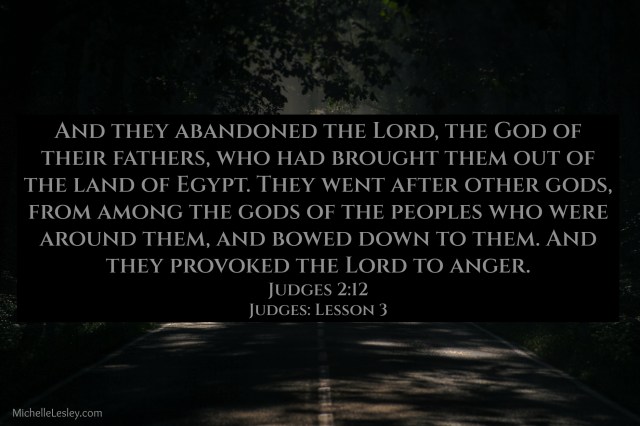
1. The passages in last week’s lesson (lesson 2, link above), and today’s lesson are, in essence, parts 1 & 2 of the introduction to Judges. Review lesson 2. As you’re studying today’s lesson, consider how it hinges upon last week’s lesson.
2. Compare 2:6-10 to 1:1, with regard to Joshua. Explain the function of 2:6-10 at the beginning of today’s passage when it’s clear from 1:1 that Joshua is already dead. (Note the Hebrew tendency to sometimes favor grouping concepts or topics together instead of writing in a linear, chronological order.) Skim back over 1:1-26, and briefly explain who “the elders who outlived Joshua” (2:7) and “all that generation” (2:10) were. How does 2:6-10 transition us from the era of Joshua to the era of the judges?
3. How does 2:10 explain 2:11-13? How does 2:11-15 fulfill 2:1-3? Explain in your own words how the Canaanite gods became a snare to Israel. Do you think, when the Israelites were worshiping those gods, that they felt, or considered themselves ensnared?
Have you ever made an idol of something in your life – perhaps your marriage, your children, your job, your popularity, your looks, even a ministry you were involved in? When you were engaged in that sin of idolatry, did you feel, or consider yourself ensnared? Explain how idolatry can deceive a person into not even realizing she’s ensnared, and how this relates to, and shows us the importance of, the first two Commandments.
4. Compare 2:14-15 with 1 John 4:8, and explain how and why these passages do not conflict with one another. (Try to figure it out on your own first, but if you’re hopelessly stuck, click here for a hint.)
5. Judges 2:16-23 is sort of a “CliffsNotes” of the rest of the book. In your own words, make a step by step outline of the pattern of sin and repentance Israel repeated throughout the era of the judges. Do you see any similarities between Israel’s pattern of sin and repentance and your own? Any differences?
When this passage refers to “Israel/they/them,” do you think it means every single individual alive in Israel at the time, or does it mean the vast majority of Israel? In other words, even in Israel’s darkest days of idolatry, were there a few Israelites who remained faithful to God? (Keep this question in mind as we continue to study Judges.) Do you see any similarities between the majority of Israel in this passage, and the majority of the visible church today?
6. How does 2:16-23, and, indeed, the whole book of Judges, point us to Jesus, the perfect judge who permanently saves?
7. In 2:21-3:6, God speaks of testing Israel. How did He test them? Why did He test them? Did they pass or fail the test? Read these passages. Does God test Christians today? How does He test Christians? Why does He test Christians? Did God test Israel, or Christians today, because He doesn’t know how they will respond to the test and He needs to find out?
Homework
Now that you’ve worked through parts 1 and 2 (lessons 2 and 3) of the introduction to Judges, outline or describe the way these two parts fit together. How does foundational disobedience (part 1) beget further disobedience (part 2)?
Review what you learned in #7. Looking back over your life, can you recall a time when God was testing you? Did you pass or fail the test? How did God use that test to grow you and strengthen your faith? Repent of any way in which you failed that test, and give God the glory for any way in which you were able to be obedient to Him in that test. During your prayer time this week, ask God to help you look at the trials in your life as tests of your faithfulness and ask Him to strengthen you to pass those tests and to grow you through those tests.
Or maybe I answered your question already? Check out my article The Mailbag: Top 10 FAQs to see if your question has been answered and to get some helpful resources.
Biblically speaking, what would be the appropriate Christian response to Ed Litton’s plagiarism? More precisely, what should that response be among the masses who will never have access to Litton or those closest to him?
It’s a great question with an answer that will leave most of us Southern Baptists frustrated, I’m afraid.
To quickly catch up readers who aren’t in the know: Newly elected president of the Southern Baptist Convention, Ed Litton, has been caught in numerous instances of preaching plagiarized sermons going back several years. Many have called upon him to repent and step down as president. As far as I’m aware, to date, he has neither biblically repented nor commented on stepping down. There is no mechanism in place in SBC governing documents for removing a sitting president from office. (For more details, see the “June” and “July” sections of my article What’s Going On in the Southern Baptist Convention?)
There are several responses that could be appropriate in this situation for the average Southern Baptists who doesn’t know or have personal access to Ed Litton:
Pray. It is always appropriate to pray for someone who is sinning to repent. Additionally, if this situation is to be resolved biblically, God is the only One powerful enough to resolve it and wise enough to know the best way to resolve it. You also need to pray for your pastor as he guides your church to decide whether to stay in or leave the SBC, and you and your family need to pray together about your pastor’s decision and whether or not you can abide by it.
Inform. If you and your church are going to remain in the SBC for now, you have to stay informed on the major issues, and this is one of them. (That’s why I wrote the “What’s going on…” article linked above, to help you stay informed.) Keep yourself informed, keep your pastor informed, and keep your Sunday School class, circle of friends, and any other appropriate people at church informed. Ask your pastor how things stand with your local SBC association, and whether or not, and how, it might be appropriate for you or someone else to keep the association informed.
Connect. I would strongly suggest joining, following on social media, subscribing to the newsletter/email list, etc. of both the Conservative Baptist Network and Founders Ministries. If any action is taken on the plagiarism issue or any other problematic issue in the SBC, it will likely spring from one or both of these groups, and you and your church will want to consider joining forces with them.
Take action(?). There are a few ways to take action in this situation as an individual, such as sending Litton a (kindly worded, non-harassing) email urging him to repent and step down, expressing your concerns to the appropriate SBC leadership, or possibly starting a petition of some sort, but I would really suggest getting some advice from your pastor first.
Honestly, I can pretty much guarantee any effort like that from an individual is going to be ignored. If the Resolutions Committee can refuse to allow a vote on a resolution proffered by 1300+ Southern Baptists, they’re not going to pay an ounce of attention to an email or a petition. Bluntly, you and I aren’t important enough to matter to those in SBC leadership. Your pastor probably isn’t either, nor the director of your association, nor even the head of your state convention. Maybe if somebody with enough power, position, and platform made enough noise about Litton stepping down (or any of these other issues) maybe, something might get done. But at this point, I’m not even sure who that might be.
All of which brings us full circle to our first and most effective response: pray. This is a mess that only God can clean up.
My husband and I were talking about women teaching/preaching to men, and he brought up an interesting question: what about when your church has a marriage conference and there is a husband/wife team who comes and they both teach?
Thanks for asking this question, because this seems to be a common teaching model for marriage and family conferences. It seems like a complicated situation to us, but it’s not to God. He said what He said in Scripture, and He means it, regardless of the circumstances.
A Christian conference is a gathering of the church body for the purpose of biblical instruction. That is a context in which Scripture’s prohibition of women instructing men in the Scriptures applies (see #7 here). So whenever the husband/wife team are addressing the co-ed audience, they just need to make sure that the wife is not giving biblical instruction to the group at large. That should fall to the husband.
That doesn’t mean that the wife can’t open her mouth at all in front of the group. It would be fine for her to…
give her personal testimony
offer practical advice (ex: “Joe and I have found it really helpful in our marriage to start the day off in prayer and a discussion of that day’s schedule.” “Guys, we ladies really like foot massages!”, etc.)
speak directly to the women in the audience about their role, behavior, or attitude in marriage as needed (Ex: “Ladies, Ephesians 5 is clear that we are to submit to our husbands.”)
answer any questions during a Q&A time that don’t require her to exposit Scripture to a male questioner
ask a question or make a brief, non-exhortational comment after her husband gives the biblical instruction portion of the session (ex: “Honey, I’m thinking some people might need a little clarification on what ‘depriving one another’ means in 1 Corinthians 7. Can you explain that to us a little more?” “Yes, 1 Peter 3:1-6 has always been so helpful to me as I strive to be a godly wife. And verse 7 has some good instruction for husbands, right, Joe?”)
And, of course, the conference can be structured so there are times of co-ed instruction and times when the wife teaches the women and the husband teaches the men.
For a husband and wife team who are doctrinally sound, spiritually mature, and committed to obeying Scripture, it shouldn’t be that difficult to lead a conference like this in a biblical way.
As far as whether or not to attend a marriage conference in which a husband and wife team will be speaking to a co-ed audience, you’ll have to do your homework to find out how committed they are to obeying Scripture in this regard. Listen to some of their previous conferences, if they’re coming to your church, ask your pastor about it, or you could try emailing the couple and asking them.
I know that some of the false teachers we see on TV are delusional and really think they create things on the same level as God, but are some people genuinely confused and simply don’t understand that what they are teaching and believing is false? Are the ones who are just confused still heretics and false teachers?
Let’s take that last question first. If you teach false doctrine or heresy, you’re a false teacher or a heretic, regardless of your motive. Whether you think what you’re teaching is right, or you know it’s wrong and you teach it anyway, the end result is the same: you’re teaching error.
Now let’s clarify the first part of your question a bit, because you bring an interesting point to the table with the word “delusional”. “Delusional” is really mental health terminology rather than biblical terminology. Is it possible some of these folks are truly mentally unbalanced? Yes. But you know what else looks a lot like mental illness in some cases? Demon possession. And I’m convinced that at least a few of these heretics are demon possessed.
But I do think the truly possessed are in the minority, and the majority are simply deceived. They are of their father the devil, so they speak his language and their will is to do his desires:
Why do you not understand what I say? It is because you cannot bear to hear my word. You are of your father the devil, and your will is to do your father’s desires. He was a murderer from the beginning, and does not stand in the truth, because there is no truth in him. When he lies, he speaks out of his own character, for he is a liar and the father of lies…Whoever is of God hears the words of God. The reason why you do not hear them is that you are not of God.”
John 8:43-44, 47
And this holds true whether we perceive the false teacher to be a conniving, greedy charlatan, or a “good guy” who’s just “honestly mistaken”. It’s also true whether or not he’s made a conscious decision to proactively serve Satan by knowingly teaching false doctrine. There are only two potential masters in a person’s life, Christ or Satan, and if you’re not a slave of Christ, you’re enslaved to Satan. There’s no middle ground for lost “nice people”. The “honestly mistaken” guy who’s teaching false doctrine is still doing his master’s bidding, he’s just deceived into thinking his master is Christ.
But when it comes to how we’re to regard and handle false teachers, it doesn’t really matter whether it’s delusion, deception, or demon possession, because God doesn’t require us to know what’s going on in their hearts and minds to be able to biblically evaluate them.
Our job is to evaluate what we can see – the person’s behavior, writings, sermons, teachings, and conversation – and determine whether or not it aligns with Scripture. If it doesn’t – regardless of what we think of the teacher’s motives or mental state – those teachings, and the person who teaches them, have no place in our churches or personal study materials.
The condition of the teacher’s heart and mind? That’s above our pay grade. We leave that to God.
I am looking for a Biblically sound women’s study on healthy eating habits and am hoping you can point me In the right direction?
I think I’ve mentioned before that the top two questions readers ask me are, “Is _____ a false / sound teacher?” and “Can you recommend a Bible study on / for _____?”
I love the heart behind both of those questions because it tells me that the person asking wants biblical teaching, and nothing could make me happier. Truly.
But, no, I can’t point you in the direction of a doctrinally sound study on healthy eating habits for two reasons:
First, as a matter of principle, I don’t recommend what I call “canned” studies (books, workbooks, DVDs, etc.), even doctrinally sound ones, at all. I recommend women study (and teach) straight from the text of Scripture. You can read more about why I hold this position and how you can learn to study/teach straight from the Bible itself at the Bible Studies tab in the blue menu bar at the top of this page.
The second reason I can’t recommend such a study is that such a study does not exist. Here’s why. Doctrinally sound studies start with a passage of Scripture and teach you what it says. And other than condemning gluttony, and making a few general statements about using your body to glorify God rather than to sin, the Bible says nothing about healthy eating habits (at least not in the way we use that phrase in 21st century America). And any study that says it does is mishandling Scripture and taking it out of context, and, therefore, isn’t doctrinally sound.
A perfect example of this is false teacher Rick Warren’s book The Daniel Diet, which is based on a mishandling of Daniel 1:8-16. (Daniel didn’t refuse the king’s food because it was unhealthy or to lose weight, but to obey God’s law and to avoid making himself unclean. Also, you’ll notice v.15 says that after ten days on this “diet” Daniel and the boys were actually “fatter”.) I would also warn you away from Lysa TerKeurst’sMade to Crave since she is a false teacher as well. And, it would not surprise me to learn that a number of other false teachers have written health and diet “Bible studies”.
The truth is, you don’t need a Bible study, you need a new paradigm. The paradigm you and many, many Christian women are currently operating under, probably without even realizing it is, “I have an issue. A book or Bible study will give me the solution for it.”. That’s not necessarily a bad or sinful paradigm (in fact, like I said, it’s very good and right that your instinct is to turn to Scripture), it’s just that there’s a better, more biblical, more helpful paradigm which, in a nutshell is, “Pursue Christ and trust Him with your issues.”
As you go about pursuing Christ, you can certainly study any biblical passages that relate to your particular issues of healthy eating. Are you failing to exercise self-control? Failing to be content? Is it an issue of laziness? Do you have an unbiblical view of your body itself? Maybe you have a particular medical condition that requires a new diet. You’ll have to prayerfully determine exactly what your issue is, then study (in context and rightly handled) the passages that pertain to that issue1, repent of any sin you might be committing, and trust, believe, and obey God’s Word.
Pray, pray, pray. Ask God to help you with what you’re studying in His Word, to help you lose weight, to see your body the way He sees it, etc.
Make an appointment with your doctor and ask what he recommends.
Get some godly counsel. Is there a godly older woman in your church who could disciple you through this? Or maybe there’s a nutritionist or dietitian who goes to your church2? If you’re not sure, ask your pastor.
And, truly, this is what I would recommend to most of the women who write and ask me if I can recommend a Bible study or book on a very specific, personal life issue. Because it’s not necessarily about finding the “solution” to whatever your issue is. Often, it’s God giving you an issue to grow you, to move you to cry out to Him, and to lead you to depend on Him to carry you through whatever it is.
1If you’re not sure where to find those passages, ask your pastor or a godly friend for help. You can also Google “Bible verses about _____” and probably get some good lists of verses, but it’s imperative that you look those verses up and read them in context so you’ll know whether or not they actually apply.
2Don’t expect free advice or help just because it’s a church friend. Ask if you can make an appointment, and plan to pay the full fee just like you would if this person were a stranger.
If you have a question about: a Bible passage, an aspect of theology, a current issue in Christianity, or how to biblically handle a family, life, or church situation, comment below (I’ll hold all questions in queue {unpublished} for a future edition of The Mailbag) or send me an e-mail or private message. If your question is chosen for publication, your anonymity will be protected.
Ladies, welcome to Open Hearts in a Closed World 2021 online conference!
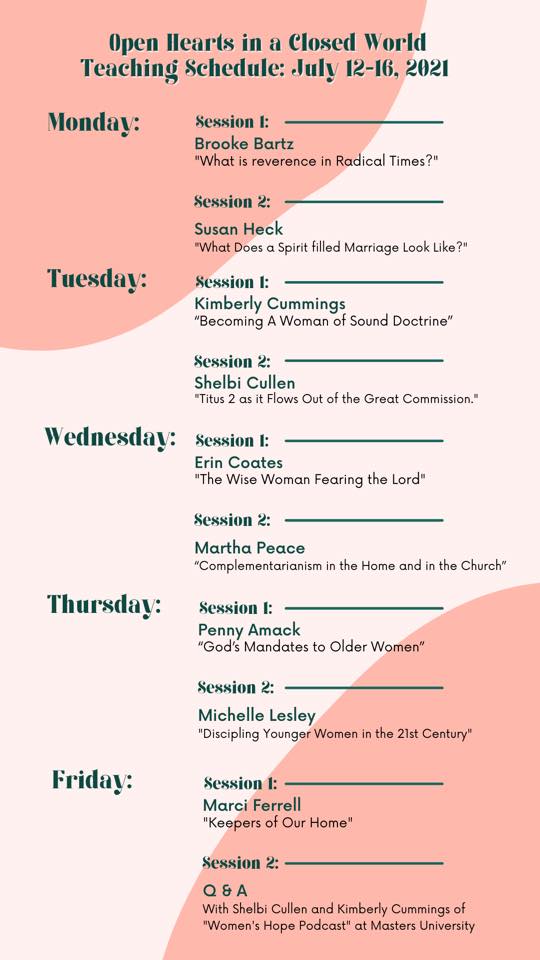
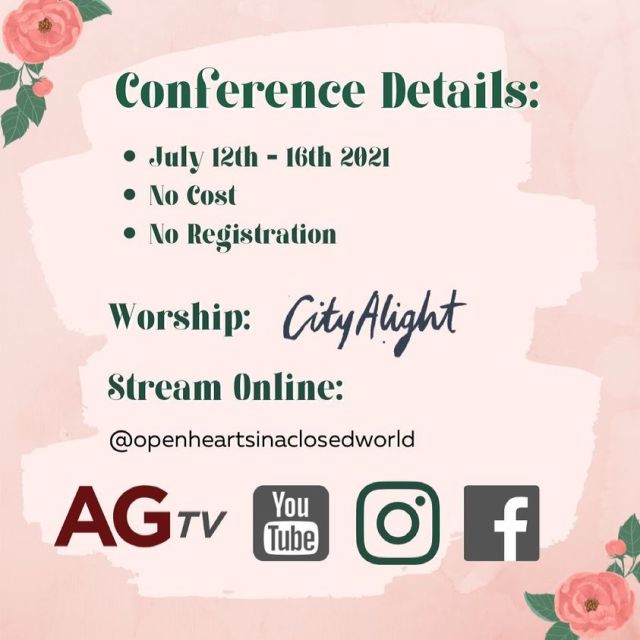
All this week, I’ll be posting each daily conference session here on the blog. You can watch here, or on the AGTV app, YouTube, IGTV(Instagram), or Facebook every day this week, July 12-16, 8:30-11:00 a.m. (CST).
The conference is totally free and you don’t have to register or sign up. Just tune in each day at your convenience and watch the teaching sessions. You could even gather up some friends and watch together! (Send me some pics if you like!)
Many have asked whether or not the sessions will still be available to watch later in the day and after this week. Yes. (As a matter of fact, if you missed last year’s conference, you can still catch all the sessions here.) BUT – once the live broadcast (8:30-11:00 a.m. CST) is over, it will take approximately one hour to process the YouTube version of the video (below) from “live” to “permanent” status, so it will not be available during that time period.
Special exclusive for my followers:
I’ve put together a two page outline for you that goes with my teaching session on Thursday (July 15) in case you’d like to take notes and have all the Scripture references handy. You can grab it here.
Here’s today’s session. (For more info. on the conference, speakers, schedule, etc., keep scrolling.)
Due to processing from “live” to “permanent” status on YouTube, this video will be unavailable between approximately 11a-12p CST.
Watch the remaining sessions of the conference at these links:Day 1Day 2Day 3Day 4
The theme of this year’s conference is Reverence in Radical Times, and our focal passage will be Titus 2:3-5:
Older women likewise are to be reverent in behavior, not slanderers or slaves to much wine. They are to teach what is good, and so train the young women to love their husbands and children, to be self-controlled, pure, working at home, kind, and submissive to their own husbands, that the word of God may not be reviled.
Ladies, welcome to Open Hearts in a Closed World 2021 online conference!
All this week, I’ll be posting each daily conference session here on the blog. You can watch here, or on the AGTV app, YouTube, IGTV(Instagram), or Facebook every day this week, July 12-16, 8:30-11:00 a.m. (CST).
The conference is totally free and you don’t have to register or sign up. Just tune in each day at your convenience and watch the teaching sessions. You could even gather up some friends and watch together! (Send me some pics if you like!)
Many have asked whether or not the sessions will still be available to watch later in the day and after this week. Yes. (As a matter of fact, if you missed last year’s conference, you can still catch all the sessions here.) BUT – once the live broadcast (8:30-11:00 a.m. CST) is over, it will take approximately one hour to process the YouTube version of the video (below) from “live” to “permanent” status, so it will not be available during that time period.
Special exclusive for my followers:
I’ve put together a two page outline for you that goes with my teaching session on Thursday (July 15) in case you’d like to take notes and have all the Scripture references handy. You can grab it here (OHCW 21 handout).
Here’s today’s session. (For more info. on the conference, speakers, schedule, etc., keep scrolling.)
Due to processing from “live” to “permanent” status on YouTube, this video will be unavailable between approximately 11a-12p CST.
Watch the remaining sessions of the conference at these links:Day 1Day 2Day 3Day 5
The theme of this year’s conference is Reverence in Radical Times, and our focal passage will be Titus 2:3-5:
Older women likewise are to be reverent in behavior, not slanderers or slaves to much wine. They are to teach what is good, and so train the young women to love their husbands and children, to be self-controlled, pure, working at home, kind, and submissive to their own husbands, that the word of God may not be reviled.