Sermons

“Did God Really Say?” ~ Free Online Conference

Boy howdy, what a treat! Owen Strachan, Justin Peters, Chris Rosebrough, Joshua Rosebrough, and Phil Johnson are all coming together this weekend for a free, online conference.

The Did God Really Say? conference on YouTube “will equip you and your loved ones with the knowledge to see where cultural changes are happening, what those changes mean to average Bible believing Christians and provide you with practical tools to equip you to stand your ground in shifting sands of cultural change.”

Friday, September 17
1:00 – 5:00 p.m. (Central)

Saturday, September 18
11:00 a.m. – 4:00 p.m. (Central)

Get the schedule and all the details at the conference website, subscribe to the conference YouTube channel, and help keep the conference free and online by donating at the conference GoFundMe page.

Mailbag

The Mailbag: Potpourri (Ministry oversight…Elliot/ten Boom preached to men…G3…Alt-her-ing Scripture)

Welcome to another โ€œpotpourriโ€ edition of The Mailbag, where I give short(er) answers to several questions rather than a long answer to one question.

I like to take the opportunity in these potpourri editions to let new readers know about my comments/e-mail/messages policy. Iโ€™m not able to respond individually to most e-mails and messages, so here are some helpful hints for getting your questions answered more quickly. Remember, the search bar (at the very bottom of each page) can be a helpful tool!

Or maybe I answered your question already? Check out my article The Mailbag: Top 10 FAQs to see if your question has been answered and to get some helpful resources.


Hello! Iโ€™ve just found you while looking for theologically sound Bible studies. Iโ€™m thankful to find your resources and look forward to reading further!

So far youโ€™ve checked all my boxes in looking for someone who is seeking to be faithful to the Word. I would assume in being a proponent of complementarianism, that you are in a church that allows you, as a woman in ministry, to submit to the pastors and/or elders of your churchโ€ฆ Can you please clarify this? In other words, are you receiving oversight outside yourself in your ministry? One reason Iโ€™m asking is our church has an elder that is over all our womenโ€™s ministries and find that as a good discernment check.

Also, where do you live? That question isnโ€™t terribly important; Iโ€™m just curious.

I live in Baton Rouge, Louisiana. (You can find out more about me in the Bio tab in the blue menu bar at the top of this page.)

This is a super question, and I’ve received it a few times in the past, but I’d like to tweak it just a bit if that’s OK.

It’s certainly not a bad thing for a woman in a parachurch ministry like mine to have her doctrinally sound pastor and elders or some sort of ministry board oversee her ministry if she and her husband and pastor and elders all mutually agree that it would be beneficial. And if God miraculously gave my pastors several more hours in the day that they didn’t know what to do with and they called me and said, “Hey, we’d like to volunteer to do this for you,” I’d probably take them up on it.

But what I’d like to clarify is that, while this may or may not be a wise and helpful arrangement, it isn’t a requirement of Scripture (and I’m not saying that you think it is) for women or men in parachurch ministries, complementarianism notwithstanding. What Scripture requires is that all church members submit to the leadership of their pastor and elders:

Obey your leaders and submit to them, for they are keeping watch over your souls, as those who will have to give an account. Let them do this with joy and not with groaning, for that would be of no advantage to you. Hebrews 13:17

As a member of my church, I certainly strive to obey this instruction. And if my blogging / podcasting / speaking ministry were a ministry of my church, like the women’s ministry of your church, it would definitely fall under the purview of my pastors.

But it isn’t. My ministry is discrete from my church just like any other church member’s job or business. Furthermore, I’ve been a member of four different churches since I started my ministry, and, sad to say, some of those pastors and leaders weren’t even biblically qualified for their own ministries, never mind overseeing mine.

Next, it depends on what you mean by โ€œoverseeโ€. If you mean – Do I submit all of my articles, podcast notes, and teaching materials to my pastors for approval before I publish, podcast, or speak at an event? Do I check with them every time I make a decision? – no, and I would never think of asking them to do all of that. Theyโ€™re busy being pastors. And, if my writing, teaching, and decision-making were so suspect that I needed them to do that, or that they felt they needed to do that, I would have no business writing and teaching on biblical topics.

Now, there have been a few times when Iโ€™ve asked for their input or advice. One time, I needed a little clarity on a certain passage. Another time (due to spiritual abuse at a previous church), I was super anxious that something I was writing might upset my pastors, so I ran it by one of them, and he essentially said, โ€œThat’s the same thing we believe. Calm down. We trust you.โ€.

And thatโ€™s basically the long and short of it. They know what I think, I know what they think, weโ€™re pretty much on the same page about everything, biblically, and they trust me. And the same goes for my husband. And I trust that if I ever write anything thatโ€™s unbiblical or needs correction, theyโ€™ll let me know, and Iโ€™ll fix it. 


Where do you place speakers such as Elisabeth Elliot, Corrie ten Boom and the like who, while they spoke to audiences that included men, did not seem to be cut from the same cloth that some female speakers of today seem to be? Do you feel they were appropriate in speaking to mixed gender audiences?

Several people have asked me this about Elisabeth Elliot recently, so it’s possible there’s something making the rounds about her that I’m not aware of, but I think there’s an aspect of this question that’s really important for all of us to key in on:

God is no respecter of persons, and we shouldn’t be, either.

If something is a sin, it’s a sin – and it doesn’t matter who’s committing it. It’s just as much a sin for Elisabeth Elliot to preach to or teach the Bible to men as it is for Beth Moore as it would be for you or for me.

And it appears that Elisabeth Elliot1 did, in fact, make a practice of committing this sin. (Here are some videos of her preaching/teaching the Bible with men clearly present in the audience: here at 1:06, here from 0:00 and at 12:38, here from 0:00, here at 1:32, and there are many others.) So, at least in that one respect, she was “cut from the same cloth that some female speakers of today seem to be.”

Apparently, there were other serious problems with Elisabeth’s doctrine as well. From the article, Courage to Be Catholic?:

“[Elisabeth] continued, “…my brother…entered the Catholic Church some years ago. I only wish I had his courage.”…she admired the decision I had made to enter the Church, as her dear brother had! After she had sung the praises of the Catholic Church for several minutes, I worked up the nerve to ask Elisabeth why she did not follow in her brother’s footsteps. “Cowardice, I suppose. My listeners and readers simply would not understand.”

Of course they wouldn’t. Catholic doctrine is heretical.

It’s harder to decipher (at least from YouTube videos) whether or not Corrie ten Boom preached and taught Scripture to mixed audiences, but so far as I can tell, she did. Corrie is generally known for giving her personal testimony, and that’s not normally a violation of Scripture for a woman (see #14 here) unless she veers off into actual preaching. However there are several YWAM (Youth With A Mission) training videos like this one (0:49) which show a man and women on the stage with Corrie as she teaches them a biblical topic, videos which, I can only assume, were used to train both male and female YWAM staff.

And, in a video entitled The Holy Spirit Gives Power (June 8, 2016) the man introducing Corrie says at 2:55, “she has toured the world preaching the gospel of Jesus Christ, winning many to Christ by both her writing and her preaching” and she goes on to preach to what sounds like a rather large audience, which, it seems unlikely, was restricted to women. (Further, the man introducing her sounds very much like Billy Graham to me, and if Billy Graham ever introduced a woman speaker for a women’s only event, that’s news to me.)

Perhaps even more disturbing was Corrie’s appearance on Kathryn Kuhlman’s show. Kathryn was a rank heretic: a female preacher, faith healer, and, essentially, one of the “founding fathers” of what is now the New Apostolic Reformation.

I don’t think anybody asking this question is intentionally saying or thinking that there’s a different standard for our heroes in the faith than for us regular old ordinary Christians, but it’s a sneaky little mindset that can weasel its way in without our even noticing it. We need to keep a couple of things in mind:

First – Surviving a horrific experience, even with great faith, doesn’t automatically make a person biblically discerning, doctrinally sound, or qualified to teach the Bible.

Second- As doctrinally sound Christians, we need to be really careful not to do the exact same thing that disciples of false teachers often do: let our sentimentality or love for an evangelical legend override biblical standards and commands, or give our favorite teachers a pass on sin.

I’ve addressed this subject further in my article Stricter Judgment, Even for MY Favorite Teacher.

1Big thank you’s to my dear friend Elizabeth Prata (an Elizabeth you should be following) for the heads up on much of this info about Elisabeth Elliot.


Will you be at the G3 Conference? I’ll be there, and I’d like to meet you!

Sadly, no, and I’m kinda bummed about that, because, not only is G3 a fantastic conference, it seems like all of my buddies that I hardly ever get to see are going to be there.

I have a conference of my own in Montana the weekend before G3 and another in California the weekend after G3, so I’m already going to miss those two Sundays at my own church, plus I don’t like leaving my family any more than I absolutely have to.

I will be in Heaven eventually, though, and we’ll all have eternity to meet and greet and fellowship together as we worship around the Throne. So, if I don’t see you here, I’ll see you Hereafter. :0)


I have a dear friend in Christ who I know loves Jesus, trusts Him, and knows her Bible. However, she sent me something recently that really made me curious and I want to know if out of love, I should discuss with her.

What she sent me was this: The Lord’s beloved rests securely on Him. He shields (her) all day long, and (she) rests on His shoulders. Deuteronomy 33:12.

It was on a pink background with very pretty script. But I believe it’s wrong to alter Scripture to make it about me, as a woman. If God meant for it to say “her” or “she” He would have made sure it did. Am I being petty, or reading too much into a simple daily devotion thing that my friend I’m sure meant nothing but love by sending to me?

No, you’re not being petty or legalistic, you just have a higher view of Scripture and better hermeneutics than she does, and you’re right. Who in the name of arrogance are we to alter or adulterate God’s written Word so it’s more pleasing to us? There are actually two issues here:

First of all, there are many passages of Scripture which use universal male pronouns to mean everybody, humankind, men and women. For example (I just picked this one at random), Psalm 8:4:

what is man that you are mindful of him, and the son of man that you care for him?

Obviously, “man” and “him” in this verse don’t mean that God is only mindful of males or only cares for males. As women, we can correctly understand that this verse includes us. And we ought to be woman enough, mature enough, and have enough reverence for God’s Word that we don’t have to put it on a pretty pink background with flowers and a swirly font, and change the pronouns from masculine to feminine so that none of the girls get their feelings hurt.

But here’s the second – and in my view, more important – issue with this particular instance: Deuteronomy 33:12 isn’t one of those universal male pronoun verses. Your friend (or whoever created the image) is ripping it completely out of context. And she had to amputate the first part of the verse in order to do so. Here’s the whole verse:

Of Benjamin he said, โ€œMay the beloved of the Lord live in security beside Him Who shields him all the day long, And he lives between His shoulders.โ€

This isn’t some universally applicable verse, even if you’re a man. This is Moses blessing the twelve tribes of Israel prior to his death. Verse 1 of chapter 33 tells us just that: “Now this is the blessing with which Moses the man of God blessed the sons of Israel before his death.”

What your friend is doing is like finding a letter her dad wrote to her brother, scratching out her brother’s name, and writing in her own name instead. Yes, Dad loves her too, but this is her brother’s letter, and she’s stealing it.

Maybe this was just a one time “oopsie” in which your friend wasn’t very careful about what she was passing along on social media. We’ve all been guilty of that. If that’s the case, and everything else seems to be doctrinally sound, you could talk to her about it if you want, but I don’t see any harm in letting this one go. But if it seems more like a pattern or a downhill slide, yes, I’d pray for wisdom and an opportune moment and gently, yet firmly, talk to her about reverence for God’s Word, and rightly handling it.


If you have a question about: a Bible passage, an aspect of theology, a current issue in Christianity, or how to biblically handle a family, life, or church situation, comment below (Iโ€™ll hold all questions in queue {unpublished} for a future edition of The Mailbag) or send me an e-mail or private message. If your question is chosen for publication, your anonymity will be protected.


Sermons

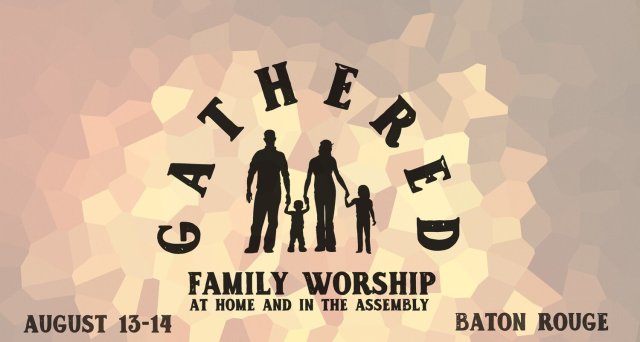
Gathered 2021: Family Worship Conference Teaching

I recently had the exciting opportunity to attend the Gathered conference here in Baton Rouge.

The topic of the conference was family worship in the context of the local church – how parents must disciple their children in conjunction with the church body, and how the church body can, in turn, support those parents and help them disciple their children.

There were four plenary sessions by Dr. Scott Aniol. Currently a professor at Southwestern Baptist Theological Seminary, Scott was recently named Executive Vice President and Editor-in-chief of G3 Ministries. And you’ll definitely want to check out his website, Religious Affections Ministries, a wonderful resource for churches, families, and individuals.

Other presenters included Andrew Pressley, Associate Pastor at First Baptist Church, Lindale, Texas (Tom Buck’s church), and Matt Sikes, Pastor of Discipleship and Worship at Pray’s Mill Baptist Church (Josh Buice’s church).

You’ll find all of the main sessions and men’s breakout session (be sure to share them with your husband!) linked, but I wanted to feature the two women’s breakout sessions taught by Scott’s wife, Becky Aniol, who, among other fine pursuits, is a stay at home, homeschooling mom of four. She gave us a lot of biblical precepts and practical tips for family worship in her two part session A Family Worship Toolbox: Resources and Routines for Monday – Sunday. You’ll find them helpful with your children, grandchildren, or the children you minister to at church. I’m sure you’ll enjoy her sessions as much as I did.

Plenary Session 1: The Goal of Family Discipleship

Plenary Session 2: Practice Makes Perfect

Plenary Session 3: Q&A
(Scott and Becky Aniol, Matt Sikes, Andrew Pressley, and Laramie Minga)

Plenary Session 4: From Integration to Segregation

Men’s Breakout: The Father’s Responsibility in Family Worship Part 1

Men’s Breakout: The Father’s Responsibility in Family Worship Part 2

Church

Throwback Thursday ~ Is It Really All Our Fault?

Originally published July 15, 2016

all our fault

“If the church would just _________,
the world would flock to us.”

“The world is in the state it’s in because
the church has fallen down on the job.”

Over the past few years, I’ve been hearing and reading statements like these more and more frequently. But are they true? Is the world really in such sad shape as a result of the failings of the church?

Yes!…and…no.

It is absolutely true that the visible church – everything that wears the label “church” or “Christian,” whether or not it’s biblical Christianity – has a lot to be ashamed of. Westboro. TBN. Homosexual church leaders and members. Pastors caught in adultery. Child molestation scandals. Female “pastors.” All manner of demonic behavior masquerading as “worship,” blasphemously attributed to the “Holy Spirit.”

Even churches with an orthodox statement of faith – which, to onlookers, seem to be doing fine, biblically – water down the gospel in the name of being seeker sensitive, use materials produced by false teachers, invite false teachers to speak at their conferences, fail to evangelize, place women in unbiblical positions of leadership, have pastors and teachers whose main form of teaching is eisegesis and pandering to felt needs, fail to provide for the needs of their members and their surrounding community, focus on fun and silliness in their youth and children’s ministries instead of Scripture and holiness, allow members to gossip, backbite, and exercise selfishness, fail to practice church discipline, make their worship services into irreverent entertainment-fests, have “pastors” who are little more than stand up comedians, and have largely biblically ignorant congregations.

Some churches are spiritually healthier than others, but nobody’s getting out of this one with clean hands. Even the healthiest church is doing something wrong in some little nook or cranny. And as Christ’s bride, it is incumbent upon us, whenever we discover those nooks and crannies, to repent, set things right, and do things biblically as we move forward.

Christ loved the church and gave himself up for her, that he might sanctify her, having cleansed her by the washing of water with the word, so that he might present the church to himself in splendor, without spot or wrinkle or any such thing, that she might be holy and without blemish. Ephesians 5:25b-27

That’s Christ’s vision of the church. A vision all churches fall woefully short of. And when the church fails in any area, it does contribute to the downhill slide of the world, because it is not being the city on the hill Christ wants it to be, and it is producing individual Christians (or false converts) who aren’t being the salt and light Christ wants them to be.

But is it fair to lay all the world’s woes and sinfulness at the doorstep of the church? Is it really true that if we would just clean up our act in this area or on that issue that we’d magically see an influx of pagans begging, “Sirs, what must I do to be saved?”

No, it isn’t.

The world isn’t steeped in sin because of the failings of the church. The world is steeped in sin because of the Fall.

Look back over history. The world was vicious and depraved long before the church ever came on the scene. And, for that matter, long before God set apart and established Israel as His chosen people. (Hello? The ante-diluvian world? Sodom and Gomorrah? Ancient Egypt? Baal and Molech worship?)

Examine any era in the last two millenia when you think the church was doing a better job than it is now and take a look at the society that church was situated in. The New Testament church? It was surrounded by a world of war, oppression, torture, debauchery, sexual deviance, slavery, misogyny, poverty, famine, and child abuse.

The head of the church, Jesus Christ, spent over thirty years physically present on this earth. We know He conducted His ministry perfectly. Not once did He fail to preach the gospel or provide for people’s needs or fall short in any other way. He even went so far as to lay His life down for the sin of the world. And what impact did that have on His immediate society? Did all the Pharisees repent and temple worship was restored to godliness? No. Did Rome stop ruling the world with an iron fist? No. Did acts of sedition and perversion and persecution suddenly disappear? No. In fact, some of those things actually got worse during and after Jesus’ time.

Just like He prophesied.

You see, Jesus didn’t say, “Be more like Me and the world will come running,” or “The church can solve the ills of the world.” He said:

If you were of the world, the world would love you as its own; but because you are not of the world, but I chose you out of the world, therefore the world hates you. John 15:19

Indeed, all who desire to live a godly life in Christ Jesus will be persecuted, while evil people and impostors will go on from bad to worse, deceiving and being deceived. 2 Timothy 3:12-13

The more the church and individual Christians look and act like Christ, the more world will hate, persecute, and ostracize us.

The church is not going to fix all the evils of society. And it’s not fair to lay that burden of responsibility – one that even Jesus’ earthly ministry didn’t accomplish – on believers who genuinely love their Savior and want to serve Him. Holding out the stick and carrot of a utopian world to the church – if only we’ll get our act together – does nothing but breed hopelessness, despair, and futility in the pews.

Does the church have a lot of repenting to do? Yes. Are there right hands we need to chop off and right eyes we need to gouge out in order to facilitate obedience to Christ? You bet. Should we be exponentially more proactive and passionate about preaching the gospel and meeting the needs of a lost and dying world? Absolutely.

But we do not do those things because we’re failing the world. We do those things out of love for and faithfulness to Christ. Christ is our goal, not a changed world. Christ is the prize we’re to fix our eyes on, not a society that behaves itself. Christ is the finish line we press toward, not domestic tranquility and morality.

Christ.

Because if it’s the church’s job to set the world right, we’re doomed. The world sins because the world is made up of sinners. And the world will continue to sin – even if every church on the planet suddenly becomes perfect – because the world is made up of sinners. But if the church’s highest attainment is love for Christ, faithfulness to Christ, and obedience to Christ, then we are successful in God’s eyes regardless of what the world around us looks like.

Let’s be faithful and trust God to handle changing the world.

Judges Bible Study

Judges ~ Lesson 9

Previous Lessons: 1, 2, 3, 4, 5, 6, 7, 8,

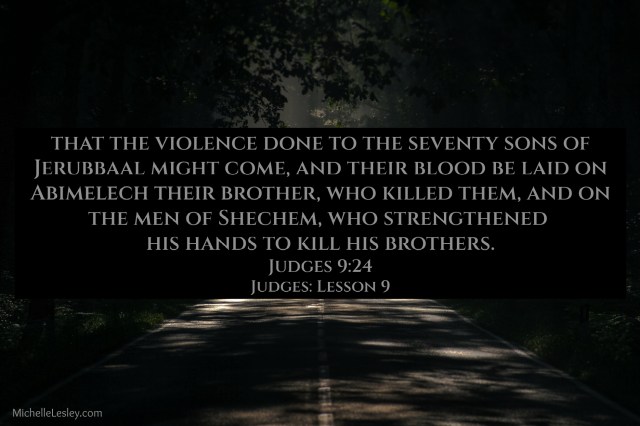
Read Judges 9

Questions to Consider

1. Go back to lesson 3 (link above) and review your answer to the first part of question 5, Israel’s pattern of sin and repentance in 2:16-23. How does today’s passage fit this pattern? How does today’s passage fit the theme verse of Judges (21:25), “In those days there was no king in Israel. Everyone did what was right in his own eyes.”?

2. Briefly review lesson 8 (link above) to set the scene for this weekโ€™s passage.

3. Read 1-2. Who were Jerubbaal and Abimelech? (1) Was Gideon’s son supposed to rule over the people? (2) Who was supposed to rule over them? Before you read any farther in chapter 9, think about this: The book of Judges is a case study of what happens when people reject God’s authority over their lives in favor of their own authority over their lives. How has that worked out in Judges so far? How do you think that’s going to work out for Abimelech and the people of Shechem in Chapter 9?

How did that work out for you before you got saved? Consider that every time you sin, even as a Christian, you are rejecting God’s authority (His commands in His Word) in favor of your own (“I’ll do what I want.”). How does that work out for you, even as a Christian?

4. Read 3-21. Who was Baal-berith? (4) Explain (16-20) the parable Jotham told in 7-15. What was the message he was trying to get across to the people of Shechem and to Abimelech? Had the people of Shechem “dealt well with Jerubbaal and his house and have done to him as his deeds deserved”? (16)

Compare Jotham’s courage and actions (16-21) to his father Gideon’s courage and actions. Consider Jotham’s (21) and Gideon’s actions to protect themselves and minimize danger to themselves at the hands of evil men while / after doing the right and godly thing. Does this indicate cowardice or prudence? Why?

5. Read 22-57. Summarize, in your own words, the plot line of this story. How does God’s justice bookend (23-24, 57) this story and point to God as the perfectly just judge? How does this story drive home the point that God should have been the One to rule over the people? That they should have submitted to His rule and authority instead of trading it for their own rule and authority?

The “Tower of Shechem” (46) and the “strong tower” of Thebez (51) were reinforced, military towers. Many fortified cities of the time built these towers for the exact purpose we see in this passage – so that, if the city were under siege, its leaders (and often the majority of the town, see verses 49, 51), could lock themselves into it and, hopefully, survive the onslaught. Those inside the tower had the advantage of height and could shoot (arrows) or throw things (53) down onto the enemy. Those attacking the tower had the disadvantage of being exposed in an open area. How does this knowledge help you better understand passages like these?

Compare 52-54 – Abimelech’s shame over a woman killing him – with God crediting women – Deborah and Jael – instead of Barak, with the victory over Sisera (lesson 5, link above). Does Abimelech’s shame help you get even more of a sense that the story of Deborah is not a “girl power” story but a “man up” story?

What was the “curse of Jotham ” (20) mentioned in verse 57?

6. “Bible trivia” question: Where else in Scripture is the event in 52-54 described, and why is it mentioned there? (Check your answer here.)


Homework

Verse 23 says that “God sent an evil spirit”. Does this indicate that God somehow approves of evil or that God instigates sin or forces people to sin? Consider how evil Abimelech and the leaders of Shechem already were and how many evil spirits were already hard at work in their lives and this situation. How can you tell from the text that this particular evil spirit mentioned in verse 23 was not inciting anything that was against the will of Abimelech or the men of Schechem?

Look up the cross-references for verse 23. Since God is completely sovereign over every aspect of the universe, can evil spirits (demons) go anywhere or do anything without God permitting them to do so? Think about all of the demons that must be at work in the world today. Are any of them acting outside of God’s control? Upon comparing verse 23 and its cross-references, can you see how these references to God “sending” an evil spirit are simply pulling back the curtain a bit on the spiritual realm to give us a glimpse of how God specifically uses a particular evil spirit in a particular situation?


Suggested Memory Verse