
Mailbag

The Mailbag: Potpourri (Ministry oversight…Elliot/ten Boom preached to men…G3…Alt-her-ing Scripture)

Welcome to another โ€œpotpourriโ€ edition of The Mailbag, where I give short(er) answers to several questions rather than a long answer to one question.

I like to take the opportunity in these potpourri editions to let new readers know about my comments/e-mail/messages policy. Iโ€™m not able to respond individually to most e-mails and messages, so here are some helpful hints for getting your questions answered more quickly. Remember, the search bar (at the very bottom of each page) can be a helpful tool!

Or maybe I answered your question already? Check out my article The Mailbag: Top 10 FAQs to see if your question has been answered and to get some helpful resources.


Hello! Iโ€™ve just found you while looking for theologically sound Bible studies. Iโ€™m thankful to find your resources and look forward to reading further!

So far youโ€™ve checked all my boxes in looking for someone who is seeking to be faithful to the Word. I would assume in being a proponent of complementarianism, that you are in a church that allows you, as a woman in ministry, to submit to the pastors and/or elders of your churchโ€ฆ Can you please clarify this? In other words, are you receiving oversight outside yourself in your ministry? One reason Iโ€™m asking is our church has an elder that is over all our womenโ€™s ministries and find that as a good discernment check.

Also, where do you live? That question isnโ€™t terribly important; Iโ€™m just curious.

I live in Baton Rouge, Louisiana. (You can find out more about me in the Bio tab in the blue menu bar at the top of this page.)

This is a super question, and I’ve received it a few times in the past, but I’d like to tweak it just a bit if that’s OK.

It’s certainly not a bad thing for a woman in a parachurch ministry like mine to have her doctrinally sound pastor and elders or some sort of ministry board oversee her ministry if she and her husband and pastor and elders all mutually agree that it would be beneficial. And if God miraculously gave my pastors several more hours in the day that they didn’t know what to do with and they called me and said, “Hey, we’d like to volunteer to do this for you,” I’d probably take them up on it.

But what I’d like to clarify is that, while this may or may not be a wise and helpful arrangement, it isn’t a requirement of Scripture (and I’m not saying that you think it is) for women or men in parachurch ministries, complementarianism notwithstanding. What Scripture requires is that all church members submit to the leadership of their pastor and elders:

Obey your leaders and submit to them, for they are keeping watch over your souls, as those who will have to give an account. Let them do this with joy and not with groaning, for that would be of no advantage to you. Hebrews 13:17

As a member of my church, I certainly strive to obey this instruction. And if my blogging / podcasting / speaking ministry were a ministry of my church, like the women’s ministry of your church, it would definitely fall under the purview of my pastors.

But it isn’t. My ministry is discrete from my church just like any other church member’s job or business. Furthermore, I’ve been a member of four different churches since I started my ministry, and, sad to say, some of those pastors and leaders weren’t even biblically qualified for their own ministries, never mind overseeing mine.

Next, it depends on what you mean by โ€œoverseeโ€. If you mean – Do I submit all of my articles, podcast notes, and teaching materials to my pastors for approval before I publish, podcast, or speak at an event? Do I check with them every time I make a decision? – no, and I would never think of asking them to do all of that. Theyโ€™re busy being pastors. And, if my writing, teaching, and decision-making were so suspect that I needed them to do that, or that they felt they needed to do that, I would have no business writing and teaching on biblical topics.

Now, there have been a few times when Iโ€™ve asked for their input or advice. One time, I needed a little clarity on a certain passage. Another time (due to spiritual abuse at a previous church), I was super anxious that something I was writing might upset my pastors, so I ran it by one of them, and he essentially said, โ€œThat’s the same thing we believe. Calm down. We trust you.โ€.

And thatโ€™s basically the long and short of it. They know what I think, I know what they think, weโ€™re pretty much on the same page about everything, biblically, and they trust me. And the same goes for my husband. And I trust that if I ever write anything thatโ€™s unbiblical or needs correction, theyโ€™ll let me know, and Iโ€™ll fix it. 


Where do you place speakers such as Elisabeth Elliot, Corrie ten Boom and the like who, while they spoke to audiences that included men, did not seem to be cut from the same cloth that some female speakers of today seem to be? Do you feel they were appropriate in speaking to mixed gender audiences?

Several people have asked me this about Elisabeth Elliot recently, so it’s possible there’s something making the rounds about her that I’m not aware of, but I think there’s an aspect of this question that’s really important for all of us to key in on:

God is no respecter of persons, and we shouldn’t be, either.

If something is a sin, it’s a sin – and it doesn’t matter who’s committing it. It’s just as much a sin for Elisabeth Elliot to preach to or teach the Bible to men as it is for Beth Moore as it would be for you or for me.

And it appears that Elisabeth Elliot1 did, in fact, make a practice of committing this sin. (Here are some videos of her preaching/teaching the Bible with men clearly present in the audience: here at 1:06, here from 0:00 and at 12:38, here from 0:00, here at 1:32, and there are many others.) So, at least in that one respect, she was “cut from the same cloth that some female speakers of today seem to be.”

Apparently, there were other serious problems with Elisabeth’s doctrine as well. From the article, Courage to Be Catholic?:

“[Elisabeth] continued, “…my brother…entered the Catholic Church some years ago. I only wish I had his courage.”…she admired the decision I had made to enter the Church, as her dear brother had! After she had sung the praises of the Catholic Church for several minutes, I worked up the nerve to ask Elisabeth why she did not follow in her brother’s footsteps. “Cowardice, I suppose. My listeners and readers simply would not understand.”

Of course they wouldn’t. Catholic doctrine is heretical.

It’s harder to decipher (at least from YouTube videos) whether or not Corrie ten Boom preached and taught Scripture to mixed audiences, but so far as I can tell, she did. Corrie is generally known for giving her personal testimony, and that’s not normally a violation of Scripture for a woman (see #14 here) unless she veers off into actual preaching. However there are several YWAM (Youth With A Mission) training videos like this one (0:49) which show a man and women on the stage with Corrie as she teaches them a biblical topic, videos which, I can only assume, were used to train both male and female YWAM staff.

And, in a video entitled The Holy Spirit Gives Power (June 8, 2016) the man introducing Corrie says at 2:55, “she has toured the world preaching the gospel of Jesus Christ, winning many to Christ by both her writing and her preaching” and she goes on to preach to what sounds like a rather large audience, which, it seems unlikely, was restricted to women. (Further, the man introducing her sounds very much like Billy Graham to me, and if Billy Graham ever introduced a woman speaker for a women’s only event, that’s news to me.)

Perhaps even more disturbing was Corrie’s appearance on Kathryn Kuhlman’s show. Kathryn was a rank heretic: a female preacher, faith healer, and, essentially, one of the “founding fathers” of what is now the New Apostolic Reformation.

I don’t think anybody asking this question is intentionally saying or thinking that there’s a different standard for our heroes in the faith than for us regular old ordinary Christians, but it’s a sneaky little mindset that can weasel its way in without our even noticing it. We need to keep a couple of things in mind:

First – Surviving a horrific experience, even with great faith, doesn’t automatically make a person biblically discerning, doctrinally sound, or qualified to teach the Bible.

Second- As doctrinally sound Christians, we need to be really careful not to do the exact same thing that disciples of false teachers often do: let our sentimentality or love for an evangelical legend override biblical standards and commands, or give our favorite teachers a pass on sin.

I’ve addressed this subject further in my article Stricter Judgment, Even for MY Favorite Teacher.

1Big thank you’s to my dear friend Elizabeth Prata (an Elizabeth you should be following) for the heads up on much of this info about Elisabeth Elliot.


Will you be at the G3 Conference? I’ll be there, and I’d like to meet you!

Sadly, no, and I’m kinda bummed about that, because, not only is G3 a fantastic conference, it seems like all of my buddies that I hardly ever get to see are going to be there.

I have a conference of my own in Montana the weekend before G3 and another in California the weekend after G3, so I’m already going to miss those two Sundays at my own church, plus I don’t like leaving my family any more than I absolutely have to.

I will be in Heaven eventually, though, and we’ll all have eternity to meet and greet and fellowship together as we worship around the Throne. So, if I don’t see you here, I’ll see you Hereafter. :0)


I have a dear friend in Christ who I know loves Jesus, trusts Him, and knows her Bible. However, she sent me something recently that really made me curious and I want to know if out of love, I should discuss with her.

What she sent me was this: The Lord’s beloved rests securely on Him. He shields (her) all day long, and (she) rests on His shoulders. Deuteronomy 33:12.

It was on a pink background with very pretty script. But I believe it’s wrong to alter Scripture to make it about me, as a woman. If God meant for it to say “her” or “she” He would have made sure it did. Am I being petty, or reading too much into a simple daily devotion thing that my friend I’m sure meant nothing but love by sending to me?

No, you’re not being petty or legalistic, you just have a higher view of Scripture and better hermeneutics than she does, and you’re right. Who in the name of arrogance are we to alter or adulterate God’s written Word so it’s more pleasing to us? There are actually two issues here:

First of all, there are many passages of Scripture which use universal male pronouns to mean everybody, humankind, men and women. For example (I just picked this one at random), Psalm 8:4:

what is man that you are mindful of him, and the son of man that you care for him?

Obviously, “man” and “him” in this verse don’t mean that God is only mindful of males or only cares for males. As women, we can correctly understand that this verse includes us. And we ought to be woman enough, mature enough, and have enough reverence for God’s Word that we don’t have to put it on a pretty pink background with flowers and a swirly font, and change the pronouns from masculine to feminine so that none of the girls get their feelings hurt.

But here’s the second – and in my view, more important – issue with this particular instance: Deuteronomy 33:12 isn’t one of those universal male pronoun verses. Your friend (or whoever created the image) is ripping it completely out of context. And she had to amputate the first part of the verse in order to do so. Here’s the whole verse:

Of Benjamin he said, โ€œMay the beloved of the Lord live in security beside Him Who shields him all the day long, And he lives between His shoulders.โ€

This isn’t some universally applicable verse, even if you’re a man. This is Moses blessing the twelve tribes of Israel prior to his death. Verse 1 of chapter 33 tells us just that: “Now this is the blessing with which Moses the man of God blessed the sons of Israel before his death.”

What your friend is doing is like finding a letter her dad wrote to her brother, scratching out her brother’s name, and writing in her own name instead. Yes, Dad loves her too, but this is her brother’s letter, and she’s stealing it.

Maybe this was just a one time “oopsie” in which your friend wasn’t very careful about what she was passing along on social media. We’ve all been guilty of that. If that’s the case, and everything else seems to be doctrinally sound, you could talk to her about it if you want, but I don’t see any harm in letting this one go. But if it seems more like a pattern or a downhill slide, yes, I’d pray for wisdom and an opportune moment and gently, yet firmly, talk to her about reverence for God’s Word, and rightly handling it.


If you have a question about: a Bible passage, an aspect of theology, a current issue in Christianity, or how to biblically handle a family, life, or church situation, comment below (Iโ€™ll hold all questions in queue {unpublished} for a future edition of The Mailbag) or send me an e-mail or private message. If your question is chosen for publication, your anonymity will be protected.

Mailbag

The Mailbag: Potpourri (Confessing past sin… Too much Calvinism?… “Fake it til you make it”)

Welcome to another โ€œpotpourriโ€ edition of The Mailbag, where I give short(er) answers to several questions rather than a long answer to one question.

I like to take the opportunity in these potpourri editions to let new readers know about my comments/e-mail/messages policy. Iโ€™m not able to respond individually to most e-mails and messages, so here are some helpful hints for getting your questions answered more quickly. Remember, the search bar (at the very bottom of each page) can be a helpful tool!

Or maybe I answered your question already? Check out my article The Mailbag: Top 10 FAQs to see if your question has been answered and to get some helpful resources.


I confessed and repented of a certain sin after I got saved, but my husband doesn’t know about it. Do I need to confess that sin to my husband in order to receive God’s blessings or be considered a Proverbs 31 wife? And should he also confess his past sins to me? By the way, my husband is a pastor.

What a beautiful heart you have – wanting to be clean before the Lord and wanting to please Him!

There might be a few very specific scenarios in which it would not be wise to bring up a past sin to your husband, but, generally speaking, in a Christian marriage yes, you should be able to talk to your husband about your past sins (and he should also be able to discuss his past sins with you). But not to get God’s blessings or to be a Proverbs 31 wife.

Marriage is about trust. In the same way that Christian husbands and wives should trust each other enough to feel comfortable being physically naked around one another, we should also trust each other enough to feel comfortable “baring it all” when it comes to our past sins.

It sounds like this is a sin you simply haven’t told him about, but it should go without saying that you should not be lying to him about it or trying to cover it up. Those are direct sins against him, and if you’re doing that, you definitely need to confess and repent to him.

All of that being said, there can be more helpful / wise ways and times to talk to your husband about your past sin and less helpful / wise ways and times to talk to him about it, and you may want to get some help figuring that out from someone who can be more objective about it than you can.

Normally, I would suggest setting up an appointment with your pastor to get some pastoral counsel about it, but since your husband is your pastor, I would suggest locating an ACBC certified Biblical Counselor (not the same thing as a “Christian counselor/therapist”) who is not a member of your church (you don’t want your husband to be embarrassed or make it difficult for the counselor to sit under her pastor’s leadership) and set up an appointment.

Some denominations offer counseling services to pastors and their families, so you may want to contact your denominational leadership to find out about that. (I’m not sure what to tell you about other denominations, but if you’re Southern Baptist, contact your local SBC association or state convention.)


Hello! I found your website while trying to see if a Christian singer was a false teacher. I started reading over your beliefs to make sure that you werenโ€™t a false teacher (I donโ€™t mean that in a rude way, itโ€™s just that I have to be really careful especially since I am only a teenager). I agree with everything except Calvinism. I was just wondering if our beliefs would still align enough to where your positions on whether or not people are false teachers would align with my beliefs. I can always ask my parents afterwards, but I just wanted to know basically if you talk about or reference Calvinist beliefs a lot. Thank you!

Wow. Just, WOW. Honey, your parents must be so proud of you. I know I would be if you were my daughter. I am thrilled – hear me: THRILLED – that you checked me out to make sure I’m not a false teacher before reading my stuff. Do you know how many adults don’t do that before following people? Most of them. I wish I had been as discerning as you are when I was your age.

Calvinism is not a factor when I sit down to evaluate whether or not someone is a false teacher, so that isn’t something you would need to worry about. In fact, there are some people on both my Popular False Teachers page and on my Recommended Bible Teachers page about whom I have no idea whether or not they’re Calvinists. There are even Calvinists I recommend against (such as Matt Chandler), or decline to proactively recommend (such as John Piper). I will say this, though – and, understand, this is a very general statement – having studied dozens of teachers, I find that those who adhere to Calvinism / Reformed theology are less likely, on the whole, to be false teachers than non-Calvinists.

I guess it depends on what you mean by talking about or referencing Calvinism “a lot”. From my perspective, I hardly ever mention it directly, but I’m sure it does come across indirectly in some of the terminology I use and the way I handle Scripture.

This is kind of humorous, but, probably about once a month or so, I get a message or an email from somebody saying, “Why don’t you talk about the false teaching of Calvinism?” or “I see you recommend John MacArthur. Don’t you know he’s one of those [gasp!] Calvinists?”. So I guess I’m not exactly beating people over the head with it if they didn’t know and I have to tell them straight out, “Yeah, I’m a Calvinist, too.”

I don’t know, I’m probably not the most objective person to answer this question. Let’s turn it over to my regular readers and you can see what they have to say in the comments section.

Readers – do you think I talk about
Calvinism “a lot” on the blog?

Answer in the comments, and help out this charming and discerning young lady.


Could you tell me where Scripture teaches โ€œfake it till you make itโ€ ?

โ€œfake it โ€™til you make itโ€. A phrase easier said than done. But where stands it written? I would say this is not true. Michelle I trust your wisdom and knowledge, but this phraseโ€ฆnot so much. I asked sarcastically where I could find it in Scripture knowing itโ€™s not written. I was hoping to have a response to my previous email, but no reply as yet. Godโ€™s word is based on truth not feelings. Trusting feelings when it comes to โ€œfake it โ€™til you make itโ€ I find is not sound wisdom. Allowing the Holy Spirit to change me is trusting in Him not myselfโ€ฆwhether itโ€™s fear or feelings.

These two comments (from the same commenter) were left on my article Fear Not: 9 Biblical Ways to Trade Worry for Trust regarding the phrase “fake it til you make it” in this paragraph:

Those worries may start creeping in, but you donโ€™t have to set the table and turn down the bed for them. Push them right out of your mind, slam the door behind them, and say (out loud is helpful), โ€œNo. Iโ€™m not going to worry. Iโ€™m going to trust the Lord.โ€ Youโ€™ll still feel worried at first, but โ€œfake it โ€™til you make it.โ€ Your feelings will eventually follow.

I’d like to address two issues regarding these comments, first the commenter’s attitude, then the content.

Attitude: First, I did not receive an email from you about this, so I can only assume “email” in your second comment actually refers to your first comment. However, if you had sent me an email, you would have to have obtained my email address here, where I clearly state (in bold type, no less):

I regret I am unable to answer most e-mails
unrelated to speaking engagements…”

So if you had emailed me, you shouldn’t have expected a reply at all, much less on your timetable.

Since you commented, you should have read – in large font directly above the comment box:

“Before commenting please see the ‘Welcome’ tab in the blue menu bar at the top of this page. Comments are handled manually, so there will be a delay before approved comments are posted.”

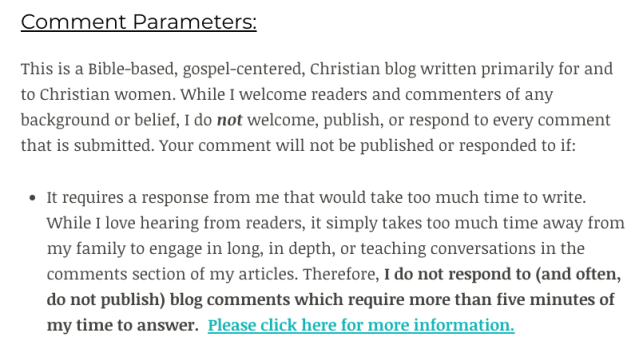
So, a) you should have expected some sort of delay, and b) if you had clicked on the Welcome tab as instructed, you would have seen this:

The “Please click here…” hyperlink goes to an article further explaining my email and comments policy and why emails and many comments usually go unanswered. I have bent over backwards to make it clear to my readers that I can’t answer most correspondence and why, even though I really wish I could.

Furthermore, you sent your first comment three weeks ago and your second comment a week later. To give you a little perspective, the first question I answered in this article was sent in almost a year ago. The second one, a month ago. Some people don’t get their questions answered for months. Others never get their questions answered, because I simply don’t have enough hours in the day to get to everyone’s questions. I hate that, but that’s just the way it has to be.

Not realizing your initial question was sarcastic, I had saved it in order to answer it in a Mailbag article, but I’ll be honest, when I got your second comment, my gut level reaction was to just delete both of them. Being impatient, demanding, and snarky when you’re asking someone else to do something for you (i.e. answer your question) is neither becoming of a Christian nor very effective.

But since I had already decided to address the content of your question, I decided to go ahead and do that and also add the part about your attitude as a teaching moment for you and anyone else to whom it might apply.

Content: I thought most people in my audience would be familiar with the phrase “fake it til you make it” (and, indeed, in the four times this article has run on my blog, you’re the only one who has commented objecting to it), but I can see where it might not be the clearest wording in the world, especially for people who aren’t familiar with the common usage of the phrase.

No one who has read the entire article could surmise that I was saying that “Godโ€™s word is based on feelings,” or that I was saying people should “[Trust] feelings when it comes to ‘fake it โ€™til you make it’โ€. (I’m not really even sure what that means since the theme of that paragraph, that section, and the entire article is that we should not trust or be controlled by our feelings.)

“Youโ€™ll still feel worried at first, but ‘fake it โ€™til you make it.’ Your feelings will eventually follow,” simply means that we should obey Scripture (in this case the Scriptures that tell us to trust God) regardless of how we feel about it and trust God to eventually line our feelings up with His Word. I thought that was clear from the context, but if it was not, I sincerely apologize. I have added a footnote to the article with this explanation in case it’s unclear to any other readers.

UPDATE (9/8/21)

I received what I thought was a very gracious response from this reader. With her permission, I share it here:

Dear Michelle,

โ€œfake it โ€˜til you make itโ€โ€ฆhereโ€ฆ

I ask your forgiveness. I had no intention of appearing impatient, nor demanding, nor snarky. Thank you for your very frank response and clarifying your answer to my question.

I am grateful for the knowledge and wisdom God has given you. My question was sincere as were my comments. And again Iโ€™m sorry if you took them as you did, as I had no intention to raise your ire in responding. I did indeed read the โ€œwelcomeโ€, and again didnโ€™t expect a response from your busy schedule and many emails you receive.

My heart was to speak as one sister to another. I have been told this phrase before. Words have consequences, and quite honestly for me, as I filter words and phrases through Godโ€™s Word, I am reminded to speak truth in love, not snarky, or demanding. We can all learn to be effective in our walk with the Lord by not jumping to conclusions that are incorrect, being teachable and gracious.

Blessings on you and your ministry.


If you have a question about: a Bible passage, an aspect of theology, a current issue in Christianity, or how to biblically handle a family, life, or church situation, comment below (Iโ€™ll hold all questions in queue {unpublished} for a future edition of The Mailbag) or send me an e-mail or private message. If your question is chosen for publication, your anonymity will be protected.

Bible Study, Mailbag

The Mailbag: What Is the Verse Mapping Method of Bible Study?

Originally published June 19, 2017

What is the “verse mapping” method of Bible study? Do you recommend it?ย A friend was asking about it and she is a big follower of Proverbs 31 Ministries, which was a red flag for me.

This is an excellent question, because there are lots of different Bible study methods out there, some good, some not. And you want to make sure you’re using a method that will help you correctly understand the text so you can grow in your faith.

I had never heard of verse mapping either, so I did what I usually do when I’ve never heard of something but want to know what it is- I Googled it. And several red flags popped up for me too.

The first hit I got was this article written by someone who thinks Beth Moore is an exemplary Bible teacher and that The Message is a reliable translation. She linked to an article on verse mapping at Proverbs 31, whose author says we need to “listen to God’s voice“. The Proverbs 31 article linked to another blogger – “the one who taught us how to verse map” – who recommended closing your eyes, letting your Bible fall open and pointing to a random verse as one way to choose a verse to map.

The rest of the first two pages of search results all seemed to be from Christian women’s blogs, none of whom I was familiar with. That’s not to say there’s necessarily anything wrong with those women or their blogs, I’m just saying I didn’t see any well known, doctrinally sound ministries recommending verse mapping in the most popular Google results.

I get the impression from these articles that verse mapping methodology can be a bit fluid. The first blogger used a journal and made copious notes (her method appeared to me to be more akin to inductive Bible study). The other two used an index card and wrote very few notes. So it would seem there’s no one set way to do verse mapping, but the general idea is to pick a Bible verse and dissect it (in various ways, depending on which method of verse mapping you’re using) as your daily Bible study format.

Separating the method itself away from the taint of false teachers, some of the recommended techniques in verse mapping are solid and could be very helpful, such as using commentaries, looking words up in the original Greek or Hebrew, writing down what is happening in the verse, and looking at the immediate context of the verse. These are all good principles of biblical hermeneutics, and if you use them as part of a systematic study of a book of the Bible or as part of a study on a biblical topic, your understanding of God’s word will be greatly aided.

The problem is, a) using it as your sole form of Bible study isn’t going to teach you all that studying longer passages of the Bible will, and b) those aforementioned good techniques are mixed in with some bad techniques, so you have to be discerning enough to tell which is which. And, chances are, if you’re discerning enough to do that, you’re probably a good student of the Bible who’sย alreadyย using the good techniques of verse mapping, so you don’t really need it.

The bad techniques?

1. Choosing random verses to dissect
There’s more to the context of a verse than just the couple of verses that immediately precede and follow it. There’s how the verse fits into its chapter, book, testament, and the overall narrative of Scripture. If you skip through Scripture picking out a verse here and a verse there to analyze you’re going to misunderstand those verses because you’re not going to know the larger context they fit into in their own immediate story and the story arc of redemption. Can you imagine studying any other piece of literature – a Shakespearean sonnet, the Declaration of Independence, a medical journal article – this way, picking out a random sentence or two here and there? Of course not. Then why would we study the Bible this way?

2. Personalizing the verse
One of the techniques verse mapping recommends is to cross out all general referents (you, they, we, etc.) and replace them with your own name. Do not do this.

First and foremost this exhibits utter disdain for the God of the universe who wrote the Bible. If He wanted your name to be in Scripture, it would already be there. You don’t get to change, even temporarily, what He wrote, and to think it’s OK to do so is arrogant and irreverent. These are the very words of God Himself- do you really dare to change them?

Second, it’s an extremely self-centered way to look at Scripture. The Bible isn’t about you and it wasn’t written to you. When those words were penned, there were real, live people – just as important as you – on the other end, and none of them were you because you hadn’t been born yet.

Third, doing this will almost certainly give you a wrong understanding of the verse. “You” doesn’t always mean you personally, Buttercup. Sometimes “you” means Israel. Sometimes “you” means the church. Sometimes “you” means Amos or Cain or Judas or Philemon. Sometimes “you” means God. Sometimes “you” even means Satan. And sticking your name in for one of these “you’s” is going to lead you away from a correct understanding of Scripture, not toward it.

3. Focus on anything that jumps out at you
Again, this is a very self-centered way to look at Scripture. Just because something jumps out at you doesn’t mean it’s the main point of the verse or that it has significant spiritual import. Certainly, if there’s a word in the verse that you don’t understand you should look it up. Or, if you find some concept in the verse interesting, go ahead and search out the cross-references for clarity. But don’t assume that word you’ve looked up or that concept you find interesting is the meaning of the verse just because it happened to catch your attention. When we study the Bible, we search for what God meant by that verse.

4. Find verses that minister to you
Now I ask you, if you follow that guideline, how often are you going to pick verses out of Leviticus that have nothing to do with your life today? When will you pick verses that step on your toes and convict you of sin? Will you ever examine hard verses that take a lot of historical and cultural understanding? At the risk of sounding like a broken record, this is a self-centered way to look at Scripture. Yes, the Bible can bring us comfort and reassurance, but the Bible isn’t a bottle of aspirin. You don’t just pop a couple of verses whenever you have a headache. The Bible isn’t there to minister to you. It’s there to equip you to minister to God, the church, your family, the lost. There’s a reason God wants pastors to preach the whole counsel of God – we need all of God’s word, even the parts that don’t “minister” to us.

In conclusion, I would not recommend verse mapping as a whole the way it is presented in the aforementioned articles, but some of the individual techniques I noted can be helpful as part of your regular, systematic study of Scripture.

If you need a little help learning how to study your Bible using good study habits, click the Bible Studies tab at the top of this page.


If you have a question about: a Bible passage, an aspect of theology, a current issue in Christianity, or how to biblically handle a family, life, or church situation, comment below (Iโ€™ll hold all questions in queue {unpublished} for a future edition of The Mailbag) or send me an e-mail or private message. If your question is chosen for publication, your anonymity will be protected.

Mailbag

The Mailbag: Potpourri (Gnomes…Babies’ eternity…Teen podcasts…Biblical womanhood…Prophetess…African American women teachers)

Welcome to another โ€œpotpourriโ€ edition of The Mailbag, where I give short(er) answers to several questions rather than a long answer to one question.

I like to take the opportunity in these potpourri editions to let new readers know about my comments/e-mail/messages policy. Iโ€™m not able to respond individually to most e-mails and messages, so here are some helpful hints for getting your questions answered more quickly. Remember, the search bar (at the very bottom of each page) can be a helpful tool!

Or maybe I answered your question already? Check out my article The Mailbag: Top 10 FAQs to see if your question has been answered and to get some helpful resources.


My church is having women’s ministry painting party. While I don’t have an issue with painting or even learning to paint, my concern is the paintings they have chosen for us to choose from. We were given 4 choices; a watering can, ice cream cone, circle plaque, and a gnome. What gives me pause is the gnome. What little I know of the history of a gnome isn’t biblical. In fact, it is demonic, I believe. Is it ok to still go even if I don’t choose the gnome? Should I say something to my pastor? What should I say?

It’s always important to think biblically about everything, not just accept something because your church endorses it. So, kudos on thinking this through!

Here’s what I would do if I were an invited attendee and if I were the event organizer:

Invited attendee: I would go and simply opt for one of the other three items to paint. I would not look down on any of the women who chose the gnome (not that you would, either), knowing that they (and probably upwards of 99% of people today) don’t know anything about the history of gnomes. To most people a gnome is just an imaginary, fairy tale type of fictional character, like a unicorn or a fairy godmother. A picture or figurine of a gnome doesn’t physically carry a demon within it, and it’s not going to curse your household or anything like that. That’s superstition, and superstition is definitely unbiblical.

I would not go to the pastor about this. In fact, I probably wouldn’t go to anyone about this, including other attendees. But if I felt I had to speak to someone about it, I’d go to the women’s ministry director (I assume she’s the one in charge of this event). I would just briefly (like a minute or two, tops) and breezily explain to her, “Hey, I know you probably didn’t know this, but I was reading this really interesting article about gnomes, and it said A, B, and C (give the 2 or 3 most important points – don’t overwhelm her with the entire history of gnomedom). I just thought you might want to know in case that would bother any of the ladies in our group. I decided to choose the ice cream cone instead. See you at the party on Saturday!”. And then I would go and have a good time while attempting not to embarrass myself with my severe deficit of artistic talent. :0)

Event organizer: If I were the event organizer and someone came to me the way I’ve just described above, if possible, I would explain the information to the ladies and rescind or replace the gnome option so as not to unnecessarily offend anyone. I can’t guarantee that’s what any other women’s ministry director would do, but that’s what I would do.

I think some of the principles in my article Is Christmas Pagan? might be helpful to you.


Two days ago I had a D&C after a miscarriage. This is the second time I can’t have my baby in my arms. It’s heartbreaking but I am so grateful to be alive, since both the pregnancy and the procedure ended up being life threatening.

During these days of recovery I re-read your article, Elizabeth’s Gift, and it comforted me deeply. I understood that no matter what happens, as long as I have my God around me I have everything I need.

But I also read an article that said that every unborn baby goes straight to hell. I don’t really know if it’s true but as a mum of two unborn babies thinking about this breaks my heart. What are your thoughts?

First, let me say, I’m so sorry for the loss of your two babies. I can only attempt to imagine how devastating that must be. I have taken a moment to pray for you, and I’m asking everyone reading this to pause for a moment and pray for you too.

I’m not sure what the author of the article you read meant by saying that babies who die before birth go to Hell, or which Scripture(s) she may have twisted to come to that conclusion, but I can tell you there’s nothing in the Bible which explicitly says that.

Here’s what we do know: God is far more loving, compassionate, just, and merciful than we are. We also know that every decision He makes is right and perfect, and He is not capricious. So that’s the foundation we start from when we look at an issue like this. We can always trust God to act in keeping with His nature and character.

So “judging” God by His own nature and character as He Himself has revealed it to us in the totality of rightly handled Scripture, does it sound like it’s in keeping with His nature and character to unilaterally condemn an entire group of people (babies who die before birth) to Hell based on a particular physical quality (lifespan and sentience) over which they have zero control and He has 100% control? Do we see Him doing that with any other people group – males, people with red hair, white people, etc. – in the Bible?

No, we do not, because, when it comes to entrance into Heaven or Hell, God judges us individually, not for being a member of a certain people group. And He’s able to do that because He knows – even better than we know, ourselves – what’s in our hearts.

As to the eternal destiny of an individual pre-born baby who dies, let me direct you to some resources that go into this in more depth, which I think will be helpful and comforting to you:

Safe in the Arms of God by John MacArthur

Do babies and others incapable of professing faith in Christ automatically go to heaven? by John MacArthur

Do babies and children go to heaven when they die? at Got Questions?


Any suggestions on biblically sound podcasts for teens?

Yep. I would, first of all, suggest mine, A Word Fitly Spoken, not because it’s mine, but because we try to make sure we explain things in a way that new Christians and people who are new to whatever topic or passage of Scripture we’re discussing can understand.

I would also recommend any of the podcasters you find at the Recommended Bible Teachers tab in the blue menu bar at the top of this page, as well as any under the “Blogs and Podcasts I Follow” heading (that’ll be in the right sidebar if you’re reading this on a computer, or near the very bottom of the page if you’re reading on your phone or tablet – just above “Links I Love!”).

Personally, as a mom of 6 and a former teacher, I think we baby and cater to teenagers, especially Christian teens, way too much. They need to grow up and mature. And…hey…they want to be treated like adults, right? Well, this is one area in which we can confidently treat them like adults – turn them on to doctrinally sound podcasts geared toward adults instead of toward teenage silliness and the cult of cool.


I was wondering if you knew of a good book for a young college age woman on the topic of biblical womanhood. Iโ€™m trying to find a book that provides a biblical view in contrast to most popular โ€œChristianโ€ books which seem to try to tear down the biblical view. Any suggestions you have would be great.

I would strongly recommend that she study straight from the text of Scripture about this. Books necessarily have to approach these topics in a “one size fits all” way, and that’s not going to teach her what it looks like to live out biblical womanhood in her unique life and context. But the living and active Word of God can.

If she would be interested, she might like to try my Bible study, Imperishable Beauty: A Study of Biblical Womanhood. It’s free, and she’s welcome to print it out if she’d like to.


I was wondering what are your thoughts on Prophetess Kimberly Moses?

I’ve never heard of her before, but I cannot fathom any circumstance, any stretch of the mind, or any reason, under which a doctrinally sound woman would call herself a “prophetess”.

I would recommend you stop following her immediately. She’s almost certainly teaching New Apostolic Reformation heresy.

(So, after I wrote the above, I was just going to leave it at that. But my curiosity got the better of me, so I Googled her. Yep, NAR. If you know anything about the NAR, you’ll spot it all over her website in about 10 seconds.)


Any recommendations for female African-American authors/bloggers/influencers?

No, because I don’t recommend teachers on the basis of ethnicity. I recommend teachers on the basis of sound, biblical doctrine.

I would recommend any of the women (or men) at the Recommended Bible Teachers tab in the blue menu bar at the top of this page, as well as any under the “Blogs and Podcasts I Follow” heading (that’ll be in the right sidebar if you’re reading this on a computer, or near the very bottom of the page if you’re reading on your phone or tablet – just above “Links I Love!”).


If you have a question about: a Bible passage, an aspect of theology, a current issue in Christianity, or how to biblically handle a family, life, or church situation, comment below (Iโ€™ll hold all questions in queue {unpublished} for a future edition of The Mailbag) or send me an e-mail or private message. If your question is chosen for publication, your anonymity will be protected.

Mailbag

The Mailbag: Nursing Home Ministry Questions

I recently received some questions about nursing home ministry, so I thought I’d put all the answers I’ve given in the past in one post so they’d be handy.

Originally published January 22, 2018:
The Mailbag:
Men attending womenโ€™s Bible study class at nursing home

A female relative of mine teaches a women’s Bible study at a Catholic nursing home (my relative is a Protestant Christian). Sometimes, a male resident or two – none of whom are saved – will wander in and attend her class. Occasionally, one of them attempts to correct her according to Catholic doctrine. Even though she’s not technically teaching “in the church” (1 Timothy 2:12) she’s uncomfortable with men attending the class, as well as with having to biblically correct their unscriptural Catholic doctrine. On the other hand, she shares the gospel every time she teaches, and she doesn’t want to turn away anyone who might receive the good news and be saved. What should she do?

I love it when Christians think deeply about issues like this. It is encouraging to interact with godly people who want to be obedient to Christ, and it pushes me to desire to obey Him better myself.

Foreword:

Just to lay a quick foundation for my answer to this question, it needs to be understood that people who currently believe and practice Catholic doctrine as it is written in Catholic documents are not saved. There are numerous unbiblical beliefs Catholics hold to (which I will not go into right now because that’s beyond the scope of this article) but for the purposes of understanding my answer, in a nutshell, the Catholic religion does not teach salvation by grace alone through faith alone in Christ alone (in fact, Catholicismย anathematizesย {condemns to Hell} anyone who teaches this), works must be included in the salvation process. If you believe your own good works play any part in earning your salvation, you are not saved. Salvation is all of Christ, and Christ alone.

โœขโœขโœขโœขโœข

I am assuming that whoever invited this teacher to teach a Bible study in the nursing home knows that she is Protestant and will be teaching Protestant (biblical) doctrine. I am also assuming that the person who invited her to teach is OK with this. I would not advise someone to give the appearance of teaching in compliance with Catholic doctrine and then surreptitiously “sneaking in” Protestant doctrine. That’s deceitful and dishonest, and it would be understandable for the Catholic residents to be correcting her.

โœขโœขโœขโœขโœข

If you’re unclear as to why having men in her Bible study class is a dilemma for the female teacher, I’d encourage you to read these two articles before moving on to my answer:

Jill in the Pulpit

Rock Your Role FAQs (this article expands on my brief comments below)

Here are my thoughts on the issue:

1. If the people attending the study are Catholic, then the female teacher is evangelizing the lost outside of the church, not discipling (teaching) Believers who are the church, unless some of those attending the study have gotten saved (the question indicates none of the male “drop ins” are saved). Evangelism falls under the “do” of the Great Commission, not the “don’t” of 1 Timothy 2:12. (see #11)

2. We always have to keep the definition of “church” in mind when we’re talking about women teaching or holding authority over men “in the church.” The gathered body of Believers is the church, not the building in which they meet. The mere fact that a group meets in a nursing home, house, park, community center, or other edifice that isn’t a church building doesn’t automatically mean a woman is free to teach men (see #7). It doesn’t automatically mean she can’t teach them either.

3. If the male attendees are being disruptive and introducing false doctrine, the teacher is well within her biblical rights and wisdom to say that this a women’s only group and exclude the men. (The same would apply to excluding any women who behave the same way.)

4. If, at some point, genuinely regenerated men begin attending the class because they want to be taught the Bible, praise God! The best case scenario would be for the teacher to go to her pastor, explain the dilemma, and have him ask one of the associate pastors, elders, or another appropriate male church member to volunteer to teach the men.


Originally published February 18, 2019
The Mailbag: Potpourri (Prayer quilts, Discouraged husband, Jesus Calling at the CPCโ€ฆ)

I need some direction. Iโ€™ve been teaching/sharing Godโ€™s Word at a nursing home for over two years on Sunday mornings. We have mostly women, but there are two men who join us. I was asked by the nursing home to lead our little church because they havenโ€™t been able to find any men willing to do it. Thatโ€™s my dilemma, I know Paul said he wouldnโ€™t allow a woman to teach men, I donโ€™t know how to handle this. I myself am not part of any other church, so I donโ€™t have a pastor to help. Iโ€™ve reached out to some churches, but no one is getting back to me. Since we canโ€™t find a man willing to lead, am I okay to keep doing what Iโ€™m doing? 

That is quite the dilemma! Let me see if I can help.

You started your e-mail by saying, โ€œI need some direction,โ€ so I hope youโ€™ll be open to some direction thatโ€™s in a bit of a different direction than the one youโ€™re asking about.

Itโ€™s wonderful that youโ€™re wanting to help out at the nursing home and teach Godโ€™s Word. We need more women in mercy ministries like this, and Iโ€™m sure youโ€™re a joy and a blessing to the ladies. But Iโ€™m afraid thereโ€™s a bigger issue you need to deal with than whether or not to be teaching at the nursing home.

You need to find a doctrinally sound church, become a member of it, and attend and serve it faithfully. Church membership, fellowship, and service are not optional for Christians (Basic Training: 7 Reasons Church is Not Optional and Non-Negotiable for Christians).

The Bible knows nothing of unchurched Christians, and serving at the nursing home is not a reason not to be joined to a local church. You could always serve at the nursing home on Sunday afternoons after worshiping at your own church, or serve on another day. If youโ€™re asking around at churches for someone to volunteer on Sunday mornings, this is why youโ€™re not getting much of a response โ€“ youโ€™re contacting churches. Pastors and their church members are supposed to be in church on Sunday mornings, not somewhere else.

I know you might be thinking that your group of ladies at the nursing home is your church because you called it โ€œour little churchโ€. It might be an awesome group of ladies with super close fellowship, but what you have there is a womenโ€™s Bible study class, not a church. It doesnโ€™t have a pastor, elders, or deacons. It doesnโ€™t have a membership, so thereโ€™s no mechanism for church discipline. Nobody is giving offerings or serving the Body. Youโ€™re not performing the ordinances of baptism and the Lordโ€™s Supper (I hope). This is not a church.

Have you ever been on an airplane and noticed that when the flight attendant gives the safety instructions, she always tells you to put on your own oxygen mask first before assisting others with theirs? Itโ€™s good advice in this situation too. Right now, youโ€™re disobeying Scripture by not being joined to a local church, so youโ€™re setting a sinful example for your ladies while simultaneously teaching them that they need to obey Godโ€™s Word. Put your mask on first. Repent and join a local church. You also need to be sitting under good preaching and teaching at your own church so youโ€™ll have something to give these ladies and to keep your own theology on track so you can make sure what youโ€™re teaching them doesnโ€™t veer off into false doctrine. Put your mask on first. You canโ€™t help other people breathe if youโ€™re passing out from lack of oxygen. Finally, joining a local church will fix the problem you mentioned of, โ€œI donโ€™t have a pastor to help.โ€ If youโ€™ll put your mask on first by finding a good church to join, you will have a pastor, elders, deacons, and lots of other men to help.

When we do things Godโ€™s way, in Godโ€™s order, most of the secondary things, like your dilemma about the men at the nursing home, tend to fall into place. Tell you what. You find a good church to join โ€“ maybe one of the ones you contacted for help (check out the โ€œSearching for a new church?โ€ tab at the top of this page if you need it) โ€“ get plugged in, and ask your pastor for some help with this. If he canโ€™t or wonโ€™t help you, write me back, and weโ€™ll go from there, OK? Iโ€™ll bet you wonโ€™t need to.


Originally published July 5, 2021
The Mailbag: Asked and Answered

Is it appropriate for a woman chaplain to teach men, evangelizing and then answering questions using the Bible to present truth in nursing home one on one or in a coed worship service at the nursing home?

I think I must have a number of followers who visit and care for those in nursing homes, because Iโ€™ve received several questions over the years about nursing home ministry. Can I just take a moment to say โ€“ thank you so much. What a blessing and an encouragement you must be to those precious ladies and gentlemen.

Letโ€™s unravel your question just a bit because there are several issues at play:

First of all, should a woman even be a chaplain? I donโ€™t want to give an across the board โ€œnoโ€ because โ€œchaplainโ€ is such a catch-all term these days, and different organizations (hospitals, prisons, the military, nursing homes, etc.) probably all have different job descriptions for their chaplains which may or may not require a woman in that position to violate Scripture.

But if I were asked, โ€œShould women be chaplains?โ€ and I had to give a yes or no answer, my answer would be no, for the simple reason that most lost people (or even Christians) arenโ€™t going to differentiate a chaplain from a pastor. To them, a chaplain is just a pastor who works in a hospital (or wherever) instead of a church. And itโ€™s unbiblical for women to be pastors, so you donโ€™t want to give the evil appearance of someone living in unrepentant sin. Even if youโ€™re not technically violating Scripture in your position, you appear to be.

OK, for your next several questions, itโ€™s immaterial whether or not these things take place in a nursing home:

Is it OK for women to evangelize (share the plan of salvation with a lost person) and answer biblical questions one on one with a man? Yes. Carefully and with wisdom: Rock Your Role FAQs #11

Is it OK for a woman to evangelize (share the plan of salvation with lost people) a co-ed group? Not if sheโ€™s essentially preaching a sermon and functioning as a preacher, which is what Iโ€™m inferring by your use of the term โ€œworship serviceโ€. Rock Your Role FAQs #11

If itโ€™s something more akin to you hanging out with 5 or 6 friends, some male and some female, and you start sharing the gospel with them, thatโ€™s different. Thatโ€™s really more like a one on one situation.

Is it OK for a woman to preach/teach in or lead a co-ed worship service? No, regardless of the venue or her title. Rock Your Role FAQs #7 Rock Your Role: Jill in the Pulpit


If you have a question about: a Bible passage, an aspect of theology, a current issue in Christianity, or how to biblically handle a family, life, or church situation, comment below (Iโ€™ll hold all questions in queue {unpublished} for a future edition of The Mailbag) or send me an e-mail or private message. If your question is chosen for publication, your anonymity will be protected.