Christmas, Mailbag, Parenting

The Mailbag: What should we tell our kids (and grandkids) about Santa Claus?

Originally published December 4, 2017

As Christian parents, is it OK for us to tell our children about Santa Claus?

Christmastime can be so much fun when you have children. Many of us remember the excitement of Santa, the Christmas tree, and presents from our own childhood. They’re happy memories, and we want to recreate those for our children.

But as Christian parents, our first priority isn’t fun, it’s obedience to Scripture. Yet is there a way to make Christmas merry for our children while still upholding God’s Word? Is Santa patently unbiblical?

No, he doesn’t have to be, as long as he keeps his sleigh parked inside the parameters of Scripture. Let’s take a look at some of the ways Santa can be unscripturally naughty, and how godly parents can keep him nice and biblical.

Santa Claus isn’t real. If you tell your children he is, or that he is the one who brings their presents, or that he knows whether they’ve been naughty or nice, you’re lying. The Bible says that lying is a sin, period. Thereโ€™s no exception for jolly old elves who pass out toys (or for tooth fairies or Easter bunnies, either, for that matter). And not only is lying a sin, it is extraordinarily hypocritical to lie to your children about Santa Claus and then turn around later and punish them when they lie about something. Lying to your children about Santa Claus teaches them that it’s OK to lie (i.e. sin) when you want to or when it would be to your advantage.

Don’t lie to your children about Santa Claus. Tell them the truth: he’s a fun, fictional character that we can enjoy reading stories and singing songs about, just like Goldilocks or Superman or Old MacDonald. As for the presents, maybe you’d like to handle it similarly to the way my husband and I did with our children. When they were very small, my husband or I would don a Santa hat on Christmas Eve and say something like: โ€œYou know how you like to play pretend? Well, mommies and daddies like to play pretend, too, especially at Christmas! Now itโ€™s time for you to go to bed so we can pretend to be Santa Claus.โ€

Santa Claus isn’t omniscient. 

He sees you when you’re sleeping
He knows when you’re awake
He knows if you’ve been bad or good
So be good, for goodness’ sake!ยน

Uh uh. No way. Omniscience is an incommunicable attribute of God. He is the only One who has the power to see and know all things, and it is an insult and an affront to Him to even suggest that a mere mortal – let alone a fictional character – has the same power and knowledge that He has. In reverence and awe for God’s preeminence, we should never ascribe to others the things that belong to God alone.

Teach your children about the attributes of God. When you read your children stories about Santa Claus or hear Santa Claus Is Comin’ to Town on the radio, it’s a perfect opportunity to teach them about God’s omniscience and power. “Did y’all just hear that? That song said Santa Claus can see you and knows how you’re behaving. Is that true? Who is the only One who always sees you, cares for you, and knows what you’re doing and thinking? Can anybody else besides God do that?”
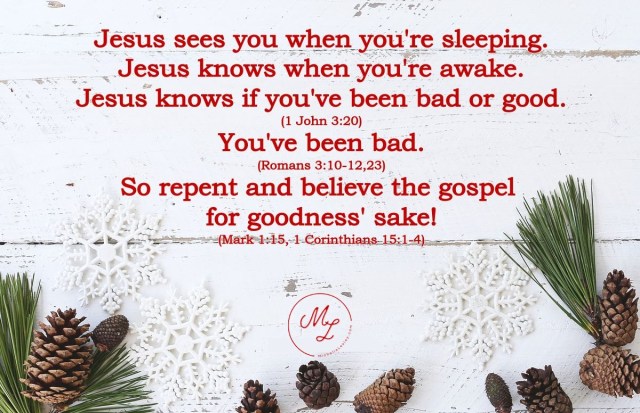
Santa Claus teaches works righteousness. In St. Nick’s economy, good behavior earns a reward (presents). Bad behavior earns punishment (coal). If you’ve ever shared the gospel with anybody, that will probably sound familiar. Most lost people think that’s what Christianity is. If you’re a “good person” God is happy with you and you’ll go to Heaven. Hell is the punishment for “bad people”: Hitler, murderers, and rapists. This is not what the Bible teaches, either about salvation, or about why children should obey their parents.

Teach your children the gospel.ย Again, this whole “naughty or nice” part of the Santa Claus narrative is a perfect gospel-teaching opportunity. Take advantage of it! Ask your child to be “nice” for one whole day. At bed time, take a few minutes to talk about the times she messed up and was “naughty” when she was supposed to be trying to be “nice.” Nobody can be nice and obedient all the time, no matter how hard we try. We areย all naughty – sinners with coal black hearts deserving the punishment of Hell. Jesus came and lived a life ofย perfectย “niceness” (obedience), died on the cross to take the punishment for our naughtiness, was buried, and rose again. He did that, not because we earned it with good behavior, but because of His mercy and grace. And then He gave us the greatest gift ever. A gift we naughty people don’t deserve: salvation and eternal life in Heaven. And it is because of our love and gratitude to Christ for saving us that we obey Him, not so that He will give us what we want. Indeed, the Bible tells us that the more obedient to Christ we are, the more persecution we will face.

Santa Claus doesn’t automatically have to be on the Christian parent’s naughty list. There are lots of ways to enjoy the fun of Santa and even turn him into an opportunity to teach your child biblical truth, all while being obedient to Scripture. But if Santa makes you biblically uncomfortable in some way, then by all means, don’t go against your conscience. Whichever way you decide – after prayer, study of the Scriptures, and discussing it with your spouse – do not judge other Christian parents by your personal convictions about Santa Claus.

Any advice for grandparents about Santa? Our son wants our grandchildren to believe in Santa. How do we respond to a grandchild who asks of the reality of Santa? I will not lie, but I want to keep peace with my son.

Thank you for being a godly grandma!

I think the solution to this dilemma is going to start with being a godly mom. Is your son a Believer? If so, you might want to show him all of the information above and talk to him about any Scriptures he’s violating. Let’s pray that will be convicting to him and he’ll decide to handle Santa in a godly way with your grandchildren.

But if he’s not convinced, or if he’s not a Believer, talk to him about your convictions about not lying to his children. Explain the difficult position he’s putting you in. He’s essentially asking you to choose between pleasing him by sinning (lying) or pleasing God by not sinning.

If he still won’t relent, the only solution I can see that keeps you from sinning yet doesn’t go against your son’s wishes is to put it back on him. When your grandchild comes to you and asks, “Grandma, is Santa Claus real?” you reply, “That’s a great question, but I think you should ask your mom and dad about that. How about some hot chocolate?”.

Your son made this bed. You shouldn’t have to lie in it.

Additional Resources:

Santa Pause with Justin Peters at A Word Fitly Spoken


ยนSanta Claus Is Comin’ to Town. John Frederick Coots and Haven Gillespie, 1934.

If you have a question about: a Bible passage, an aspect of theology, a current issue in Christianity, or how to biblically handle a family, life, or church situation, comment below (Iโ€™ll hold all questions in queue {unpublished} for a future edition of The Mailbag) or send me an e-mail or private message. If your question is chosen for publication, your anonymity will be protected.

Holidays (Other), Mailbag, Thanks/Thanksgiving

The Mailbag: Teaching Children Gratefulness

Do you know of any Biblically sound books that will help teach a 3 yr old how to have a grateful heart? My daughter is trying to cultivate that in my 3 yr old grandson.

Awww, how sweet! What a blessing that he has a godly mommy and Grammy (or Mimi or Mamaw or…).

My youngest child is 18 so I’m not familiar with whatever is currently popular and available, although I’m sure there are some good, doctrinally sound children’s books out there. (Readers, if you have any suggestions, let this sister know in the comments.)

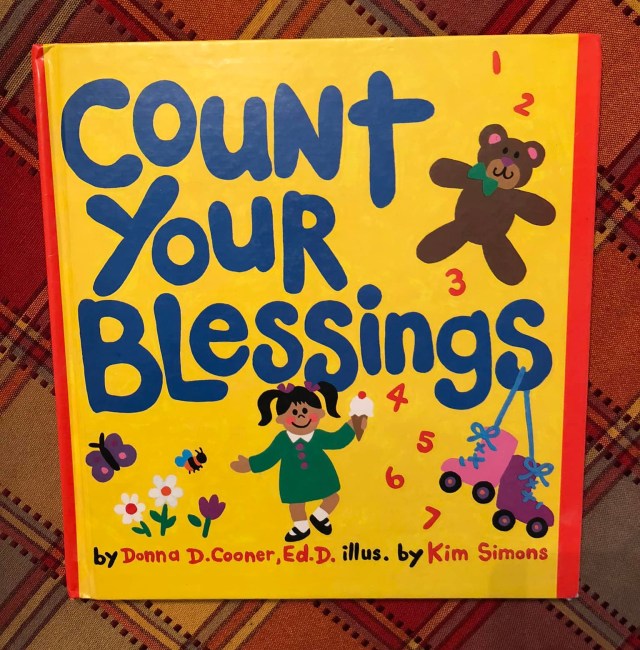
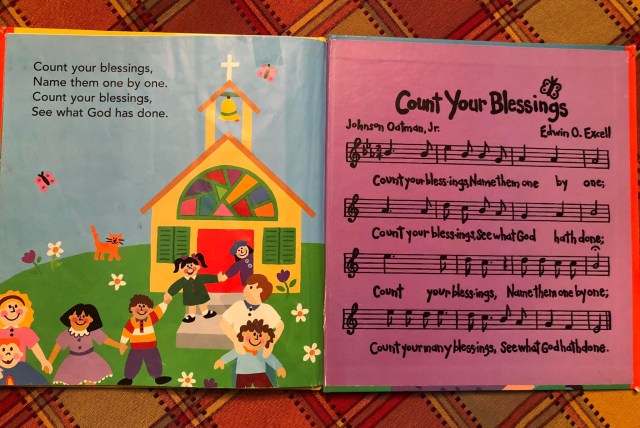
But if you’ll indulge me a trip down memory lane to wallow in sentimentality for just a moment, this was my daughter’s favorite book when she was a toddler (and all her little brothers loved it too!). It combines counting skills, thankfulness, and a hymn – pretty great, if you ask me!

Count Your Blessings by Donna D. Cooner, 1995

Now, it’s just sitting in my closet waiting for my grandchildren to enjoy it…โค

If you decide to buy some toddler books on gratitude, I would just caution you to vet the authors of any book you’re considering just like you would vet the author of a book for adults. There are many false teachersPriscilla Shirer, Sarah Young, and Sheila Walsh just to name a few off the top of my head – who have branched out into writing children’s books.

But honestly, I think this is a great opportunity for you and your daughter to start teaching your grandson the Bible, Scripture memory, and prayer as it relates to being grateful to God.

This is a great opportunity to start teaching your child the Bible, Scripture memory, and prayer as it relates to being grateful to God.

Read some stories about people in the Bible who were thankful – the thankful leper, Zacchaeus, Noah, Daniel, rebuilding the temple…really any story in which God acts, provides, or protects and people thank Him for it – and ask a few simple questions.

  • What did the main character in the story need or ask God for? What did God do?
  • What did the main character say or do when God acted, provided, or protected?
  • Has God ever acted, provided for, or protected you like that? How can we tell Him thank you?

Grab your concordance and look up some words and phrases like “give thanks“. Find a simple verse(s), talk about what it means, and practice saying it together. You might be surprised at just how quickly he can memorize those verses! The Bible verse memes in my article Top 10 Bible Verses on Giving Thanks are perfect for printing out or copying to your phone or tablet for this.

Another way to reinforce giving thanks to God is through music. You may find something helpful at Seeds Kids Worship, or just create your own playlist on your favorite music platform.

One way I helped my children remember to be thankful (and let me tell you, it didn’t just help my children!) was with a simple little game I called The Gratitude Game. Itโ€™s kind of like playing โ€œI Spy.โ€ Just look out the window when you’re driving around in the car, or look around as you’re taking a walk, and take turns thanking God for what you see: โ€œThank You, God, for making birds.โ€ โ€œThank You for ice cream.โ€ โ€œThank You for police officers who help us.โ€

Be sure to model thankfulness, too. When you or your daughter say bedtime prayers or the blessing before meals with your grandson, be sure to spend some time thanking God for things and acknowledging Him as provider, protector, the Giver of blessings, and so on. Remark thankfully on various things throughout the day: “I’m so thankful God gave us a warm day to play outside,” “Thank you, God, for sending the ice cream truck our way!” Also make sure you’re showing gratitude to people. Set the example for your grandson of saying “Thank you,” sending thank you notes or gifts, and demonstrating appreciation for others.

Books can be fun and helpful, and I hope you find a good one for your little sweetie, but you can’t beat stories and activities that center on Scripture itself.

When it comes to teaching your little ones gratitude, you can’t beat stories and activities that center on Scripture itself.


If you have a question about: a Bible passage, an aspect of theology, a current issue in Christianity, or how to biblically handle a family, life, or church situation, comment below (Iโ€™ll hold all questions in queue {unpublished} for a future edition of The Mailbag) or send me an e-mail or private message. If your question is chosen for publication, your anonymity will be protected.
Holidays (Other), Mailbag

The Mailbag: Halloween vs. Yoga?

I read your article Should Christians Participate in Halloween? and I am hoping to get a point cleared up in my head. I donโ€™t want to be legalistic, and hope not to come across that way. I am just very confused about it. I agree with you on every other theological point. But I donโ€™t see this as [adiaphora] in the same way I donโ€™t see practicing yoga as [adiaphora]. I asked you this same question last year and did not get a reply. Maybe I asked in an offensive way. Honestly want clarity on this issue. How is partaking in any way with a pagan practice any different than practicing yoga? Thanks in advance.

This is a really great question. I appreciate how you’re thinking this through and wanting to be biblically consistent. I want to be biblically consistent, too, so let’s dig into this:

I asked you this same question last year and did not get a reply. Maybe I asked in an offensive way.

Let me quickly address this point of policy first. Although I don’t respond to people who come after me in an angry, argumentative, attacking way, that isn’t the only reason I don’t respond to emails, messages, comments, etc. In fact, it’s not even the main reason, because that’s a very small percentage of the correspondence I receive. So it’s very unlikely that’s the reason I didn’t respond to your question. (I apologize, but I don’t remember receiving the question.)

The main reason I don’t respond to most of the correspondence I receive is that I simply don’t have time. If you’d like a longer explanation about that, click here.

How is partaking in any way with a pagan practice any different than practicing yoga?

It isn’t. “Partaking in a pagan practice” is the reason yoga is unbiblical.

But that’s not what my Halloween article said nor what it was about. I know you actually read the article, and I really appreciate that, but a lot of people either didn’t read the article and only responded (vehemently) to the title of it, or they skipped, missed, or didn’t understand these very clear statements in the opening paragraphs:

…Halloween activities available to you that do not violate scriptural principles or your conscience or cause you to become a stumbling block to someone weaker in the faith…

Please understand that when I say [should Christians participate in?] โ€œHalloween-related activities,โ€ I am including things like handing out candy and tracts to your neighborhood trick-or-treaters, participating in your churchโ€™s trunk or treat {assuming no sin is being committed and the gospel is being shared}, etc.

The article in no way suggests that it’s OK for Christians to take part in paganism or sin. It just doesn’t. In fact, the Scriptures I quote in the article as well as my commentary on them, and all of the additional resources at the end of the article explicitly say that Christians are not to take part in those kinds of things.

But sharing the gospel with the children who come to your door, the acquaintances you talk with in your yard, the neighbors your kids trick-or-treat from, or the families who drop by your church’s candy-fest because it’s safe and non-scary is not, in any conceivable way, sinful, demonic, unChristian, celebrating Satan, or any of the other epithets that come my way every year when I run that article. And it certainly isn’t participating in paganism. How could sharing the gospel in any circumstance be demonic or any of those other things? It’s blasphemous to say such a thing.

Dear sister who sent in the question, I know you didn’t mean it that way, but please indulge me a tangent for a moment: I think some of the others who commented on the article didn’t think things through enough to realize this is what they were inadvertently saying with their broad brush remarks – that sharing the gospel in the midst of evil is itself evil.

Do we not remember that Jesus was a guest in the homes of prostitutes, tax collectors, and sinners – as evil an environment to the “Christians” of His day as Halloween is to Christians today? Do we not remember it was the Pharisees who rebuked Him for doing so and for (supposedly) defiling Himself?

Jesus didn’t defile Himself by going into those homes because He wasn’t participating in, nor approving of, any sin which took place there. He met those people where they were, called them to repentance, and planted the seeds of the gospel. And that’s exactly what many Christians do on Halloween. (And they often receive from their fellow Christians the same Pharisaical judgment Jesus received.)

And this is the crux of the answer to your question, my sister. Participating in dark, evil, pagan, or debaucherous aspects of Halloween is just as wrong as participating in yoga. How is participating in non-sinful aspects of Halloween different from participating in yoga?

Think of it this way: A kid rings your doorbell on Halloween. You hand him a tract and some candy. That tract is the good news that the celebration of death, evil, and darkness all around him is wrong and that Jesus is the light of the world and the Lord of life. You’re leveraging the good news of the gospel against the evil, pagan, and sinful aspects of Halloween. When you do yoga, you’re taking part in paganism, cooperating with it, and tacitly approving of it – not fighting against it.

I donโ€™t see [Halloween] as [adiaphora] in the same way I donโ€™t see practicing yoga as [adiaphora].

That’s good, because while participating in non-sinful aspects of Halloween, such as the aforementioned, is an issue of adiaphora (Christian liberty), participating in the pagan (Hindu) worship ritual of yoga is not, so you shouldn’t see them the same way.

All of this, of course, is not to say that you can’t avoid Halloween altogether if it makes you uncomfortable. You don’t have to take part in your church’s fall fest or hand out tracts at your door. You can go out to dinner, go to a Reformation Day worship service, go to bed early, or whatever you like. But what you can’t do is bind the consciences of your brothers and sisters in Christ who want to do something on Halloween that isn’t sinful and might even be evangelistic. You cannot unbiblically judge them by your personal convictions. And you certainly can’t call them names or question their salvation as I’ve had the misfortune of seeing some professing Christians do. You have to follow your biblically-informed conscience on issues of Christian liberty. Your brothers and sisters have to follow their own consciences. You will answer to God for your decisions. They will answer to God for theirs.

Additional Resources:

Christian Liberty at A Word Fitly Spoken

Christian Liberty with Michelle Lesleyย at Echo Zoe Radio


If you have a question about: a Bible passage, an aspect of theology, a current issue in Christianity, or how to biblically handle a family, life, or church situation, comment below (Iโ€™ll hold all questions in queue {unpublished} for a future edition of The Mailbag) or send me an e-mail or private message. If your question is chosen for publication, your anonymity will be protected.

Mailbag

The Mailbag: When is it OK to leave a church that’s begun embracing false doctrine?

Originally published September 12, 2016

The elders and pastor of my church have made it clear that they aren’t interested in my husband’s and my concerns about, among other problems, a new women’s study (by a false teacher) starting this month. He told me he would read the articles I sent him but that I was wrong. Is it OK to leave this church, and, if so, when? How long do we wait and not see change?

That’s a great question, and I’m afraid there’s no “one size fits all” answer. When a church begins slipping, biblically, and there’s a Christian in that church who’s wise and discerning enough to see it, God has put that Christian in that church to help biblically solve that problem, or at least to serve as a prophetic warning as to what God’s Word says about the issue and what will happen if the church does not correct its course.

Our very first priority in this situation is prayer. We must pray fervently for God to change the hearts of the pastors and other leaders, for wisdom to know how to best approach the problem scripturally, and for God to give us wisdom about how long to stay and when to leave. (For us married ladies, that decision ultimately falls to our husbands, so we need to be praying for them, too.)

When you’ve done what you can to help biblically solve the problem(s) and have consistently been rebuffed (and it sounds like that’s about where you and your husband are with this church), it may be time to leave. It is perfectly biblical to leave a church that is embracing false doctrine despite scriptural warnings (Titus 3:10-11, Romans 16:17-18, 2 John 9-11, 2 Corinthians 11:12-15, Mark 6:11, Matthew 7:6).

Sometimes, God will make it exceedingly clear as to when you should leave because the church will ask you to leave or, in some way, make it impossible for you to stay.

It sounds like you and your husband have tried to help this church. Just continue to pray for your church and its leadership, and for wisdom (especially for your husband) about staying or leaving. Then trust God to direct you (Proverbs 3:5-6).

If you do end up having to leave, make sure you immediately begin your search for a doctrinally sound church to attend. No church is perfect, but we need to obey God’s mandate to be faithful members of a local body of believers.

Additional Resources:

The Mailbag: How should I approach my church leaders about a false teacher theyโ€™re introducing?

The Mailbag: How to Leave a Church

Searching for a new church?


If you have a question about: a Bible passage, an aspect of theology, a current issue in Christianity, or how to biblically handle a family, life, or church situation, comment below (Iโ€™ll hold all questions in queue {unpublished} for a future edition of The Mailbag) or send me an e-mail or private message. If your question is chosen for publication, your anonymity will be protected.

Mailbag

The Mailbag: Potpourri (Christian online platforms…Home church…”I lost my temper”…Send in your pix!)

Welcome to another โ€œpotpourriโ€ edition of The Mailbag, where I give short(er) answers to several questions rather than a long answer to one question.

I like to take the opportunity in these potpourri editions to let new readers know about my comments/e-mail/messages policy. Iโ€™m not able to respond individually to most e-mails and messages, so here are some helpful hints for getting your questions answered more quickly. Remember, the search bar (at the very bottom of each page) can be a helpful tool!

Or maybe I answered your question already? Check out my article The Mailbag: Top 10 FAQs to see if your question has been answered and to get some helpful resources.


I wanted to ask your opinion on which web host would be suitable to use for an online business? I have an online store and I currently use WIX, however, I recently found out they monetarily fund and support LGBTQ events and such. I don’t want our money going to support that. I did a lot of research and prayed, but I can’t for the life of me find a provider that is conservative. I know there will most likely be things I don’t agree with with pretty much any worldly web hosting company, but where do I draw the line? Is God okay with paying a web host who uses their funds to support anti-Biblical issues? I’m convicted of continuing to use WIX and I don’t want to continue with them. I originally left ETSY for the same reason. I just don’t know where to move my website! I would need an e-commerce provider too since I sell stuff. If you don’t mind me asking, who do you use? I see your website is Word Press, but I know you need a host for that too.

(Readers, if you have any suggestions of conservative and/or Christian blog or e-commerce platforms, please leave a comment at the end of this article.)

I completely sympathize with your dilemma. I don’t like my money going to support sinful causes like perversion, abortion, liberal politics, etc., either. You’re right, I do use WordPress for the blog, but they host it themselves. I don’t have a separate host, and I don’t do e-commerce, so I’m afraid I don’t have any practical suggestions there.

You’re correct, pretty much everything you pay for, whether it’s an online platform, the gas you put in your car, your pooch’s favorite dog food, even the device you’re reading this on right now, is owned or produced by a secular company that’s donating to or financing something that’s biblically objectionable. Even most so-called “Christian” companies probably support people or ministries that aren’t doctrinally sound. In practical terms, finding a company to patronize that doesn’t contribute to something unbiblical is almost as unlikely as finding a mermaid or a unicorn.

I can’t tell you where to draw the line – that’s a conclusion you (and your husband, if you’re married) will have to come to through prayer and listening to your biblically informed conscience – with each company you consider, but I think you may find some of the principles in my article The Mailbag: Should Christians Participate in Boycotts? to be helpful.

“Is God okay with paying a web host who uses their funds to support anti-Biblical issues?” Well, consider this – It’s not precisely the same thing as buying a product or service from a private company, but Jesus paid the temple tax, and we know from His clearing of the temple, His many rebukes of the scribes and Pharisees, and the fact that the temple leadership had Jesus crucified that He was well aware of the evil that tax money ended up supporting. And when the Pharisees asked Jesus, “Is it lawful to pay taxes to Caesar or not?” while their motive was to trap Jesus, the basis of this particular question they chose was probably similar to the basis of your question (not saying you’re a Pharisee – please don’t misunderstand): “Should God’s people give money to a pagan who does ungodly things?”. And Jesus’ answer was that they should pay their taxes. Like I said, it’s not exactly the same thing because taxes are an obligation and blog platforms are not, but it is something to study and consider.

Pray about it, trust God to guide you, and don’t sin against your conscience. You may also want to take a look at the principles for decision-making in my article Basic Training: 8 Steps to Finding Godโ€™s Will for Your Life.


My husband and I live in Canada. When the government placed our small town under lockdown due to COVID, not one church here remained open. Now that things have opened back up slightly, we are hesitant to join ourselves to a church that might, at any given time, close their doors at the whim of our government officials. Additionally, there are very few churches in our area and we have doctrinal concerns about all of them. But this leaves us without a church home.

We have started meeting together on the Lord’s Day with nearly 30 other like-minded brothers and sisters. We fervently seek the Lordโ€™s wisdom and guidance and do not want to be disobedient in any way. We want to please the Lord in our worship together. My husband and I never conceived of starting a church, we just wanted to obey our Lord in continuing to gather as the church body when the โ€œchurch institutionโ€ failed us. Iโ€™m desperate for guidance and have no idea where to turn to for help.

Well, sister, I’ve got good news for you. You do have a church home. You have a home church church home. When the church started out in the book of Acts, it existed in the form of groups of like-minded believers who met together in homes, often in secret, hiding from a persecutory government. The church is not the building, but the body of Believers meeting together in person for the study and preaching of the Word, baptism, the Lord’s Supper, prayer, worship, fellowship, and practicing the “one anothers”. In many parts of the world home churches are still the normal expression of the church due to persecution, and as persecution continues to increase, so will the underground church.

I’ve never started a church either, but let me see if I can point you to some resources that can help:

First, go to the Searching for a new church? tab in the blue menu bar at the top of this page. Next:

  • Carefully comb through every single church search engine listed there to make absolutely sure you haven’t overlooked a doctrinally sound, established church within achievable driving distance of your house. (Home churches can be very susceptible to false doctrine, so you want to make every effort to join yourself to an established, doctrinally sound church if at all possible.)
  • If there simply does not exist an established, doctrinally sound church you can get to (even if it may not be terribly convenient) each week, scroll down to the “Church Planting” section, get in touch with Grace Advance, explain your situation, and ask them for help. Church planting is what they do, and I’m certain they can give you better guidance than I can.
  • As you’re going through this process of getting in touch with Grace Advance and following their counsel, read through all of the information under What to look for in a church (especially the links in the second paragraph of Six Questions for a Potential Church), so the men leading your home church understand, and perhaps can begin codifying a doctrinal statement on these issues for your home church. It may also be helpful to visit the websites of churches you know to be doctrinally sound and read through their statements of faith (sometimes called “doctrinal distinctives,” “what we believe,” “what we teach,” “constitution and by-laws,” etc.).

May God richly bless you and your church.


I recently lost my temper with a store employee and made a scene over something very stupid. It is a large corporate store and not one I frequent often, but this young woman is most likely from my surrounding area, and thus, I feel like I did not treat a neighbor well. I have prayed and asked God to forgive me for shaming His name and for treating another person badly for something that was not her fault. What else can I do? I feel terrible. I let my emotions overcome me, and it was completely unbecoming of a Christian woman.

Wow, praise God.

No, seriously…this is something to praise God for. Praise God that He convicted you of this sin. That’s one of the evidences that you’re a Believer and that the Holy Spirit is working in your life. Praise God that your heart is tender to that conviction and you want to do what’s pleasing to Him. Another evidence that you’re a Believer. Praise God that through Christ’s sacrifice on the cross, He has indeed forgiven you for this sin and you stand righteous before Him. (You do need to accept and believe His forgiveness if that’s part of the reason you’re still feeling terrible.)

I would suggest you go back to the store, locate the employee, repent to her and ask her forgiveness. I would also suggest taking a small “peace offering,” like a gift card to a local coffee shop or maybe a batch of brownies you’ve made. You could also include a tract or a small gospel booklet. Frame your apology to her in a gospel-centered way, and, hopefully, this will turn into a witnessing encounter.


This last one isn’t a question submitted by a reader, but rather a request from me! :0)

If you or your women’s Bible study group are working through one of my Bible studies, I’d love it if you’d send me a picture of yourself or the group studying or discussing it. And if you could somehow include the title image for the study (see below) in the picture – maybe with everybody gathered around the image on a screen, or everybody holding it up on their phones, or print out a copy of the image and hold it up, or something like that – that would be fantastic. (These pictures will probably be shared on my blog and/or social media, so make sure everybody in the picture is OK with that.)

You can email the pictures to me here.

These are the title images from some of my studies. You can find them at the top of each lesson:

You can always find all of my Bible studies at the Bible studies tab in the blue menu bar at the top of this page.

Thank you!


If you have a question about: a Bible passage, an aspect of theology, a current issue in Christianity, or how to biblically handle a family, life, or church situation, comment below (Iโ€™ll hold all questions in queue {unpublished} for a future edition of The Mailbag) or send me an e-mail or private message. If your question is chosen for publication, your anonymity will be protected.