Holidays (Other), Marriage

Throwback Thursday ~ My Husband Brought Me Flowers Today

Originally published June 27, 2014

โ€œIโ€™m so tired of flowers,โ€ sighed the elderly woman in the TV commercial as my jaw hit the floor. She had just described how her husband of fifty years, seated next to her, brought her flowers on their first date, and every year since had given her the same bouquet on that day.

And she was tired of flowers.

It wasnโ€™t enough that she had a husband who stayed with her for fifty years. Or that he actually remembered the day of their first date every year. Or that he was caring enough to send her flowers on that date. Or that he was sentimental and romantic enough to send her the same flowers every year.

No. She was tired of flowers. She wanted the product the commercial was trying to sell.

I wanted a shoe to throw at the TV.

My husband brought me flowers today. I know, in the picture they look rather more like birthday candles than flowers. Thatโ€™s because, technically, my flowers were birthday candles.

I was getting ready for our youngest sonโ€™s birthday party. I had already made a trip to the store and thought I had everything I needed. Until I discovered I was nearly out of baking powder. My husband was out running errands, so I sent him a text asking if he could pick some up for me. He did. No problem. Until I remembered I didnโ€™t have any candles for the birthday cake. And he had already left the store. And it was raining.

โ€œAnd it was raining.โ€ I say that like itโ€™s just so pedestrian, like itโ€™s some normal, everyday thing, which, in south Louisiana in June, I assure you, it is not. Every day, yes. Normal, no. Remember that scene in one of those โ€™90โ€™s โ€œasteroid crashes into the earthโ€ movies where the asteroid has just hit and the man and his daughter are standing on the beach watching the huge resulting tidal wave roll in to engulf them? Well if, instead of the beach, you can imagine yourself trying to navigate a WalMart parking lot with a buggy full of groceries and four kids in tow in the middle of that tidal wave, youโ€™ll have some idea of what monsoon season is like down here.

And you know what my husband did when I asked him to go get birthday candles in that mess? He did it gladly. No complaints. No asking, โ€œWhy didnโ€™t you think about this sooner?โ€ He just walked in the house, soaked and smiling, and handed me the candles.

No bouquet could have been better.

Ladies, my husband has a lot of faults. Iโ€™ll bet yours does too. Because just like us, theyโ€™re sinful human beings. Often, like the lady in the commercial, we trample over a dozen roses to plant our feet in a briar patch. We overlook the ways our husbands are a blessing to us and focus only on our complaints.

Maybe he didnโ€™t get you exactly what you wanted for your birthday, but does he work hard every day to support your family? So, he didnโ€™t notice your new haircut right away. Does he give the kids their bath every night? Yes, his dirty socks are constantly on the floor in front of the hamper, but didnโ€™t he change the oil in the car yesterday?

1 Thessalonians 5:16-18 says:

Rejoice always, pray without ceasing, give thanks in all circumstances; for this is the will of God in Christ Jesus for you.

The next time youโ€™re tempted to complain about your husbandโ€™s shortcomings, why not praise God instead for a way that he has blessed you or done something admriable? And letโ€™s make sure to thank our husbands for those little โ€œflowersโ€ they bring us every day.


This article was originally published at Satisfaction Through Christ.
Celebrity Pastors, Holidays (Other), New Year's

Bonus “Razz-olutions”

I know, I know – it’s January 4. Time to get back to real life after the holidays, right? But it’s so hard to let go and leave that festive and fun time of the year behind! So, yes, this is another New Years-y related post, but after today, I promise to mothball all the holiday stuff until next year. Scout’s honor. (In the interest of full disclosure, you should know I was never a Scout. :0)

Last week, Amy and I released the AWFS’s Evangelical Resolutions Wish List episode of A Word Fitly Spoken. Did you get a chance to listen yet? If not, I’d recommend you fire up the old podcast machine (or just click the link on the title above) and give it a listen, because a) what follows won’t make as much sense if you don’t, and b) we chose the best resolutions for the podcast episode. Trust me, you’re going to kick yourself if you don’t listen.

(And for those who are already getting a little squinchy at the idea of Christians occasionally engaging in fun and frolic, we addressed that – from Scripture – right off the bat. So no complainies on that aspect of the episode or this post, please.)

Caroline Stanbury Ladies Of London GIF - Caroline Stanbury Ladies Of London Unicorn GIFs

The basic idea is that we made up a list of New Year’s resolutions (some of which were more akin to “razz-olutions”) we wish various evangelical celebrities – the good, the bad, and the ugly (from our favorite doctrinally sound teachers all the way down to heretics) – would make.

Here are the leftovers that didn’t make the cut for the episode. The junk on the cutting room floor, so to speak…

We wish Steven Furtick would resolve to stop wearing tight pants. It’s cutting off the circulation to the portion of his brain that might otherwise be able to comprehend sound doctrine. Or…you know…like…any verse of Scripture at all.

We wish Bethel would resolve to stop putting gold glitter in their air ducts. That ain’t a manifestation of the Holy Spirit, y’all. It’s 25 bucks and a trip to Hobby Lobby.

We wish somebody would resolve to lock Ed Litton in a room with only a pencil, paper, and a Bible, and challenge him to write an original sermon. If we weren’t all good Baptists, we’d be taking bets as to whether or not he could. The smart money is on “not”.

We wish Beth Moore would resolve to go home. I mean, on her Instagram it seems like she enjoys cooking and gardening…that’s a good start, right?

We wish Benny Hinn would resolve to get a new suit. Or maybe a sweater vest. Or even a windbreaker. Maybe Ed Young, Jr. can help him.

We wish Gloria Copeland would resolve to prevent just one devastating storm this year. You don’t see “weather controllers” preventing devastating storms for the same reason you don’t see “faith healers” emptying out hospitals. Oops, did I just double dip on some of those heretics?

We wish Todd Friel would resolve to come out of his shell a little. He’s just so staid and passive. Get a little life in ye, me good man!

We wish Chris Rosebrough would resolve to make a heretic walk the plank. The crocs are hungry, Cap’n.

We wish contemporary “Christian” artists would resolve to stop looking like theyโ€™re passing a kidney stone when theyโ€™re singing. Is praising the Lord really this painful? Well…maybe…if you’re praising the lord of the flies.

We wish Todd White would resolve to get a haircut. My head and neck hurt just thinking how heavy that mass of hair must be. You’re not Samson, dude.

We wish James White would resolve to stop wearing seizure-inducing sweaters. And, great googly moogly, the dear brother lives in Phoenix! It’s like wearing sweaters on the surface of the sun!

Got a resolution you’d like to make for an evangelical celebrity? Make it lighthearted and pithy – not mean-spirited – and share it in the comments below.
I’ll pick my favorite and add it to this article.
(Bonus points if yours is funnier than mine were
– and that’s a pretty low bar!)


Photo Credits: I did not take any of these photos. I am not claiming credit for any of these photos. I am not making money off any of these photos. If you are the photographer of one of these images and want credit, let me know, and I’ll credit you. If you aren’t the photographer and want to know who is, click here.

Holidays (Other), Mailbag, Thanks/Thanksgiving

The Mailbag: Teaching Children Gratefulness

Do you know of any Biblically sound books that will help teach a 3 yr old how to have a grateful heart? My daughter is trying to cultivate that in my 3 yr old grandson.

Awww, how sweet! What a blessing that he has a godly mommy and Grammy (or Mimi or Mamaw or…).

My youngest child is 18 so I’m not familiar with whatever is currently popular and available, although I’m sure there are some good, doctrinally sound children’s books out there. (Readers, if you have any suggestions, let this sister know in the comments.)

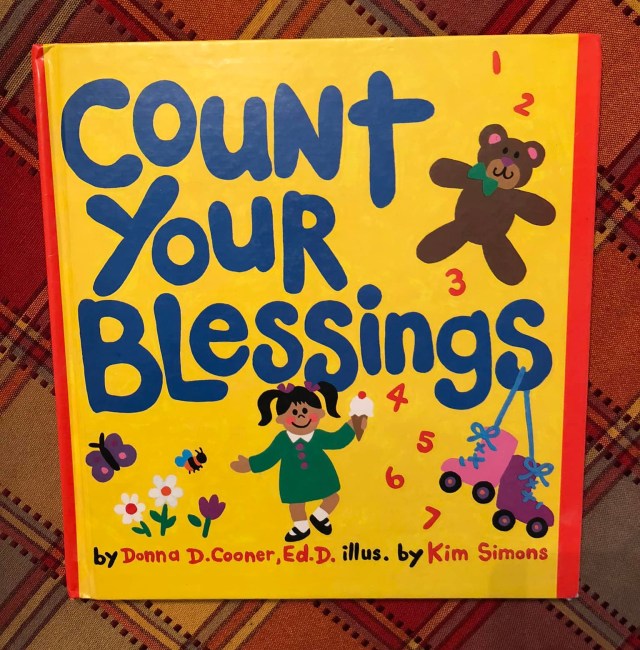
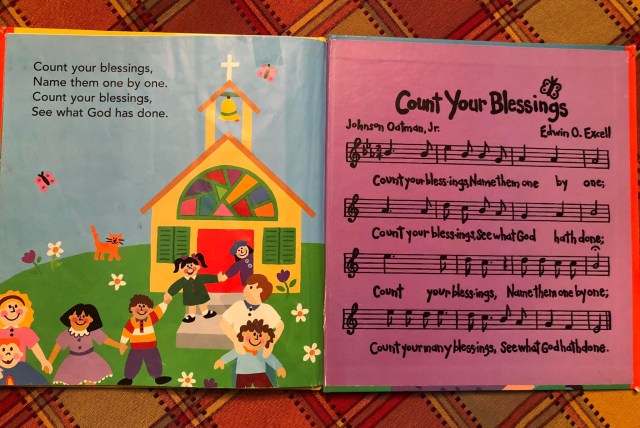
But if you’ll indulge me a trip down memory lane to wallow in sentimentality for just a moment, this was my daughter’s favorite book when she was a toddler (and all her little brothers loved it too!). It combines counting skills, thankfulness, and a hymn – pretty great, if you ask me!

Count Your Blessings by Donna D. Cooner, 1995

Now, it’s just sitting in my closet waiting for my grandchildren to enjoy it…โค

If you decide to buy some toddler books on gratitude, I would just caution you to vet the authors of any book you’re considering just like you would vet the author of a book for adults. There are many false teachers – Priscilla Shirer, Sarah Young, and Sheila Walsh just to name a few off the top of my head – who have branched out into writing children’s books.

But honestly, I think this is a great opportunity for you and your daughter to start teaching your grandson the Bible, Scripture memory, and prayer as it relates to being grateful to God.
This is a great opportunity to start teaching your child the Bible, Scripture memory, and prayer as it relates to being grateful to God.

Read some stories about people in the Bible who were thankful – the thankful leper, Zacchaeus, Noah, Daniel, rebuilding the temple…really any story in which God acts, provides, or protects and people thank Him for it – and ask a few simple questions.

  • What did the main character in the story need or ask God for? What did God do?
  • What did the main character say or do when God acted, provided, or protected?
  • Has God ever acted, provided for, or protected you like that? How can we tell Him thank you?

Grab your concordance and look up some words and phrases like “give thanks“. Find a simple verse(s), talk about what it means, and practice saying it together. You might be surprised at just how quickly he can memorize those verses! The Bible verse memes in my article Top 10 Bible Verses on Giving Thanks are perfect for printing out or copying to your phone or tablet for this.

Another way to reinforce giving thanks to God is through music. You may find something helpful at Seeds Kids Worship, or just create your own playlist on your favorite music platform.

One way I helped my children remember to be thankful (and let me tell you, it didn’t just help my children!) was with a simple little game I called The Gratitude Game. Itโ€™s kind of like playing โ€œI Spy.โ€ Just look out the window when you’re driving around in the car, or look around as you’re taking a walk, and take turns thanking God for what you see: โ€œThank You, God, for making birds.โ€ โ€œThank You for ice cream.โ€ โ€œThank You for police officers who help us.โ€

Be sure to model thankfulness, too. When you or your daughter say bedtime prayers or the blessing before meals with your grandson, be sure to spend some time thanking God for things and acknowledging Him as provider, protector, the Giver of blessings, and so on. Remark thankfully on various things throughout the day: “I’m so thankful God gave us a warm day to play outside,” “Thank you, God, for sending the ice cream truck our way!” Also make sure you’re showing gratitude to people. Set the example for your grandson of saying “Thank you,” sending thank you notes or gifts, and demonstrating appreciation for others.

Books can be fun and helpful, and I hope you find a good one for your little sweetie, but you can’t beat stories and activities that center on Scripture itself.

When it comes to teaching your little ones gratitude, you can’t beat stories and activities that center on Scripture itself.


If you have a question about: a Bible passage, an aspect of theology, a current issue in Christianity, or how to biblically handle a family, life, or church situation, comment below (Iโ€™ll hold all questions in queue {unpublished} for a future edition of The Mailbag) or send me an e-mail or private message. If your question is chosen for publication, your anonymity will be protected.

Holidays (Other), Mailbag

The Mailbag: Halloween vs. Yoga?

I read your article Should Christians Participate in Halloween? and I am hoping to get a point cleared up in my head. I donโ€™t want to be legalistic, and hope not to come across that way. I am just very confused about it. I agree with you on every other theological point. But I donโ€™t see this as [adiaphora] in the same way I donโ€™t see practicing yoga as [adiaphora]. I asked you this same question last year and did not get a reply. Maybe I asked in an offensive way. Honestly want clarity on this issue. How is partaking in any way with a pagan practice any different than practicing yoga? Thanks in advance.

This is a really great question. I appreciate how you’re thinking this through and wanting to be biblically consistent. I want to be biblically consistent, too, so let’s dig into this:

I asked you this same question last year and did not get a reply. Maybe I asked in an offensive way.

Let me quickly address this point of policy first. Although I don’t respond to people who come after me in an angry, argumentative, attacking way, that isn’t the only reason I don’t respond to emails, messages, comments, etc. In fact, it’s not even the main reason, because that’s a very small percentage of the correspondence I receive. So it’s very unlikely that’s the reason I didn’t respond to your question. (I apologize, but I don’t remember receiving the question.)

The main reason I don’t respond to most of the correspondence I receive is that I simply don’t have time. If you’d like a longer explanation about that, click here.

How is partaking in any way with a pagan practice any different than practicing yoga?

It isn’t. “Partaking in a pagan practice” is the reason yoga is unbiblical.

But that’s not what my Halloween article said nor what it was about. I know you actually read the article, and I really appreciate that, but a lot of people either didn’t read the article and only responded (vehemently) to the title of it, or they skipped, missed, or didn’t understand these very clear statements in the opening paragraphs:

…Halloween activities available to you that do not violate scriptural principles or your conscience or cause you to become a stumbling block to someone weaker in the faith…

Please understand that when I say [should Christians participate in?] โ€œHalloween-related activities,โ€ I am including things like handing out candy and tracts to your neighborhood trick-or-treaters, participating in your churchโ€™s trunk or treat {assuming no sin is being committed and the gospel is being shared}, etc.

The article in no way suggests that it’s OK for Christians to take part in paganism or sin. It just doesn’t. In fact, the Scriptures I quote in the article as well as my commentary on them, and all of the additional resources at the end of the article explicitly say that Christians are not to take part in those kinds of things.

But sharing the gospel with the children who come to your door, the acquaintances you talk with in your yard, the neighbors your kids trick-or-treat from, or the families who drop by your church’s candy-fest because it’s safe and non-scary is not, in any conceivable way, sinful, demonic, unChristian, celebrating Satan, or any of the other epithets that come my way every year when I run that article. And it certainly isn’t participating in paganism. How could sharing the gospel in any circumstance be demonic or any of those other things? It’s blasphemous to say such a thing.

Dear sister who sent in the question, I know you didn’t mean it that way, but please indulge me a tangent for a moment: I think some of the others who commented on the article didn’t think things through enough to realize this is what they were inadvertently saying with their broad brush remarks – that sharing the gospel in the midst of evil is itself evil.

Do we not remember that Jesus was a guest in the homes of prostitutes, tax collectors, and sinners – as evil an environment to the “Christians” of His day as Halloween is to Christians today? Do we not remember it was the Pharisees who rebuked Him for doing so and for (supposedly) defiling Himself?

Jesus didn’t defile Himself by going into those homes because He wasn’t participating in, nor approving of, any sin which took place there. He met those people where they were, called them to repentance, and planted the seeds of the gospel. And that’s exactly what many Christians do on Halloween. (And they often receive from their fellow Christians the same Pharisaical judgment Jesus received.)

And this is the crux of the answer to your question, my sister. Participating in dark, evil, pagan, or debaucherous aspects of Halloween is just as wrong as participating in yoga. How is participating in non-sinful aspects of Halloween different from participating in yoga?

Think of it this way: A kid rings your doorbell on Halloween. You hand him a tract and some candy. That tract is the good news that the celebration of death, evil, and darkness all around him is wrong and that Jesus is the light of the world and the Lord of life. You’re leveraging the good news of the gospel against the evil, pagan, and sinful aspects of Halloween. When you do yoga, you’re taking part in paganism, cooperating with it, and tacitly approving of it – not fighting against it.

I donโ€™t see [Halloween] as [adiaphora] in the same way I donโ€™t see practicing yoga as [adiaphora].

That’s good, because while participating in non-sinful aspects of Halloween, such as the aforementioned, is an issue of adiaphora (Christian liberty), participating in the pagan (Hindu) worship ritual of yoga is not, so you shouldn’t see them the same way.

All of this, of course, is not to say that you can’t avoid Halloween altogether if it makes you uncomfortable. You don’t have to take part in your church’s fall fest or hand out tracts at your door. You can go out to dinner, go to a Reformation Day worship service, go to bed early, or whatever you like. But what you can’t do is bind the consciences of your brothers and sisters in Christ who want to do something on Halloween that isn’t sinful and might even be evangelistic. You cannot unbiblically judge them by your personal convictions. And you certainly can’t call them names or question their salvation as I’ve had the misfortune of seeing some professing Christians do. You have to follow your biblically-informed conscience on issues of Christian liberty. Your brothers and sisters have to follow their own consciences. You will answer to God for your decisions. They will answer to God for theirs.

Additional Resources:

Christian Liberty at A Word Fitly Spoken

Christian Liberty with Michelle Lesleyย at Echo Zoe Radio


If you have a question about: a Bible passage, an aspect of theology, a current issue in Christianity, or how to biblically handle a family, life, or church situation, comment below (Iโ€™ll hold all questions in queue {unpublished} for a future edition of The Mailbag) or send me an e-mail or private message. If your question is chosen for publication, your anonymity will be protected.

Church, Holidays (Other), Worship

7 Ways to Honor Mothers During Your Mother’s Day Worship Service

Mother’s Day is just around the corner.

It’s nice to have a day set aside to recognize moms, be thankful for them, and appreciate them for all their hard work and everything they’ve done for us.

And if there’s anywhere motherhood should be honored, it’s in the church. Over and over, the Bible teaches us that motherhood is a high calling. A sacred trust. A solemn responsibility. No woman should ever be made to feel that she’s “just” a wife and mother. That’s the world’s perspective, not God’s.

So, pastors and women’s ministry leaders, how can the church best honor moms during the Mother’s Day worship service? Here are seven ways…

1.
Don’t

2.
No, seriously…don’t.

Yes, you read that right. Don’t make the sermon, songs, and prayers all about motherhood, and don’t do the typical “honoring of the mothers” hoo-hah that has become traditional in many churches during the Sunday worship service that coincides with Mother’s Day:

  • “Will all of our mothers please stand?” Congregation applauds. Sometimes a flower or other small gift is handed out to all the mothers standing.
  • Honoring of the youngest mother, or mother with the youngest baby present (“newest mother”) with a flower, gift, or corsage
  • Honoring of the oldest mother (strangely, I’ve never seen the mother with the oldest child present honored) with a flower, gift, or corsage
  • Honoring of the mother with the most children (or most children present) with a flower, gift, or corsage

Why? Because, though it might not be visible on the surface, when you do this, you open a Pandora’s Box of thoughts and emotions. And not all of those are godly or happy thoughts and emotions.

When you take people’s focus off worshiping God and put it on honoring people, what they’re going to be thinking about is their feelings toward the people being honored, and their feelings about themselves:

“That woman is the meanest old biddy in the church. She shouldn’t be getting honored for anything.”

“I have more children than she does, but some of mine live out of state. It’s not fair that she gets the corsage just because she guilted all of her kids – who don’t even go to church – into showing up today.”

“Us single women never get honored for anything.”

“I’d give anything to have a baby. Why them and not me, Lord?”

“This is excruciatingly embarrassing. Thanks for reminding me and the entire congregation that the reason I’m the youngest mother here is because I sinfully gave up my virginity at 14.”

Keep people focused on Jesus during the worship service. That’s where their focus is supposed to be anyway, and as an added bonus, you’ll avoid stirring up all of those often-ungodly thoughts and feelings.

3.
And especially don’t…

…do this thing that some churches have started doing of honoring all women on Mother’s Day. You think what you’re doing is preventing anybody’s feelings from getting hurt, but in many cases, you’re just pouring salt in the wound:

“Sorry you’ve been going through the agony of infertility for ten years. Here’s a piece of Christian kitsch for a consolation prize.”

“Here’s a carnation to highlight the fact that not only do you not have children, you’re in your forties and are still waiting for Mr. Right.”

“So you’re getting puked on, and pulled at, and you’re dealing with colic and temper tantrums and potty training every day, and your family budget is decimated and you’re operating on about three hours of sleep a night and you can’t even get five minutes alone in the bathroom? We’re going to take the woman sitting next to you who put her career first, has power, prestige, and position in the world, plenty of money in the bank, and all the “me time” she wants, and we’re going to honor her the same way we’re honoring you.”

That’s not how kind and loving churches mean it to come across, of course, but that’s how it can feel to the women being “honored,” nonetheless.

About thirty or so years ago, some well meaning person in kids’ sports came up with the idea of every team – win or lose, and every kid on every team- super jock or perpetual ball-dropper, getting a trophy at the end of the season so nobody’s feelings would get hurt.

It didn’t work. Those kids knew which teams had won the most games and lost the most games. They knew who the best players were and who always got sent out into deep, deep, deep right field (like I did). They knew who had earned the trophies and who had not. And when everybody got a trophy at the end of the season, it was a meaningless prize for the winners and feelings of shame for an undeserved award for the losers.

The women in your church know it’s Mother’s Day – a day for honoring mothers. And they know whether or not they are mothers and whether or not they’ve “earned,” so to speak, or qualified, for the honor you’re giving them.

If you really don’t want to hurt the feelings of women who aren’t mothers, keep everybody’s focus on Christ and His Word instead of on Mother’s Day.

4.
And along those same lines, don’t…

…reinforce narcissistic navel-gazing – the “it’s all about me and my feelings of worth / loss / sadness / fulfillment” that they’re already being fed by the truckload by the world and by pop-women’s “Bible” study.

Many women are already living life being led around by their noses by their feelings. They wear their feelings on their sleeves. They’re easily offended. They lash out at anyone who even inadvertently hurts their feelings. They demand that the sharp corners of the world be padded so their feelings won’t be hurt.

And if you’re doing the “honor all women” thing on Mother’s Day, I know you don’t mean to, but you’re subtly reinforcing that outlook and coddling any feelings of bitterness, discontentment, resentment, entitlement, and anger that are silently flying around the room. (“Please don’t freak out because the mothers all got a flower and you didn’t. Here, you can have a flower too.”)

Yes, the pain in the heart of a woman who has lost a child, has wayward children, has lost a mother, had an abusive mother, has been unable to conceive, or desperately wants to be married is deep and real. And it is absolutely and inarguably incumbent upon us as compassionate, caring, kind, and merciful followers of Christ to weep with those who weep in the midst of suffering.

But God also requires us to draw upon His strength, look past our own pain, and rejoice with those who rejoice. Just as it is good and right to comfort a friend whoโ€™s infertile or grieve with parents who have miscarried, it is also good and right for that friend and those parents to rejoice on Motherโ€™s Day and Fatherโ€™s Day with those whom God has chosen to bless with children, or to celebrate with loved ones who have just announced a pregnancy. We take the focus off ourselves and put it on others, just like Jesus did.1

If you really want to honor all the women in your church, counter the worldliness, fleshliness, and selfishness many of them are imbibing. Teach them – all year round – that God’s Word is their authority, not their feelings. Drill down on the golden rule. Show them how to put others first. Help them learn how to weep with those who weep and rejoice with those who rejoice.

5.
Don’t neglect…

…the ministry of the Word. What all Christians – mothers and non-mothers alike – need during the worship service is to have God’s Word proclaimed to them.

Now I know that some pastors will immediately respond, “But I’m going to be preaching the Word. I’m preaching on Naomi and Ruth / Mary / Hannah / Proverbs 31, etc.” And if you’re rightly dividing and expositing whatever that passage is, I’m not knocking that, but you’re the exception, not the rule.

Just some food for thought between you and the Lord as you consider your sermon on the Sunday of Mother’s Day…

  • Are you really rightly handling the Word, or is this basically a Hallmark homily or a sentimental eulogizing of mothers?
  • Are all of the Mother’s Day awards, songs, videos, testimonies, and so on cutting down on the sermon time so that you don’t have time to properly proclaim the Word?
  • Are you so focused on motherhood that you’re leaving out of the proclamation of God’s Word anyone who’s not a mother – men, children, childless couples, singles?
  • If your ladies aren’t yet well schooled in not being led by their feelings, and/or you’re of a mind not to hurt anyone’s feelings, is your motherhood-focused sermon going to hurt the feelings of women who aren’t mothers (and are you going to get an earful about it on Monday morning)?
  • Are your Mother’s Day and Father’s Day sermons accidentally falling into the pattern many have noted in recent years: mothers can do no wrong, and fathers can do no right, mothers are “saints,” and fathers are “sinners”?
  • If you’re typically an expository preacher and a motherhood-focused sermon deviates from the book you’re currently preaching through, are you deviating because God is leading you to do so? Or is this deviation being led by the calendar? Or by the thought that the women of your church will pitch a fit if you don’t focus on motherhood during the Mother’s Day sermon?
  • Do you realize that many doctrinally sound mothers prefer that you keep right on preaching through whatever book you’re currently in because they’re enjoying it and God is using it to grow them? I’m one of them, and I’ve heard from many others like me: “I don’t want to hear how great I am. I want to hear how great Christ is.”

6.
Don’t overlook…

…the fact that there are lots of ways and times you can honor and encourage mothers besides during the Mother’s Day worship service.

  • When you’re preaching through a book and come to a passage about mothering, go ahead lift up what the Word says about mothering. (That might sound a little contradictory to what I’ve already said, but preaching about motherhood on October 9 or July 31 is a lot less emotionally triggering than it is on Mother’s Day. Plus, there’s a good chance the passage isn’t exclusively about motherhood.)
  • Have a Mother’s Day potluck or picnic – everyone invited, of course – after the service where the dads and kids do all the set up, cooking, and clean up. (And have one for Father’s Day, too, with moms and kids serving!)
  • Host a parents’ night out from time to time to give moms a break and give husbands and wives some quality time together.
  • Make sure you’ve got Titus 2:3-5 going on, in some form, in your church. Young women need spiritual moms to lean on and to train them.
  • Make a baby cry/nursing room (with sermon piped in) and a nursery available during the worship service for those who want them, and offer children’s classes or child care whenever adult classes are offered. Also, don’t make being on the nursery rotation a requirement for moms to leave their children in the nursery.

    I know these ideas won’t be popular with some churches, but hear me out: as a young, stay at home mom with lots of small children, some weeks the only time I made it out of the house and got to talk to other adults was Sundays and Wednesdays at church. The churches I belonged to that offered a nursery and the other aforementioned amenities served, honored, appreciated, and loved me well by doing so. I needed that brief time of undistracted respite in God’s Word with God’s people to rest, recharge, and keep from losing my mind.

A quick “Happy Mother’s Day to all you moms out there!” from the pastor is no big deal, but, generally speaking, keep the focus on God during the worship service, and have fun honoring Mom some other time.

7.
And most importantly, don’t forget…

…God. A worship service isn’t (nor should it be) like any other gathering of people. At any other gathering of people, people are in charge, and people are the focus. People decide the reason for the gathering, the theme of the gathering, who or what the gathering is to center on, who’s going to run things, which materials are or aren’t appropriate for the gathering, which activities are going to take place during the gathering, and what’s going to please or displease the people who are gathering.

Not so with a worship service. God dictates all of those components and parameters in His Word, and we obediently carry them out.

The reason for the worship service is to honor God – not mothers or any others – and worship Him.

The theme of the worship service is worshiping God.

The worship service is to center on God.

The men God has appointed to the offices of pastor and elders are to run things during the worship service.

The only appropriate materials for the worship service are God’s Word and materials that focus our worship on God and His Word.

The activities that are to take place during the worship service – the proclamation of the Word, prayer, praise, singing, and giving offerings – are prescribed by God in His Word and directed to God.

And the worship service isn’t about what’s pleasing or displeasing to the people in attendance, it’s about what’s pleasing to God.

Should mothers be appreciated, even honored, by the church? Sure! But not during the time we’ve specifically set aside to honor God. And really, shouldn’t mothers and motherhood be appreciated and honored much more than one hour a year?

Happy Mother’s Day to all you moms out there!

Let’s hear from you, readers.
What’s a great way to honor moms and motherhood that keeps the
focus of the worship service on God, where it’s supposed to be?


1Excerpted from my article Safe Spaces and Wearing Our Hearts on Our Sleeves: 6 Ways to Follow Jesusโ€™ Example of Handling Hurt