Book Reviews, Guest Posts, Salvation

Guest Post: A Review of “From Death to Life: How Salvation Works”

If your theology pretty much matches up with mine (as outlined in the “Welcome” and “Statement of Faith” tabs) and you’d like to contribute a guest post, drop me an e-mail at MichelleLesley1@yahoo.com,
and let’s chat about it.
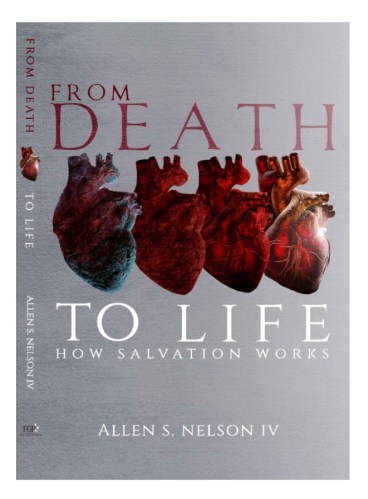
photo credit: Stephen J. Melniszyn

A Review of Allen S. Nelson IV’s
From Death to Life: How Salvation Works
by Katy B.

The most agonizing, frustrating experience in my ministry to women is the woman who claims to be “saved” but gives no evidence of it. No interest in talking about Jesus, no interest in holiness, reading the Bible, going to church, serving God’s people. She has a salvation testimony (often dramatic and self-glorifying) that is superficial, shallow, and devoid of any real repentance for her sin. I suspect she’s a false convert. And I find it exceptionally difficult to talk to false converts.

In From Death to Life, Pastor Allen Nelson confronts the disaster of false conversions, linking them to a false understanding of salvation: what it is, what it does, and how it works. He writes, “Ask fifteen people what it takes to be saved and it’s not out of the realm of possibility that you’ll get twenty different answers.” (Loc 173

He makes the bold statement that “there is no spiritual life in many who claim to be Christians in America.(Loc 247) He calls them the “walking dead”.

How does that happen? What would cause a person to wrongly believe he or she is a Christian? He lays some of the responsibility at the feet of churches that use methods such as external manipulation, diluted gospel presentations, the altar call, and the sinner’s prayer to lead the walking dead to their false professions of faith and their false assurances of salvation. He blisters easy-believism practices that, even if well-intentioned, have done damage to churches more influenced by a fallen culture than by God’s own Word.

So how does salvation work? The author has narrowed the answer down to five main points:

1. The gospel must be proclaimed.

2. God must move.

3. The sinner must respond in faith and repentance.

4. God justifies the sinner.

5. The sinner grows in the Lord over a lifetime.

Pastor Nelson not only unpacks, but folds, hangs up, and neatly puts away each of these main points in a few short chapters. In doing so, he poses and then answers questions such as, “What is the true gospel?”, “What is biblical repentance?”, “What is saving faith?”, and “What exactly is justification?” His answers are delivered in a direct, engaging, accessible style with plenty of biblical illustrations and scriptural references. No theological dictionary needed.

The book includes “howto’s” but doesn’t read like a “howto” manual. The tone is pastoral, sometimes comfortable, sometimes convicting, but never harsh. At times, the reading felt like sitting over coffee with Pastor Nelson, asking questions about various evangelistic situations, and receiving useful advice on how to respond.

A destitute woman in a homeless shelter, eyes pallid, needle tracks running down her arms, naturally incites my heart instinct to put my arms around her, tell her Jesus loves her, and give her some money. But Pastor Nelson reminds us:

“People need to hear more than “Jesus loves you,” What they need to hear today is what they’ve always needed: to know that they are sinners, that they need a Savior, that Jesus is that Savior, and until and unless they come to Him in faith, they will justly spend an eternity facing the punishment of their sins.” (Loc 2413)

He points out that it is vital that we all (not just the “trained professionals”) know what to say when the time comes to share the gospel of Christ. And while there is no formula, it is essential that the facts of the gospel are understood. The book helpfully guides the reader in a biblical understanding of how salvation happens and presents realistic examples of responses that can be used with unbelievers/false converts in evangelistic conversations.

The chapter “Plant, Water, Trust God, Repeat” is a compelling warning to stick to a biblical approach to evangelizing the lost. (Throughout the book he gives examples of unbiblical approaches.) In this encouraging chapter, he discusses applying how salvation works in real life scenarios, acknowledging that it is not always easy. He doesn’t present himself as a superhero evangelist.

This is a serious book, but the author can also be funny. I got a laugh out of his response to the command to “ask Jesus into your heart”. His tone, however, is utterly serious when discussing repentance:

“God doesn’t beg people to repent so they can be the star player on His team. He demands repentance. He owes mankind nothing. What a fearful and insolent game we play by making repentance an optional feature to becoming a Christian, refusing to properly define it in hopes of sneaking people into the kingdom, or by flat out dismissing it altogether.” (Loc 1164)

He spends a good bit of time parked on repentance, emphasizing that biblical repentance is necessary for any person to become a Christian. He asserts, “Remorse does not equal repentance” and goes on to give what he calls the bare necessities of repentance.

Is it possible to know if a person has actually been converted? In the chapter on sanctification, the author acknowledges that while we can’t see the heart, we can use the discernment God gives us to see evidence of true conversion. He provides a practical alliteration method to assist in discerning whether or not the gospel has actually taken root in a person’s heart and the changes we would expect to see in a truly converted person.

He warns the church against haphazardly affirming people as Christians without exercising grace-filled discernment:

“Often, we claim that the problem in our churches is that too many people are immature believers when the real problem is that many we call immature, actually have no life in Christ at all. They aren’t growing because they aren’t living.” (Loc 1878)

The sanctification chapter, my favorite, thrust me to a fresh examination of my own life using his alliteration template. What evidence of salvation would others see in me? What would they discern as my motivation for life? There is plenty of self-application for the reader.

The book has three appendices. Appendix 1: The Sinner’s Prayer, Appendix 2: Acts 2 is Not an Altar Call, Appendix 3: Putting “Baptist” Back in Your Church. In these appendices, the author makes some “say whaaaat?!? observations that will rock your world if your church endorses these practices.

This is a short book. Although the print version is only 200 pages, there is nothing shallow about the content. The reader will step into a deep pool. Did I know how salvation works before I read the book? Yes. Have I been guilty of using unbiblical methods to try to bring about a conversion? Yes. I finished the book with an unanticipated, heart wrenching reorientation to the gospel as the power of God unto salvation. I bet I’m not the only reader who closed the book and repented.

I began by saying I find it exceptionally difficult to talk to false converts. What do you say to someone who believes she is saved when it is clear that she is not? Pastor Nelson is immeasurably supportive in reinforcing that “we must proclaim the gospel. Without it, people will go to hell. It’s as simple as that.” (Loc 441)

The book left me feeling hopeful, energized, looking forward to my next evangelistic encounter. God saves sinners. God saves sinners. And he uses sinners like me to do so.

Pastor Nelson writes, “Every single one of us is charged with sharing the gospel with those God providentially places in our life.” What a calling, what a staggering privilege. God could sovereignly call His own to Himself without us, but He has chosen to work through us. This book will certainly help us in our evangelism. I recommend it for everyone.

¹Katy reviewed the Kindle edition of the book and used Kindle location numbers rather than page numbers.


Allen “Cuatro” Nelson, IV, author of From Death to Life, is the pastor of Perryville Second Baptist Church in Perryville, Arkansas, and co-host of The Rural Church Podcast. Contact Him directly via Twitter to receive a free study guide with your order of From Death to Life or a discount on bulk orders. You can also order from Amazon.

Katy can’t remember when she became a Christian but is assured that, by the grace of God alone, she is a Christian. She ministers to women in her OPC church, in homeless shelters, in a prison, and sometimes at the grocery store. She is an executive with a United States health care corporation and enjoys her work, although she would rather be reading. You can find Katy on Twitter at @KatyvonBora.
ALTHOUGH I DO MY BEST TO THOROUGHLY VET THE THEOLOGY OF THOSE WHO SUBMIT GUEST POSTS, IT IS ALWAYS POSSIBLE FOR THINGS TO SLIP THROUGH THE CRACKS. PLEASE MAKE SURE ANYONE YOU FOLLOW, INCLUDING ME, RIGHTLY AND FAITHFULLY HANDLES GOD’S WORD AND HOLDS TO SOUND BIBLICAL DOCTRINE.
Book Reviews, Guest Posts

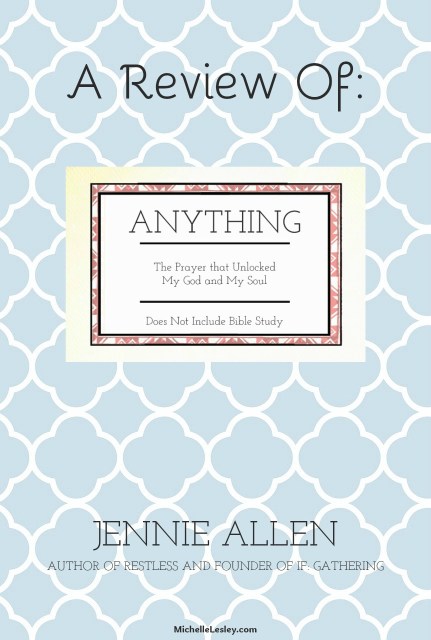
Guest Post: A Review of Jennie Allen’s “Anything: The Prayer that Unlocked My God and My Soul”

If your theology pretty much matches up with mine (as outlined in the “Welcome” and “Statement of Faith” tabs) and you’d like to contribute a guest post, drop me an e-mail at MichelleLesley1@yahoo.com,
and let’s chat about it.

A Review of Jennie Allen’s
Anything: The Prayer that Unlocked My God and My Soul

by Carol Coppens

Many years ago, when I was in the 6th grade, I was taught that when doing a book report, even if I didn’t like the book, I should try to say something good about it. That was fine teaching at the time and I think it has made me a better writer, this trying to see both sides. I’m not in school any longer though and these days, I’m bound less by trying to see the good and more to pointing out the multiple errors of books like Anything. If you’re a Jennie Allen fan, you won’t like what I have to say but I can’t stay silent.

Anything is a poorly written book. It’s an irreverent book. It’s a book that will never help any woman discover the totality of God’s plan of redemption, His sovereignty, His wrath which rests on the unregenerate, nor His holy fury at those who presume to speak for Him. This is not a book that will help you to dive deep into the character of God and to know Him better but instead, Jennie’s book is a tedious, self absorbed, experience driven, hermeneutically unsound, over-stepper of scriptural boundaries, mish-mash of emotionalism and repetitive “wrecked-ness”. Here are some of the specific faults that I see.

Even in these days of relativity, where the only rule that seems to apply is that there are to be no rules at all, there are still a few that are necessary. One of the rules of basic English grammar is, if you’re going to use an adjective (remember that word from English class?) you’d better do your homework and find out exactly what that word means, in the context in which you plan to use it.

The word reckless is used multiple times in this book. Jennie describes childlike faith as living “simply, recklessly.” On pg. 97, she writes that she and her husband, “now lay in the hands of a reckless, invisible God.” Page 143 tells of her realization that people are going to think they are foolish for adopting, saying, “that goes with almost any act of recklessness, even reckless love.” Maybe she thought the word sounded powerful and kind of daring when she penned it but the definition of reckless is “without thinking or caring about the consequences of an action.”

Describe human beings as reckless as much as you like, because we all certainly can be, but when a writer uses the word reckless to describe almighty God, that person has crossed over into blasphemy and I would shudder to think that I had written such a thing about the God I will eventually have to give an account to. Some of the other words she uses to describe God are, “unsafe”, “wildly unpredictable”, “radical”, “ridiculously radical” and she also writes that “God is still not very practical.” Exactly where are the chapters and verses for these descriptions of God, Jennie?

In many places, Jennie adds words to Scripture that are not there. Space hinders me from listing them all, so one example will have to do. On page 184, she speaks for Jesus and writes, “as if he were letting us in on the secret, Jesus whispered back to his father, this will all be worth it. Wait till they are with us and see our glory. Just wait till all of this work and suffering and pouring out is over and we are in heaven together forever. Just wait.”

This conversation is, of course, recorded nowhere in Scripture but the words “do not exceed what is written”, definitely are. Jennie would do well to read and meditate deeply on that verse in 1 Corinthians 4. When we imagine that God is speaking to us apart from Scripture, we can easily be led to enter very dangerous territory.

An example of her flawed interpretations of Scripture is on page 37. Jennie quotes Hosea 2:14-17 but then she blatantly misinterprets God’s promise to restore Israel to Himself, as a “dramatic metaphor” about those of us who chase other loves. I say, leave Biblical interpreting to those who know about these things, Jennie. If you think that you’ve been given a new interpretation of these verses that no other person has ever had before, you’re just plain wrong. God was promising restoration to Israel in these verses and nothing else.

She also does emotional and hermeneutical callisthenics with God’s call to Abraham to sacrifice Isaac (pgs. 69-70). Jennie’s theory is that God was punishing Abraham for his overwhelming love for his son that, according to her, had usurped God as Abraham’s first love. If she had thoughtfully studied these Bible passages or, if she truly understood God’s plan to ultimately save His elect, she would know that the sacrifice of Isaac and the ram God substituted for the boy, was a shadow of God’s own sacrifice of His son Jesus Christ on the cross. There is no excuse for such lazy interpretation of the sacred Scriptures. In these current times, the proliferation of false and misleading doctrine abounds. Having the correct interpretation of Scripture is of paramount importance because our eternal futures depend on understanding correctly, what God is saying to us.

On page 102, Jennie asks “so how do we actually let God change us?” Finally, I thought, a good solid question after having read page after page of drivel. Can an explanation of justification and sanctification be far behind? Sadly, they weren’t even hinted at and she goes on to tell a rather horrific (as a mother I cringed) story of telling her two oldest children to climb up a cliff and jump off! For Jennie, jumping is the key. Either “jump or crawl down” and “the more we jump and see our God come alive around us, the more we jump without fear – and the bigger the cliffs get”, she says. As the Peanuts character Charlie Brown was known to exclaim, good grief!

In the final analysis, the biggest problem I had with this book (and I slogged through it twice) was my knowing that, from the time of her “vision” in the night that Jennie feels was definitely from God, the wheels of the IF: Gatherings began to turn. For those readers who still might be unfamiliar with IF, they are para-church organization, begun by Jennie, that has no scriptural basis or authority. The gatherings happen outside of the local churches and their oversight, supposedly to accomplish something, ie. discipling women, that only churches are charged to do, in Scripture. In this case, the ends do not justify the means.

Because all the women involved in IF cannot possibly be born again, spirit filled, doctrinally sound, mature women with the spiritual gift of teaching, the possibilities for unscriptural philosophies and practices entering in to local churches, families and society at large, are enormous. I see this movement as no less than a calculated move of Satan against women, a frontal attack on the sufficiency of Scripture and a throwing off of the direct commands of God, in His Word, for both married and single women. Jennie Allen might believe that her “call” to begin IF was of God, but I do not.

So, at the end of the day, would I recommend this book to anyone? Absolutely not! What I do recommend instead is simply this – read your Bible, always praying that God will illuminate your mind with His truth. Get involved with a biblically solid church and pray for God to open doors for you to serve there. There is no substitute for a godly, biblically saturated, discerning Christian woman and one only gets that way by hard work and study. The Scriptures do not open themselves to the slothful. When a woman is mature in Christ and can properly discern truth from error then and only then it will come to pass that the writings of the Jennie Allens of this world will be seen for what they truly are, rubbish.

With a grateful nod to my 6th grade English teacher, I suppose I could say one good thing about this book and that is, that it wasn’t any longer.


Carol and her husband Mike live in a small town, on the shores of Lake Erie, in Ontario, Canada. She was 49 years old when Christ called her to be His disciple. A love for the pure truth of God’s Word fuels her passion to expose false teaching and especially that kind which has women as its primary target.


ALTHOUGH I DO MY BEST TO THOROUGHLY VET THE THEOLOGY OF THose WHO SUBMIT GUEST POSTS, IT IS ALWAYS POSSIBLE FOR THINGS TO SLIP THROUGH THE CRACKS. PLEASE MAKE SURE ANYone YOU FOLLOW, INCLUDING ME, RIGHTLY AND FAITHFULLY HANDLES GOD’S WORD AND HOLDS TO SOUND BIBLICAL DOCTRINE.
Christian women, Church, Discernment, Guest Posts

Guest Post: Building a Biblically Healthy Women’s Ministry (by a pastor, for pastors)

If your theology pretty much matches up with mine (as outlined in the “Welcome” and “Statement of Faith” tabs) and you’d like to contribute a guest post, drop me an e-mail at MichelleLesley1@yahoo.com,
and let’s chat about it.


Building a Biblically Healthy Women’s Ministry
(by a pastor, for pastors)

by Pastor John Chester

It is no secret that I am not a fan of discernment ministries, and that I think the concept of Biblical discernment is grossly misunderstood by many. But that in no way means that I don’t think telling truth from error and sound theology from errant (or even heretical) theology is unimportant.

And nowhere is it more important than in women’s ministry. The reason I say that is simple, more than 50% of the people in our churches are either women or they are growing into women. According to The Pew Research Center 55% of those attending Evangelical churches are women. 

Yet women’s ministry is often not thought of much by us pastors, I think because we view “women’s ministry” as a thing or program, rather than ministry to women who make up more than half of the congregation we are charged to shepherd. And so we spin it off to someone else or put it on our benign neglect list so that we can concentrate on “more important” things. But nothing is more important than the souls of the women of the church. And practically speaking, any error introduced in a women’s Bible study will work its way through whole families and infect the whole church.

With that in mind, let me offer some tips to guard against error in your church’s women’s ministry.

Preach The Bible

The pulpit sets the tone for the church and everything that the church does, or at least it should. The good news is that even the smallest church with the least talented preacher can have a strong pulpit, because the strength of the pulpit depends on what is preached, not the preacher. What the church needs is a healthy dose of Bible. And by a healthy dose, I mean all that should be preached is the Bible.

It is the Scripture that is inspired and the Word of God that is living and active, and it is the word of God that makes your pulpit strong, not your ability. No one needs your ten tips on having a more productive quiet time or your five steps toward a healthy marriage even if you sprinkle them with a few verses. The people the Lord has entrusted to you need to hear from Him, not you. Your job as a preacher is to decrease while the whole counsel of God is declared. By all means, illustrate, explain, introduce, conclude and apply the text, just stick to the text!

Why this is so important for women’s ministry and guarding the women of your church from error is that it will trickle down in to the church’s Bible studies. If on Sunday (and whenever else you preach) the women of the church get a strong dose of God’s truth, they are going to be better able to spot error and less susceptible to it. And when they see that you have a high view of Scripture, they will develop a high view of Scripture too. When they see you are a Berean who evaluates everything in light of what Scripture says, they will be more likely too as well.

And as a corollary, when you’re preaching the Bible, use it as an opportunity to teach the church, women included, how to think about and interpret the Bible. I’m not saying that the pulpit is a place for a discourse on the grammatico-historic hermeneutic, but it is a place to (often) say things like “this would have meant to the original readers” or “context determines meaning” or “Whenever you see a ‘therefore,’ ask yourself, ‘What is the ‘therefore’ there for?’.” These may be throwaway phrases to you, but they teach the congregation, including the women, how to approach Scripture.

Pay Attention

This seems very basic but it needs to be said, you need to know what is going on, what is being taught and what materials are being used. And you need to read any material being used in any class or study. Read, not skim, not look up on the internet, not ask your seminary alumni group on Facebook, but actually read. Need I remind you that you will give an account for how you cared for the souls the Lord entrusts to you? When you stand before God to give an account, “Well, I Googled it,” is not going to be good enough.

You need to pay attention to what is popular in the world of women’s ministry too. The women in your church buy and read more books than the men. Pay attention to what is out there, and don’t be afraid to address any errors that are gaining traction in churchianity”.

Be The Bad Guy

What I mean by that is be willing to be the one to take the heat. Be willing to veto a book, a curriculum, or even a topic that the women’s Bible study wants to use, and be willing to have the leader lay the blame for the veto on you. I would much rather have someone say to me, “We wanted to use ________ book. Why did you say to use ________ instead?” than have a bad book used, or quash the joy of the women’s Bible study leader if she became an object of scorn. And quite frankly (and this actually happened to me) I would rather have the women’s Bible study leader mad at me, than to have the women be taught something that is wrong.

Invest In Your Leaders

I am genuinely baffled by the lack of investment in women’s leaders. We pastors will often go out of our way to invest both time and treasure in a young man we think might one day have a significant ministry in our church (or dare we hope and pray) or even go into pastoral ministry themselves.. But we often fail to invest our time and treasure in women who have a significant ministry in our churches right now. Might I suggest that the bare minimum you should do for every Bible study leader (man or woman) is to provide basic instruction in hermeneutics. A great resource is Grasping God’s Word by Scott Duvall and Daniel Hays, and there is an excellent companion workbook that makes teaching basic hermeneutics a snap. I promise you that if you teach the teachers of the women in your church how to approach Scripture, it will rub off.

Invest time and invest treasure too. Provide at your (or the church’s) expense good reliable resources for deeper study to leaders of your church’s women’s Bible study. If the women are going through a book of the Bible (with an approved curriculum as the guide) provide reliable (and accessible) commentaries on that book. If the women’s Bible study is topical or using a topical book as a guide, provide some other good books for deeper study and reading. 

Be Approachable

The women of your church need to feel comfortable sending you an email, shooting you a text or even Facebook messaging you with a question. They should even feel OK picking up the phone and calling you if need be. I get the wisdom in erecting hedges and being careful how you interact with women. But you can’t shepherd effectively if you treat over half of your congregation as walking third rails. Rest assured the women of the church will pick up on your reluctance to interact with them and they will be reluctant to approach you with any questions, doctrinal or otherwise.

If you are married, this is one area where your wife can really help you. Her saying “you should ask my husband” will go a long way. And as a corollary one of the worst things that can come out of your mouth when a woman from your church asks you a theological question is “you should ask my wife.”

If you are like me you will have to work at this. The one thing I can say that always gets a laugh from my wife is, “I’m a people person.” It’s not that I don’t love people, it’s that I tend toward shyness, and I’m not super outgoing. So I work at being an accessible resource for the women of the church, and you can too. And who knows, you may one day be rewarded with a call where a newer believer asks “Is it true that the Israelites ate the scapegoat?”. (That is a real question I got from a real woman in the church and why it is so important that women feel like they can pick up the phone and call you.)

Write

Your pulpit ministry and other teaching at the church is not enough. You need need to be regularly writing. As Al Mohler observed, “Leadership is about communication, and much of that communication is necessarily written…leaders must learn to write and to set time aside for writing.

But you say you don’t have time. Mohler, one of the busiest men on the planet offers this helpful bit of advice, “You do what you have to do.” I contribute to a group blog with other pastors and a couple of former seminary professors. We all write with an audience in mind – our own church. Why? For two reasons, it builds a resource library that they can access, and it allows us to address issues that we may not get to address in a systematic fashion from the pulpit. I’ve covered topics like the various approaches to apologetics, what goes into a worldview, basic pneumatology, basic anthropology, how to bring Scripture to bear on anxiety, the sanctifying power of suffering, and much more. And yes I have written some things that would fall into the broad category of discernment, like why our church isn’t charismatic, the danger of letting a prolife social gospel supplant the biblical gospel and the respect for life that flows from it, why assisted suicide is unbiblical and even why events like Together 2016 (which for the record took place in our proverbial back yard) should be avoided. I write because I want to educate the church, especially the women of the church, who as a rule read more, about these issues.

Be willing to Sacrifice

Whatever cherished activity or ministry is keeping you from being all in on your church’s ministry to the women of the church, give it up! Let me give you an example. I love our men’s Bible study, so much so that I had the next three topics for the study preplanned. But currently there is no overlap in our church between the women qualified to lead a women’s Bible study and the women with the desire and time to do so. So the Wednesday night Men’s Bible study I have taught since the church opened has been tabled and replaced with a coed midweek Bible study. Sure, I had planned on going through the topics covered in Men Counseling Men edited by John Street, but instead I am teaching an Old Testament survey course geared to Christians of both genders. Truth be told I’d rather be with the guys, but that is not the best thing for the church, and as pastors we should lead in counting others (including the women of the church) as more significant than ourselves.

I could go on and on, but I’ll close with this; it breaks my heart that Michelle asked me to write this guest post. When she asked me to write this post she said that multiple women had contacted her and asked if there was anything about how important it is to help church ladies tell truth from error that they could print out and give to their pastors. For shame! No one should be more concerned with the spiritual well being and growth of the women in the church than their pastors. That in some places and in some cases that is not true is a blight on our brotherhood. This is a profound failure to fulfill the charge of 1 Peter 5:1-4, and there is no excuse for it. As the Apostle said:

So I exhort the elders among you, as a fellow elder and a witness of the sufferings of Christ, as well as a partaker in the glory that is going to be revealed: shepherd the flock of God that is among you, exercising oversight, not under compulsion, but willingly, as God would have you; not for shameful gain, but eagerly; not domineering over those in your charge, but being examples to the flock. And when the chief Shepherd appears, you will receive the unfading crown of glory.


John Chester is the pastor of Piedmont Bible Church, a Grace Advance church plant in Haymarket, Virginia. Prior to ministry John worked as a lacrosse coach, a pizza maker, a writer, a marketing executive, and just about everything in between. He hails from The City of Champions: Pittsburgh, Pennsylvania, and is blessed to be married to his wife Cassandra. Read John’s blog articles at ParkingSpace23.


Note from Michelle: I first had the pleasure of “meeting” John when I read and responded to this excellent article of his on ParkingSpace23. While he and I have a couple of differences on discernment ministry, I think the world of him as a brother in Christ, pastor, and fellow blogger. I literally teared up when I first read this guest post, because I wish every church could have a pastor like John.


ALTHOUGH I DO MY BEST TO THOROUGHLY VET THE THEOLOGY OF THE BLOGGERS WHO SUBMIT GUEST POSTS, IT IS ALWAYS POSSIBLE FOR THINGS TO SLIP THROUGH THE CRACKS. PLEASE MAKE SURE ANY BLOGGER YOU FOLLOW, INCLUDING ME, RIGHTLY AND FAITHFULLY HANDLES GOD’S WORD AND HOLDS TO SOUND BIBLICAL DOCTRINE.
Guest Posts

Guest Post: How to Improve Your Reading Experience

If your theology pretty much matches up with mine (as outlined in the “Welcome” and “Statement of Faith” tabs) and you’d like to contribute a guest post, drop me an e-mail at MichelleLesley1@yahoo.com,
and let’s chat about it.

Today, I’m excited to share with you a guest post from my daughter Michaela, who has recently started a blog of her own. This article is adapted from her blog article How to Improve Your Reading Experience. I know many of you are connoisseurs of Christian books, so I thought this might be helpful. Some of her suggestions can even help with your Bible reading.

How to Improve Your Reading Experience
by Michaela Lesley

Anyone who knows me knows that I am an avid reader. I have my mom, grandmother, and aunt to thank for this obsession, which began at a very young age. My mom would take me and my younger brothers to the library every few weeks, and it was an outing I always looked forward to. Every summer, my mom would pick out a book series and read out loud to me and my brother, Jordan, every day. My grandmother also enjoyed reading out loud to me, but because she lived in another state, she had to get creative. She would pick out books or short stories and record herself reading them on a cassette tape (it has definitely been a while since I wrote out the word “cassette”, and I almost forgot how to spell it). I would play these tapes whenever I was in my room playing, and at night while I was trying to fall asleep. My mom’s sister, author Kaye Dacus, was always the type of person to give books or Barnes & Noble gift cards as presents, and I always knew I was in for a treat whenever I got something from her in the mail around my birthday.

While I’m a few classics short to be able to consider myself a well-seasoned reader, I do consider myself good at reading. I know how to get through many books quickly, and I know how to stay in the loop when it comes to new popular books. Here are a few tricks I’ve learned over the years to make the most out of reading:

1: Goodreads.com– This is one of the easiest ways to keep track of your books. You can log in to Goodreads through your preferred social media account, or you can start a separate account through the site. There is also a very handy app, if you aren’t often near a desktop or laptop. On this site, you can mark books as To Read, Read, or Currently Reading. If you are currently reading a book, you can track your progress by putting what page you are on, and the site will tell you what percentage of the book you have finished. Once you have completed a book or marked it as “Read”, Goodreads gives you the options to rate the book on a Five Star scale and post a review of the book. You can also create your own “Shelves” to further organize books. I personally create a new shelf for every year, so I can keep track of how many books I’ve read that year. You can also see which books are trending, and Goodreads will recommend new books to you based on what  you have read. These are just a few of the many things you can do with the site, but these are the features I find the most useful. You can create an account here: Goodreads

2: Reading Playlists– This is something that I have been doing for a while now, and it makes reading so much more enjoyable. I use Spotify to create playlists specifically for reading. These playlists have songs and scores from some of my favorite movies. I also use Pandora to listen to the Movie Scores station. I mostly read fantasy and science-fiction, which means lots of intense fight scenes and bad guys giving monologues. I can picture the the characters and what they’re doing, and having music helps set the scene in my head. I’ve also found that I read faster when I listen to music.

3: Audiobooks and Ebooks– Thanks to being an adult, I don’t have as much time as I used to to sit down and read a book. But, there are currently 67 books on my To Read list, and I add more all the time. So, I have to find ways to get through that list somehow. My favorite non-traditional way of reading is listening to audiobooks (and yes, listening to a book counts as reading a book. Don’t let anyone tell you otherwise). I listen to books while doing house work, while driving, or just while doing something relaxing. I use Audible.com to listen to my audiobooks. Audible is part of Amazon, and a membership is $15 a month (your first month is free). The $15 a month gives you 1 credit, which you can use to buy any audiobook. The great thing about this is that most of the books cost more than $15, so it’s a really great deal. You can listen to the books on your smart phone, tablet, or computer, even without an internet connection. Once you finish the book, you can remove it to save space on your device. However, you can re-download the book at anytime. Overdrive is a service that many libraries use, and it allows you to “borrow” audiobook and ebook files with your library card.  This way, you have the convenience without having to spend any money! Kindle (Amazon’s ebook service) and Nook (Barnes and Noble’s ebook service) are useful as well! You can either download the apps onto your phone or tablet, or you can buy the actual Nook/Kindle devices. Ebooks tend to be much cheaper than physical books, and you can take them with you in your pocket! You also have the option to read in the dark, which is helpful if you are traveling at night or if you have a roommate.

4: Book-to-Screen Adaptations– We live in a time where it seems like every popular book is getting a TV show or movie. If I see a preview for a movie or TV show that looks like it might interest me, and I see that it’s based on a book, I immediately add that book to my To Read list. That book becomes a top priority. I feel an urgency to read that book. If you make yourself finish the book before seeing the movie or watching the show, then you will have a reason to finish it quickly. It’s exciting to see a story you love come alive on the screen, and watching that movie or show can be your reward for finishing the book. On the flip side, if you have a favorite movie or TV show that you find out is actually based on a book, then it will be easy for you to get into that book. This is a great way for people who aren’t already readers to get into reading.

5:  Reading with Friends– back in 2012, all of my friends and I were reading a popular trilogy. We had seen the previews for the first movie, and we knew we wanted to read the books together and see the movie together. We would all carry the books with us to class. We would read them in the van on the way to basketball games. We would stay up late and text each other our reactions to certain chapters. We all finished those books in about a week and a half. Reading a book with friends is a very fun way to bond as a group. You can encourage each other to read, and you can discuss the story together. My best friend and I are currently reading a book series together. A new book comes out every year, and we read it together and have fun conversations about where we think the story is going plot-wise.

6: Developing Reading Habits– getting through books can be hard if you are like me and you are easily distracted. With Netflix, YouTube, and Social Media, it’s easy to waste your free time on other things. Setting a designated time to read is a good first step to prioritize reading. Many people like to read before bed, to help them unwind before they fall asleep. Having a specific place to read can also help you focus. I have stopped reading in my room, because I am more easily distracted in there. I prefer to read in my living room, on the couch, with my reading playlist playing on my phone. This specific setting helps me concentrate. If I find that I’m still getting distracted, I pull up my phone’s stopwatch, and try to see how quickly I can read one page. I hit the “lap” button every time I make it through a page. When my phone is being used for a purpose like that, I find that I don’t check Facebook or Instagram as often.

Happy reading, my friends! ❤


Michaela Lesley was born and raised in Baton Rouge, Louisiana. She loves to travel and wander around new places, and is always reading a new book. She is a certified Jesus Freak, and is 100% OK with that. Michaela blogs at Michaela of Baton Rouge.


ALTHOUGH I DO MY BEST TO THOROUGHLY VET THE THEOLOGY OF THE BLOGGERS WHO SUBMIT GUEST POSTS, IT IS ALWAYS POSSIBLE FOR THINGS TO SLIP THROUGH THE CRACKS. PLEASE MAKE SURE ANY BLOGGER YOU FOLLOW, INCLUDING ME, RIGHTLY AND FAITHFULLY HANDLES GOD’S WORD AND HOLDS TO SOUND BIBLICAL DOCTRINE.
Entertainment, Guest Posts

Guest Post: Has the Bible Changed What You Watch?

If your theology pretty much matches up with mine (as outlined in the “Welcome” and “Statement of Faith” tabs) and you’d like to contribute a guest post, drop me an e-mail at MichelleLesley1@yahoo.com,
and let’s chat about it.

Has the Bible Changed What You Watch?
by Leslie

As a young married couple, my husband and I got in the habit of watching a particular TV show. Almost every week we tuned in to laugh at the antics of its characters for a half hour. We watched it without any conviction or qualms. At that time, it was simply a funny show.

Fast forward about fifteen years when this same show started to air again in re-runs. But now we were a little wiser. We were more grounded in Scripture. And we were more discerning. And so when we tuned in a few times for old times’ sake, we were most uncomfortable. We finally realized that the fornication and other sin that we were subjecting ourselves to for a few laughs was most definitely an offense to our Holy God. We turned it off and haven’t watched it since.

The same thing happened with a very popular 80’s movie. We had fond memories of watching it ourselves as teenagers and so one Sunday afternoon we turned it on for our kids. A few minutes into it–after listening to the characters take our precious Savior’s name in vain with appalling regularity– my husband turned it off.

This is a great example of how the Bible has changed us and what we watch. Has the Bible changed you and what you allow to enter your heart and mind through your television or the movie theater?

There has been a kind of strange dynamic over the past thirty or forty years with Christians and entertainment. This is probably due to a number of factors, including biblical illiteracy and our deep love for the world. But whatever the reason, most Christians have grown extremely comfortable watching sin on a screen with horrifying regularity.

If anyone dares to mention this trend as troublesome, they are immediately labeled a legalist. But is this legalism? Is the gray area of entertainment as gray as we would like to believe?

The more we study the Word, the more we understand that it is truly our grid for all of life. While we often focus on it being the grid through which we run pastors and Christian authors, it should also be what we use to evaluate all things worldly, as well.

God has made it clear in His word what is sinful. Passages like Galatians 5:19-21 help us to understand what God hates—

Now the works of the flesh are evident: sexual immorality, impurity, sensuality, 20 idolatry, sorcery, enmity, strife, jealousy, fits of anger, rivalries, dissensions, divisions, 21 envy, drunkenness, orgies, and things like these. I warn you, as I warned you before, that those who do such things will not inherit the kingdom of God.

If God hates these things, why do we think it is okay to watch things that are filled with them? Sexual immorality and sorcery are two of the most popular things on TV and in movies today and yet many Christians enthusiastically watch them, claiming no conviction in this area.

But if we know God hates it, shouldn’t we hate it, too? Is our claim of having no conviction an honest one?

Inevitably, when this topic of entertainment comes up, the idea of Christian freedom comes up with it. And, yes, how wonderful it is that we are free in Christ! But Paul shows us what this freedom really means in I Corinthians 10:23—

All things are lawful for me,but not all things are helpful; all things are lawful for me, but not all things edify.

So just because we can do something does not mean we should do it. Is it helpful? Will it edify? These are important questions to ask ourselves regarding entertainment.

And in Romans 6:1-4, Paul explains this idea of Christian freedom for us even further-

What shall we say then? Shall we continue in sin that grace may abound? 2 Certainly not! How shall we who died to sin live any longer in it? 3 Or do you not know that as many of us as were baptized into Christ Jesus were baptized into His death? 4 Therefore we were buried with Him through baptism into death, that just as Christ was raised from the dead by the glory of the Father, even so we also should walk in newness of life.

Grace means we walk in new life! Bound to sin no longer, we long to live a life that is pleasing to God.

This is not about a set of rules (legalism) but rather about how we go about pleasing the Lord with the choices we make every day. I Corinthians 10:31 gives us some insight—

Therefore, whether you eat or drink, or whatever you do, do all to the glory of God.

And Colossians 3:17 says something very similar—

And whatever you do in word or deed, do all in the name of the Lord Jesus, giving thanks to God the Father through Him.

Whatever we do. All things. Do you notice there is no exception for entertainment? Even our entertainment is to bring God glory.

And so these verses cause us to ask: Are we pleasing the Lord with the things we are watching?

If we are honest with ourselves, we will see that much of what passes as acceptable entertainment for Christians today does not fit under these guidelines.

The more I have studied the Word of God, the more I have come to understand how the Gospel affects all of my life. If we are approaching our Bible Study with a submissive heart and a desire to obey what we read, it should be changing us in a myriad of ways–including our entertainment choices.

While we do have great freedom under Christ, it is not the freedom to sin but instead it’s the freedom to break the chains of sin and to live a life of holiness. Why, as believers, do we long to keep this close contact with the sin that ensnares by putting it in front of our eyes and participating in it vicariously?

This is not a popular topic to write about and I confess that I don’t always like it myself. Honoring God with our entertainment is difficult in this day and age. But it can be done with some careful research of shows and movies before we watch them–along with the fortitude to turn the TV off or to walk out of the movie theater when we should.

May we have boldness and a heart to please God as we seek to honor Him with what we watch!


Leslie has been married to Eric for 29 years. They have four grown kids, three in-law kids, and are now enjoying being grandparents. Leslie’s desire is to develop a love for the Word of God in her readers, along with teaching them to run all of life’s experiences, challenges, and choices through its grid. You will find her at Growing4Life.net.


ALTHOUGH I DO MY BEST TO THOROUGHLY VET THE THEOLOGY OF THE BLOGGERS WHO SUBMIT GUEST POSTS, IT IS ALWAYS POSSIBLE FOR THINGS TO SLIP THROUGH THE CRACKS. PLEASE MAKE SURE ANY BLOGGER YOU FOLLOW, INCLUDING ME, RIGHTLY AND FAITHFULLY HANDLES GOD’S WORD AND HOLDS TO SOUND BIBLICAL DOCTRINE.