“Never challenge or speak out against God’s anointed,” I recently read in a book for Christian women.
“Never challenge or speak out against God’s anointed,” I recently read in a book for Christian women. Have you ever heard someone say this? Is it biblical?
Have you ever heard someone say this? Is it biblical? Who are “God’s anointed”? Why should we never challenge or speak out against them? What does it mean to be “anointed” anyway?
This is just one more of the many dangerous false teachings coming out of the Word of Faith and New Apostolic Reformation heresies. It is an adulteration of Psalm 105:15/1 Chronicles 16:22 (same text).
saying, “Touch not my anointed ones, do my prophets no harm!”
Psalm 105:15 / 1 Chronicles 16:22
The phrase “touch not My anointed” is lifted out of context and imbued with the meaning “never criticize, correct, or rebuke the pastor.” Unfortunately, churches that wield this false teaching like a weapon usually do so because they are pastored by a false teacher who needs to be (or is being) biblically criticized, corrected, or rebuked.
The context of Psalm 105/1 Chronicles 16 makes it obvious that this is not what this verse means, even in the Old Testament, as anyone who takes the trouble to read the whole chapter can clearly see. This verse is about God protecting the Israelites from oppression by foreign kings when they were wandering in the wilderness. “Touch not My anointed oneS” and “do my prophets no harm” is a warning to pagan nations to leave God’s people – all of them, the common people as well as the prophets – alone during the Exodus.
This has nothing whatsoever to do with New Testament churches and the idea that one should never challenge or speak out against a pastor. Pastors are only “anointed” today in the same sense that every believer is “anointed.”
In the Bible, “anoint” simply means to apply oil or another substance (Luke 7:38, John 9:6) to a body part (your own or someone else’s). In the Old Testament, one of the occasions for applying oil was in ceremonies to consecrate – set apart – someone (or something: Genesis 31:13, Exodus 29:36) for a particular purpose. For example, David was anointed with oil when God set him apart as king. All Old Testament priests were anointed with oil. Elisha the prophet was anointed with oil.
But we do not see this in the New Testament. No one is anointed with oil as part of a consecration ceremony. In the New Testament, the verses containing the word “anoint” fall into one of three categories: medicinal/hygienic application of oil and other substances, references to Jesus as the “Anointed One” (Messiah), and two passages (2 Corinthians 1:21-22, 1 John 2:20,27) speaking of all Christians as being allegorically “anointed”: set apart as God’s special people (the same way Psalm 105/1 Chronicles 16 talk about the Israelites as God’s special, set apart people).
The only individual in the New Testament who was anointed – literally or allegorically – in the Old Testament, ceremonial, consecrated sense is Jesus. Why? Because He fulfills all three of those Old Testament “anointed” positions: prophet, priest, and king. He is the final prophet, the Great High Priest, and the eternal King.
Jesus fulfills all three of those Old Testament “anointed” positions: prophet, priest, and king. He is the final prophet, the Great High Priest, and the eternal King.
Therefore, no New Testament believers are “anointed” to any position but we are all spiritually anointed – set apart to and for Christ as His special possession. We are to submit to our pastors and elders (Hebrews 13:17) insofar as they teach and obey God’s written Word (1 Timothy 5:19-20, Acts 5:29), but “never challenge or speak out against God’s anointed”? Only if the Anointed One you’re talking about is Jesus.
“Never challenge or speak out against God’s anointed”? Only if the Anointed One you’re talking about is Jesus.
Ever heard of Jeroboam? If you’ve read your Old Testament, the name probably rings a bell, but, let’s face it, it’s hard to keep all those Jeroboams, Rehoboams, Ahinoams, and Abinoams straight, right? Well, let’s read a little bit about Jeroboam:
And Jeroboam said in his heart, “Now the kingdom will turn back to the house of David. 27 If this people go up to offer sacrifices in the temple of the Lord at Jerusalem, then the heart of this people will turn again to their lord, to Rehoboam king of Judah, and they will kill me and return to Rehoboam king of Judah.” 28 So the king took counsel and made two calves of gold. And he said to the people, “You have gone up to Jerusalem long enough. Behold your gods, O Israel, who brought you up out of the land of Egypt.” 29 And he set one in Bethel, and the other he put in Dan. 30 Then this thing became a sin, for the people went as far as Dan to be before one. 31 He also made temples on high places and appointed priests from among all the people, who were not of the Levites. 32 And Jeroboam appointed a feast on the fifteenth day of the eighth month like the feast that was in Judah, and he offered sacrifices on the altar.
1 Kings 12:26-32a
The Kingdom of Israel had just split into the southern kingdom of Judah and the Northern kingdom of Israel. Jerusalem, where the temple is located, is in Judah. Jeroboam (king of Israel) figures that if his people continue traveling to Jerusalem for feasts and sacrifices, they will eventually turn their loyalty back to the the kingly lineage of David (aka: Judah, 26-27) and he’ll lose both his kingdom and his head. So, in order to keep the people inside the borders of Israel and control them, he makes a couple of golden calves (which somebody should have remembered turned out badly the last time that was tried {Exodus 32}) for them to worship at either of two convenient locations, Bethel, in the southern part of Israel, and Dan in the northern part. Jeroboam, leading the way, had the Israelites simply transfer their feasts and sacrifices that they would have offered to God to these golden calves. It’s a fascinating story that you can read more about here if you’re interested.
So why am I going on and on about Jeroboam?
Because Jeroboam’s story is so similar to something that is happening in the visible church today. He was a well known personality who led God’s people to worship an idol which he told them was God. And God’s people went along with it, transferring their worship from the one true God to the golden calf called “God.”
There are a ton of Jeroboams out there today. Some of you reading this might be following one of them and worshiping the idol their false theology tells you is the God of the Bible. And in the same way that a man of God came along and rebuked Jeroboam for his blasphemy, a man or woman of God might come along and call out the Christian celebrity you’re following, or take you aside -out of love and concern- and let you know that person is a false teacher.
I hope you won’t respond like Jeroboam did. He was so angry, he tried to kill the prophet. But sadly, I have seen this type of response (at least verbally) many times, especially from women, when faced with the fact that their favorite Bible teacher or author is preaching a false gospel.
So, what’s a godly way to respond when someone tells you you’re following a false teacher?
1. Consider the source and listen.
If you know the person who’s telling you this, think about her godliness and character. Is she generally a godly person? Does she know her Bible well? Does she show love and concern for others? Is she trustworthy? A godly person of good character has no reason to toss out wild and unfounded accusations, especially if you’re her friend and it might offend you. In fact, she’s probably scared to tell you.
But even if it’s a stranger on a blog saying Celebrity Bible Woman is a false teacher, hear her out and make sure you understand what the issues are. Remember, what she’s saying might be true, but you’ll never know if you immediately write her off.
2. Listen for content, not tone.
There are some discerning people out there who will bring you flowers and candy and hold your hand as they gently tell you the person you’re following is a false teacher, and then there are discerning people whose tone or manner might rub you the wrong way as they’re delivering the news. Don’t let the way something is said turn you off to the content of what is being said. Don’t sacrifice truth on the altar of tone.
3. Keep your emotions in check.
It’s tempting to let our feelings take charge when we’re receiving bad news, but you aren’t going to be able to evaluate the content of what the person is saying if you’re consumed by rage or hurt. It might help to remind yourself of your relationship to the teacher/author in question. Do you even know her personally? It’s not like someone is leveling accusations against your child, spouse, or best friend. Put your emotions aside and let reason and clear thinking rule the day.
4. Don’t blindly believe the messenger.
You don’t have to -nor should you- believe everything you hear just because it quotes a Bible verse or wraps itself in the label “Christian”. That applies to both the person who tells you you’re following a false teacher and the alleged false teacher herself. Listen carefully to what the person has to say, make sure you understand it, then get out your Bible and get to work. Are the issues the person has raised biblical? What does God’s word have to say about these issues? Is the person you’re following violating Scripture? If so, choose to stop following the false teacher because the Bible -not a person- tells you to do so. People are fallible. God’s word is not.
5. Don’t shoot the messenger.
It’s been my experience that women who are loyal devotees of false teachers can be some of the most vicious people in the world if you dare to question their idol. I have had women verbally rip me to shreds, threaten me, call me names, accuse me of “judging,” and tell me I’m what’s wrong with Christianity for politely pointing out from Scripture that someone is teaching false doctrine. Ladies, we give Christian women as a whole a bad name when we act like that. More importantly, that kind of behavior is a reproach to Christ, and never appropriate for someone who calls herself a Christian.
6. Defend from Scripture, not opinion, emotion, or personal preferences.
It is downright embarrassing when a person is shown that Celebrity Bible Woman is violating a certain Scripture, and her only argument is, “But I just LOVE her! She’s such a great teacher and helps me understand the Bible so well!” If it were really true that Celebrity Bible Woman is such a great Bible teacher, her followers ought to be able to prove -from Scripture- that what Celebrity Bible Woman is doing or teaching isn’t unbiblical. The bottom line is that Scripture is our ultimate authority, not our opinions, not our personal preferences, not how much we love a certain teacher. For a Christian, if something comes up against the Bible, the Bible wins. Period. So, if you’re going to defend Celebrity Bible Woman, defend her from Scripture. And if you can’t, why are you still following her?
7. Love Christ more than you love your favorite teacher.
If someone shows you from Scripture that your favorite teacher, author, or pastor is teaching false doctrine and you ignore that warning because you are so enamored with that teacher, then what you’re saying is that you love that teacher more than you love Christ and His word. Jesus said:
Whoever loves father or mother more than me is not worthy of me, and whoever loves son or daughter more than me is not worthy of me.
Matthew 10:37
Your parents. Your children. They’re the people you love most in the world. If Jesus says you can’t love them more than you love Him, do you think it’s going to be OK with Him if you love your favorite Bible teacher more than you love Him? It’s not. Love Christ above all else, and cut that false teacher out of your life.
It can be difficult to hear that you’re following a false teacher. You like her. She makes you feel good. You think you’re doing great in your walk with the Lord. It’s hard to give all that up. But we must be careful that we never put our feelings for a person above Christ and His word. If someone tells you you’re following a false teacher, don’t brush her off or attack her. She’s most likely coming to you out of love and concern for you and for the body of Christ. Check out what she’s saying against the Bible. And if she turns out to be right, stop following that false teacher and thank her. Because a person who rescues you from an enemy of Christ is truly your friend.
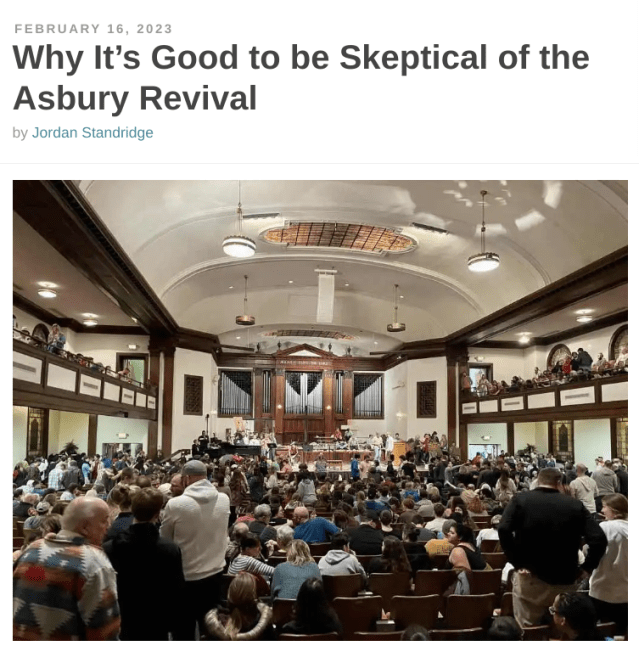
Have you been hearing about this “Asbury Revival” thing lately, and wondering what it is? Is it a “real” revival? Is it biblical? Are people getting saved? These are just a few of the questions Christians have been asking as video, eyewitness accounts, and, undoubtedly, a good deal of speculation have made their way out of Kentucky to other parts of the country.
I would encourage you to examine the resources below and compare everything to rightly handled, in context Scripture. This is a way of testing the spirits as Scripture commands us, rather than simply believing every spirit that comes along.
Beloved, do not believe every spirit, but test the spirits to see whether they are from God, for many false prophets have gone out into the world.
1 John 4:1
To help you practice your discernment, here (and throughout this article) are some questions to keep in mind as you read about and watch the “Asbury revival”:
🔥Where does the Bible say that, in context, and rightly handled? Does the Bible really say that?
🔥Is what I’m reading objective, rightly handled, in context Scripture, or someone’s subjective personal experiences, opinions, feelings, or preferences? Which am I hearing more of?
🔥Could what I’m reading about have been replicated by a non-Christian person, event, or experience?
🔥Who, or what, is my attention being drawn to – Jesus and His written Word, or people, opinions, feelings, and experiences?
🔥A good, biblical approach to evaluating events like this, initially, is to “wait and see” what will transpire. We don’t want to make snap, uninformed judgments, but when there’s the possibility that spiritual damage could be done, at what point have we waited long enough and seen enough evidence that it is time to stop waiting and start warning?
What’s this all about?
“The 2023 Asbury Revival is an ongoing Christian revival at Asbury University in Wilmore, Kentucky. The event was prompted after students spontaneously stayed in Hughes Auditorium following a regularly scheduled chapel service on 8 Feb. 2023. News of the phenomena was quickly spread on social media and in Christian online publications. The revival has been compared to similar revivals at Asbury, notably one that occurred in 1970, which had far-reaching consequences in Methodism, US culture, and in the growth of the Jesus movement. The revival is noted for its use of social media, as the participants are mainly members of Generation Z.” 2023 Asbury Revival, Wikipedia
(Normally, I would not use Wikipedia as a resource, but after sifting through a dozen or so news stories for one that wasn’t slanted, didn’t drown the reader in tons of superfluous information, and simply presented the basic facts, unbelievably, Wikipedia is what I was left with. There are a few more details and a decent timeline of events at the link above.)
🔥Are all of Asbury’s doctrines and practices biblical? If not, which ones, and why?
🔥Consider the following passage as you learn about Asbury’s doctrine and practices. Which parts of what you will read below are “tree,” and which parts are “fruit”? According to Scripture, does Asbury seem to be a healthy tree that will bear good fruit, or a diseased tree that will bear bad fruit?
You will recognize them by their fruits. Are grapes gathered from thornbushes, or figs from thistles? So, every healthy tree bears good fruit, but the diseased tree bears bad fruit. A healthy tree cannot bear bad fruit, nor can a diseased tree bear good fruit. Every tree that does not bear good fruit is cut down and thrown into the fire. Thus you will recognize them by their fruits.
“Not everyone who says to me, ‘Lord, Lord,’ will enter the kingdom of heaven, but the one who does the will of my Father who is in heaven. On that day many will say to me, ‘Lord, Lord, did we not prophesy in your name, and cast out demons in your name, and do many mighty works in your name?’ And then will I declare to them, ‘I never knew you; depart from me, you workers of lawlessness.’ Matthew 7:16-23
Asbury University has “its roots in the American Methodist and holiness tradition.” Here is their theological foundation as explained by Asbury University: Wesleyan-Holiness Theology
Though Asbury University retains many biblical standards on paper, genearally speaking, Wesleyans are Arminian, egalitarian rather than complementarian, pro-abortion, pro-homosexuality, and social justice oriented. They tend toward theological “progressivism” – the liberal end of the theological spectrum rather than the conservative end.
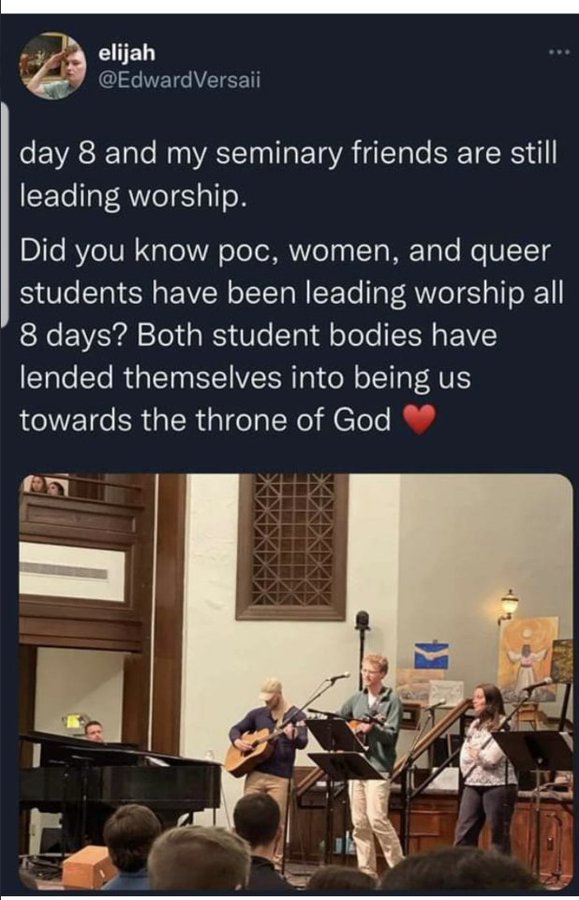
And, indeed, there are openly homosexual students at Asbury, and they have been helping lead this event. From an Asbury student:
Read both of these pics in their entirety – particularly the last paragraph of the second. Todd Bentley is far from my only concern about what is happening at Asbury. pic.twitter.com/MWTokgSUDD
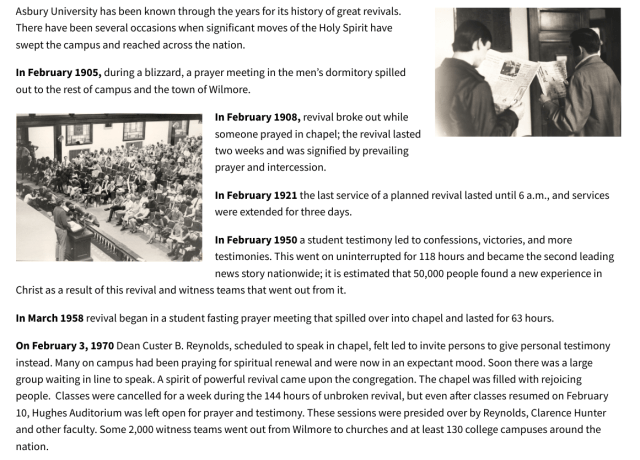
Asbury University also has a history of recurring spiritual events which they have dubbed “revivals” and attribute to the Holy Spirit. From the Asbury University website:
Notice anything about the dates of these events? They all occurred near the time of the Collegiate Day of Prayer, which is always the last Thursday of February. This has raised questions as to whether or not these events may have been at least somewhat contrived or encouraged. Coincidentally or not, Asbury University is hosting the 200th anniversary simulcast for the Collegiate Day of Prayer on Thursday, February 23 – the day after the current “revival” is scheduled to end.
Content of the Meetings
🔥What does the Bible say about the way we are to worship? How does the content of the Asbury meetings measure up against Scripture’s commands and instructions for biblical worship?
What’s being called the “Asbury revival” started after a regular weekly chapel service. This is the message that was preached during that chapel service that apparently got things going.
Many people have said that the gospel was preached during this sermon. Many others have said the gospel appeared nowhere in this sermon.
This is the gospel:
You are a sinner. You were born in sin and rebellion against the holy God of the universe, and you’ve also willfully chosen to break His law. You’ve lied. You’ve wanted and taken things that didn’t belong to you, which is coveting and stealing. You’ve lusted after someone, which Jesus said is committing adultery in your heart. You’ve been sinfully angry, which Jesus says is committing murder in your heart. You’ve dishonored your parents. And that’s only 6 of the 10 Commandments.
James 2:10 says, “For whoever keeps the whole law but fails in one point has become guilty of all of it.” So you’re guilty of breaking all of God’s law.
When you break the law, justice must be meted out. And the just punishment for rebellion against God is an eternity in Hell, which all of us richly deserve. And you can take that eternal death sentence for your sin, and serve it yourself if you want to, but God, who is rich in mercy, has provided another way out. A better way out. He sent His son, Jesus, to earth to live a perfect sinless life so He could take your death penalty for you. And that’s just what He did on the cross. He died in your place. He took the punishment for your sin. And then he rose bodily from the grave on the third day afterward.
If you want to be right with God, have your sins forgiven, and stand clean before Him now and when you die, confess your sin and rebellion against Him. Sorrowfully turn your heart and life away from sin and toward Him, believing that Jesus’ death, burial, and resurrection paid the penalty for your sin, and you ask Him to save you. And He will.
(For a more extensive version of the gospel with more Scripture references click the What Must I Do to Be Saved? tab in the blue menu bar at the top of this page.)
🔥Was the gospel preached during this message? Did you hear about sin, repentance, God’s law, Christ’s life, death, burial, and resurrection for your sin, and God’s grace, mercy, and forgiveness? Can people get genuinely saved without hearing the full biblical gospel?
While many people have stood and spoken in front of those assembled, there have been conflicting reports about whether or not any further sermons have been preached.
Not all public speaking, even in a Christian or church setting, is preaching. To preach is to point the congregation to Christ and His written Word by taking a passage of Scripture and teaching, exegeting, expositing, and proclaiming it. Rightly handled Scripture is the substance around which a sermon revolves. Other forms of Christian speaking – such as personal testimonies, public prayer, words of encouragement, and merely reading or alluding to Scripture – are valid and appropriate at times, but they are not the same thing as preaching a sermon.
Below is the livestream of the Asbury meeting.
🔥Which types of speaking do you see and hear? Preaching? Teaching Scripture? Personal testimonies? Is the speaker teaching and explaining Scripture, speaking about personal thoughts and experiences, speaking about the experience of the “revival” itself? Do you see more singing and prayer or more preaching?
🔥Consider this passage as you listen to the speakers in the livestream:
For “everyone who calls on the name of the Lord will be saved.” How then will they call on him in whom they have not believed? And how are they to believe in him of whom they have never heard? And how are they to hear without someone preaching? And how are they to preach unless they are sent? As it is written, “How beautiful are the feet of those who preach the good news!” But they have not all obeyed the gospel. For Isaiah says, “Lord, who has believed what he has heard from us?” So faith comes from hearing, and hearing through the word of Christ. Romans 10:13-17
🔥Could someone hear the full gospel and get saved through what any of the speakers are saying? Why or why not?
There have been a number of reports that the nearly perpetual music during the meetings has largely been songs from Bethel, Hillsong, and Elevation. What do you observe in the livestream?
🔥Have all of the songs’ lyrics been doctrinally sound according to Scripture? Is God pleased when we use music from heretical sources to worship Him even if the lyrics of a particular song don’t conflict with Scripture?
One of the concerns early on in the meetings was that rank heretics of the worst order such as Todd Bentley, Rodney Howard Browne, Tasha Cobbs, and Greg Locke were attracted to and enjoyed attending the Asbury meetings. Some speculated that they attended in order to gain some sort of power, take over the meetings, or garner attention for themselves.
🔥Would such demonically controlled people have shown up at a “revival” meeting at any doctrinally sound church you can think of where the gospel was being preached and Scripture was being rightly handled? If they had, what impact should that have had on them, spiritually?
When a man as dark and twisted and as prolific a liar as Todd Bentley says he felt nothing but “wave after wave of the tangible love and joy and peace of the father (sic)” at a “revival” one cannot help but have serious and legitimate questions about said revival. pic.twitter.com/k2hlSeTL7V
OP Continued: “…This happens when people get hungry for more of God. Many will refer to this as a sovereign move of God, however God sovereignly moved 2000 years ago on the day of Pentecost, and he has never stopped. He is still moving today. Can’t wait to hear all the critics, the controllers or better yet the opportunists who would love to co-opt what God does. Let this shut down the whole university! Let the fire continue to fall & spread! #Revival #HolySpirit #Awakening @AsburyUniv
In addition to the worst of the worst evangelical heretics, several in Catholic leadership have attended the meetings and spoken glowingly about them. (Catholicism is not Christianity. Those who hold to Catholic doctrine – and we certainly would expect Catholic leaders to hold to Catholic doctrine – are not Christians because Catholicism anathematizes the biblical gospel.)
🔥Is it possible for an unbeliever who anathematizes the biblical gospel (i.e. believes and teaches that anyone who believes the biblical gospel is condemned to Hell) to be “set on fire with the Holy Spirit”? According to Scripture, what is the function of the Holy Spirit in the life of an unbeliever?
There has been one (that I’m aware of) instance of someone allegedly exorcising a demon during the meetings. If you’re familiar with the trappings of the New Apostolic Reformation, you know that what you see in the video below goes hand in glove with the NAR’s heretical theology of “spiritual warfare”.
🔥Does a “tree” (see Matthew passage above) of sound doctrine produce heretical fruit? Would this type of incident be likely to happen at any doctrinally sound church you know of? If not, why not? If so, how would it have been handled by the pastors and elders?
What Other Biblically Trustworthy Voices Are Saying
🔥Some have said it’s sinful or wrong to biblically critique the Asbury meetings without physically going there to experience it personally in real time. Does the Bible require us to be physically present while something is happening in order to experience it personally before making informed, biblical evaluation, observation, or critique?
If yes, have you ever evaluated the Holocaust or slavery as sinful? Have you ever said that Mormonism, Hinduism, Satanism, etc., were unbiblical, having never practiced one of those religions yourself? Consider this passage in which Jesus comments on events at which He was not physically present.
🔥Consider these passages. God is able to take any sin, any false doctrine, any bad situation, and use it for His glory and our good. What are some scripturally good, doctrinally sound things that could happen as a result of the meetings at Asbury?
🔥What are some things doctrinally sound Christians and churches could do to reach out to and help the students at Asbury?
🔥When someone hears the biblical gospel and gets genuinely saved while still a member of a “bad tree” belief system or a follower of a false teacher, does she stay in that unbiblical environment or does God grow her and bring her out of it? What is something you could do to share the gospel with and disciple someone caught in a false belief system?
It’s so predictable it would be almost comical if it weren’t so wearisome and worrisome. Every time I write an article about a false teacher or mention on social media that someone is a false teacher, her disciples come out of the woodwork to defend her.
Not only are the same arguments raised repeatedly, but they’re raised in the same ways, ways which leave the person who’s making the argument without a shred of credibility. And if you want your argument to be believed, the first thing you’ve got to be is credible.
Lawyers know this. That’s why, when they select witnesses to testify in their cases, they prefer to choose people who are morally credible and/or factually credible. A morally credible witness is someone who’s likely to be believed based mainly on her reputation as an honest, upstanding person. A nun. A judge. A sweet little church-going grandma. A factually credible witness’ personal reputation might not even be at issue. She’s someone who’s believable because of the airtight factual information she’s able to present. Maybe she’s an expert in the field in question, or she’s in possession of receipts or videos or some other form of tangible irrefutable evidence.
When it comes to biblical doctrine and apologetics, there is only one witness who is morally and factually credible: God. You and I don’t have a moral leg to stand on because we’re sinners, so we can’t expect others to take our word for it in doctrinal debates simply because we’re such swell gals. And as far as the facts and truths of Christianity go, God is the ultimate expert witness, because He is the Author of those facts and truths.
So when we’re engaged in a discussion about what is Christian and what is not, our only feasible and credible position is to put God’s written Word – His testimony – center stage, stand off to the side, point a finger at it, and declare, “Thus saith the Lord.” It’s an open and shut case.
But people who defend false teachers can’t do that because if they did, they would be agreeing with God that the person they’re defending is a false teacher. So they offer their own testimony in other ways. And that’s where the wheels fall off – of their arguments and their credibility. Here are six ways your credibility can be crushed when you’re defending a false teacher.
1. Rejecting the Authority of Scripture
This is a very real, serious, and pervasive problem among many professing Christians today. You’re fine with obeying Scripture – right up to the point where it disagrees with you or interferes with something you want to do. That’s not obedience, and that’s not Christianity. That’s the religion of you: you being your supreme authority, the lord of your life, the arbiter of what’s right and wrong.
Are you fine with obeying Scripture – right up to the point where it disagrees with you or interferes with something you want to do? That’s not obedience, and that’s not Christianity. That’s the religion of *you*.
Christianity is about surrendering everything about yourself to Christ and doing what He says to do in every circumstance. If He says, “Go,” you go. If He says, “Don’t,” you don’t. If He says, “Jump,” you say, “How high?”, and then you jump. You don’t call the shots. He does. You don’t get to have opinions and preferences that differ from His.
It’s clear that you’re not submitting to the authority of Scripture when you’re presented with, for example, 1 Timothy 2:12, and video evidence of your favorite teacher violating that Scripture, and your retort is, “But that’s the only place the Bible says that!”. (It’s not, but even if it were, how many times do you demand that God must say something before you’ll believe or obey it? Two? Seventeen? Ninety-three?) Or you attempt brush that Scripture aside as, “That was only an instruction for that particular time and culture,” when verses 13-14 make clear that it’s not.
Once again, you are in the driver’s seat, not God and His Word. You have no moral or factual credibility of your own. Why should someone believe you over God?
2. Failing to Argue from Scripture
When someone says to you, “Scripture says X. Your favorite teacher says Y on page 252 of her book,” you can’t defend her by saying, “You’re just a mean old doody head!” or “But she’s so nice and she’s had such a positive influence on my life!”. It would be just as effective to say, “But she’s from Montana!” or “She flosses her teeth so nicely!” So what?
Maybe I am a mean old doody head. Maybe I’m not. Maybe she has had some positive influence on your life, or maybe you only think she has because your definition of “positive influence” is your definition, not God’s. That’s not the issue. The only issue is whether or not she is walking blamelessly and teaching what accords with sound doctrine as measured by rightly handled, in context Scripture. And to argue that she is, you have to get into your Bible, study it, and present your case from God’s written Word. In other words, the fact that you like her or she’s nice doesn’t prove that what she’s teaching is biblical. And arguing those things as though they do shows that you either don’t know or don’t care what the issue is; what you care most about is your personal feelings and preferences – not a strong argument for believing anything you have to say about her being a good teacher.
3. Mishandling Scripture
I appreciate it when people at least try to defend a teacher or doctrine by using Scripture. I really do. If nothing else, it shows you know that teachers and doctrine are supposed to be in alignment with Scripture and that Scripture is our authority as Christians. And those are two very important biblical concepts.
But when you attempt to defend a teacher with Scripture and it’s obvious you don’t understand the passage, have taken it out of context, or are twisting it, you’re making my argument for me that you should not be sitting under that teacher. Because if she were as great a Bible teacher as you say, and you’ve learned so much from her, you wouldn’t be mangling God’s Word. She would have taught you how to handle it properly.
If she were as great a Bible teacher as you say, and you’ve learned so much from her, you wouldn’t be mangling God’s Word. She would have taught you how to handle it properly.
It’s hard for me to believe your argument when you’re making mine for me.
4. Lying, or Denying Reality
I’m not sure which one is worse when it comes to defending false teachers. Increasingly, I will mention that, for example, Priscilla Shirer is a false teacher, and one of her followers will pipe up and demand that I provide evidence to back up this assertion. I provide this article, which contains copious amounts of both Scripture and video, audio, and text evidence of how Priscilla violates these Scriptures. The person then comes back and brazenly says I have provided no evidence and no Scripture. Not that she disagrees with the Scripture and the evidence I’ve presented, but that it isn’t there.
I guess I shouldn’t be so dumbfounded that this keeps happening, but I am. Because when you make a statement like that, there are only two possibilities: a) you’re lying – saying you’ve read the article when you haven’t, or b) you are denying the existence of something that’s in black and white in front of your own eyes. I’m not really sure how to handle that in Christian apologetics. If you’re clearly lying, you’re not believable, and there’s no common ground for reasoning and discussion. And if you’re denying reality – well, when I was getting my degree in psychology, we were taught that you needed to be medicated. All I can say is that neither speaks in favor of your credibility.
5. Displaying the Fruit of the Flesh
We all know what the fruit of the Spirit is: love, joy, peace, patience, kindness, goodness, faithfulness, gentleness, self-control. But frequently, people (who profess to be Christians) do not present their defense of a false teacher with an accompanying display of that fruit. Quite the opposite, in fact. Their argument is presented in hatred, anger, bitterness, fear, unkindness, impatience, harshness, and with wanton abandon. We’re not talking a polite disagreement, here. We’re talking name-calling, profanity, threats, and verbal evisceration. From people who claim to be Christians. In defense of someone they don’t even know personally.
When you act that way, I’m hard put to even believe you’re a Christian, much less that you have a valid, biblical argument, or that this teacher is doing a bang up job of teaching you the Bible so you can be conformed to the image of Christ.
6. The Bible Doesn’t Back You Up
This is the most significant reason people who claim to be Christians yet defend false teachers lack credibility. The Bible doesn’t find them credible either.
Take a moment and read John 9:1-10:31 (I know it’s long, but you need the context.) This passage is about knowing and following Christ (not, as so many false teachers like to claim, that if you’re a Christian you’ll be able to hear God speaking to you audibly). “Thieves”, “robbers” (10:1), “strangers” (10:5), and “wolves” (10:12) are all false teachers who do not enter the sheepfold by the door (Jesus – 10:1,7) but sneak in some other way. Jesus is very clear in this passage that if you’re truly His sheep, you will follow only Him, not a false teacher:
A stranger they will not follow, but they will flee from him, for they do not know the voice of strangers. (10:5) … All who came before me are thieves and robbers, but the sheep did not listen to them. (10:8) … I am the good shepherd. I know my own and my own know me, (10:14) … but you do not believe because you are not among my sheep. My sheep hear my voice, and I know them, and they follow me. (10:26-27)
Jesus says that following and defending false teachers doesn’t match your claim to be one of His sheep.
First Corinthians 2:14 says that if you’re not saved, you won’t be able to understand the true, biblical things of God. The will seem like foolishness to you and you will reject them:
The natural person does not accept the things of the Spirit of God, for they are folly to him, and he is not able to understand them because they are spiritually discerned.
In other words, Jesus says that following and defending false teachers doesn’t match your claim to be one of His sheep (a Christian). And rejecting incontrovertible biblical truth because you consider it to be foolishness is a symptom of someone who isn’t saved. Either you’re a genuinely born again Christian who embraces biblical teaching and rejects false teachers, or you embrace false teachers and reject biblical teaching because you’ve never truly been born again. The Bible says you can’t do both at the same time.
Either you’re a genuinely born again Christian who embraces biblical teaching and rejects false teachers, or you embrace false teachers and reject biblical teaching because you’ve never truly been born again.
God has made things pretty simple for us. He has given us His written Word as the standard for our beliefs and practices. All we have to do is hold it up, like a yardstick, next to every doctrine and teacher who comes our way and throw out anyone and anything that doesn’t measure up. It’s when professing Christians try to use another standard or fudge the measurements that problems arise. Credibility lies with those who believe and hold high the standard of God’s written Word – not because of anything within themselves, but because they stand behind and glorify the Author of truth.
It’s a funny thing that it’s so easy for us to see the far away faults and foibles of others, but the ones in our own hearts – the sins and hypocrisy we know most intimately – are constantly in our spiritual blind spot. Jesus understood this all too well and admonished us to make sure our own hands are clean before taking the tweezers to the mote in a sister’s eye.
Often, it’s not that we’re ignoring the plank that’s obscuring our vision, we’re just not even aware that it’s there. When I evaluate my own heart to confess my sins to the Lord, the ones that weigh heaviest on my spirit are not those that I know I’ve committed and need to repent of, it’s the ones I’m sure are lurking somewhere… but I can’t quite put my finger on them.
One of the subtle hypocrisies theologically orthodox, blameless and upright, discerning Christians can have trouble seeing in ourselves is our failure to hold our favorite pastors and teachers to the same biblical standards we apply to other pastors and teachers.
Would you make excuses for them? Sweep this stuff under the rug and continue to listen to their sermons and read their books without batting an eye?
Pastors and teachers don’t get a pass on sin just because they’re Reformed, or discerning, or have a virtually unblemished record of doctrinal soundness, or because they’re “one of the good guys.”
Pastors and teachers don’t get a pass on sin just because they’re Reformed, or discerning, or have a virtually unblemished record of doctrinal soundness, or because they’re “one of the good guys.” If they’re called to account, and they repent and strive toward holiness, hallelujah! That’s what God requires of all Christians – that we walk before Him blamelessly and bear fruit in keeping with repentance. But if they unrepentantly persist in sin despite biblical correction, there’s a problem there- with their own hearts, and with ours, if we knowingly turn a blind eye to their willful disobedience just because they’re our favorites.
God makes it clear throughout His Word that pastors, teachers, and others in positions of spiritual leadership bear a grave responsibility to set a godly example for those who look to them for teaching and guidance. And, in certain ways, God requires a higher standard for those in spiritual leadership than He requires of Christians He has not called to lead.
…No man of the offspring of Aaron the priest who has a blemish shall come near to offer the Lord’s food offerings; since he has a blemish, he shall not come near to offer the bread of his God. He may eat the bread of his God, both of the most holy and of the holy things, but he shall not go through the veil or approach the altar, because he has a blemish, that he may not profane my sanctuaries, for I am the Lord who sanctifies them… Leviticus 21
…And Moses said to Aaron and to Eleazar and Ithamar his sons, “Do not let the hair of your heads hang loose, and do not tear your clothes, lest you die, and wrath come upon all the congregation; but let your brothers, the whole house of Israel, bewail the burning that the Lord has kindled. And do not go outside the entrance of the tent of meeting, lest you die, for the anointing oil of the Lord is upon you.” And they did according to the word of Moses… Leviticus 10:1-11
Let no one despise you for your youth, but set the believers an example in speech, in conduct, in love, in faith, in purity. 1 Timothy 4:12
Show yourself in all respects to be a model of good works, and in your teaching show integrity, dignity, and sound speech that cannot be condemned, so that an opponent may be put to shame, having nothing evil to say about us. Titus 2:7-8
not domineering over those in your charge, but being examples to the flock. 1 Peter 5:3
Brothers, join in imitating me, and keep your eyes on those who walk according to the example you have in us. Philippians 3:17
Be imitators of me, as I am of Christ. 1 Corinthians 11:1
But if that servant says to himself, ‘My master is delayed in coming,’ and begins to beat the male and female servants, and to eat and drink and get drunk,the master of that servant will come on a day when he does not expect him and at an hour he does not know, and will cut him in pieces and put him with the unfaithful. And that servant who knew his master’s will but did not get ready or act according to his will, will receive a severe beating. But the one who did not know, and did what deserved a beating, will receive a light beating. Everyone to whom much was given, of him much will be required, and from him to whom they entrusted much, they will demand the more. Luke 12:45-48
you then who teach others, do you not teach yourself? While you preach against stealing, do you steal? You who say that one must not commit adultery, do you commit adultery? You who abhor idols, do you rob temples? You who boast in the law dishonor God by breaking the law. Romans 2:21-23
Not many of you should become teachers, my brothers, for you know that we who teach will be judged with greater strictness. James 3:1
As the passages above allude to, sound doctrine, while crucial, is not God’s only requirement for pastors and teachers. They are also required to rebuke those who contradict sound doctrine (not befriend them or join them on the conference dais). And Paul outlines the numerous behavioral requirements for pastors, elders, and deacons not once but twice, even going so far as to say that deacons must “prove themselves blameless” and that “an overseer, as God’s steward, must be above reproach.” Right theology does not excuse wrong behavior.
Why, then, when God’s standards for those who lead are so high, are we quick to sweep aside unrepentant wrongdoing by the teachers we hold most dear, sometimes even holding them to lower standards than we would hold ourselves? “I would never preach to men, but I’ll give Teacher X a pass on it.” “There’s no way I’d partner with a false teacher, but it’s not a big deal that Preacher Y does it.”
The Jesus who says “be perfect as your Heavenly Father is perfect,” who says that even one sin is one sin too many, is not a God who is OK with His people glossing over disobedience. God wants sin dealt with, repented of, and forsaken, especially in those who lead, because receiving correction and repenting of sin sets a rare and phenomenal biblical example for Christians to follow.
The Jesus who says “be perfect as your Heavenly Father is perfect,” who says that even one sin is one sin too many, is not a God who is OK with His people glossing over disobedience.
Do we go off the deep end and reject a trustworthy teacher the first time she does something a little iffy? Of course not. But should we step back, keep a closer, more objective eye on her and her trajectory as time goes by to see if she corrects her course? Yes. Should we stop following her if she continues to dive deeper and deeper into sin with no signs of turning around? Even if she’s always been doctrinally sound? Even if she’s complementarian? Even if she attends a church with a good theological reputation? Even if we’ve enjoyed all of her books thus far? Definitely.
Let’s shed some light on those blind spots our favorite teachers occupy and let our highest loyalty be to Christ, His Word, and His standards for leadership.
¹Sadly (click link on Lauren Chandler’s name), since the original publication of this article, Matt Chandler should no longer be “our darling Matt,” either.