Christian women, Complementarianism

From the Archives: Women’s Roles In the Church

I’m still out spending time with my family for a few days.
I hope you’ll enjoy this selection from the archives.

It’s been a while since I finished my Rock Your Role series which examines the main Scriptures often debated in the battle for the biblical role of women in the church. I’m starting to get questions on these topics again, which is great! This is an issue all Christian women need to have a biblical understanding of. So I thought I’d post the links to the articles that answer the questions I’m most commonly asked.

Jill in the Pulpit

“Why can’t women be pastors, teach men, or hold authority over men in the church?”


Are Female Bloggers Violating Scripture by “Teaching” Men?

โ€œYou say that women shouldnโ€™t teach men, but what about men who read your blog? Arenโ€™t you teaching them?โ€

Oh No She Di-int! Priscilla Didn’t Preach, Deborah Didn’t Dominate, and Esther Wasn’t an Egalitarian

“Of course women can preach, because…Esther! Because…Phoebe! Because…the women at Jesus’ tomb!”

Rock Your Role FAQs

Can women share the gospel with men? Teach at Christian schools? Speak at co-ed conferences? Answer questions in a co-ed Sunday School class? And more!

There are other articles in the Rock Your Role series which you may also enjoy. Just click and start scrolling.

Complementarianism

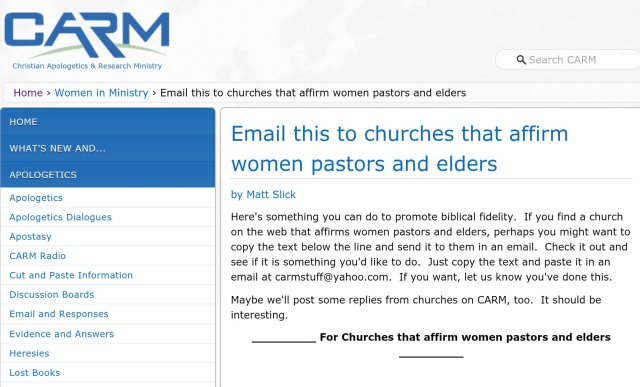
CARM Resource on Female “Pastors”

CARM has a great resource for sharing biblical truth about female "pastors".


Are you familiar with the Christian Apologetics & Resource Ministry (CARM)? You should be. It’s an invaluable resource. From answers to tough questions, to apologetics training, to information on tons of cults, world religions, and heresies, CARM is a treasure trove of materials that will inform you, help you grow in your faith, and evangelize and disciple others.

Recently, I came across this resource article for churches which approve female pastors and elders. Readers often ask me for information like this that they can send out, so I thought I’d pass it along. Click here for the full article.

Christian women, Complementarianism

Women Teaching Men: My Thoughts on Aimee’s and Mary’s Articles

aimee mary

UPDATE: Please note, this article was written in 2016. It should not be construed to be a current endorsement of either Aimee or Mary.

My friends and readers are the best. They are so sweet and helpful when it comes to making sure I stay up to date on what’s happening out there in Evangelicaland. It’s like having a little army of really smart co-laborers who are great at research.

Last week, a couple of articles about women teaching men appeared on the Reformed complementarian women’s landscape, and several folks were kind enough to send them to me and ask for my reaction. I e-mailed the readers back with my responses, which I’ve posted below.

What is Sunday School? What Does it Appear to Be? And Who Can Teach It?
by Aimee Byrd
May 18, 2016

I have loved and respected Aimee’s work as a writer and podcaster for a while. This article was apparently written to clarify some things that had been said on a Mortification of Spin podcast.

“I didn’t catch the podcast, but I did read the article. I was disappointed with what Aimee said, because Steve’s comments [Steve Cooley’s comments in the comment section following the article] are correct. Also, if we look at the broad pattern of male headship in Scripture…

man was created first, then woman
woman was created to be helper to man
women are to submit to their husbands
women are not to serve in the office of elder or pastor
women are not to preach to men
women are not to exercise authority over/lead men in the church

…which fits better with this pattern, women teaching men in co-ed Sunday School or women notย teaching men in co-ed Sunday School? I think it’s pretty clear that women notย teaching men in co-ed Sunday School fits best. Why would God set this pattern of male headship in motion and then turn around and contradict it when it comes to women teaching men in Sunday School?

Furthermore, the gathering of a body of believers for studying the Bible isย the gathering of the church, whether it is in someone’s home (like the first century church), a sanctuary, or a Sunday School classroom. We’re the ones who have invented all these lines of delineation between Sunday School, worship service, Christian conferences, revival meetings, etc., and then tried to go back and figure out which of these man-made distinctions 1 Timothy 2:12 applies to. When 1 Timothy was written, they didn’t have all that. The church was just the gathering of the believers for worship, study, etc. So 1 Timothy 2:12 applies to the gathered body of believers without respect to all these artificial lines we’ve drawn.”

Again, I have great respect for Aimee, but I disagree with her on this particular issue. It’s possible that the differences in our denominational viewpoints of Sunday School play a big part in this, and that if we ever had the chance to sit down and hash it out over coffee or something, we might find more common ground.

Women Teaching Men- How Far is Too Far?
by Mary Kassian
May 21, 2016

I’m not as familiar with Mary as I am with Aimee, but I’ve read and enjoyed a few of her articles. This one may have been a response to Aimee’s article above.

“Good stuff! I agree with her about 90%. I love that she brought out the part about “teaching under a man’s authority.” I wrote about that not long ago. It’s nice to hear somebody with a bigger platform say it. I hope people will listen to her!

I also love what she says about what we love versus following a set of rules. So true! Another aspect of this that I run into frequently with women who want to preach is that they’re so focused on leading they forget about Jesus’ example of humility in servanthood. We’re supposed to be focused on serving, not gaining notoriety.

My main disagreement with her would be the line she (and most others who address this issue) draws between the worship service and things like Sunday School and Christian conferences. Those are really man made lines of distinction rather than biblical ones. The “church” is the gathered body of believers for worship and biblical instruction. So whenever believers are gathered for those purposes – whether weย call it Sunday School or worship service or a Christian conference, and whether it’s in a sanctuary, Sunday School classroom, or conference center – that’s the church, and the Scriptural mandate for women not to teach or hold authority over men applies.

I also think it’s interesting that in the second paragraph under “Can Women Teach Under Male Authority” she rightly points out, “The text doesn’t say, ‘A woman may teach men if…'”. But then later in the article she talks about how she feels it’s OK for her to teach men if they’re much younger than she is. Well, just like the text doesn’t say a woman can teach men if she’s doing so under male authority, it also doesn’t say it’s OK for a woman to teach men if she’s much older than they are. It just says “don’t”. Curious.”

Mary’s position on this issue is much more similar to mine. I hope to hear more from her about this in future articles.

Complementarianism

Fencing Off the Forbidden Fruit Tree

Often, with regard to 1 Timothy 2:12, husbands and pastors will reassure a woman that itโ€™s OK for her to teach that co-ed Sunday School class or step into a church leadership role reserved for men because sheโ€™ll be doing so โ€œunder his [husbandโ€™s or pastorโ€™s] authority.โ€

But is that biblical?

When God tells us (in context, rightly handled, of course) not to do something and we do it anyway, that is sin. Only God has the authority to say what is sin and what is not. No one โ€“ not your pastor, your husband, your parents, your best friend, the Pope, nobody โ€“ has the authority to tell you that itโ€™s OK to do something God has said is sin. That authority belongs to God alone.

Try inserting any other sin into that situation. Does your husband, pastor, or anyone else have the authority to tell you itโ€™s OK to lie? Cuss? Covet? Of course not. And why would they even consider doing such a thing?

My point exactly.

The issue here is that this particular sin (teaching/exercising authority over men) has become so acceptable in the church that we no longer even see it as sin. If your husband or pastor gave you the go ahead to preach to or teach men in the gathered assembly of the church body, and you were to ask him to show you in Scripture where God says itโ€™s OK for him to allow you to do that, he would quickly realize that he is not basing his decision on Scripture (because there is no Scripture that allows him to give you that permission), but on his own personal opinion that itโ€™s OK. And that opinion has been heavily influenced by the fact that this sin is now so widely acceptable in the church at large.

Beth Moore is a perfect example of why husbands and pastors should not allow or encourage women to violate Godโ€™s word by teaching men. Beth Moore started out teaching a womenโ€™s Sunday school class in her home church. It grew. Men wanted to attend the class (a problem Iโ€™ve addressed here). She was hesitant, so she talked to her husband and pastor about it. They both told her it was OK because she would be teaching the men โ€œunder their authorityโ€ (despite the fact that thereโ€™s no passage of Scripture that allows them to say that or gives them the right to lay some sort of “mantle of authority” on her) That initial compromise led to another and another. Fast forward to today, and this is still the argument Beth Moore โ€“ in all of her false doctrinal glory โ€“ uses for preaching to men if she bothers to defend herself at all. And she has influenced thousands of women (and their husbands and pastors) to do the same.

But it doesnโ€™t matter how sound our doctrine is, when women stand in front of co-ed groups and teach (or accept positions of authority over men in the church) we are teaching more than just whatโ€™s coming out of our mouths. Weโ€™re teaching that group of people by example that itโ€™s OK for women to teach men. That Godโ€™s Word can be ignored and disobeyed in this area while we stand there urging them to obey it in other areas. How can a woman exhort a group to obey God while she is standing there disobeying Him herself?

Itโ€™s my prayer that weโ€™ll begin to see more husbands and pastors uphold Godโ€™s Word and protect their wives and female church members from sinning by encouraging them to fulfill all of the wonderful roles God has for women in the church and by fencing off that one tree in the garden that bears the forbidden fruit of teaching and exercising authority over men.

Adapted from a Facebook mini-blog.

Additional Resources:

Rock Your Role

Rock Your Role: Jill in the Pulpit

Rock Your Role FAQs

The Mailbag: Counter Arguments to Egalitarianism

The Mother of All Rebellions: Having a Woman Preach on Motherโ€™s Day

Complementarianism, Rock Your Role

Rock Your Role: Oh No She Di-int! Priscilla Didn’t Preach, Deborah Didn’t Dominate, and Esther Wasn’t an Egalitarian

Rock Your Role is a series examining the โ€œgo toโ€ and hot button Scriptures that relate to and help us understand our role as women in the church. Donโ€™t forget to prayerfully consider our three key questions
as you read.

How can you say women arenโ€™t to preach to, teach, or hold authority over men in the church? What about Deborah, Esther, Huldah, Phoebe, Priscilla, and the women at Jesusโ€™ tomb? Didnโ€™t they all preach to men, teach them, or hold authority over them?

Thatโ€™s one of the arguments often put forth by people who reject what Godโ€™s word plainly says about the biblical role of women in the church. And the short answer is very simple: Yes and no, and so what?

But maybe a longer answer would be better.

First of all, thereโ€™s a proper way and an improper way to understand Scripture. We want to make sure we understand Scripture the proper way. When we look to Scripture to find out how we should behave – what we should do and not do โ€“ we do not look first, or primarily, at the biographies of people in the Bible and what they did or didnโ€™t do, and model ourselves after them.

Broadly speaking, there are two main types of Scripture: descriptive and prescriptive. Descriptive passages describe something that happened: Noah built an ark. Esther became queen. Paul got shipwrecked. These passages simply tell us what happened to somebody. Prescriptive passages are commands or statements to obey. Donโ€™t lie. Share the gospel. Forgive others.

If we wanted to know how to have a godly marriage, for example, we would look at passages like Ephesians 5:22-33, 1 Corinthians 7, and Exodus 20:14,17. These are all passages that clearly tell us what to do and what not to do in order to have a godly marriage.

What we would not do is look at Davidโ€™s and Solomonโ€™s lives and conclude that polygamy is Godโ€™s design for marriage. We would not read about Hosea and assume that God wants Christian men to marry prostitutes. We would not read the story of the woman at the well and think that being married five times and then shacking up with number six is OK with Jesus.

When looking for instruction about the role of women in the church, we look to clear, prescriptive passages which tell us what to do and what not to do, not descriptive passages about various women in the Bible.

And when looking for instruction about the role of women in the church, we look to clear, prescriptive passages which tell us what to do and what not to do, not descriptive passages about various women in the Bible.

Descriptive passages may support, but never trump, the clear instruction of prescriptive passages.

But just for funzies, letโ€™s take a quick look at these ladies so often trotted out in defense of Christian women disobeying Scripture. (If youโ€™re unclear as to what Godโ€™s word says about womenโ€™s role in the church, you might want to check out this article and this article before reading further.)

Deborah, Huldah, and Esther:

The very first thing we need to remember about these ladies is that they were under the old (Mosaic) covenant of the Old Testament, not the new (grace) covenant of the New Testament. There are a lot of things about the old covenant that no longer apply to Christians in the New Testament because Christ fulfilled the law of the old covenant (Bacon and poly-cotton blends, anyone?). Likewise, there are things about the new covenant that did not apply under the old covenant (The church? Evangelism? Nowhere to be found in the Old Testament.), or for which there are no reasonable precedents in the Old Testament because the church is a new covenant institution.

None of these women were pastors. None taught men the Scriptures in the church (or even temple) setting. None assumed authority over men in the church (or even the temple).

Deborah was a judge. She decided disputes between Israelites and discussed with Barak battle instructions that God had already revealed to him. When Barak refused to stand up and fight like a man, God used Deborah, a woman, to show him that another woman, Jael, would get the glory for killing Sisera. In a patriarchal society a woman in leadership and a female war hero would not have been seen by men or women as a positive thing, but rather as shaming men who were too cowardly to step up, lead, and protect their women and children.

Huldah was a prophetess. She was sent for during the reign of Josiah when the temple was being repaired and the priests hadnโ€™t even been able to find the book of the law for years. Again, what does it say about the spiritual condition of the most important men in the country โ€“ the king and the high priest – when they, in a highly patriarchal society, have to humble themselves and seek out a woman to tell them what God says? Huldah repeated to them what God had told her, and that was it. Since we now have Godโ€™s written word and He no longer speaks through direct revelation this way, there is no parallel between Huldah and New Testament women preaching, teaching, and exercising authority.

Esther, under threat of death, couldnโ€™t even talk to her own husband without his permission, so Iโ€™m not really sure why people seem to think she exercised any authority over men. In fact, the writer of the book of Esther several times makes a point of saying how obedient she was to Mordecai. Esther wasnโ€™t a spiritual leader, she was a queen. The word โ€œGodโ€ isnโ€™t even mentioned in her book, and she certainly didnโ€™t instruct anybody in the Scriptures. Esther is probably one of the weakest examples you could come up with as support for women preaching, teaching, or exercising authority in the church.

The Women at Jesus’ Tomb, Priscilla, and Phoebe

The women at Jesusโ€™ tomb were sort of Old Testament-ish, too, if you think about it. The church didnโ€™t yet exist when they saw Jesus resurrected and ran back to tell the disciples about it. Still, this was not preaching, teaching, or holding authority over the disciples even in a non-church setting. This was a) giving eyewitness testimony of what they had seen and b) carrying a message from Jesus to the disciples. There was no commentary or instruction from the women to the disciples, just a report on what they had seen and a message of where Jesus and the disciples would meet up. And, really, donโ€™t people usually see โ€œmessenger boysโ€ (or girls) as subservient to the people theyโ€™re carrying messages between?

Priscilla (or Prisca) might be the best known Christian woman in the church era of the New Testament. When people try to use her as an argument for female preachers, teachers, and authority, they usually go to Acts 18:26 which says that she and her husband took Apollos aside and fully explained the gospel to him. This was a private meeting among the three of them, likely in their home over a meal or other casual circumstances, not preaching or teaching in the church. Additionally, the Bible makes absolutely no mention of how much, if any, of the actual “explaining” Priscilla did. Itโ€™s quite possible she just sat by as Aquila did the majority of the explaining and contributed only here and there or when Aquila forgot something.

Phoebe is mentioned once in the New Testament, in Romans 16:1-2. Paul commends her to the church at Rome and asks them to help her out because she has been a good servant of the church at Cenchreae. That the word โ€œservantโ€ can also be translated as โ€œdeaconessโ€ in no way indicates that Phoebe (or Priscilla or Junia or any of the other women mentioned in Romans 16) preached to or taught men or exercised authority over men, despite the fact that male deacons today might do such things. The Greek word diakonos simply means โ€œservant.โ€ Acts 6:1-6 gives us a glimpse at some of the services the early deacons likely provided- โ€œwaiting tablesโ€ and meeting the physical needs of the believers. The apostles even drew a distinction between their preaching of the word and the need for others to minister to the material needs of the people.

And one more thing about Priscilla, Phoebe, and the other women of Romans 16: Who โ€“ under the inspiration of the Holy Spirit – wrote the book of Romans? Paul. Who โ€“ under the inspiration of the Holy Spirit โ€“ wrote 1 Timothy 2:11-15? Paul. Would the Holy Spirit have led Paul in Romans 16 to praise women who were rebelling against His Word in 1 Timothy 2? Have you ever known God, anywhere in Scripture, to praise people who unrepentantly break His Word? Would it make any sense, logically, for Paul to praise in Romans 16 women who were habitually and rebelliously disobeying his instructions in 1 Timothy 2?

Would it make any sense for Paul to praise in Romans 16 women who were habitually and rebelliously disobeying his instructions in 1 Timothy 2?

God does not contradict Himself. Godโ€™s Word does not contradict itself. If He gives us an explicit command, biographical details of a Bible characterโ€™s life do not override that command, and we are to obey it.

While there are numerous, important ways God wants Christian women to serve Him in the church, the Bible is clear that we are not to preach to or teach men or exercise authority over men in the assembly of believers. We are to follow in the footsteps of godly women like Esther, Priscilla, and all the others by humbly submitting to His Word and obeying it.

We are to follow in the footsteps of godly women like Esther, Priscilla, and all the others by humbly submitting to His Word and obeying it.


Additional Resources:

Bad Examples of Women Pastors (But Great Examples of Godly Women) by Gabe Hughes