Christian women, Discernment, Men

Throwback Thursday ~ Women and False Teachers: Why Men Don’t Get It, and Why It’s Imperative That They Do

Originally published September 22, 2017

Confession time: Sometimes – OK, often – I think my brain works more like a man’s than a woman’s. You’ve got a problem? Suck it up- here’s the solution. The mall? A perfectly horrifying way to ruin a Saturday. And why do we have to hug people hello and goodbye when we see each other multiple times a week?

I’ve always been more comfortable around men, and when I was single, I had mostly male friends. They’re generallyยน less mysterious and easier to figure out than women, and they don’t usually play those manipulative emotional games some women can be notorious for. If a man says he wants a cheese sandwich, there’s no hidden “you don’t bring me flowers often enough” meaning there. He just wants a cheese sandwich. I like that. It’s pretty much how I operate.

Which makes me the perfect person for God to plunk down smack dab in the middle of women’s ministry, right?

Harrumph.

God just has this way about Him of stretching us and growing us beyond our comfortable little confines. I used to be terrified of walking into a room full of women (They’re so unpredictable! You never know when a big emotional scene might break out!) But after years of teaching and discipling women, developing close friendships with women, serving and ministering to women, I now walk into that room and see precious sisters, created oh so tenderly and intricately by God’s loving hands.

God purposefully and intentionally made each woman unique, but with common traits and perspectives that bind us together as sisters and differentiate us from men. And because men aren’t wired by God the same way women are, sometimes they’re just not going to get the way women think about things, approach people, or respond to issues. Sometimes (shopping, flowers, hugginess) that’s no big deal. They can shrug their shoulders, extend grace, and make space for the women in their lives to think, feel, and react differently than men would without really taking the time to understand why.

There’s at least one biblical issue women respond to differently at the core level of their spiritual DNA than men do. And men, it’s crucial that you get it on this one.

But there’s at least one biblical issue women respond to differently at the core level of their spiritual DNA than men do. And men, it’s crucial that you get it on this one. You’re the pastors. The elders. The husbands. The fathers. The ones responsible before God for leading your churches and your families in doctrinally sound spiritual growth. You’ve got to get this for the sake of the girls and women you lead:

Women respond differently to false teachers than men do.

And, ladies, we need to understand this about ourselves, too.

It started, not with the advent of modern feminism, or the church age, or even the Fall. It started in the Garden.

Genesis 3 begins…

Now the serpent was more crafty than any other beast of the field that the Lord God had made. He said to the woman

Have you ever wondered why the serpent approached Eve instead of Adam?

Before sin entered the world, before that snake in the grass even thought up his dastardly plan of deception, there was a void in the world. None of the animals or birds could fill it. Neither could Adam. God determined that, in order to make His creation complete, there was a need for woman to fill that void. So He reached down with His own two hands (so to speak) and personally crafted a woman.

God had made both animals and Adam out of cold, dead dirt. Not so with woman. God made woman out of soft, warm, living flesh, already coursing with life. God made man to tend the ground from which he had come. God made woman to tend the man from which she had come.

God made man to tend the ground from which he had come. God made woman to tend the man from which she had come.

And in the same way that God used a different method for creating man and woman and gave them different modes of work, He also gave them different mental and emotional makeups.

God created women with some incredible strengths. Women are usually much better nurturers than men. We’re often better at negotiating, compromising, and making peace between opposing parties. We’re more sensitive to what others are going through and how to treat people in a kind and compassionate way. We bear up under certain pains and stressors better than men do. We’re usually better communicators than men. And, frequently it’s much easier for women to trust, love, and give the benefit of the doubt to others.

And along with those unique strengths come unique challenges that we have to watch out for and that men need some insight about.

We’re kinder and more compassionate, so we have to be careful about people who would take advantage of that. Nurturing is great for raising our children, but if we baby them all their lives, that’s not healthy. Being trusting is a fantastic character trait, but it’s imperative that we be vigilant not to put our trust in the wrong person.

Could it be that the serpent approached Eve instead of Adam because he thought she would be more trusting, give him the benefit of the doubt, and thus be easier to deceive?

First Timothy 2:14 echoes this idea. In 1 Timothy 2:11-14, God explains that women are not to teach men or exercise authority over men in the gathered body of Believers – the church. He gives two reasons for this in verses 13-14. The first reason (13) is the Creative order: “Adam was formed first, then Eve”. God’s second reason is in verse 14:

and Adam was not deceived, but the woman was deceived and became a transgressor.

It’s interesting that verse 13 refers to the specific woman, Eve, but verse 14 uses the more generic term “the woman.” Are women, as a whole, more likely to be victimized by deceivers than men are? Scripture seems to point us that direction.

In 2 Timothy 3:1-9, Paul warns Timothy that people – including those in the church – will become more and more degenerate during the last days. There will even be those who have an outer facade of godliness but are not operating by the power and indwelling of the Holy Spirit (5). In other words: false teachers. Verses 6-7 tell us that among these false teachers are those…

…who creep into households and capture weak women, burdened with sins and led astray by various passions, always learning and never able to arrive at a knowledge of the truth.

In verse 16 of this same chapter we read that “all Scripture is breathed out by God,” and we know that God never makes mistakes or chooses His words haphazardly. So we know there’s a reason God uses the words “weak women” here. Not weak men, not weak Christians, not weak people – weak women. God graciously gives a warning to women not to be taken in by these false teachers, and an exhortation to men – particularly pastors, since this is a pastoral epistle – to protect the women of their churches and families against those who would prey upon tenderhearted, trusting women.

One reason these women are weak is that they’re led astray by various passions. Today, the word “passion” or “passionate” often has a sexual connotation, but that’s not the only meaning, especially not here. Dictionary.com defines passion as “any powerful or compelling emotion or feeling, as love or hate; a strong or extravagant fondness, enthusiasm, or desire for anything.” Merriam-Webster says passion is, “the emotions as distinguished from reason; a strong liking or desire for or devotion to some activity, object, or concept.”

As with so many other valuable characteristics God has blessed women with, passion is a two-edged sword. God wants us to have a passion for holiness, pursing Christ, and biblical ministry to others, but we have to be extremely careful to steward that passion with the reins, bit, and bridle of discernment and knowledge of the Scriptures. Otherwise, we will pour our passion – our powerful and compelling loyalty, enthusiasm, fondness, and love – into the wrong teachers and doctrines.

Which brings us full circle to Eve, because that’s where her train jumped the tracks.

But the serpent said to the woman, โ€œYou will not surely die. For God knows that when you eat of it your eyes will be opened, and you will be like God, knowing good and evil.โ€ So when the woman saw that the tree was good for food, and that it was a delight to the eyes, and that the tree was to be desired to make one wise, she took of its fruit and ate, and she also gave some to her husband who was with her, and he ate.
Genesis 3:4-6 

Notice the serpent doesn’t invite Eve to do something blatantly evil. “God knows…” “…you will be like God.” He’s tempting her to do something she thinks is godly. Then Eve takes her eyes off God and His Word and looks instead at the tree.

๐ŸƒIt was good for food The fruit would satisfy a felt need. It was practical. She and Adam needed supper. Here was an easy solution. And, besides, it looked delicious and nutritious.

๐ŸƒIt was a delight to the eyes– The fruit appealed to Eve’s sense of beauty. It looked good to her.

๐ŸƒIt was to be desired to make one wise– Eve had a passion to grow in wisdom and godliness, and this beautiful, appealing, practical, attractive fruit seemed, in her eyes, the best and most enjoyable way to reach that goal.

This is the same way women are being deceived today. The attractive “tree” (Ever notice that most false teachers are at least somewhat physically attractive – “a delight to the eyes”?) extends a branch with lovely-looking, supposedly nutritious fruit on it which she says will lead to godly wisdom and growth (even though her teaching conflicts with God’s written Word). And it’ll be delicious too. Those who bite the apple will feast on love, positive thoughts, encouragement, and self-esteem-building teaching. It’s too appealing to the woman’s senses – and she’s too weak in her knowledge of Scripture and her desire to obey it – to pass up. She succumbs to the passions of her senses, plucks the fruit, and eats.

And then a fascinating phenomenon begins to take place. The weak woman feeds her passions with the fruit of false doctrine, and then she begins to pour that passion – that intense, compelling loyalty, love, fondness, and enthusiasm – into the false teacher herself. As anyone who has ever tried to gently open a devotee’s eyes can attest, hell hath no fury like a confronted Beth Moore disciple. I have seen women defend their favorite false teachers – against clear Scripture, mind you – with a viciousness I’m not sure I could muster to protect my own children against physical harm.

Men may enjoy a particular false teacher, but women worship them.

Men may enjoy a particular false teacher, but women worship them.

And this is the crux of the difference that men rarely grasp when the topic of discernment comes up. I’ve talked to countless pastors who don’t understand why simply preaching and teaching sound doctrine from the pulpit and in the Sunday School class isn’t sufficient to protect their churches from the infiltration of false doctrine and false teachers. This is why.

I’ve talked to countless pastors who don’t understand why simply preaching and teaching sound doctrine isn’t sufficient to protect their churches from false doctrine and false teachers. This. is. why.

Maybe a man will hear hear a biblical truth, realize the preacher he’s been listening to conflicts with it, and simply walk away. A woman won’t. Because, not only has the teaching a woman listens to inextricably wrapped its tentacles around the very core of her soul, she has also formed an emotional bond with the teacher that’s almost impossible to break. She loves her. And she will nearly always choose that loving, bonded “relationship” over biblical truth, giving the teacher the benefit of the doubt and making excuses for her every step of the way.

A woman will nearly always choose that loving, bonded “relationship” with the teacher over biblical truth, giving the teacher the benefit of the doubt and making excuses for her every step of the way.

The Holy Spirit gets it. He understands the power false teachers wield over weak women and the destruction false teaching in general brings upon the church, so He inspired Paul to write Titus 1:9:

[A pastor] must hold firm to the trustworthy word as taught, so that he may be able to give instruction in sound doctrine and also to rebuke those who contradict it.

Pastors who only preach sound doctrine are only doing half their job.

Pastors who only preach sound doctrine are only doing half their job. And notice that this verse doesn’t merely say to “rebuke teaching that contradicts sound doctrine” in a generic sort of way. It says rebuke “those who” contradict it. “Those who” are people. Specific people. People with names.

Many pastors and teachers don’t want to name names of false teachers. They’ll quote false teachers, allude to them, describe them, and drop hints as to their identity, hoping against hope their church members will figure out who they’re talking about and stop following them. But they don’t want to call specific names. I understand the fear of naming names. It opens pastors up to attack by the aforementioned disciples of false teachers. I’ve experienced their venom, and believe me, nobody wants to go through that.

Guys – pastors, teachers, husbands – I’m telling you the women you’re preaching to, the women who are in the tightest clutches of false teachers aren’t getting your veiled allusions to generic, unnamed “false teachers”.

But guys – pastors, teachers, husbands – I’m telling you the women you’re preaching to, the women who are in the tightest clutches of false teachers aren’t getting it. They are not going to hear your veiled allusions to “some Christian authors who say…” or “the pastor of one of the largest churches in America teaches…” and think you’re talking about the false teacher they’re following. They think you’re talking about somebody else. The guy their neighbor is following. That crazy preacher on TBN. But not my favorite Southern Baptist “Bible” study teacher who’s a best seller at LifeWay and is touted on social media by well known pastors.

It takes courage – manly courage – to stand up in front of your congregation, class, or wife and warn them against specific false teachers, but that’s what godly men – who love the women in their churches and families and want to see them spiritually healthy – do.

We need your help, men. The church needs your help. Your family needs your help. Please get this so you can help other “Eves” not to be deceived and weak women to become strong followers of Christ, not false teachers.


ยนIf it’s not abundantly clear from context, please understand that I’m speaking in generalities in this article. Naturally, individuals vary.


Additional Resources

Popular False Teachers & Unbiblical Trends

Is She a False Teacher? 7 Steps to Figuring it Out on Your Own

Clinging to the Golden Calf: 7 Godly Responses When Someone Says Youโ€™re Following a False Teacher

Basic Training: Being Berean- 8 Steps for Comparing Teaching toย Scripture

Do You MIND? : Five Reasons for Pastors to Mind What Their Brides Areย Reading

Women In Combat

Mailbag

The Mailbag: Potpourri (Do they know they’re heretics? … Removing Allie … Confirmation invitation?)

Welcome to another โ€œpotpourriโ€ edition of The Mailbag, where I give short(er) answers to several questions rather than a long answer to one question.

I like to take the opportunity in these potpourri editions to let new readers know about my comments/e-mail/messages policy. Iโ€™m not able to respond individually to most e-mails and messages, so here are some helpful hints for getting your questions answered more quickly. Remember, the search bar (at the very bottom of each page) can be a helpful tool!

Or maybe I answered your question already? Check out my article The Mailbag: Top 10 FAQs to see if your question has been answered and to get some helpful resources.


I am wondering, do people who fit the definition of heretic know they are wrong? Are they consciously rejecting the gospel or genuinely confused / misinterpreting it?

Great question! In my experience, false teachers fall into one of two categories:

1. Con artists who know the whole false teaching universe is a sham, but they’ve observed how much money can be made off the grift and want a piece of the pie, so they feign believing and teaching false doctrine in order to scam people out of their money. They’re no different from people who run pyramid schemes or fake land deals to cheat people. Think Elmer Gantry. These folks are a tiny – I mean, microscopic – segment of those we would call false teachers.

2. Nearly all heretics and false teachers would fall into the second category- the deceived deceivers.

But evil men and impostors will proceed from bad to worse, deceiving and being deceived.

2 Timothy 3:13

with gentleness correcting those who are in opposition, if perhaps God may give them repentance leading to the full knowledge of the truth, and they may come to their senses and escape from the snare of the devil, having been held captive by him to do his will.

2 Timothy 2:25-26

They are deceived into believing that what they’re teaching is the truth and that discerning Christians who rebuke them are “legalistic” or “Pharisees” or “putting God in a box” or some such nonsense.

The people you describe as “genuinely confused / misinterpreting it,” are not in the category of “false teacher”. They are in the category of “genuine Christian in need of discipleship,” much like Apollos. He was teaching what, as far as he knew, was the truth of the gospel. When Priscilla and Aquila took him aside and corrected him, he embraced that correction, began teaching the gospel correctly, and was sent out with joy by the church to continue teaching.


Why did you remove Allie Beth Stuckey from your Recommended Bible Teachers, Authors, etc. list?

Please believe me when I say I didn’t want to, and I waited longer to remove her, and extended more grace and benefit of the doubt to her than anyone else I’ve ever removed (which, praise God, has only been a handful of people). But in fairness to others I’ve removed, to avoid being hypocritical, and out of concern for my followers, I had no choice.

I have been listening to Allie’s podcast, Relatable, for about five years now. I have always thought she did a wonderful job of discussing political issues from a biblical worldview, and explaining these issues in a way that puts them on the bottom shelf for people like me who don’t keep up or don’t get it. That was why I initially started listening.

As her show became increasingly theological in nature, a few things occasionally gave me pause, but nothing that couldn’t be quickly overlooked with love for someone who is generally doctrinally sound.

But then there were the interviews with professing Christians who are biblically problematic. I do want to stress that the vast majority of professing Christians Allie interviewed through the end of 2024 (the last time I listened to an episode) were solid and doctrinally sound. I also want to make clear that I think it’s perfectly acceptable for a Christian host of a Christian podcast to interview lost people (who don’t profess to be Christians) when the topic warrants that. And that is par for the course when your primary field is politics. Neither of these are the interviews I’m referring to.

The interviews I’m talking about have been interviews with professing Christians who have ranged from problematic to literal heretic, and who have shared their testimonies or offered commentary on theological issues. Allie has not had them on the show to challenge their unbiblical beliefs, teachings, or actions, but to present them as acceptable teachers and/or brothers and sisters in Christ.

The Robertsons- Allie has interviewed various members of the Robertson family of Duck Dynasty fame. The Robertsons’ church (where Phil and Al are elders), is part of the Church of Christ denomination, which teaches baptismal regeneration. Baptismal regeneration, in a nutshell, is the belief that you must be baptized in order to be saved – that salvation does not take place until you have been baptized. This is a false gospel.

And yet, Allie has platformed Phil, Al, Willie, and Jase Robertson on the show in episode 1145, Jase and Al Give an Update on Phil Robertsonโ€™s Tragic Diagnosesepisode 592, Sharing the Gospel with Trump, and episode 1009, Confidently Sharing the Gospel, all of which were largely about evangelism. You don’t invite people on your show who believe and teach a false gospel1 to get their insights about sharing the gospel.

In April of 2024, Allie interviewed Tara-Leigh Cobble, in The Bible Isnโ€™t About You | Guest: Tara-Leigh Cobble | Ep 993, and despite being provided with information about why Tara-Leigh is biblically problematic

…recommended her again in this January 2025 Instagram post:

Then there was Is ‘The Chosen’ Biblical? | Guest: Dallas Jenkins | Ep 726. The obvious answer to any doctrinally sound Christian who has watched or researched The Chosen is, “Absolutely not!”. But it seemed as though perhaps Allie was not very familiar with The Chosen, and the interview mostly consisted of softball questions, which had the (unintended, I’m sure) effect of giving Dallas Jenkins not only a pass on the blasphemy he’s responsible for, both on screen and off, but further opportunity to deceptively claim to a large audience that said blasphemies are actually biblical. (Commendably, however, Allie did make very clear that Mormonism is not Christianity, when that issue arose during the interview.)

I have also had readers ask me to address the fact that Candace Cameron Bure has been a guest on Relatable and was featured at Allie’s Share the Arrows conference for Christian women in 2024. Candace is someone who has flown under my radar because she’s not really a teacher, per se, she’s an actress, but she does share and promote a lot of false teachers on Instagram and her podcast (e.g. Gather25, she had Priscilla Shirer co-host the entire eighth season of her podcast, Jennie Allen, the entire sixth season, Bianca Olthoffseason 4, and Tara-Leigh Cobbleseason 1), and if she’s being platformed (by Allie or anyone else) as someone to listen to about Christian issues, this is extremely problematic.

But the interview that finally forced me to remove Allie from my recommends was in December of 2024 when she had Lisa Bevere on the show, not only introducing her as “a sister in Christ,” but promoting her new book.

Allie also appeared with Lisa on pro-life org Live Action’s podcast, The Lies Women Face | Exclusives with Lisa Bevere & Allie Beth Stuckey.

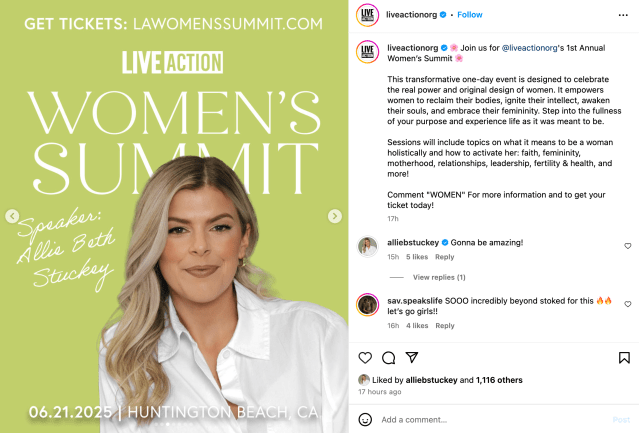
And, as far as I know, Allie is still scheduled to appear with Lisa again in June 2025 at Live Action’s Women’s Summit.

Lisa Bevere is a literal heretic. She and her husband John teach New Apostolic Reformation heresy, and are well known speakers and celebrities in the NAR world. This is not hard to find out. It takes only a few minutes and a search engine. You can read more about the Beveres in my article about them.

Allie and I have exchanged a handful of DMs in the past, so I reached out to her twice after the episode posted but didn’t receive a response (which is understandable since I’m sure she probably receives hundreds of messages a day). When she posted about the episode on Facebook, she received well over a hundred comments, all but a few of them reproving her for platforming Lisa.

I continued listening to Relatable, hoping that, even though it wouldn’t be easy, Allie would offer some sort of retraction, warning her listeners away from Lisa and her heretical teaching, but none was forthcoming.

Several weeks ago, I reached out to Allie again, including the link to my article about the Beveres and encouraging her to publicly retract her support of Lisa. This time, Allie graciously and kindly thanked me and said she would read the article. I have reached out to her twice since then to ask her thoughts, but haven’t heard back from her yet. I’m sure she’s just very busy and will get to it when she can.

To date, as far as I know, Allie has not publicly repented for and retracted her promotion of Lisa, and, as you can see above, the episode with Lisa has not been removed from her YouTube channel.

These are the reasons I’ve removed Allie from my list of recommended teachers and authors.2

UPDATE (May 2025): Since the publication of this article just two months ago, I’ve become aware of two additional serious instances of Allie’s lack of discernment:

1. Allie is scheduled to be a featured speaker at Gabe and Rebekah Lyons‘ Thinq Summit conference (formerly Q Conference/Q-ideas). The Lyonses are extremely progressive (liberal) in their theology. They’re egalitarian, affirming of homosexuality and other sexual immorality, and yoke almost exclusively with false teachers. Read more here.

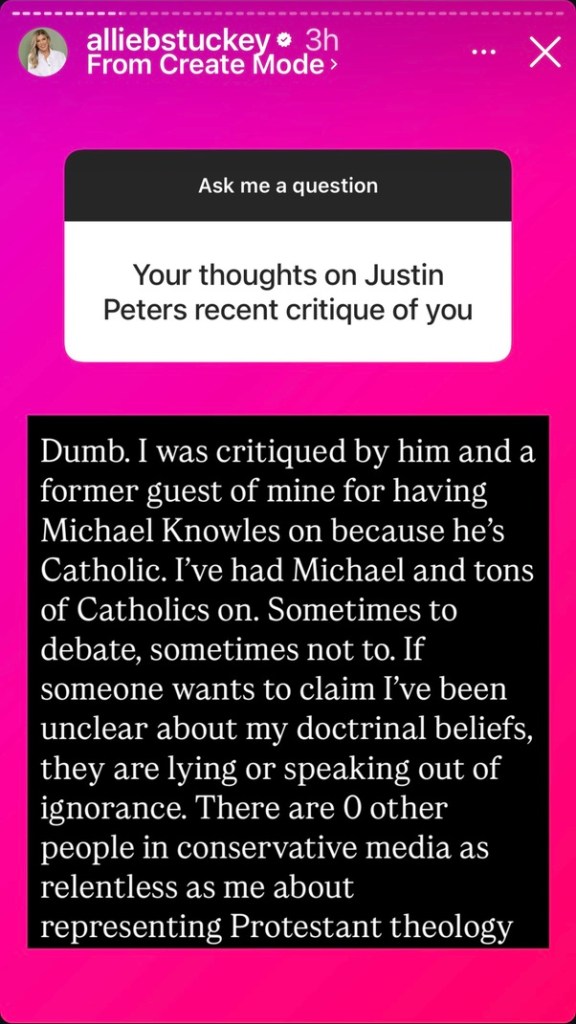
2. Allie recently platformed (see “Additional Resources” below) Michael Knowles, a staunch Catholic, on her show, seemed to treat him as a brother in Christ, and recommended his show and books to her audience. More info on Catholicism here. More details on why platforming Michael was problematic here (full video here), which Allie did not take kindly to.

Readers, I want you to clearly understand some things here, so please read the following information slowly, carefully, and as many times as you have to in order to grasp what I am and am not saying so that you won’t misrepresent me, or Allie, or jump to wrong conclusions.

I am not saying Allie, herself, is a false teacher. That’s not what removing her from my list of recommended teachers means. It simply means I can’t, in good conscience, and in fairness to others, proactively point people to her. For the foreseeable future, I have no reason or any plans to add her to my list of false teachers.

I am not questioning Allie’s salvation. I really feel like that should be obvious. The only reason I’m even saying this is because I know somebody who’s not reading carefully is going to jump to that wrong conclusion.

I am questioning Allie’s discernment, wisdom, and/or research. To whom much is given, much will be required (Luke 12:48). Allie has a large audience. Many of her followers are lost, new Christians, or undiscerning, which makes them especially vulnerable to false teachers. Before Allie platforms someone on her show as a brother or sister in Christ, a trustworthy Christian resource, or someone with expertise in an area of theology or the Christian life, she has a personal responsibility as a Christian to vet that person and make sure s/he is doctrinally sound so she won’t be thrusting vulnerable people into the arms of a wolf, or even someone who’s just theologically mistaken. Allie has failed to do this several times, which is the crux of the reason I’m pausing recommending her. If you choose to continue following Allie, I would strongly recommend that you vet anyone she interviews, platforms at her own events, or appears with at other events before you decide to follow or receive teaching from that person.

There’s nothing personal or emotional about this decision. I still love Allie to death and consider her a sister in Christ. I’m not mad or upset with her, and I hope that feeling is mutual. Although I’m somewhat disappointed that she hasn’t issued any sort of public retraction or statement of repentance – because that would be the biblical thing to do, and she has thus far failed to do it – removing her from the list of recommended teachers was a policy and ministry decision I was forced to make, not a personal one.

Everybody errs. I do. You do. This time, Allie did. We need to remember the grace Christ has extended to us while still exhibiting repentance when we sin, and expecting brothers and sisters in Christ to do the same. And we certainly need to remember the Golden Rule – to treat others the way we would want to be treated.

This doesn’t have to be permanent, and I’m hoping it’s not. I would love to add Allie back to my list of Recommended Teachers, Authors, etc., if and when that becomes an option.

Additional Resource:

Unequally Yoked: When Christians Platform False Teachers at A Word Fitly Spoken


How should we respond to an invitation to attend our niece’s confirmation in the Catholic Church?

Before we get into the mechanics of how to respond, everybody take a moment and think this through. How would you respond if you were invited to a ceremony or celebration for a loved one who was becoming a Mormon? A Hindu? A member of a cult? If you’re recoiling right now, that’s the same inward response you should have if you’re invited to attend a loved one’s initiation into Catholicism.

Catholicism isn’t Christianity. It is just as anti-Christian and anti-biblical as any of those other religions.

I know it’s really difficult when someone you love has embraced an unbiblical theology and invites you to celebrate with her. You love her, you want to participate in this with her just like you participate with her in birthdays, Christmas, and other special events, and you don’t want to be the big, bad Christian meanie. But out of loyalty to Christ, you can’t celebrate blasphemy and false doctrine, and out of love for your loved one, you can’t celebrate something that’s going to send her to an eternity in Hell.

So, what do you do? I don’t know how invitations to confirmations work. If it’s like a formal wedding invitation that includes an R.s.v.p. card (or some sort of response website, like The Knot), simply mark “will not attend” and send it back.

Whether or not you explain why you won’t be attending sort of depends on how close you are to this niece and her family, whether or not they pretty much already know why you’re not attending, and whether or not you want to.

If you’re not close with the niece and her family, you were just one of the 500 other people they invited, the aforementioned R.s.v.p. (or if it’s more casual, a verbal or text, “I’m sorry, but we won’t be able to make it.”) will suffice. If you want to write a letter or email briefly explaining why you can’t biblically attend, you can do that, just be sure to keep it kind and loving rather than attacking or lecturing.

If you are close with the niece and her family and you’ve already had some discussions about why Catholicism isn’t biblical, you can simply let them know you won’t be able to make it. They probably already know why, but if they ask, you can briefly remind them of your past conversations and that your conscience won’t allow you to attend.

If you’re close with the niece and her family, and you haven’t ever had any discussions about why Catholicism is unbiblical, you can try simply responding that you won’t be able to make it, but if you’re otherwise really involved in her life, they’re going to want to know why you’d miss such an important event. Do not make up an excuse. That’s lying. Briefly explain to them why your love and loyalty to Christ and your love for your niece won’t let you attend. If you think they’re open to it and it would help, you could even send them this resource.

Additional Resources:

Roman Catholicism: Mass Confusion at A Word Fitly Spoken

Truth and Love โ€“ with Mike Gendron at A Word Fitly Spoken


1Because I know I’m going to get the question, “Are you saying that the Robertsons aren’t Christians because they believe in baptismal regeneration?” here’s my answer: That’s something that would have to be determined on a case by case basis. They and their church also preach, teach, and believe the biblical gospel. I’ve heard them present it. If anyone genuinely repents and believes the biblical gospel, that person is saved at that moment. If he subsequently believes he has to be immediately baptized or he’s not going to Heaven when he dies, that’s a false belief, but it doesn’t negate that person’s genuine belief in the true gospel. Conversely, if he believes it’s his baptism that saves, regenerates, or justifies him, rather than repenting and believing the gospel, that person is not saved. You can see how you would really need to talk to an individual who holds to baptismal regeneration about exactly what he personally believes in order to help him understand whether or not he’s genuinely saved. Be all of that as it may, it is still a false gospel to teach that a person is not saved unless he is baptized. That is my point about the Robertsons being called upon as experts on evangelism on Allie’s show.

2I have also had followers alert me to some of the political rally-type events Allie has spoken at, and questioned whether or not she was unbiblically instructing men in the Scriptures or sharing the stage with other false teachers at these events. To be perfectly transparent, I haven’t looked into this, so I don’t know. If that’s a concern for you, I would encourage you to do the research for yourself.


If you have a question about: a Bible passage, an aspect of theology, a current issue in Christianity, or how to biblically handle a family, life, or church situation, comment below (Iโ€™ll hold all questions in queue {unpublished} for a future edition of The Mailbag) or send me an e-mail or private message. If your question is chosen for publication, your anonymity will be protected.

False Doctrine, False Teachers, Movies

Throwback Thursday ~ Movie Time: Church of Tares

Originally published March 22, 2022

Are you familiar with Rick Warren and his books from several years ago, The Purpose Driven Life and The Purpose Driven Church? Today’s Movie Time feature, Church of Tares, takes a look at Rick Warren, his materials, programs, and his mentors, and demonstrates how the “Purpose Driven” movement grew into the seeker driven and church growth / megachurch movements, and how they may eventually terminate into a one world religion.

Sound a little “out there” or borderline conspiracy theory? Well, we’ve been seeing a lot of “out there” things come to pass lately. Grab your popcorn, snuggle up on the couch, and watch and judge for yourself.

Supplemental Related Info:

Andy Stanley

Craig Groeschel

Steven Furtick

Dallas Willard, Richard Foster, and the “Contemplative Christianity” movement

Bill Hybels / Willow Creek

Discernment, False Teachers

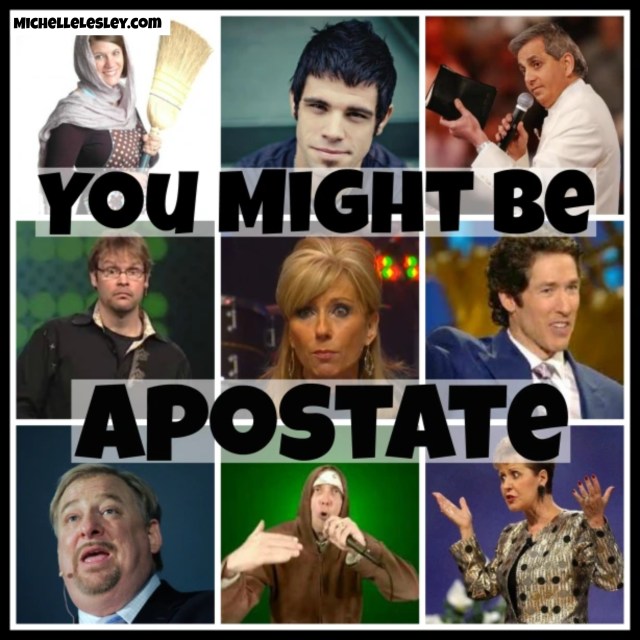
You Might Be Apostate

Originally published June 3, 2016

Comedian Jeff Foxworthy hit the big time several years ago with his “You Might Be a Redneck” one-liners. He frequently introduced the bit by saying, “I’ve found that there are rednecks all over, but sometimes people don’t know they’re rednecks. So, I came up with this little test…” and continued with such gems as:

“If you’ve ever had to carry a bucket of paint to the top of a water tower to defend your sister’s honor, you might be a redneck.”

“If your wife has ever said, ‘Honey, come get this transmission out of the tub so I can take a bath!’ you might be a redneck.”

“If you’ve ever been accused of lying through your tooth, you might be a redneck.”

It was a routine that a lot of us in the South found hilarious because we knew someone (or were someone) who fit nearly every one of Jeff’s jabs.

Like rednecks, there are apostate false teachers all over the place out there, only a lot of them (and their disciples) don’t know they’re false teachers. And the fruit of their lives and ministries is far wackier than anything a redneck has ever dreamed up. That fruit is a sign that we’d better examine the root of doctrine from which the fruit sprang.

So if any of the preachers and teachers you’re following have ever said or done the following things (or something even crazier), watch out, because they Might Be Apostate.

HoNuthaLevel

If you’re a middle aged pastor who makes embarrassing rap videos, who publicly extols the virtues of Spanx for men (even though it gives you gas) and who calls himself a Ferrari you might be apostate.

If you feature a Naked Cowboy impersonater (aka- your youth “pastor”) at your “Christian” women’s conference, you might be apostate.

If you’ve ever purposefully applied the pronoun “herself” to God, you might be apostate.

If you celebrated your 35th birthday by preaching at the “church” of your mentor, T.D. Jakes, and placing a $35,000 check in his offering wheelbarrow, you might be apostate.

If God has ever told you to go up to a stranger in the airport and ask if you can brush his hair, you might be apostate.

If you’ve ever given your congregation a sob story about needing a new $70 million Gulfstream jet, because the old one is worn out, you might be apostate.

If you think of the Holy Spirit as the “sneaky,” “silly,” “funny,” “blue genie from Aladdin,” you might be apostate.

If you’re a woman who thinks God is OK with you preaching to men despite what His Word clearly says to the contrary, you might be apostate.

If you’ve ever said, regarding your church’s worship service, “I probably wouldn’t have a stripper on stage…” but leave the door open to the idea because “God told Isaiah to walk around naked for three years,” you might be apostate.

Benny Hinn at Maple Leaf Gardens on Sept. 28, 1992 photos by Tony Bock/Toronto Star and handout photo.

If you think smacking people in the face with your Nehru jacket is a ministry of the Holy Spirit, you might be apostate.

If you’ve ever typed a Facebook status in tongues, you might be apostate.

If you say you’re a trinitarian, but think the Father, Son, and Holy Ghost are three “manifestations” of God rather than three Persons, you ARE apostate.

If you think Proverbs 21:9 means you should camp out on your roof in a quest for biblical womanhood, you might be apostate.

If your senior pastor father sexually abused boys at your church and paid them off to keep them quiet and you, as the subsequent pastor, knew about it but didn’t speak up, you might be apostate.

If you officiated at your homosexual son’s “wedding,” you might be apostate.

If you’re a pastor who thinks expository preaching is “cheating” because it’s “too easy” and that “it’s not the way you grow people” AND that we shouldn’t say “the Bible says…” AND that parents who take their children to a small church instead of a mega church are “stinkin’ selfish,” AND that we shouldn’t use the Bible to convince the lost of their need for Christ, AND that we need to “unhitch” from the Old Testament, you might be apostate.

If you’re Oprah’s idea of an awesome pastor, you might be apostate.

download

If your preaching, ministry, and theology have ever been publicly rebuked by John MacArthur, Paul Washer, or Justin Peters, you might be apostate.

If you partnered with a Roman Catholic mystic with a degree in spiritual psychology to make a completely unbiblical movie about the Bible featuring ninja angels and Mary Magdalene bossing the disciples around, you might be apostate.

If you and your 80s rock star third husband stand in the pulpit and tell people to watch porn to improve their sex life, you might be apostate.

If a feature of your “worship service” is people laughing uncontrollably or barking like dogs, you might be apostate.

If you’ve ever decided to “p*ss off the religious people” on Easter Sunday by playing AC/DC’s Highway to Hell to open the service, you might be apostate.

If you’ve written a book entitled “I Am” and it’s about positive confession rather than Jehovah, you might be apostate.

If you think you have the power to control the weather by the words you speak, you might be apostate.

Joyce-Meyer-600x450

If you think that between the cross and the resurrection Jesus went to Hell and that Satan and the demons jumped up and down on His back, you might be apostate.

If the top three “pastors” you encourage people to follow on Twitter are T.D. Jakes, Rick Warren, and Joel Osteen, you might be apostate.

If a currently practicing homosexual couple wants to serve in leadership at your church and your only problem with it is that one of them isn’t yet divorced from his wife, you might be apostate.

If you’ve ever been accused of having an affair with Benny Hinn, you might be apostate.

If, a hundred years ago, your worship leaders might have been carted off to the funny farm or treated to an exorcism for conducting themselves like this, you might be apostate.

And, if you’re about to write a comment rebuking me for marking false teachers to avoid and exposing unfruitful works of darkness because Jesus would never do such a thing then you don’t know your Bible.

And you just might be apostate.

Mailbag, Prayer

The Mailbag: Help! Our ladies’ prayer meeting is a disaster!

Originally published August 6, 2018

I am married to a pastor of a small SBC church. Every Sunday evening I have a 30-minute prayer time for the ladies of the church. It feels like a disaster! Women ramble on and on with “prayer requests” that really seem to be either gossip or current news events. When it comes time to actually pray, I’m the one who is praying and everyone else is completely silent. Recently, the women were so out of control with talking that they didn’t even notice when I said it was time to pray, so I canceled the prayer meeting until further notice.

I know praying together as sisters couldn’t be a bad thing, but what do I do if it seems like no one else is actually praying? Am I giving up too soon? And just to be clear I’ve tried different “formulas” for the meeting (having specific scriptures that we pray, having a specific theme for the prayer, etc.).

Oh dear sister, I’m so sorry for your frustration! I have led a few ladies’ prayer groups myself, and I know it isn’t easy. If I could offer you one word of encouragement, though – your ladies are showing up! One of my dilemmas was having ladies who didn’t see prayer as important enough to even come to a prayer meeting. You’ve got them there – that’s a huge hurdle that’s out of your way.

But once you’ve got them there, what do you do with this gaggle of gals? Let’s see if we can figure that out together.

A few things I’m surmising from your e-mail:

First, I’m guessing you’re a sweet, younger lady and that at least some of the ladies in your group are 10+ years older than you are. (Even if I’m wrong, I’m going to go with this for a minute because there are probably some ladies reading this who are in that dynamic.)

Trying to lead ladies who are older than you are can be intimidating, especially when you have the added pressure of your husband being the pastor – you want to reflect well upon him and not be the cause of any issues he would have to deal with. If your personality is very easy going and less assertive, that’s going to add to the challenge and result in things like the ladies ignoring you when you say it’s time to start praying.

Another dynamic that’s probably affecting your group is that at least some of the ladies are there mainly because you’re the pastor’s wife, and they either feel a sense of duty to be there or they want to support you with their presence because they love you, or both. Neither of which are bad things, because it’s getting them to show up (and, hey, a little love and support never hurts, right?). But it may mean that prayer isn’t the primary reason some of them are there.

The way you describe the ladies’ talking, behavior, and “prayer requests” leads me to believe that they probably don’t know how to pray in a corporate prayer meeting, especially one that’s not an “organ recital” (all the prayer requests revolve around people who are sick, having surgery, etc.). Sadly, this is pretty typical for SBC churches in my experience.

The extensive conversing may also signal that these ladies are starved for meaningful fellowship with one another.

So taking all of that into consideration, here are a few thoughts I had:

๐Ÿ™ I think taking a hiatus was a good idea. It will give you time to regroup and reorganize your approach. My counsel would be that as long as you have ladies who are willing to attend, it’s too soon to give up (assuming, of course, that your husband is in agreement with that).

๐Ÿ™ Set aside a block of time to talk this through with your husband and ask his advice. Just by virtue of being a man, he has a different perspective than you do, and probably has some helpful ideas and suggestions. As your pastor, he likely has additional insight on the ladies in your group, as well as some leadership strategies and experiences that could be beneficial to you.

๐Ÿ™ When you start the group up again, you might want to consider, if it’s possible, having your husband lead for a couple of months. It’s just a fact of life that people act differently around pastors than they do around others. My guess is that your ladies will sit quietly and attentively for your husband. If you can develop that habit in them over the course of a couple of months, it will be easier for you to step in with more confidence and assertiveness when you resume leading the group.

๐Ÿ™ Find an older godly lady who has experience teaching and leading women’s classes and ask her to mentor you. 

๐Ÿ™ If that older godly lady is one of your church members, and you and she are both willing, maybe it would work for her to lead the group for, say, six months to a year while you attend as a participant. That could be helpful in two ways: a) You could learn by observing her leadership, and, b) You could model for the other ladies what it should look like to be a participant in this group, and they could learn from your example.

๐Ÿ™ It sounds like these ladies need to be discipled regarding what prayer is and how to do it. Instead of immediately diving back into praying when you start the group back up, consider taking a few months to study prayer together first. You’re welcome to use any of my articles on prayer (I’d recommend this one and this one in particular.) Or, you could take them through my Bible study: Sweet Hour of Prayer: Learning to Pray from the People of Scripture. And be sure to check the bookstores at GTY and Ligonier.

๐Ÿ™ It also sounds like your ladies need more structure and guidance. One thing you might want to do is dispense with the verbal sharing of prayer requests as it’s traditionally done and restructure that aspect of the meeting. There are several different ways you can do this:

โ‡’ You decide the prayer focus (praying for the lost, missionaries, revival, an upcoming church event, etc.) for each week. Write down specific things to pray for – nearly verbatim, if you have to – on an index card or piece of paper and hand one to each lady as she comes in. For example, if you’re praying for missionaries, give the name of the missionary and a few needs he has.

โ‡’ Homework assignments. At the end of each meeting, tell the ladies what the prayer focus will be for the next week, give each one a card with a different aspect of that topic, ask her to be praying about it during the week and to come prepared to pray aloud about it at the next meeting. For example, if you’re going to be praying about VBS next week, the cards might say things like leaders, teachers, students, gospel presentation, safety, etc.

โ‡’ “Conversation prayer“. This works really well with children and people who are inexperienced with corporate prayer. Basically, what you’re doing is replacing prayer request time with praying for the request as it’s mentioned. You open with a brief prayer. After that, the floor is open for anyone to pray about anything they would ordinarily have mentioned as a prayer request. The only catch is, they have to keep it to three sentences, max (You’ll want to stress this rule and remind them of it often). This keeps the prayer time from being dominated by long-winded people, and it introduces an idea others can build on in prayer which encourages more people to participate. Additionally, it takes the pressure off of those who are nervous about praying out loud. For example, one person might pray, “Lord, please comfort and strengthen Sally in the death of her husband,” which might prompt the next person to pray, “Please provide for her material needs now that she’s without George’s income,” and the next: “Please show us ways we can minister to Sally.” There are going to be long silences at first. That’s OK. Wait it out. When it’s time to wrap up, you lead the closing prayer.

โ‡’ Guided conversation prayer. Same as conversation prayer, but more structured. You choose a few areas of prayer focus and let the ladies know what they are before the prayer time begins. Open in prayer, introducing the first topic. The floor is now open for anyone to pray up to three sentences on that topic (and, of course, people can pray more than once if they want to, but only three sentences at a time). When it’s time to move on, announce the next topic or pray a brief prayer introducing it.

โ‡’ Small group prayer. If you have enough people, break them into groups of 2-4, and assign each group a topic to pray about. When the groups start getting quiet, hand them another topic to pray about. (Be sure you’re giving them plenty of time to pray, though. I’ve been in prayer meetings using this method where the leader hops from one topic to the next so fast that the first person in the group doesn’t even finish praying before the topic is changed.) For a 30 minute meeting and groups of 2-4, I’d recommend no more than 3-4 topics for each group.

๐Ÿ™ If you think lack of fellowship might be a factor in the ladies’ behavior, there is nothing wrong with making the last “prayer meeting” of each month a low key fellowship – a “three weeks on, one week off” kind of thing – where they have the unprogrammed space to just sit and talk (and snack – gotta have snacks!). Fellowship is vital to the life of the church, and, believe me, as they get to know each other better and bear one another’s burdens, they will bring more things to the table to pray about during the three weeks of prayer meetings.

๐Ÿ™ Most importantly, you pray. Pray for patience and confidence as you lead. Pray for each of the ladies in your group. Pray that God will grow them in maturity in prayer. Pray that He will help everyone stay focused. Pray that those who are timid will be emboldened and that God will rein in those who have a tendency to dominate. Prayer is an area of spiritual growth, and only God can produce that growth. Ask Him to.

Additional Resources:

Articles on Prayer

Sweet Hour of Prayer Bible Study

Episodes about Prayer at A Word Fitly Spoken


If you have a question about: a Bible passage, an aspect of theology, a current issue in Christianity, or how to biblically handle a family, life, or church situation, comment below (Iโ€™ll hold all questions in queue {unpublished} for a future edition of The Mailbag) or send me an e-mail or private message. If your question is chosen for publication, your anonymity will be protected.