Christian women

You Don’t Need Jezebel for a Role Model

In the midst of all the craziness going on out there, did you notice that, for the first time in history, the United States has a woman occupying the office of Vice President?

It’s been overshadowed a bit by the Covid vaccination, the protest at the Capitol, the “will they or won’t they” impeachment proceedings against former President Trump, the flurry of executive orders issued by President Biden in his first few days in office, and, of course, Bernie’s mittens.

Sorry to rain on your inaugural parade, there, feminists, but it seems like there aren’t very many folks – at least not as many as you’d probably like – celebrating this supposedly groundbreaking moment for women. I guess it’s kind of hard when the tribe you’re joined to has, for the moment anyway, left you in the wallflower line to dance with the “gender is just a social construct”
guys
gals
humans
huwomens

people.

But cheer up. A few gentlewomen of your ilk are out there beating the drum for Kamala Harris to be the Great American Role Model for young girls to look up to. She’s a woman in a position of power, after all, and that’s all that matters.

Or is it?

For Christian women and girls, it takes a lot more than two X chromosomes and a fancy job title to qualify as a role model, and Kamala Harris doesn’t even come close to being in the running.

For starters, she’s not a Christian. But it goes waaaaaay beyond that. You could probably recite with me the litany of the evils she stands for:

  • She promotes the torturing to death of babies in the womb, hopes to expand access to abortion, voted against protecting babies born alive after botched abortions, and votes against every piece of pro-life legislation that crosses her desk.
  • As California’s Attorney General she prosecuted David Daleiden for exposing Planned Parenthood’s illegal sales of aborted babies’ body parts.
  • She has voted in favor of banning abstinence-only sex education.
  • She was one of the original co-sponsors of the Equality Act, which enshrines sexual perversion lifestyles into a special legal class, thereby threatening the freedom of churches, Christian organizations, and others to operate according to biblical principles.
  • She is an outspoken advocate for the the sexual perversion lifestyle agenda
  • When same sex “marriage” was legalized in California, she praised the decision and celebrated it by performing the first same sex “wedding” in San Francisco.
  • She has been supportive of Black Lives Matter and many of their protest activities.

…and so much more.

Is everything she stands for evil? I doubt it. I would assume she’s not in favor of kicking puppies or armed robbery or littering, and probably lots of other things. But from a biblical perspective, in her capacity as a governmental leader, she generally advocates for wickedness. And that is certainly not the type of person Christians should look up to as a role model.

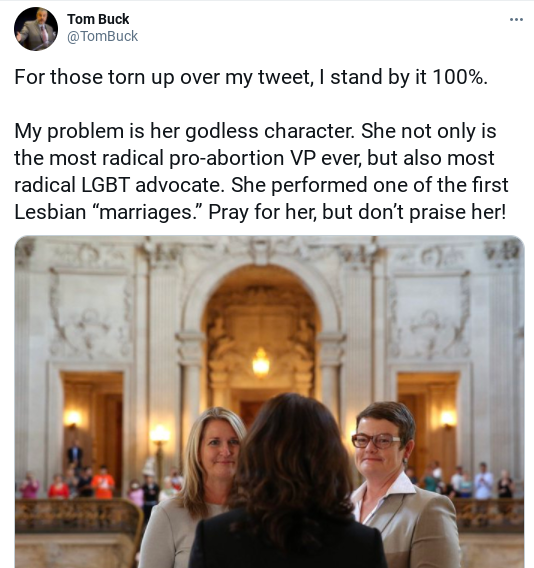
Which must have been what got my friend, Pastor Tom Buck, thinking about the evil Old Testament queen, Jezebel, and led him to make this astute observation on Twitter:


And, though he wasn’t actually calling Vice President Harris “Jezebel,”1 he’s absolutely right in drawing the comparison between Israelite women looking up to a wicked queen and Christian women looking up to a Vice President who fights for all sorts of things the Bible calls wickedness.

Do you know who Jezebel was and what she stood for? She was the wife of King Ahab, who, 1 Kings tells us, did more evil in the sight of the Lord, and did more to provoke the Lord, than all who were before him. And his “vice president,” Queen Jezebel, pushed him there.

Hold your nose and brace yourself, and let’s check out Jezebel’s bio:

1 Kings 16:31– Jezebel was the daughter of Ethbaal (whose name means “Baal is alive”). Idolatry was the way of life she had been raised in- an idolatry that required human sacrifice as a sacrament.

1 Kings 18:4,13– Jezebel “cut off” and “killed” the prophets of the Lord.

1 Kings 18:19– Jezebel welcomed, embraced, and honored the 450 false prophets of Baal and the 400 false prophets of Asherah.

1 Kings 19:1-2– After the showdown on Mt. Carmel in which God demonstrated through Elijah that He was the one true God, and Elijah put the prophets of Baal to death, Jezebel swore to kill Elijah, God’s representative to His people.

1 Kings 21:1-16– Jezebel, in the name of the king, ordered city officials to have false accusations of capital crimes levied against Naboth in order to execute him and steal his land, which Naboth, in obedience to God, had refused to give the king.

1 Kings 21:25– “There was none who sold himself to do what was evil in the sight of the Lord like Ahab, whom Jezebel his wife incited.” She encouraged the king toward greater wickedness.

2 Kings 9– God was so disgusted with Jezebel’s vile character and behavior that He destroyed Ahab’s lineage and killed Jezebel in one of the basest, most humiliating ways possible. Dogs, at the time, were wild, filthy, and despised, so much so that to call someone a “dog” was an outrageous epithet. And anyone not receiving a proper burial was looked upon as cursed by God. We’re given some hints in this chapter that Jezebel may have been sexually immoral, but Scripture places far more emphasis on her sins of idolatry (often called “whoring” in the Old Testament- indeed 2 Chronicles says “the house of Ahab led Israel into ‘whoredom'”, i.e. idolatry), rebellion against God, and general wickedness than on any acts of sexual immorality she may have committed.

That’s Jezebel. A woman in the second most powerful position in the country who facilitated the murder of innocent human beings, ran swiftly to do evil, and zealously defied the commands of the living God.

Let the reader understand.

You cannot look up at the cross of Christ and look up to Kamala at the same time. She champions the sins that nailed your precious Savior to the tree.

“So who can I point my daughters to as role models?” a reader recently asked me. “With so many false teachers out there, I can only think of one or two well known Christians I can hold up to them as examples.”

That’s OK, because you don’t need to.

Forget the evangelical celebrities, ladies. Teach your girls to look up to the godly older women in your church, and, if God has so blessed you, in your family. And you look to them, too.

Look for the women in your church who are like the godly widows of 1 Timothy 5. The ones who…

  • are deserving of honor
  • “set [their] hope on God and continue in supplications and prayers night and day”
  • have been faithful wives
  • have a reputation for good works
  • have been godly mothers
  • have shown hospitality, served God’s people, cared for the afflicted, and devoted themselves to every good work
  • are faithful to Christ
  • aren’t idlers, gossips and busybodies, saying what they should not
  • give the adversary no occasion for slander.

Look up to the women in your church who exemplify the godly character of the older women in Titus 2. Women who…

  • are reverent in behavior
  • control their tongues and speak of others in godly ways
  • don’t allow themselves to be controlled by alcohol or anything else but Christ
  • are able to teach and train young women to be godly women, wives, and mothers
  • strive to prevent the word of God from being reviled.

These are the women you and your girls should look to – not the celebrities who don’t even know you exist, but the older, spiritually mature real life women you know and have access to. The women you can pour your heart out to, call when you have a question, get wise counsel from when you need advice. That’s the biblical model – personal discipleship, not admiration from afar.

And ladies my age and older – those of us who have been married a minute and have managed to shoot our little arrows out the door and into lives of their own, who have flourished in a life of God-ordained singlehood, who have suffered the loss of a spouse or the loss of a marriage, those of us who have been there, done that, and been around the block a time or two – well, scroll back up there and read those character qualities from Titus and Timothy again, because those are the women we need to be. It’s all well and good to point these younger ladies to the godly older women in their churches, but we’d better be there for them when they show up. We need to strive to be able to say to them, as Paul said, “Imitate me as I imitate Christ.”

Younger women need, and older women need to be church “mothers” and “older sisters” who lead by example and nurture those under their care in real time.

Nobody needs Jezebel as a role model.


1Tom was accused by some of using a racial slur against Kamala Harris, because, apparently some consider the term “Jezebel” to mean “a promiscuous woman of color”. This was certainly news to me, Tom, and a host of others who had never heard such a thing before. He was (as am I in this article) strictly referencing the Jezebel of the Bible and her evil character, which had nothing to do with ethnicity, and little, if anything, to do with sexual immorality. Jezebel is an icon of female wickedness just like Hitler is an icon of wickedness in general. When you compare someone to Hitler you’re not saying they’re German or antisemitic, and when you compare someone to Jezebel, all that’s being implied is that she’s a generally evil woman, regardless of race or chastity.


Sermon on the Mount Bible Study

The Sermon on the Mount ~ Lesson 2

Previous Lessons: 1

Matthew 1-4

Questions to Consider

1. Briefly review the the introductory questions and materials in Lesson 1 (link above).

2. Read Matthew 1-4. How do the events in these chapters lay the groundwork for Jesus to preach the Sermon on the Mount? What sort of overall context do chapters 1-4 provide for the Sermon?

3. As you read chapters 1-4, notice Matthew’s emphasis on prophecy fulfilled. Make a note of each fulfilled prophecy mentioned and think of them as points on Jesus’ “rรฉsumรฉ”. How do each of these fulfilled prophecies point to Jesus’ qualifications to fill the position of Messiah, thus giving Him the divine authority to deliver the Sermon on the Mount?

Besides these instances of fulfilled prophecy, list any other verses that demonstrate Jesus’ qualifications – as God, Messiah, holy, etc. – to authoritatively deliver the Sermon on the Mount. (Hint: Here are a few to get you started.)

4. Explain the various ways God protected and preserved Jesus’ life and safety in chapters 1-4 so that He would be able to fulfill His earthly ministry (chapter 5 and beyond).

5. Why, besides the fact that it fulfilled prophecy, was it necessary for John the Baptist (chapter 3) to “prepare the way of the Lord”? What were some of the things he did to herald and introduce Jesus’ coming, and how did this prepare the hearts of the people to receive Him? What was John’s message to the Pharisees and the people?

Carefully examine 3:7-10. Do any of these ideas or phrases sound familiar as something Jesus Himself later said? Use your cross-references and look up the passages in which Jesus said or taught the same things.

6. How were each of the following significant in laying the foundation for Jesus’ earthly ministry?

  • Jesus’ baptism
  • Jesus’ temptation in the wilderness
  • Jesus relocating to Capernaum
  • Jesus calling the disciples

Homework

Carefully examine 4:1-11. Which Scriptures does Satan quote to Jesus? Does he rightly handle those Scriptures or use them out of context to further his own agenda? Why is it wrong to use Scripture this way? How does Jesus combat Satan’s temptations and Bible twistings? What is significant about Jesus’ use of the phrase “It is written”? Think of a situation in your life in which you could use rightly handled, in context Scripture to fight temptation or to stand against false teaching. Find a way to put that into practice this week. Use Scripture like Jesus used Scripture, not like Satan used Scripture.

False Doctrine, Movies

Movie Tuesday: Critical Race Theory – Part 4

If you’ve been following the blog for a while, you know that, from time to time, I post biblically edifying, informative movies, videos, or documentaries on Tuesdays – ergo, “Movie Tuesday.”

Recently, my friend, Pastor Travis McNeely, released a six video series on Critical Race Theory featuring LSU law professor, Randy Trahan. In this series, Randy, a former proponent of CRT, describes his journey into – and out of – critical theory, explains what CRT is, and why it’s a danger to the church, particularly to Southern Baptists.

So, for the next few weeks, every Tuesday will be Movie Tuesday as we make our way through this video series. I would urge you to carefully watch each episode – especially if you’re Southern Baptist (if we actually have an SBC annual meeting this year, this issue is sure to come up) – so you’ll be informed and able to develop a biblical position on this egregious false teaching that is quickly spreading through the church.

Travis has developed a discussion guide to go with the videos, so as you watch, consider whether this might be a good series for your pastor to guide your church through, and pass it along to him.

Missed an episode? Part 1 Part 2 Part 3

Maybe you’ve been blessed in that you haven’t seen CRT in your church, your denomination, or any Christian organizations you’re connected to. Or maybe you have encountered CRT in one of these venues, but you weren’t aware of it because you weren’t exactly sure what it looks like “in real life”. Today, Randy gives us some real world examples of what CRT looks like as it has appeared in several well known evangelical organizations, including the Southern Baptist Convention.

Without further ado, here is part 4 of the series.

Abuse, Mailbag, Marriage

The Mailbag: Must I reconcile with my abusive ex-husband?

I was in a very volatile marriage to an abusive, lost man and I was also lost at the time. There was violence in the marriage which caused me to run away and divorce him out of fear. This was seven years ago and I have not seen nor heard from him since.

I have recently been saved and have repented of all my past sin and divorce1. I do understand that God hates divorce, and why, and that He would want me to reconcile with my ex-husband, if possible. But I am terrified about inquiring of my ex-husband because of the abuse I experienced. I donโ€™t want to go back to him, if heโ€™s even unmarried currently. I want to move forward in my new life as a daughter of God in the situation I am currently in โ€“ where He called me.

Does my not wanting to go back to my ex mean I am not truly repentant? And subsequently not truly forgiven? I did write my ex a letter that I sent to his parents’ address asking for forgiveness (for sins I had committed against him) about a year and a half ago and I believe he knows where he could find me if he wanted to reconcile; I have heard nothing. I have had nightmares about all this. Part of the reason we donโ€™t live in the same town is I didnโ€™t want to be found. I was so lost in my sin until God opened my eyes and now I cannot change my past and that has left me feeling helpless and hopeless.

First, I just want to take a moment to rejoice with you that God has brought you out of darkness and into His marvelous light! Welcome to the family! I also praise Him for rescuing you out of such a terrible situation and placing you in a safe environment. I hope by now this wicked man has been brought to justice and is no longer able to harm anyone.

OK, let’s take this one step at a time, for you and for any others who may be in a similar situation…

I was unable to glean from your email whether or not you are now joined to, and faithfully attending, a doctrinally sound church. If you’re not, that’s step one for many reasons: a) God commands it, so you’ll want to be obedient to Him, b) all Christians need training in the Scriptures and fellowship with our brothers and sisters, c) you need to unlearn all the ungodly ways of thinking and seeing yourself and others that the abuse taught you and replace them with godly, spiritually healthy ways of thinking and seeing yourself and others, and d) you need pastoral counsel about this particular situation you’ve asked me about.

If you haven’t yet found a doctrinally sound church and need some help, I would encourage you to go to the blue menu bar at the top of this page and click on the Searching for a new church? tab. When you get there, study up on the resources under “What to look for in a church,” and then begin exploring the many church search engines to find a good church near you.

Once you find a solid church (or if you’re already in a solid church), step two is to set up an appointment with your pastor for counseling. You need a shepherd who can walk through this situation with you face to face, long term, and can take the time to listen to all of the details. Binding up the wounds of injured sheep and tending to them while they heal is part of a shepherd’s job.

Next let’s take a look at some of the biblical issues.

You are correct in saying that, if possible, it’s God’s desire for a husband and wife to reconcile. But the only way that would be possible in your situation is if your ex-husband:

  • has thoroughly and completely repented of all of his sin (including, but not limited to, the abuse and violence)
  • has trusted Christ as his Savior,
  • has joined, and is faithfully attending, a doctrinally sound local church
  • is bearing fruit in keeping with repentance as witnessed by doctrinally sound mature brothers and sisters in Christ at his church (in other words, we can’t just take his word for it that he’s changed)
  • and all of this has been going on for a significant amount of time (like, at least year or two, not last week).

One of the things you should discuss with your pastor in counseling is whether or not, and how, to find out if your ex-husband has gotten saved and is living a repentant life that honors Christ. If he has not written you back or attempted any contact in the past seven years, chances are he is still lost and unrepentant.

This is another reason it’s important for you to be in a good church – you should not be the one to approach, or have any contact with, your ex-husband. Even if you’re not worried for your physical safety, clearly, contacting him would traumatize you at this point in your life. If any research is to be done into your ex-husband’s spiritual condition, it should be done by your pastor, elders, a deacon, or whoever your pastor designates as the wisest choice.

If it is discovered that God has graciously saved your ex-husband (and all of the items I bullet-pointed above are true of his life) and he has not remarried, then your pastor, his pastor, you, and he will have to put your heads together and figure out how to proceed biblically from here. And I imagine that will involve a lot of time and intense counseling before any decisions can be made.

You should not return to your ex-husband if he is unrepentant and/or still unsaved. (And if your pastor tells you that you should or you have to, you’re at the wrong church. That’s pastoral malpractice.) Notice I said “return to,” not “reconcile”. To be reconciled is for two people to be made right with one another. It’s for two people to come together in agreement to forgive past hurts and move forward together in a peaceful and harmonious relationship. Two people. That’s what the word “reconciled” means. In other words, you cannot be reconciled to someone who will not be reconciled to you because he still wants to hurt you.

Can two walk together, except they be agreed?

Amos 3:3

Returning to your unrepentant ex-husband is not only unwise for the sake of your own personal safety, but consider what the Bible says about you – a Believer – voluntarily2 entering into a marriage with an unbeliever:

Do not be unequally yoked with unbelievers. For what partnership has righteousness with lawlessness? Or what fellowship has light with darkness? What accord has Christ with Belial? Or what portion does a believer share with an unbeliever?

2 Corinthians 6:14-15

While this passage doesn’t apply exclusively to marriage, marriage is one of the relationships it does apply to. If we are not to yoke with unbelievers in ministry, or enmeshed business relationships, or close friendships, how much more should we not yoke with an unbeliever in the most intimate relationship of all – the oneness relationship of marriage?

You alluded to “remaining in the state in which you were called,” which is an excellent point Paul teaches in 1 Corinthians 7:17-24:

So, brothers, in whatever condition each was called, there let him remain with God.

1 Corinthians 7:24

The basic idea Paul is trying to convey here is not that you shouldn’t make Zacchaeus-like restitution or apologies for sins you’ve committed whenever that’s possible, but that you can’t undo your pre-salvation, sinful past (just like Zacchaeus couldn’t undo the fact that he cheated people in the first place). And you don’t have to. That was nailed to the cross, and it stayed dead and buried when Jesus came out of the tomb.

You can’t undo your pre-salvation, sinful past. And you don’t have to. That was nailed to the cross, and it stayed dead and buried when Jesus came out of the tomb.

That’s precisely why you shouldn’t feel helpless and hopeless. That is our help and our hope: Jesus did for us what we so desperately needed and could not do for ourselves. He took our sin, our shame, our disgraceful past away – as far as the east is from the west – and dressed us in His royal robes of righteousness, making us clean and right with God to walk in newness of life! No one can change her past. Even God doesn’t change your past. God puts your past to death and changes your future.

No one can change her past. Even God doesn’t change your past. God puts your past to death and changes your future.

Not only that, this bit about remaining in the state in which you were called comes right on the heels of verse 15, which says:

But if the unbelieving partner separates, let it be so. In such cases the brother or sister is not enslaved. God has called you to peace.

1 Corinthians 7:15

Your unbelieving ex-husband is separated from you. Let it be so. “Let sleeping dogs lie,” you might say. Keep the peace that God has blessed you with by not opening up this can of worms and unnecessarily creating what could be a volatile situation.

You ask, “Does my not wanting to go back to my ex mean I am not truly repentant? And subsequently not truly forgiven?”. No, honey. It means God blessed you with good sense that still works. If this were a situation in which you divorced a godly (non-abusive, obviously) husband for your own selfish, sinful reasons, subsequently got saved, and still refused to be reconciled to him, there would probably be some issues of sin that your pastor would need to counsel you about. But getting saved, honoring all of the Scriptures mentioned above, and refusing to poorly steward the mind, body, and spirit God blessed you with by pointlessly putting them back in harm’s way? That demonstrates that you have repented and been forgiven and that God is hard at work healing you and renewing your mind.

Now, go make that appointment with your pastor.

1The reader stated that she “repented of…my divorce”. I did not deal with biblical and unbiblical reasons for divorce in this article because the focus of her question was, “Where do I go from here?” not, “Did I sin by divorcing him?”, and if she did sin in some way by divorcing him (and I’m not saying she did), she has already repented of it. But I do want anyone reading this to know that if you’re in an abusive relationship, it is not a sin to get yourself and your children somewhere safe. Getting to a safe place is not the same thing as getting a divorce. If you are being abused, get to safety immediately and call your pastor, and the police, if appropriate, for help.

2This is not a proactive instruction to currently married people to divorce their unbelieving (non-abusive) spouses. Paul deals with that in 1 Corinthians 7:12-16.


If you have a question about: a Bible passage, an aspect of theology, a current issue in Christianity, or how to biblically handle a family, life, or church situation, comment below (Iโ€™ll hold all questions in queue {unpublished} for a future edition of The Mailbag) or send me an e-mail or private message. If your question is chosen for publication, your anonymity will be protected.

Evangelism, Gospel

What Must I Do to Be Saved?

For a while now, I have been wanting to add a permanent tab to the blue menu bar at the top of the blog that clearly lays out the gospel in both text and video format. Well I’ve finally gotten a chance to add it, and I would encourage you to share it around on your social media pages as often as you can to help get the gospel out to the lost. Below is a copy of what you’ll find at the new “What Must I Do to Be Saved?” tab in the blue menu bar at the top of the blog.


โ€œSirs, what must I do to be saved?โ€
And they said, โ€œBelieve in the Lord Jesus, and you will be saved…
Acts 16:30b-31a

Are you like the Philippian jailer? Maybe you’ve never set foot in a church, but you’ve heard Christians talking about Jesus, and you’re wondering what it’s all about.

Or maybe you’ve been a decades-long member of an organization that calls itself a church but you’ve never heard the true, biblical gospel before.

Maybe you always thought you were a Christian, but lately, you’re not so sure.

Whatever your back story, you’ve come to the right place.

There’s good news and there’s bad news, but the bad news has to come first:

โ™ฆ You are a sinner (you have transgressed God by breaking His law).

Therefore, just as sin came into the world through one man, and death through sin, and so death spread to all men because all sinned Romans 5:12

as it is written: โ€œNone is righteous, no, not one; Romans 3:10

for all have sinned and fall short of the glory of God, Romans 3:23

โ™ฆ The penalty for your sin is an eternity in Hell.

For the wages of sin is death, Romans 6:23a

but for those who are self-seeking and do not obey the truth, but obey unrighteousness, there will be wrath and fury. Romans 2:8

And if anyoneโ€™s name was not found written in the book of life, he was thrown into the lake of fire. Revelation 20:15

โ™ฆ You canโ€™t escape Hell by being a good person, having a good heart, or any other effort on your part.

We have all become like one who is unclean, and all our righteous deeds are like a polluted garment. Isaiah 64:6a

as it is written: โ€œNone is righteous, no, not one; no one understands; no one seeks for God. All have turned aside; together they have become worthless; no one does good, not even one.โ€ Romans 3:10-12

he saved us, not because of works done by us in righteousness, but according to his own mercy, by the washing of regeneration and renewal of the Holy Spirit, Titus 3:5

But the good news is…

โ™ฆ Salvation (being forgiven for your sin so you can be in good standing with God) is a result of Godโ€™s mercy and grace, not something you can earn. It is a gift.

For by grace you have been saved through faith. And this is not your own doing; it is the gift of God, not a result of works, so that no one may boast. Ephesians 2:8-9

So then it depends not on human will or exertion, but on God, who has mercy. Romans 9:16

For the wages of sin is death, but the free gift of God is eternal life in Christ Jesus our Lord. Romans 6:23

โ™ฆ The gift God offers you is that, on the cross, Christ took the punishment you deserve for your sin. He will take away your sin and give you His perfect standing before God in exchange.

For Christ also suffered once for sins, the righteous for the unrighteous, that he might bring us to God, 1 Peter 3:18a

for all have sinned and fall short of the glory of God, and are justified by his grace as a gift, through the redemption that is in Christ Jesus, whom God put forward as a propitiation by his blood, to be received by faith. Romans 3:23-25a

For our sake he made him to be sin who knew no sin, so that in him we might become the righteousness of God. 2 Corinthians 5:21

โ™ฆ The way you receive that gift and have Christโ€™s righteousness โ€œcredited to your accountโ€ is to repent from (have the heart desire to turn away from and ask Godโ€™s forgiveness for) your sin and trust that Christโ€™s death, burial, and resurrection paid the penalty for your sin.

[Jesus said] โ€œThe time is fulfilled, and the kingdom of God is at hand; repent and believe in the gospel.โ€ Mark 1:15

Repent therefore, and turn back, that your sins may be blotted out, Acts 3:19

In him you also, when you heard the word of truth, the gospel of your salvation, and believed in him, were sealed with the promised Holy Spirit, Ephesians 1:13

because, if you confess with your mouth that Jesus is Lord and believe in your heart that God raised him from the dead, you will be saved. Romans 10:9

This is the gospel. Turn from your sin and from trying to earn favor with God by your so-called good behavior and throw yourself on the mercy of God, trusting Christโ€™s finished work on the cross to forgive your sin and make you righteous in Godโ€™s eyes.

Thatโ€™s what salvation โ€“ or becoming a Christian โ€“ is. Adding anything to the gospel or taking anything away from it is not salvation or biblical Christianity. It is a false gospel. Believing a false gospel will not forgive your sin, make you right with God, or take you to Heaven when you die. Unfortunately, many people believe a false gospel and there are many people who claim to be Christians, pastors, and Bible teachers who teach a false gospel.

What are some of those false gospels?

If youโ€™re basically a good person, or your good deeds outweigh the bad, youโ€™re OK with God, and youโ€™ll go to Heaven when you die.

If youโ€™ve been baptized at any point in your life and for any reason, youโ€™re saved.

If you go to church regularly, youโ€™re a Christian.

If you participate in communion or the Lordโ€™s Supper, youโ€™re a Christian.

The reason we come to Jesus is to have a better, more comfortable, or more successful life.

The reason we come to Jesus is to get healed from a medical condition, because He will make us wealthy, or because He will do cool supernatural signs and wonders in our lives.

Simply saying youโ€™re a Christian, or believing that you are a Christian, makes you one.

If you were born in America and youโ€™re not Jewish, Hindu, Muslim, or some other religion, youโ€™re a Christian.

If you believe in God, youโ€™re a Christian.

If you give mental assent to the facts about Jesus (without repenting and trusting Him), youโ€™re saved.

If, at some point in your life you repeated the words of a โ€œsinnerโ€™s prayer,โ€ โ€œaccepted Jesus,โ€ or โ€œasked Jesus into your heartโ€ – even though you didnโ€™t know what you were doing, and without true repentance and faith – youโ€™ve been born again.

You can become a Christian without repenting from your sin.

You can believe in a โ€œJesusโ€ of your own making, rather the one described in Scripture, and still be a Christian.

Are you a Christian? Have you ever felt the weight of your guilt before God and asked Him to cleanse you and make you right with Him? Do you believe and embrace that Christโ€™s death, burial, and resurrection satisfied Godโ€™s wrath against you for your sin?

The Bible says we should examine ourselves to discover whether or not we are truly in the faith. Take some quiet, undistracted time alone with God today and search your heart. What do you really believe? Is it the true gospel of Scripture, or something else? Donโ€™t put it off, itโ€™s too important. If you need some help, try working through my study Am I Really Saved? A 1 John Check-Up.

If you find that youโ€™re not in Christ, talk to Him. Confess your sin and your need for Him to save you. Ask His forgiveness and declare your trust in Him.

Donโ€™t wonder and guess any more about where you stand with God. Know.

Working together with him, then, we appeal to you not to receive the grace of God in vain. For he says, โ€œIn a favorable time I listened to you, and in a day of salvation I have helped you.โ€ Behold, now is the favorable time; behold, now is the day of salvation. 2 Corinthians 6:1-2

Once you’ve trusted Christ for salvation, or if you still have some questions, you’ll want to find and join a doctrinally sound church where you can sit under good, biblical preaching and teaching so you can grow in Christ. Check out the Searching for a new church? tab in the blue menu bar at the top of this page to find out what to look for in a church and to locate a solid church near you.

When you’ve found a good church, set up an appointment with your pastor to talk about being baptized. Baptism doesn’t save or absolve you from sin, but it is your first important step of obedience in following Christ. To learn more, read my article Basic Training: Baptism.