Bible Study

Throwback Thursday ~ 10 Simple Steps to Plain Vanilla Bible Study

Originally published April 22, 2016.

plain vanilla

Baskin Robbins is one of my favorite places to get ice cream. Not only is their ice cream good, but they boast a plethora of flavors to choose from. I love to start at one end of the counter and work my way through all their offerings, getting a little “taste spoon” here and there if a particular flavor piques my interest.

Flavor_Enlarged_Peanutbutter'nChocolate2
Photo courtesy of BaskinRobbins.com.

Having a myriad of options is great when it comes to ice cream, but when it comes to studying the Bible, the tsunami of materials, methods, and other choices out there can be overwhelming. Where do I start? How do I know if a certain Bible study book or teacher is doctrinally sound? Is the study method I’m using in line with good hermeneutics?

It can be enough to make you throw your hands up in the air and head for your local Thirty One Flavors to drown your sorrows in Peanut Butter ‘N Chocolate.

Sometimes it can help to get back to plain old, simple, vanilla Bible study. I’ve been saying for a while now that Christian women should, for the most part, put all the “canned” Bible study books, workbooks, and DVDs aside and simply pick up their Bibles and study them in a systematic way. After all, up until somewhere near the latter half of the 20th century, that’s generally how people studied the Bible. And it worked. People grew in their faith to godly maturity just fine. So, why can’t it work today?

It can. It does. It will.

Unfortunately, the blessing of lots of options, methods, resources, and information, and the marketing of that blessing by celebrity Christians and Christian retailing, has bred a generation of Christian women who are fearful that they aren’t as smart or as capable of reading and understanding God’s word as all the “experts” out there. They look at the simplicity of picking up their Bibles and studying them like calves looking worriedly at a new gate.

“What does that mean?”

“How do I do that?”

“I’m scared I’ll get it wrong!”

It absolutely breaks my heart to hear this angst from women who, I’m certain, genuinely want to study God’s word correctly so that they can know Him better and grow in their faith. And it makes me livid at the churches who haven’t trained them properly, the plantation-style women’s “Bible study” marketing that has kept them ignorant and dependent slaves to Christian retailers, and whatever other forces have conspired to keep these precious ladies away from the pure milk of the word.

So let’s reboot, get back to basics, and get as many women digging into the Word as possible.

First, it’s important to start out with a biblical perspective:

1. God is kind, and He loves you.

Yeah, I know, that’s pretty basic. But it’s worth bringing to the forefront for this discussion. This is a God who loves you and wants you to know Him. He has revealed Himself to you through creation, through Christ, and through His written word. He has indwelt you as a believer with the Holy Spirit to help you understand Scripture. He has told you that you can ask for wisdom and promises to provide it. In His kindness God has bent over backwards to provide you with ways to know Him. He is not some mean ogre sitting up there just waiting for you to get something wrong so He can chastise you. He wants you to understand His word.

2. The Perspicuity of Scripture

There’s this really great, comforting, reassuring doctrine called the perspicuity of Scripture. The gist of it is that Scripture is, for the most part, clear and understandable, especially for believers, because of the aforementioned indwelling of the Holy Spirit. But even lost people tend to understand a lot of what Scripture says (that’s why you hear so many of them arguing against it – they couldn’t do that if they didn’t at least partially understand it).

So, by and large, if you’re reading the Bible in an orderly way you should be able to understand it fairly well. You don’t have to have a seminary degree or be an “expert.” There are dirt farmers and country preachers out there who have a better grasp of Scripture than some celebrity pastors in multi-million dollar churches with thousands of congregants, and a string of seminary degrees behind their names.

OK, now that we have a biblical perspective on studying the Bible, how do we do it in a systematic or orderly way?

3. Pray

Don’t see this as childish or unimportant and skip it. Start your Bible study time by asking God to help you understand His word, to learn what He wants you to learn from it, and to obey its instruction. Even if you’re pretty well versed in the Scriptures, praying like this before opening God’s word will remind you of its holiness and your proper place of humility and submission to it.

bible-1089968_12804. Read the Bible the way you would any other book.

When you pick up a novel, do you read one sentence out of the middle of chapter 4, followed, the next day, by a paragraph from chapter 37, and, the next day, a couple of lines from chapter 1? Of course not. You wouldn’t know what was going on and what the characters meant by what they were saying. If you wouldn’t read something as inconsequential as a novel this way, why would you read the Bible in such a haphazard manner? Yet this is precisely the way people often approach daily Bible study.

My pastor said something awesome about this in his sermon the other day:

The Bible isn’t Google for self-help.

And he’s so right. We don’t just parachute in to a random passage, hoping to glean a nugget of truth. Pick a book of the Bible (maybe Genesis or one of the gospels if you’re new to all this), start at the beginning, and read a little each day until you reach the end. It’s really that simple.

5. Context, context, context

It’s important to read and understand Scripture in its context: how a verse fits with the verses immediately surrounding it, within its chapter, within its book, and within the overarching narrative of the Bible. This is really the biggest key to comprehending Scripture. Fortunately, the main way to do this is by reading the Bible in an orderly way (see #4- You did already read #4, right?)

Another invaluable practice is to make use of the cross-references and footnotes in your Bible. Cross-references will help you get a better idea of how the passage you’re reading fits together with other, related passages. Footnotes are there to add a touch of clarity to particular words and passages.

6. Get a plan, Fran.

If structure helps you, choose a good Bible reading plan. For the beginner, start off with one of the shorter plans so you won’t get overwhelmed. When you’re ready, I highly recommend the chronological plan. It is extremely helpful for learning the big picture of Scripture.

If you decide to choose a reading plan, though, hold its schedule loosely and don’t be beholden to its time frame. Work through the readings at your own pace. Take the time to let the Scriptures sink in and spend as long as you need to on any given section. God doesn’t give gold stars for finishing the Bible in a year.

7. Understand the background and setting.

There are some passages in Scripture that are a little more difficult to understand if you don’t know the customs of the time or what was going on historically and politically. In these cases a good study Bible, commentary, and other resources can be beneficial. I’ve touched on the specifics of some of these resources here. Many of these helpful materials can be found on-line for free.

8. Take notes on the text.

Hmm…an orderly method of reading…footnotes…extra resources…taking notes…this is starting to sound like…well…studying! Yep, that’s the idea. Isn’t it interesting that we often take a more serious and scholarly approach to studying for a class or a test than we do to studying our Bibles?

If you were a better student than I was in high school and college, you probably took notes on your text books as you read them. You wrote down things you wanted to remember, things that seemed important, things you didn’t understand and wanted to work on more later, things that were especially meaningful, even questions that occurred to you. Those are all good things to write down as you study your Bible, as well.

presenter-1206345_12809. Listen to good preaching.

As a Christian, you should already be doing this at least weekly at the church you’re a member of. But try to sneak in some extra listening – to your own pastor or another doctrinally sound pastor – as often as you can during the week. Listening to someone rightly handle and explain God’s word helps you to understand it and trains you to rightly handle it yourself as you study.

I once read that children who read a lot are better spellers. Not because they study spelling more, but because they’re exposed to more words and have the correct spelling of words constantly in front of their eyes. They sort of soak up good spelling by osmosis, and when it’s time for the spelling test, they simply write down what they’ve absorbed. Listening to good, expository preaching can have the same kind of helpful impact on your Bible study skills.

10. Practice makes perfect.

Studying the Bible is just like any other skill. You’ll probably fumble around a good bit when you’re first getting started, but if you stick to it, you’ll find that it gets easier and you get better at it as time goes by. Don’t be afraid to start. Jump right in there and try. Nothing ventured, nothing gained, right?


Ladies, simply picking up the Bible and studying it each day is such a joy. I have been doing it for years, and I love it. The excitement of “digging for buried treasure” in God’s word and uncovering the truths of Scripture for myself has been far more meaningful to me and has grown me so much more than any workbook or curriculum I’ve ever used. I hope you’ll put aside your book studies and devotionals, and give it a try yourself!

Ezekiel Bible Study

Ezekiel ~ Catch Up Week


Previous Lessons: 12345678, 9

It’s Catch Up Week!

I’m out of pocket this week, so you get a catch up week!

Catch up on any lessons you might be behind on, go back and do any of the homework you may not have had time for, review your memory verses, or if you’re already caught up, you could even read ahead in Ezekiel a little (we got through the end of Ezekiel 19 in lesson 9). It’s your week to use as you see fit.

Memory verses for review (there was no memory verse for lesson 1):

Lesson 2


Lesson 3


Lesson 4


Lesson 5


Lesson 6


Lesson 7


Lesson 8


Lesson 9


Bible Study, Church

Throwback Thursday ~ 4 Ways We’re Getting Women’s Discipleship Wrong, and How We Can Get it Right!

Originally published November 2, 2018

In the days leading up to Wednesday’s observance of Reformation Day, I directed your attention, in part, to the brave and godly women who played a part in the Protestant Reformation. A few days ago, I shared this post on my Facebook page…

…and asked:

Is the women’s Bible study you’re attending preparing you for something like this?

Of course, when I say, “something like this,” I don’t mean only being executed for your faith. I mean something hard. Life-shattering. Devastating. The loss of your spouse. A stillbirth. Your adult child choosing the prodigal life. A terminal diagnosis. Losing your business or your job because you won’t compromise on Scripture.

And it isn’t just the big, life-altering things, either. What about “smaller” issues like humility, serving without resentment, gratitude, glorifying God instead of self, submitting to your husband, patience, and prioritizing your time in a godly way? What about daily life in general?

Praise God, many women can truthfully answer, “Yes,” to my question. Their churches are training them in the Scriptures and discipling them well so that they can face big or small issues in a godly, biblical way.

But if the best sellers shelf at LifeWay is anything to go by, far more women would have to answer, “No.” Something is wrong in women’s discipleship in the vast majority of evangelical churches. I see the product it creates every day: women who run their lives by their feelings instead of the Word of God, women who believe their own opinions and experiences over Scripture, women who attend every study, every simulcast, every conference, every women’s ministry activity, yet whose lives are devoid of the Fruit of the Spirit.

Our churches have far too many weak women, burdened with sins and led astray by various passions, always learning and never able to arrive at a knowledge of the truth. (2 Timothy 3:6b-7)

And if you’re consistently getting a defective product, you’ve got to trace the problem back down the manufacturing line to find out what’s wrong and fix it so your product won’t be defective any more.

So what’s going wrong on our discipleship assembly line, and what can we do to fix it?

1.
We’re creating false converts instead of true Believers

This is the main reason we see women who can’t or won’t deal with life’s issues – big or small – in a biblical way. They can’t because they’ve never been truly saved, despite what they may claim. And the reason many of them think they’re saved – because they’ve prayed a prayer, walked an aisle, or made a commitment to…something – is that their churches have not taught them the biblical gospel.

The biblical gospel is not “Jesus is a nice accessory to add to your life to make it prettier, like a new purse or bracelet,” or “Jesus will heal you, give you the money you need, or do cool signs and wonders for you,” or “Jesus will help you accomplish your dreams,” or “You’re worthy. You’re enough. Jesus loves you.”

The biblical gospel is raw and startling and offensive: You’re not worthy because you’ve offended a holy God with your sin and rebellion. You deserve death and Hell for your crimes against the King, and there’s nothing you can do to assuage His wrath against you. It is right and good for you to feel guilty and hopeless about that. But because God is good, and worthy, and kind, and merciful, He, in the person of Jesus Christ, took the wrath and punishment you so richly deserve by suffering humiliation and dying on the cross. He endured all of that so you wouldn’t have to. Then He rose again to conquer death so you could live. So He could give you the gift of repentance and faith and credit His righteousness to your account to forgive your sin and make you right with God. You’re not enough. Jesus is enough. And praise God for that!

The Fix:

We need our pastors and teachers to fearlessly and unashamedly proclaim the hard edges of the gospel. We need to train church members to share the gospel correctly. We need to stop reassuring people living in unrepentant sin that they’re saved. If it walks like an unsaved duck and quacks like an unsaved duck, it’s most likely an unsaved duck. And that duck needs to examine herself against Scripture, maybe with the help of a mature sister in Christ, to find out where she stands with the Lord.

Basic Training: The Gospel

Am I Really Saved?: A First John Check Up

2.
We’re dealing drugs instead of fostering joy

If you look out across the landscape of evangelicalism today, you’ll notice the dynamic between women’s ministry and Christian woman bears an eerie resemblance to the dynamic between drug dealer and addict.

Women are hurting or bored or discontent or unsaved, so they bounce from women’s Bible study to women’s ministry activity to women’s fellowship to women’s retreat to get their next hit of Christianese-laced dopamine so they’ll feel better and maybe get a little escape from their circumstances. And Christian retailers, conferences, and often even local churches are right there to peddle the latest designer drug to women who can’t get enough.

Now, don’t get me wrong. There’s nothing intrinsically bad about any of those activities. In fact, assuming they’re doctrinally sound, they can all be very good things! But if we’re using the emotional high we get from them as a substitute for biblical joy, or if we think those things are the source of joy because that’s the dime bag we’re being sold, that’s spiritually pathological.

The Fix:

Real, biblical, satiating joy doesn’t come from an outward activity. It comes from the inner working, shaping, and sanctification of the Holy Spirit – a concept we’ve got to get across to Christian women. Joy comes from gazing at Creation, the cross, the communion of the saints, and remembering – celebrating – all Christ has done, and will continue to do, for us and in us. Joy comes from repentance and forgiveness from sin. Joy comes from worshiping in spirit and in truth. Joy comes from unity with the brethren. Joy isn’t a temporary injection of happiness, it’s a congenital spiritual trait.

3.
We’re parking women in evangelical daycare
instead of giving them spiritual mothers

In most churches, “women’s discipleship” means the church has purchased a divangelista’s DVD and workbook package, and provided a room set up with chairs, a DVD player and monitor, and a woman to “facilitate” the class. It’s the spiritual equivalent of glorified babysitting. The kids might have some fun, be entertained, and enjoy spending time with their friends, but it’s not the same thing as having a mom.

Mom tucks you in at night. Mom listens to your stories. Mom makes you eat your vegetables. Mom kisses your bo-bos. Mom disciplines you when you’ve disobeyed. Mom pours her life into you. Mom is there.

That Christian celebrity on the screen doesn’t even know the women of your church exist. She doesn’t know their names. She can’t comfort them when they’re sad or rejoice with them in their blessings or advise them when they need counsel. And yet, by continually feeding women a diet of celebrity studies, we teach them to idolize and become disciples of this woman they’ll never meet. They’ll never watch her serve in their church. They’ll never observe her walk through trials. They’ll never be able to pour their heart out to her over a cup of coffee or feel her arms in a warm embrace.

Christian women don’t need evangelical daycare, they need spiritual moms.

The Fix:

I know this is going to sound like a bombshell to a lot of people, but you can have a strong, healthy, thriving women’s discipleship ecology in your church without ever setting foot in a Christian bookstore. Without DVDs. Without curricula and workbooks. Because women’s discipleship isn’t about parking them in front of a TV and hoping they get something out of it.

What we need is older women who are trained to teach the Bible and show other women how to study it on their own. Real life, flesh and blood, in-your-own-church spiritual moms who don’t have perfect hair and makeup and designer clothes or sparkle with charisma. Women with a few miles on them who know what it’s like to be broke or have a rebellious child or battle cancer or fight for their marriage, and can walk day by day with other women through their trials. Women who are spiritually mature and can set an example for their spiritual daughters of repentance, evangelism, servanthood, humility, prayer, and kindness. You know, the kind of women Titus 2:3-5 talks about?

McBible Study and the Famine of God’s Word

Women and False Teachers: Why Men Don’t Get It, and Why It’s Imperative That They Do

4.
We’re teaching idolatry of self
instead of slavery to Christ

I don’t agree with that.” “That’s just your interpretation.” “That teacher you’re calling a heretic has helped me so much!” “I don’t care what the Bible says, I like/dislike ___.”

IIIMememe. Sometimes it’s because they’re false converts. Sometimes it’s because that’s what the divangelista on the DVD is teaching them. Often, it’s a combination of both. Somewhere down the assembly line, we’re ratcheting up women’s self-esteem with how wonderful they are, that they’re God’s masterpiece, His princess, the pinnacle of awesomeness. By making them disciples of the celebrity they’re watching on the screen, we teach them to value worldly success and fame rather than humility, suffering, and serving. We appeal to women’s fleshly emotions, coddle their self-centered feelings, and in a total misunderstanding of Christian unity, validate their unbiblical opinions and experiences to make sure there’s no controversy or hurt feelings. Is it any wonder we have an abundance of Christian women for whom self reigns supreme? Who think their truth is the truth?

The Fix:

It’s totally natural for self to sit on the throne of an unsaved woman’s heart. If that’s the cause of her self-idolatry, the only solution is the gospel and God opening her heart to receive it.

But we’re doing genuinely regenerated Christian women no favors when we inundate them with homages to self. We already love ourselves too much. We don’t need the church encouraging that, we need the church to help us fight that. And the number one way the church can do that is to stop being afraid.

Stop being afraid of controversy. Stop being afraid to call the names of false teachers who are harming women. Stop being afraid to call sin, sin. Stop being afraid of hurting women’s feelings with biblical truth. Stop being afraid to correct unbiblical theology and opinions. Stop being afraid of an unscriptural definition of disunity and learn what good Christian factions are. Stop being afraid. Fear is not a Fruit of the Spirit nor an appropriate attribute of the church.

Teach women the biblical construct of being slaves of Christ, their good, kind, and merciful Master. Teach them that they are not entitled to any opinions other than their Master’s. They may not hold beliefs contrary to their Master’s Word. They may not think, feel, speak, or act in ways that displease their Master. They are to obey all that their Master has commanded them in His Word. He is the Master. He calls the shots. We are the slaves. We obey.

Basic Training: The Bible is Our Authority

Bad Fruit, Diseased Trees, and the Authority of God’s Word


There are so many ways we’re getting women’s discipleship wrong. These four points are just the tip of the proverbial ice berg. We’ve made women’s discipleship a pretty, pink tea party instead of the hard, bloody, call to die that it actually is.

Why aren’t supposedly Christian women prepared to die for Christ? We haven’t prepared them to live for Christ.

And yet…we can! There is hope! We can fearlessly teach women the whole gospel, the whole counsel of God. We can rehab spiritual euphoria addicts and reorient them to biblical joy. We can ditch the DVDs and divangelistas and give women the Christian mothers in their local churches whom they so desperately need. We can devalue self-idolatry and shape and sharpen slaves of Christ.

We can. And it’s guaranteed to work, too. All we have to do is start trusting and obeying God’s Word over man’s methods, and we’ll be getting women’s discipleship right.

Ezekiel Bible Study

Ezekiel ~ Lesson 9


Previous Lessons: 1, 2, 3, 4, 5, 6, 7, 8

Read Ezekiel 17-19

Questions to Consider

1. Review your notes from last week’s lesson and be reminded of the things that lead into, and set the stage for, this week’s passage.

2. Chapter 17

Read 17:1-10- Think back through what we’ve read in Ezekiel so far. What are some of the various methods God has used to get His message across to His people? Which method is He using now? (17:2) What does God say is His purpose in using parables? Have you noticed as we’ve been studying Ezekiel that God usually explains what He meant by the parable He told, or the diorama or drama Ezekiel enacted?

Read 17:11-15- Explain in your own words what the parable meant. (Don’t forget to use your cross-references.) What should “the royal offspring” (17:13) of Jerusalem (use your cross-references to find out who this was) have done instead of making a covenant with the king of Babylon or attempting to secure military help from Egypt?

Read 17:16-21- What will be the consequences for “the royal offspring” (17:13) for breaking his oath and covenant with the king of Babylon? Look carefully at 19-20. Who does God say he has actually sinned against by breaking the oath and covenant? Why? (Hint: Think about swearing an oath, even in a court of law today. Who do you swear by?) Compare what God says here to David’s assessment of his own sin in Psalm 51.

Explain why all sin and wrongdoing is, at its foundation, rebellion against God.

Read 17:22-24- What does this passage point ahead to? Explore the tree motif.

3. Read chapter 18.

Explain 18:4 in your own words.

In 18:5-18, God presents two different father/son scenarios. Briefly summarize the character of the father, the character of the son, and the consequences for the actions of each in the following sections:

Father              Son             Consequences (father)       Consequences (son)

5-13:

14-18

In 18:21-32, explain the heart of God toward sinners. Does God delight or take joy in exercising His wrath against sinners? What is His posture toward sinners? How does this passage explain repentance and God’s forgiveness of sin? How does it showcase God’s mercy toward sinners?

Chapter 18 talks a great deal about people’s wicked or righteous behavior. Is this chapter teaching works righteousness (that we can earn right standing with God by our good behavior or obeying His laws)? How do you know – based on specific Scriptures and the fact that the Bible doesn’t contradict itself – that it is not? What is the spiritual motivation for the righteous behavior described in chapter 18?

Is 18:24 saying that a person can lose her salvation? How do you know – based on specific Scriptures and the fact that the Bible doesn’t contradict itself – that it is not?

How does 18:21-32 show that God’s way of reckoning sin and righteousness is just and Israel’s way is unjust?

Imagine you’re one of the few faithful Israelites during this time. You love the Lord and do your best to obey Him. How would chapter 18 comfort you and reassure you as you keep hearing these messages of God’s impending wrath?

4. Read chapter 19.

Read through this chapter examining all of the cross-references. Who are the people alluded to in this chapter? What are the historical events alluded to in this chapter? Summarize in your own words what this chapter is referring to.

What is a lamentation, and why would it have been appropriate for the people to lament over the events of this chapter?

Have you ever lamented over your sin? Explain why, for Christians, lament should always lead to repentance and gratitude for God’s forgiveness.


Homework

• Add 17:21,24 to your “And you/they shall know that I am the Lord” list. Write down who will know that He is the Lord, what will cause them to know He is the Lord, and why God wants them to know He is the Lord.

• How would you use the principles in chapter 18 to explain to a friend why things like generational curses, reparations for slavery, systemic racism, “I’m a Christian because my parents are faithful church members,” etc., are unbiblical? Why is it important to God that we know that He holds every person responsible to Him individually for our sin, and that He applies Christ’s righteousness to us individually when we repent and place our faith in Him? How does this reflect God’s attribute of justice?


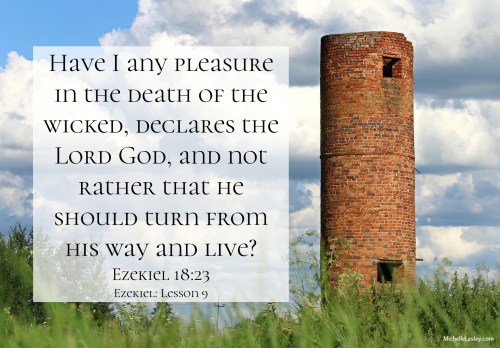
Suggested Memory Verse

Share Your Testimony

Testimony Tuesday: Audrey’s Story

Audrey’s Story

A few months ago, I was scrolling on Twitter when a tweet from Michelle Lesley got my attention. She said, in her experience, false teachings enter the church through women’s ministries and worship music. I was aware of this. Many other evangelicals voiced similar concerns on doctrinal errors in women’s ministries and contemporary worship music. What stood out to me wasn’t what the tweet said, but what it didn’t.

In my experience, there is a third entrance through which false doctrines sneak into the church. It is a small door, but it was through it that I got introduced to false teachers.

This entrance is the young adult ministries.

Most churches have ministries for Christians who are in their 20’s and 30’s. I have been a member of several of them, and I noticed other young adults almost always led them. They get attracted to popular young pastors the same way women are drawn to popular female teachers. These pastors are trendy, funny, relatable, and have a substantial social media presence. They, however, are not doctrinally sound.

They, however, are not doctrinally sound…

Being a social media recluse, I only discovered these pastors through the 20’s/30’s ministry at my former church.

My first “Bible study” there was Good or God by John Bevere, and it was the first Christian book I ever read. Since I was a new Christian with little discernment, I believed everything Bevere taught. I got a few of his other books and watched several of his lessons from his preaching ministry, Messenger International. He quickly became one of my favorite teachers.

But as I learned much later, John Bevere is a questionable teacher. He teaches extra-biblical revelations — he once said God told him He was about to do new things in the church that would make Pentecost day child’s play. He teaches tongues is a supernatural language that helps us communicate with God so that the devil doesn’t understand us. And his wife, Lisa Bevere, disobeys Scriptures by teaching men and partnering with false teachers.

The next study we did was Transformed by Rick Warren.

Rick Warren is the pioneer of the seeker-sensitive movement, and he is not a trustworthy teacher. His book, The Purpose-Driven Church, has caused many churches to water down the gospel, and add worldly components in their services to keep unregenerated hearts entertained. In Transformed, Warren frequently twists Scriptures and uses dubious translations to make incorrect statements.

I just wanted to study the Bible…

After a while, I got frustrated with these types of studies and my life group. I just wanted to study the Bible. I hoped that after Transformed, we would finally dig in the Word. But the leader dashed my hopes when she announced yet another canned study from yet another popular pastor. I wanted to say something, but I was new and shy. So I kept quiet. By God’s grace, someone else in the group voiced the concerns I had about our Bible study sessions. The leader considered them, and we started studying books of the Bible.

But ironically, it gave me even more exposure to dangerous teachers.

As we discussed our weekly readings, my mates frequently mentioned pertinent quotes or sermons by their favorite pastors. That’s how I discovered names like Steven Furtick, Robert Morris, and Judah Smith. Trusting their judgment, I listened to these pastors and others associated with them. And for me, Christianity’s best and brightest were men like Craig Groeschel, Michael Todd, T. D. Jakes, Joel Osteen, Chad Veach, and John Gray. (I don’t consider all these men false teachers, but I don’t recommend them.)

After a shallow diet of Bible books studies, we eventually returned to canned studies. The next one we did was undoubtedly the worst of them all. It was Battlefield of the Mind by Joyce Meyer.

Joyce Meyer is a certified false teacher who teaches heresy like the Prosperity Gospel and Word of Faith theology. I bought her book intending to read it, but by God’s providence, my schedule changed, and I only attended three sessions. I still shudder when I think of the damning doctrines I almost learned.

I still shudder when I think of the damning doctrines…

Shortly after, I moved to another state, and I have never been back to that church. It’s been almost two years since then, and I realize now there were several other issues with that church. Nevertheless, young adult ministries can still be an avenue for false teaching even in sound churches, and need close oversight.

They are tomorrow’s leaders, and they have a profound influence on today’s youths. Most of the people in my life group worked in the children’s ministry or mentored teens in the church. If these kids get exposed to false teachers at such an impressionable age, it will be difficult to break that hold later. It is evidenced by the visceral reactions of Christians online when someone critiques their favorite teachers.

I used to be one of them. Someone once called my favorite pastor a false teacher, and I passionately defended him. I am ashamed to say that I even used the p-word (“Pharisee”). But today, I no longer follow him and his like.

The Lord is faithful…

I credit this change to American Gospel: Christ Alone, that exposed counterfeit gospels and their leaders, many of whom I respected even though I didn’t follow them; Justin Peters who set me free from false teachings like extra-biblical revelations and mysticism that have been a stumbling block in my faith; Michelle Lesley, who pulled me off the path of egalitarianism, made me appreciate my role as a woman, and exposed dangerous women teaching otherwise; and What Shall I Cry Ministry that taught me the difference between expository preaching and man-centered preaching.

My deepest gratitude goes to the Holy Spirit, who provided me with these excellent resources and opened my eyes to the truth.

The Lord is faithful, and He will protect His elect.

Grace and peace to you!


Ladies, God is still at work in the hearts and lives of His people, including yours! Would you like to share a testimony of how God saved you, how He has blessed you, convicted you, taught you something from His Word, brought you out from under false doctrine, placed you in a good church or done something otherwise awesome in your life? Private/direct message me on social media, e-mail me (MichelleLesley1@yahoo.com), or comment below. Your testimony can be as brief as a few sentences or as long as 1500 words. Let’s encourage one another with God’s work in our lives!