Encouragement, Suffering

Five Words of Encouragement for Spiritual Warfare’s Battle-Weary Soldiers

Anybody who tells you the Christian life is all lollipops and unicorns is selling something. No reasonable person who is the slightest bit familiar with the New Testament or church history could honestly believe that. The New Testament church was born and baptized in blood – first the blood of Christ, and the blood of His martyred disciples ever since.

Anybody who tells you the Christian life is all lollipops and unicorns is selling something.

In the spirit, God blesses us with joy unspeakable and full of glory, the peace that passes all understanding, and the comfort of “Lo, I am with you always.” And that is much to be thankful for, because life in the robe of flesh would be unbearable without those blessings.

But as we walk this real, tangible, eat your veggies and brush your teeth phase of existence, Jesus isn’t just a pretty pink purse we pick up along the way to complement our life’s wardrobe. To put on Christ is to volunteer to wear a target on your back. And your front, come to think of it. Because when you unapologetically stand for Christ and the truth of His Word, you will not only face a full frontal attack from the world, you’ll also risk being stabbed in the back by those you thought were comrades in arms.

When you unapologetically stand for Christ and the truth of His Word, you will not only face a full frontal attack from the world, you’ll also risk being stabbed in the back by those you thought were comrades in arms.

Dealing with and responding to those attacks – that’s what spiritual warfare is. Not this modern, ridiculous, NAR-inspired version of “binding” Satan and bellowing commands into the air as though you have the power and the authority to boss the devil around (Even Michael the archangel wouldn’t go there.). We’re called to be good soldiers of Christ Jesus, not the Commander.

As good soldiers in the Lord’s army (yes sir!) real, biblical spiritual warfare is being protected and prepared in the spirit to righteously and courageously walk out biblical truth on the battlefield of whatever tangible circumstances God has placed you in. It’s understanding that those attacking you are not your real enemy – not the ones calling the shots. They’re soldiers, just like you. They’re either lost and ensnared by the devil, having been held captive by him to do his will (kind of a spiritual Stockholm Syndrome), or it’s friendly fire from someone in your unit who’s saved, but has somehow, momentarily mistaken you for the enemy.

But the wounds of warfare are painful and debilitating no matter who’s wielding the weapon. So for all of you ladies who have been persecuted by the world, attacked by family, abused by fellow church members, and abandoned by friends simply for holding fast to Christ and His Word and refusing to compromise, let these words of encouragement from the very One you cling to salve your soul…

For all of you ladies who have been persecuted by the world, attacked by family, abused by fellow church members, and abandoned by friends simply for holding fast to Christ and His Word and refusing to compromise, let these words of encouragement from the very One you cling to salve your soul…

1.
Jesus knows how you feel

There will never be a moment when we can cry out to Jesus from the depths of our desperation, “You have no idea what this is like – how badly it hurts!”. Yes, He does. Not just because He’s omniscient. Not just because He knitted you together in your mother’s womb and knows all the secrets of your heart. But because He walked that lonely and painful road Himself, as a man in the flesh, just like you.

He was despised and rejected by men, a man of sorrows and acquainted with grief; and as one from whom men hide their faces, he was despised, and we esteemed him not…
…we esteemed him stricken, smitten by God, and afflicted…
…He was oppressed, and he was afflicted…
…By oppression and judgment he was taken away…
…And they made his grave with the wicked…although he had done no violence, and there was no deceit in his mouth.
From Isaiah 53

But I am a worm and not a man, scorned by mankind and despised by the people. All who see me mock me; they make mouths at me; they wag their heads; โ€œHe trusts in the Lord; let him deliver him; let him rescue him, for he delights in him!โ€
Psalm 22:6-8

Many of them said, โ€œ[Jesus] has a demon, and is insane; why listen to him?โ€
John 10:20

If the world hates you, know that it has hated me [Jesus] before it hated you.
John 15:18

and coming to his hometown [Jesus] taught them in their synagogue, so that they were astonished, and said, โ€œWhere did this man get this wisdom and these mighty works?…And they took offense at him. But Jesus said to them, โ€œA prophet is not without honor except in his hometown and in his own household.โ€
Matthew 13:54,57

Jesus knows how you feel, Dear One. He knows.

Jesus knows how you feel, Dear One. He knows.

2.
Jesus loves you

There may be times when you feel like everyone is against you. It’s hard to be hated. But hold on to this truth and don’t let go of it: Jesus loves you. He delights in you. He will never turn His face away from you.

I have loved you with an everlasting love; therefore I have continued my faithfulness to you.
Jeremiah 31:3b

All the paths of the Lord are steadfast love and faithfulness, for those who keep his covenant and his testimonies.
Psalm 25.10

I will rejoice and be glad in your steadfast love, because you have seen my affliction; you have known the distress of my soul,
Psalm 31:7

May the Lord direct your hearts to the love of God and to the steadfastness of Christ.
2 Thessalonians 3:5

Jesus loves you. He delights in you. He willย neverย turn His face away from you.

3.
Jesus will sustain you

Jesus isn’t a lifeline that only reaches halfway across the rushing river. He is our rock. Our fortress. Strength. Sustenance. Stability. What He brings you to, He will bring you through, as the old saying goes. He’s not going to abandon you in the middle of your troubles or fail to provide grace and help when you need it. You can trust Him.

you whom I took from the ends of the earth, and called from its farthest corners, saying to you, โ€œYou are my servant, I have chosen you and not cast you offโ€; fear not, for I am with you; be not dismayed, for I am your God; I will strengthen you, I will help you, I will uphold you with my righteous right hand.
Isaiah 41:9-10

Behold, God is my helper; the Lord is the upholder of my life.
Psalm 54:4

So we can confidently say, โ€œThe Lord is my helper; I will not fear; what can man do to me?โ€
Hebrews 13:6

Cast your burden on the Lord, and he will sustain you; he will never permit the righteous to be moved.
Psalm 55:22

our Lord Jesus Christ, who will sustain you to the end, guiltless in the day of our Lord Jesus Christ.
1 Corinthians 1:7b-8

Jesus isn’t a lifeline that only reaches halfway across the rushing river. He is our rock. Our fortress.

4.
Jesus will honor you

In the world’s eyes, voluntarily suffering for the name of Christ is shameful, pitiable, foolish, and worthy of derision. In God’s economy, sharing in Christ’s sufferings is an honor and worthy of reward.

and when they had called in the apostles, they beat them and charged them not to speak in the name of Jesus, and let them go. Then they left the presence of the council, rejoicing that they were counted worthy to suffer dishonor for the name.
Acts 5:40-41

Blessed are those who are persecuted for righteousness’ sake, for theirs is the kingdom of heaven. Blessed are you when others revile you and persecute you and utter all kinds of evil against you falsely on my account. Rejoice and be glad, for your reward is great in heaven, for so they persecuted the prophets who were before you.
Matthew 5:10-12

[Moses] choosing rather to be mistreated with the people of God than to enjoy the fleeting pleasures of sin. He considered the reproach of Christ greater wealth than the treasures of Egypt, for he was looking to the reward.
Hebrews 11:25-26

But rejoice insofar as you share Christ’s sufferings, that you may also rejoice and be glad when his glory is revealed. If you are insulted for the name of Christ, you are blessed, because the Spirit of glory and of God rests upon you…Yet if anyone suffers as a Christian, let him not be ashamed, but let him glorify God in that name.
1 Peter 4:13-14,16

In God’s economy, sharing in Christ’s sufferings is an honor and worthy of reward.

5.
Jesus will vindicate you

Perhaps one of the greatest comforts in the midst of the battle fatigue of spiritual warfare is God’s omniscience and justice. Not a single insult will be hurled at you that escapes His notice. None of the flak you’ve taken for Him will slip through the cracks and be forgotten. One day, whether here or hereafter, God will set everything right.

Behold, all who are incensed against you shall be put to shame and confounded; those who strive against you shall be as nothing and shall perish. You shall seek those who contend with you, but you shall not find them; those who war against you shall be as nothing at all.
Isaiah 41:11-12

For the Lord will vindicate his people and have compassion on his servants.
Psalm 135:14

You have seen the wrong done to me, O Lord; judge my cause. You have seen all their vengeance, all their plots against me. You have heard their taunts, O Lord, all their plots against me. The lips and thoughts of my assailants are against me all the day long. Behold their sitting and their rising; I am the object of their taunts.

You will repay them, O Lord, according to the work of their hands. You will give them dullness of heart; your curse will be on them. You will pursue them in anger and destroy them from under your heavens, O Lord.
Lamentations 3:59-66

When he opened the fifth seal, I saw under the altar the souls of those who had been slain for the word of God and for the witness they had borne. They cried out with a loud voice, โ€œO Sovereign Lord, holy and true, how long before you will judge and avenge our blood on those who dwell on the earth?โ€
Revelation 6:9-10

One day, whether here or hereafter, God *will* set everything right.

As you suffer for the Name above all names and do battle for His cause, strengthen your hands for combat with His great and precious promises, which can never be broken. Rest in Jesus’ love for you. Know that He understands your pain and anguish. Trust Him to sustain you. Believe that He will honor and vindicate you. For the Lord is good; his steadfast love endures forever, and his faithfulness to all generations.

Which promises do you cling to in the midst of spiritual warfare?
1&2 Timothy Bible Study

1 & 2 Timothy: Lesson 10

Previous Lessons: 1, 2, 3, 4, 5, 6, 7, 8, 9

Read 2 Timothy 2

Questions to Consider

1 . Examine the phrase, “You, then, my child…” in verse 1. Who is “you/my child”? Notice how the word “then” in this phrase makes it very similar to phrases like, “Therefore…,” “So then…,” or “Because of this…”. What is our rule of hermeneutics when a chapter or verse starts with this kind of transitional phrase? (Hint: see question 6 in lesson 9, link above). Where should you look next?

How do the themes of suffering for the gospel, not being ashamed of the gospel, and guarding the deposit from chapter 1 relate to what Paul is about to tell Timothy? Trace the line of entrusting the deposit of the gospel, beginning with Christ entrusting it to Paul. To whom did Paul entrust it? To whom is Timothy to entrust it? (2)

2. “Think over what [Paul] says” (7) in the illustrations he uses in verses 3-6, asking the Lord to “give you understanding in everything.” Who do the soldier, the athlete, and the farmer represent? (1-2) What is Paul’s admonition to Timothy and these men in each of these illustrations? Do these admonitions apply only to pastors and elders? How might they apply to the average Christian today?

3. In verses 8-13, we have our repeated motif of Paul summarizing the gospel in the middle of instructing Timothy. What impact has it had on you to see the Holy Spirit continually driving home the gospel in these epistles regardless of what instruction He’s giving pastors and the church? Does your pastor help your church to center on the gospel in everything – sermons, music, worship service, Bible study classes, fellowship, church business, programs, evangelism, missions, and the church member’s daily life? What is the significance of the word “remember” at the beginning of verse 8 and “remind them of these things” at the beginning of verse 14?

4. Explain the significance of the themes of “suffering” (as carried over from chapter 1) in 1-13 and “quarreling” in 14-26.

5. Examine each of the times a form of the word “quarrel” is used in 14-26. (14,23,24) Does this mean that disagreement, controversy, and confrontation are always to be avoided in the church regardless of the issue? Recall the examples of controversy we have already seen in 1 Timothy. What issues did these controversies have to do with? Do they seem to be the same issues of “quarreling” Paul is talking about in this passage? What do “quarrel about words” (14, 1 Tim. 6:4) and “foolish, ignorant controversies” (23) mean? What is the difference between these types of controversies and quarrels and the necessary factions Paul describes in 1 Corinthians? Considering how Paul has already warned Timothy about quelling false doctrine in the church, is rebuking false teachers taking part in “quarrels about words” and “foolish, ignorant controversies” or being “quarrelsome”?

6. Examine verses 15-19. List the things in verses 16-18 that can bring chaos and disorder to the church. Explain the instructions and precepts in verses 15 and 19. Notice how these instructions and precepts bring stability and unity to the church, and how these two verses “bookend” or contain the chaos in verses 16-18. What does this tell you about the church, and you as an individual, walking in obedience to God?

7. Examine verses 20-21 in light of verses 22-25a (note the “So” at the beginning of verse 22). How do verses 22-25a describe how someone may “cleanse himself from what is dishonorable”? What are the characteristics of someone who is “a vessel for honorable use”?

8. Who is “the Lord’s servant” in verse 24? Compare verses 24-25a with the qualifications for pastors and deacons we saw in 1 Timothy 3. What are the similarities and differences? How could you walk out the instructions in 24-25a as a mother, leader, Bible teacher, while evangelizing, or while defending the faith? Verses 25b-26 tell us why pastors, teachers, and, yes, even a mom or a woman sharing the gospel should exhibit these characteristics. What is that reason? How do verses 25b-26 point back to the gospel-centrality of the church, pastors, and individuals we looked at in #3?


Homework

How do we know which controversies are “foolish and ignorant” and which ones are important biblical issues that must be settled according to Scripture? Give 2-3 examples of each kind of controversy that you’ve experienced or witnessed in your church or with other Believers. What would have been the biblical way to handle each of these controversies? Take some time in prayer to ask God to help you avoid foolish, ignorant controversies but to stand firmly in controversies over the truth of His Word, and the wisdom to discern the difference.


Suggested Memory Verse


Podcast Appearances

The Rapp Report Podcast Guest Appearance: The Open Letter to Beth Moore and Complementarianism


A few days ago, I had the pleasure of sitting down and chatting withย Andrew Rappaport on the The Rapp Report podcast, a ministry of Striving for Eternity. Listen in as Andrew and I discuss the Open Letter to Beth Moore*, complementarianismย and more!


Be sure to subscribe to the The Rapp Report podcast, and don’t forget to followย Striving for Eternity on Facebook and Twitter!

*Ladies, if you’d like to add your signature to the letter, click on the link above, scroll all the way to the bottom, and add a comment in the comment box. (You will not see your signature immediately since I approve comments manually.)


Got a podcast of your own or have a podcasting friend who needs a guest? Need a speaker for a womenโ€™s conference or church event? Click the โ€œSpeaking Engagementsโ€ tab at the top of this page, drop me an e-mail, and letโ€™s chat!

Mailbag

The Mailbag: Questions about the Open Letter to Beth Moore

ย Since the publication of the Open Letter to Beth Moore, several questions have arisen that I’d like to address in today’s edition ofย The Mailbag.

(Ladies who would like to add your signature to the letter- click the link above, scroll all the way down, and add a comment in the comment box. Your comment will not appear immediately, since I manually approve comments.) (You are welcome to leave a comment, but I am no longer adding signatures to the letter.)

If you’re not familiar with the context of this article, please read An Open Letter to Beth Moore – Timeline of Events.


1. Michelle, why did you write the letter?
I didn’t
(long-time readers can probably tell from the format and phraseology), and it was not my idea. I was asked to give input on the letter, be one of the original signers, and help publicize the letter, and I agreed to do so. Most of the original signers have also posted the letter at their websites.

2. What is the purpose of the letter?
The purpose of the letter should be self-evident if read carefully in its entirety. It is to learn Beth Moore’s position on homosexuality in light of the fact that she has been virtually silent on this issue.

3. Why is Beth Moore’s position on homosexuality any of your business?
Ironically, the people who have asked this question consider it their business to know why it is our business.

First of all, let’s clarify something. This is not a personal question like, “Boxers or briefs?” or “How’s your relationship with your husband?”. Those are questions that can rightly be answered with, “None of your business.” The questions we have asked are more akin to asking a politician, “What is your position on the First Amendment?” If someone asked a politician that question in a public setting, we would find it very odd if he did not answer and his supporters told the questioner it was none of her business.

Beth Moore has said repeatedly that she has been a Bible teacher for forty years. Asking a Bible teacher questions about what she believes about the Bible is perfectly reasonable, especially when that Bible teacher has decades of experience, is an evangelical celebrity, and publicly shares what she believes about the Bible on various topics every day on Twitter. Asking what Beth believes about homosexuality is a legitimate biblical question that cannot be credibly answered with, “None of your business.”

One of the reasons I personally believe it is very much my business is not mentioned in the letter. (Again, I did not write it, though I do not fault the author for omitting this point.) It is my business and that of every single one of the 14.8 million other Southern Baptists out there.

Largely because the world has made homosexuality the litmus test of “Are you for us or against us?” the Southern Baptist Convention has, not unwisely, also made it a litmus test (see Article III.1.1) for whether or not churches can be in cooperation with the SBC and whether or not LifeWay will carry an author’s materials (we’ve seen this with Jen Hatmaker, Eugene Peterson, etc.).

Beth Moore is the best known Southern Baptist in the world, hands down. I have no doubt that she influences more Christians than the president of the SBC, the heads of all SBC entities, and all SBC pastors. If the SBC is going to make homosexuality the iconic issue on which we judge churches and authors, why should Beth, as LifeWay’s best selling author, and the best known and most influential Southern Baptist in the world not have to make it clear where she stands on homosexuality? If any Southern Baptist should have to clearly and publicly declare where she stands on the issue of homosexuality, it’s Beth. I mean, if any Southern Baptist church member walked into her pastor’s office and asked him these questions and he equivocated, refused to answer, or couldn’t biblically answer them, he would be flirting with violating the SBC requirement that churches hold a biblical stance on homosexuality or face being disfellowshipped. But Beth Moore doesn’t have to answer? No, she owes it to every Southern Baptist to clearly state where she stands on this issue – especially to LifeWay and to the women and churches who use her materials.

But, as original signer of the letter, Elizabeth Prata, asks, “Does the SBC and Lifeway apply a double standard to Beth Moore?

But Beth also owes it to her followers to make it clear where she stands on this important biblical issue. I’m surmising – from the comments of several people who have defended her – that some of her followers are practicing homosexuals or are affirming of homosexuality. If she is a Bible teacher, it is her obligation (whether she answers the letter directly to us or not) not to “shrink from declaring to [them] the whole counsel of God” (Acts 20:27), which includes the Bible’s teaching on this currently ubiquitous issue. Certainly, any Christian must broach this issue lovingly and compassionately, but it must be broached, and broached clearly, firmly, and unashamedly. It is not loving to neglect or decline to call sinners to repentance for fear of hurting their feelings when those people could die in their sins and spend an eternity in Hell. Beth has a large platform and could bring biblical clarity to this issue to her many followers. We are prayerfully hoping she chooses to steward her platform to the glory of God by helping those in her sphere of influence to understand the Bible’s clear teaching on homosexuality.

4. Beth is under no obligation to answer this letter.
Of course she’s not, and no one ever said she was. She does not answer to me, personally, or any of the other signers of the letter. We have also not “demanded” as some have put it, that she respond to the letter. We have merely asked a few simple questions. Speaking for myself, it is immaterial to me whether or not she ever directly responds to me and the other signers of this letter. But as I mentioned above in #3, she is under obligation to Southern Baptists and to her followers to make her position on homosexuality known and clear. The venue or method she chooses for doing so (i.e. a direct response to the letter, writing a Bible study on homosexuality, a letter to Southern Baptist leadership explaining her position, etc.) is unimportant.

5. Why didn’t you contact Beth privately as Matthew 18:15-20 says to do?
The Matthew 18 passage on church discipline does not apply in the case of public discourse in the public square or to asking a Bible teacher questions about the Bible. It is about sin in the local congregation where you actually know the offender personally and have access to him/her. It has to do with correcting sin in the local church and removing the offender from the local church if she refuses to repent. Jesus, Paul, and others addressed public teaching and other issues publicly many times without following the (again, inapplicable) steps in Matthew 18. D.A. Carson,ย Josh Buice, andย Randy Alcorn have each written excellent articles further explaining the inapplicability of this passage to public teaching. The only way to apply the Matthew 18 passage on church discipline in this situation would be if Beth’s own church and pastor applied it to her.

Furthermore, even though the Matthew 18 passage does not apply to asking someone questions or teaching in the public square, many people (including me) have tried to contact Beth privately on numerous occasions only to have their e-mails ignored. One of the ladies who added her signature to the letter mentioned that she has known Beth personally since the days when she was in Beth’s aerobics class (before Beth became a Bible teacher) and has tried several times to contact her about concerns over her teachings, and even her e-mails have gone unanswered.

6. I don’t think the “open letter” format is the appropriate venue for addressing issues like this.
I’m not crazy about open letters myself, but consider the following:

1. As I mentioned in #5 above, even though this is not a Matthew 18 issue, many have tried to contact Beth privately numerous times about various issues and have been ignored, including at least one woman who has known Beth personally for decades. There is no reason to expect that she would respond to this issue in private correspondence.

2. Southern Baptist and/or LifeWay leadership has either not held her publicly accountable on this issue or she has refused to be held accountable by them.

3. Beth has not answered public social media questions about this issue.

4. Beth has not spontaneously/voluntarily made her position on this issue clear.

Since none of these venues have been effective, and some feel the open letter format is inappropriate, what is the appropriate venue?

Original signer of the letter, Elizabeth Prata, has more to add here concerning Beth’s availability to be contacted.

I would also remind those objecting to the open letter format that Beth herself wrote an open letter on her own blog about a year ago. It’s still on her LPM blog and is titled “A Letter to My Brothers” if you’d like to read it. It would be inconsistent to object to our use of the open letter format without also objecting to Beth’s use of the open letter format.

7. If Beth makes an unequivocally clear biblical statement on homosexuality, does that mean she is a doctrinally sound Bible teacher?
No. If Beth makes an unequivocally clear biblical statement on homosexuality, we would rejoice that God’s Word has been rightly proclaimed on that issue to all who hear or read it, and we would offer our thanks and encouragement to Beth for doing so. It would be a wonderful, courageous step in a godly direction for Beth’s theology.

We hope that wonderful step would be her first step down the road of submitting to and teaching sound biblical doctrine in three other major problematic areas of Beth’s theology which render her doctrinally unsound: mishandling God’s Word, preaching to men, and partnering with false teachers.

8. So what if Beth is friends with Jonathan Merritt and Jen Hatmaker? People can be friends with people they disagree with.
Of course people can be friends with people they disagree with. That’s not the question. The question is – does Beth actually disagree with them? She hasn’t said so. And if she does disagree with them, why has she not made this clear to her followers? When someone is a public figure and Bible teacher she has to be very careful and circumspect about her associations and the example she sets. Beth’s followers look up to her and consider her their teacher. When public adulatory interactions take place between Beth and those who have clearly affirmed homosexuality (especially when Beth has been virtually silent on this issue), many of her followers will take that as a tacit agreement (or at least not disagreement) with their theology.

9. Who is Martha Pearce?
It’s not Martha PeaRce, who was one of the original signers of the letter, it’s Martha Peace. Like “peace on earth.” Martha Peace is well known in doctrinally sound women’s ministry and biblical counseling circles. I believe a few articles and/or broadcasts may have spelled or pronounced her name incorrectly. It’s my hope that journalists, interviewers, etc., will make sure they have her name correct since the fact that she signed the letter will be impactful to many women.

10. Has Beth responded the letter or the questions yet? Do you anticipate that she will?
As of this time, no, Beth has not responded to the letter or the questions yet in any meaningful way.

She posted a cryptically vague Facebook post warning her followers about “Bible beaters void of the Holy Spirit” roughly coinciding with the release of the letter, but while this may have been a visceral reaction to the letter, I personally (I believe some of the other original signers may have differing opinions), do not consider it a response, or answer, to the letter. It did not mention or even allude to the letter, any of us who signed the letter, anyone or anything mentioned in the letter, or the topic of homosexuality.

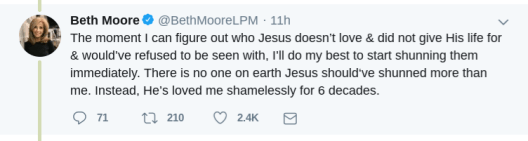
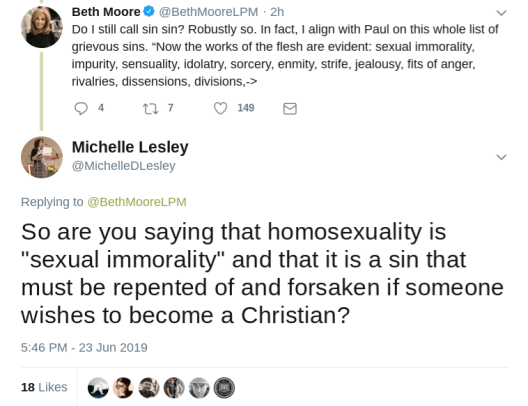
Beth also posted this tweet thread, which may seem to sort of answer the letter, but actually does not. A couple of excerpts from the thread:

Let’s review the questions from the letter:

1. Do you believe homosexuality is inherently sinful?

2. Do you believe that the practice of the homosexual lifestyle is compatible with holy Christian living?

3. Do you believe a person who dies as a practicing homosexual but professes to be a Christian will inherit eternal life?

4. Do you believe same sex attraction is, in and of itself, an inherently sinful, unnatural, and disordered desire that must be mortified?

5. Why have you been so silent on this subject in light of your desire to โ€œteach the word of God?โ€

There is nothing anywhere in the questions or the letter addressing who Jesus “didn’t love,” “did not give His life for,” or “would’ve refused to be seen with.”

There is not even a hint of a suggestion in the questions or the letter that she, or anyone else, should “shun” anyone.

Assuming this tweet is responding to the letter (we have to assume because she doesn’t say one way or the other and, again, she never mentions homosexuality in this thread), this is a passive aggressive ad hominem dig at the signers of the letter.

Why would I ask Beth to clarify her tweet (which she has yet to respond to)? Well, for starters, you’ll notice she intentionally chose a verse that does not use any form of the word “homosexuality,” even though she is undoubtedly familiar with the ones that do. Why? Why not use 1 Corinthians 6:9-10 (also written by Paul) which uses the more specific term?

For those of us who are familiar with Galatians 5:19 and the Greek behind it, we already know that “sexual immorality” covers all sexual activity outside the monogamous heterosexual marriage bed, which does include homosexuality. Therefore, many of Beth’s followers from a conservative church background will take her quotation of this passage in Galatians 5 to mean, “Yes, I agree with the Bible that homosexuality is a sin.”

However, as I pointed out earlier, Beth also has homosexual and homosexual affirming followers, many of whom likely subscribe to the “gay Christian” movement’s ideology that the verses in the Bible that condemn homosexuality are only speaking of homosexual temple prostitution and assorted other perversions, not loving, faithful, monogamous homosexual “marriages” or relationships. Additionally, as the letter cited, Beth’s friend Jen Hatmaker has made it abundantly clear that she believes homosexual unions can be “holy” and that unrepentant, practicing homosexuals can be Christians, which Beth has never publicly refuted. Beth’s adulatory friendship with Jen and Jonathan are likely seen by many of her homosexual/homosexual affirming followers as a tacit endorsement of their errant theology. People who believe all of these errant ideas about homosexuality are not going to to see the term “sexual immorality” as applying to faithful homosexual relationships (How could a relationship be “holy” and “immoral” at the same time?), so they will see Beth’s tweet as saying that she considers “sexual immorality” a sin, but not that that term includes “moral” homosexual relationships.

So we’re basically right back where we started. This tweet is not an answer, and it doesn’t clarify her position on homosexuality. It is an obfuscation in an attempt to deflect any further questioning of her position on the issue.

Personally, and I believe most of the other original signers would agree, I do not anticipate that Beth will respond directly to the letter or clearly answer the questions. As I stated earlier, it seems to be her practice to ignore e-mails and social media comments that request biblical accountability from her, and I don’t see why our letter would be treated any differently.

11. You’re just trying to get attention, make a name for yourself, or build up your own ministry by publishing this letter.

DebbieLynne Kespert, one of the original signers of the letter helpfully answers this false accusation in her article Did I Publish The Open Letter To Beth Moore In Order To Get People To Read The Outspoken TULIP?


The question we should all be asking ourselves is – whyWhy is Beth afraid to answer these very simple questions that she knows the answers to? Why has she avoided answering them for five days? Why, when she finally “responded,” did she give such an evasive answer instead of clearly stating her position on homosexuality as she has on many other issues? If you took these questions to your pastor or Bible study teacher at church and he responded to them the way Beth Moore responded, what would you think?

Whether Beth chooses to answer our letter directly or not, it is our prayer (and we are praying for her) that she will boldly and unashamedly take a clear biblical stand on the issue of homosexuality in order to help her followers better understand the truth of God’s Word – that sinners may be saved, that saints may be properly discipled, and that God may receive all the glory.


If you have a question about: a Bible passage, an aspect of theology, a current issue in Christianity, or how to biblically handle a family, life, or church situation, comment below (Iโ€™ll hold all questions in queue {unpublished} for a future edition of The Mailbag) or send me an e-mail or private message. If your question is chosen for publication, your anonymity will be protected.

Book Reviews

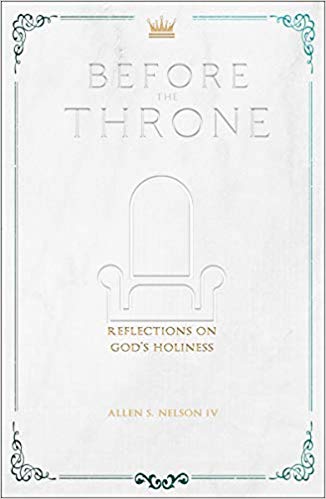
Guest Post: A Review of “Before the Throne”

If your theology pretty much matches up with mine (as outlined in the โ€œWelcomeโ€ and โ€œStatement of Faithโ€ tabs) and youโ€™d like to contribute a guest post, drop me an e-mail at MichelleLesley1@yahoo.com,
and letโ€™s chat about it.

A Review of Allen S. Nelson IVโ€™s
Before the Throne
by Melissa Googe

Each day, I become increasingly grieved by our world. We are surrounded by conflict over issues that, if we were to abide by Scripture, would be quickly settled. How can those saved by Godโ€™s grace be so divided over the answers to todayโ€™s controversies?

As a long-time Christian and the wife of a pastor, I am blessed to have spent many years in my faith. I grew up in a Christian home. I have many Christian friends. I teach in a public school system where our motto is JOY (Jesus, Others, Yourself). I am surrounded by Christians, yet I find myself so frustrated with family members, friends, or colleagues that I strongly consider unfollowing them on social media or want to avoid being around them.

Sadly, there is a movement among Christians to โ€œmodernizeโ€ our faith to make it more โ€œrelevant.โ€ To accomplish this, churches have adopted popular worldly ideas instead of expecting the lost to embrace Biblical views upon salvation. In Nelsonโ€™s preface, when I was beginning to know that I had found a kindred soul, he wrote that the answer to the churchโ€™s compulsion to be relevant is โ€œto look downward so as to look upward.โ€ He continued on to say that โ€œthe church that looks long into the face of God in Scripture will find that the question for โ€œrelevancyโ€ is no longer all that relevant.โ€ (2)

Oversimplification of all that is involved in living a Christian life and reaching others for Christ has led to churches full of lost people who falsely believe they are saved. How do we know this? Just take an honest look around. Many who claim to be Christians today actually hold to a form of โ€œpractical atheism.โ€ (19) Nelson describes a practical atheist as one who โ€œacknowledges the existence of God in his or her mind but lives as though He either doesnโ€™t exist, or that He actually doesnโ€™t care how we live or how He is to be worshiped.โ€ Wow! This description really brings some people to mind, doesnโ€™t it?

I sat down with Nelsonโ€™s Before the Throne: Reflections on Godโ€™s Holiness with an expectation of encountering complex theology about Godโ€™s holiness that would require me to stop reading and research information to be able to make my way through the text. While Godโ€™s holiness is not a simple subject, instead of having to stop because of running into something I didnโ€™t understand, I had to stop because I was being humbled. This book, while it is about Godโ€™s holiness, is guaranteed to cause you not only to reflect upon Godโ€™s holiness, but to realize how truly unworthy and lost we are without Him and the sacrifice of His son.

Sin. Such a small word, but what word carries more weight? Humans try to minimize sin, but there is nothing of greater cost to us as the dividing line between us and holiness of God. Acknowledging God but then living as though He doesnโ€™t exist, as though He doesnโ€™t care how we live, or as though He doesnโ€™t care about how we worship Him is completely sinful. If we are honest, no one reading this would dare to claim to have never sinned in such a way. Like Paul said in Romans 7: 15, โ€œI do not understand what I do. For what I want to do I do not do, but what I hate I do.โ€

Nelsonโ€™s Before the Throne helps readers understand what holiness is, how God and holiness are synonymous, and what referring to Godโ€™s holiness really means. While Godโ€™s holiness is anything but simple, Nelson has done an exemplary job of detailed explanations and examples of Godโ€™s undoubtable, unspeakable, untamable, unblemishable, unmatchable, unquestionable, uncontainable, unchangeable, unapproachable, uncompromising, unborable, and unquenchable holiness.

I will not attempt to touch upon each of Nelsonโ€™s points; read his book and find for yourself the โ€œexcitement, woe, conviction, awe, and gladnessโ€ of Godโ€™s holiness that Nelson shares with readers! (1) Instead, I will share how reading Nelsonโ€™s book helped me to immediately recognize Godโ€™s holiness in action. Godโ€™s holiness isnโ€™t something that we should only think about during the preaching hour on Sunday; we should spend time each day โ€œintentionally contemplating the holiness of God.โ€ (209) I propose that reading Nelsonโ€™s book will help to clarify attributes of Godโ€™s holiness that are described and present in His Word, and you will then be able to apply your improved understanding of Godโ€™s holiness to lifeโ€™s many different circumstances.

Last week, our small, rural county lost a pillar of our community. I could never put into words what he meant to many in the area, as he, the owner of the only funeral home in the county, was the one who ministered to us when we lost family members and friends. One response to his passing on social media was to share an excerpt from The Shack by William P. Young. In this excerpt, โ€œthe Lordโ€ states, โ€œโ€ฆbecause I work incredible good out of unspeakable tragedies doesnโ€™t mean I orchestrate the tragedies. Donโ€™t ever assume that my using something means I caused it or that I needed it to accomplish my purposes.โ€ I know this was shared with the intention of comforting those grieving, but exactly how is reading about how the Lord has nothing to do with โ€œunspeakable tragediesโ€ going to comfort the bereaved?

I am sure we have all experienced the deep grief that comes with the passing of a loved one. Four years ago, my best friendโ€™s battle with cancer ended. I believe He has a plan. I believe in Godโ€™s holiness. Yet it is hard to hold onto those truths in such times. Today, I could still allow myself to be drawn into the heartbreak of losing Katherineโ€™s tangible presence, of missing our laughter, of seeing her children grow up without her. Instead, I choose, and let us all choose, to be comforted by these truths about Godโ€™s unquestionable holiness. โ€œWe donโ€™t judge events and conditions and then question whether God was holy in His actions. Rather, we begin with the premise that God is holy and then we filter all these through this truth โ€“ even the events and circumstances we cannot fully explain.โ€ (102) โ€œFor today, we only know in part, but part of what we do know is that all God decides, decrees, and demands is holy.โ€ (103)

Yesterday, a friend shared a Steven Furtick video from Elevation Church dated April 4th in which Furtick seeks to illustrate Godโ€™s grace between the gaps of where you have been and where He is taking you. However, Furtickโ€™s illustration shows that in walking with God, โ€œWhen you take a step, when you make a move, God moves too.โ€ According to Furtick, God will not let you reach Him because you would become arrogant; โ€œSo what God is gonna do, God is going to make sure that as you grow, the gap stays.โ€ Essentially, Furtickโ€™s illustration teaches that you can strive to live a holy and obedient life, but you will never grow any closer to God.

I am thankful for Godโ€™s unchangeable holiness and for His unapproachable holiness. Nelson cites A.W. Tozer who wrote, โ€œFor He, being unchanging and unchangeable, can never become holier than He is.โ€ (132) God is not going to become any holier, so He is not going to continuously move away from us. As Nelson states, โ€œThe fact that God is unchanging is unquestionable upon any honest reading of the Scriptures,โ€ and he references verses from James, Malachi, and Hebrews. (132-33)

Furtickโ€™s illustration missed the mark. It communicated that you can walk in Godโ€™s grace, and you can grow from where you were, but you are not ever going to be able to reach God. The people in Furtickโ€™s church cheered his message. Dear Christian brothers and sisters, this is a perfect example of why we need to know His Word, of why we need to be able to recognize false teachings, and of why we need a much better grasp of His holiness. โ€œGrace doesnโ€™t minimize our sin. It exposes it for what it really is and then covers it with the blood of Jesus.โ€ (158) Christians should desire sanctification (an important word missing from Furtickโ€™s illustration), at the same time knowing that โ€œIn and of ourselves, we cannot approach the God of unapproachable holiness. But the son can. And in Him, we can draw near to God.โ€ (157) Praise be to God!

As a Language Arts teacher, I speak often of the vast number of words we have that fall short in the most important moments of life. Sometimes all we can do to express our meaning is to repeat our words. I leave you with a note from Nelson on Godโ€™s unquestionable holiness. โ€œLanguage buckles under the pressure to satisfactorily describe God. The threefold repetition of holy is the best our words can do to show that God is holy to the maximum.โ€ (100) There is nothing of any greater importance than Godโ€™s holiness, and no better example of when one word alone is not enough. May Before the Throne deepen your understanding of Godโ€™s holiness and leads you to desire to know His Word and our holy, holy, holy God evermore.


Allen โ€œCuatroโ€ Nelson, IV, author of Before the Throne, is the pastor of Perryville Second Baptist Church in Perryville, Arkansas. Contact Allen directly via Twitter to orderย Before the Throneย or his first book, From Death to Life. You can also order from Amazon.

Melissa Googe came to know Christ at a young age and is thankful for each day she has had to spend with Him. Being raised in a Christian home, being the wife of a pastor, and being the mother of three are just a few of the other blessings God has given her. Melissa’s primary ministry has been to serve as a middle school teacher for eighteen years in public schools. She enjoys sharing her love of reading with students and friends and fulfilling the call to minister to others.


ALTHOUGH I DO MY BEST TO THOROUGHLY VET THE THEOLOGY OF THOSE WHO SUBMIT GUEST POSTS, IT IS ALWAYS POSSIBLE FOR THINGS TO SLIP THROUGH THE CRACKS. PLEASE MAKE SURE ANYONE YOU FOLLOW, INCLUDING ME, RIGHTLY AND FAITHFULLY HANDLES GODโ€™S WORD AND HOLDS TO SOUND BIBLICAL DOCTRINE