Mark Bible Study

Mark: Lesson 22

Previous Lessons: 1, 2, 3, 4, 5, 6, 7, 8, 9, 10, 11, 12, 13, 14, 15, 16, 17, 18, 19, 20, 21

Mark 14:53-72

And they led Jesus to the high priest. And all the chief priests and the elders and the scribes came together. 54 And Peter had followed him at a distance, right into the courtyard of the high priest. And he was sitting with the guards and warming himself at the fire. 55 Now the chief priests and the whole council were seeking testimony against Jesus to put him to death, but they found none. 56 For many bore false witness against him, but their testimony did not agree. 57 And some stood up and bore false witness against him, saying, 58 “We heard him say, ‘I will destroy this temple that is made with hands, and in three days I will build another, not made with hands.’” 59 Yet even about this their testimony did not agree. 60 And the high priest stood up in the midst and asked Jesus, “Have you no answer to make? What is it that these men testify against you?” 61 But he remained silent and made no answer. Again the high priest asked him, “Are you the Christ, the Son of the Blessed?” 62 And Jesus said, “I am, and you will see the Son of Man seated at the right hand of Power, and coming with the clouds of heaven.” 63 And the high priest tore his garments and said, “What further witnesses do we need? 64 You have heard his blasphemy. What is your decision?” And they all condemned him as deserving death. 65 And some began to spit on him and to cover his face and to strike him, saying to him, “Prophesy!” And the guards received him with blows.

66 And as Peter was below in the courtyard, one of the servant girls of the high priest came, 67 and seeing Peter warming himself, she looked at him and said, “You also were with the Nazarene, Jesus.” 68 But he denied it, saying, “I neither know nor understand what you mean.” And he went out into the gateway and the rooster crowed. 69 And the servant girl saw him and began again to say to the bystanders, “This man is one of them.” 70 But again he denied it. And after a little while the bystanders again said to Peter, “Certainly you are one of them, for you are a Galilean.” 71 But he began to invoke a curse on himself and to swear, “I do not know this man of whom you speak.” 72 And immediately the rooster crowed a second time. And Peter remembered how Jesus had said to him, “Before the rooster crows twice, you will deny me three times.” And he broke down and wept.


The Holy Bible, English Standard Version. ESV® Permanent Text Edition® (2016). Copyright © 2001 by Crossway Bibles, a publishing ministry of Good News Publishers.


Questions to Consider

1. Briefly review lesson 21 (link above) for context.

2. List the various people and groups named in verses 53-55 who assembled to hear testimony against Jesus. Describe the ideas, people, or positions these people/groups represented, and why each of them might have wanted Jesus killed (55). Consider past interactions Jesus had with them (you might want to review previous lessons to refresh your memory) as well as the religiopolitical climate of the day.

3. Was the Council (Sanhedrin) seeking honest, accurate testimony about Jesus so they could arrive at a just verdict about Him? (55) What kind of testimony did they receive? (55-57,59) What would the Council’s verdict about Jesus have been if they had not been driven by an agenda and had received honest testimony? (55) Compare verse 58 with John 2:18-22. What did Jesus mean by this statement, and how were the “lie-witnesses” trying to twist His words?

4. In a few sentences, describe the general way Jesus was treated by the Council, witnesses, and others present in verses 53-65. How did Jesus react and respond? (60-62) Why didn’t Jesus defend Himself when verbally (56-60) and physically (65) attacked? What was Jesus’ ultimate mission and how might defending Himself have distracted Himself and others from that mission?

5. Compare the way Jesus was treated in verses 53-65 with these passages. What kind of treatment from unbelievers can followers of Jesus expect? Why? Word of Faith heresy teaches that those who have enough faith will receive wealth, adulation, and success, and that if you experience problems or suffering in your life, it’s because you don’t have enough faith. How does the suffering the perfectly faithful Jesus experienced (and the passages about Jesus’ followers suffering) blow that false teaching out of the water?

6. Jesus said, in Luke 6:45, “The good person out of the good treasure of his heart produces good, and the evil person out of his evil treasure produces evil, for out of the abundance of the heart his mouth speaks.” List some of the “evil treasures” (contempt, hatred, etc.) that came out in the words and actions of the “evil people” in verses 53-65. How did Jesus demonstrate the following attributes (and others you might observe) in this passage: longsuffering, love, meekness, mercy, self-control? Read Matthew 5:43-48. How did Jesus “practice what He preached” in verses 53-65?

7. Describe in your own words what’s going on with Peter in this passage. (54, 66-72) Compare this scene with Peter to Jesus’ earlier prophecy about this event in 14:27-31. How does this demonstrate Jesus’ omniscience, deity, and office of Prophet? Observe this fulfilled prophecy in light of what Jesus was ordered to do at the end of verse 65.

8. How does Peter keep physical/geographical distance between himself and Jesus in verses 54, 66, 68? As the moments go by, is Peter getting (physically) closer to Jesus or farther away from Him? How does Peter distance himself relationally from Jesus in verses 68, 70, 71? As the evening passes, is Peter drawing closer to Jesus, relationally, or increasingly distancing himself? How does Peter’s physical proximity to Jesus mirror his relational proximity to Jesus?

9. Considering what was simultaneously happening to Jesus (53-65), why did Peter deny knowing Jesus? What might he have been afraid would happen to him if he admitted being Jesus’ disciple? What went through Peter’s heart and mind when the rooster crowed the second time? (72) Have you ever – maybe more subtly – denied knowing Jesus or hidden the fact that you were a Christian? Why? What were you afraid would happen? Was this a good reason to conceal your relationship with Christ or distance yourself from Him? Have you repented of this?

10. Compare 14:27-31 and 54, 66-72 in light of what Jesus said in 14:38: “Watch and pray that you may not enter into temptation. The spirit indeed is willing, but the flesh is weak.” How was Peter’s spirit willing in the earlier passage and his flesh weak in the latter passage?

11. As Mark is “God’s good news for the Gentiles,” imagine you’re a first century Gentile reading today’s passage. What impression does this passage give you of Peter? The Jewish rulers? The way Jesus responded to persecution and abandonment by His own people? How might the Gentile perception of the way the Jews – including Jesus’ own disciples – treated Jesus at His trials and crucifixion have had an impact on the first century church (made up of both Jews and Gentiles)?


Homework

Meditate on the way Jesus responded to persecution and mistreatment in verses 53-65. Recall an incident from your own life in which you were persecuted or mistreated by others. List the ways you responded in the same way Jesus did. List the ways you responded that were not Christlike. Is it always necessary, and godly, to defend yourself against attack?


Suggested Memory Verse

Watch and pray that you may not enter into temptation. The spirit indeed is willing, but the flesh is weak. Mark 14:38
Discernment, Doctrinally Sound Teachers, Word of Faith Movement

Josh Buice – Justin Peters Interview

(Photos courtesy of twitter)

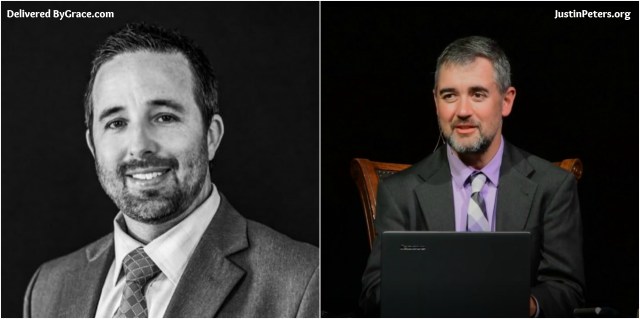
One of my favorite blogs is pastor Josh Buice’s Delivered by Grace. Josh is pastor of Pray’s Mill Baptist Church in Douglasville, Georgia, near Atlanta, and also coordinates the annual G3 Conference (gospel, grace, and glory) there. I’d highly recommend anything Josh is in charge of, so read the blog, go to the conference, and visit his church next time you’re in the area.

Josh recently interviewed another favorite of mine, Justin Peters. Justin is perhaps best known for his teaching and discernment ministry exposing the Word of Faith movement. You’ll definitely want to visit Justin’s web site to read his amazing testimony and view an excerpt from his discernment seminar.

In the interview, Justin touched on his testimony, discussed the Word of Faith movement, talked about false teachers Todd White, Joseph Prince, Beth Moore (more information here, including Josh’s article referred to in the interview and more from Justin on Beth), and Joyce Meyer, and explained the problems with heavenly tourism books and movies like Heaven Is for Real. The interview is both informative and edifying, and I encourage you to give it a listen.

Click Here to Listen


Bible Study, Mailbag

The Mailbag: I love the Bible, but I have to force myself to read it


I am struggling with reading the Word. I find myself having to drag myself to it to dedicate time to read it, struggling against doing other things instead. I love the Lord with all my heart. I love His Word, LOVE everything about the Bible. I know that love for God’s word and hunger for it is one of the marks of salvation. I want to hunger for reading it like a baby hungers for milk. I want that passion for His word.

Please don’t tell me to check my salvation as I daily obsess about this to the point where my sister in Christ said I have an OCD about this. I hear about false converts and it scares me. An elder told me that you can do the unpardonable sin against the Holy Spirit and I thought that once I was saved I could not do that, that was the sin of unbelief. Now, I am sometimes scared to even think about the Holy Spirit, because what if I do that! Please take me Lord, before I would do that! Please help me. 

This question from a friend of my Facebook page just reached through the screen and clutched at my heart. I’ve been right where this sister is now, and I know many of you have been there as well. If you would, take a moment to pray for her and any other Christian you know who’s struggling with this kind of anxiety in her walk.

The Unpardonable Sin
You cannot commit the unpardonable sin. No one living today can commit that sin. I don’t mean to sound harsh, as we all make mistakes, but I am appalled at your elder’s ignorance on this issue and what he said to you. It’s a very common question, and he should at least know a simple answer to it. I’ve covered it here: What is the unpardonable sin?

Check your salvation?
There is no reason for me to tell you to check your salvation, and it never entered my mind to do so. Lost people don’t ask God to take their lives lest they commit the unpardonable sin or worry about whether or not they hunger enough for God’s Word. Only saved people think like that, because saved people are new creations in Christ, with the mind of Christ, who desire to please Christ. Lost people can’t even understand the things of God because these things are revealed by the Holy Spirit, which they don’t have.

I would really encourage you to work through the book of 1 John (I’ve written a study on it if you’d find that helpful). John wrote this epistle to reassure believers. As he says in 5:13: “I write these things to you who believe in the name of the Son of God that you may know that you have eternal life.”

Getting over the “hump” of reticence.
What you describe about dragging yourself to do your Bible study but then loving the Word once you get over that hump of reticence is absolutely, without a doubt, one hundred per cent normal. Pastors feel that way. Elders feel that way. Bible teachers feel that way. Every Christian, including me, feels that way at least sometimes. Usually several times a week for me.

That feeling does not mean you’re not hungering for the Word or that you don’t have a passion for it. Indeed, if you weren’t hungering for the Word with such a passion, you wouldn’t be so up in arms about feeling tempted to do something besides reading your Bible.

That feeling is not something lacking in your desire for the Word. That feeling is Satan tempting you to do anything rather than study your Bible. And the way you combat that temptation? You pray through it, pick up your Bible, and start reading – regardless of how you feel about it. Obedience is hard sometimes. But when you grit your teeth against that temptation and obey God anyway, that is a precious offering to the Lord. He doesn’t require that you feel all hearts and flower-y while you’re doing it. That’s you putting that pressure on yourself. This is battle. Fight. You obey and let God worry about your feelings.

“What do you think? A man had two sons. And he went to the first and said, ‘Son, go and work in the vineyard today.’ And he answered, ‘I will not,’ but afterward he changed his mind and went. And he went to the other son and said the same. And he answered, ‘I go, sir,’ but did not go. Which of the two did the will of his father?” They said, “The first.” Matthew 21:28-31a

Peace be unto you.
God did not save you in order for you to spend your life in a state of fear and anxiety. As the Westminster Shorter Catechism says, “Man’s chief end is to glorify God, and to enjoy him forever.” Forever starts the moment you’re saved. God wants you to enjoy spending time with Him in this life just as much as He wants you to in the next.

Christ is the Prince of Peace and His desire is for you to be at peace with Him. He knows you inside and out and He still delights in you. It is safe to let go, relax, and rest in His love and delight. He is not going to let go of you. Here are a few Scriptures that may bring you some comfort and reassurance. Believe them. Trust Him. He loves you. Let that sink in and simply love Him back.

For the Lord takes pleasure in his people;
he adorns the humble with salvation.
Let the godly exult in glory;
let them sing for joy on their beds.
Psalm 149:4-5


If you have a question about: a Bible passage, an aspect of theology, a current issue in Christianity, or how to biblically handle a family, life, or church situation, comment below (I’ll hold all questions in queue {unpublished} for a future edition of The Mailbag) or send me an e-mail or private message. If your question is chosen for publication, your anonymity will be protected.

Basic Training

Basic Training: 8 Steps to Finding God’s Will for Your Life

For more in the Basic Training series, click here.

What is God’s will for my life?

I’ve asked this question before. I don’t remember the exact circumstances, but it was probably some time in my late teens to mid-twenties. You know- when you’re making all those big, life-changing decisions: Where should I go to college? What should I major in? What kind of career do I want? Which job should I take? Should I move to another state? Whom should I marry? When should we start having children? How many children should we have?

Maybe you’ve asked the same question yourself. Life as a young adult can be pretty overwhelming, especially when you’re still kind of immature and inexperienced, and you have to make so many big decisions that have such intense and long-lasting impact on your own life and the lives of others. As you age, there are still big decisions to face from time to time, and they can still feel overwhelming.

So, how can a godly woman who wants to make sure she’s making a godly decision be certain she’s following “God’s will for her life”?

1.
Reframe the Question

When we use the term “God’s will for my life” we’re usually thinking in terms of a life map. A career track. A family plan. It’s almost as if we think of God as pulling up the spreadsheet that has our name on it and that every category of our lives is neatly planned out and squared away in a little box. The way we would organize it.

College: LSU
Major: Education
Career: Teacher
Marry: Joe Blow
Kids: 2
Retirement age: 65

That’s our focus, but that’s not God’s focus. Does God care about and guide us through all of life’s circumstances? Of course, but God’s primary concern is our holiness and growth in Christ, not our choice of a career or whom to marry. Those life circumstances are merely tools in God’s hands to shape us into more Christlike people. We look at the life circumstances first and think it’s God’s highest priority that we choose what matches up with His spreadsheet. God’s highest priority is that we pursue Him and holy living, and leave the details up to Him. The question really shouldn’t be, “What is God’s road map for my career, family, etc., from this point forward?” but “In the process of pursuing Christ, how can I make godly decisions that line up with Scripture?”

2.
It’s In the Book

When we want to know anything about God, the Bible is always our go to source of information. What does the Bible say about God’s will for our lives?

God’s will for your life is to trust and obey Him in suffering.
Therefore let those who suffer according to God’s will entrust their souls
to a faithful Creator while doing good. 1 Peter 4:19

God’s will for your life is whatever is good, acceptable, and perfect.
Do not be conformed to this world, but be transformed by the renewal of your mind, that by testing you may discern what is the will of God, what is good and acceptable and perfect. Romans 12:2

God’s will for your life is joyful obedience to Him.
not by the way of eye-service, as people-pleasers, but as bondservants of Christ, doing the will of God from the heart, rendering service with a good will as to the Lord and not to man, Ephesians 6:6-7

God’s will for your life is to pursue purity and forsake impurity.
For this is the will of God, your sanctification: that you abstain from sexual immorality…For God has not called us for impurity, but in holiness. 1 Thessalonians 4:3,7

God’s will for your life is to live in gratitude to Him.
give thanks in all circumstances; for this is the will of God in Christ Jesus for you.
1 Thessalonians 5:18

God’s will for your life is to be a living testimony to Him.
For this is the will of God, that by doing good you should put to silence
the ignorance of foolish people. 1 Peter 2:15

God’s will for your life is to live for His desires, not your own.
Since therefore Christ suffered in the flesh, arm yourselves with the same way of thinking, for whoever has suffered in the flesh has ceased from sin, so as to live for the rest of the time in the flesh no longer for human passions but for the will of God. 1 Peter 4:1-2

God’s will for your life is to be wise, not foolish.
Look carefully then how you walk, not as unwise but as wise, making the best use of the time, because the days are evil. Therefore do not be foolish, but understand what the will of the Lord is. Ephesians 5:15-17

And there’s so much more. Any Scripture that instructs you on how to live your life is God’s will for your life.

3.
Live in the Word

An athlete preparing for the Olympics doesn’t just go about life as usual and panic the day before his event because he doesn’t know the right techniques and strategies for his event. He trains and studies every day so that when it’s time for his event, he’s as ready as he can be.

The Christian life is a little bit like that. While the athlete knows exactly what his event will be and exactly which day he’ll have to perform, we don’t always know what kinds of life decisions we’ll be faced with or when they’ll materialize. But daily study of God’s Word is the best way to prepare our hearts, train our minds, and strengthen our character so we’re as ready as we can be for whatever circumstances God sends our way.

4.
Pray

A strong daily prayer life also helps prepare our hearts and minds to make difficult decisions. We should absolutely pray about the particulars of specific situations that challenge us, but just the general practice of communing with God in prayer day by day teaches us to depend on Him, trust Him, be conformed to His will, love Him, honor Him, and submit to Him. And that’s a great foundation for making godly decisions.

5.
Flee from Sin

Sometimes the formidable decisions we face are a result of our own sin. So just stay away from sin. Not only is that God’s will for your life because it honors and glorifies Him, but, as a bonus, you can totally avoid having to make the difficult decisions that are part and parcel of the consequences of sin.

6.
Get Invested in Church

In addition to the fact that it’s God’s will for your life to be a faithful, active member of a local, biblically led and structured body of believers, investing yourself – your time, your love, your priority, your money, your service – in the life of the church means that when you face challenging decisions you already have a godly support network in place. Brothers and sisters in Christ will be at the ready to pray for you, provide practical help and advice, comfort you, point you to God’s Word, walk through it with you, check on you, rejoice or grieve with you, and so on.

7.
Get Wisdom

Get wisdom,” Proverbs 4 admonishes. God isn’t going to just bop you on the head with a magic wand, and “Presto!” you’ve got the wisdom to make godly choices. It doesn’t work that way (believe me, I’ve tried). You have to proactively pursue it. How do you get wisdom?

Study God’s Word Copious amounts of it, every day, starting with the wisdom literature. Listen to good, doctrinally sound sermons from your own pastor and others. Get plugged in to a good Sunday School, Bible study, or discipleship class. Read doctrinally sound books. Discuss Scripture with others. Find out which biblical principles apply to the decision you’re faced with and pore over them.

Pray Ask God to grow you in wisdom. Ask Him to help you correctly apply Scripture to your situation and lead you to the wisest, most godly decision. Ask others to pray these things for you as well.

Seek out wise brothers and sisters for counsel. Reach out to mature Christians who can offer godly advice and help you apply God’s word to the decision making process. Set up an appointment with your pastor (or an  ACBC certified Biblical Counselor) for counseling. Seek the expert advice of brothers and sisters who are professionals in the field (legal, medical, educational, etc.) of your dilemma.

Get informed. Usually, in order to make a wise and godly decision about something, you have to know the “facts of the case” first. For example, if you’re trying to make a wise decision about whether or not to take a certain job, first find out as much as you possibly can about the job, the company, the work environment, the pay, and so on. You can’t rightly apply Scripture (or pray, or seek counsel) if you don’t know what you’re applying Scripture to.

8.
Trust God

You’ve studied Scripture about it. You’ve prayed about it and have others praying for you about it. You’ve sought wisdom about it. You’ve done everything you can do on your part to pursue godliness and make a biblical decision, and all that’s left is to make the actual decision.

So make it and quit fretting over whether or not it’s “God’s will.”

Yes, it’s really that simple.

Why? Because if you’ve done all that prayer and study and seeking wisdom, guess what? You’ve already done God’s will for your life: You’ve pursued Him. You’ve pursued holiness. So go ahead and make the choice that seems the wisest and most godly. Stuck between two options that appear to be equally godly? Choose the one you like better. Sometimes God uses those unique tastes, preferences, and “bents” He has fearfully and wonderfully knit into us to guide us one way or another.

Go ahead and make the decision and stop worrying (because we know worrying isn’t God’s will for your life). Trust in God’s sovereign power to control the situation, His care for you to guide you and carry you through, His love for you, and His desire to do what’s best for you.

Trust in the Lord with all your heart, and do not lean on your own understanding. In all your ways acknowledge him, and he will make straight your paths. Proverbs 3:5-6


It is precious in God’s sight when we want to please and obey Him, but He doesn’t want us to become overwrought along the way with anxiety over decisions. When God tells us we can trust Him to guide us and direct our paths, He really means that. Strive to live godly in Christ Jesus and trust God to handle the rest.


Additional Resources

How to Know God’s Will for Your Life at For the Gospel with Costi Hinn

God Doesn’t Whisper! With Jim Osman at A Word Fitly Spoken

Finding God’s Will for Your Life by Lewis Richerson

Mark Bible Study

Mark: Lesson 21

Previous Lessons: 1, 2, 3, 4, 5, 6, 7, 8, 9, 10, 11, 12, 13, 14, 15, 16, 17, 18, 19, 20

Mark 14:26-52

And when they had sung a hymn, they went out to the Mount of Olives. 27 And Jesus said to them, “You will all fall away, for it is written, ‘I will strike the shepherd, and the sheep will be scattered.’ 28 But after I am raised up, I will go before you to Galilee.” 29 Peter said to him, “Even though they all fall away, I will not.” 30 And Jesus said to him, “Truly, I tell you, this very night, before the rooster crows twice, you will deny me three times.” 31 But he said emphatically, “If I must die with you, I will not deny you.” And they all said the same.

32 And they went to a place called Gethsemane. And he said to his disciples, “Sit here while I pray.” 33 And he took with him Peter and James and John, and began to be greatly distressed and troubled. 34 And he said to them, “My soul is very sorrowful, even to death. Remain here and watch.” 35 And going a little farther, he fell on the ground and prayed that, if it were possible, the hour might pass from him. 36 And he said, “Abba, Father, all things are possible for you. Remove this cup from me. Yet not what I will, but what you will.”37 And he came and found them sleeping, and he said to Peter, “Simon, are you asleep? Could you not watch one hour? 38 Watch and pray that you may not enter into temptation. The spirit indeed is willing, but the flesh is weak.” 39 And again he went away and prayed, saying the same words. 40 And again he came and found them sleeping, for their eyes were very heavy, and they did not know what to answer him. 41 And he came the third time and said to them, “Are you still sleeping and taking your rest? It is enough; the hour has come. The Son of Man is betrayed into the hands of sinners. 42 Rise, let us be going; see, my betrayer is at hand.”

43 And immediately, while he was still speaking, Judas came, one of the twelve, and with him a crowd with swords and clubs, from the chief priests and the scribes and the elders. 44 Now the betrayer had given them a sign, saying, “The one I will kiss is the man. Seize him and lead him away under guard.” 45 And when he came, he went up to him at once and said, “Rabbi!” And he kissed him. 46 And they laid hands on him and seized him. 47 But one of those who stood by drew his sword and struck the servant of the high priest and cut off his ear. 48 And Jesus said to them, “Have you come out as against a robber, with swords and clubs to capture me? 49 Day after day I was with you in the temple teaching, and you did not seize me. But let the Scriptures be fulfilled.” 50 And they all left him and fled.

51 And a young man followed him, with nothing but a linen cloth about his body. And they seized him, 52 but he left the linen cloth and ran away naked.


The Holy Bible, English Standard Version. ESV® Permanent Text Edition® (2016). Copyright © 2001 by Crossway Bibles, a publishing ministry of Good News Publishers.


Questions to Consider

1. Briefly review lesson 20 (link above) for context.

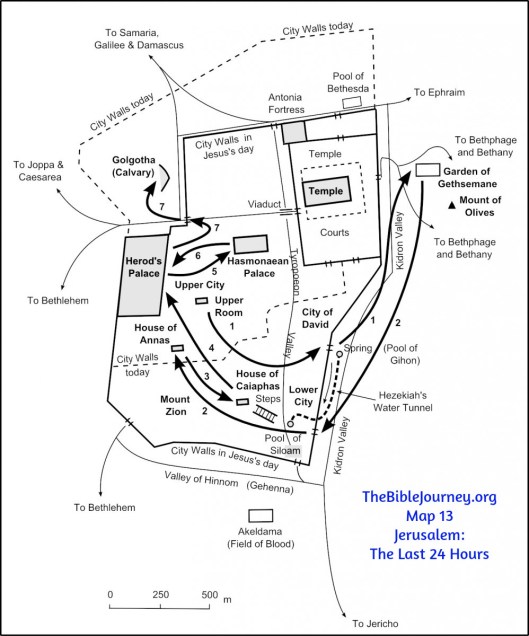
2. Examine the map below. Trace Jesus’ movements from lesson 20 (the upper room, #1) to the locales in today’s lesson. Where did Jesus and the disciples go first? (26) Next? (32) (Please note: I do not endorse anything on the website cited below that conflicts with my theology as outlined in my Welcome and Statement of Faith tabs above.)

3. Study verses 26-31. How, in this passage, does Jesus demonstrate that He is both a prophet (27,28,30) and the fulfillment of prophecy? (27,49) As you’ll recall from previous lessons, Christ has told the disciples about His impending death many times. Do you get the sense from this passage that they have grasped what is about to happen to Jesus? Compare and contrast the way the disciples believed Jesus’ prophecy of His betrayal (18-19) with their disbelief of His prophecy that they would abandon Him. 

4. Read verses 32-42. If Jesus was God, why did He need to pray? How do Jesus’ desire to pray and the words He prayed demonstrate the Trinity – and the agreement within the Trinity – to us? Compare verse 37 to verses 29 and 31. What do you observe about Peter, and why might Jesus have called him “Simon” instead of Peter? In what ways would it have been better in verses 29-31 for Peter and the others to heed Jesus’ admonition of verse 38 than to make the bold pronouncements they made?

5. What was Jesus’ will, or preference, regarding His impending suffering and crucifixion? (36) Was there any way in which Jesus was lacking faith in God as He prayed (or at any moment of His earthly life)? How did God answer Jesus’ prayer? The Word of Faith heresy teaches a) that it is never God’s will for us to suffer and b) that if God does not answer our prayers the way we want Him to it’s because we don’t have enough faith in Him. How does this passage refute these unbiblical teachings? What can we learn from Jesus’ prayer about the right way to pray?

6. Read Philippians 2:8 and Hebrews 12:4 with verse 36. How far was Jesus willing to go to be obedient to God? How does your willingness to obey God stack up to Jesus’ willingness to go even to a torturous death rather than to disobey God? Is your obedience more like the disciples’ willingness to obey but failure to follow through? (29,31,37,40,41) Do you obey God when it’s painful? Inconvenient? Embarrassing? Expensive? Difficult? When it’s not your will?

7. Go over verses 43-52. Why might the posse that came to arrest Jesus have felt the need to be armed (43) and to place Jesus under guard (44)? If the chief priests, scribes, and elders thought Jesus was so dangerous or blasphemous that they needed to put Him to death, how is it that they needed Judas to point Him out to them? (44) Why would they not have recognized Him on sight? (48-49) How is verse 50 the fulfillment of Jesus’ prophecy in verse 27?

8. Look at verses 51-52 through the lenses of 2 Timothy 3:16-17. God must have thought these details were important enough to include in Scripture, because they’re there. Why do you think God wanted us to know this about the young man? How can we learn, be reproved, corrected, trained for righteousness, made complete, or equipped for every good work by these two verses?

9. Which aspects of spiritual character (ex: obedience, humility, etc.) does Jesus display in today’s passage? What are some specific ways you can emulate Jesus’ spiritual character in your current life circumstances?


Homework

In question 3, we saw that the disciples unquestioningly believed Jesus when He said one of them would betray Him, but didn’t believe Him when He said they would all abandon Him. Why is it so easy to believe some parts of God’s Word and so hard to believe other parts? Identify a verse, passage, or promise of Scripture you struggle to truly believe. Study that passage and its cross references this week, and pray that God will help you to trust Him and believe that part of His Word.


Suggested Memory Verse

Watch and pray that you may not enter into temptation. The spirit indeed is willing, but the flesh is weak. Mark 14:38