Mark Bible Study

Mark: Lesson 4

Previous Lessons: 1, 2, 3

Mark 2

And when he returned to Capernaum after some days, it was reported that he was at home. And many were gathered together, so that there was no more room, not even at the door. And he was preaching the word to them. And they came, bringing to him a paralytic carried by four men. And when they could not get near him because of the crowd, they removed the roof above him, and when they had made an opening, they let down the bed on which the paralytic lay. And when Jesus saw their faith, he said to the paralytic, “Son, your sins are forgiven.” Now some of the scribes were sitting there, questioning in their hearts, “Why does this man speak like that? He is blaspheming! Who can forgive sins but God alone?” And immediately Jesus, perceiving in his spirit that they thus questioned within themselves, said to them, “Why do you question these things in your hearts? Which is easier, to say to the paralytic, ‘Your sins are forgiven,’ or to say, ‘Rise, take up your bed and walk’? 10 But that you may know that the Son of Man has authority on earth to forgive sins”—he said to the paralytic— 11 “I say to you, rise, pick up your bed, and go home.” 12 And he rose and immediately picked up his bed and went out before them all, so that they were all amazed and glorified God, saying, “We never saw anything like this!”

13 He went out again beside the sea, and all the crowd was coming to him, and he was teaching them.14 And as he passed by, he saw Levi the son of Alphaeus sitting at the tax booth, and he said to him, “Follow me.” And he rose and followed him.

15 And as he reclined at table in his house, many tax collectors and sinners were reclining with Jesus and his disciples, for there were many who followed him. 16 And the scribes of the Pharisees, when they saw that he was eating with sinners and tax collectors, said to his disciples, “Why does he eat with tax collectors and sinners?” 17 And when Jesus heard it, he said to them, “Those who are well have no need of a physician, but those who are sick. I came not to call the righteous, but sinners.”

18 Now John’s disciples and the Pharisees were fasting. And people came and said to him, “Why do John’s disciples and the disciples of the Pharisees fast, but your disciples do not fast?” 19 And Jesus said to them, “Can the wedding guests fast while the bridegroom is with them? As long as they have the bridegroom with them, they cannot fast. 20 The days will come when the bridegroom is taken away from them, and then they will fast in that day. 21 No one sews a piece of unshrunk cloth on an old garment. If he does, the patch tears away from it, the new from the old, and a worse tear is made. 22 And no one puts new wine into old wineskins. If he does, the wine will burst the skins—and the wine is destroyed, and so are the skins. But new wine is for fresh wineskins.”

23 One Sabbath he was going through the grainfields, and as they made their way, his disciples began to pluck heads of grain. 24 And the Pharisees were saying to him, “Look, why are they doing what is not lawful on the Sabbath?” 25 And he said to them, “Have you never read what David did, when he was in need and was hungry, he and those who were with him: 26 how he entered the house of God, in the time of Abiathar the high priest, and ate the bread of the Presence, which it is not lawful for any but the priests to eat, and also gave it to those who were with him?” 27 And he said to them, “The Sabbath was made for man, not man for the Sabbath. 28 So the Son of Man is lord even of the Sabbath.”\


The Holy Bible, English Standard Version. ESV® Permanent Text Edition® (2016). Copyright © 2001 by Crossway Bibles, a publishing ministry of Good News Publishers.


Questions to Consider

1. As we study through Mark, keep in mind that the various stories of what Jesus said and did show us who He is. Recalling that Mark’s audience was primarily Gentile, why would it have been important for him to define who Jesus was?

2. Examine verses 1-12. What is Jesus doing as this story opens? (2) Why did the paralytic’s friends bring him to Jesus- to hear Him preach (2), to be healed, or to have his sins forgiven (5)? What two things did Jesus do for the paralytic, and which one came first? (5, 11-12) What did the paralytic’s friends see as his greatest need? What did Jesus see as his greatest need? What do you think Jesus would say about modern day “faith healers” who focus strictly on the “miracle” of healing and never preach the gospel?

3. Read verses 13-17. What is Jesus doing as this story opens? (13) What was Levi’s (Matthew’s) profession? (14) Why would the guests at Levi’s house have been “tax collectors and sinners” (15-16) rather than scribes and Pharisees or tradesmen and farmers? How might Peter, Andrew, James, and John have initially reacted to Jesus calling a tax collector to be a fellow disciple?

This passage is often cited as evidence of “Jesus hanging out with sinners” by Christians seeking to justify hanging out with people they ought not hang out with, going places they ought not go, and doing things they ought not do. Would Jesus, the sinless Son of God, use this passage that way? What was Jesus’ goal in “hanging out with sinners”? (17)

4. How do the story of the paralytic (5,10) and the story of the calling of Levi (14,17) point to the central mission of Jesus’ earthly ministry?

5. Was the fasting that the Pharisees and John’s disciples were participating in and questioning Jesus about (18) Pharisaical ritual fasting, or the type of New Testament fasting that centered around Christ? Why would Jesus not have wanted His disciples to participate in works-based, ritual, old covenant-style, old garment/wineskin (21,22) fasting when He was there to proclaim the new patch/wineskin (21,22) of the new covenant- the gospel?

6. In 23-28, how did Jesus’ use of David’s actions as a parallel to His own actions…

a) provide an example of Israel’s revered king whom the Pharisees would not have wanted to argue against?

b) allude to the fact that He was the Son of David, the Messiah?

As we saw in chapter 1, and throughout the gospels, Jesus’ lordship over the Sabbath is a major theme and a major sticking point for the scribes and Pharisees. Why? Who established the Sabbath and had the right to rule over it? So, when Jesus says in verse 28 that He is lord of the Sabbath, what would that have meant to the Pharisees? In verse 24, the Pharisees accuse Jesus of breaking the law. Since we know Jesus was sinless, was He actually breaking God’s law here? Then whose “law” was He breaking? Why was it wrong for the Pharisees to accuse Jesus of breaking God’s law when He wasn’t?

7. What do each of these stories tell us (and Mark’s Gentile audience) about who Jesus is- His deity, miraculous power, lordship, authority, etc.?


Homework

Do you ever have an opportunity to “hang out with sinners” like Jesus did? Most of us do, whether it’s co-workers, family members, the ladies at the salon, fellow soccer moms, or the next door neighbor. Take a moment to pray for the lost people you’ll hang out with this week, and ask God to help you follow in Jesus’ footsteps and share the gospel with them.


Suggested Memory Verse

And when Jesus heard it, he said to them, “Those who are well have no need of a physician, but those who are sick. I came not to call the righteous, but sinners.”
Mark 2:17

Movies

YouTubesday

Just some great little random YouTube videos I thought I’d pass along for your enjoyment and edification…

Here’s what happens when you’re a false prophet and you make the mistake of calling a doctrinally sound pastor up to “receive a word.”


I’m going to make Southern Gospel fans of y’all yet. How can you not love these lyrics?


I know not everybody enjoys Christian comedy, but if you do, it looks like John Crist might be the next Tim Hawkins.


“Only God can judge me!”
“Right. And if you don’t repent, that judgment is going to be ‘Guilty!’.”
Here’s the latest from our friend Pastor Gabe over at WWUTT.

https://www.youtube.com/watch?v=CtkdmHcpU50


Sure, Jesus is calling Sarah Young. Calling her to repent and believe in the sufficiency of Scripture, that is. (More info. on Sarah Young/Jesus Calling under the “Popular False Teachers” tab at the top of the blog.)

Bible Study, Mailbag

The Mailbag: Can you recommend a good Bible study for women/teens/kids?

Can you recommend a good women’s Bible study? 

Can you recommend a Bible study we can do with our teens/children?

Next to being asked whether or not a particular teacher is doctrinally sound, this question, or some variation of it, is the one I’m most often asked. And, to be honest, it’s a question I have a love-hate relationship with.

I love (LOVELOVELOVELOVE) that women ask me this question because it means two things: they want to study, or teach their children, the Bible and they want to be sure what they’re learning or teaching is doctrinally sound and in line with Scripture. That’s the central reason my ministry even exists- I want Christian women to be grounded in the Bible and sound doctrine, and it brings me unbelievable joy and encouragement when I see women seek that out.

The hate part has nothing to do with the people asking the question, but with the prevailing line of thought in evangelicalism that has led them to ask the question. Namely, that the people in the pew aren’t capable of studying and understanding the Bible for themselves- they need some Christian celebrity to tell them what it means.

This is scarily reminiscent of the pre-Protestant Reformation ideology that ruled Roman Catholic “Christianity.” The pope and the priests, not the Scriptures themselves, told Christians what to believe. Catholic rulers prohibited the people from having copies of the Bible in their own language and martyred many Bible translators and Reformers. Only the elite, those in leadership, were supposedly able to comprehend the Scriptures and dispense doctrine to the common Christian.

Twentieth and twenty-first century evangelicalism hasn’t taken that direct and violent route, but rather, has gradually brainwashed – whether intentionally or unintentionally – Christians into thinking that if they’re going to study or teach the Bible, they have to have a curriculum, book, or DVD study in order to do so. Teach straight from the Bible with no leader’s guide or student books? It’s practically unheard of in the average church, and hardly anyone is equipped to do so. Why? Because for the past several decades, that’s how Bible study has been presented to church members. You walk into Sunday School and you’re handed a quarterly. Somebody wants to teach a women’s Bible study? She’s sent to peruse the shelves of LifeWay for a popular author, not to her prayer closet and her Bible. Using teaching materials written by somebody else is just assumed.

Well in my opinion, it’s time for another reformation. A Bible study reformation. And, so, with hammer in hand, I have one resolution I want to nail to the door of Church As Usual:

I will no longer help perpetuate the stranglehold the pre-packaged Bible study industry has on Christians. If you are a 21st century believer with access to a Bible in your native language and doctrinally sound preaching and teaching I will not recommend a Bible study book or program to you. You need to pick up the actual Bible and begin studying the God-breathed text for yourself, and teach it to your children. 

“…my conscience is captive to the Word of God. I cannot and will not recant anything, for to go against conscience is neither right nor safe. Here I stand, I can do no other, so help me God. Amen.”1

Ladies, I know you may feel inadequate, but don’t give in to those feelings. Try. Pick a book of the Bible, start at the beginning, and read it through to the end, taking as much time as you need. You might just be pleasantly surprised at how well you grasp it. That’s because, if you’re a believer, the Holy Spirit resides within you and will help you to understand the Word He authored.

Read directly from the Bible to your children. Ask them simple questions about the passage: How was this Bible character obedient or disobedient to God? What can we learn about what God is like from this chapter? What does this passage teach us about prayer, forgiveness, loving each other, kindness, etc.? Explain any big words they might not understand, or look them up together.

Afraid you might get something wrong? Confused by a particular verse? That may happen from time to time, and that’s OK. Bible study is a skill just like everything else. Nobody ever tried a new task and was perfect at it the very first time. But God has not only given you the Holy Spirit who will never lead you into doctrinal error, He has given you a pastor, elders, teachers, and brothers and sisters in the Lord to help disciple you. Ask questions, trust God to illumine your understanding, and keep right on practicing.

There are also a myriad of reference materials that can hone your skills and help as you study your Bible (see the “Additional Resources” section below). And there are some fantastic, easy to read books on theology by trustworthy authors that can give you greater clarity on various points of doctrine. By all means, read as many as you can get your hands on.

But when it’s time for Bible study, study your Bible. When it’s time to teach your children, teach them the Bible. You can do this, ladies. Women with less education and fewer resources than you have access to have done it for centuries and have flourished in their walk with the Lord.

Trust God. Study hard. You can do this.


Additional Resources:

The Mailbag: We Want Bible Study Answers

Bible Study resource articles

Bible Studies by Michelle Lesley

10 Simple Steps to Plain Vanilla Bible Study

You’re Not as Dumb as You Think You Are: Five Reasons to Put Down that Devotional and Pick Up the Actual Bible

10 Bookmarkable Biblical Resources for Christian Women

Rightly Dividing: 12 Do’s and Don’ts for Effective Bible Study


¹Just a little tribute to Martin Luther at the Diet of Worms


If you have a question about: a Bible passage, an aspect of theology, a current issue in Christianity, or how to biblically handle a family, life, or church situation, comment below (I’ll hold all questions in queue {unpublished} for a future edition of The Mailbag) or send me an e-mail. If your question is chosen for publication, your anonymity will be protected.

Book Reviews

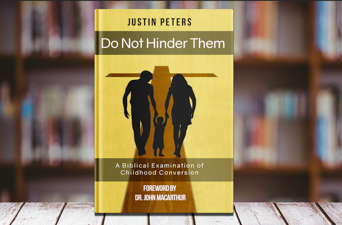
A Review of Justin Peters’ “Do Not Hinder Them”

As I’ve mentioned before, solicited book reviews are not part of my regular repertoire here at the blog. In fact, for a variety of reasons, I have a policy against writing them.

But when one of your heroes in the faith asks, you make an exception. And, for me, Justin Peters is one of those heroes in the faith (even more so because I’m sure he wouldn’t want me calling him that).

I introduced Justin this way in my article, A Few MORE Good Men: 10 Doctrinally Sound Male Teachers:

Justin Peters Ministries exists to preach the Gospel of Jesus Christ to the lost and to help equip the saved to ‘speak the truth in love’ (Ephesians 4:15). Great care is taken to preach and teach God’s Word in its proper context and simply let the text speak for itself.”

The first thing I ever noticed about Justin Peters is his striking example of biblical meekness. Justin is soft-spoken and peaceable, but firm in his gospel convictions and aflame with the desire for the lost to come to salvation. You must read Justin’s testimony of coming to know Christ after years in seminary and ministry as a false convert. What Justin is perhaps best known for is his teaching and discernment ministry exposing the Word of Faith movement. It started with a trip to a faith healer as a teen to have his own cerebral palsy healed and grew into Clouds Without Water, a seminar designed to educate the church on the history, growth, and metastasization of the Word of Faith heresy.

But Justin doesn’t limit himself to discernment ministry, and his new book, Do Not Hinder Them: A Biblical Examination of Childhood Conversion, opens the door to another of his theological interests- salvation and baptism, especially as they pertain to children.

A simple, yet fundamental, point of theology which needs to be understood in order to grasp the concept of the book is the difference between credo-baptism and paedo-baptism. Credo-baptism is also called “believer’s baptism.” This means that a new believer stands before the church, professes her faith in Christ, and is then baptized out of obedience to Him- to demonstrate that she has passed from death unto life and now wishes to be identified as a follower of Christ. Credo-baptists believe strongly that baptism is only to be administered to professing believers.

Paedo-baptism is infant baptism. It is administered to all babies and children (by definition, unable to profess faith in Christ) by a number of Protestant denominations as a symbol that a child has been born into a covenant (believing) family who will raise her in the nurture and admonition of the Lord and the knowledge of the gospel.

There’s an angst that Bible believing credo-baptist parents often experience, which, undoubtedly, is foreign to paedo-baptist parents:

My young child has come to me claiming to have asked Jesus into her heart and wants to be baptized. How can I tell if she’s really saved and that it’s right for her to be baptized at this age?

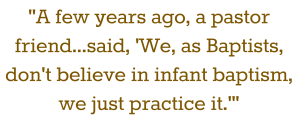
It’s a long standing dilemma for Southern Baptists like Justin…and me. My mother happened to mention in passing a few years ago that I had begged to be baptized when I was about six. It made sense because that’s about the time all of my little friends were being baptized, but, I was very surprised to hear this story because, as an adult, I had no recollection of it whatsoever, and I can guarantee you I wasn’t saved at the time. My parents wisely said no.

As parents ourselves, my husband and I have faced the same struggle. Five of our six children were baptized as young children. One is not currently walking with the Lord and two of them were re-baptized later at their own request when they realized they had not been saved the first go round.

This is the central issue Justin tackles in Do Not Hinder Them.

But don’t be fooled by the title of the book. While it’s a must read for Christian parents, pastors, and those who work in children’s ministry, you also need to read this book if…

…you’ve ever wondered if you’re really saved.
…you’re wondering if that loved one (of any age) who claims to be a Christian is really saved.
…you’re a paedo-baptist wanting to get a better grip on credo-baptist beliefs and struggles
…you’re brand new to the study of theology and are looking for a resource that will easily help you to “dip a toe in the water” (so to speak)

In other words, though Justin addresses the issue of genuine conversion as it applies to children seeking baptism, the question of “How can I know if I/my loved one is really saved?” is one we all face at some point in our walk with Christ. So, while there may be a few parts of this book that don’t apply if you’re not a pastor, children’s ministry worker, or parent, most of it is helpful for every Christian.

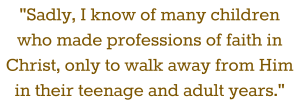
One of the foundational issues Justin cites as having gotten us into the muck and mire of baptizing unregenerate children, only to have them “walk away” from the Lord (though, indeed, they were never saved in the first place) as teens or young adults – sullying the name of Christ and His church – or to seek a second baptism once they realize they were unsaved the first time, is the fact that we have so watered down the gospel and the soteriology our churches subscribe to and practice. “Getting saved” has been reduced to parroting a sinner’s prayer, or mental assent to a simplistic set of facts that even the demons believe. There is little to no presentation of sin and rebellion, guilt before a holy God, God’s wrath toward the sinner, and the eternal punishment of sin. And when was the last time you heard a pastor urge someone contemplating following Jesus to count the cost of being His disciple? Instead, it’s, “Don’t you want to go to Heaven when you die?” or “Just believe A, B, and C, and you’re saved!” or “God loves you and has a wonderful plan for your life!” Rarely are young children mature enough in their thinking to be able to grasp the true nature and meaning of why they need a Savior and what repentance, regeneration, and discipleship really entail.

And that’s largely our fault. As Christian parents, we understandably want our children “in,” safe from an eternity in Hell. So we make it as easy as possible for them to complete the transaction. Instead of raising our children up to understand and attain to the high bar of the demands of the gospel, we lower the bar so far that even the youngest child can toddle right over it. In the end, the problem is not that we’re baptizing unsaved babes as our paedo-baptist brothers and sisters do, but that we’re presenting a false gospel that creates false converts who hang their eternity on having repeated a prayer and passed through the baptistry.

The second key issue Justin says has contributed to the epidemic of baptizing unregenerate children is the fact that we base our decision to baptize them solely on their verbal profession of faith rather than on the fruit of a changed life.

I remember all too well the worry over my own small children’s salvation in this regard. How could I tell if they were really saved or not? They had been in church and raised in a Christian home all their lives- they knew all the right answers to give when we questioned them about their salvation experiences.

As Justin wisely points out, this is often the case with “church kids.” They know how to repeat back what they’ve learned in Sunday School, and, because they’ve been raised in a godly atmosphere, they’re likely already good kids, outwardly behaving in what looks like a Christlike way. When they come to us and say, “I’ve asked Jesus into my heart,” how can we tell if it’s genuine saving faith?

Most of the time, the answer is- we can’t. Until, that is, that faith has been tested and their testimony proven true through the refining process of trial, temptation, and persecution. Until he is able to bear fruit in keeping with the repentance he claims. Does your child freely choose obedience to Christ over giving in to temptation? Does he cling to Christ during times of difficulty? Does he visibly stand for Christ when ridiculed for doing so by his peers? What five year old even faces such situations?

And that’s precisely Justin’s point. We rush our children through the baptismal waters as soon as they claim to have received Christ rather than waiting to see their faith prove out over the ensuing years. Your five year won’t face the temptation to use drugs or engage in sex. But your teenager will. It’s unlikely a gang of kindergartners will surround your child and mock his belief in Christ and biblical values. Sophomores and juniors do so gleefully. How does your young adult, who claims to be born again, handle these types of situations? When it’s his choice, not yours, does he consistently and unrepentantly go along with the worldly crowd or does he bear up and walk faithfully with Christ? Justin suggests, and I can’t help but agree, that the testing of our children’s faith that comes with age and independence, and the fruits of Christlikeness they bear – such as: godly sorrow over sin, personal holiness, hunger for the Word, and increasing discernment –  are a much more reliable barometer of their spiritual state than the “right answers” they are able to give as small children. It is for this reason that Justin suggests postponing baptism until the late teens or early 20s, while encouraging and nurturing our children’s faith as they grow and mature.

Do Not Hinder Them so effectively addresses these matters of concern to the church that I unhesitatingly recommend it to all Christians. Justin writes in a simple, unassuming style that even the newest believer would be comfortable with, and explains complicated theological terms and issues with ease. The book is chock full of helpful footnotes rife with Scripture references and supplementary resources, and is only 112 pages long, making it an easy evening’s read. Do Not Hinder Them is available in soft cover format (not available in e-book format at this time) and is endorsed by Dr. John MacArthur. You can purchase a copy at Justin’s web site or on Amazon.


All brown “pull quotes” in this article are taken from:
Peters, Justin. Do Not Hinder Them: A Biblical Examination of Childhood Conversion. Justin Peters Ministries, 2017.

Mark Bible Study

Mark: Lesson 3

Previous Lessons: 1, 2

Mark 1:21-45

And they went into Capernaum, and immediately on the Sabbath he entered the synagogue and was teaching. 22 And they were astonished at his teaching, for he taught them as one who had authority, and not as the scribes. 23 And immediately there was in their synagogue a man with an unclean spirit. And he cried out, 24 “What have you to do with us, Jesus of Nazareth? Have you come to destroy us? I know who you are—the Holy One of God.” 25 But Jesus rebuked him, saying, “Be silent, and come out of him!” 26 And the unclean spirit, convulsing him and crying out with a loud voice, came out of him. 27 And they were all amazed, so that they questioned among themselves, saying, “What is this? A new teaching with authority! He commands even the unclean spirits, and they obey him.” 28 And at once his fame spread everywhere throughout all the surrounding region of Galilee.

29 And immediately he left the synagogue and entered the house of Simon and Andrew, with James and John. 30 Now Simon’s mother-in-law lay ill with a fever, and immediately they told him about her. 31 And he came and took her by the hand and lifted her up, and the fever left her, and she began to serve them.

32 That evening at sundown they brought to him all who were sick or oppressed by demons. 33 And the whole city was gathered together at the door. 34 And he healed many who were sick with various diseases, and cast out many demons. And he would not permit the demons to speak, because they knew him.

35 And rising very early in the morning, while it was still dark, he departed and went out to a desolate place, and there he prayed. 36 And Simon and those who were with him searched for him, 37 and they found him and said to him, “Everyone is looking for you.” 38 And he said to them, “Let us go on to the next towns, that I may preach there also, for that is why I came out.” 39 And he went throughout all Galilee, preaching in their synagogues and casting out demons.

40 And a leper came to him, imploring him, and kneeling said to him, “If you will, you can make me clean.” 41 Moved with pity, he stretched out his hand and touched him and said to him, “I will; be clean.”42 And immediately the leprosy left him, and he was made clean. 43 And Jesus sternly charged him and sent him away at once, 44 and said to him, “See that you say nothing to anyone, but go, show yourself to the priest and offer for your cleansing what Moses commanded, for a proof to them.” 45 But he went out and began to talk freely about it, and to spread the news, so that Jesus could no longer openly enter a town, but was out in desolate places, and people were coming to him from every quarter.


The Holy Bible, English Standard Version. ESV® Permanent Text Edition® (2016). Copyright © 2001 by Crossway Bibles, a publishing ministry of Good News Publishers.


Questions to Consider

1. In Lesson 2 (link above) we saw that Mark 1:1 introduces Jesus as the “Christ” and the “Son of God.” How do verses 21-45 demonstrate that Jesus is, indeed, the promised Messiah, and that He is divine? How does Mark 1:1-20 “credentialize” Jesus and lay the foundation for what he does in verses 21-45?

2. In Mark 1:1-20, Jesus is baptized, successfully endures the “trial by fire” of temptation, calls His first disciples, and begins His ministry. Where, and on which day, according to verse 21, does Jesus’ ministry begin? Is there any significance to the fact that Jesus began His ministry in a synagogue on the Sabbath? What is a synagogue? Why would this have been a natural and appropriate place for Rabbi Jesus’ ministry to begin? Why did Jesus begin His teaching ministry by seeking out a Jewish audience? According to Mark 1:15, what was the central message of Jesus’ teaching that day?

As we study Mark, watch for the word “Sabbath,” the events that happen on the Sabbath, and their connection to Jesus’ deity, lordship, and authority.

3. What are the three main categories of ministry Jesus engages in in 21-45?

4. Examine Jesus’ preaching/teaching ministry in 21-22, 38-39, 45. Where did Jesus teach/preach, primarily? What was the people’s reaction to Jesus’ teaching? What does verse 22 mean when it says, “He taught them as one who had authority, and not as the scribes”? How does verse 38 indicate Jesus’ preaching/teaching was His primary focus in ministry?

5. Examine Jesus’ exorcising of demons in 23-27, 32-34, 39. What was the demon in 23-27 responding to? (21-22) How did this distract people from listening to Jesus teach? How did both Jesus’ teaching (21-22) and the first exorcism (23-27) demonstrate Jesus’ authority and divinity? When the demons testified about who Jesus was (24, 34), what was His response to them? (25, 34) Why wouldn’t Jesus allow them to speak even though what they were saying about Him was true? How did the people react to this miracle? (27-28)

6. Examine the healings Jesus performed in 30-31, 32-34, 40-45. Did Jesus heal Simon’s mother-in-law just so she would get up and serve them? (31) What do you think was her attitude of heart as she “began to serve them?” How did so many people (33-34) know to come to Jesus for healing? (28, 45)

What was the ceremonial status of a person with leprosy? How did being ceremonially unclean separate a person from the people of God and from the worship of God? Normally, a priest would be made unclean by touching a leper. But when Jesus, our great high priest, touched lepers, was He made unclean, or the leper made clean? (41-42) How does this healing point to Jesus’ mission to reconcile unclean sinners to a holy God? Compare Jesus’ obedience and submission to God’s word (44) with the former leper’s disobedience to Jesus’ word (45). How might his disobedience have caused difficulty for others who wanted to get to Jesus? (45)

7. Why was Jesus famous? (28, 33, 45) Returning to the last question in #4, do you think Jesus would have preferred to be known more for His teaching or for His miracles? Why?

8. What do verses 35-37 indicate about the importance of prayer to Jesus? Why do you think (28, 33, 45) He got up so early to pray?


Homework

Verses 35-37 give us an idea of how important prayer was to Jesus- so important that, even though He must have been exhausted from the hard work of ministry, He made sacrifices (like sleep) and cordoned off uninterrupted time for it.

Talking with the Lord as you go about the activities of your day is a wonderful way to “pray without ceasing,” but do you also follow Jesus’ example of cordoning off a regular, uninterrupted block of time specifically devoted to prayer, even if you have to make sacrifices to do so? If not, sit down this week, make a plan for your prayer time – when, where, what you’ll need to sacrifice – and implement it daily.


Suggested Memory Verse

Now after John was arrested, Jesus came into Galilee, proclaiming the gospel of God, and saying, “The time is fulfilled, and the kingdom of God is at hand; repent and believe in the gospel.”
Mark 1:14-15