Basic Training, Bible

Basic Training: The Bible Is Sufficient

For more in the Basic Training series, click here.
God said to me…/I heard God say…

Listen for God’s voice…

God spoke to me in a dream…

God gave me a vision of…

We hear things like this non-stop these days in pop-evangelicalism. And it’s not just in the whack job Word of Faith or New Apostolic Reformation movements, or in Charismatic churches, either. These words are coming out of the mouths of regular, every day Baptists and Methodists and Lutherans and Presbyterians, too. It’s largely due to the infiltration of Word of Faith and New Apostolic Reformation false doctrine into our churches via a) “Bible studies” from false teachers like Beth Moore, Joyce Meyer, Priscilla Shirer, Christine Caine, Lysa TerKeurst and others and b) individual church members who feed on a steady diet of “Christian” television such as TBN, CBN, Daystar, and GodTV. Christians are getting the false idea that they need to hear, or should be hearing, God speak to them instead of trusting in the sufficiency of God’s word.

The theological term for “God spoke to me/showed me in a dream/etc.” is extra-biblical revelation– words or revelations, supposedly directly from God, that happen outside the pages of the Bible. I’d like to share with you six reasons God’s word is sufficient, and extra-biblcal revelation is both unbiblical and unnecessary.

1. Extra-biblical revelation is not the method God has established for communicating with us.
Maybe you and I would prefer it if God would just talk to us and tell us, one on one, in no uncertain terms, what He wants us to do. But that’s not the way that God prefers to communicate with New Testament Christians this side of a closed canon. God chooses to communicate with us through His written word. He says:

All Scripture is breathed out by God and profitable for teaching, for reproof, for correction, and for training in righteousness, that the man of God may be complete, equipped for every good work. 2 Timothy 3:16-17

Long ago, at many times and in many ways, God spoke to our fathers by the prophets, but in these last days he has spoken to us by his Son, whom he appointed the heir of all things, through whom also he created the world. Hebrews 1:1-2

Let’s bear in mind, it is God Himself who breathed out these words. These verses are God speaking to us, and He says Scripture is enough to make us complete and mature, and to equip us for everything He has for us to do.

When we insist on “hearing God speak” outside of Scripture, we’re essentially saying, “God, I reject Your way and demand you do things my way instead.” Remember, God set up this whole Christianity thing, and He gets to make the rules, not us.

2. What makes you so sure it’s God who’s speaking to you?
Just because you have a feeling, an urge, or an intense experience doesn’t mean that was God speaking to you. Maybe it was Satan. Maybe it was your own wicked heart. Maybe it was a temptation to sin. Maybe it was just an old memory resurfacing. How can you know, objectively (not based on your feelings, the intensity of the experience, etc.), beyond a shadow of a doubt, that it was actually God speaking to you? And if you can’t know for sure it was God, why would you put your trust in whatever “He said” to you?

As Christians, we can irrefutably know God is speaking to us when we read His word because we know He is the author of Scripture.

3. Extra-biblical revelation is redundant and unnecessary.
Even those (most of them, anyway) who believe God still talks to people will tell you that God will never say something to you that contradicts His written Word. So why not just bypass the whole “God spoke to me” thing and go straight to the Bible? Or as Puritan John Owen put it:

As God Himself has told us in His written Word, the Bible is sufficient instruction for every situation in our lives. We don’t need God to speak to us verbally. He has already spoken. Why aren’t we satisfied with that?

4. Insisting on extra-biblical revelation demonstrates a lack of trust in God and His ways.
James 1:5 says:

If any of you lacks wisdom, let him ask God, who gives generously to all without reproach, and it will be given him.

And where do we get wisdom to handle the situations and decisions of life? Not from a voice from Heaven saying “do this” or “do that,” but from Scripture:

The unfolding of your words gives light; it imparts understanding to the simple. Psalm 119:130

Let my cry come before you, O Lord; give me understanding according to your word! Psalm 119:169

The law of the Lord is perfect, reviving the soul; the testimony of the Lord is sure, making wise the simple; Psalm 19:7

and how from childhood you have been acquainted with the sacred writings, which are able to make you wise for salvation through faith in Christ Jesus. 2 Timothy 3:15

We don’t need God to tell us what decision to make, we want Him to, because that’s easier than doing the hard work of digging into Scripture, studying the biblical principles that apply to our situation, making the best and most godly decision we can, and trusting God for the outcome. But that’s exactly what God wants us to do:

Trust in the Lord with all your heart, and do not lean on your own understanding. In all your ways acknowledge him, and he will make straight your paths. Proverbs 3:5-6

When we honor and trust God by looking to His written word for the Holy Spirit’s guidance, He has promised to give us wisdom to make godly decisions and make our paths straight.

5. What about being led by the Holy Spirit?
For some reason people often draw a distinction between being “led” by the Holy Spirit and studying the Scriptures He breathed out, as though they’re two different things. Studying, believing, and obeying the words the Holy Spirit inspired is being led by the Spirit.

6. Extra-biblical revelation sets up a class system within Christianity.
Why do some people “hear” from God and others don’t? The reason implied by the Christian leaders (or even your fellow church members) – who make sure you know they’ve personally heard from God – is that people God speaks to are, spiritually, a cut above. Special. More faithful. More favored by God than you are. It’s like a carrot dangling in front of a horse. It keeps you buying their books, attending their conferences, following them on social media, hoping against hope that one day you’ll become one of the spiritual elite.

But how does the idea that others are “hearing God speak” affect a Christian who isn’t hearing from God? She starts thinking maybe God isn’t pleased with her. Maybe she’s sinning against God in some way. Maybe she’s not being faithful enough, praying enough, giving enough. Maybe God doesn’t love her. Maybe she’s not even saved. It turns her into a second class citizen of God’s Kingdom and causes her to covet something she doesn’t have and God never promised her.

None of this is biblical. There are no first tier and second tier Christians. A lot of the people God actually spoke to in Scripture were hardly paragons of spiritual awesomeness: BalaamSaul, and Moses, just to name a few. And God measures “spiritual awesomeness” not in strutting your closeness to Him before others, but in humility, servanthood, and crucifying self.

Ladies, God’s written Word is sufficient for our every need. We can trust that the words of Scripture are directly from the lips of God Himself. No one can say that with any certainty about extra-biblical revelation. Trust God to direct your paths and give you biblical wisdom to make godly decisions as you grow in the knowledge and understanding of His word.


Additional Resources

God Doesnโ€™t Whisper! With Jim Osman at A Word Fitly Spoken

Thatโ€™s Enough! The Sufficiency of Scripture at A Word Fitly Spoken

Isnโ€™t the Gospel enough? (The Sufficiency of Scripture) at A Word Fitly Spoken

How Does the Holy Spirit Lead Us? at A Word Fitly Spoken

Basic Training: 8 Steps to Finding Godโ€™s Will for Your Life

Where is it written that God doesn’t speak audibly any more? at Naomi’s Table

God Told Me: The Pentecostalization of Evangelical Theology of Revelation at G3 Ministries

Listening to God Without Getting All Weird About It by David Appelt

How God Speaks To Us Today by Tim Challies

Sin, Throwback Thursday

Throwback Thursday ~ The Stench of a Sweet Aroma

Originally published November 15, 2010

It seems like I’ve been cutting up a lot of onions lately. Fajitas. Chili. Homemade soups. People have been cooking with onions since the days of Israel’s captivity in Egypt, and probably even earlier than that. You’ve really got to wonder about the first person to pick up an onion, slice into it, be overwhelmed by noxious fumes, and say, “Oh yeah. We’ve got to put that thing in the stew. That’s just what it needs!”

But, lately, my walk with the Lord has been a lot like an onion. He keeps peeling back layer after layer of my heart. And the more he does that, the more my sin stinks. And the more I realize I stink, the more it stings me. And the more it stings me, the more I weep.

But God has promised that, when I give Him those sins, He will take them away and “cast [them] into the depths of the sea” (Micah 7:19), and the sting will be gone. Just like when I drop those onions into my pot of soup. No more tears, no more stink. I wash my hands thoroughly, and I’m clean (Psalm 51:2). It’s over.

Or is it?

Why did I cut up that onion in the first place? After all, I could have just left it sitting in the fridge. There wouldn’t have been any pain or tears.

But my soup would have been weak and lacking the robust flavor it could have had.

No good comes from an onion that’s been left in the refrigerator. It’s only when I cut up the onion and put it into the soup that anything good can come out of it. As it cooks, the onion’s awful fumes are transformed into a full and savory flavor that completes the taste of the soup.

And that’s why I keep coming back to God and asking Him to reveal my sin to me. It’s a painful and teary experience, but when He takes my sin, forgives me, and deals with me, only good can come of it. What “cooks out” of my sin might be a lesson learned, compassion for others strugging with the same sin, and the wisdom to help them, humility, or more dependence on God.

Dealing with my sin with the Lord makes me stronger in Him, and that’s mmm, mmm, good.

Ruth Bible Study

Ruth: Lesson 1

Welcome to our new study of Ruth! There are so many captivating facets to the book of Ruth: it’s a snippet of Old Testament history, a beautiful romance, a demonstration of God’s love and value of women, a foreshadowing of Christ- our Redeemer. Over the next several weeks, we’ll be taking a look at all these treasures – and more – that God has for us to discover through Ruth’s story.

Let’s get started!

Introduction to the book of Ruth:

Before we begin studying a book of the Bible, it’s very important that we understand some things about that book. We need to know…

Who the author was and anything we might be able to find out about him or his background.

Who the audience of the book is: Jews or Gentiles? Old Testament Israelites or New Testament Christians? This will help us understand the author’s purpose and approach to what he’s writing.

What kind of biblical literature we’re looking at. We approach books of history differently than books of wisdom, books of wisdom differently than books of prophecy, etc.

What the purpose of the book is. Was it written to encourage? Rebuke? Warn?

What the historical backdrop is for the book. Is Israel at war? At peace? In exile? Under a bad king? Good king? Understanding the historical events surrounding a piece of writing help us understand what was written and why it was written.

When the book was written. Where does the book fall on the timeline of biblical history? This is especially important for Old Testament books which are not always arranged in chronological order.

So this week, before we start studying the actual text of the book of Ruth, we need to lay the foundation to understanding the book by finding the answers to these questions.

Read the following overviews of the book of Ruth, taking notes on anything that might aid your understanding of the book, and answer the questions below:

Bible Introductions: Ruth at Grace to You

Overview of the Book of Ruthย at Reformed Answers

Book of Ruthย at Got Questions

1. Who wrote the book ofย Ruth? Does the fact that we don’t definitively know the author’s name mean we can’t trust the biblicality of this book?

2. What is the approximate date Ruth was written? During what period of Israel’s history (kings, exile, judges, antediluvian, etc.) was Ruth written?

3. Considering the period of Israel’s history during which Ruth was written, who do you think is the intended audience of the book of Ruth? Why?

4. Which genre of biblical literature is the book of Ruth: law, history, wisdom, poetry, narrative, epistles, or prophecy/apocalyptic? What does this this tell us about the approach we should take when studying this book versus our approach to books of other genres?

5. What is the theme or purpose of the book of Ruth?

6.ย Who are the main characters in the book of Ruth?

7. Where do the events in the book of Ruth take place? (Sometimes, a good Bible map like this oneย orย this oneย can be helpful.)

8. What else did you learn about Ruth or the setting of this book that might help you understand the text of the book better?

Uncategorized

E-Mail, Messages, and Blog Comments Policy

mailbox-595854_1280

I’ve got mail. Lots of mail. Which is awesome. I love hearing from readers and I love responding back. But if you’ve been following me for any length of time or if you’ve sent me an e-mail, social media private message, or blog comment requiring a teaching response from me, you know that finding the time to respond is a struggle for me.

I don’t discuss this frequently (because you’re here for content that will point you to God’s word and edify you in your walk, not to hear about me), but I do my best to keep my life priorities in a biblical order:

1. My personal relationship with Christ
2. Serving and ministering to my husband
3. Serving and ministering to my children
4. Being a faithful, active member of my church
5. Spending time with friends and loved ones
6. Everything else

I think the rightful place for any online ministry I do (blogging and responding to readers) is at #6, or sometimes further down the list if I feel like there’s something more urgent God wants me to attend to at the moment. God has blessed me with a husband and children, and my primary job is to minister to them.

This is the framework I try to work from every morning when I get up and begin to order my day. But, like Paul said, I know the right thing to do, I just don’t always do it. I was talking to my husband about this the other day, and I realized I’ve been blowing it lately. I’ve sinned against my family by not giving them the time they need from me. And that has to stop.

And one of the ways that’s going to stop is that I’m going to cut way back on responding to e-mails, private messages, and blog comments- probably by about 90%. I love y’all and I want to help each and every person who writes to me, but the amount of mail I get is just too overwhelming for me to be able to do that any more.

Also, I will not be responding to (and often, not publishing) blog comments which require more than five minutes of my time to answer. While I love hearing from readers, it is simply taking too much time to engage in long, in depth, or teaching conversations in the comments section of my articles.

However, I do want you to get the answers, information, and help you need, so I’m hoping these pointers will help:

Read my article Blog Orientation for New Readers and Old Friends for helpful information and resources about me and about the blog.

It’s still OK to send me an e-mail. A lot of the stand-alone articles I write are in response to readers’ needs and questions, as well as trends I see in the church and evangelicalism. Even though I probably won’t be able to respond, help me stay aware of things like this by dropping me a quick note with your question and any applicable links. If you have a question you need answered, your best bet is to email me rather than commenting on an article or sending me a private message on social media. Your question may be answered via The Mailbag (see below).

If you send me an email or social media private message with aย question or a request for advice, it may be used โ€“ with identifying information removed โ€“ in a future edition ofย The Mailbag (see below). If you doย notย want your email/PM used in a Mailbag article, youย must specifyย this somewhere in your email/PM (with the understanding that your email/PM probably will not be answered, as Iโ€™ve mentioned above).

I would respectfully request that you not re-send the same email/PM multiple times or send the same message to my emailย andย social media PMs in an attempt to urge me into responding.

The Mailbag– I run a weekly feature on the blog called The Mailbag, the sole purpose of which is to answer readers’ questions. Keep an eye out to see if the question you’ve sent in has been answered. (As always, your anonymity will be protected.)

Click the hyperlinks. If you’re reading an article and see a word in a different color text that’s underlined when you hover over it, clicking on it will take you to another article or resource that will provide you with more information.

Use the search bar. I get lots of questions that could easily be answered by using the search bar and reading the article(s) I’ve already written on the subject. The search bar is located at the very bottom of every page of the blog. There’s also a tab labeled Search Bar in the blue menu bar at the top of the blog.

Use the tabs at the top of the blog. (In the blue menu bar.) I’m often asked about teachers whose names appear under either the “Popular False Teachers” tab or the “Recommended Bible Teachers” tab. You’ll also find my statement of faith and answers to other commonly asked questions.

Read the Welcome & FAQs- Start Here tab. I don’t publish every blog comment or respond to every message. Here’s why, as well as other information I’m often asked about.

Information on false teachersย Again, first use the tabs in the blue menu bar at the top of the page and the search bar (be certain you’re spelling the name correctly). If you don’t find the person you’re looking for, please ask me. If I get enough inquiries about a particular teacher, ministry, etc., I’ll look into it and put the information in an article. If you need an immediate answer, please click here. These are the guidelines I use when researching teachers. I hope they’ll be helpful to you as you do your research.

Objecting to my warnings against false teachers While I understand how disconcerting it can be to see a warning against a celebrity Bible teacher you happen to love, please don’t waste your time commenting (it won’t be published), messaging, or e-mailing me to lambaste me for doing so. Your objection is not unique, clever, or biblical, and it answered in this article: Answering the Opposition: Responses to the Most Frequently Raised Discernment Objections. Additionally, please don’t attempt to manipulate or guilt me out of writing discernment articles by hand-wringingly telling me how sad, grieved, devastated, depressed, etc., you are to have discovered my blog.

Ask your pastorย Or your Sunday School teacher, a trusted, godly friend, etc., when you have questions about the Bible or how it applies to your particular situation.

Set up an appointment with your pastor for pastoral counsel. Sometimes I receive questions about what to do in a catastrophic life circumstance, major situations at church, and so on. As much as I wish I could help with these things, I’m not equipped to do so via e-mail from thousands of miles away, and it would be both irresponsible and unbiblical for me to try. These are situations in which you need to set up an appointment with your pastor for counseling, talk to one of your elders, or ask a godly friend to help you through. (Sometimes a certified biblical counselor is also an option.) This is just one of the dozens of reasons why it’s crucial to join and be an active member of a doctrinally sound local church. Your pastor, elders, and brothers and sisters in Christ in your church are there to help you. Regretfully, I cannot engage in discipleship or counseling relationships with readers via e-mail.

If you need fellowshipย I often hear from ladies who say it’s hard to find Christian friends, or discerning friends, to talk to. I totally get that. It’s hard for me, too. The primary solution to that dilemma is to find the most doctrinally sound church you can, get involved, and go about the business of proactively investing in friendships. Have lunch. Go out for coffee. Find another lady to study the Bible or a good book with. Have another couple over for supper. Don’t expect pre-fab friends, make them. Secondarily, there are many excellent Facebook groups where you can discuss theology, personal issues, and make online friends.

I’m sorry I won’t be able to correspond as much from here on out, but please know you have my, and my family’s thanks for understanding.

Bible, Mailbag

The Mailbag: Which Bible Do You Recommend?

I was saved out of Mormonism but, as a new Christian, spent some time in the Word of Faith movement. I want a Bible that hasn’t been tampered with by a false religion, but I’m not sure which one I can trust. Which Bible do you recommend?

What a blessing it is to even be able to ask this question! You would not ask this question if God had not graciously saved you, and you could not ask this question if there weren’t a ton of different Bibles available in English, nor if you lived in a country where it is illegal to own a copy of God’s word. It’s a dilemma, but it’s a good dilemma to have.

The good news is that there are many fantastic Bibles out there- far more good ones than bad, and far more than I could recommend in this brief article. So, please don’t take this as an exhaustive list or think that because I’ve left a certain Bible out that it isn’t any good.

The first thing you want to look for is a good translation, not a paraphrase. You want to know what God said through Paul, not what somebody 2000 years later thinks about what God said through Paul. You’re looking to get as close to the original wording as is possible.

There are several great English translations on the market. I started using the English Standard Version (ESV) about four years ago, and I love it. Prior to that I used the New American Standard Bible (NASB) for about 20 years. It is also an excellent translation. If you’re familiar with various Bible translations, ESV is, in my opinion, like a more accurate, more linguistically sophisticated 1984 New International Version (NIV). NASB is like a cross between the King James Version (KJV) and the 1984 NIV, but more accurate. The Legacy Standard Bible (LSB), is excellent and is basically a recent precision update of the NASB. In my opinion, ESV, NASB, and LSB are the best translations out there today.

There are, however, several other solid translations such as the New King James Version (NKJV), the Lexham English Bible (LEB), the Christian Standard Bible (CSB– This is a newly revised version of the Holman Christian Standard Bible {HCSB}, and they’re dropping the “Holman”. So HCSB and CSB – whichever one you happen to see – are the same thing.), and the “old” or “1984”ย NIV (You want to stay away from the TNIV {Today’s New International Version}, now out of print, and any 2011 or later NIV, as those both contain gender neutral/inclusive language. The 1984 edition is also out of print, but you may be able to acquire one from a second hand store.)

The KJV is a good translation and the language is beautiful, but if you have trouble with 1611 English, itโ€™s not the only game in town anymore. Some of our modern translations are actually more accurate than the KJV because thousands more biblical manuscripts have been discovered since it was first published, allowing translators to be more precise.

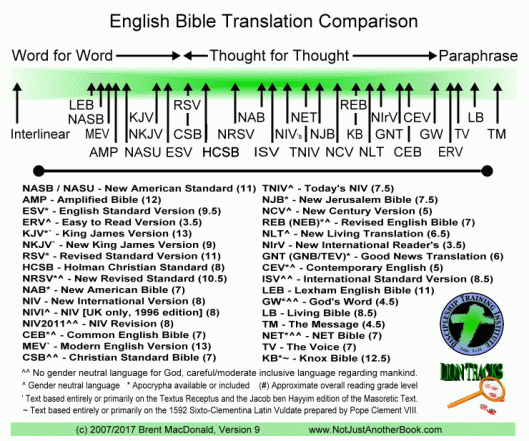
Below is a helpful chart from Brent MacDonald of Not Just Another Book comparing a number of different translations and paraphrases. (On this chart, it’s good to be a “leftist”).

bibletranslationcomparisonsmall

You can try most of these translations out for free at Bible GatewayThere’s even a great feature that allows you to compare several versions side by side:

Just as there are a number of good Bible versions I would recommend, there are a few I’m familiar with which I would strongly recommend againstThe Message, The Voice, The Passion Translation, The Amplified Bible, and any “translation” that uses gender neutral language.

More than a few articles have voiced concerns over The Message’s – a paraphrase – often misleading texts. (I would add that Eugene Peterson {author of The Message} frequently shows poor discernment. One recent example is his front cover endorsement of the heresy-laden book – and movie – The Shack.)

The Voice is not only a paraphrase, its contributors include female “pastors” and false teachers such as Brian McLaren, Phyllis Tickle, Chris Seay, and Leonard Sweet.

The Passion Translation is a New Apostolic Reformation version of the Bible which actually changes the wording of many verses in order to fit the NAR agenda. Click here for a Bible translation scholar’s review of Passion’s version of Psalms.

The Amplified Bible falls prey to an improper translation technique called illegitimate totality transfer, which, in its attempt to clarify a particular word or phrase, may actually end up causing you to misunderstand the correct meaning of the verse.

I’ve already mentioned the post-1984 versions of the NIV, but be sure to avoid any “translation” of the Bible that uses gender neutral language extensively or exclusively. And you certainly don’t want a “Bible” that uses neutral or feminine pronouns or references to God – those should always be male.

There are some perfectly reliable and accurate newer Bible translations that will, for example, occasionally render (or add a footnote) “brothers” as “brothers and sisters” when it’s clear from the context that Paul is talking to or about the entire church. That’s not what we’re talking about here. We’re talking about changing passages clearly referring only to men to include women. Thus, these “translations” are actually changing God’s words. Let me give you an example from the Common English Bible (CEB). This is 1 Timothy 3:1-7:

This saying is reliable: if anyone has a goal to be a supervisor in the church, they want a good thing. 2 So the churchโ€™s supervisor must be without fault. They should be faithful to their spouse, sober, modest, and honest. They should show hospitality and be skilled at teaching. 3 They shouldnโ€™t be addicted to alcohol or be a bully. Instead, they should be gentle, peaceable, and not greedy. 4 They should manage their own household wellโ€”they should see that their children are obedient with complete respect, 5 because if they donโ€™t know how to manage their own household, how can they take care of Godโ€™s church? 6 They shouldnโ€™t be new believers so that they wonโ€™t become proud and fall under the devilโ€™s spell. 7 They should also have a good reputation with those outside the church so that they wonโ€™t be embarrassed and fall into the devilโ€™s trap.

Compare this to any reliable translation, and you’ll see the problem (and not just with the gender neutral language). I recently saw a woman “pastor” defend her right to serve in that office from this passage in the CEB “translation,” which, I imagine, is precisely the reason it was rendered this way. (It appears that there are likely a number of other problems with the CEB, as well. I looked only at the passage above and 1 Timothy 2:11-15, and the translation of that passage is completely botched as well, erroneously rendering “woman” and “man” as “wife” and “husband,” removing the “for/because” at the beginning of 13, and completely mangling the meanings of verses 14 and 15. This passage could also be used to support the sins of women preaching, pastoring, and holding authority over men in the church. Again, compare this to any reliable translation.)

If you’re looking for a good study Bible (or want to avoid a bad one), I’ve discussed that a bit here (#4). I frequently use and highly recommend both the ESV MacArthur Study Bible and the Faithlife Study Bible (which is FREE!). When shopping for a study Bible, do you homework and vet the contributors. Avoid any study Bibles whose contributors are false teachers, theologians from apostate churches, female “pastors,” etc. Some in particular I would recommend you avoid are the CSB LifeWay Women’s Bible, ESV Women’s Study Bible and the YouVersion app (all feature false teachers). And check out this article from Tim Challies: What Makes a Really Good Study Bible?.

Looking for a great Bible app? Check these out.


If you have a question about: a Bible passage, an aspect of theology, a current issue in Christianity, or how to biblically handle a family, life, or church situation, comment below (Iโ€™ll hold all questions in queue {unpublished} for a future edition of The Mailbag) or send me an e-mail or private message. If your question is chosen for publication, your anonymity will be protected.