

Month: September 2015

Throwback Thursday ~ Anything to Get the Kids to Read?
Originally published December 9, 2008.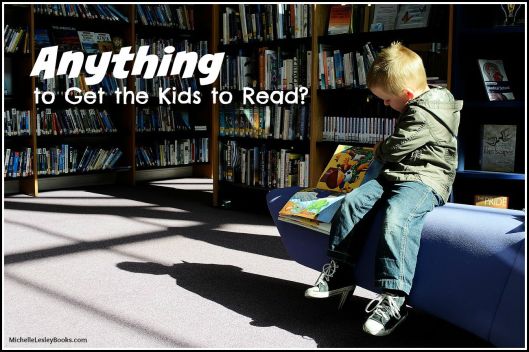

This seems to be a new mantra that has sprung up among parents and educators over the last few years. I’ve heard it many times– said with an almost religious fervor –as though a child who doesn’t read is in the same immediate danger as a child who doesn’t eat.
And whenever I hear this statement made with such intensity, I can’t help but think, “Anything to get the kids to read? Really? Anything?” Just how far are we willing to go for the sake of reading?
Most recently I heard this statement made in response to a topic on my local talk radio station. It seems a high school English teacher assigned his class a book to read that contained a significant amount of profanity. Parents complained. The principal intervened and the assignment was terminated. Many who disagreed with the principal’s decision repeated the litany, almost in unison: “Who cares if there’s profanity? The kids were reading.”
On another occasion, a Christian father and I were discussing the new movie and book, Twilight. He was planning to allow his “tween-ager” to see the movie in hopes that she would then read the books. He had made this decision, not because he thought the subject matter of the books or movie would be good for her (in fact, he indicated that he had decided to allow her to see it against his better judgment of the content), but because he wanted to do something that would get her to read more.
Now, granted, I haven’t read the book series or seen the movie, so my comment stems only from the several reviews and articles I’ve read about them, but has reading become so important even to Christian parents that they feel the need to OK a book/movie for their children that gives at least the appearance of nominal approval to vampirism?
Don’t get me wrong, I think reading is very important. I’m an avid reader, as are my children who are old enough to read independently. I guess I’m just a little perplexed that in a country with freedom of the press, where we have access to a bountiful supply of good books, both Christian and secular, that don’t contain questionable material, we are getting sucked into the mentality that the only way to get kids to read is to present them with books that contain and normalize profanity, occultism, gratuitous violence and gore, inappropriate and explicit sexuality, and any number of other things that we wouldn’t want them exposed to in real life. Why choose books like that when there are so many other better choices?
There are better ways to turn your kids into readers of good books:
- Start early- Read to your kids from the time they are infants. Make it a normal, habitual part of life. I used to read to my babies when I was nursing them. I just read aloud from whatever book or magazine I happened to be reading at the moment myself. (That was actually a lot more interesting than reading Green Eggs and Ham or Go Dogs, Go to them a zillion times a day!)
- Make it part of the daily routine- Just as you set aside time for brushing teeth, naps, daily devotions, homework, etc., set aside time every day to read to your children, or require your older children to spend a certain amount of time reading every day. One thing I have found that works well with my children is to occasionally allow them to stay up fifteen or twenty minutes past their bedtime, but only if they will use that time to read.
- Make reading something to look forward to– Several years ago, I began a practice of reading my older children a book series every summer. We started with the Little House on the Prairie books, then moved to the Narnia books and others. As we near the end of the school year each May, one of the things I have them do is start looking around the library and the internet for the book series they want us to read that summer. They look forward to this each year. Finding an appropriate author or a topic your children like and having them watch for the latest book to come out is another way to build excitement.
- Reward reading– Because I love to read so much, it is hard to for me to imagine anyone needing a reward for reading; it’s kind of a reward in itself! Some kids need a little more motivation, though. They might enjoy participating in reading contests such as Pizza Hut’s “Book It” program. Also, check out the programs at your local library. Our library sponsors a reading contest for both kids and adults every summer. It allows the reader to set a goal for the number of books he thinks he can read over the summer and then awards prizes for those who reach their goals. Or, if your kid is dying to see a movie that is based on a certain book, make seeing the movie a reward for reading the book.
- Set an example– Be a reader yourself. Find an interesting book and curl up on the couch with your kids while they read their books.
- Limit the electronic pacifiers– This is a good idea even if you’re not especially interested in getting your child to read more. Unlimited time in front of the TV, computer, gaming system, or hand-held video games is hazardous to your child’s intellectual health. Conversely, having your child read in order to earn “screen time” can be a good motivator.
As with everything else, it’s important to abide by Biblical principles when choosing reading materials for ourselves and our children. Reading is important, but not as important as filling our kids’ minds with Godliness.
Finally, brethren, whatever is true, whatever is honorable, whatever is right, whatever is pure, whatever is lovely, whatever is of good repute, if there is any excellence and if anything worthy of praise, dwell on these things. Philippians 4:8
Am I Really Saved?: A First John Check Up ~ Lesson 6: What is Love?

Am I Really Saved? A First John Check Up
Lesson 6: What is Love?
Please Read: 1 John 3:10-24
Previous Lessons: 1, 2, 3, 4, 5
Examine yourselves, to see whether you are in the faith. Test yourselves. Or do you not realize this about yourselves, that Jesus Christ is in you?—unless indeed you fail to meet the test!
2 Corinthians 13:5
1 John 3:10-15
Am I Really Saved? Checkpoint 10: Do I love my brothers?
By this it is evident who are the children of God, and who are the children of the devil: whoever does not practice righteousness is not of God, nor is the one who does not love his brother. 11 For this is the message that you have heard from the beginning, that we should love one another. 12 We should not be like Cain, who was of the evil one and murdered his brother. And why did he murder him? Because his own deeds were evil and his brother’s righteous. 13 Do not be surprised, brothers, that the world hates you. 14 We know that we have passed out of death into life, because we love the brothers. Whoever does not love abides in death. 15 Everyone who hates his brother is a murderer, and you know that no murderer has eternal life abiding in him.
Here, John circles back to love versus hate, but he looks at it from a bit of a different perspective than he used in chapter 2. John draws a parallel between the two different types of brothers- familial and spiritual – and uses these relationships to explain true brotherly love, and why this is a characteristic of Christians.
- Which phrase in the first sentence of verse 12 compares non-Christians to Cain? How does verse 15 make this comparison?
- Why, according to verse 12, did Cain murder Abel (his brother)? Was it because Abel provoked him or was evil in some way? Verse 13 indicates that the world will hate us for the same reason Cain hated Abel. What is that reason? How does John 3:19-20 relate to this concept?
God’s righteousness, shining through Abel, reflected Cain’s sin back at him. He felt guilty, convicted, and he wanted to get away from those feelings of condemnation. This is the same foundational reason the world hates Christians today. They hate the Christ who lives within us because, in Him, they see their own evil deeds reflected back at them. They feel guilty and convicted, and, wanting to suppress the truth about their sin, they hate us or do whatever else they can to escape those feelings of condemnation.
- How is hatred by the world for being Christlike evidence that we belong to Christ?
- If hatred is characteristic of the world, what, necessarily, must be characteristic of Christians? (v. 14)
- How do you feel when you’re around someone you know is a Christian? Do you enjoy open, easy, godly fellowship with her? Do you ever feel guilty or convicted just by being around her? Does talking with her about the things of God make you feel threatened, defensive, or argumentative?
1 John 3:16-17
OK, the Christian’s life is characterized by love for her brothers and sisters in Christ, but what, exactly, is love? Is it just being nice to people? Being a doormat? Never getting angry? Turning a blind eye to sin? How do we know if we’re acting in love or not?
John gives us a very simple definition: he laid down his life for us, and we ought to lay down our lives for the brothers.
Christ sets the standard for what love is. He defines love. Not our feelings. Not our opinions. Not the world’s definition of love. The cross is the measuring stick against which we measure anything we might call “love.” Anything that falls short isn’t love. This is how we know that things like homosexuality, abuse, sinful jealousy, pedophilia, cohabitation, universalism, living vicariously through your children, adultery, and tolerance of sin are not love. Any “love” that doesn’t look like Christ’s holy, righteous, biblical, dying to self love isn’t love.
He laid down his life for us, and we ought to lay down our lives for the brothers. Did you notice John didn’t say “He died for us and we ought to die for our brothers”? I wonder if that might have anything to do with the fact that there’s more than one way to lay your life down for someone. Certainly, Christ demonstrated His love for us by dying for us on the cross, and, that same love should compel us to willingly die for others if circumstances call for it.
But Christ didn’t just lay down His life for us in death, He laid down His life for us in life, too. Every temptation He resisted, every time He put his own wants and needs aside to put someone else first, every time He humbled Himself to serve others, He was laying down His life for us. And in the same way, we ought to lay down our lives for our brothers. We serve people. We provide for people. Even when it comes at a personal cost. We don’t just talk the talk, John says, we walk the walk.
1 John 3:18-22
Am I Really Saved? Checkpoint 11: Am I bearing the fruit of love?
Little children, let us not love in word or talk but in deed and in truth.19 By this we shall know that we are of the truth and reassure our heart before him; 20 for whenever our heart condemns us, God is greater than our heart, and he knows everything. 21 Beloved, if our heart does not condemn us, we have confidence before God; 22 and whatever we ask we receive from him, because we keep his commandments and do what pleases him.
- What does the word “this” in verse 19 refer to?
Let’s face it, there are going to be times when we sin big or again, and it’s easy to give in to those thoughts of, “How could I possibly be saved if I act like that?”. But whenever our hearts condemn us that way, John urges us to look back over the general direction of our spiritual lives. Not so we can feel good about ourselves or because our good deeds somehow make up for our sins, but because God says when our emotions are getting the best of us, that’s a good, objective way to calm down and get some reassurance of our salvation. Is it the desire of my heart to act in love for God and love for others? Do I generally carry that desire through with action? God says we can look to these things as evidence of our salvation.
God knows everything. He knows whether or not you belong to Him, and He wants you to know, too. And if the objective evidence shows you’re saved, you’ll have the confidence to put aside those feelings of condemnation, and boldly approach the throne in prayer, knowing that you keep God’s commandments and do what pleases Him.
- What does verse 20 mean when it says “God is greater than our heart”? How does this show us that God is the judge of whether or not we are saved, not us or our feelings?
- How do keeping God’s commandments and doing what pleases Him (22) impact the way we pray?
1 John 3:23-24
Am I Really Saved? Checkpoint 12: Do I keep the ultimate commandment?
And this is his commandment, that we believe in the name of his Son Jesus Christ and love one another, just as he has commanded us. 24 Whoever keeps his commandments abides in God, and God in him. And by this we know that he abides in us, by the Spirit whom he has given us.
- What is the commandment in verse 23? How many parts (notice the second “and”) are there to this command? What does verse 24 indicate about the person who keeps this command?
- How do we know that God abides in us? (24b)
- Do you keep this commandment? Is your belief in Christ a simple mental acknowledgement, or have you staked your life and eternity on Christ?
The two parts of the ultimate commandment are inseparable: we are to believe in Christ for salvation and love one another. You can’t have one without the other. Those who keep this command can be certain that they are in Christ. The Holy Spirit bears witness to this.
This week we’ve looked at three more checkpoints in our “Am I Really Saved?” study:
Do I love my brothers?
Am I bearing the fruit of love?
Do I keep the ultimate commandment?
Saved people may be hated by the world, but they love their brothers. They can look back over their lives and see evidence of their Christlike love, in word and deed, for others. They keep the ultimate commandment of staking their lives on their belief in Christ and loving their fellow Christians.
Unsaved people often feel guilty, convicted, or defensive around Christians as Christ reflects their sin back at them. They do not have a track record of showing Christlike love for others, and, while they may proclaim belief in Christ, their profession is only lip deep.
Additional Resources:
1 John 3– Matthew Henry’s Commentary
Can I Be Sure I’m Saved?– by R.C. Sproul
True or False? A Study in 1 John– at Naomi’s Table (lessons 13-14)
