
1&2 Timothy Bible Study

1 & 2 Timothy: Lesson 9

Previous Lessons: 1, 2, 3, 4, 5, 6, 7, 8

Read 2 Timothy 1

Questions to Consider

1. Before diving in to chapter 1, you may wish to review your answers to the introductory questions in lesson 8 (link above).

2. Examine the greeting of this letter (1-2). Who is this letter from? Where is he currently residing? (8) Who is this letter addressed to? What was Timothy’s position in the church at Ephesus? Since 2 Timothy is one of the pastoral epistles, how do its instructions apply to pastors, church members, and the church today?

3. Compare the greeting of 2 Timothy (1-2) to the greeting of 1 Timothy. How does Paul present his credentials, describe Timothy, and invoke God’s blessings in each greeting? What are the similarities and differences in each of these?

4. Read 3-18, noticing the repetition of three words, one in 8 & 12, one in 12 & 14, one in 8, 12, 16. What are these three words? What can these words help us understand about a general theme of this chapter and the letter as a whole?

5. Look closely at Paul’s personal remarks to Timothy in 3-7. Describe the ways Paul serves and encourages Timothy, personally, in this section. How can this section inform the church that pastors need encouragement? What might your own pastor(s) be in “tears” about? (4) Are you praying for your pastor(s)? (3) What specific words of encouragement could you offer your pastor(s) this (and every) week? (5-7)

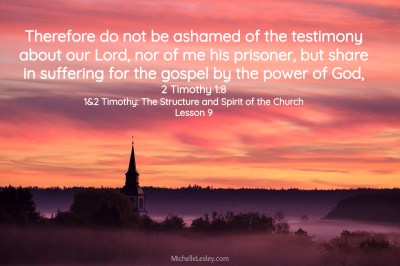
6. What word does verse 8 start with? Backtrack into verses 6-7 to see what that “therefore” is there for. Would Timothy be able to carry out what Paul said in verse 8 without “girding up his loins” with the instructions in 6-7? Why is it important for us to prepare, spiritually, for future persecution?

Consider the context (6-7) of verse 8. What might Timothy have been “fearful” (7) of (hint: How was society/government treating Christians at that time in history?), and how does that inform our understanding of his being “ashamed” of the “testimony about our Lord” and about Paul? Does “ashamed” mean mere social embarrassment in this context? What would the consequences have been of Timothy aligning himself with the gospel and with Paul? (8b) (Compare with Peter’s “shame” over aligning himself with Jesus.)

Explain how a professing Christian today might be “ashamed” of the “testimony about our Lord” or of aligning herself with Christians who are suffering the consequences of being bold in the faith.

9. In verses 9-10 we have one of our recurring motifs (see lesson 5 question 9 – link above – if your memory needs jogging). What is it? Take a few moments to revel in this passage, soak up the beauty of the gospel, and thank God for it. Can you list all of the theological concepts alluded to in this passage? (eg. predestination, sola gratia, etc.)

10. Compare Paul’s “I am not ashamed,” and “I am suffering” in 11-12 with his instructions to Timothy not to be ashamed and to join in suffering in verse 8. How was Paul leaving an example for Timothy to follow? What are some ways we can follow Paul’s example today?

11. Examine the concept of “guarding the deposit entrusted to you” as it pertains to Paul and to Timothy in 12-14. Why did Paul say he was not ashamed – he did not fear or shrink back – to align himself with Christ and the gospel? (12b- remember that in this context, “for” means “because”). Who is the “he” in verse 12? (see v. 14) When Paul says “what has been entrusted to me,” what does he mean? What is the thing, the “good deposit” (14) that has been entrusted to him and to Timothy? (13) Who entrusted this good deposit to Paul? (11-12) To Timothy? (13) What does Paul mean by “guarding” this good deposit? (12,14) Have Christians received this “good deposit” today? Who entrusted it to us, and how are we to “guard” it? (14)

12. Read 15-18. Who does Paul mention that were “ashamed” of him? (15) Why do you think they “turned away” from aligning themselves with Paul? Who was not ashamed of aligning himself with Paul and the gospel (15), and how did he demonstrate this (16-18)? What are some ways you can demonstrate, through the good works God has ordained for you, that you are not ashamed of being aligned with Christ and the gospel?


Homework

Review 3-7 again. Examine the specific ways Paul encouraged Timothy in this section. Think of someone who is a true child in the faith to you, maybe your own child, a younger woman at church, etc. Drop her a card, e-mail, or text this week to encourage her in her walk with the Lord and to let her know how you’re praying for her.


Suggested Memory Verse
1&2 Timothy Bible Study

1 & 2 Timothy: Lesson 8

Previous Lessons: 123456, 7


Last week, we finished up the book of 1 Timothy. Today, we’re doing our preliminary background work on the book of 2 Timothy before diving into the text. You might want to review lesson 1 (link above) and compare the background information on 1 Timothy to the background information on 2 Timothy. How are they similar? How are they different?


Introduction to 2 Timothy

Before we begin studying a book of the Bible, it’s very important that we understand some things about that book. We need to know…

Who the author was and anything we might be able to find out about him or his background.

Who the audience of the book is: Jews or Gentiles? Old Testament Israelites or New Testament Christians? This will help us understand the author’s purpose and approach to what he’s writing.

What kind of biblical literature we’re looking at. We approach books of history differently than books of wisdom, books of wisdom differently than books of prophecy, etc.

What the purpose of the book is. Was it written to encourage? Rebuke? Warn?

What the historical backdrop is for the book. Is Israel at war? At peace? In exile? Under a bad king? Good king? Understanding the historical events surrounding a piece of writing help us understand what was written and why it was written.

When the book was written. Where does the book fall on the timeline of biblical history? This is especially important for Old Testament books which are not always arranged in chronological order.

So this week, before we start studying the actual text of the book of 2 Timothy, we need to lay the foundation to understanding the book by finding the answers to these questions.

Read the following overviews of the book of 2 Timothy, taking notes on anything that might aid your understanding of the book, and answer the questions below:

Bible Introductions: 2 Timothy at Grace to You

Overview of the Book of 2 Timothy at Reformed Answers

Book of 2 Timothy at Got Questions

1. Who wrote the book of 2 Timothy? How do we know this?

2. Approximately when was 2 Timothy written? What is the geographical setting of the book of 2 Timothy? Here are some maps (scroll down to “2 Timothy”) that may be helpful as you study through the book of 2 Timothy.

3. Who is the original, intended audience of the book of 2 Timothy? Describe the historical setting (historic events, politics, sociology of the time, etc.) of 2 Timothy.

4. Which genre of biblical literature is the book of 2 Timothy: law, history, wisdom, poetry, narrative, epistles, or prophecy/apocalyptic? What does this tell us about the approach we should take when studying this book versus our approach to books of other genres?

5. What is the theme or purpose of the book of 2 Timothy?

6. What are some of the major topics of instruction in the book of 2 Timothy? How do these topics relate to the theme of 2 Timothy?

7. What are some ways 2 Timothy points to and connects to Jesus?

8. What else did you learn about 2 Timothy or the setting of this book that might help you understand the text of the book better?

Take some time in prayer this week to begin preparing your heart to study 2 Timothy. What are some ways your pastor and church could be encouraged by the instruction of 2 Timothy? What might you learn that could make you a healthier church member? Do you have any areas that need improvement when it comes to the way you serve God or your brothers and sisters in Christ? Ask God to grow you in those areas as we continue to study 1 & 2 Timothy: The Structure and Spirit of the Church.

Podcast Appearances

Throwback Thursday ~ Scripture Matters Podcast Guest Appearance: Women In Ministry

Originally posted December 8, 2017


Recently, I had the opportunity to sit down and chat with Richard Swartz, host of the Scripture Matters podcast. Listen in as we talk about some of the major issues in women’s ministry today, women’s discipleship, false teachers, and “golden calf tipping”. Richard and I also discussed the importance of husbands, fathers, and pastors protecting the souls of the women in their lives, so there’s something edifying for everyone!


Got a podcast of your own or have a podcasting friend who needs a guest? Need a speaker for a women’s conference or church event? Click the “Speaking Engagements” tab at the top of this page, drop me an e-mail, and let’s chat!

1&2 Timothy Bible Study

1 & 2 Timothy: Lesson 7

Previous Lessons: 1, 2, 3, 4, 5, 6

Read 1 Timothy 6

Questions to Consider

1. Examine verses 1-2, putting yourself in the sandals of a first century house servant who is a Christian. Explain God’s instruction that you’re to obey in each of these verses. What are the reasons God gives for these instructions in each verse? (Hint: after “so that” (1), after “since” (2)).

We often talk about how Ephesians 5 explains that the wife portrays to the world how the church is to relate to Christ, and how the husband portrays how Christ relates to the church. Explain what the Christian servant, by obeying the instructions in verses 1-2, portrays to the world about how a Christian relates to her master, Christ. How can these principles apply to the Christian employee’s behavior and attitude toward her boss in today’s world?

2. Read verses 3-10 from a “helicopter view” (big picture, main ideas). What are the two main concepts this passage deals with in 3-5a and 5b-10? How does this passage connect false doctrine and greed?

3. Carefully read verse 3. In the church today, many will say that as long as someone agrees to the most fundamental doctrines of soteriology (the things you must believe at the most basic level in order to be saved), that person should not be labeled a false teacher (even if they persist in teaching other unbiblical things despite correction, ex: homosexuality is OK, women preachers are OK, etc.). Does verse 3 seem to agree with that idea? Explain the terms “sound words of our Lord Jesus Christ,” and “teaching that accords with godliness.” Compare and contrast “different doctrine” with “different gospel” in Galatians 1:6-10. Are there different “levels” of unbiblical teaching?

4. How does 4a describe the false teacher? What is the fruit of teaching false doctrine? (4b-5) Compare this fruit to the fruit of false teachers described in Matthew 7:15-20. What kind of fruit does doctrinally sound teaching produce? Compare the fruit of false teaching with the fruit of doctrinally sound teaching. Matthew 7:20 says we will recognize false teachers by the fruit their ministry produces. You are the fruit of the pastors and teachers you sit under. If someone were examining your life, would she conclude that you sit under false teachers or doctrinally sound teachers?

5. Carefully examine verses 6-10. What do these verses teach us about contentment? How is godliness with contentment a great gain? How do greed and coveting rob us? How can we find our contentment and satisfaction in Christ?

6. Ephesians 4:21-32 explains the concept of “putting off” the old self and “putting on” the new self. We “put off,” or stop doing, something that is sinful (ex: lying, 4:25a), and “put on,” or proactively seek ways to do, the opposite, biblical thing (ex: proactively tell the truth 4:25b). Examine verses 11-21 in light of the Ephesians passage. What does “these things” in verse 11 refer to (the two major concepts in question #2)?

Make a list of the ways verses 11-16 and 20-21 instruct us to “put off” false doctrine and “put on” sound doctrine. Notice the imperatives (flee, pursue, fight, etc.) Paul uses. How does this wording convey the idea that these instructions are commands that require intentional action on our part?

Make a list of the ways verses 17-19 instruct us to “put off” greed and coveting and “put on” giving, generosity, and contentment in Christ, again noting the imperatives.

How can corporately putting off greed and false teaching, and putting on contentment and sound doctrine benefit and protect the structure and spirit of the local church?

7. Two of our recurring motifs in the book of 1 Timothy are back, and kind of overlap in verses 13-16. Can you identify these two motifs (Hint: If your memory needs jogging, see lesson 6, question 7 and lesson 5, question 9) and explain their significance? How are they similar or different to the previous instances of these motifs?


Homework

As we’ve studied 1 Timothy, one of the themes we’ve seen is the hierarchical structure of authority in the church (and even in the world), where each of us fits in that hierarchy, and how we’re to submit to those in authority over us. Can you think of other biblical passages that deal with these themes? Why do you think God made authority one of the major themes of this book and of the Bible?


Suggested Memory Verse

Podcast Appearances

Voice of Reason Radio Podcast Guest Appearance

Voice of Reason Radio


It was such a pleasure to be a recent guest on the Voice of Reason Radio podcast. Chris Honholz, Rich Story, and I chatted about biblical womanhood, women’s ministry, Beth Moore, and more!

Voice of Reason Radio

Click here to listen in…

subscribe to the Voice of Reason Radio podcast, and don’t forget to follow VOR on Facebook and Twitter!


Got a podcast of your own or have a podcasting friend who needs a guest? Need a speaker for a women’s conference or church event? Click the “Speaking Engagements” tab at the top of this page, drop me an e-mail, and let’s chat!