Psalm 119 Bible Study

New Bible Study Kickoff and Title Pic Contest

Happy Wednesday, Ladies! It’s time to kick off our next Bible study:

…..with a fun title pic contest!

What does Godโ€™s Word teach us about…itself? As we make our way through this lovely psalm, you’ll learn about loving God’s Word, the various ways Scripture helps us in our daily lives, and the reliability of God’s Word. But most importantly, you’ll learn about and increase in your love for the God of the Word.

Weighing in at a hefty 176 verses, Psalm 119 is well known as the longest chapter in the Bible, and is similar in length to Philippians and James. Think you can memorize it? I challenge you to try!

Psalm 119ย will be an โ€œexpositorially topicalโ€ (an expository deep dive into a short segment of Scripture) study, similar to The Sermon on the Mount and ย The Ten. Over roughly 14 to 18 lessons, we will examine, along with the psalmist, the attributes of the God who breathed out Scripture, and the way He uses Scripture to grow, strengthen, comfort, reassure, and equip us.

But before we get started studying next Wednesday, how about a little fun?

You’ve probably noticed that I design a title picture for each Bible study I write. Here are a few past title pics:
You can see the rest of them at the Bible Studies tab in the blue menu bar at the top of this page, if you like, to get a feel for my style and the general appearance I like my title pics to portray.

Y’all have sent in some beautiful and creative entries in our past title pic contests – indeed, the title pics for The Sermon on the Mount, The Women of Genesis, Living Stones, and Imperishable Beauty were all designed by readers – so, once again, I wanted to get some of you involved in the design process for our new study.

Do you enjoy and have a knack for photo editing? Know someone who does? If so, I’m accepting submissions for title pictures for the Psalm 119 study. If your submission is chosen it will be used each week of the study, and you’ll be credited (name or website) by watermark. I’d love to be able to offer a huge cash prize, but, hey, we’re small potatoes here. This is just for fun and maybe a little publicity for your site, if you have one.

Contest Guidelines

โ˜™ You must use images that don’t require attribution. Pictures you’ve taken yourself are fine, as are images from sources such as Pixabay, Pexels, Freely, Unsplash, StockSnap, or other free stock photo web sites. Please include the image source web sites you use along with your submission. (You cannot just grab and use any old picture off the internet. Photographers own their images and usually require permission, attribution, and often a fee, for their use.)

โ˜™ Title pics should be landscape (a horizontal rectangle) with a width of 1000-2000 pixels and proportionate height. I prefer JPG images, but PNG is fine, too, if necessary.

โ˜™ Your title pic must contain the full title of the study: Psalm 119: The Glory of God’s Word (Be sure to double check your spelling and punctuation. You can leave the colon after 119 out if “Psalm 119” and “The Glory of God’s Word” are not on the same line. See my image above.).

โ˜™ If your submission is selected, I’ll be glad to watermark it with your website address (please submit your picture without any watermarks) if you have one, as long as your web site doesn’t conflict with my statement of faith or my beliefs outlined in the Welcome tab.

โ˜™ Deadline for submissions is 11:59 p.m., Monday, January 31, 2022

โ˜™ E-mail your title pic submission along with your full name, web site address (if any), and the source(s) you used for your image(s) to MichelleLesley1@yahoo.com. You are welcome to submit as many images as you like.

โ˜™ Please don’t be offended if your submission isn’t selected. If I peruse all the submissions and I’m just not “feeling it,” I may still elect to design one of my own.

โ˜™โ˜™โ˜™โ˜™โ˜™

Feel free to share this around with friends who have an interest in photo editing. If you want to take a whack at it for fun but don’t know where to start, play around with Be Funky, PicMonkey, or Canva and see which one works best for you.

Think about – maybe even read – Psalm 119 and try to capture in your image the theme of the chapter or a key truth expressed by a certain verse.

Happy designing!
Wednesday's Word

Wednesday’s Word ~ 1 John 4

For further study on the book of 1 John, try my study, Am I Really Saved?: A First John Checkup, from which this lesson is excerpted.

1 John 4

Beloved, do not believe every spirit, but test the spirits to see whether they are from God, for many false prophets have gone out into the world. By this you know the Spirit of God: every spirit that confesses that Jesus Christ has come in the flesh is from God, and every spirit that does not confess Jesus is not from God. This is the spirit of the antichrist, which you heard was coming and now is in the world already. Little children, you are from God and have overcome them, for he who is in you is greater than he who is in the world. They are from the world; therefore they speak from the world, and the world listens to them. We are from God. Whoever knows God listens to us; whoever is not from God does not listen to us. By this we know the Spirit of truth and the spirit of error.

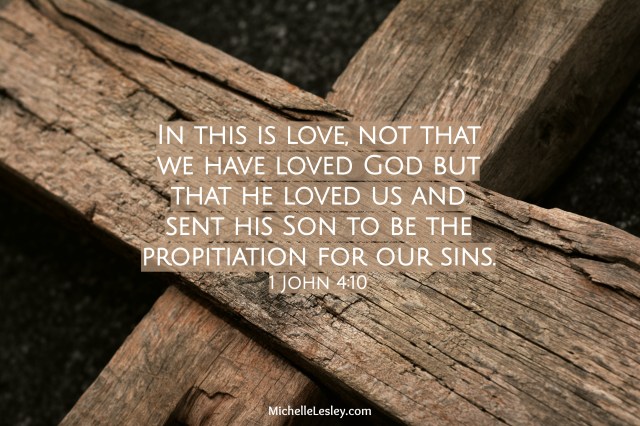
Beloved, let us love one another, for love is from God, and whoever loves has been born of God and knows God. Anyone who does not love does not know God, because God is love. In this the love of God was made manifest among us, that God sent his only Son into the world, so that we might live through him. 10 In this is love, not that we have loved God but that he loved us and sent his Son to be the propitiation for our sins. 11 Beloved, if God so loved us, we also ought to love one another. 12 No one has ever seen God; if we love one another, God abides in us and his love is perfected in us.

13 By this we know that we abide in him and he in us, because he has given us of his Spirit. 14 And we have seen and testify that the Father has sent his Son to be the Savior of the world. 15 Whoever confesses that Jesus is the Son of God, God abides in him, and he in God. 16 So we have come to know and to believe the love that God has for us. God is love, and whoever abides in love abides in God, and God abides in him. 17 By this is love perfected with us, so that we may have confidence for the day of judgment, because as he is so also are we in this world. 18 There is no fear in love, but perfect love casts out fear. For fear has to do with punishment, and whoever fears has not been perfected in love. 19 We love because he first loved us. 20 If anyone says, โ€œI love God,โ€ and hates his brother, he is a liar; for he who does not love his brother whom he has seen cannot love God whom he has not seen. 21 And this commandment we have from him: whoever loves God must also love his brother.


The Holy Bible, English Standard Version Copyright ยฉ 2001 by Crossway Bibles, a publishing ministry of Good News Publishers.


Questions to Consider

1. What is the theme or purpose of theย bookย ofย 1 John? What is the historical backdrop for the book of 1 John?

2. Whichย Spiritย is controlling true Christian teachers? What spirit is controlling false teachers according to verse 3? True or false: If youโ€™re following a false teacher, youโ€™re following a demonic spirit. What does it mean to โ€œtest the spiritsโ€? (v1) How did the nobleย Bereansย test the spirits?

3. According to verses 7-8, who defines, originates, and is the embodiment of, love? How does this tell Christians Who and what is to motivate any love that we might feel or show to others? Is the โ€œloveโ€ that non-Christians feel or show to others motivated by God or by other factors such as affection, selfishness, lust, etc.? Can you truly love others if you do not know God? In verses 9-10, what is the ultimate definition and demonstration (what action did God take) of the phrase โ€œGod is loveโ€?

4. How do we know, according to verse 13, that we belong to Christ? How can we tell ifย we have the Spirit? In what ways do our actions show that we have the Holy Spirit?

5. What does our love (or lack of love) for others say about whether or not we truly know God? (20) What does verse 20 call people who claim to love God but do not love others? Are such people saved?

Bible Study

How to Study the Bible- and How Not To!

Originally published December 31, 2020

It’s almost the new year! Are you making a resolution to start having a personal, daily Bible study time? Would you like to improve on the way you study your Bible? Maybe you’re looking for a Bible reading plan, or maybe you’re just looking to change things up a little?

If that sounds like you, give a listen to this December 2020 episode of A Word Fitly Spoken:

How to Study the Bible – and How Not To!

Amy and I discuss what our own Bible study times look like, plus some other helpful methods and resources. We also discuss false doctrine and false teachers to avoid as you’re studying your Bible.

This episode is a great way to kick off the new year. And don’t forget to subscribe to A Word Fitly Spoken on your favorite podcast platform!

Additional Resources:

Bible Study Resourcesย (how to study the Bible)
Bible Studies
Bible Reading Plans for the New Year- 2022

Popular False Teachers & Unbiblical Trends

Judges Bible Study

Judges ~ Lesson 18- Wrap Up

Previous Lessons: 1, 2, 3, 4, 5, 6, 7, 8, 9, 10, 11, 12, 13, 14, 15, 16, 17

Wrap Up

Questions to Consider

1. Was there anything new God taught you in this study that particularly impacted you? What was it, and why was it so significant?

2. How is your walk with the Lord different after this study than it was before?

3. What are the reasons for, and the consequences of, “Everyone did what was right in his own eyes”? What are the implications of this mindset and posture of heart for God’s people, both individually and as the church, today?

4. What did you learn about idolatry and syncretism from this study, and how can you apply this to the church and Christian organizations?

5. What did this study teach you about trusting and obeying God?

6. Have there been any passages or concepts in this study that God used to convict you of disobedience and lead you to repentance? How will you walk differently in this area from now on?

7. What did this study teach you about the character of those who lead God’s people?

8. What have you learned about God and His nature and character from this study?


Homework

Spend some time in prayer this week asking God to show you how to put into practice one thing you learned from this study.

Recite all of your memory verses from this study. Which one is most meaningful to you right now?

Judges Bible Study

Judges ~ Lesson 17

Don’t forget to come back next week for our wrap up lesson!

Previous Lessons: 1, 2, 3, 4, 5, 6, 7, 8, 9, 10, 11, 12, 13, 14, 15, 16

Read Judges 21

Questions to Consider

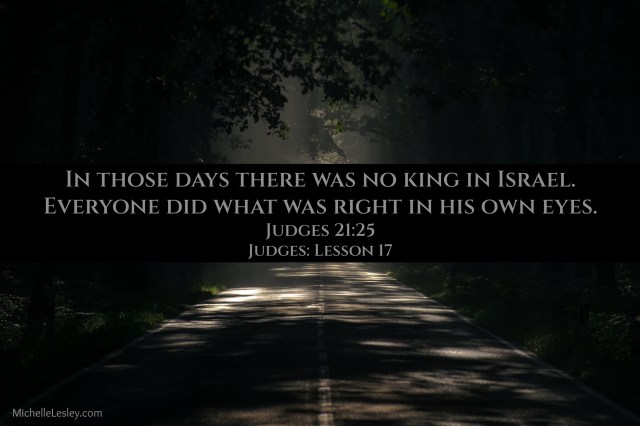
1. Go back to lesson 3 (link above) and review your answer to the first part of question 5, Israel’s pattern of sin and repentance in 2:16-23. How does today’s passage fit this pattern? How does today’s passage fit the theme verse of Judges (21:25), “In those days there was no king in Israel. Everyone did what was right in his own eyes.”?

2. Chapter 21 is a continuation of the story that began in chapter 19. Briefly review lessons 15 & 16 (links above) to refresh your memory.

3. Read all of chapter 21.

4. Explain 1-15 in your own words. What is taking place in this passage? What transpired at Mizpah (1,18)? (hint: use your cross references) Why was there “one tribe lacking in Israel”? (3,6) Which tribe was it, and why was it “lacking”? (3,6, chapter 20) If there were no Benjaminite women left for the Benjaminite men to marry and none of the other Israelite tribes would give their daughters to the Benjaminite men for wives (7), what would have happened to Benjamin as a tribe? Why was it imperative that the Benjaminite men marry women from among the tribes of Israel? Why couldn’t they just marry a woman from a neighboring country?

5. In the law, God explained why He didn’t want Israel marrying foreign wives. What was His reason? Think about all the idolatry we’ve seen in the book of Judges. Which seemed to be more important to Israel in chapter 21, the letter of the law (the outward behavior of not marrying foreign wives), or the heart of the law (the inward heart condition of loving God and rejecting idolatry)?

Recall Jesus’ teaching in the Sermon on the Mount: “You have heard it said that [letter of the law], but I say to you [heart of the law].” Was Jesus saying that obedience in our external behavior – such as (for the Israelites) obeying the command not to marry foreign wives – wasn’t important? Where does our outward obedience flow from? From God’s perspective (a perspective we should attain to), is mere outward, behavioral conformity to the law true obedience to Him?

Compare the Old Testament’s prohibition on God’s people marrying unbelievers to the New Testament’s prohibition on God’s people marrying (or closely yoking with) unbelievers.

6. We live in a very individualistic society. Old Testament Israel was a very corporate society. How does this impact and explain Israel’s grief and compassion (2,3,6,15) over the potential loss of the tribe of Benjamin, even though they had recently been at war with, and killing, the Benjaminites?

Compare the Old Testament corporate perspective in this passage with the New Testament corporate perspective of the church in 1 Corinthians 12. Make the connection between Judges 21:2,3,6,15 and 1 Corinthians 12:26. Why did God design His people to be interdependent – to need each other?

7. Explain in your own words what is happening in verses 16-25. What does verse 22 mean?

Did telling and allowing the Benjaminites to snatch the women (22) let Israel and Shiloh off the hook for the vow (18) since they weren’t technically โ€œgiving our daughters to themโ€? Were they truly keeping the vow, or was this yet another letter of the law versus heart of the law situation? What about the laws against coveting and stealing – were those laws being kept or broken in this situation?

When it comes to sin, does God ever let people off on a technicality? Is someone who looks for loopholes in God’s commands a person whose obedience is motivated by her love for the Lord, or someone who loves sin and wants to “get away with” as much of it as possible? Do you ever play games like this with God’s commands?

8. Do you notice anything in chapter 21 indicating that God instructed Israel to do any of the things they did, or that He approved of any of these things? Did Israel inquire of the Lord about the lack of wives for the Benjaminite men, or did they take matters into their own hands? Think about how Sarai took matters into her own hands to have a son, when God’s plan was for Him to provide her with a son. Could not the same God who miraculously provided an offspring for Abraham have also miraculously provided wives for Benjamin? How does taking matters into our own hands, especially by sinning, a) demonstrate a lack of trust in God and His ways, and b) never turn out as well as trusting God and His ways does?

9. How would you respond to this statement? “Living by doing what is right in your own eyes (25) gives you an inconsistent spiritual framework that puts you in the position of looking in moral indignation upon one sin while committing another to ‘correct’ it.”

Compare verse 4 to verse 25. Do our outward actions of worship (4) mean anything if our hearts aren’t right with God (25)?


Homework

Review your answers to question 5, above. Are there any areas of your life in which you are being externally, behaviorally obedient to God, but that outward conformity to the requirements of Scripture isn’t motivated by love for God or the heart of the law?

For example: Do you give your offerings or attend church reluctantly or resentfully rather than giving generously and cheerfully, or attending eagerly because you love the Lord and His people?

Think it over and repent of any areas in which your obedience is not a natural outflow of your heart. Choose one of these areas, and over the next week, do a deep dive into the Word on that particular issue. Why does God want you to do or not do that behavior? What should be the posture of your heart that leads to outward obedience on that issue? Ask God to change your heart so your outward behavior will be rightly motivated and will be a joy rather than a burden.


Suggested Memory Verse