Mailbag

The Mailbag: Judge not?

Judge not lest ye be judged…

This was a reader’s recent response to one of my articles warning about a false teacher, and I thought I’d share and expand on my response to her here, because I know many of you, when you’ve said or posted things about false doctrine or false teachers, have had someone pridefully and self-righteously attempt to shame you and shut you up with a worldly twisting of these precious words of our Lord Jesus…

Some pridefully and self-righteously attempt to shame Christians and shut us up with a worldly twisting of these precious words of our Lord Jesus: “Judge not.”

You know, Matthew 7:1 is a great verse, but it’s currently probably the most twisted and abused Bible verse there is. And this is one common abuse of it – defending false teachers.

If you weren’t sitting under false teachers like the one you’re defending, you might have an accurate and biblical understanding of what that verse actually means. Instead, you’re believing and using the world’s twisted version of it.

Matthew 7:1 does not mean Christians shouldn’t warn against false teachers.

Matthew 7:1 does not mean Christians shouldn’t warn against false teachers.

If that’s what Jesus meant when He said that, He would have been contradicting Scripture, because there are many, many passages of Scripture that command us – and pastors in particular – to warn against false teachers and eradicate them from the church.

He must hold firm to the trustworthy word as taught, so that he may be able to give instruction in sound doctrine and also to rebuke those who contradict it.

Titus 1:9

Titus 1:9 is the final requirement in the list of qualifications for pastors/elders in Titus 1. If a pastor does not rebuke and warn against those who contradict sound doctrine (i.e. false teachers) he is biblically disqualified from the pastorate.

But now I am writing to you not to associate with any so-called brother if he is a sexually immoral person, or greedy, or an idolater, or a reviler, or a drunkard, or a swindlerโ€”not even to eat with such a one. 12 For what have I to do with judging outsiders? Are you not to judge those who are within the church? 13 But those who are outside, God will judge. Remove the wicked man from among yourselves.

1 Corinthians 5:11-13

False teachers – who claim to be brothers and sisters in Christ – are idolators (some of them are sexually immoral, greedy, revilers, drunkards, and swindlers as well) because they create a god according to their own liking, steal biblical names (like God or Jesus) for it, and teach people to worship their false god instead of the one true God Scripture reveals to us. Scripture clearly commands us to judge them and remove them from the church.

And the idea that Jesus would have contradicted Scripture is just silly and ridiculous. We know God doesn’t contradict Himself, or He would be a liar and would cease to be God.

The idea that Jesus would have contradicted Scripture is just silly and ridiculous.

in the hope of eternal life, which the God who cannot lie promised from all eternity,

Titus 1:2

Furthermore, the Jesus who said “Do not judge,” in Matthew 7 is the same Jesus who tells us that we are to “judge with righteous judgment” in John 7.

Do not judge according to appearance, but judge with righteous judgment.

John 7:24

In Matthew 7:1, as you can plainly see by reading verses 1-5,…

โ€œDo not judge, so that you will not be judged. 2 For with what judgment you judge, you will be judged; and with what measure you measure, it will be measured to you. 3 And why do you look at the speck that is in your brotherโ€™s eye, but do not notice the log that is in your own eye? 4 Or how can you say to your brother, โ€˜Let me take the speck out of your eye,โ€™ and behold, the log is in your own eye? 5 You hypocrite, first take the log out of your own eye, and then you will see clearly to take the speck out of your brotherโ€™s eye.”

Matthew 7:1-5

…Jesus is telling us not to judge unrighteously (in juxtaposition to his admonition in John’s account to judge righteously) or hypocritically – in other words…

  • We’re not to judge others when we’re equally guilty of unrepentant sin.
  • We’re not to judge others for doing something we’re currently guilty of ourselves.
  • We’re not to judge others for doing something that’s actually biblical just because it offends our worldly, fleshly sensibilities.

Kind of like what you’re doing by unrighteously, unbiblically, and hypocritically judging me for warning against false teachers, which, again, is actually commanded and demonstrated by God in Scripture. How could I be doing something wrong when I’m doing what Scripture tells me to do?

When you chide a doctrinally sound Christian for warning against false teachers, you are the one who is unrighteously, unbiblically, and hypocritically judging.

You might also notice that in the same chapter (Matthew 7) in which Jesus says “Do not judge,” in verse 1, He goes on to warn against – and judge – false teachers:

Beware of the false prophets, who come to you in sheepโ€™s clothing, but inwardly are ravenous wolves. 16 You will know them by their fruits. Are grapes gathered from thorn bushes or figs from thistles? 17 Even so, every good tree bears good fruit, but the bad tree bears bad fruit. 18 A good tree cannot bear bad fruit, nor can a bad tree bear good fruit. 19 Every tree that does not bear good fruit is cut down and thrown into the fire. 20 So then, you will know them by their fruits.
21 โ€œNot everyone who says to Me, โ€˜Lord, Lord,โ€™ will enter the kingdom of heaven, but he who does the will of My Father who is in heaven will enter. 22 Many will say to Me on that day, โ€˜Lord, Lord, in Your name did we not prophesy, and in Your name cast out demons, and in Your name do many miracles?โ€™ 23 And then I will declare to them, โ€˜I never knew you; depart from Me, you who practice lawlessness.โ€™

Matthew 7:15-23

And that’s not the only time Jesus warned against, rebuked, or judged false teachers…

…beware of the leaven of the Pharisees and Sadducees.โ€ 12 Then they understood that He did not say to beware of the leaven of bread, but of the teaching of the Pharisees and Sadducees.

Matthew 16:11b-12

And perhaps Jesus’ lengthiest, most scathing warning about and rebuke of false teachers is found in Matthew 23:1-36. Just a few choice excerpts since this is a long passage – here’s the warning to the hearers:

Then Jesus spoke to the crowds and to His disciples, 2 saying: โ€œThe scribes and the Pharisees have seated themselves in the chair of Moses; 3 therefore all that they tell you, do and keep, but do not do according to their deeds; for they say things and do not do them. 4 And they tie up heavy burdens and lay them on menโ€™s shoulders, but they themselves are unwilling to move them with so much as a finger. 5 But they do all their deeds to be noticed by men;

Matthew 23:1-5a

“They say things and do not do them…they do all their deeds to be noticed by men…” Huh. There’s that hypocrisy Jesus was talking about back in chapter 7.

Here’s the rebuke to the false teachers themselves:

โ€œBut woe to you, scribes and Pharisees, hypocrites, because you shut off the kingdom of heaven from people; for you do not enter in yourselves, nor do you allow those who are entering to go in…you travel around on sea and land to make one proselyte; and when he becomes one, you make him twice as much a son of hell as yourselves…You blind guides…For you clean the outside of the cup and of the dish, but inside they are full of robbery and self-indulgence….you are like whitewashed tombs which on the outside appear beautiful, but inside they are full of dead menโ€™s bones and all uncleanness. In this way, you also outwardly appear righteous to men, but inwardly you are full of hypocrisy and lawlessness…You serpents, you brood of vipers, how will you escape the sentence of hell?…I am sending you prophets and wise men and scribes; some of them you will kill and crucify, and some of them you will flog in your synagogues, and persecute from city to city, so that upon you may fall the guilt of all the righteous blood shed on earth…

Excerpted from Matthew 23:13-35

I’ve never warned against or rebuked a false teacher this sharply, but Jesus did. And we know He was right in doing so. But if you’re going to judge, criticize, and condemn someone like me who merely points out, in a matter of fact tone, how false teachers deviate from Scripture, and urges you, therefore, to obey God’s commands to have nothing to do with them, my goodness, what in the world are you going to say to Jesus about the way He warned against and rebuked false teachers?

If I’m wrong for saying, Teacher X is a false teacher because she preaches to men, teaches false doctrine, and yokes with other false teachers, and, therefore, I would not recommend you follow her, is Jesus wrong for calling false teachers “blind guides,” “whitewashed tombs,” and “brood of vipers”?

You’d best think on that lest you be hypocritical in your judgment.

The world has taken Matthew 7:1 and blasphemously twisted it into a club with which to pummel Christians who stand unwaveringly on the truth of God’s Word and, with Spirit-empowered courage, love sinners enough to call them to repent and believe the gospel, and love God, the church, and professing Christians enough to warn them against harmful false teachers and false doctrine.

The world has taken Matthew 7:1 and blasphemously twisted it into a club with which to pummel Christians, and, sadly, many professing Christians have followed the world’s example.

To the world, “Judge not,” means, “Don’t you ever dare say anything that’s not 100% affirming of me, my beliefs, or my sin of choice. Always be nice. Never say anything that could, in any way, be construed as negative. If you do, you’ll suffer the consequences.”. And, sadly, professing Christians discipled by the world and false teachers have adopted this worldly definition of “judging” and wield it like a weapon to shame and shut up Christians who are obeying Scripture.

But as genuinely regenerated Believers, accurately handling the Word of truth and having it illumined to us by the indwelling Holy Spirit, we know that Matthew 7:1 cannot possibly mean that we are not to warn against false teachers, because…

  • Jesus didn’t contradict Scripture, and Scripture commands us to warn against, rebuke, and judge false doctrine and false teachers.
  • Jesus didn’t contradict Himself during His earthly ministry, saying “Don’t judge,” in Matthew and “Do judge,” in John and other passages.
  • Jesus Himself warned against, rebuked, and judged false doctrine and false teachers.

We know that Matthew 7:1 doesn’t mean, “Don’t warn against false teachers,” because: Jesus didn’t contradict Scripture, Jesus didn’t contradict Himself, and Jesus Himself warned against, rebuked, and judged false teachers.

The question is not – why am I warning against false teachers.

The question is, why aren’t you?

The question is not – why am I warning against false teachers. The question is, why aren’t you?


Additional Resources:

Answering the Opposition- Responses to the Most Frequently Raised Discernment Objections (see #9)

I Can’t Sit Down, Shut Up, and Play Nice

Addressing Objections to Discernment- Part 4 at A Word Fitly Spoken

Twisted Scripture โ€“ Part 2 at A Word Fitly Spoken

Does the Bible really say weโ€™re not to judge? by Amy Spreeman

What does the Bible mean when it says, โ€œDo not judgeโ€? at Got Questions?

Thou Shalt Judge with Justin Peters and Todd Friel

Judge Not by Todd Friel


If you have a question about: a Bible passage, an aspect of theology, a current issue in Christianity, or how to biblically handle a family, life, or church situation, comment below (Iโ€™ll hold all questions in queue {unpublished} for a future edition of The Mailbag) or send me an e-mail or private message. If your question is chosen for publication, your anonymity will be protected.
Basic Training, Bible Study, Sermons

Basic Training: Bible Studies and Sermons

For more in the Basic Training series, click here.

When I started theย Basic Training series, I thought I’d be writing about foundational theological concepts and practices in Christianity. You know, likeย baptism orย the sufficiency of Scripture. It never occurred to me that I might someday need to explain something so basic that most lost people could define it as well as (sometimes better than) many professed Christian leaders.

But the more “Bible” studies and sermons I take in, the more I think a remedial course in exactly what those things are supposed to consist of might be very beneficial to the church at large, and an unfortunate necessity for many pastors, teachers, and Christian celebrities.

I could be way off base here, but I’d almost bet that if you went up to ten random people on the street and asked them what a Bible study class is supposed to do, at least nine out of ten of them would answer, “Study the Bible.” If you asked those same people what a sermon is, you might get more varied answers, “It’s when the preacher explains what the Bible says,” or “It’s a pastor telling you how to be a good person,” (remember these are random, probably unsaved, people) or “A sermon tells you about God.” But I’m guessing none of them would answer, “It’s when a preacher gives a stand up comedy routine,” or “A sermon is mostly stories about the preacher, his family, and other people,” or “A sermon is when you watch a movie and then the preacher adds a few remarks at the end about what you can learn about God or life from the movie.”

Yet, that’s pretty much where way too many churches are these days.

So let’s take a look at what Bible studies and sermons are and aren’t supposed to be.

It’s All About The Bible

This is supposed to be a “duh” moment for Christians, pastors, teachers, and churches. If someone is teaching a Bible study or a pastor is preaching a sermon, the first thing he should reach for is his Bible. He is to be preaching or teaching God’s written Word. It’s right there in black and white in 2 Timothy 4:1-2:

I charge you in the presence of God and of Christ Jesus, who is to judge the living and the dead, and by his appearing and his kingdom: preach the word; be ready in season and out of season; reprove, rebuke, and exhort, with complete patience and teaching.

That’s a very solemn and weighty charge to pastors. In today’s vernacular, it’s almost like placing your right hand on the Bible, raising your right hand, and saying, “As God is my witness, I swear to God I will ______.” (and actually understanding the gravity of that and meaning it). God is witnessing this charge to you pastor – you’d better take seriously your duty to preach His Word.

And notice, there are only two times when a pastor is supposed to preach the Word: in season and out of season. When his people want to hear it and when they don’t. When he feels like it and when he doesn’t. When he’ll be persecuted and when he won’t. When it’s easy and when it’s hard. When it’s a pleasant, encouraging passage, and when it’s a passage that offends people. Pastors, and, by extension teachers, are to preach and teach the written Word of God in every sermon and teaching opportunity. Always.

It’s Not About the Preacher/Teacher/Author

There are a lot of awesome pastors, teachers, and authors out there who labor faithfully to rightly teach God’s Word to His people. I am unspeakably grateful to them and for them.

But let’s face it, there are also a lot of narcissistic gas bags out there who use the pulpit and the pages to pump up their already over-inflated egos by endlessly blathering on and on about themselves, their families, their friends, and their experiences. You can tell by the ratio of personal stories to Scripture who they love best and are most interested in.

I’ve read books and heard sermons that I walked away from thinking, “I know more about that pastor or author, his family, his trips, the charity work he does, and who his important friends are than I do about God and His Word.” (I’ll tell you this, he’s received his reward.)

Pastors, teachers, authors aren’t to preach themselves, they’re to preach the Word.

It’s Not About Gimmicks and Entertainment

A sermon series based on movies. A pastor riding a motorcycle into church. Ziplining during the sermon. Rock concerts and light shows. Raffles and giveaways of cars and other big ticket items. The pastor and his wife promoting a sermon series on sex. On the news. From a bed. On the roof of the church.

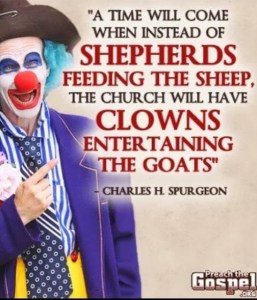
Pastors and teachers aren’t charged to entertain people or get them in the doors of the church and keep them there by any means necessary. Pastors and teachers are charged – with God as their witness – to faithfully preach and teach His written Word. Jesus said shepherds who love Him will feed His sheep, not entertain them.

Newsflash – the world isn’t going to find that interesting enough to get out of bed for on Sunday morning. Newsflash – That’s fine. The gathering of the church isn’t for the world. The gathering of the church is for the church – the people who have been saved out of the world and into the body of Christ – to give them an opportunity to worship the Savior they love with their brothers and sisters, to disciple them in God’s Word, and to equip them with God’s Word to go out and share the gospel with the world.

It’s Not About You, Either

The flip side of “it’s all about the Bible” is, it’s not about you. What does that mean? The sermon or the Bible study lesson should not teach us to look down in narcissistic navel-gazing, it should teach us to look up at God, who He is, what He has done, and what He says in His written Word.

Over the years, I’ve had the discouraging duty of reviewing various women’s “Bible” studies. Though some have been better than others, the theme running through the majority of them is “it’s all about you” – your feelings, your hurts, your ego, your opinions, your personal experiences. It’s evident in the way authors insert long stories about their own lives and base their ideas, agendas, and assertions on those personal experiences rather than on Scripture. It’s evident in the questions the reader is supposed to answer at the end of each lesson: “Have you ever experienced _____?” “How does ____ make you feel?” “If you could ____, how would you do it?” “What do you think others’ opinion of you is?”

Good Bible studies give you rightly handled, in context Scripture until it’s coming out of your ears, and then they ask questions like, “What are the attributes of God listed in this passage?” “Verse 3 talks about lying. What are some other verses that talk about lying, and how can we tell from these verses how God views lying and why?” “How does this passage point us to Christ?”

Is there a need for introspection during Bible studies and sermons? Sometimes. But the focus is not you and your feelings and experiences. The focus is on reflecting on the glory of God in the passage you’ve just heard, repenting of the sin the passage you’ve just read has convicted you about, obeying the command in the passage you’ve just heard, and things like that. It’s Bible-focused, driven, and governed, not me-focused, driven, and governed.

Context, Context, Context

It’s not just important to preach and teach the Bible, it’s important to handle the text of the Bible correctly and in context.

You’ve probably heard the old joke about the guy who wants God to tell him what he should do with his life. So he opens up the Bible to a random spot, closes his eyes, puts his finger down on the page, and looks at the verse he’s pointing at. It’s a New Testament verse: “Judas went and hanged himself.” “Hmm,” he thinks, “that doesn’t make much sense.” He shuts his Bible and tries the process again. This time, it’s an Old Testament verse, “Go and do thou likewise.”

We laugh at the silliness of this little story, but it hits frighteningly close to home for far too many pastors and teachers.

Perhaps you’ve read a devotional that quotes a Bible verse (or maybe even just part of a verse) at the top of the page. The author then goes on to teach on that verse or tell a personal story. When you look up the verse and read a little more of the chapter it’s in, you discover it has nothing to do with the author’s story or doesn’t mean what the author was teaching.

Or maybe you’ve sat in a church service where the pastor reads a verse or two at the beginning of the sermon and then basically closes his Bible and shares personal thoughts and stories for the rest of the sermon time that have nothing to do with the verses he read at the beginning. Or a sermon in which the pastor hopscotches all over the Bible (often using a myriad of translations) reading a verse here, half a verse there, in an effort to prove his homespun thesis or support the agenda he’s crafted.

Yes, technically, there’s Bible in all of those teachings, but none of those methods handle Scripture properly or in context. That’s called eisegesis, and it basically means reading your own ideas into the text of Scripture, or twisting Scripture to get it to say what you want it to mean.

The proper method of teaching Scripture is exegesis. Exegesis is taking a passage of Scripture in context, and โ€œleading outโ€ of it- teaching what the passage means. That’s nearly always going to require reading several verses from the passage to catch the reader or listener up on what’s going on in the story she’s just parachuted into.

Good pastors and teachers read and teach the biblical text in an organized way. When you sit down to study, say, a history book, you start at the beginning of the book and you work your way through to the end. You donโ€™t start by reading two paragraphs out of the middle of chapter 7, then move on to the last three sentences of chapter 49, then the first half of chapter 1. Thatโ€™s how people preach, teach, and โ€œstudyโ€ the Bible sometimes, and itโ€™s just as crazy to read the Bible that way as it would be to study a history book, or math book, or science book that way, or even to read a novel or a magazine using that helter-skelter method.

Expository vs. Topical

This section is a brief, modified excerpt from my article The Mailbag: Expository or Topical Preaching: Which is better?.

For readers who might not be familiar with the terms, expository preaching and teaching is basically when a pastor preaches (or a teacher teaches) through books of the Bible from beginning to end carefully explaining what each passage means. (Ezra is an example of an expository Bible study.)

Topical preaching can have a couple of different meanings depending on who youโ€™re talking to and what she understands the term to mean. Some people understand โ€œtopical preachingโ€ to mean a sermon series, usually in a seeker driven church, that centers around something in pop culture. (For example, popular movies or the Olympics.) Normally, these sermons are very shallow, biblically โ€“ sometimes nothing more than a pep talk or self-help tips. This type of preaching and teaching is unbiblical, and if it makes up the bulk of the teaching at your church, Iโ€™d recommend finding a new church.

There is, however, a biblical form of topical preaching and teaching that can be very helpful, occasionally. If a doctrinally sound pastor sees an issue in the church that needs to be addressed, or a biblical topic to explore, there is nothing wrong with his taking a break from preaching through a certain book (or when heโ€™s between books) to teach on this issue from the pulpit. (Imperishable Beauty: A Study of Biblical Womanhood is an example of a biblical, topical Bible study.)

In my opinion, the majority of a pastorโ€™s preaching and a Bible study’s teaching should be expository with occasional breaks for (biblical) topical preaching and teaching as needed. There are a variety of reasons for this (more in the linked article):

โ€ข Expository preaching models for the congregation the proper, systematic way they should study the Bible at home.

โ€ข Expository preaching helps a pastor better preach the whole counsel of God.

โ€ข Expository preaching pushes pastors to tackle hard and unfamiliar passages as they come up in the text.

โ€ข Expository preaching should keep the Old Testament and certain books of the Bible from being neglected as much as they usually are.

โ€ข Expository preaching gives the congregation a better grip on the overall story arc of the Bible and the culture of the period being studied.

Expository and topical preaching are both helpful in their own ways, but the most important thing is that the pastor is โ€œrightly handling the word of truth.โ€


There’s a lot of lousy preaching and teaching out there these days, but if you’ll look for good, solid biblical preaching and teaching (check the Recommended Bible Teachers and Bible Studies tabs above for ideas) God can use it mightily in your spiritual life to grow you to greater Christlikeness.