Discernment, False Teachers

Is She a False Teacher? 7 Steps to Figuring it Out on Your Own

Originally published July 22, 2016

“What are your thoughts about  _____?
Is she doctrinally sound? Is she a false teacher?”

That’s probably the number one question I’m asked by readers. It gives me so much joy each time I receive that question because it’s encouraging to hear from Christian women who don’t want to be led astray and want to worship Christ in spirit and in truth.

I’m delighted to answer readers’ questions about various teachers (You can find information about many of today’s best known evangelical personalities and ministries under my “Popular False Teachers & Unbiblical Trends” tab at the top of this page.) but, unfortunately, my answers often take a while. I’ve never heard of many of the teachers I’m asked about, and, even with the ones I’m familiar with, in order to give a fair and biblically accurate answer, I have to research each of them. That frequently takes at least several days of work. The less famous the teacher is, the less information there is out there about her, and the longer it takes. And that weighs on me because I know a lot of you, when you write to me about a certain teacher, need answers now.

It also weighs on me because I don’t want you to just take my word for things. I am a fallible, sinful human being. I get things wrong. I miss things. I make mistakes. Also, I’m not going to be around forever (well, not on this planet anyway!)

For these reasons, and because the ability to vet the personalities and teachers you follow is an important spiritual skill every Christian should hone and teach others, I want you to be able to research these people for yourself. “Teach a (wo)man to fish…” and all that, you know. Here are the seven steps I take to discover whether or not a teacher is doctrinally sound.

1. Know your Bible

This. is. not. optional. Get a trustworthy translation (read: not The Message, The Passion “Translation,” a Joyce Meyer Study Bible, etc.) and study it forwards, backwards, and upside down if you have to. Find, join, and faithfully attend (also not optional) a doctrinally sound church that will immerse you in the depths of God’s Word through its preaching and teaching. Listen to good sermon podcasts or an audio Bible during the week. Memorize Scripture. Learn good hermeneutics. Every Christian should be doing these things by default anyway, and one by-product of knowing your Bible is that when you see or hear a statement by a teacher, you often won’t have to do a lick of research to determine whether or not you’re being taught biblical truth. The Scriptures will already be in your heart and mind for comparison.

2. Pray

One of the things I ask of God during my regular prayer time is that He would protect me from being deceived by false teachers, that He would continue to grow me in wisdom and discernment, and that He would develop the mind of Christ in me. It’s also a good idea to pray for wisdom and discernment, and for trustworthy information, before researching a teacher.

3. Know your criteria

One of the arguments I frequently hear when warning people away from a false teacher is “But every teacher makes mistakes!” (see #7 here) Of course every teacher makes mistakes in her teaching, and every teacher sins. A sin or a mistake doesn’t qualify someone as a false teacher. What you’re looking for is repentance and correction.

A trustworthy, biblical teacher teaches sound biblical doctrine and avoids known sin nearly without exception. When those exceptions occur and someone brings it to her attention, she listens, is teachable, repents, and corrects her error (Apollos is a great biblical example of this). False teachers, on the other hand, unrepentantly persist in sin or teaching false doctrine despite biblical correction. Often, they exhibit complete unteachability (as do their followers), deriding those biblically calling them to account as haters, divisive, slanderers, scoffers, jealous, etc.

When I research a teacher, I examine three fundamental areas of her life and teaching: a) Does she currently and unrepentantly preach to men? (Or, if the teacher is male: Does he allow women to preach to mixed audiences from his pulpit or in his stead? Is his wife co-pastor of the church? Are there any women on his church’s staff in pastoral positions?) b) Does she endorse and/or partner with known false teachers or ministries? c) Does the doctrine she teaches and practices line up with Scripture? These aren’t the only things that make someone a false teacher, but they’re three of the most prominent and important.

4. Criteria a: Women teaching men

This is a scriptural litmus test that can help give you a quick answer as to whether you should be following a certain teacher or not. The Bible tells us that women are not to preach to, teach the Bible to, or exercise authority over men in the gathered body of believers. Not in the four walls of a church, not on a simulcast, not at a Christian conference. Period. (Click here for more information.)

And it’s not a so-called secondary issue, either. It’s a sin. A preacher or teacher who unrepentantly disobeys this Scripture is no different from one who disobeys Scripture by viewing pornography, embezzling church funds, or teaching that homosexuality or abortion are OK. Scripture is Scripture. It’s all inspired by God the Holy Spirit. There aren’t any instructions to the church that it’s OK with God if you twist their context, brush them aside, or disobey them. If a female teacher currently and unrepentantly preaches to men or a male teacher allows women to do so in his church or ministry, that’s not a teacher you should be following.

Furthermore, a woman preaching to men is itself false doctrine. When a woman preaches to men, her behavior is teaching the false doctrine that itโ€™s perfectly fine to disobey Scripture if you want to. That if you donโ€™t like a certain command of Scripture, itโ€™s OK to just ignore it. If your pastor stepped into the pulpit Sunday morning and said in words that itโ€™s OK to disobey or ignore Scriptureโ€™s commands, your church would run him out of town on a rail, and rightly so. There’s no difference between your pastor saying it in words and a woman acting it out with her behavior.

Finally, women teaching men and women teaching other false doctrine are highly correlated. I have researched scores of women teachers. Every single one of them who unrepentantly teaches men also teaches false doctrine in some other aspect of her theology (usually progressivism, Word of Faith {prosperity gospel} or New Apostolic Reformation). In other words, if a woman teaches men, you can just about take it to the bank that she also teaches additional false doctrine.

How to find out if the teacher is disobeying Scripture in this area?

Check YouTube and Vimeo for videos of the female teacher speaking at various events. Are men clearly present in the audience?

Consider the events the female teacher speaks at. Does she speak exclusively at events for women, or does she also speak at co-ed events?

Examine the speaking engagement calendar on the female teacher’s web site. Is she scheduled to speak at Anytown Baptist Church at 11:00 a.m. on a Sunday? She’s probably giving the sermon that morning. (Some female teachers purposely leave these preaching engagements off their events calendars and social media to avoid biblical rebuke.)

For (male) preachers / pastors, check the sermon archives and the “meet our staff” sections of the church web site. Are women serving on staff as “pastors” or in positions of authority over men? Do the sermon archives feature female speakers who have preached to the whole congregation?

5. Criteria b: Partnering with false teachers

Scripture is abundantly clear that we are to have nothing to do with false teachers. Nothing. John tells us that even to greet them is to take part in their wicked works. To publicly praise, point people to, or partner with false teachers is even worse.

Finding out if the teacher you’re researching praises or partners with false teachers is another biblical litmus test that can help quickly determine whether you should be following her or not.

The easiest way to do this is with an internet search engine. Type the name of the teacher you’re researching into the search bar followed by the names of at least a few well known false teachers or ministries (for example: Jane Smith Joel Osteen). You may wish to try names like Joel Osteen, T.D. Jakes, Andy Stanley, Joyce Meyer, Beth Moore, Christine Caine, Hillsong, Bethel, IF: Gathering, Proverbs 31 Ministries, etc.

Examine the results. Are there a lot of connections between the teacher you’re researching and known false teachers? Does she frequently and favorably quote, comment on, or re-post false teachers on her social media pages? Does she make a habit of sharing the stage with or appearing alongside false teachers at conferences and other events? Do false teachers praise her, invite her to speak at their churches and conferences, or write endorsements of her materials?

Birds of a feather flock together. If you lie down with dogs, you get up with fleas. Bad company corrupts good morals. It’s all true. A teacher who frequently, favorably, and unrepentantly associates herself with false teachers should be avoided.

6. Criteria c: Biblical doctrine

If a teacher has failed criteria a and/or b, that’s sufficient. You should not be receiving teaching from that person. Those two criteria will quickly weed out about 90% of false teachers out there today. However, “passing” both criteria a & b, while a fair indicator that you’re probably dealing with a doctrinally sound teacher, is not sufficient. A teacher can operate biblically in those two areas and still teach or practice unbiblical doctrine. You must examine the doctrine and practices of the teacher you’re considering following to see if they’re biblical, and that can take some time and energy.

Does the teacher have a statement of faith or “what I believe” section of her web site? Examine it. Are all of the tenets biblical and backed up with chapter and verse Scripture? Are the tenets specific, detailed, and clear cut as opposed to general and nebulous? A solid statement of faith can be helpful, but keep in mind that a significant number of churches and ministries have perfectly biblical statements of faith “on paper” yet do not faithfully adhere to to those principles in teaching and practice. (Another red flag that can be helpful to look for on a teacher’s website: Does s/he go by the title “Apostle” or “Prophet/Prophetess”? If so, s/he’s a false teacher. There are no more apostles and prophets. Furthermore, people who go by those titles are New Apostolic Reformation heretics 99+% of the time. While the term “bishop” is sometimes used in doctrinally sound theological camps, most of the time this title is going to indicate Catholic or New Apostolic Reformation heresy.)

Ask doctrinally sound, trustworthy friends if they’re familiar with the teacher’s doctrine. There are also many theologically solid Facebook groups you can join and ask your fellow members their impressions of various teachers. There are a lot of Christians out there who have read a lot of books and listened to a lot of teaching. They can be very helpful resources.

What do reputable, doctrinally sound teachers and ministries have to say about the teacher, her teachings, or the Scripture or doctrine in question? I regularly use and highly recommend the following sites1:

(Some of these folks vet teachers in more than one category, so check them all if you need to. And note that many below have more than one link.)

(Mostly) Word of Faith (prosperity gospel) / New Apostolic
Reformation (NAR) Teachers & Ministries:

Berean Research (Amy Spreeman)

Dawn Hill (The Lovesick Scribe) (Website)

Steve Kozar (Website)

Justin Peters

Chris Rosebrough (Archives)

(Mostly) New Age / Mysticism Teachers & Ministries:

Christian Answers for the New Age (Website) (Marcia Montenegro)

Doreen Virtue

(Mostly) Progressive / Woke Teachers & Ministries:

Protestia

Woke Preacher Clips

(Mostly) Pop Evangelical Teachers & Ministries:

The End Time (Elizabeth Prata)

Think on These Things (Gary Gilley)

Doctrinal Questions and Issues:

Got Questions

Grace to You


Here’s what you should be looking for in preaching and teaching. Read the person’s materials or listen to her teaching. Take notes. When the teacher makes an assertion, ask yourself, “Where, in context, does the Bible say that?” When the teacher cites a passage of Scripture, look it up and see if she’s using it in context. Does the teacher primarily use one reliable translation of the Bible when teaching, or does she skip around through various translations and paraphrases while teaching to make sure the verses use certain words that fit with the theme or idea she’s teaching? Does she engage in gimmickry or does she simply teach the Word? Is the centerpiece of her teaching a correctly exegeted passage of Scripture, or does her teaching revolve around a story, movie, prop, idea, theme, topic, or illustration that comes from outside of Scripture? Does she frequently allegorize Scripture? Does she make every Scripture about you, your hopes and dreams, your experiences? Does she spend more time correctly handling and teaching Scripture or telling stories, jokes, and illustrations? These are all things to watch and listen for. If a teacher consistently mishandles, misunderstands, or misapplies Scripture, she’s not a teacher you should be following.

7. Check the date

When you’re researching a teacher, check the date on the evidence you’re examining. Is it old or fairly current? We all grow and mature over the years in our walk with the Lord. Are you seeing red flags in the teacher’s older materials? Try to find out if she has repented and corrected those unbiblical teachings or behaviors. If so, and she’s currently teaching and behaving in a way that lines up with Scripture, forgive her. It is not fair or biblical to hold past sin against someone when she has repented and Christ has forgiven her. She, and her recent materials, should only be avoided if she is currently and unrepentantly teaching and/or practicing false doctrine.


Before receiving teaching from anyone, it’s important that we examine that teacher’s doctrine and practices in light of Scripture. God commends the Bereans for receiving Paul’s word with eagerness, yet examining the Scriptures to see if what he was teaching them lined up with the Bible. May we be as vigilant and noble as they in our quest to know Christ and His word.

1These sites are run by fallen human beings. They sometimes sin or get things wrong. Do your best to double check their evidence and conclusions. If you have a question or concern, contact the ministry. I do not personally always agree with every single piece of information published by any of these ministries, but they are all generally doctrinally sound.

Discernment

Tara Leigh Cobble, The Bible Recap, & D-Group

If you are considering commenting or sending me an e-mail objecting to the fact that I warn against certain teachers, please click here and read this article first. Your objection is most likely answered here. I won’t be publishing comments or answering emails that are answered by this article.


This article is kept continuously updated as needed.

I get lots of questions about particular authors, pastors, and Bible teachers, and whether or not I recommend them. Some of the best known can be found above at my Popular False Teachers tab. The teacher below is someone I’ve been asked about recently, so I’ve done a quick check (this is brief research, not exhaustive) on her.

Generally speaking, in order for me to recommend a teacher, speaker, or author, he or she has to meet three criteria:

a) A female teacher cannot currently and unrepentantly preach to or teach men in violation of 1 Timothy 2:12. A male teacher or pastor cannot allow women to carry out this violation of Scripture in his ministry. The pastor or teacher cannot currently and unrepentantly be living in any other sin (for example, cohabiting with her boyfriend or living as a homosexual).

b) The pastor or teacher cannot currently and unrepentantly be partnering with or frequently appearing with false teachers. This is a violation of Scripture.

c) The pastor or teacher cannot currently and unrepentantly be teaching false doctrine.

I am not very familiar with most of the teachers I’m asked about (there are so many out there!) and have not had the opportunity to examine their writings or hear them speak, so most of the “quick checking” I do involves items a and b (although in order to partner with false teachers (b) it is reasonable to assume their doctrine is acceptable to the false teacher and that they are not teaching anything that would conflict with the false teacher’s doctrine). Partnering with false teachers and women preaching to men are each sufficient biblical reasons not to follow a pastor, teacher, or author, or use his/her materials.

Just to be clear, “not recommended” is a spectrum. On one end of this spectrum are people like Nancy Leigh DeMoss Wolgemuth and Kay Arthur. These are people I would not label as false teachers because their doctrine is generally sound, but because of some red flags I’m seeing with them, you won’t find me proactively endorsing them or suggesting them as a good resource, either. There are better people you could be listening to. On the other end of the spectrum are people like Joyce Meyer and Rachel Held Evans- complete heretics whose teachings, if believed, might lead you to an eternity in Hell. Most of the teachers I review fall somewhere in the middle of this spectrum (leaning toward the latter).

If you’d like to check out some pastors and teachers I heartily recommend, click the Recommended Bible Teachers tab at the top of this page.


Tara-Leigh Cobble, or “TLC” as she likes to be called, “began her ministry as a singer-songwriter, performing her own songs and leading worship around the globe. After her first book was published, she added speaking to her repertoire. As a musician, writer and speaker, she spent more than a decade touring internationally before creating D-Groups and finding a home and community for herself in Dallas, Texas.”

More from Tara-Leigh’s bio: “I started D-Group (Discipleship Group) [with] a handful of college students in 2009 and it has grown into 250+ groups around the world…I love to speak to audiences about God and His Word, and I’ve written a few books with an aim to point others toward Him through my story as well as their own. I also write and host a daily podcast called The Bible Recap, which aims to keep people connected to reading the Bible when they’re tempted to quit for lack of understanding, as well as a daily radio show called The God Shot.”

In late 2021 / early 2022, requests started flooding in for me to review Tara-Leigh, mainly due to the fact that many were preparing to begin a “read through the Bible in a year” plan in January. They wanted to know if the suddenly popular program, The Bible Recap (TBR) – Tara-Leigh’s brief daily podcast “recapping” each day’s reading in a one-year chronological reading plan – was doctrinally sound and whether or not they should use it. To that end, I began listening to TBR and researching it, Tara-Leigh, and D-Group.

The Bible Recap (TBR)

I listened to about two dozen of the first 60 episodes of the “year 4” TBR season, making notes along the way. In each 5-10 minute episode, Tara-Leigh briefly summarizes that day’s reading and adds a few comments, ending with a “God Shot” – a point from the reading that stood out most to her, personally.

For the most part, I didn’t hear much that was biblically problematic in the TBR episodes I listened to. But someone spending eight minutes basically reiterating the primary facts from a passage of Scripture and getting it mostly right isn’t an automatic indicator that she’s doctrinally sound. False teachers can do that. Atheists can do that. Perfectly doctrinally sound pastors and teachers can do that. People everywhere on the spectrum between those two extremes can do that.

There were several times I thought that the way Tara-Leigh worded something wasn’t necessarily wrong, but also wasn’t as clear or precise as it should have been, and that people who were new to reading the Bible (a significant portion of her target audience) could have easily misunderstood. I didn’t make any notes on those instances because they didn’t rise to the level of false doctrine, and we’ve all had times when we could have worded something better.

I did make some notes on several other points. Here are just a few:

  • Day 002 episode: โ€œWe donโ€™t want to scream where Scripture whispers.โ€œ An unfortunate choice of words, or was she echoing the sentiment from J.D. Greear – “We ought to whisper about what the Bible whispers about and we ought to shout about what it shouts about.” – that Southern Baptists in the know are all too familiar with? (TBR does include resources from Greear.)

    โ€œGod let Noah know that this was only the beginning of their relationship.โ€œ (Referring to Genesis 6:18). This is probably just a poor choice of words meant to indicate that this was the beginning of the Noahic covenant, or that God was reassuring Noah that he wasnโ€™t going to die, but this is technically incorrect. Noah already had a relationship with God. Thatโ€™s indicated by the fact that God had a conversation with Noah in 6:13-22, and it’s also why God found Noah to be the only righteous person on earth.
  • Day 003 episode: After the flood, the earth was not โ€œmuddy and grossโ€œ as Tara-Leigh describes it. Genesis 8:13-14 is clear that the land dried up completely. Furthermore, in the flood, God re-created the earth. It may not have had the holy perfection of Eden since this was post-Fall, but the God who deemed His Creation “good” in Genesis 1 didn’t re-create a chaotic and disheveled world that looked like a natural disaster had just hit it, either.
  • Day 008 episode: “Are there times when God speaks to us? I believe God’s Spirit does give impressions to His children. After all, one of His names is ‘Guide’…Saying, ‘God told me X,’ carries a lot of certainty with it. I’d be more likely to say it this way, ‘I feel like God was saying X,’ or, ‘I feel like God was impressing this on my heart.’.

    Tara-Leigh is teaching extra-biblical revelation here because she’s a continuationist (more below). Extra-biblical revelation undermines the doctrine of the sufficiency of Scripture. Of course, God guides us. And the way He guides us is through His all-sufficient written Word, as He tells us Himself. Reading, believing, following, and obeying the written Word God the Holy Spirit breathed out is being led, or “guided,” by God.

    Furthermore, all throughout Scripture, when God spoke, there was absolute, stake your life on it certainty. If you weren’t certain it was God speaking to you, you’d better keep your mouth shut or risk execution. If you were certain it was God speaking to you, you’d better open your mouth and boldly proclaim exactly what He said, or risk execution. If the holy God of the universe is speaking to you, you dare not mealy mouth or equivocate. And if He’s not, you dare not say He is. There’s no fence-sitting on this one.

    Finally, this “I feel” language again undermines the sufficiency of Scripture, and reinforces an all too common false doctrine in the church: believing, trusting, and obeying our subjective feelings and personal experiences over God’s written Word. And because that is a place and position only Scripture should occupy, that false doctrine, believed and practiced by so many, is idolatry. (Hear me clearly: I’m not saying that Tara-Leigh believes in, practices, or holds to this form of idolatry herself, only that this type of “I feel” language reinforces this sort of idolatry that others cling to.)
  • Day 043 episode: Tara-Leigh talks about the glory of God filling the tabernacle as a cloud, and the fact that Moses could not go into the tabernacle because of that glory cloud. She says there was a โ€œdensityโ€œ to Godโ€˜s glory, and gives the example that she has never been in a plane that had to fly above a cloud because it could not physically pass through the cloud.

    This passage does not mean that Godโ€™s glory was a tangibly impassable barrier, like a brick wall. It means that God’s manifest glory was so magnificent and intensely powerful that it was too overwhelming for Moses to go into the tabernacle. Itโ€™s possible Tara-Leigh didnโ€™t mean to convey that God’s glory was physically tangible, but I think thatโ€™s what most people are going to take away from what she said.

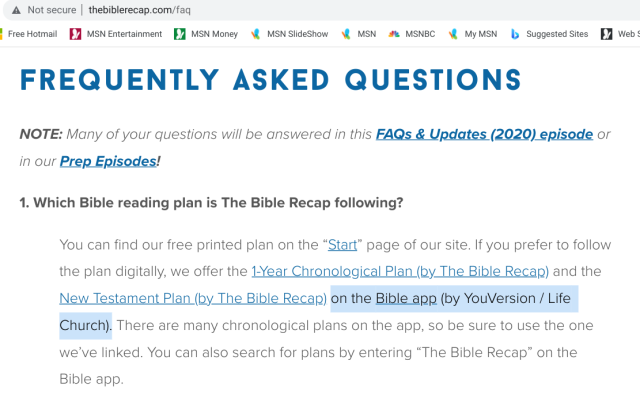
TBR recommends and partners with the YouVersion app. Although many people do not realize that YouVersion was created by and is maintained by false teacher Craig Groeschel’s LifeChurch.tv (it also features devotions and other materials by numerous false teachers), Tara-Leigh apparently does, and has partnered with YouVersion by platforming TBR there:

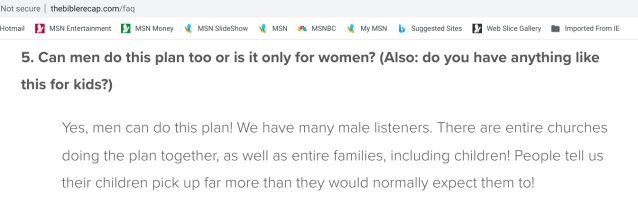
Tara-Leigh teaches the Bible to men, without reservation, through TBR. It is one thing for a woman to have a Bible teaching program or materials specifically for women available to the public and not be able to control who uses it. It is another thing all together to welcome and encourage men to be taught by a woman, especially in the gathering of the church body. This just validates and encourages the sin of women violating Scripture by teaching men.

TBR frequently features The Bible Project videos and podcast episodes in its episode show notes as supplementary materials, and TBP overviews of each book of the Bible are used exclusively. To be fair, many supplementary materials from doctrinally sound sources are provided, but they’re provided right alongside materials from false and/or problematic sources like Tim Keller (Day O16), Kay Warren (Day 038), J.D. Greear (Days 050, 323, 352), The Village Church (Matt Chandler’s church, Days 125, 291- Sam Alberry, 317), The Gospel Coalition (Days 133- Article: Did David Rape Bathsheba? answer: “David was a rapist.”, 213, 260, 277 & 352- Thabiti Anyabwile, 286, 315, 322, 323, 336, 345, 363) Skye Jethani (341).

D-Group

D-Group = Discipleship Group. We are men’s and women’s discipleship and Bible study groups that meet weekly in homes around the world.” D-Groups are gender specific and meet for eight sessions of study per year. Each session lasts six weeks and centers around a different book or curriculum. (D-Group is discrete from The Bible Recap, related only by the fact that Tara-Leigh heads up both.)

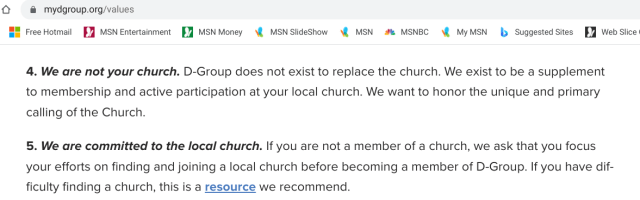
D-Group exists in three venues: church groups, home groups not connected to churches, and online groups. Commendably, in policy, D-Group requires that participants be members of, or actively seeking membership in a local church, and discourages participants from treating D-Group as a substitute or replacement for the local church…

…but the very fact that it establishes and encourages home groups and online groups not connected to a local church undercuts this commitment in practice. No doubt there are many online and home group members who eschew or are lax about membership in a solid local church, considering D-Group to be their church instead. Indeed, the Why D-Groups page of the website says that one of the results of being involved in a D-Group is: “And those who lack rich relationships with other Christians have found a place of encouragement and challenge.” Although it’s certainly not wrong to be encouraged and challenged by Christian friends outside your local church, the primary “place” this sort of thing should be happening is in the context of your local church. Additionally, group leaders are trained by the D-Group organization, not by the local church. Again, this sort of training should be taking place in the local church and under the authority of the pastors and elders there.

It’s an unbiblical structure and methodology. Discipleship proper is to take place within the context of and under the authority of the local church, not in parachurch ministries or groups, and certainly not in online “groups”. There is no provision, allowance, or instruction for parachurch discipleship in the New Testament. And if D-Group is Reformed, and as committed to “living out the truths revealed by God in Scripture” as they claim to be, they should already know this and work through local churches exclusively.

D-Group holds to continuationism (which explains Tara-Leigh’s aforementioned stance on extra-biblical revelation, and TBR resources from continuationists such as John Piper, The Village Church, etc.), and cites The Village Church’s position paper on continuationism as part of their Beliefs.

D-Group claims to be complementarian, but, apparently, they mean – without clearly saying so – so-called “narrow” or “soft” (essentially: anything goes except women as senior pastors) complementarianism. As I’ve explained in the past, so-called “soft/narrow complementarianism” is not complementarianism, but functional egalitarianism.

Under the Beliefs section of D-Group’s Resources page, two of the resources cited on complementarianism are from The Village Church and Mary Kassian. TVC is where Jen Wilkin, who preaches to men at conferences and other events is on staff as the director of family and student ministries, and where pastor Matt Chandler has publicly praised women who preach to men, like Beth Moore. The short TVC article cited isn’t very substantive, and merely states that they don’t allow women to be elders. I briefly reviewed the Mary Kassian article when it first came out in 2016. Long story short, she believes it’s OK for women to preach to and teach men except in the Sunday worship service (unless it’s Mother’s Day or another special event, then it’s OK).

Tara-Leigh herself preaches to and teaches men in person at her speaking engagements (see below).

D-Group is governed by women. Of the 36 members of D-Group’s “team,” all but four are women. These four men are under the authority of – among other women – founder and CEO Tara-Leigh, of course, as well as a female “Theology + Content Director”. This is not a direct violation of Scripture, since the D-Group organization is not a gathering of the church, but this does align with and point to their “soft complementarianism” posture.

D-Group recommends many of the same false and/or biblically problematic teachers and resources as The Bible Recap, and more:

In the Diversity and Racial Reconciliation section of D-Groups Beliefs page, resources are cited from woke and racialist sources such as Eric Mason, Latasha Morrison’s Be the Bridge, and The Witness, a list of theological works by black theologians and pastors, including Jarvis Williams, Anthony Bradley, Thabiti Anyabwile, and Raphael Warnock, the horrifyingly liberal “pastor” and Democrat senator who endorses the torture and murder of unborn children. (The Witness also includes a book on homiletics written by a woman.)

The LGBTQIA section includes resources from Living Out founder, Sam Allberry, and Jackie Hill-Perry.

I don’t want to overstate this point, but it’s worth noting. Are worldly terms and constructs like “diversity,” “racial reconciliation,” and “LGBTQIA” congruent with a doctrinally sound Christian ministry? Where does the Bible use these terms or teach such constructs?

Tara-Leigh Cobble

As founder and leader of TBR and D-Group, Tara-Leigh’s theology concerning continuationism, functional egalitarianism, extra-biblical revelation, and social justice issues is evident.

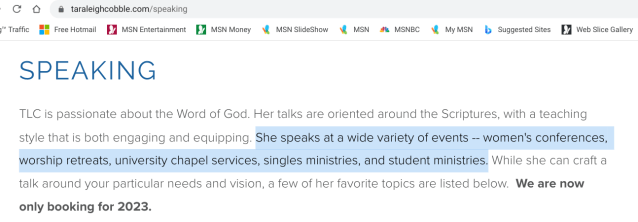
In addition to her organizations holding to a functional egalitarianism position, Tara-Leigh personally teaches men via her speaking engagements.

The following two videos are currently featured on her website’s “Speaking” page, as exemplars of her teaching.

Tara-Leigh preaching at a co-ed retreat (Tara Leigh Cobble INTV Retreat | October 26, 2018)

Tara-Leigh speaking at The Nines (the NINES 2019 – Loving Scripture, Biblical Literacy, & the Future of the Church | October 31, 2019 – Men clearly audible in the audience throughout). The caption on this video on Tara-Leigh’s website reads: “TLC speaking to pastors at The Nines Conference (Buckhead Church, Atlanta) about the future of the church.”

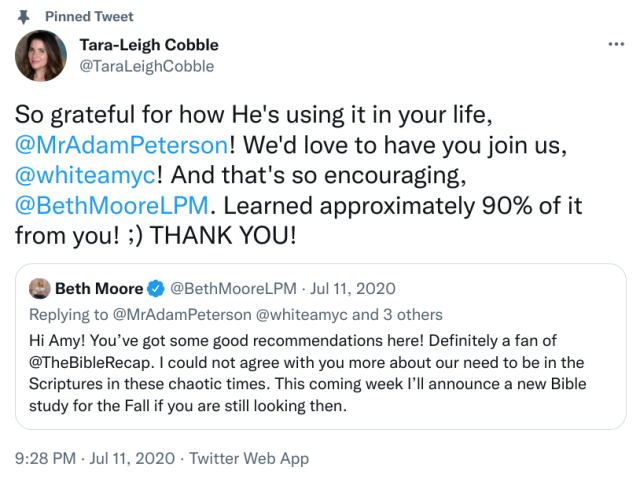
Unfortunately, Tara-Leigh also has an affinity for false teachers and false doctrine.

This is the pinned tweet – the first thing you see – on Tara-Leigh’s Twitter account. Apparently, Beth is a “fan” of TBR and Tara-Leigh “learned approximately 90%” of her Bible teaching from Beth Moore.

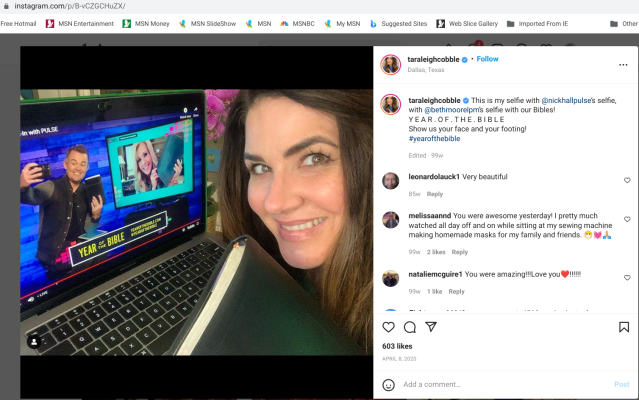
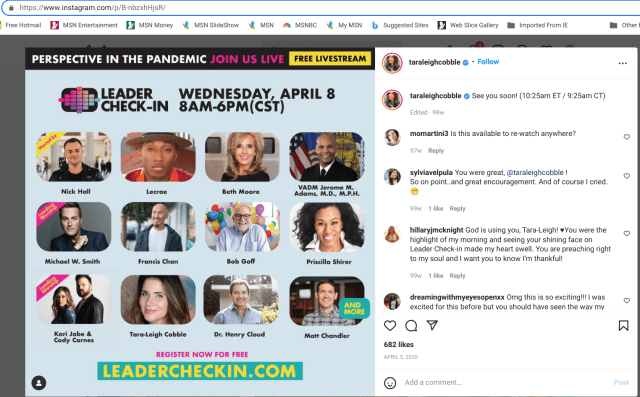
Excitedly posing with Beth Moore

…for this event featuring a number of false and biblically problematic teachers including Beth Moore and Priscilla Shirer.

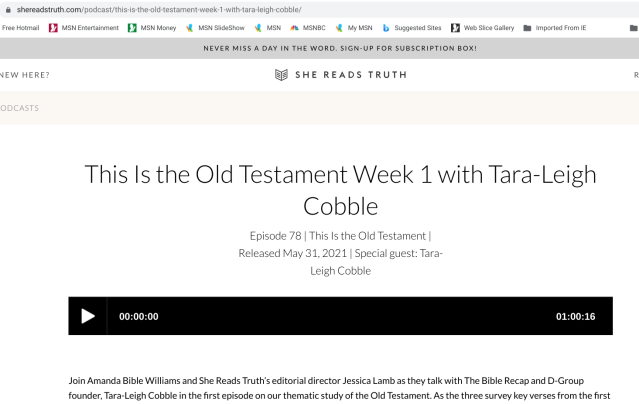
Tara-Leigh appeared on the She Reads Truth podcast.

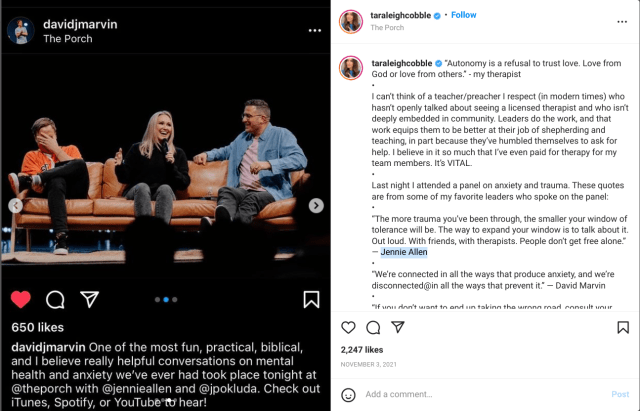
Here, she calls Jennie Allen one of her “favorite” leaders.

And since she brought it up in this post, I’d like to address another issue here. Tara-Leigh refers to her own “therapist” and also says, “I canโ€™t think of a teacher/preacher I respect (in modern times) who hasnโ€™t openly talked about seeing a licensed therapist…I believe in it so much that Iโ€™ve even paid for therapy for my team members. Itโ€™s VITAL.”

While everyone faces difficulties from time to time, and some of those difficulties are intense enough that a time of pastoral or biblical counseling is needed, routine or ongoing “therapy” from a “licensed therapist” (which, in the common vernacular, and at “trauma” events like this one, usually refers to a secular psychiatrist, psychologist, or other mental health professional) is no more “VITAL,” or even indicated, for normal, healthy individuals – even for non-Christians – than a weekly trip to the doctor for someone who isn’t sick.

The idea that Christians, across the board, need to be in therapy on a regular basis as though that’s normal or vital is found nowhere in Scripture, and undermines the Bible’s teaching that Scripture alone is sufficient for life and godliness.

Tara-Leigh’s notes from a “conversation” with “black and white Christian leaders and pastors” about “what the church’s role might look like in the midst of our current civil rights movement.”. You’ll notice the concepts of white privilege, systemic or “covert” racism, that white people need to “just listen,” etc. (Several pages. You’ll need to scroll through.)


Tara-Leigh seems like a very nice person with a sweet heart and genuine motives. She has some good ideas, and I’d like to be able to heartily recommend her to you. But unfortunately, even though she’s much closer to the “Nancy Leigh DeMoss Wolgemuth / Kay Arthur” end of the spectrum than the “Joyce Meyer / Rachel Held Evans” end of the spectrum that I mentioned in the introduction, I can’t proactively recommend her or any of her ministries or materials to you either. There are better people you could be listening to.


Additional Resources:

โ˜ž Since the original publication of this article, a number of readers have asked if there is a program similar to TBR that takes followers through a chronological Bible reading plan with a daily recap of each day’s reading. I am not aware of any other program or podcast exactly like that, but let me give you a couple of resources.

  • In 2014, I led my ladies’ Sunday School class through the chronological plan and taught a weekly lesson selected from that week’s reading. If that’s of interest, you can always find those lessons at the Bible Studies tab in the blue menu bar at the top of this page (at the very end under “Miscellaneous”).
  • My friend, Pastor David Schrock, has recorded a podcast for daily readings through the New Testament called Via Emmaus on the Road (also on Spotify and Apple Podcasts). It’s in canonical (Matthew – Revelation) order, but God arranged the New Testament canon much more chronologically than the Old Testament. (Plus, if you want to, you can follow a chronological plan and just look up the podcast for each day’s passage.). (David wants you to know that he plans to re-record the episodes on Matthew to improve the sound editing, but if you listen “as is” the sound does get better after the first month.)

โ˜ž Other readers have said they were listening to TBR, but stopped when something seemed “off” to them. Now, they just use the TBR podcast episode titles to tell them which passage to read for the day. There’s certainly nothing wrong with that, but if you’d like something that’s a little less cumbersome, I’ve got a printable of the entire year’s readings for you. Every year around New Year’s I publish a “round up” of Bible reading plans. The chronological plan is always first on the list because I recommend it so highly. Go to the Bible Studies tab and click on “Bible Reading Plans,” then click the link on #1, and print it, bookmark it, screenshot it, etc.

Discernment, Speaking Engagements

Report Back & Video: Sister 2 Sister Meeting

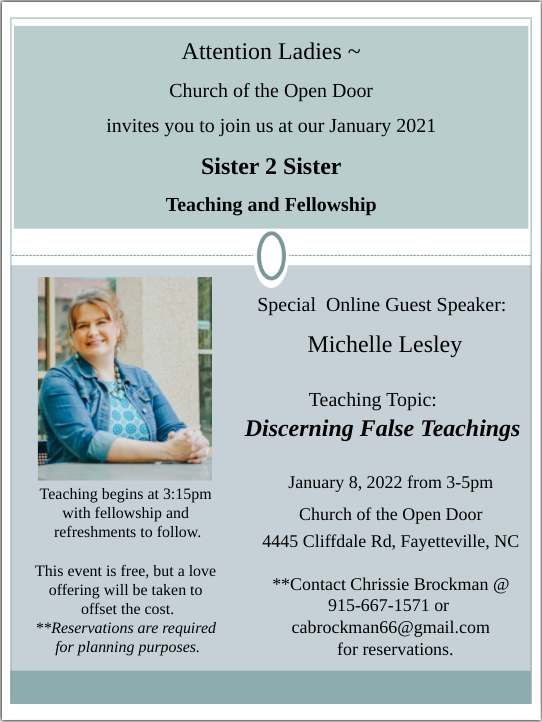
Over the weekend, I had the pleasure of speaking live, via Zoom, to Church of the Open Door’s quarterly Sister 2 Sister women’s meeting, held in Fayetteville, North Carolina.

As this was sort of a “micro-conference,” I taught for about 30 minutes on the topic of Discernment, followed by about 30 minutes of Q&A with some super questions from the ladies in attendance.

If you’d like to watch the video,
please click here.

If you’d like to access the handout that goes with
the teaching session, please click here.

Articles / resources mentioned or touched on in the video:

What is the New Apostolic Reformation?

Is She a False Teacher? 7 Steps to Figuring it Out on Your Own

The Mailbag: Potpourri (…Heretical book disposal) (I think this is the article I was thinking of and mentioned in answer to the first Q&A question.)

Women Preaching: Itโ€™s Not a Secondary Doctrinal Issue

Learning from the Sins of Others: Ravi Zacharias

Recommended Bible Teachers

Answering the Opposition- Responses to the Most Frequently Raised Discernmentย Objections #3, 8

Popular False Teachers & Unbiblical Trends

Tony Evans

Why Our Church No Longer Plays Bethel or Hillsong Music (or Elevation or Jesus Culture), and Neither Should Yours

The Mailbag: False Doctrine in Contemporary Christianย Music


If your church or organization is ever in need of a speaker for a womenโ€™s event, Iโ€™d love to come share with your ladies as well. Click here for more information.

Bible Study

How to Study the Bible- and How Not To!

Originally published December 31, 2020

It’s almost the new year! Are you making a resolution to start having a personal, daily Bible study time? Would you like to improve on the way you study your Bible? Maybe you’re looking for a Bible reading plan, or maybe you’re just looking to change things up a little?

If that sounds like you, give a listen to this December 2020 episode of A Word Fitly Spoken:

How to Study the Bible – and How Not To!

Amy and I discuss what our own Bible study times look like, plus some other helpful methods and resources. We also discuss false doctrine and false teachers to avoid as you’re studying your Bible.

This episode is a great way to kick off the new year. And don’t forget to subscribe to A Word Fitly Spoken on your favorite podcast platform!

Additional Resources:

Bible Study Resourcesย (how to study the Bible)
Bible Studies
Bible Reading Plans for the New Year- 2022

Popular False Teachers & Unbiblical Trends

Church, Discernment

Throwback Thursday ~ Build the Wall and Station a Guard: A Plea for Pastors to Protect 6 Areas of the Church Vulnerable to False Doctrine

Originally published August 5, 2016

The Great Wall of China

The Wailing Wall

The walls of Jericho

Walls. Sometimes they go up, and sometimes they come a tumblin’ down. When I was a kid it was, “Mr. Gorbachev, tear down this wall!” Now it’s, “Elect me and I’ll build a wall between the United States and Mexico.”

There was a time in history when it was common practice for a city to have a wall built around its perimeter. Walls have historically been built for protection, to keep inhabitants safe from attacking marauders. When Israel returned to Jerusalem after Babylonian captivity, their first priority was to rebuild the altar – their focal point of worship. Next came the temple – to consecrate, or set apart, their worship. And, finally, the city wall – which protected everything, including their worship.

Today, when Christians plant a church, we start off with our focal point of worship, the author and finisher of our faith, Jesus Christ. He is the foundation of the church, the center of our worship, our rallying point.

As the church grows, we consecrate it, setting it apart from other organizations and gatherings by buying or constructing its own special building. It’s not a store or an office or a restaurant. It’s a church. It’s where believers gather to worship, fellowship, and be trained in God’s word.

But somehow we never get around to protecting our churches from enemy attack. Indeed, it hardly ever occurs to most pastors and church members that there’s a need for a wall.

But there is. A huge need. And for some churches, it’s already too late.

Pastor, I plead with you- it’s time to build a wall around your church. A “walls of Jericho”-high wall. A chariot races on top- thick wall. And an armed guard posted at the gate. Not to keep out visitors or people who might look or act differently from your congregation- God forbid! It’s to keep out the false doctrine that’s infiltrating and attacking the Body in so many ways. And some areas of your wall are going to need extra fortification because they’re protecting these six vulnerable areas.

1. The Preaching of the Word

Pastor, the buck starts and stops with you. Are you preaching the Word? In season and out of season? Are you rightly handling God’s word? Preaching sound doctrine and rebuking those who contradict it? Declaring the whole counsel of God? Or is your focus on preaching to entertain, to keep people happy, to encourage giving, or to keep from rocking the boat? Only you can answer these questions. Strong preaching is the first step in building a strong wall to protect your church.

2. The Teaching of the Word

How much do you know about how, and what, your Sunday School, Bible study, or other small group leaders teach? Have you ever observed, evaluated, or interviewed any of your teachers? Does your church have any formal qualifications for teachers? Are they required to go through any sort of training? Who are their spiritual influencers? Which celebrity pastors and authors are they recommending to their classes?

A teacher who is listening to or reading materials by false teachers during the week is going to have her theology shaped by those false teachers, and she’s going to bring that warped theology into the classroom where it will infect the students. A teacher whose main discussion questions are, “How do you feel about this verse?” or “What does this verse mean to you?” is not handling God’s word properly and, thus, not properly training her students. Find out what’s going on in your Sunday School classrooms, and strengthen your wall by strengthening your teachers.

3. Sunday School/Small Group Curricula

Because so few teachers are properly trained, churches tend to rely heavily on the Sunday School curricula to do the actual teaching. Have you examined your curricula lately? Are the lessons anchored in copious amounts of rightly exposited Scripture or are they mainly comprised of inspirational stories and illustrations? Are the discussion questions watered down pablum or do they challenge people to think and search the Scriptures for understanding? Does the curriculum recommend supplementary materials or music from doctrinally sound, or questionable, sources? Does the curriculum recommend “homework assignments” that include unbiblical practices such as contemplative prayer or yoga? Build a solid wall with solid curricula.

4. Women’s Bible Study

This is an area of your wall which needs major fortification. In many churches, it is the primary avenue through which false teaching infiltrates the Body. Is your women’s ministry using studies or materials by a best selling author like Beth Moore, Priscilla Shirer, Christine Caine, Joyce Meyer, Lysa TerKeurst (Proverbs 31), Jen Hatmaker, Lisa Harper, Lisa Bevere, Victoria Osteen, Jennie Allen, Rachel Held Evans, Ann Voskamp, Sheila Walsh, or anyone with “Jakes” in her name? Are they attending conferences, retreats, or simulcasts headlined by any of these people? Then the women of your church are being taught false doctrine. Your men’s Bible study curriculum also needs to be examined, but women’s Bible study is a major foothold of false doctrine.

5. Music

If your church uses KLOVE’s playlist to formulate its worship set, you’re probably importing false doctrine right into your worship service. You’ve got to vet both the lyrics (hymns don’t get a pass on this, by the way) and the artists for sound theology. When it comes to contemporary worship music, the most popular and common sources of false doctrine are Hillsong, Elevation, and Bethel/Jesus Culture. Here’s another good resource.

6. Ecumenism

Is your church partnering or fellowshipping with other local churches outside your own denomination? Are you thoroughly familiar with their beliefs and practices? Are those beliefs and practices biblical? Where do they stand on female pastors, elders, and teachers? Homosexuals as church members or leaders? Abortion? The inerrancy, infallibility, and supremacy of Scripture? Extra-biblical revelation? Signs and wonders? Works righteousness? Do they have a biblical statement of faith “on paper” but stray from it in practice? Not every organization that calls itself a Christian church actually is one by biblical standards, and we are not to partner or fellowship with those whose beliefs and practices do not line up with Scripture.

That’s a lot of vetting to do for a pastor who’s probably already overwhelmed and stretched thin. May I make a suggestion? Don’t try to do it alone. After all, those cities with protective walls hired soldiers to guard the gates. Is there an associate pastor who could take on vetting curricula and fellow churches and conference speakers? Is there a mature, discerning layman or woman you trust who would be willing to lend a hand with researching your music or women’s Bible study books? Do you have a “master teacher” capable of training your Sunday School and small group teachers? Ask your people for help. Use the able. Train the willing. Get that wall built to shut out false doctrine, and station your armed guards at the gates to check out everything that comes in.

The enemy is out there, dear pastor. Let’s make sure that’s where he stays.