Mailbag, Marriage, Sanctification

The Mailbag: Can I share the gospel with my unsaved husband?

I was brought up to believe that women win their unsaved spouses by actions, not words, because of dissension in the the home and that sort of thing. Would love your thoughts.

One of the most difficult and stressful situations a Christian woman can walk through is being married to someone who is not saved. Sometimes this happens because husband and wife are both unsaved when they get married and the wife gets saved later. Sometimes it happens because the wife (and sometimes the husband, too) think the husband is saved and it later becomes obvious that he is a false convert. And sometimes what happens is that a spiritually immature Christian woman goes into marriage knowing her husband isnโ€™t saved, and she either doesnโ€™t care or she thinks sheโ€™ll change him right away.

Single ladies, please take heed and take this to heart: know your man well, spiritually, before you get married. While itโ€™s impossible to know with 100% certainty whether or not another person is saved, do your best. Make sure this is a man who can be the spiritual leader of your home – a man who will make wise and godly decisions, who intends to parent biblically, who is able and eager to lead your family in Bible study and prayer, and who is committed to faithfully attending and serving the local church. Many women who went into marriage thinking these things would somehow take care of themselves can tell you from sad experience that the issues you and your husband have before marriage will only get worse after marriage.

Thatโ€™s the best way to answer the readerโ€™s question: prophylaxis. Prevent the problem before it happens.

That said, God is the One who decides when you get saved, and if you and your husband werenโ€™t saved when you got married, but you are now, praise God for that! What a wonderful thing that He saved you and that He has placed a 24/7 witness to the gospel in your husbandโ€™s life!

If you ever feel alone in having an unsaved husband, take comfort and think about all the ladies in the first century when Christianity was brand new. Many, if not most, Christian women were in your situation. They worried and agonized over their husbandsโ€™ salvation just like you do. In fact, it was such a common situation in the early church that Paul and Peter each dedicated part of their writings to instructing and encouraging wives about walking out their faith in a marriage to an unsaved husband:

Likewise, wives, be subject to your own husbands, so that even if some do not obey the word, they may be won without a word by the conduct of their wives, when they see your respectful and pure conduct. Do not let your adorning be externalโ€”the braiding of hair and the putting on of gold jewelry, or the clothing you wearโ€” but let your adorning be the hidden person of the heart with the imperishable beauty of a gentle and quiet spirit, which in God’s sight is very precious. For this is how the holy women who hoped in God used to adorn themselves, by submitting to their own husbands, as Sarah obeyed Abraham, calling him lord. And you are her children, if you do good and do not fear anything that is frightening. 1 Peter 3:1-6


If any woman has a husband who is an unbeliever, and he consents to live with her, she should not divorce him. For the unbelieving husband is made holy because of his wife, and the unbelieving wife is made holy because of her husband. Otherwise your children would be unclean, but as it is, they are holy…For how do you know, wife, whether you will save your husband? Or how do you know, husband, whether you will save your wife? 1 Corinthians 7:13-14,16

I believe the readerโ€™s question focuses in on 1 Peter 3:1:

Likewise, wives, be subject to your own husbands, so that even if some do not obey the word, they may be won without a word by the conduct of their wives, when they see your respectful and pure conduct.

If we isolate this verse from its immediate context of surrounding verses, the context of the book of 1 Peter, and the context of the New Testament, it seems to say that a wife can win her husband to Christ simply by her Christlike behavior with no need to ever open her mouth and share the gospel with him. However, if we take a step back and even just think about it logically for a minute, we know that canโ€™t be what this verse is saying.

Think about how you came to saving faith. Did you get saved exclusively by watching someone act humbly, patiently, lovingly, etc.? Or did someone explain to you that you were a sinner in need of repentance, that Christ paid the penalty for your sin on the cross, that He rose again on the third day, and that if you placed your faith in Him, He would cleanse and forgive you and give you eternal life? Those are things you canโ€™t get just by watching someone behave kindly and lovingly. They have to be explained by a friend, a sermon, a tract, the Bible, or some other use of words. (This is whatโ€™s problematic with the old clichรฉ โ€œPreach the gospel at all times. Use words if necessary.โ€ Words are always necessary for explaining the gospel.)

Next, letโ€™s think about the context of the New Testament at large as well as 1 Peter. Can you think of any instances in which Christians are told to share the gospel with anybody simply by modeling good behavior? No. The iconic evangelism passage, the Great Commission, tells us to โ€œmake disciples…teaching them to observe all that I have commanded you.โ€ You have to talk to people, and maybe even use books or other written materials – with words – in order to teach and disciple. The theme of 1 Peter itself is largely, โ€œWalk in holiness, a) because itโ€™s the godly thing to do, and b) because it could open a door for you to share the gospel with others.โ€ Peter never suggests that godly behavior is the stopping point of evangelism, only the starting point.

Another great example is the account of Philip and the Ethiopian eunuch. The Ethiopian eunuch was actually reading a gospel passage from the Bible, when Philip arrived on the scene. โ€œDo you understand what youโ€™re reading?โ€ Philip asked. โ€œHow can I unless someone explains it to me?โ€ he answered. At that point, Philip did not put on a little skit of good works for the Ethiopian to watch, he climbed into the chariot beside him and explained the gospel from Scripture.

The 1 Corinthians 7 passage adds clarity as well, indicating that God has essentially placed a saved wife and mother in her family to be a missionary to her husband and children.

Now letโ€™s think about this verse in the context of 1 Peter 3:1-6. If you look at those six verses as a set, what is the main idea of the passage? Itโ€™s not witnessing, itโ€™s being winsome. Through Peterโ€™s pen, the Holy Spirit is helping women to see that godly behavior sets a gorgeous table from which the main dish of the gospel can be appetizingly served. Donโ€™t be confused – itโ€™s not about dressing like a supermodel dripping with jewels; thatโ€™s not whatโ€™s going to have the most profound impact on a husbandโ€™s heart – itโ€™s about being beautiful from the inside out. Your character, your demeanor, your submission and self-sacrifice, โ€œa gentle and quiet spirit.โ€ Thatโ€™s the focus of this passage – laying the foundation – so that when an opening presents itself to share Christ with your husband, the gospel is adorned with your grace and godliness instead of your behavior and attitude being an impediment to his receiving the good news.

The primary characteristic of having a โ€œgentle and quiet spiritโ€ is trusting God. And that plays into this passage too, because the scariest and weightiest thing youโ€™re going to have to trust God with is your husbandโ€™s salvation. God has to save your husband in His good time just like He saved you in His good time. You cannot convince, lecture, or nag him into the kingdom of God, even though it will be tempting to try because you want it so badly.

Thatโ€™s another application of this passage that can be very comforting and helpful. Maybe when you first got saved, you were so eager for your husband to know Christ that you harped at him constantly about it. You overwhelmed him with the gospel to the point that he said, โ€œPlease stop talking to me about that.โ€ This passage in 1 Peter reassures you that itโ€™s OK to back off. Youโ€™ve shared the gospel with your husband. Heโ€™s heard it. Until or unless a moment comes when you know beyond a shadow of a doubt that the Holy Spirit is intensely working on your husbandโ€™s heart, heโ€™s โ€œripe for the picking,โ€ and he needs you to pray with him or explain the gospel again, your job is over. Itโ€™s the Holy Spiritโ€™s turn. Stand aside and donโ€™t get in the way of the work Heโ€™s doing through the gospel seed youโ€™ve planted, your prayers for your husband, and your godly behavior.

God can save your husband even if youโ€™ve messed up and said the wrong thing. God can save your husband even if you donโ€™t say that โ€œone more thingโ€ you think will push him over the edge of salvation. Yes, share the gospel with your husband, but realize that God does not place the burden of saving your husband on your shoulders. Only Christ is strong enough to bear that burden. Rest in that, trust Him, and walk obediently. You are not responsible for saving your husband. God is.

“But what about the Bible’s prohibition against women teaching men?” some readers might be wondering. “Wouldn’t that preclude women from sharing the gospel with their unsaved husbands? Is it OK for Christian women to share something biblical or theological they’ve learned with their Christian husbands?”

This question refers to the prohibition in 1 Timothy 2:11-3:7 against women pastoring, preaching, instructing men in the Scriptures, and holding authority over men in the gathered body of the church. A private discussion at home between you and your husband is not the gathering of the church, so this passage does not apply. I’ve answered this question in more detail in this article (second question) and this article (second question).


If you have a question about: a Bible passage, an aspect of theology, a current issue in Christianity, or how to biblically handle a family, life, or church situation, comment below (Iโ€™ll hold all questions in queue {unpublished} for a future edition of The Mailbag) or send me an e-mail or private message. If your question is chosen for publication, your anonymity will be protected.


Evangelism

Evangelism Encouragement

Sometimes a witnessing encounter can leave us discouraged. Weโ€™ve experienced the unfathomable joy and peace of being set free from our sin, becoming new creatures in Christ, and resting assured of our eternity with Him, and all we want to do is share with others how they can have all of those riches, too! Occasionally, the fruit is ripe unto harvest, and the person weโ€™re sharing the gospel with repents and trusts Christ as Savior on the spot. But more often than not, the person rejects the gospel, maybe even lambasting us in the process.

Itโ€™s no fun to be called names or insulted for the cause of Christ, but we can get used to that knowing what the Bible says about persecution and understanding that itโ€™s to be expected from unbelievers. But how difficult it is to watch people walk away from Christ knowing the futility theyโ€™ll continue to live in and the eternity that awaits them.

If you base your success or encouragement in evangelism on whether or not someone immediately trusts Christ, youโ€™ll spend a lot of time discouraged and thinking youโ€™re a failure at sharing the gospel. Here are a few reminders to keep our focus in the right place and our evangelism mindset biblical so we can remain encouraged:

โ˜™God loves and cares for that person infinitely more than you do, and Heโ€™s concerned about that personโ€™s lostness far more than you could ever hope to be.

โ˜™Acts 2:41 is the exception, not the rule. The apostles and other New Testament Christians were often severely persecuted and ridiculed for sharing the gospel. Even Jesusโ€™ own โ€œwitnessing encountersโ€ didnโ€™t always result in someone immediately getting saved.

โ˜™Jesus said the โ€œgate [to eternal life] is narrowโ€ and โ€œthose who find it are fewโ€ (emphasis mine). We should not be surprised when many reject Christ.

โ˜™The outcome of a witnessing encounter is on the Holy Spirit, not you. You cannot convince, nag, or argue someone into genuine saving faith (and you shouldnโ€™t try because itโ€™ll probably produce a false convert). Only the Holy Spirit can do that work on a personโ€™s heart in His own timing.

โ˜™Your job is to present the gospel. If youโ€™ve done that, youโ€™ve successfully been faithful to what God has called you to do. What God chooses to do with your gospel presentation is up to Him, and you must trust Him to handle it.

โ˜™You donโ€™t know how God is working in that personโ€™s heart. Just because he doesnโ€™t trust Christ immediately doesnโ€™t mean God wonโ€™t use the gospel youโ€™ve presented to save him tomorrow or next year or in fifty years.

โ˜™Godโ€™s word never returns to Him void. It always accomplishes the purpose for which HE sent it. Our purpose is always to see people saved, but Godโ€™s purpose for His Word in that moment might be to distinguish wheat from tare, or to allow the person to harden his heart. It is never a waste of time or a failed effort to faithfully proclaim Godโ€™s word.

Donโ€™t base your encouragement or success in evangelism on the immediate results, but on whether or not youโ€™ve been faithful to obey God by sharing the gospel.

What are some passages of Scripture or words of wisdom from godly friends that have helped you stay encouraged as you share the gospel with others?


Additional Resources

What Must I Do to Be Saved?

Holy Habits for the New Year: Evangelism โ€“ with Rich Story at A Word Fitly Spoken

Truth and Love โ€“ with Mike Gendron at A Word Fitly Spoken

Witness Wednesday at Wretched Radio

Bezeugen Tract Club

Living Waters (evangelism equipping ministry)

Christian women, Complementarianism, Mailbag

The Mailbag: Is it biblical for women to carry out The Great Commission?

Last week, I received some questions from a Facebook follower regarding my article Basic Training: The Great Commission. I thought they were very insightful and that other readers might have the same questions, so I’m sharing and expanding on my answers to her here. (I’ve edited/condensed the reader’s questions and comments {in bold type} for the sake of brevity.)

Given my understanding of what Jesus is commanding, and comparing it with other examples in the New Testament, it’s not for women to do the Great Commission. Our role is not to make disciples, teach, or baptize, but to keep the home, edify other women believers, etc. The Great Commission is for men, not women, to do because…

1. The Great Commission requires teaching and baptizing.

2. Jesus was speaking the Great Commission to His disciples, who were all male.

3. We don’t see any specific New Testament examples of women sharing the gospel with the lost through their own witness or example.

4. Because we don’t see any specific New Testament examples of women sharing the gospel or any explicit commands for women to share the gospel, it violates the regulative principle for women to share the gospel with the lost.

This reader’s questions really got me thinking and digging. I love questions that make me think hard and dig into Scripture and theology for answers!

First, let me briefly address the points of this issue that are not in dispute. As I understand her, the reader is in full agreement with Titus 2:3-5 and the example of Lois and Eunice. She agrees with the biblical principles of women training their own children in the gospel and discipling Christian women (already saved) inside the church. Her questions have mainly to do with sharing the gospel with the lost outside the church – evangelism.

Next, before we dive into the reader’s questions themselves, it is very important to distinguish between two types of Scripture:

Broadly speaking, there are two main types of Scripture: descriptive and prescriptive. Descriptive passages describe something that happened: Noah built an ark. Esther became queen. Paul got shipwrecked. These passages simply tell us what happened to somebody. Prescriptive passages are commands or statements to obey. Donโ€™t lie. Share the gospel. Forgive others.

If we wanted to know how to have a godly marriage, for example, we would look at passages like Ephesians 5:22-33, 1 Corinthians 7, and Exodus 20:14,17. These are all passages that clearly tell us what to do and what not to do in order to have a godly marriage.

What we would not do is look at Davidโ€™s and Solomonโ€™s lives and conclude that polygamy is Godโ€™s design for marriage. We would not read about Hosea and assume that God wants Christian men to marry prostitutes. We would not read the story of the woman at the well and think that being married five times and then shacking up with number six is OK with Jesus.

Descriptive passages may support, but never trump, the clear instruction of prescriptive passages.ยน

Now, let’s see if we can come to some biblical conclusions on her questions:

1. The Great Commission requires teaching and baptizing.

Teaching:
Often, when we’re looking at women’s roles in the church and being obedient to 1 Timothy 2:12, people conflate evangelism with teaching. Teaching Scripture to saved people inside the church gathering is not the same thing as sharing the gospel with lost people outside the church gathering. They are two separate, distinct things. First Timothy 2:12 (and other prohibitive passages) only prohibits the former, not the latter. The Great Commission, and the New Testament overall, commands the latter.

Teaching Scripture to saved people inside the church gathering is not the same thing as sharing the gospel with lost people outside the church gathering. They are two separate, distinct things.

As Christian women we want to be sure we keep these two things straight and carry out The Great Commission in the way God has prescribed for women to carry it out. May we share the gospel with a lost man or woman “as we are going”? Yes. If that person is a man, once he is saved is it biblically appropriate for a woman to teach and disciple him? No. If he is saved, he is supposed to be joined to a local church. Once inside the church body, he is to be taught Scripture and discipled by men.

As Christian women we want to be sure we keep teaching and evangelism straight and carry out The Great Commission in theย way God has prescribed forย *women* to carry it out.

Here are some resources which may be of further help:

Rock Your Role: Jill in the Pulpit

Rock Your Role FAQs (see #11 for using wisdom on sharing the gospel with men)

Basic Training: 7 Reasons Church is Not Optional and Non-Negotiable for Christians

Women Preaching the Gospel? at A Word Fitly Spoken (This is sort of the opposite {and unbiblical} argument: “Because the Bible says ‘preach the gospel’ -meaning, we’re to evangelize- that means women can preach in church, too!”. I thought you might find it interesting.)

Baptism:
When it comes to teaching inside the church, we have clear, prescriptive passages that specifically tell us what women are not to do. With evangelism, we also have clear commands in The Great Commission, and elsewhere, that disciples of Christ are to share the gospel.

But when it comes to baptism, we don’t have a clear “this or that person should or should not perform baptisms” passage, so we need to look at the principles and precedents surrounding baptism.

The people specifically named as personally performing baptisms in the New Testament were John the Baptist (who baptized Jesus), the twelve apostles, Philip the Evangelist, Paul and/or Silas, and Paul. All of these were men, and all held pastoral or pastoral/elder-type formal leadership positions in the embryonic or infancy stages of the church. All of them were commissioned, ordained, or set apart to their positions by God, Jesus, or the church. We do not see any New Testament instances of random church members – male or female – performing baptisms, only those in positions of church leadership.

Additionally, baptism is a formal, official, consecrated ordinance of the church, not a casual, personal, relational activity between individuals, friends, or loved ones. It should no more be administered by any church member who wants to do it than the Lord’s Supper should be. Both ordinances should be administered by an ordained pastor or elder of the church. That leaves out women as well as most men. Does the responsibility of pastors to baptize mean that men who aren’t pastors shouldn’t carry out the Great Commission? Of course not. We – men and women – share the gospel with someone, and if that person gets saved, part of our responsibility is to do what we can to get him plugged in to a local church where a pastor can baptize him. We don’t have to baptize him ourselves in order to be fulfilling The Great Commission.

Basic Training: Baptism

2. Jesus was speaking the Great Commission to His disciples, who were all male.
Yes, they were all male. They were all apostles, too. But first and foremost, they were all disciples – followers of Christ – just as Christians are today. Our identity in Christ – who we are, spiritually – trumps what we are, physically (male or female), and what we do (different roles and behaviors) as a result of who and what we are. Galatians 3:28 tells us:

There is neither Jew nor Greek, there is neither slave nor free, there is no male and female, for you are all one in Christ Jesus.

In Christ, there is only one type of being: Christian. There is only one kind of spiritual DNA. There’s no XX and XY. There’s just X. Ontologically, Christians are all the same kind of spiritual being.

The Great Commission is based on who the disciples, and we, are – followers of Christ – just as many of the other things that Jesus taught His disciples were. For example, when the disciples said, “Lord, teach us to pray,” and Jesus responded with the Lord’s Prayer, did Jesus mean that only the Twelve, or only men should use it as their model in prayer? When Jesus washed the disciples’ feet, did He mean that only the disciples or only men should serve one another in humility? When Peter asked Jesus how many times he had to forgive, did “seventy times seven” apply only to Peter, only to the disciples, or only to men? Of course not. Christ’s instructions to His followers apply to all who follow Him. It is in the way in which we carry these instructions out that Christ differentiates and delegates divergent and discrete responsibilities to men, women, and church leadership.

As disciples, we are to carry out The Great Commission. As Christian women, we carry it out in a different way from men and pastors.

As disciples, we are to carry out The Great Commission. As Christian women, we carry it out in a *differentย way* from men and pastors.

3. We don’t see any specific New Testament examples of women sharing the gospel with the lost through their own witness or example.
We don’t see any specific verses that say something along the lines of “Miriam shared the gospel with Simon, and he got saved,” that’s true. But how about these…

โœขThe woman at the well in John 4: “So the woman left her water jar and went away into town and said to the people, ‘Come, see a man who told me all that I ever did. Can this be the Christ?’ They went out of the town and were coming to him.” (28-30)

โœขThe widow (and townswomen) of Nain in Luke 7: “Fear seized them all, and they glorified God, saying, ‘A great prophet has arisen among us!’ and ‘God has visited his people!’ And this report about him spread through the whole of Judea and all the surrounding country.” (16-17)

โœขThe friends of Tabitha in Acts 9: ” And he gave her his hand and raised her up. Then, calling the saints and widows, he presented her alive. And it became known throughout all Joppa, and many believed in the Lord.” (41-42)

โœขLydia in Acts 16: “The Lordย opened her heart to pay attention to what was said by Paul.ย And after she was baptized,ย and her household as well…” (14-15)

โœข1 Corinthians 7:12-16: “If any woman has a husband who is an unbeliever, and he consents to live with her, she should not divorce him. For the unbelieving husband is made holy because of his wife…For how do you know, wife, whether you will save your husband?”

โœข1 Peter 3:1-6: “Likewise, wives, be subject to your own husbands, so that even if some do not obey the word, they may be won without a word by the conduct of their wives.”

The first four examples imply that various women, to one degree or another, were pointing people to Jesus. But, again, these are descriptive passages. They lend a bit of support to the idea of women sharing the gospel with others, but we build doctrine on prescriptive passages like The Great Commission. The last two examples are prescriptive passages instructing women in sharing the gospel with their lost husbands. These passages are supportive of women sharing the gospel.

4. Because we don’t see any specific New Testament examples of women sharing the gospel or any explicit commands for women to share the gospel, it violates the regulative principle for women to share the gospel with the lost.
Well, as I mentioned above, we do see descriptive passages that at least hint at women sharing the gospel, and we also see prescriptive passages that explicitly instruct women in sharing the gospel with their lost husbands. But The Great Commission and other passages that are general commands to all followers of Christ to share the gospel are the strong and emphatic passages we draw doctrine from, not the more tangential passages. So even if the regulative principle did apply to evangelism, it would be supported by Scripture.

But the regulative principleย doesn’tย apply to evangelism as the full terminology – the regulative principle of worship – helps us to understand. The regulative principle applies to the corporate worship service, not evangelism, not marriage, not finances, not employment, not parenting, nor any other biblical issue. Just corporate worship.

Are women to carry out The Great Commission? Yes. We are to carry it out in the way Christ has prescribed for godly Christian women.

Are women to carry out The Great Commission? Yes. We are to carry it out in the way Christ has prescribed for godly Christian women.


ยนRock Your Role: Oh No She Di-int! Priscilla Didnโ€™t Preach, Deborah Didnโ€™t Dominate, and Esther Wasnโ€™t an Egalitarian

If you have a question about: a Bible passage, an aspect of theology, a current issue in Christianity, or how to biblically handle a family, life, or church situation, comment below (Iโ€™ll hold all questions in queue {unpublished} for a future edition of The Mailbag) or send me an e-mail or private message. If your question is chosen for publication, your anonymity will be protected.

Basic Training, Evangelism

Basic Training: The Great Commission

For more in the Basic Training series, click here.

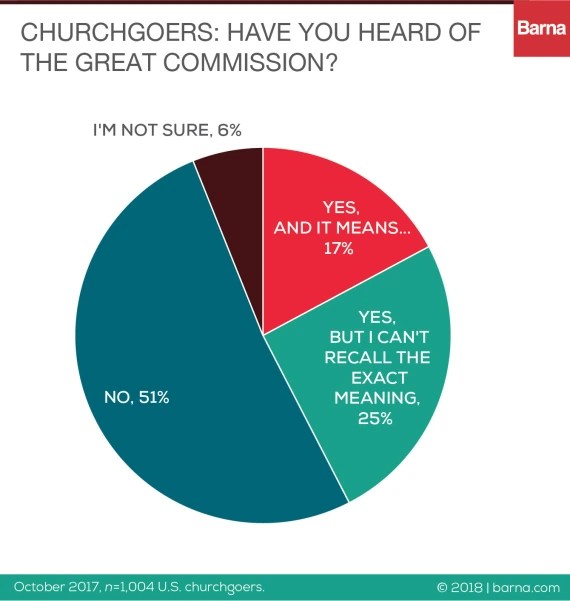
Have you ever heard the phrase “The Great Commission“? Do you know what it means? If not, you’re not alone…

photo courtesy of barna.com

The Barna Group recently conducted a study asking churchgoers if they had previously “heard of the Great Commission.” In their report, 51% of Churchgoers Donโ€™t Know of the Great Commission the results of the study were summarized thusly:

“…half of U.S. churchgoers (51%) say they do not know this term. It would be reassuring to assume that the other half who know the term are also actually familiar with the passage known by this name, but that proportion is low (17%). Meanwhile, ‘the Great Commission’ does ring a bell for one in four (25%), though they canโ€™t remember what it is. Six percent of churchgoers are simply not sure whether they have heard this term ‘the Great Commission’ before.”

Now, if you know anything about statistics, you know how important it is to structure your questions carefully and get a representative sampling of the population you’re surveying in order to get the most accurate results. What does “churchgoer” mean? Is it possible people have never heard the term “The Great Commission” simply because churches don’t use this particular phrase any more? It’s important to take things like this into consideration because it affects the results of the survey. (You can find out more about Barna’s structuring process for this study at the end of the article linked above.) But even if the numbers of the Barna survey aren’t exact, I think it’s safe to say there are a lot of people out there in churchland who aren’t familiar with The Great Commission.

Just for fun, let’s see what the results would be if we surveyed readers of my blog:

The Great Commission refers to some of Jesus’ final words to the disciples before His ascension and is cited from Matthew 28:18-20:

And Jesus came and said to them, ‘All authority in heaven and on earth has been given to me. Go therefore and make disciples of all nations, baptizing them in the name of the Father and of the Son and of the Holy Spirit, teaching them to observe all that I have commanded you. And behold, I am with you always, to the end of the age.’

With these words Jesus commissioned the eleven remaining disciples to go out into the world and carry on His mission. Since every Christian is a disciple, or follower, of Christ, this is our commission from Him as well. Let’s examine what it says.

All authority in heaven and on earth has been given to Me.
Before commissioning his disciples, Jesus reminds them that everything He’s about to say is founded on and imbued with His authority. Jesus alone has the divine authority to establish the church and to dictate the way in which His church is to be set up and to grow.

We 21st century Christians would do well to keep forefront in our minds and hearts the authority of Christ over His church. There is no need for churches to “cast vision” or come up with mission statements. Christ is the head of the church and has already given us His vision for it. The Great Commission is His mission statement for the church.

Go therefore
“Therefore” in this little phrase refers back to what Christ has just said about His authority. In other words, because all authority in heaven and on earth has been given to Me, I am telling you to go.

“Go” is a very generic verb in English. We can “go” into the kitchen or we can “go” to the moon or we can “go” out and conquer the world. We can “go” anywhere from our own personal microcosm to the edges of the known universe. And that is the same sense the Greek word ฯ€ฮฟฯฮตแฝปฯ‰ captures: as you “go your way,” as you “go forth,” as you “walk”, as you “pursue the journey on which [you have] entered.” Wherever life takes us, whether it’s across the street or across the world, we go as ambassadors of Christ, carrying the good news of the gospel with us.

All nations
Revelation 7:9 tells us that God will save people from “every nation, from all tribes and peoples and languages.” So that’s who we share the gospel with as we go our way. Everybody. Regardless of where they’re from, what they look like, or how they talk. We are not to withhold the gospel from anyone, and we’re to make sure the church is proactively carrying the gospel to every populated geographical location on earth.

Make disciples…teaching them to observe all that I have commanded you
Notice the language Jesus uses here. He doesn’t say “make converts” or “make Christians”. He says “make disciples.”

Think about what the disciples did while Jesus was on earth. First, they answered His call to follow Him. Then, they began the journey of following Him wherever He went. He trained and equipped them day and night. They loved Him and worshiped Him. They imitated the things He did and said. They carried on His work after He ascended. Jesus is saying to the disciples, and to us, “Replicate yourselves. Make more like you.”

That means that the Great Commission starts with sharing the gospel with a lost person, but it doesn’t end there. There’s more to our mission than just evangelism. We are to train and equip Christians to follow Jesus daily, to love and worship Him, to imitate Him in obedience, and to carry on His work.

Baptizing them in the name of the Father and of the Son and of the Holy Spirit
After salvation, baptism is the first step a new Christian takes on the road of discipleship. It is not optional. Baptism publicly identifies a person – to the church and to the world – as a Christian, and is a personal pledge to follow Christ obediently all the days of one’s life.

Being baptized “in the name of the Father and of the Son and of the Holy Spirit” carries several layers of meaning.

๐Ÿ’งAgain, pay careful attention to the language in this phrase. Jesus does not say “in the nameS” – plural. He says, “in the name” – singular. This is a boldly Trinitarian statement directly from two of its members: Jesus, who spoke these words to the disciples, and the Holy Spirit, who breathed them out through the pen of Matthew. This is God Himself telling us who He is. Jesus spoke these words to good Jewish boys who were born and bred on the shema: “Hear, O Israel: The Lord our God, the Lord is one.” There was to be no confusion for new Believers back then, Believers today, or to the onlooking world, as to who these Christians are following. They are not following three different gods. They are following the one true God in three Persons: God the Father, God the Son, and God the Holy Spirit – the whole ball of wax.

๐Ÿ’งNames meant far more in biblical times than they do to us today. We see God changing people’s names – Abram to Abraham, Jacob to Israel, Simon to Peter, etc. – when He commissioned them for a new mission or phase of life. Being baptized “in the name of” the Father, Son, and Holy Spirit echoes that tradition of God changing people’s names. You are no longer your own, you are Christ’s. You are no longer “Sinner”, you are “Saint”. You no longer go forth in your own name, but in the name of the Father, Son, and Holy Spirit as their emissary, endowed with the power and authority of God to live for Him and to proclaim the gospel to a lost and dying world.

๐Ÿ’งBecause Christians are, by definition, Trinitarians, and because baptizing a Believer is commissioning her to go forth into the world as a representative of Christ, it’s appropriate for pastors to take this verse literally when performing a baptism and verbalize its words: “I baptize you in the name of the Father, and of the Son, and of the Holy Spirit.”

Basic Training: Baptism

And behold, I am with you always, to the end of the age.
What a sweet promise, both to the disciples and to us today. Obediently following Christ in our daily lives, sharing the gospel, and making disciples can be lonely, exhausting, and discouraging at times. But we don’t have to do it alone, and we don’t have to do it in the flesh. Christ is with us and He knows all too well how hard it can be. God has given the Holy Spirit to indwell and empower Believers to live for Him and to carry out The Great Commission.

Additional Resources

What is the Great Commission? at Got Questions

The Great Commission by John MacArthur

The Great Commission by Burk Parsons

Book Reviews, Guest Posts, Salvation

Guest Post: A Review of “From Death to Life: How Salvation Works”

If your theology pretty much matches up with mine (as outlined in the โ€œWelcomeโ€ and โ€œStatement of Faithโ€ tabs) and youโ€™d like to contribute a guest post, drop me an e-mail at MichelleLesley1@yahoo.com,
and letโ€™s chat about it.

photo credit: Stephen J. Melniszyn

A Review of Allen S. Nelson IVโ€™s
From Death to Life: How Salvation Works
by Katy B.

The most agonizing, frustrating experience in my ministry to women is the woman who claims to be โ€œsavedโ€ but gives no evidence of it. No interest in talking about Jesus, no interest in holiness, reading the Bible, going to church, serving Godโ€™s people. She has a salvation testimony (often dramatic and self-glorifying) that is superficial, shallow, and devoid of any real repentance for her sin. I suspect sheโ€™s a false convert. And I find it exceptionally difficult to talk to false converts.

In From Death to Life, Pastor Allen Nelson confronts the disaster of false conversions, linking them to a false understanding of salvation: what it is, what it does, and how it works. He writes, โ€œAsk fifteen people what it takes to be saved and itโ€™s not out of the realm of possibility that youโ€™ll get twenty different answers.โ€ (Loc 173)ยน

He makes the bold statement that โ€œthere is no spiritual life in many who claim to be Christians in America.โ€ (Loc 247) He calls them the โ€œwalking deadโ€.

How does that happen? What would cause a person to wrongly believe he or she is a Christian? He lays some of the responsibility at the feet of churches that use methods such as external manipulation, diluted gospel presentations, the altar call, and the sinnerโ€™s prayer to lead the walking dead to their false professions of faith and their false assurances of salvation. He blisters easy-believism practices that, even if well-intentioned, have done damage to churches more influenced by a fallen culture than by Godโ€™s own Word.

So how does salvation work? The author has narrowed the answer down to five main points:

1. The gospel must be proclaimed.

2. God must move.

3. The sinner must respond in faith and repentance.

4. God justifies the sinner.

5. The sinner grows in the Lord over a lifetime.

Pastor Nelson not only unpacks, but folds, hangs up, and neatly puts away each of these main points in a few short chapters. In doing so, he poses and then answersย questions such as, โ€œWhat is the true gospel?โ€, โ€œWhat is biblical repentance?โ€, โ€œWhat is saving faith?โ€, and โ€œWhat exactly is justification?โ€ His answers are delivered in a direct, engaging, accessible style with plenty of biblical illustrations and scriptural references. No theological dictionary needed.

The book includes โ€œhowto’sโ€ but doesnโ€™t read like a โ€œhowtoโ€ manual. The tone is pastoral, sometimes comfortable, sometimes convicting, but never harsh. At times, the reading felt like sitting over coffee with Pastor Nelson, asking questions about various evangelistic situations, and receiving useful advice on how to respond.

A destitute woman in a homeless shelter, eyes pallid, needle tracks running down her arms, naturally incites my heart instinct to put my arms around her, tell her Jesus loves her, and give her some money. But Pastor Nelson reminds us:

โ€œPeople need to hear more than โ€œJesus loves you,โ€ What they need to hear today is what theyโ€™ve always needed: to know that they are sinners, that they need a Savior, that Jesus is that Savior, and until and unless they come to Him in faith, they will justly spend an eternity facing the punishment of their sins.โ€ (Loc 2413)

He points out that it is vital that we all (not just the โ€œtrained professionalsโ€) know what to say when the time comes to share the gospel of Christ. And while there is no formula, it is essential that the facts of the gospel are understood. The book helpfully guides the reader in a biblical understanding of how salvation happens and presents realistic examples of responses that can be used with unbelievers/false converts in evangelistic conversations.

The chapter โ€œPlant, Water, Trust God, Repeatโ€ is a compelling warning to stick to a biblical approach to evangelizing the lost. (Throughout the book he gives examples of unbiblical approaches.) In this encouraging chapter, he discusses applying how salvation works in real life scenarios, acknowledging that it is not always easy. He doesnโ€™t present himself as a superhero evangelist.

This is a serious book, but the author can also be funny. I got a laugh out of his response to the command to โ€œask Jesus into your heartโ€. His tone, however, is utterly serious when discussing repentance:

โ€œGod doesnโ€™t beg people to repent so they can be the star player on His team. He demands repentance. He owes mankind nothing. What a fearful and insolent game we play by making repentance an optional feature to becoming a Christian, refusing to properly define it in hopes of sneaking people into the kingdom, or by flat out dismissing it altogether.โ€ (Loc 1164)

He spends a good bit of time parked on repentance, emphasizing that biblical repentance is necessary for any person to become a Christian. He asserts, โ€œRemorse does not equal repentanceโ€ and goes on to give what he calls the bare necessities of repentance.

Is it possible to know if a person has actually been converted? In the chapter on sanctification, the author acknowledges that while we canโ€™t see the heart, we can use the discernment God gives us to see evidence of true conversion. He provides a practical alliteration method to assist in discerning whether or not the gospel has actually taken root in a personโ€™s heart and the changes we would expect to see in a truly converted person.

He warns the church against haphazardly affirming people as Christians without exercising grace-filled discernment:

โ€œOften, we claim that the problem in our churches is that too many people are immature believers when the real problem is that many we call immature, actually have no life in Christ at all. They arenโ€™t growing because they arenโ€™t living.โ€ (Loc 1878)

The sanctification chapter, my favorite, thrust me to a fresh examination of my own life using his alliteration template. What evidence of salvation would others see in me? What would they discern as my motivation for life? There is plenty of self-application for the reader.

The book has three appendices. Appendix 1: The Sinnerโ€™s Prayer, Appendix 2: Acts 2 is Not an Altar Call, Appendix 3: Putting โ€œBaptistโ€ Back in Your Church. In these appendices, the author makes some โ€œsay whaaaat?!?โ€ observations that will rock your world if your church endorses these practices.

This is a short book. Although the print version is only 200 pages, there is nothing shallow about the content. The reader will step into a deep pool. Did I know how salvation works before I read the book? Yes. Have I been guilty of using unbiblical methods to try to bring about a conversion? Yes. I finished the book with an unanticipated, heart wrenching reorientation to the gospel as the power of God unto salvation. I bet Iโ€™m not the only reader who closed the book and repented.

I began by saying I find it exceptionally difficult to talk to false converts. What do you say to someone who believes she is saved when it is clear that she is not? Pastor Nelson is immeasurably supportive in reinforcing that โ€œwe must proclaim the gospel. Without it, people will go to hell. Itโ€™s as simple as that.โ€ (Loc 441)

The book left me feeling hopeful, energized, looking forward to my next evangelistic encounter. God saves sinners. God saves sinners. And he uses sinners like me to do so.

Pastor Nelson writes, โ€œEvery single one of us is charged with sharing the gospel with those God providentially places in our life.โ€ What a calling, what a staggering privilege. God could sovereignly call His own to Himself without us, but He has chosen to work through us. This book will certainly help us in our evangelism. I recommend it for everyone.

ยนKaty reviewed the Kindle edition of the book and used Kindle location numbers rather than page numbers.


Allen “Cuatro” Nelson, IV, author of From Death to Life, is the pastor of Perryville Second Baptist Church in Perryville, Arkansas, and co-host of The Rural Church Podcast. Contact Him directly via Twitter to receive a free study guide with your order of From Death to Life or a discount on bulk orders. You can also order from Amazon.

Katy canโ€™t remember when she became a Christian but is assured that, by the grace of God alone, she is a Christian. She ministers to women in her OPC church, in homeless shelters, in a prison, and sometimes at the grocery store. She is an executive with a United States health care corporation and enjoys her work, although she would rather be reading. You can find Katy on Twitter at @KatyvonBora.

ALTHOUGH I DO MY BEST TO THOROUGHLY VET THE THEOLOGY OF THOSE WHO SUBMIT GUEST POSTS, IT IS ALWAYS POSSIBLE FOR THINGS TO SLIP THROUGH THE CRACKS. PLEASE MAKE SURE ANYONE YOU FOLLOW, INCLUDING ME, RIGHTLY AND FAITHFULLY HANDLES GODโ€™S WORD AND HOLDS TO SOUND BIBLICAL DOCTRINE.