Sanctification, Sin

Guilt and Shame- Burden or Blessing?

Originally published May 22, 2020

I agree with what you’re saying, I’m just afraid it might arouse guilt and shame in newer believers, as well as those with sensitive consciences,” a follower recently said in response to a statement of biblical truth I posted on social media. I’ve been pondering that ever since she said it. It was good food for thought.

Guilt and shame are not subjects we often talk about outright. Rather, they seem to be a taboo silently woven into the fabric of our collective consciousness in 21st century Western culture – even in evangelicalism. It’s an unspoken law with the direst of consequences: “Thou shalt never say or do anything that causes anyone to feel guilty or ashamed for the choices she has made or the way she lives her life.” If you do, cancel culture will hunt you down and publicly eviscerate you. You’ll be shunned, and you can kiss your reputation goodbye. Why? Because our society tells us that guilt and shame are the absolute worst things someone can feel.

But is that really true? Or could it be that the prince of the power of the air is lying to us yet again?

While the church has historically done a stellar job of sharing the good news that Christ took away our guilt and shame on the cross, it has not always done a good job of explaining what the emotionsยน of guilt and shame are or the proper function they are to serve in the lives of both Believers and unbelievers.

There are two kinds of emotional guilt and shame: biblically appropriate and biblically inappropriate. Biblically appropriate guilt and shame is when you feel guilty and ashamed as a result of doing something wrong. Biblically inappropriate guilt and shame is when you feel guilty and ashamed when you haven’t done anything wrong.

Biblically appropriate guilt and shame are good gifts from God. They are like a fever that tells you you’re sick and need to take some medicine. Lost or saved, new Believer or seasoned Saint, sensitive conscience or not, if someone is sinning, she should feel guilt and shame, because she has transgressed a holy God. For the lost person, that guilt and shame is an internal reminder that she stands forensically (legally) guilty before God and needs a Savior. For the Believer, that guilt and shame is the conviction of the Holy Spirit leading her to repent and obey Christ instead of sinning. Biblically appropriate guilt and shame are biblically appropriate because your feelings about what you’ve done match the facts of what you’ve done. You feel guilty and ashamed because you are guilty of doing something shameful: sin.

The warning sign of guilt and shame is a blessing from a good, kind, and merciful God calling us to repent immediately and return to Him before we dig ourselves into a deeper pit of sin. Like a loving father who starts with a stern look when his child first misbehaves and then progressively moves on to increasing levels of discipline, God does not pour out the full fury of His wrath at our first bobble toward sin. He starts with the “stern look” of guilt and shame.

Have you ever read the Old Testament and explored some of the more drastic warning signs God had to send His people, and the pagans they lived among, when they sinned and hardened their hearts against the guilt and shame He blessed them with? Have you contemplated the horrors of eternal conscious torment in Hell, lately? When we consider…

  • how dangerous sin is for us in this life,
  • how petrifying the prospect of what God could do to us, has every right to do to us in His anger over our sin if He were so inclined,
  • how the heart of God is not to punish and destroy, but to redeem and reconcile

…it is much easier to recognize biblically appropriate guilt and shame as an act of unfathomable love from God.

If a professing Christian doesn’t normally feel guilt and shame when she has clearly sinned, she should be extremely concerned. That is usually the fruit of someone who is unregenerate, not someone who is saved, and she would do well to follow Scripture’s mandate to examine herself against rightly handled Scripture to see if she is indeed in the faith.

But what about experiencing biblically inappropriate shame and guilt? In the life of a genuinely regenerated Christian, biblically inappropriate shame and guilt mainly takes one of two forms:

  • feeling shame and guilt for your own pre-salvation sins, or post-salvation sins you’ve already repented of
  • feeling shame and guilt for someone else’s sin or for something else outside your control

This kind of shame and guilt is inappropriate because it is misapplied. God intended shame and guilt to bring you to repentance for your sin, not to haunt you for sin you’ve already repented of or for someone else’s sin or something outside your control.

If you have bowed the knee to Christ in repentance and faith that His death on the cross, burial, and resurrection paid the penalty for your sin, then God’s good gift of guilt and shame has done its job. It’s over. Christ took your guilt and shame and sin, nailed it all to the cross – and it died there. It did not come down off the cross with Jesus, and it was not resurrected with Him. You have the glorious privilege as one robed in the righteousness of Christ, to rebuke those feelings of guilt and shame over past sins any time they rear their ugly heads, armed with the knowledge that you are forgiven and free. Christ paid with His blood to give you the right not to have to feel those feelings. Send them packing by praising God for His wonderful gift of grace and mercy to you in Christ.

And what about feeling guilt and shame for someone else’s sin? Perhaps you did your best to raise your child in a godly way, but he grew up to become a rapist or murderer, and you feel guilty. Maybe someone committed the sin of abuse against you and you’re dying of shame inside. If I just hadn’t done this, or if I had only done that, he wouldn’t have done what he did. It’s my fault.

May I make a suggestion? Do a good, long, hard study of Ezekiel 18. God is crystal clear – in such a loving and comforting way – that He does not hold you responsible for anyone’s sin but your own. You are – not as a matter of subjective opinion or feelings, but as a matter of forensic, objective fact – not guilty of that person’s sin. So if you’re feeling guilt and shame, your feelings don’t match the facts. Your feelings are boldly and brashly lying to you in the face of what God says is true about you. He says you’re not guilty. Your feelings say you are. Who are you going to believe?

That’s why it’s incredibly important that we believe God’s objectively true written Word over and above our feelings. It’s also why it makes me so angry when seeker driven churches and women’s “Bible” study materials focus on your personal feelings, opinions, preferences, and life experiences instead of properly teaching you the Bible. How can you believe God’s Word over your feelings if you don’t even know God’s Word? When all you know is your raw emotions and not what God says, that leaves you trapped, a slave to your con artist feelings, when you could be completely set free from the shame and guilt God never intended for you to feel for someone else’s sin.

And, finally, you could be feeling biblically inappropriate guilt for an accident or something else outside your control. If we had just bought a different house, we wouldn’t have been living in this one when the tornado hit, and my husband would still be alive. If I had just taken a different route, I wouldn’t have encountered that unexpected traffic accident and missed my daughter’s senior recital.

There’s a key truth all Christians need to come to grips with here: God is sovereign over every atom and event in the universe. You are not. God knows the future. You do not. God is God. You are not. When you feel guilty for things you had no way of knowing, preventing, or avoiding, you are essentially saying you should have God’s omnipotence and omniscience. You’re feeling guilty for not being God.

And your feelings of guilt over something like this are also saying that God was wrong for allowing what happened to happen, because if you were God, you wouldn’t have let it happen. Take a moment and let that sink in. Your feelings of guilt over something unforeseen and unavoidable say that you think you could do a better job of being God than He can. Well, let me tell you what we both already know. You can’t.

God determined from the foundations of the earth exactly which day, and how, and where, your husband was going to die. If it wasn’t God’s will that he die in a tornado on that day, in that house, he wouldn’t have. If God wanted you at your daughter’s recital, you would have been there.

You don’t have control. Control is an illusion. God has control. (And that’s good. Because God knows faaaaaaaaaaaaaaaaaaaaar better than we do the right thing to do in every situation.) And if you don’t have control, then you didn’t do anything wrong. And if you didn’t do anything wrong, feeling guilty is biblically inappropriate, a) because God’s purpose for guilt is to draw you to repentance over your sin, not for failing to achieve Godhood, and b) because your feelings (“I’m guilty!”) don’t match the facts (you’re not).

God is sovereign. He always does what is right and best in every situation, even if you can’t see it and don’t understand. And because He always does what is right and best, you can trust Him in those terrible incomprehensible situations. Take some time to study what God’s Word says about trusting Him.


A major problem in evangelicalism today is that we have followed the world’s lead and made people’s feelings into a god. We are more worried about hurting people’s feelings than providing them actual biblical help. And we all, including me, need to repent of that and stop it. It is infinitely better to fleetingly hurt someone’s feelings with biblical truth that leads her to Christ, than to allow her feelings to be an untouchable idol that keeps her in sin.

There has to be something higher, more important, than protecting someone from feeling biblically appropriate guilt and shame. There has to be something lofty enough to rescue people out of biblically inappropriate guilt and shame.

There is: God and His Word.

Exalting God and His Word to their proper and deserved place of preeminence and authority, and submitting to them in our hearts, minds, churches, and relationships is not simplistic, it’s foundational. And when it comes to the veneration of people’s feelings (and far too many other issues) we have become the foolish man who has traded a foundation on the rock of God’s truth and His ways for one on the enticingly sandy beach of worldly “wisdom”.

And, y’all…

…it’s starting to rain.


ยนThere is also a forensic definition of guilt. For example, if you rob a bank, you are forensically (legally), objectively guilty of the crime of robbery regardless of how you feel about it. This article deals mainly with the emotion of guilt– feeling guilty, or having a guilty conscience.

Additional Resources:

Guilt, Shame, and Regret at A Word Fitly Spoken

What Embarrassment Reveals About Your Heart at Transformed with Dr. Greg Gifford

Donโ€™t Let Embarrassment Dictate Your Spiritual Life at Transformed with Dr. Greg Gifford

Holidays (Other), Obedience, Sanctification

40 Things to Give Up for Lent

Originally published March 3, 2017

Although, as a Louisiana girl, I’ve had a decades long love affair with king cake, and I totally support the increased availability of fish entrรฉes at local restaurants and getting a few days off school or work, I’m not a big fan of Mardi Gras and Lent.

The intrinsic philosophy behind Mardi Gras – a day of revelry, indulgence, and debauchery to get it all out of your system before you have to start “being good” for Lent – is patently unbiblical.

The practice of Lent often is, as well. Lent is the forty day period, beginning with Ash Wednesday and ending with Easter Sunday, observed by Catholics and some Protestants. Originally, it was simply a time of fasting, prayer, and worship in anticipation of Easter, and for Christians who continue to observe it this way, it can be a valuable and meaningful time of respite and renewal with the Lord.

For many, however, Lent – particularly the aspect of giving something up for Lent in an act of self-denial – is nothing more than an empty religious ritual, or worse, works righteousness. Giving something up for Lent because, “I’m Catholic and that’s what good Catholics do,” or to atone for your sins, or to curry favor with God, or to flaunt your self-righteousness flies in the face of grace alone, faith alone, Christ alone biblical Christianity.

If you give something up for Lent, why do you do so? If it’s for one of the aforementioned unbiblical reasons (or others), or even if you don’t observe Lent at all, I’d like to challenge us all to give up the things below for Lent:

1. Give up Lent for Lent.

2. Give up attending any church that requires the observance of Lent in a sacramental way and find a doctrinally sound one.

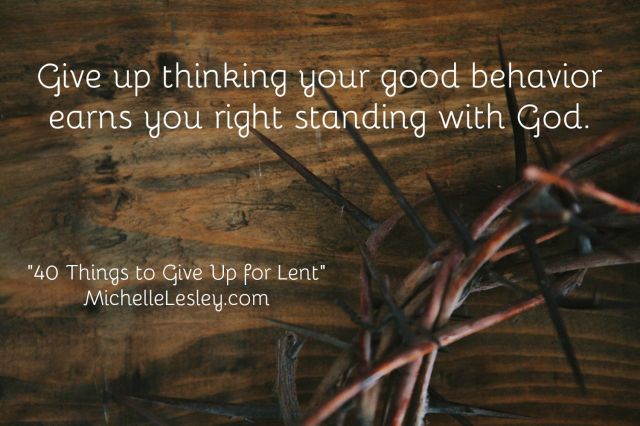
3. Give up thinking your good behavior earns you right standing with God.

4. Give up the idea that there’s any such thing as truly good behavior.

5. Give up thinking your good deeds could ever outweigh your sins.

6. Give up willfully indulging in sin as long as you “make up for it” later.

7. Give up the notion that penance or self-denial can pay for your sins.

8. Give up thinking that penance or self-denial curries favor with God.

9. Give up the idea that repentance and obedience belong to a certain season on the calendar. We are to walk in repentance every day.

10. Give up the concept that Christmas and Easter are Christian “high holy days.” We celebrate Christ’s incarnation and resurrection every Sunday, and should prepare ourselves all during the week. Every Sunday is a high holy day for the Christian.

11. Give up rote participation in church rituals. Search the Scriptures and see if they’re biblical first.

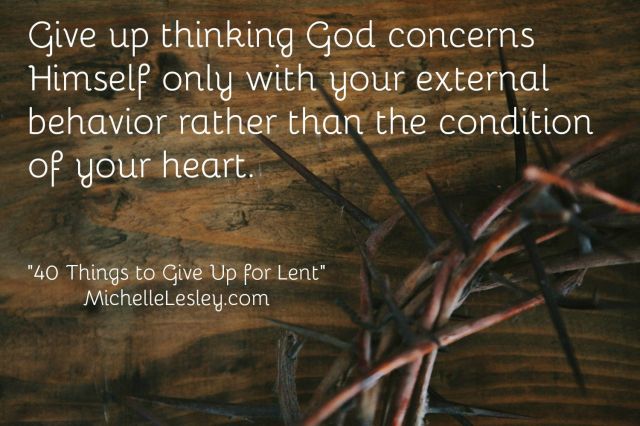
12. Give up thinking God concerns Himself strictly with your external behavior rather than the condition of your heart.

13. Give up “sounding a trumpet before you” with humblebrags on social media and in real life about giving things up for Lent, fasting, giving offerings, or any other good works you might do. You just lost your reward, baby.

14. Give up approaching church attendance as punching the time clock for God. The Christian’s entire life, our very beings, belong to Christ, not just a couple of hours on Sunday.

15. Give up the delusion that you’re basically a good person. You’re not.

16. Give up biblical ignorance and become a good student of God’s word.

17. Give up forsaking the assembly and become a faithful, serving member of your local church.

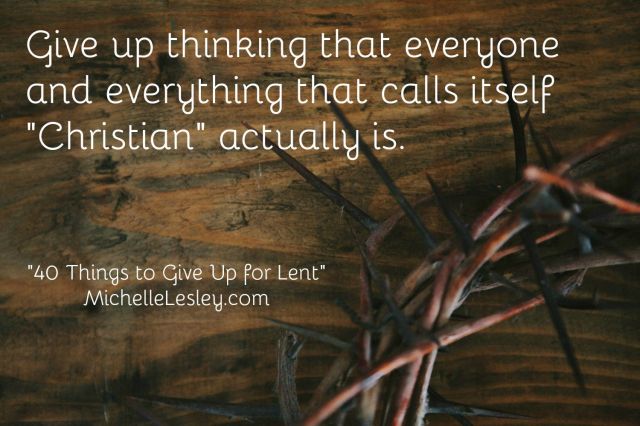
18. Give up thinking that everyone and everything that calls itself “Christian” actually is.

19. Give up the desire to have your itching ears scratched and long for the truth of God’s word. Even when it’s hard to hear.

20. Give up neglecting the daily study of God’s word.

21. Give up rejecting parts of the Bible you don’t agree with. We don’t sit in judgment over Scripture. Scripture sits in judgment over us.

22. Give up neglecting your prayer life.

23. Give up making excuses for failing to memorize Scripture. You can do it!

24. Give up being a non-serving member of your church.

25. Give up being a non-giving member of your church.

26. Give up thinking you’re hearing God speak to you. If you want to hear God speak to you, open your Bible and study it. God has spoken in His word and many are largely ignoring what He has already said.

27. Give up following false teachers and be a good Berean.

28. Give up being afraid to share the gospel and just do it.

29. Give up thinking you can please God apart from faith in Christ.

30. Give up basing your doctrine and beliefs on your own (or anyone else’s) opinions, experiences, and feelings, and base them on correctly handled Scripture instead.

31. Give up following your wicked and deceitful heart, take up your cross daily, and follow Christ.

32. Give up thinking you have to do big things for God in order for Him to be pleased with you and “aspire to live quietly, and to mind your own affairs, and to work with your hands.”

33. Give up worrying and trust God.

34. Give up neglecting to fear God’s wrath if you don’t know Christ.

35. Give up fearing God’s wrath if you do know Christ.

36. Give up the idea that “God is love” means God is a pushover who won’t judge you.

37. Give up thinking you’ve been so bad that God could never forgive you.

38. Give up thinking you’re so good that you don’t need God to forgive you.

39. Give up refusing to forgive others when Christ has forgiven you so much.

40. Give up everything and be saved by grace alone, through faith alone, in Christ alone, and walk in His ways, all the days of your life, to the glory of God alone.

Relationships, Sanctification

Throwback Thursday ~ In Defense of Offense: Why Christians Need to Stop Worrying About Offending People

Originally published January 18, 2019

“You’re a liar,” he said dryly, the passion in his eyes gleaming through.

“What?!?! HOW DARE YOU call me a liar!” his fellow church member fumed.

“You’re a liar, Joe. You show up at church for an hour a week and claim to be a Christian, yet you’ve been living with your girlfriend for over a year, you’ve told me you use pornography, and I’ve talked to five different people with incontrovertible evidence that you’ve cheated in your business dealings with them. When you say you’re a Christian, you’re lying. Just admit it.”

Have you ever had a conversation like this with someone? Have you ever witnessed a conversation like this?

Most of us would never dream of calling someone a liar who claims to be a Christian yet walks in disobedience to Christ. Goodness, no! It might offend the person or cause her to question her salvation! She might leave the church or walk away from the faith!

You know who wouldn’t be afraid of offending such a person or causing her to doubt her salvation? Someone who would dream of calling a professed Christian walking in disobedience a liar?

The Holy Spirit – via the Apostle John – that’s who.

Whoever says โ€œI know [Jesus]โ€ but does not keep his commandments is a liar, and the truth is not in him, but whoever keeps his word, in him truly the love of God is perfected. By this we may know that we are in him: whoever says he abides in him ought to walk in the same way in which [Jesus] walked.

1 John 2:4-6

Take a moment and let that really sink in. People who claim to be Christians yet habitually and unrepentantly make a practice of sinning are not saved.

People who claim to be Christians yet habitually and unrepentantly make a practice of sinning are not saved.

To the Holy Spirit and John that’s as plain and simple and uncontroversial as saying, “The sky is blue, and water’s wet.” But to a false convert, them’s fightin’ words.

And we know it.

So we refrain from lovingly speaking hard, biblical truths to people who need to hear them, usually for one of a handful of reasons:

โ€ข We don’t want this person’s wrath aimed at us because it’s a hassle or because we don’t want to lose the relationship with her.

โ€ข We don’t actually believe the Bible and trust God’s sovereignty. We’d rather lean on our own understanding, desperately clinging to the irrational hope that this person is truly a Christian who’s hanging by a thread, and we don’t want to be the one responsible for saying anything that might clip that thread.

โ€ข We’re worried about how we’ll look to others and that they’ll accuse us of being unloving, unchristlike, and harming the unity of the church.

What do those reasons have in common?

Me. Me me me me me me me.

I want to keep my relationship with this person in tact. I don’t want others to blame me for this person’s reaction to biblical truth or call me unloving or divisive. I don’t want to deal with the aggravation of this person’s emotional blow up.

It’s not exactly the greater love of laying down one’s life for a friend, is it? We’re not even willing to lay down our comfort or our reputation in order to tell someone her walk doesn’t match her talk and call her to repentance. Is that love at all, or is it just plain, old fashioned selfishness? We bow and scrape at the idol of not hurting other people’s feelings while those people careen down the road paved with our good intentions straight toward the gates of Hell. How is that love? 

We bow and scrape at the idol of not hurting other people’s feelings while those people careen down the road paved with our good intentions straight toward the gates of Hell. How is that love?

Love is valuing, and acting on, what is best for another person over and above our own self interests. You know, kind of like Jesus did during His life, death, and resurrection:

By this we know love, that he laid down his life for us, and we ought to lay down our lives for the brothers.

1 John 3:16

You know, it’s interesting that the Holy Spirit speaks a lot of hard, “you’re not saved if…” truths in a book (1 John) whose purpose is to give true Christians assurance of their salvation. The Third Person of the Trinity – the embodiment of perfect love – doesn’t seem to think it’s unloving to tell false converts they aren’t saved, while at the same time reassuring young, shaky-kneed saints.

But us? We can’t seem to get our act together and do both from a heart of love the way the Holy Spirit does.

Weโ€™ve focused so much attention on reassuring anyone who claims the label “Christian” of their eternal security that weโ€™ve lost sight of the fact that there are a great many false converts in our midst who should be questioning their salvation. The gate is wide that leads to destruction, Jesus said. It is the narrow gate that leads to life, and few are those who find it. Test yourself to see if you’re in the faith. How will they know these things if we don’t tell them?

The Bible has hard, sharp edges. It’s a sword, for crying out loud, not a feather duster. The primary purpose of a sword is to cut.

The gospel divides. Jesus – the creator of Christian unity – said, “I have not come to bring peace, but a sword. For I have come to set a man against his father, and a daughter against her mother, and a daughter-in-law against her mother-in-law.” Jesus – perfectly kind, perfectly loving Jesus – called those claiming to be God’s people yet walking in disobedience hypocrites, vipers, and sons of the Devil. Jesus – the Jesus who was more compassionately evangelistic than we could ever hope to be – didn’t beg, plead, or hand-wringingly water down Kingdom requirements so the rich young ruler would keep a toe in the door of God’s house. Jesus held high the standard of the gospel and let him walk away. Jesus wasn’t a nerdy little wimp offering people a cheap plastic heavenly trinket if they would only be His friend. This almighty King demanded perfection, the highest love, loyalty unto death. And, by the way, you’d better count the cost before deciding to follow Him. Jesus wasn’t worried about offending people with biblical truth.

We need to stop worrying that the Bible is going to offend people who need to be offended by its demands, requirements, and judgments so that they might repent and be reconciled to Christ. Whether it’s a sinner in need of a Savior or a saint in need of sanctification, the ministry of reconciliation Christ has called us to begins with confronting sin.

We need to stop worrying that the Bible is going to offend people who *need* to be offended by its demands, requirements, and judgments so that they might repent and be reconciled to Christ.

Every person we would potentially approach with biblical truth is either saved or lost.

If a person is genuinely one of Christ’s sheep, she will hear the voice of her Shepherd calling to her from the truths of His Word, turn from her sin, and follow Him. It may take time. It may take help. It may take teaching and many tears. But sheep love the Shepherd and follow Him. They grow toward Him, not away from Him.

If a person is lost, she isn’t going to get any “loster” when you biblically call her to repentance. Lost is lost, even if that lost person claims to be, or thinks she is, a Christian. There’s no such thing as a genuinely regenerated Christian who’s just barely hanging on to Jesus by her fingernails and you come along and push her out of the faith by confronting her sin with biblical truth. Uh uh. If she abandons Christ in favor of her sin, she was never saved in the first place, I don’t care what she claims to the contrary.

If a person is lost, she isn’t going to get any “loster” when you biblically call her to repentance.

All of this nonsense floating around these days about “de-converting” from Christianity, or “I used to be a real, genuine, bona fide Christian, but I’m not anymore.” Hogwash and poppycock. The Bible says if you leave the body of Christ, you were never a member of it to begin with. That God is greater than all (including you) and no one (not even yourself) is able to snatch you out of His hand if you belong to Him. That those who are saved will endure to the end. That Jesus will not lose a single one of those the Father has entrusted to Him. Dare we believe the words of sinners about themselves over what the Word of God says about them? No matter what you say or do, you don’t have the power to be responsible for someone leaving the faith. Whatever circumstance or person they might use as a scapegoat, people “leave” Christianity because they don’t know or love Christ and they’ve gotten tired of pretending like they do.

The people we love enough to lovingly, yet firmly, speak hard biblical truths to are either Christians who will come to love and embrace those truths (and love us for caring enough to speak them), or theyโ€™re lost or false converts who need to be confronted with the mirror of God’s Word so they can face up to the fact that theyโ€™re lost. Where the Bible speaks plainly and definitively, we must not be ashamed of the gospel and shrink from speaking plainly and definitively in agreement with it.

Stop being afraid of offending people by speaking hard, biblical truths. Sometimes the most loving thing you can do for someone is offend her.

Stop being afraid of offending people by speaking hard, biblical truths. Sometimes the most loving thing you can do for someone is offend her.

Church, Sin

Dis. Grace.: Responding Biblically to Church Scandal

Originally published June 30, 2015


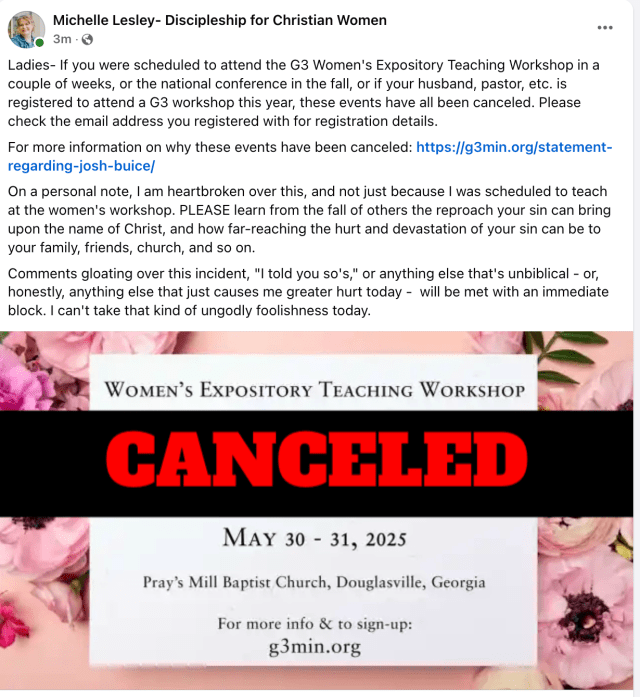
The last time I re-ran this article was in September of 2024 (only about eight months ago), when Steve Lawson was caught in sin. Today, I’m re-running it because another well known pastor, and president of G3 Ministries, Josh Buice, has been caught in sin. As Josh is under church discipline, I have removed him from my list of recommended pastors and teachers. G3 itself is still a trustworthy ministry, and my hearty recommendation of it continues. Please read the statement from G3 here.

If you are registered for the G3 Women’s Expository Teaching Workshop at the end of May, any of the other workshops, or the national conference this fall, please check the email address you registered with for further information on your registration. I’m so sorry I won’t get to see those of you who were going to be at the women’s workshop.

I’m going to take the rest of this week off from blogging, not just due to this, but primarily due to some other things I’ve got going on as well (mostly good things๐Ÿ™‚).

Please keep G3 Ministries and Prays Mill Baptist Church (Josh’s church) in your prayers as they navigate this difficult time.


It happened again last week. Another scandal. Another high profile pastor stepping down from the ministry in disgrace. Another family broken. Another church stunned and bereft.

And itโ€™s not just the money grubbing televangelists anymore, either. This was one of the theological good guys. Sadly, pastors and Christian leaders โ€“ both those in the public eye and those right around the corner โ€“ seem to be dropping like flies these days. Adultery. Financial sin. Pornography. Abuse. Fraud. The list of sinful behavior goes on and on, leaving a wake of destruction in its path and giving Christ and His bride a black eye in the process.

So, what is the biblical response to scandals like these for Joe and Jane Christian? We view the situation through the lenses of Romans 8:28:

And we know that for those who love God all things work together for good, for those who are called according to his purpose.

How can God use this scandal, awful as it is, for my good and the good of my brothers and sisters in Christ? Itโ€™s an opportunity to learn, teach, and minister in so many ways:

Fully grasp the destructive power of sinโ€ฆ

Imagine the agony the pastorโ€™s sin is creating in so many lives. What must his wife be going through? His children? His church? What about his own relationship with God? What about the lost people he was trying to win to Christ? What about the fact that his career may be over and he may lose his house?

Itโ€™s been said that sin destroys completely and completely destroys. Itโ€™s a good time to reflect on the fact that sin is not something to be trifled with. Count the cost. Would it be worth it to you to commit the same sin in your own life?

Itโ€™s been said that sin destroys completely and completely destroys. Itโ€™s a good time to reflect on the fact that sin is not something to be trifled with.

Realize your need for Christโ€ฆ

โ€œThere, but for the grace of God, go I.โ€ โ€œTherefore let anyone who thinks that he stands take heed lest he fall.โ€ (1 Corinthians 10:12) โ€œPride goes before destruction, and a haughty spirit before a fall.โ€ (Proverbs 16:18)

Donโ€™t fall into the trap of thinking youโ€™re better or holier than the person who sinned, therefore, you would never do what he did. Instead, let his sin push you towards the cross, realizing that youโ€™re just as weak and susceptible to temptation as he is. Let it amp up your prayer life and drive you to cling to Christ and His word lest you fall into sin.

Let his sin push you towards the cross, realizing that youโ€™re just as weak and susceptible to temptation as he is.

Dive into Godโ€™s wordโ€ฆ

What does the Bible say about the sin in question? Learn what Godโ€™s word says. Apply it to your life, your work, or your marriage. Teach it to your children. Share it with those in your circle of influence. Build up your brothers and sisters in Christ so they might stand firm against temptation.

Implement safeguardsโ€ฆ

People donโ€™t just wake up one day and decide to commit adultery or embezzlement or whatever. Every sin starts with a wayward thought, which, when left unchecked (or entertained), snowballs into action. What could the scandalized pastor have done, practically, to prevent his sin? What are some concrete, proactive steps you can take to guard against sin in your life? Maybe your husband should hold the credit cards or you should cut ties with that certain male friend. Donโ€™t wait for sin to find you. Build some walls before it arrives.

Use the scandal as a springboard for prayerโ€ฆ

Pray for those involved in the scandal. Ask God to protect you, your husband, and your loved ones from that particular sin. Realize that your own pastor and church staff are tempted to sin every day, pray for them regularly, and let them know youโ€™re praying for them.

Practice the Golden Ruleโ€ฆ

What if you were the one who sinned? How would you want people to talk about and treat you and your family? Call a sin a sin, but letโ€™s remember, when it comes to scandals, to watch our words and actions, and treat others the way we would want to be treated.

Use the scandal as an opportunity to share the gospelโ€ฆ

Inevitably, some lost people will see pastoral sin as one more candle in their โ€œChristians are just a bunch of hypocritesโ€ cake. Donโ€™t be embarrassed if an unbeliever approaches you with this line of fire (and whatever you do, don’t try to make light of or justify the pastorโ€™s sin). Own it. Admit it. โ€œYouโ€™re right. This guy sinned. He needs to repent and be forgiven by Christ. He needs to make things right with the people around him. Just like me. Just like you. By the way, Christ was crucified for sinners like him and me and you. Have you ever repented of your own sin and trusted in Christโ€™s death, burial, and resurrection as the payment for your sin? Mind if I tell you how?โ€

Repent and Forgiveโ€ฆ

Itโ€™s hurtful when someone you trust and look up to lets you down. But because weโ€™re sinful humans living in a broken world, itโ€™s going to happen. The pastor who sinned needs to repent. When he does, the people around him need to forgive, even though there will probably still be disciplinary consequences to his actions. Is there sin in your life that you need to repent of and face the consequences for? Is there someone who has sinned against you that you need to forgive? God extends the grace of forgiveness to repentant sinners and the grace to forgive to their victims. Repent. Forgive.


Scandals among Christian leaders are heartbreaking, disappointing, embarrassing. But the God who sent His only Son to the cross to turn sinners into saints has a wonderful way of taking offenses and turning them into opportunities for His kingdom.

Scandals among Christian leaders are heartbreaking. But the God who sent His only Son to the cross to turn sinners into saints has a wonderful way of taking offenses and turning them into opportunities for His kingdom.


Additional Resources

Pastoral Propriety with Church Ladies, and 7 Ways Women Can Help

Sin Feels Like Death, Because it Is by Amy Spreeman

โ€œDisqualifiedโ€: What it means and how a pastor gets there at The Cripplegate

Podcast Appearances

Podcast Guest Appearance – Contending for the Word

It was such a pleasure, recently, to chat with my friend Dave Jenkins on his podcast Contending for the Word, in an episode titled Exposing Priscilla Shirer’s False Teachings: A Detailed Analysis.

On the show, we evaluated a few videos of Priscilla Shirer’s teaching, and discussed how and why it’s unbiblical. Other topics included false teachers she has yoked with, the fact that she preaches to men, and whether or not she believes and teaches a heretical view of the Trinity called modalism.

Be sure to check out Dave’s website, Servants of Grace, where you’ll find an abundance of great teaching, podcasts, and materials, as well as his social media links- and give Dave a follow!


Articles / resources mentioned or touched on in the episode:

Going Beyond Scripture: Why It’s Time to Say Goodbye to Priscilla Shirer and Going Beyond Ministries

Popular False Teachers & Unbiblical Trends


Got a podcast of your own or have a podcasting friend who needs a guest? Need a speaker for a womenโ€™s conference or church event? Click the โ€œSpeaking Engagementsโ€ tab in the blue menu bar at the top of this page, drop me an e-mail, and letโ€™s chat!