Holidays (Other), New Year's

Sanctification Over Resolutions: 6 Ways God Could Sanctify You in the New Year

Originally published January 1, 2018

Happy New Year!

There’s just something about the beginning of a new year that brings with it a yen for getting a fresh start. We think back over the past year, evaluate what we’ve spent our time and efforts on – or what we should have spent our time and efforts on – and, invariably, there’s a desire to make this year better.

Lots of people make lots of resolutions on January 1: to lose weight, to stop smoking, to exercise more. And by mid-February, some 80% of those people will have failed and given up on their resolutions.ยน Why? Partly because (statistically speaking) most of those people are lost and the flesh is exceedingly hard to tame by sheer “pull yourself up by your own bootstraps” willpower. Even Holy Spirit-indwelt Believers can testify to the pull of the flesh.

Should we, as Christians make New Year’s resolutions? Is it OK to set a goal to get a certain area of our lives under better control? Sure, there’s nothing wrong with that. But, is it possible there’s a bigger picture we need to take a look at?

Should we, as Christians make New Year’s resolutions? Sure, there’s nothing wrong with that. But, is it possible there’s a bigger picture we need to take a look at?

The Christian life is not one of putting out fires via resolutions. We don’t tackle one problem, get it under control and then move on to each of the other five problems that popped up while we were working on the first one. It’s more like fire prevention. We get up every day and hose down the house and yard by resting in Christ, communing with Him through prayer and the Word, and seeking to obey Him throughout the day. Sanctification is not mainly reactive, it’s proactive. And it doesn’t come by our own outward effort and striving, but by Christ growing us, changing our hearts, and enabling us to obey Him from the inside out.

Sanctification is not mainly reactive, it’s proactive.

And guess what? Along the way as Christ is conforming you to His image, you’re going to fail. You’re going to give in to temptation, and you’re going to sin against your Master. But here’s what biblical sanctification offers you that New Year’s resolutions cruelly withhold:

If we confess our sins, he is faithful and just to forgive us our sins and to cleanse us from all unrighteousness. 1 John 1:9

The steadfast love of the Lord never ceases;
his mercies never come to an end;
they are new every morning;
great is your faithfulness.
Lamentations 3:22-23

You don’t just get a fresh start once a year. You get a fresh start every time you confess your sin, repent, and receive Christ’s cleansing and forgiveness. You get the mercy of Christ, the grace of God, and the empowerment of the Holy Spirit to move forward in submission to God’s Word. You get the steadfast, never ceasing love of the Father who is out for your good rather than the unfeeling “do more, try harder, be better” taskmaster of New Year’s resolutions.

So, bearing all that in mind, how might God be trying to grow you in Christlikeness this year? What are some ways you can get up each day and proactively rest in, and obey Christ? Let’s prayerfully consider the following aspects of our walk and ask God to sanctify us and help us submit our will to His as we follow Him in this new year.

Growing in the Word

1. Daily personal Bible study. Do you set aside daily time for the personal study of God’s Word? Have you ever read the Bible from cover to cover? Have you considered, maybe just for this year, putting away all of the Bible study books and materials authored by others and using only the Bible during the next 365 days of your personal study time? Evaluate your daily time in God’s Word. Here are some resources you might find helpful:

๐Ÿ“–ย Bible Study Resourcesย (how to study the Bible)
๐Ÿ“–ย Bible Studies
๐Ÿ“–ย Bible Reading Plans for the New Year- 2026
๐Ÿ“–ย Youโ€™re Not as Dumb as You Think You Are: Five Reasons to Put Down that Devotional and Pick Up the Actual Bible

2. Scripture memorization. This is something God got a hold of me about several years ago. It’s important to store up God’s Word in our hearts as a weapon against temptation, for comfort, for prayer, and to encourage others. Try starting with verses you’re already somewhat familiar with. Many find it easier to memorize Scripture in song form, or by typing it out. If your pastor is preaching through a certain book, memorize a verse or passage out of each chapter as he comes to it. I’ve found it helpful to recite my verses in my head in bed at night. It helps me fall asleep faster, and there’s actually research that shows retention is improved if you study right before bed.

๐Ÿง  Scripture Memory with Susan Heck at A Word Fitly Spoken

Growth In Prayer

3. Daily prayer time. Of course we should be talking to the Lord throughout the day as we go about the routine of life and work, but that’s not a substitute for having a daily block of time set aside for focusing all of our attention on communicating with God. Jesus set this example for us, and we should follow it. Do you have a daily time of prayer? Do you know how to pray in a way that’s pleasing to God and helps you grow in Christ?

๐Ÿ™ Prayer
๐Ÿ™ After this Manner Therefore Pray
๐Ÿ™ Basic Training: 8 Things You Need to Know about Prayer
๐Ÿ™ Sweet Hour of Prayer (Bible study on prayer)

Growth in the Body of Christ

4. If you don’t have a solid church, find one. Physically gathering with the Body of Christ for worship, teaching, fellowship, prayer, baptism, the Lord’s Supper, giving, serving – and so much more – is not optional. It’s vital to your growth in Christ.

โ›ช Basic Training: 7 Reasons Church is Not Optional and Non-Negotiable for Christians
โ›ช Six Ways Not to Forsake the Assembly
โ›ช Searching for a new church?

5. Faithful church attendance. At a minimum, Christians should be at Sunday morning worship and Sunday School/Bible study class/small group every week unless Providentially hindered (circumstances beyond your control: illness, emergency, the rare out of town trip, occasionally having to work). That’s not legalism, that’s loving the Bride of Christ and having your priorities in line with Scripture. Contrary to popular metrics, habitually missing Sunday worship twice or more a month (when you could be there if you made it a priority) is not faithful attendance. If you’re lackadaisical in church attendance, examine your heart. What’s going on in your spiritual life that’s keeping you from wanting to gather with your brothers and sisters in Christ? (And if it’s a problem with the church itself, see #4.)

6. Don’t just “go to church,” invest yourself in it. Are you serving your church in some capacity? Do you regularly and fervently pray for your church, your fellow church members, and your pastors, elders, and teachers? Have you poured yourself into personal relationships with others at church for fellowship, care, and discipling? Do you regularly, sacrificially, and joyfully give offerings? Are you sharing the gospel with the lost? As with anything else, you get out of it what you put into it. God loves you and wants you to invest yourself in His Bride for His glory and for your joy.

โ›ช The Servanthood Survey
โ›ช Let Me Count the Ways: 75 Ways Women Can Biblically Minister to Others
โ›ช Servanthood
โ›ช Top 10 Ways to Pray for Your Pastor
โ›ช To Tithe or Not to Titheโ€ฆ
โ›ช Evangelism

How might God want to conform you more to the image of Christ this year? Could it be in one of these areas? Maybe another area? New Year’s resolutions are often about how you want to shape your life. Sanctification is about how God wants to shape your life. Not just for the new year, but for eternity.

New Year’s resolutions are often about how you want to shape your life. Sanctification is about how God wants to shape your life. Not just for the new year, but for eternity.


ยนLuciani, Joseph. “Why 80 Percent of New Year’s Resolutions Fail.” U.S. News & World Report. December 29, 2015. Web. December 29, 2017.
Thanks/Thanksgiving

25 Things I Forgot to Thank God For

Originally published March 13, 2015

I’ve just been in a funk, lately. Nothing out of the ordinary is wrong, but it’s been raining for eleventy two days in a row, and the constant darkness and dreariness seems to have wormed its way into my psyche and, I noticed recently, even into my prayer life.

A couple of days ago, I started out my prayer time with a huge sigh followed by a bunch of wimpering and whining about nothing of consequence. I was just moody. And I didn’t feel like praying.

And then God graciously brought a lovely little snippet of Scripture to my mind:

give thanks in all circumstances;
for this is the will of God in Christ Jesus for you.

1 Thessalonians 5:18

Want to know God’s will for your life? There it is: give thanks in all circumstances. When you get a new car. When you catch your spouse cheating on you. When you’re on a glorious vacation. When you get laid off from work. When you’re happy. When you’re sad. When you’re in the mood, and when you’re not in the mood.

Give thanks in – not necessarily for, but in – all circumstances.

Well, this was certainly a circumstance. Why not give gratitude a try? I was in the car headed to pick up my boys from school, and I decided to spend the entire twenty minute drive just thanking God for things.

I started with the big stuff: salvation, forgiveness for my sin, times when God has miraculously provided, specific answers to prayer…

How often do we forget to thank God for all the (in our eyes) tiny little unnoticed things He does for us every day?

I was starting to slow down and I still had about half the drive left. Surely there was more to be thankful for! And that’s when it struck me. How often do we forget to thank God for all the (in our eyes) tiny little unnoticed things He does for us every day? We thank Him for the miracles, but what about the mundane? What “little things” had I forgotten to thank God for?

1. Air conditioning. I live in the South. Enough said.

2. I know where my next meal is coming from.

3. Social media and e-mail. I can keep up with far off loved ones, and I’ve “met” some awfully nice people.

4. I can see. I can hear. I can think clearly. I can walk.

5. I live in a country where Christianity is not yet against the law.

6. Sunsets.

7. Cute baby animals.

8. I can read and write. That’s not the case for women, globally.

9. I was able to conceive and carry my children to term.

10. Warm quilts on cold nights.

11. The Bible is available in my native language, and I have several copies of it.

12. I have no fear of suicide bombers in my community.

13. The beach.

14. A crawfish boil with friends.

15. Reliable electricity.

16. Hearing my children sing when they think no one is listening.

17. My husband is a Believer and is good to me.

18. Mountains. I miss mountains.

19. Indoor plumbing and clean drinking water.

20. Laughing hysterically with my family.

21. Level-headed discernment ministries.

22. Peanut butter and chocolate ice cream.

23. A roof over my head.

24. Home schooling.

25. People who are kind (or crazy) enough to read my blog articles all the way to the end.

Well, that was my list, and I think I’ll keep looking for things to add to it. Thanking God for the “little things,” realizing they might be big things to others, and recognizing the pervasiveness of God’s blessings and provision cheered me up and was truly a worship experience.

We thank Him for the miracles, but what about the mundane?

What kinds of things would you put on your list?

Holidays (Other)

Is 2 Chronicles 7:14 God’s Promise to American Christians Today?

Originally published July 3, 2015

Is 2 Chronicles 7:14 God’s promise to American Christians today?

“if my people who are called by my name humble themselves, and pray and seek my face and turn from their wicked ways, then I will hear from heaven and will forgive their sin and heal their land.”
2 Chronicles 7:14

This verse is often quoted as a call to prayer and revival for American Christians, suggesting that if we pray, repent, and humble ourselves, God will turn America around and make it โ€œone nation under Godโ€ again. Since the 4th of July is coming up, you’ll probably be seeing this verse all over social media, but is it really a promise to us today about America?

Not this particular verse, no. Here’s why:

1. This verse is only part of a sentence (you can tell by the way it starts with a lowercase letter). In order to rightly handle God’s word (2 Timothy 2:15), it’s imperative that we consider a verse’s immediate context as well as the way it fits in with the big picture of the entire Bible. Even adding just verses 13 and 15 shows us that this verse was written about Old Testament Israel, not America. Reading all of chapter 7 sheds even more light on this verse, and if we throw in chapter 6, especially 6:26-31, we can clearly see that 7:14 is part of God’s specific answer to Solomon’s prayer at the dedication of the temple.

2. There are no supporting Scriptures in the New Testament (remember, Believers are in the church era under the new covenant of grace) that imply that if Christians humble themselves and repent that God will give them a nation governed by biblical laws and leaders and that we will have a society that behaves itself, morally. In fact, in the New Testament, in the early church, we see the exact opposite. The more the church prayed, humbled itself, and spread the gospel, the more Rome persecuted Christians. And yet, we never hear of them claiming 2 Chronicles 7:14 as Godโ€™s promise to them that He would turn things around if they would only humble themselves and seek His face more. The New Testament, even Jesus Himself, says that we will be persecuted for godly living (John 15:20, Matthew 10:22, 2 Timothy 3:12-13).

3. We canโ€™t claim the promise without claiming the punishment. Look again at verse 13. It specifies that pestilence and the agricultural hardships of drought and locust infestation are the ones that God promises to heal. It is a promise of literal healing of the land so that crops will grow unharmed, game will be plentiful, and people will be healthy and able to eat, not a promise of a metaphorical โ€œhealingโ€ of a nationโ€™s immorality.

If we claim that this โ€œhealing of the landโ€ applies to us today, then we also have to claim that God will punish our disobedience with those very things He promises to heal (drought, locusts, and pestilence), because thatโ€™s what these verses are talking about.

4. The reason this passage sounds like it applies to us is because there are some principles in this verse that do apply to us. How do we know? Because they are supported by other clear and direct Scriptures:

Are we Godโ€™s people who are called by His nameโ€? Yes (Acts 11:26)

Should we humble ourselves? Yes (1 Peter 5:6)

Should we pray and seek Godโ€™s face? Yes (1 Thessalonians 5:17)

Should we turn from any wicked ways we practice? Yes (Acts 3:19)

Will God hear from Heaven if we do these things? Yes (1 John 5:14-15)

Does God promise to heal our land of bad morals or the agricultural problems He has punished our disobedience with if we do these things? No.

Asking God to fulfill His promises and thanking Him for those already fulfilled is a wonderful and worshipful way to pray. But, if we truly want to pray โ€œin the name of Jesusโ€ and pray rightly for Godโ€™s will to be done, we must use wisdom, discernment, and the tools God has given us to discover exactly what He has promised us.


Additional Resources:

Properly Praying the Promises

What is the meaning of 2 Chronicles 7:14? at Got Questions?

Church, Sin

Dis. Grace.: Responding Biblically to Church Scandal

Originally published June 30, 2015


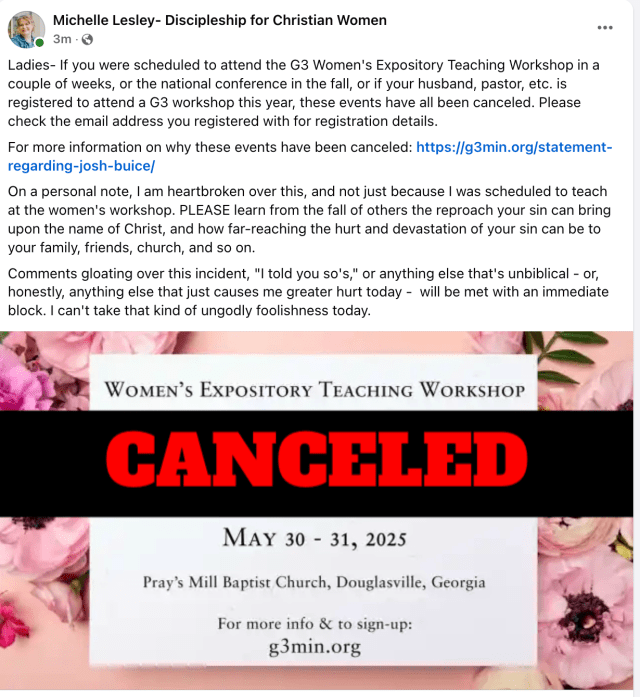
The last time I re-ran this article was in September of 2024 (only about eight months ago), when Steve Lawson was caught in sin. Today, I’m re-running it because another well known pastor, and president of G3 Ministries, Josh Buice, has been caught in sin. As Josh is under church discipline, I have removed him from my list of recommended pastors and teachers. G3 itself is still a trustworthy ministry, and my hearty recommendation of it continues. Please read the statement from G3 here.

If you are registered for the G3 Women’s Expository Teaching Workshop at the end of May, any of the other workshops, or the national conference this fall, please check the email address you registered with for further information on your registration. I’m so sorry I won’t get to see those of you who were going to be at the women’s workshop.

I’m going to take the rest of this week off from blogging, not just due to this, but primarily due to some other things I’ve got going on as well (mostly good things๐Ÿ™‚).

Please keep G3 Ministries and Prays Mill Baptist Church (Josh’s church) in your prayers as they navigate this difficult time.


It happened again last week. Another scandal. Another high profile pastor stepping down from the ministry in disgrace. Another family broken. Another church stunned and bereft.

And itโ€™s not just the money grubbing televangelists anymore, either. This was one of the theological good guys. Sadly, pastors and Christian leaders โ€“ both those in the public eye and those right around the corner โ€“ seem to be dropping like flies these days. Adultery. Financial sin. Pornography. Abuse. Fraud. The list of sinful behavior goes on and on, leaving a wake of destruction in its path and giving Christ and His bride a black eye in the process.

So, what is the biblical response to scandals like these for Joe and Jane Christian? We view the situation through the lenses of Romans 8:28:

And we know that for those who love God all things work together for good, for those who are called according to his purpose.

How can God use this scandal, awful as it is, for my good and the good of my brothers and sisters in Christ? Itโ€™s an opportunity to learn, teach, and minister in so many ways:

Fully grasp the destructive power of sinโ€ฆ

Imagine the agony the pastorโ€™s sin is creating in so many lives. What must his wife be going through? His children? His church? What about his own relationship with God? What about the lost people he was trying to win to Christ? What about the fact that his career may be over and he may lose his house?

Itโ€™s been said that sin destroys completely and completely destroys. Itโ€™s a good time to reflect on the fact that sin is not something to be trifled with. Count the cost. Would it be worth it to you to commit the same sin in your own life?

Itโ€™s been said that sin destroys completely and completely destroys. Itโ€™s a good time to reflect on the fact that sin is not something to be trifled with.

Realize your need for Christโ€ฆ

โ€œThere, but for the grace of God, go I.โ€ โ€œTherefore let anyone who thinks that he stands take heed lest he fall.โ€ (1 Corinthians 10:12) โ€œPride goes before destruction, and a haughty spirit before a fall.โ€ (Proverbs 16:18)

Donโ€™t fall into the trap of thinking youโ€™re better or holier than the person who sinned, therefore, you would never do what he did. Instead, let his sin push you towards the cross, realizing that youโ€™re just as weak and susceptible to temptation as he is. Let it amp up your prayer life and drive you to cling to Christ and His word lest you fall into sin.

Let his sin push you towards the cross, realizing that youโ€™re just as weak and susceptible to temptation as he is.

Dive into Godโ€™s wordโ€ฆ

What does the Bible say about the sin in question? Learn what Godโ€™s word says. Apply it to your life, your work, or your marriage. Teach it to your children. Share it with those in your circle of influence. Build up your brothers and sisters in Christ so they might stand firm against temptation.

Implement safeguardsโ€ฆ

People donโ€™t just wake up one day and decide to commit adultery or embezzlement or whatever. Every sin starts with a wayward thought, which, when left unchecked (or entertained), snowballs into action. What could the scandalized pastor have done, practically, to prevent his sin? What are some concrete, proactive steps you can take to guard against sin in your life? Maybe your husband should hold the credit cards or you should cut ties with that certain male friend. Donโ€™t wait for sin to find you. Build some walls before it arrives.

Use the scandal as a springboard for prayerโ€ฆ

Pray for those involved in the scandal. Ask God to protect you, your husband, and your loved ones from that particular sin. Realize that your own pastor and church staff are tempted to sin every day, pray for them regularly, and let them know youโ€™re praying for them.

Practice the Golden Ruleโ€ฆ

What if you were the one who sinned? How would you want people to talk about and treat you and your family? Call a sin a sin, but letโ€™s remember, when it comes to scandals, to watch our words and actions, and treat others the way we would want to be treated.

Use the scandal as an opportunity to share the gospelโ€ฆ

Inevitably, some lost people will see pastoral sin as one more candle in their โ€œChristians are just a bunch of hypocritesโ€ cake. Donโ€™t be embarrassed if an unbeliever approaches you with this line of fire (and whatever you do, don’t try to make light of or justify the pastorโ€™s sin). Own it. Admit it. โ€œYouโ€™re right. This guy sinned. He needs to repent and be forgiven by Christ. He needs to make things right with the people around him. Just like me. Just like you. By the way, Christ was crucified for sinners like him and me and you. Have you ever repented of your own sin and trusted in Christโ€™s death, burial, and resurrection as the payment for your sin? Mind if I tell you how?โ€

Repent and Forgiveโ€ฆ

Itโ€™s hurtful when someone you trust and look up to lets you down. But because weโ€™re sinful humans living in a broken world, itโ€™s going to happen. The pastor who sinned needs to repent. When he does, the people around him need to forgive, even though there will probably still be disciplinary consequences to his actions. Is there sin in your life that you need to repent of and face the consequences for? Is there someone who has sinned against you that you need to forgive? God extends the grace of forgiveness to repentant sinners and the grace to forgive to their victims. Repent. Forgive.


Scandals among Christian leaders are heartbreaking, disappointing, embarrassing. But the God who sent His only Son to the cross to turn sinners into saints has a wonderful way of taking offenses and turning them into opportunities for His kingdom.

Scandals among Christian leaders are heartbreaking. But the God who sent His only Son to the cross to turn sinners into saints has a wonderful way of taking offenses and turning them into opportunities for His kingdom.


Additional Resources

Pastoral Propriety with Church Ladies, and 7 Ways Women Can Help

Sin Feels Like Death, Because it Is by Amy Spreeman

โ€œDisqualifiedโ€: What it means and how a pastor gets there at The Cripplegate

Mailbag, Prayer

The Mailbag: Help! Our ladies’ prayer meeting is a disaster!

Originally published August 6, 2018

I am married to a pastor of a small SBC church. Every Sunday evening I have a 30-minute prayer time for the ladies of the church. It feels like a disaster! Women ramble on and on with “prayer requests” that really seem to be either gossip or current news events. When it comes time to actually pray, I’m the one who is praying and everyone else is completely silent. Recently, the women were so out of control with talking that they didn’t even notice when I said it was time to pray, so I canceled the prayer meeting until further notice.

I know praying together as sisters couldn’t be a bad thing, but what do I do if it seems like no one else is actually praying? Am I giving up too soon? And just to be clear I’ve tried different “formulas” for the meeting (having specific scriptures that we pray, having a specific theme for the prayer, etc.).

Oh dear sister, I’m so sorry for your frustration! I have led a few ladies’ prayer groups myself, and I know it isn’t easy. If I could offer you one word of encouragement, though – your ladies are showing up! One of my dilemmas was having ladies who didn’t see prayer as important enough to even come to a prayer meeting. You’ve got them there – that’s a huge hurdle that’s out of your way.

But once you’ve got them there, what do you do with this gaggle of gals? Let’s see if we can figure that out together.

A few things I’m surmising from your e-mail:

First, I’m guessing you’re a sweet, younger lady and that at least some of the ladies in your group are 10+ years older than you are. (Even if I’m wrong, I’m going to go with this for a minute because there are probably some ladies reading this who are in that dynamic.)

Trying to lead ladies who are older than you are can be intimidating, especially when you have the added pressure of your husband being the pastor – you want to reflect well upon him and not be the cause of any issues he would have to deal with. If your personality is very easy going and less assertive, that’s going to add to the challenge and result in things like the ladies ignoring you when you say it’s time to start praying.

Another dynamic that’s probably affecting your group is that at least some of the ladies are there mainly because you’re the pastor’s wife, and they either feel a sense of duty to be there or they want to support you with their presence because they love you, or both. Neither of which are bad things, because it’s getting them to show up (and, hey, a little love and support never hurts, right?). But it may mean that prayer isn’t the primary reason some of them are there.

The way you describe the ladies’ talking, behavior, and “prayer requests” leads me to believe that they probably don’t know how to pray in a corporate prayer meeting, especially one that’s not an “organ recital” (all the prayer requests revolve around people who are sick, having surgery, etc.). Sadly, this is pretty typical for SBC churches in my experience.

The extensive conversing may also signal that these ladies are starved for meaningful fellowship with one another.

So taking all of that into consideration, here are a few thoughts I had:

๐Ÿ™ I think taking a hiatus was a good idea. It will give you time to regroup and reorganize your approach. My counsel would be that as long as you have ladies who are willing to attend, it’s too soon to give up (assuming, of course, that your husband is in agreement with that).

๐Ÿ™ Set aside a block of time to talk this through with your husband and ask his advice. Just by virtue of being a man, he has a different perspective than you do, and probably has some helpful ideas and suggestions. As your pastor, he likely has additional insight on the ladies in your group, as well as some leadership strategies and experiences that could be beneficial to you.

๐Ÿ™ When you start the group up again, you might want to consider, if it’s possible, having your husband lead for a couple of months. It’s just a fact of life that people act differently around pastors than they do around others. My guess is that your ladies will sit quietly and attentively for your husband. If you can develop that habit in them over the course of a couple of months, it will be easier for you to step in with more confidence and assertiveness when you resume leading the group.

๐Ÿ™ Find an older godly lady who has experience teaching and leading women’s classes and ask her to mentor you. 

๐Ÿ™ If that older godly lady is one of your church members, and you and she are both willing, maybe it would work for her to lead the group for, say, six months to a year while you attend as a participant. That could be helpful in two ways: a) You could learn by observing her leadership, and, b) You could model for the other ladies what it should look like to be a participant in this group, and they could learn from your example.

๐Ÿ™ It sounds like these ladies need to be discipled regarding what prayer is and how to do it. Instead of immediately diving back into praying when you start the group back up, consider taking a few months to study prayer together first. You’re welcome to use any of my articles on prayer (I’d recommend this one and this one in particular.) Or, you could take them through my Bible study: Sweet Hour of Prayer: Learning to Pray from the People of Scripture. And be sure to check the bookstores at GTY and Ligonier.

๐Ÿ™ It also sounds like your ladies need more structure and guidance. One thing you might want to do is dispense with the verbal sharing of prayer requests as it’s traditionally done and restructure that aspect of the meeting. There are several different ways you can do this:

โ‡’ You decide the prayer focus (praying for the lost, missionaries, revival, an upcoming church event, etc.) for each week. Write down specific things to pray for – nearly verbatim, if you have to – on an index card or piece of paper and hand one to each lady as she comes in. For example, if you’re praying for missionaries, give the name of the missionary and a few needs he has.

โ‡’ Homework assignments. At the end of each meeting, tell the ladies what the prayer focus will be for the next week, give each one a card with a different aspect of that topic, ask her to be praying about it during the week and to come prepared to pray aloud about it at the next meeting. For example, if you’re going to be praying about VBS next week, the cards might say things like leaders, teachers, students, gospel presentation, safety, etc.

โ‡’ “Conversation prayer“. This works really well with children and people who are inexperienced with corporate prayer. Basically, what you’re doing is replacing prayer request time with praying for the request as it’s mentioned. You open with a brief prayer. After that, the floor is open for anyone to pray about anything they would ordinarily have mentioned as a prayer request. The only catch is, they have to keep it to three sentences, max (You’ll want to stress this rule and remind them of it often). This keeps the prayer time from being dominated by long-winded people, and it introduces an idea others can build on in prayer which encourages more people to participate. Additionally, it takes the pressure off of those who are nervous about praying out loud. For example, one person might pray, “Lord, please comfort and strengthen Sally in the death of her husband,” which might prompt the next person to pray, “Please provide for her material needs now that she’s without George’s income,” and the next: “Please show us ways we can minister to Sally.” There are going to be long silences at first. That’s OK. Wait it out. When it’s time to wrap up, you lead the closing prayer.

โ‡’ Guided conversation prayer. Same as conversation prayer, but more structured. You choose a few areas of prayer focus and let the ladies know what they are before the prayer time begins. Open in prayer, introducing the first topic. The floor is now open for anyone to pray up to three sentences on that topic (and, of course, people can pray more than once if they want to, but only three sentences at a time). When it’s time to move on, announce the next topic or pray a brief prayer introducing it.

โ‡’ Small group prayer. If you have enough people, break them into groups of 2-4, and assign each group a topic to pray about. When the groups start getting quiet, hand them another topic to pray about. (Be sure you’re giving them plenty of time to pray, though. I’ve been in prayer meetings using this method where the leader hops from one topic to the next so fast that the first person in the group doesn’t even finish praying before the topic is changed.) For a 30 minute meeting and groups of 2-4, I’d recommend no more than 3-4 topics for each group.

๐Ÿ™ If you think lack of fellowship might be a factor in the ladies’ behavior, there is nothing wrong with making the last “prayer meeting” of each month a low key fellowship – a “three weeks on, one week off” kind of thing – where they have the unprogrammed space to just sit and talk (and snack – gotta have snacks!). Fellowship is vital to the life of the church, and, believe me, as they get to know each other better and bear one another’s burdens, they will bring more things to the table to pray about during the three weeks of prayer meetings.

๐Ÿ™ Most importantly, you pray. Pray for patience and confidence as you lead. Pray for each of the ladies in your group. Pray that God will grow them in maturity in prayer. Pray that He will help everyone stay focused. Pray that those who are timid will be emboldened and that God will rein in those who have a tendency to dominate. Prayer is an area of spiritual growth, and only God can produce that growth. Ask Him to.

Additional Resources:

Articles on Prayer

Sweet Hour of Prayer Bible Study

Episodes about Prayer at A Word Fitly Spoken


If you have a question about: a Bible passage, an aspect of theology, a current issue in Christianity, or how to biblically handle a family, life, or church situation, comment below (Iโ€™ll hold all questions in queue {unpublished} for a future edition of The Mailbag) or send me an e-mail or private message. If your question is chosen for publication, your anonymity will be protected.