Christian women, Complementarianism, Holidays (Other)

The Mother of All Rebellions: Having a Woman Preach on Mother’s Day

Originally published May 10, 2019

When you gaze out across the landscape of the visible church through an earthly, superficial lens, you’ve got to scratch your head and wonder, “Has evangelicalism lost its ever-lovin’ mind?”.

And the answer is to take off those inch-deep dollar store glasses, fire up the electron microscope of Scripture, look long and deep into God’s Word, and reply to yourself, “Of course it has, silly rabbit. What did you expect?”. The Bible is perfectly clear about these things and why they happen.

Exhibit A: The trend in recent years to invite a woman to preach the Sunday morning sermon in church, to the whole congregation (including men) just because it’s Mother’s Day. Not a brief personal testimonythe sermon. This isn’t anything brand new. Lisa Harper has done it at Max Lucado’s church. Christine Caine has done itLisa Bevere has done it. Lysa TerKeurst has done it. Priscilla Shirer has done it. And a host of other famous and unfamous women at famous and unfamous churches have been doing it for years, even at churches that normally obey Scripture and don’t let women preach.

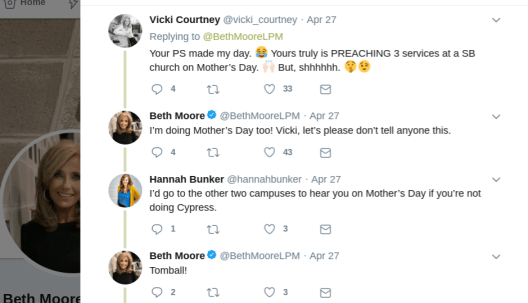
This year (2019), Beth Moore has caused quite the stir by hiding in plain sight the fact that she will be preaching the sermondoing Mother’s Day” this coming Sunday, presumably at the Tomball, Texas, campus of the church she attends (founded and pastored by her son-in-law Curtis Jones1) Bayou City Fellowship:

I say “hiding in plain sight” because she has given enough of an impression here that she is preaching the sermon to test the waters and see what the reaction will be, but has worded her tweet vaguely enough that if she meets too much resistance she can still decide to back out of preaching, give a brief word of biblically appropriate Mother’s Day greeting or encouragement to the ladies at another point during the service, and come back and claim with wide-eyed innocence that that’s what she meant all along by saying she was “doing” Mother’s Day. (Someone asked Beth point blank, in a subsequent tweet if Beth’s tweet meant that she would be preaching the Sunday service and Beth did not answer her. If she’s not, why not just say so? And if she is and isn’t ashamed of it, why not just say so?)

I say “presumably” at BCF-Tomball because, even though she publicizes specific details about time and place with other speaking engagements, she has not mentioned (at least not anywhere I can find as of the time I’m writing this) the specific church she’s preaching at on Sunday, and the church hasn’t mentioned on their website that she’ll be the guest preacher. Additionally, unlike other speaking engagements Beth does, this speaking engagement is not listed on the calendar of events at her website and she hasn’t mentioned it (other than the tweet above) on social media. With all this “open secrecy” I will be surprised if the video or audio of her sermon is posted on YouTube and/or the church website.

Why all this cloak and dagger about the highest profile woman in the Southern Baptist Convention2, possibly in the entirety of evangelicalism, preaching the Mother’s Day sermon?

Because she knows it’s unbiblical. Because we know it’s unbiblical. And it doesn’t take an electron microscope to see it. It’s right there, in black and white, jumping off the pages of Scripture:

I do not permit a woman to teach or to exercise authority over a man; rather, she is to remain quiet. 1 Timothy 2:12

It couldn’t be more clear. And for pastors who ought to know better to either fall prey to or intentionally perpetuate the serpentine seduction of “Did God really say you can’t preach?”, using Mother’s Day as an excuse to induce a woman to sin by having her deliver the sermon is a slap in the face – to God, to the church, and to women.

Using Mother’s Day as an excuse to induce a woman to sin by having her deliver the sermon is a slap in the face – to God, to the church, and to women.

What do his actions say to God? “I don’t like Your way and I won’t submit to it. I don’t trust that Your way is right regardless of what the world says. I’ll do what’s right in my own eyes.” It’s the lesson his church learns from his actions as well.

But why is inviting a woman to preach an affront to Christian women? Take a stroll down to verse 15 of 1 Timothy 2:

Yet she will be saved through childbearing—if they continue in faith and love and holiness, with self-control.

Not only does the pastor who invites a woman to preach adulterate the role God has set aside specifically for men, he also denigrates one of the good and holy roles God has specifically and intentionally set aside for women: the role of literal, and spiritual, mother.

Eve shattered God’s perfect, unique design for women by allowing herself to be seduced into rebellion. But are we daughters of Eve forever doomed to bear the shame and guilt of her sin, never to have a role in building the Kingdom? Pariahs, to be shunned and shut out of God’s plan? No, praise God! Through the cross, the good works Christ has ordained for Christian women to do – including mothering our own children and being spiritual mothers to our daughters in the faith – redeem the prestige of women. Mothering, in every sense in which God intended it, raises the role of women back to its rightful place in God’s plan.

And we don’t need men – especially men who are supposed to be rightly leading God’s people – to come along and entice us to mess that all up again.

But that’s exactly what’s happening.

When a pastor invites a woman to sin by taking over the pulpit, he drags her and the women of his church right back to post-Fall Eden. He trashes the rank and repute of our God-given high and holy role of mother and implicitly says Being a woman isn’t good enough. You have to steal the role of men to be valued and esteemed. 

When a pastor invites a woman to sin by taking over the pulpit, he implicitly says, “Being a woman isn’t good enough. You have to steal the role of men to be valued and esteemed.”

Ladies, he’s wrong.

We don’t need to be second rate imitations of men in order to “count”. We need to be first rate, full throttle, take it to the limit women of God. God loves us and values us so much more than to give men a special and amazing role and leave us without an equally special and amazing, yet totally distinct, role. The God who spoke the universe into existence and planned out an unparalleled purpose for every single plant, animal, bacterium, and every other atom of the cosmos, did not leave the queen of His creation roleless. He did not bring us into being only to toddle along after the Hairy Ones trying to copy their every move. How unloving of God, and devaluing to women, would that be? Why would you want to act like a man when God blessed you with the gift of being a woman?

If, by God’s good Providence, you’ve “stumbled across” this article and you’re a woman who has been invited to preach, I plead with you: don’t buy the lie. Say no. Your Savior has a whole treasure chest of good works for you to do as a woman. You are worth infinitely more to Him as the woman He created you to be than you are to the world, or a worldly church, as a cheap knock-off of a man.

The practice of denigrating women, devaluing our God-given role, disobeying God, and darkening the understanding of the church by inviting women to sinfully take the pulpit must stop in the house of God.

Let us be the mothers our own children need, raising up a godly seed unto the Lord. Let us be the spiritual mothers longed for by younger women in the faith, daughters orphaned by Christian women who have abandoned them to take on the role of men. The practice of denigrating women, devaluing our God-given role, disobeying God, and darkening the understanding of the church by inviting women to sinfully take the pulpit must stop in the house of God and be replaced by strong godly women, unafraid and unashamed to flourish in the precious role our Lord has blessed us with.

Especially on Mother’s Day.


Updates to this article:

1Curtis Jones (Beth Moore’s son-in-law) resigned his pastorate at BCF in July 2020.

2Beth Moore has left the Southern Baptist Convention and is now attending an Anglican church where – surprise, surprise – she preaches from time to time.


Additional Resources:

Beth Moore vs. Owen Strahan on WWUTT Podcast
(Related links):
Michelle Lesley’s Twitter thread on Beth’s Sunday sermon preaching
Beth Moore’s Twitter response to Midwestern Seminary professor Owen
Strahan’s article on biblical complementarianism

Divine Order in a Chaotic Age: On Women Preaching by Owen Strahan

Why Asking Women to Preach Is Spiritual Abuse by Josh Buice

Christian women, Discernment, Men

Throwback Thursday ~ Women and False Teachers: Why Men Don’t Get It, and Why It’s Imperative That They Do

Originally published September 22, 2017

Confession time: Sometimes – OK, often – I think my brain works more like a man’s than a woman’s. You’ve got a problem? Suck it up- here’s the solution. The mall? A perfectly horrifying way to ruin a Saturday. And why do we have to hug people hello and goodbye when we see each other multiple times a week?

I’ve always been more comfortable around men, and when I was single, I had mostly male friends. They’re generally¹ less mysterious and easier to figure out than women, and they don’t usually play those manipulative emotional games some women can be notorious for. If a man says he wants a cheese sandwich, there’s no hidden “you don’t bring me flowers often enough” meaning there. He just wants a cheese sandwich. I like that. It’s pretty much how I operate.

Which makes me the perfect person for God to plunk down smack dab in the middle of women’s ministry, right?

Harrumph.

God just has this way about Him of stretching us and growing us beyond our comfortable little confines. I used to be terrified of walking into a room full of women (They’re so unpredictable! You never know when a big emotional scene might break out!) But after years of teaching and discipling women, developing close friendships with women, serving and ministering to women, I now walk into that room and see precious sisters, created oh so tenderly and intricately by God’s loving hands.

God purposefully and intentionally made each woman unique, but with common traits and perspectives that bind us together as sisters and differentiate us from men. And because men aren’t wired by God the same way women are, sometimes they’re just not going to get the way women think about things, approach people, or respond to issues. Sometimes (shopping, flowers, hugginess) that’s no big deal. They can shrug their shoulders, extend grace, and make space for the women in their lives to think, feel, and react differently than men would without really taking the time to understand why.

There’s at least one biblical issue women respond to differently at the core level of their spiritual DNA than men do. And men, it’s crucial that you get it on this one.

But there’s at least one biblical issue women respond to differently at the core level of their spiritual DNA than men do. And men, it’s crucial that you get it on this one. You’re the pastors. The elders. The husbands. The fathers. The ones responsible before God for leading your churches and your families in doctrinally sound spiritual growth. You’ve got to get this for the sake of the girls and women you lead:

Women respond differently to false teachers than men do.

And, ladies, we need to understand this about ourselves, too.

It started, not with the advent of modern feminism, or the church age, or even the Fall. It started in the Garden.

Genesis 3 begins…

Now the serpent was more crafty than any other beast of the field that the Lord God had made. He said to the woman

Have you ever wondered why the serpent approached Eve instead of Adam?

Before sin entered the world, before that snake in the grass even thought up his dastardly plan of deception, there was a void in the world. None of the animals or birds could fill it. Neither could Adam. God determined that, in order to make His creation complete, there was a need for woman to fill that void. So He reached down with His own two hands (so to speak) and personally crafted a woman.

God had made both animals and Adam out of cold, dead dirt. Not so with woman. God made woman out of soft, warm, living flesh, already coursing with life. God made man to tend the ground from which he had come. God made woman to tend the man from which she had come.

God made man to tend the ground from which he had come. God made woman to tend the man from which she had come.

And in the same way that God used a different method for creating man and woman and gave them different modes of work, He also gave them different mental and emotional makeups.

God created women with some incredible strengths. Women are usually much better nurturers than men. We’re often better at negotiating, compromising, and making peace between opposing parties. We’re more sensitive to what others are going through and how to treat people in a kind and compassionate way. We bear up under certain pains and stressors better than men do. We’re usually better communicators than men. And, frequently it’s much easier for women to trust, love, and give the benefit of the doubt to others.

And along with those unique strengths come unique challenges that we have to watch out for and that men need some insight about.

We’re kinder and more compassionate, so we have to be careful about people who would take advantage of that. Nurturing is great for raising our children, but if we baby them all their lives, that’s not healthy. Being trusting is a fantastic character trait, but it’s imperative that we be vigilant not to put our trust in the wrong person.

Could it be that the serpent approached Eve instead of Adam because he thought she would be more trusting, give him the benefit of the doubt, and thus be easier to deceive?

First Timothy 2:14 echoes this idea. In 1 Timothy 2:11-14, God explains that women are not to teach men or exercise authority over men in the gathered body of Believers – the church. He gives two reasons for this in verses 13-14. The first reason (13) is the Creative order: “Adam was formed first, then Eve”. God’s second reason is in verse 14:

and Adam was not deceived, but the woman was deceived and became a transgressor.

It’s interesting that verse 13 refers to the specific woman, Eve, but verse 14 uses the more generic term “the woman.” Are women, as a whole, more likely to be victimized by deceivers than men are? Scripture seems to point us that direction.

In 2 Timothy 3:1-9, Paul warns Timothy that people – including those in the church – will become more and more degenerate during the last days. There will even be those who have an outer facade of godliness but are not operating by the power and indwelling of the Holy Spirit (5). In other words: false teachers. Verses 6-7 tell us that among these false teachers are those…

…who creep into households and capture weak women, burdened with sins and led astray by various passions, always learning and never able to arrive at a knowledge of the truth.

In verse 16 of this same chapter we read that “all Scripture is breathed out by God,” and we know that God never makes mistakes or chooses His words haphazardly. So we know there’s a reason God uses the words “weak women” here. Not weak men, not weak Christians, not weak people – weak women. God graciously gives a warning to women not to be taken in by these false teachers, and an exhortation to men – particularly pastors, since this is a pastoral epistle – to protect the women of their churches and families against those who would prey upon tenderhearted, trusting women.

One reason these women are weak is that they’re led astray by various passions. Today, the word “passion” or “passionate” often has a sexual connotation, but that’s not the only meaning, especially not here. Dictionary.com defines passion as “any powerful or compelling emotion or feeling, as love or hate; a strong or extravagant fondness, enthusiasm, or desire for anything.” Merriam-Webster says passion is, “the emotions as distinguished from reason; a strong liking or desire for or devotion to some activity, object, or concept.”

As with so many other valuable characteristics God has blessed women with, passion is a two-edged sword. God wants us to have a passion for holiness, pursing Christ, and biblical ministry to others, but we have to be extremely careful to steward that passion with the reins, bit, and bridle of discernment and knowledge of the Scriptures. Otherwise, we will pour our passion – our powerful and compelling loyalty, enthusiasm, fondness, and love – into the wrong teachers and doctrines.

Which brings us full circle to Eve, because that’s where her train jumped the tracks.

But the serpent said to the woman, “You will not surely die. For God knows that when you eat of it your eyes will be opened, and you will be like God, knowing good and evil.” So when the woman saw that the tree was good for food, and that it was a delight to the eyes, and that the tree was to be desired to make one wise, she took of its fruit and ate, and she also gave some to her husband who was with her, and he ate.
Genesis 3:4-6 

Notice the serpent doesn’t invite Eve to do something blatantly evil. “God knows…” “…you will be like God.” He’s tempting her to do something she thinks is godly. Then Eve takes her eyes off God and His Word and looks instead at the tree.

🍃It was good for food The fruit would satisfy a felt need. It was practical. She and Adam needed supper. Here was an easy solution. And, besides, it looked delicious and nutritious.

🍃It was a delight to the eyes– The fruit appealed to Eve’s sense of beauty. It looked good to her.

🍃It was to be desired to make one wise– Eve had a passion to grow in wisdom and godliness, and this beautiful, appealing, practical, attractive fruit seemed, in her eyes, the best and most enjoyable way to reach that goal.

This is the same way women are being deceived today. The attractive “tree” (Ever notice that most false teachers are at least somewhat physically attractive – “a delight to the eyes”?) extends a branch with lovely-looking, supposedly nutritious fruit on it which she says will lead to godly wisdom and growth (even though her teaching conflicts with God’s written Word). And it’ll be delicious too. Those who bite the apple will feast on love, positive thoughts, encouragement, and self-esteem-building teaching. It’s too appealing to the woman’s senses – and she’s too weak in her knowledge of Scripture and her desire to obey it – to pass up. She succumbs to the passions of her senses, plucks the fruit, and eats.

And then a fascinating phenomenon begins to take place. The weak woman feeds her passions with the fruit of false doctrine, and then she begins to pour that passion – that intense, compelling loyalty, love, fondness, and enthusiasm – into the false teacher herself. As anyone who has ever tried to gently open a devotee’s eyes can attest, hell hath no fury like a confronted Beth Moore disciple. I have seen women defend their favorite false teachers – against clear Scripture, mind you – with a viciousness I’m not sure I could muster to protect my own children against physical harm.

Men may enjoy a particular false teacher, but women worship them.

Men may enjoy a particular false teacher, but women worship them.

And this is the crux of the difference that men rarely grasp when the topic of discernment comes up. I’ve talked to countless pastors who don’t understand why simply preaching and teaching sound doctrine from the pulpit and in the Sunday School class isn’t sufficient to protect their churches from the infiltration of false doctrine and false teachers. This is why.

I’ve talked to countless pastors who don’t understand why simply preaching and teaching sound doctrine isn’t sufficient to protect their churches from false doctrine and false teachers. This. is. why.

Maybe a man will hear hear a biblical truth, realize the preacher he’s been listening to conflicts with it, and simply walk away. A woman won’t. Because, not only has the teaching a woman listens to inextricably wrapped its tentacles around the very core of her soul, she has also formed an emotional bond with the teacher that’s almost impossible to break. She loves her. And she will nearly always choose that loving, bonded “relationship” over biblical truth, giving the teacher the benefit of the doubt and making excuses for her every step of the way.

A woman will nearly always choose that loving, bonded “relationship” with the teacher over biblical truth, giving the teacher the benefit of the doubt and making excuses for her every step of the way.

The Holy Spirit gets it. He understands the power false teachers wield over weak women and the destruction false teaching in general brings upon the church, so He inspired Paul to write Titus 1:9:

[A pastor] must hold firm to the trustworthy word as taught, so that he may be able to give instruction in sound doctrine and also to rebuke those who contradict it.

Pastors who only preach sound doctrine are only doing half their job.

Pastors who only preach sound doctrine are only doing half their job. And notice that this verse doesn’t merely say to “rebuke teaching that contradicts sound doctrine” in a generic sort of way. It says rebuke “those who” contradict it. “Those who” are people. Specific people. People with names.

Many pastors and teachers don’t want to name names of false teachers. They’ll quote false teachers, allude to them, describe them, and drop hints as to their identity, hoping against hope their church members will figure out who they’re talking about and stop following them. But they don’t want to call specific names. I understand the fear of naming names. It opens pastors up to attack by the aforementioned disciples of false teachers. I’ve experienced their venom, and believe me, nobody wants to go through that.

Guys – pastors, teachers, husbands – I’m telling you the women you’re preaching to, the women who are in the tightest clutches of false teachers aren’t getting your veiled allusions to generic, unnamed “false teachers”.

But guys – pastors, teachers, husbands – I’m telling you the women you’re preaching to, the women who are in the tightest clutches of false teachers aren’t getting it. They are not going to hear your veiled allusions to “some Christian authors who say…” or “the pastor of one of the largest churches in America teaches…” and think you’re talking about the false teacher they’re following. They think you’re talking about somebody else. The guy their neighbor is following. That crazy preacher on TBN. But not my favorite Southern Baptist “Bible” study teacher who’s a best seller at LifeWay and is touted on social media by well known pastors.

It takes courage – manly courage – to stand up in front of your congregation, class, or wife and warn them against specific false teachers, but that’s what godly men – who love the women in their churches and families and want to see them spiritually healthy – do.

We need your help, men. The church needs your help. Your family needs your help. Please get this so you can help other “Eves” not to be deceived and weak women to become strong followers of Christ, not false teachers.


¹If it’s not abundantly clear from context, please understand that I’m speaking in generalities in this article. Naturally, individuals vary.


Additional Resources

Popular False Teachers & Unbiblical Trends

Is She a False Teacher? 7 Steps to Figuring it Out on Your Own

Clinging to the Golden Calf: 7 Godly Responses When Someone Says You’re Following a False Teacher

Basic Training: Being Berean- 8 Steps for Comparing Teaching to Scripture

Do You MIND? : Five Reasons for Pastors to Mind What Their Brides Are Reading

Women In Combat

Mailbag

The Mailbag: Top 10 FAQs

Originally published September 7, 2020

I get lots of great questions, and sometimes, they’re the same questions from lots of different people. So I thought today it would be fun, instead of answering just one person’s question, to answer lots of people’s questions. Here are the top 10 Mailbag questions readers most frequently ask:

1.

“Do you know anything about [Christian pastor/teacher/author] or his/her materials? Is he/she doctrinally sound?”

The best way to find out if I’ve written anything on a particular teacher is to put her name (make sure you spell it correctly) into the search bar, which is located at the bottom of every page of the blog. You can also check the Popular False Teachers & Unbiblical Trends tab and the Recommended Bible Teachers tab (in the blue menu bar at the top of this page) to see if the teacher’s name is located there.

If you need answers on a certain teacher right away, and I haven’t written anything about her, you will need to do the research yourself, which is a skill every Christian needs to hone anyway. (You should never just take my, or anybody else’s, word for it that a particular teacher is or isn’t trustworthy.) In case you need a little help getting started, I’ve described how I do my research, complete with some quick litmus tests and shortcuts in my article Is She a False Teacher? 7 Steps to Figuring It Out on Your Own

If I haven’t written an article about a teacher you see as problematic who’s reaching a wide audience, you’re welcome to send me her name along with any links you may have to her unbiblical teaching or behavior. If I get enough questions about a particular teacher, I’ll probably write an article on her.

2.

“Can you recommend a good
women’s/children’s/teens/particular topic Bible study?”

No. On principle, I do not recommend what I call “canned” (book, workbook, DVD, etc.) Bible studies- not even doctrinally sound ones. The church has become so utterly dependent on books and materials written by others that the majority of evangelicals have no idea how to simply pick up the Bible and study or teach straight from the text of Scripture. I may be the only one to stand against that tide, but I’m standing against it. We need to, as a general practice, cut out the middleman and get back to learning and teaching straight from the Bible itself.

If studying or teaching directly from Scripture is new to you, I would encourage you to check out the Bible Studies tab in the blue menu bar at the top of this page, which explains more about my philosophy of Bible study and provides numerous resources to help you learn how to study or teach the Bible itself.

One of the resources you’ll find is all of the Bible studies I’ve written. They are all free for individual and group use, and you are welcome to print out as many copies as you need. My studies are learn-by-doing “training wheels” that teach you: how to study/teach the Bible in a systematic way, the kinds of things you should be noticing in the text, the kinds of questions you should be asking of the text, and how the various parts of the Bible fit together to tell God’s grand story of redemption through Christ. Work through a study or two. Once you get the hang of it, you’ll be ready to unbolt those training wheels and study or teach on your own without needing to rely on anyone else’s materials any more – even mine.

Here are a few additional resources:

The Mailbag: Can you recommend a good Bible study for women/teens/kids?

The Mailbag: “We need to stop relying on canned studies,” doesn’t mean, “We need to rely on doctrinally sound canned studies.”

McBible Study and the Famine of God’s Word

3.

“You shouldn’t be warning against [popular false teacher]
for [X,Y,Z] reason!”

Sorry, but that’s not what the Bible says. The question isn’t, “Why am I warning against them?”. The question is, “Why aren’t you?”

Answering the Opposition- Responses to the Most Frequently Raised Discernment Objections

4.

I’m trying to find a doctrinally sound church. Can you help me?

It is my delight to help my brothers and sisters find a solid church. Please check out the Searching for a new church? tab in the blue menu bar at the top of this page.

If you’re newly saved and/or coming out of the New Apostolic Reformation, prosperity gospel, New Age, Catholicism, Mormonism, etc., I would strongly recommend reading through all of the resources in the “What to look for in a church” section of that tab before beginning your search for an actual church. You need to know what makes a church doctrinally sound (or not), and those resources can help.

Notice that there are multiple church search engines at the top of that tab. If you don’t find something in your area at the first search engine, go to the next one, and keep going until you’ve exhausted all of them.

Keep in mind that doctrinally sound churches are becoming scarcer and scarcer. You may have to drive longer than you’d like to get to one. It may not meet all your preferences. You might have to try a different denomination than you’re used to. The most doctrinally sound church you can find within achievable driving distance may have a few biblical “warts” (for example: a generally solid preaching/teaching church but the women’s ministry uses materials by false teachers). It is possible that God may put you in that less than perfect church to sanctify you, or for you to help bring about biblical change.

Sometimes people e-mail me asking if I can help them find a church. Your best bet is really to use all of the resources at the “Searching for a new church” tab. I want to reassure you that, unlike Walmart, I don’t have any churches in the back store room that haven’t been stocked yet. With the exception of a handful of churches my readers have recommended that I haven’t had a chance to vet yet, everything I have is out on the shelves at that tab. :0) (I would also encourage everyone reading this – if you attend a doctrinally sound church, click the link above and see if your church is listed on at least one of the three most popular church search engines: Founders, G3, and/or Master’s Seminary church search engines. If not, talk to your pastor about submitting your church’s information to one or more of these so people can find you!)

If you’ve made a good faith effort at the “Searching…” tab and have exhausted all of the resources there, and you still can’t find a passable church within achievable driving distance, you have two options (one of which is not giving up on church and staying home): move to an area that has a solid, established church, or look into church planting.

If you’re considering moving for a church, do everything in your power to make sure that church is solid and is going to stay that way. Find out about their history. Watch their worship services online regularly for a few months. Set up a Zoom call with the pastor or elders, explain your situation, and “interview them”. Don’t be shy to ask any, and as many questions as you need to. You’re picking up your entire life and moving based on what they say. Churches are apostatizing at an alarming rate. The last thing you want to do is move somewhere for a church you thought was sound, only to have it take a turn toward sin or false doctrine six months after you get there.

Personally, I think church planting is the preferable option for at least two reasons. First, you don’t have to go through the hassle, logistics (“Will I be able to find a job in this new place?”), and emotional upheaval of leaving family and friends behind that comes with moving. Second, if you’re in an area where you can’t find a good church, neither can any of your neighbors. You could be the person God uses to bring a solid church to an area without a gospel witness. How amazing would that be? Pick up the phone or fire up your email and start contacting the church planting organizations listed. Explain your dilemma. Ask for their help. If none of the church planting organizations can help, contact the nearest doctrinally sound church, explain things to the pastor, and ask about his church planting a church in your area.

5.

The leadership at my church is kicking off a new Bible study using materials by a false teacher. What should I do?

It breaks my heart that this is, indeed, a frequently asked question. Please see my article The Mailbag: How should I approach my church leaders about a false teacher they’re introducing?.

6.

My church uses …
or
I’m looking for a new church,
and I found one that’s really sound, except they use…
Bethel / Jesus Culture / Hillsong / Elevation music
or other music from heretical sources.
What should I do?

Please see my article The Mailbag: How should I approach my church leaders about a false teacher they’re introducing?. You can find information about Bethel, et al at the Popular False Teachers & Unbiblical Trends tab in the blue menu bar at the top of this page. Some other resources that may be helpful:

Why Your Church Should Stop Playing Bethel, Hillsong, Elevation and Jesus Culture

The Mailbag: False Doctrine in Contemporary Christian Music

7.

My friend is following a false teacher. How can I help her see this? 

Here are some resources that can help:

Words with Friends: How to contend with loved ones – at A Word Fitly Spoken (many additional resources linked here)

Words With Friends by Amy Spreeman

Clinging to the Golden Calf: 7 Godly Responses When Someone Says You’re Following a False Teacher 

8.

Whaddaya mean women can’t preach to men? Of course they can!

Again, sorry, but that’s not what the Bible says. I would strongly encourage you to read all of the articles in my Rock Your Role series, which examines the Scriptures dealing with the role of women in the church. (Remember, for Christians, God’s Word is our authority, not our feelings, opinions, and preferences.) I would suggest starting with these:

Jill in the Pulpit

Oh No She Di-int! Priscilla Didn’t Preach, Deborah Didn’t Dominate, and Esther Wasn’t an Egalitarian

Rock Your Role FAQs

The Mailbag: Counter Arguments to Egalitarianism

9.

Why isn’t Teacher X listed at your Popular False Teachers tab?
Does the fact that she’s not listed mean she’s doctrinally sound?
Why isn’t Teacher Y listed at your Recommended Bible Teachers tab? Does the fact that she’s not listed mean she’s a false teacher?

Please understand that these are not comprehensive lists of every false teacher or doctrinally sound teacher in existence. There are thousands of both, so that would be impossible. Also, don’t jump to conclusions about any teacher who’s not on the list. The absence of a particular teacher’s name on either list says nothing definitive about whether or not I would recommend that teacher.

The articles I’ve written about false teachers have mainly been in response to readers inquiring about them. In other words, if you don’t see a particular teacher’s name on the list, it’s probably because I haven’t been asked about her, I’ve been asked about her but haven’t had time to get to it yet, or for one of the reasons below.

The teachers on the recommended teachers list are those I’ve personally listened to or read at enough length that I feel comfortable endorsing them. Most of the teachers on the list trend toward being Calvinistic/Reformed and cessationist because I believe this is the most biblically correct view of Scripture, and because, in my experience, those of these persuasions are generally more discerning about associating with false teachers, and more expository in their teaching. (Of course there are some non-Calvinist/Reformed pastors and teachers who are stellar in these areas. I’ve had the privilege of knowing a few personally.)

There are a few other reasons you might not see someone’s name on either the false teachers or the recommended teachers lists:

• My articles on false teachers are nearly always about teachers: who are well known (thus the “Popular” in “Popular False Teachers”), who women in my particular audience – average American evangelical women – are most likely to follow, and whose materials are being used in those average American evangelical women’s churches. It takes multiple hours of research to vet teachers, and I have to invest those hours into the teachers who are deceiving the greatest numbers women in my audience.

• I don’t tend to write articles on teachers who are so blatantly heretical and/or are so well known for being heretical that it should be obvious (unless I feel there’s some compelling reason to do so). This is why you won’t see, for example, Kenneth Copeland, Benny Hinn, or Nadia Bolz-Weber on the false teachers list. Kenneth and Benny are fairly well known for being prosperity gospel heretics, and a 30 second Google search should make it obvious to most Christians who aren’t already familiar with her that Nadia is a liberal heretic. And, again, your average American evangelical woman isn’t following people like this, and her church isn’t using their materials.

• Normally, I don’t write about contemporary teachers who are dead, especially if they’re not particularly popular with my demographic. This is why you don’t see names like Mother Teresa or David Wilkerson on the list.

10.

I have a dire and complicated family/marriage/church situation,
can you help me?
Can you mentor/disciple me?

I deeply wish I could answer “yes” to all of these inquiries. I’m a helper. I want to help people. But I also know that in most of these situations, I’m not the right person for the job. So my answer to these inquiries has to be “no”. I cannot engage in counseling or discipling/mentoring relationships via e-mail.

The first reason for this is that my primary duty before the Lord is to care for my husband, children, and grandchildren, to manage my household, and to be a faithful church member. That takes a lot of time and energy. And if you’ve ever read my e-mail policy, you know I don’t even have time to answer most of the e-mails I receive, let alone the time that’s required to properly disciple, mentor, or counsel someone through a difficult circumstance.

But the second reason I’m not the right person for the job is that all of these are the job of the local church. It’s not right for me to get between you and your pastor when you need counsel or between you and an older sister at your church when you need to be discipled. You need someone who can walk with you, face to face, for the long haul, through these situations. Relying on me would be cheating yourself out of connecting with the person at your church who could be there for you the best and help you the most.

And, finally, especially in dire counseling situations such as abuse, extreme marital problems, or complex issues at church, I’m not familiar with the laws and resources in your area, I’m only hearing your side of the story, I’m not getting all of the details, etc. Your pastor or an older sister at church is there. They can better help you navigate the intricacies of the situation and provide you with more effective solutions than I can.


If you have a question about: a Bible passage, an aspect of theology, a current issue in Christianity, or how to biblically handle a family, life, or church situation, comment below (I’ll hold all questions in queue {unpublished} for a future edition of The Mailbag) or send me an e-mail or private message. If your question is chosen for publication, your anonymity will be protected.

Church, Sin

Dis. Grace.: Responding Biblically to Church Scandal

Originally published June 30, 2015


In light of the recent news about Steve Lawson, I thought it might be helpful to re-run this article. I will be removing Dr. Lawson from my list of recommended Bible teachers forthwith.

No, this is not a rumor. No, nothing has been hacked. Yes, this has been confirmed by (and was announced by) his own church. Sadly, it is true.:


It happened again last week. Another scandal. Another high profile pastor stepping down from the ministry in disgrace. Another family broken. Another church stunned and bereft.

And it’s not just the money grubbing televangelists anymore, either. This was one of the theological good guys. Sadly, pastors and Christian leaders – both those in the public eye and those right around the corner – seem to be dropping like flies these days. Adultery. Financial sin. Pornography. Abuse. Fraud. The list of sinful behavior goes on and on, leaving a wake of destruction in its path and giving Christ and His bride a black eye in the process.

So, what is the biblical response to scandals like these for Joe and Jane Christian? We view the situation through the lenses of Romans 8:28:

And we know that for those who love God all things work together for good, for those who are called according to his purpose.

How can God use this scandal, awful as it is, for my good and the good of my brothers and sisters in Christ? It’s an opportunity to learn, teach, and minister in so many ways:

Fully grasp the destructive power of sin…

Imagine the agony the pastor’s sin is creating in so many lives. What must his wife be going through? His children? His church? What about his own relationship with God? What about the lost people he was trying to win to Christ? What about the fact that his career may be over and he may lose his house?

It’s been said that sin destroys completely and completely destroys. It’s a good time to reflect on the fact that sin is not something to be trifled with. Count the cost. Would it be worth it to you to commit the same sin in your own life?

Realize your need for Christ…

“There, but for the grace of God, go I.” “Therefore let anyone who thinks that he stands take heed lest he fall.” (1 Corinthians 10:12) “Pride goes before destruction, and a haughty spirit before a fall.” (Proverbs 16:18)

Don’t fall into the trap of thinking you’re better or holier than the person who sinned, therefore, you would never do what he did. Instead, let his sin push you towards the cross, realizing that you’re just as weak and susceptible to temptation as he is. Let it amp up your prayer life and drive you to cling to Christ and His word lest you fall into sin.

Dive into God’s word…

What does the Bible say about the sin in question? Learn what God’s word says. Apply it to your life, your work, or your marriage. Teach it to your children. Share it with those in your circle of influence. Build up your brothers and sisters in Christ so they might stand firm against temptation.

Implement safeguards…

People don’t just wake up one day and decide to commit adultery or embezzlement or whatever. Every sin starts with a wayward thought, which, when left unchecked (or entertained), snowballs into action. What could the scandalized pastor have done, practically, to prevent his sin? What are some concrete, proactive steps you can take to guard against sin in your life? Maybe your husband should hold the credit cards or you should cut ties with that certain male friend. Don’t wait for sin to find you. Build some walls before it arrives.

Use the scandal as a springboard for prayer…

Pray for those involved in the scandal. Ask God to protect you, your husband, and your loved ones from that particular sin. Realize that your own pastor and church staff are tempted to sin every day, pray for them regularly, and let them know you’re praying for them.

Practice the Golden Rule

What if you were the one who sinned? How would you want people to talk about and treat you and your family? Call a sin a sin, but let’s remember, when it comes to scandals, to watch our words and actions, and treat others the way we would want to be treated.

Use the scandal as an opportunity to share the gospel…

Inevitably, some lost people will see pastoral sin as one more candle in their “Christians are just a bunch of hypocrites” cake. Don’t be embarrassed if an unbeliever approaches you with this line of fire (and whatever you do, don’t try to make light of or justify the pastor’s sin). Own it. Admit it. “You’re right. This guy sinned. He needs to repent and be forgiven by Christ. He needs to make things right with the people around him. Just like me. Just like you. By the way, Christ was crucified for sinners like him and me and you. Have you ever repented of your own sin and trusted in Christ’s death, burial, and resurrection as the payment for your sin? Mind if I tell you how?”

Repent and Forgive…

It’s hurtful when someone you trust and look up to lets you down. But because we’re sinful humans living in a broken world, it’s going to happen. The pastor who sinned needs to repent. When he does, the people around him need to forgive, even though there will probably still be disciplinary consequences to his actions. Is there sin in your life that you need to repent of and face the consequences for? Is there someone who has sinned against you that you need to forgive? God extends the grace of forgiveness to repentant sinners and the grace to forgive to their victims. Repent. Forgive.


Scandals among Christian leaders are heartbreaking, disappointing, embarrassing. But the God who sent His only Son to the cross to turn sinners into saints has a wonderful way of taking offenses and turning them into opportunities for His kingdom.

Scandals among Christian leaders are heartbreaking. But the God who sent His only Son to the cross to turn sinners into saints has a wonderful way of taking offenses and turning them into opportunities for His kingdom.

Discernment

Fighting Off the Wolves

Originally published March 20, 2018

12974352_1075682862478482_4420640709694072913_n
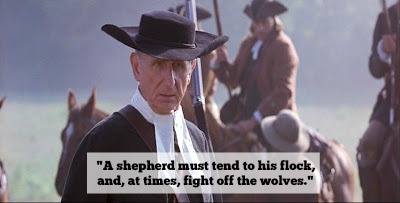
Photo and quote courtesy of The Patriot. ©2000, Columbia Pictures, Inc.

I love pastors. I really do. As a minister of music’s wife, church member, and through involvement in other ministries, I’ve known a lot of them. They have a tough job that most of us wouldn’t take on in a million years. I pray for and encourage my own pastor and my pastor buddies regularly, and try to remind y’all to do the same from time to time. All this to say, I’m not a preacher-basher. Far from it.

But sometimes there’s a bit of a veering in a dangerous direction, like a vehicle heading towards the center line, among (some, not all) pastors who are momentarily distracted and might need a friendly “Hey, did you see that truck we’re about to crash into?” from their terrified, front seat passenger.

Color me terrified.

There are pastors out there who treat false teachers with kid gloves. They refuse to label anyone as a false teacher, or only vaguely allude to certain false teachers without naming names. I’d like to encourage those pastors to pull the steering wheel to the right and call a spade a spade. Yes, they need to use the label of false teacher soberly, sadly, and only after making sure, with hard evidence, that it is warranted, but enough with grown men of God tiptoeing around under the guise of “we don’t know what’s in that person’s heart” or “I’m afraid to be painted with the ‘mean old discernment blogger’ brush.”

Enough with grown men of God tiptoeing around under the guise of “we don’t know what’s in that person’s heart” or “I’m afraid to be painted with the ‘mean old discernment blogger’ brush.”

The Bible doesn’t say anywhere that a pastor shouldn’t call someone a false teacher and warn the flock about him just because the pastor doesn’t know for sure what’s in the person’s heart or because he’s afraid of what others might think. We are all to look at their words and their behavior and judge (that’s right, I said “judge“) whether or not they are teaching what accords with sound doctrine. And if they’re not, they need to be denounced. Not in a wild-eyed, foaming at the mouth, wingnut way, but certainly loudly and decisively as a mature man of God.

We never see Paul or Jesus or Peter or Jude or any other godly man in the Bible being over-cautious about firmly calling out those who had proved themselves to be false teachers.

We never see Paul or Jesus or Peter or Jude or any other godly man in the Bible being over-cautious about firmly calling out those who had proved themselves to be false teachers.

“Beware of the leaven of the Pharisees and Sadducees.” – Jesus, Matthew 16:11

“Woe to you, Scribes and Pharisees, hypocrites…blind guides…fools…serpents…brood of vipers.” – Jesus, Matthew 23

“For such men are false apostles, deceitful workmen, disguising themselves as apostles of Christ. And no wonder, for even Satan disguises himself as an angel of light. So it is no surprise if his servants, also, disguise themselves as servants of righteousness. Their end will correspond to their deeds.” – Paul, 2 Corinthians 11:13-15

“For certain people have crept in unnoticed who long ago were designated for this condemnation, ungodly people, who pervert the grace of our God into sensuality and deny our only Master and Lord, Jesus Christ.” – Jude, Jude 4

“They count it pleasure to revel in the daytime. They are blots and blemishes, reveling in their deceptions, while they feast with you. They have eyes full of adultery, insatiable for sin. They entice unsteady souls. They have hearts trained in greed. Accursed children! Forsaking the right way, they have gone astray.” – Peter, 2 Peter 2:13b-15a

“But even if we or an angel from heaven should preach to you a gospel contrary to the one we preached to you, let him be accursed. As we have said before, so now I say again: If anyone is preaching to you a gospel contrary to the one you received, let him be accursed.”
Paul, Galatians 1:8-9

Would pastors today be wise to use this same kind of verbiage? Maybe. Maybe not. These godly men spoke and wrote in a way that was appropriate for their time, culture, and context. Our time, culture, and context are different and may call for a different approach. But the point is, none of them were afraid to speak the truth boldly about false teachers in order to protect the sheep God had entrusted to them. And we sheep today desperately need courageous shepherds who will do the same.

Pastors, if you speak out against false teachers, there are people who will get mad at you. It’s unavoidable. But there are others who know the truth and will be cheering you on and supporting you. And there are still others you will turn back from false doctrine who will learn the truth of God’s word and love you for warning them. And their souls are worth any risk or trial.

Be encouraged, dear pastors. Be strong in the Lord. Be faithful to Him. You can do this!

Be encouraged, dear pastors. Be strong in the Lord. Be faithful to Him. You can do this!

Remember the words of your brother and fellow laborer Paul, who, after condemning false teachers in Galatians 1:6-9, may have anticipated the same backlash you might receive:

For am I now seeking the approval of man, or of God? Or am I trying to please man? If I were still trying to please man, I would not be a servant of Christ.
Galatians 1:10