Judges Bible Study

Judges ~ Lesson 2

Welcome, ladies! Just a reminder, please do not skip Lesson 1 from last week (link below). Not only will it answer any questions you may have about the study itself, but if you want to study Judges properly, you must do the background work contained in Lesson 1.

Previous Lessons: 1

Read Judges 1:1-2:5

Questions to Consider

1. Review your notes from last week’s introductory lesson. What are some things to keep in mind as you begin to study the text of Judges today?

2. Carefully examine Deuteronomy 7. How does this passage serve as the historical backdrop for 1:1? How does Judges 1:1-2:5 carry out, and fail to carry out, Deuteronomy 7?

3. In your own words, and using your cross-references, describe what is happening in 1:1-3. Why was it important that the people inquired of the Lord? Were Judah and Simeon individuals?

4. Using the maps in your Bible, or these maps (scroll down to โ€œJudgesโ€), attempt to identify as many locations mentioned in today’s passage as possible, and describe, in your own words, the confrontations at each location.

5. In 1:27-36, who are Manasseh, Ephraim, Zebulun, Asher, Naphtali, and Dan? How did they fail to carry out God’s instructions from Deuteronomy 7?

6. In 2:2, God says to Israel, “You have not obeyed my voice.” List the ways Israel had disobeyed God. Did God give them “credit” for their partial obedience in 1:1-26? It has been said that “Partial obedience is disobedience.” Explain this statement in light of today’s passage.

Israel was a corporate body of God’s people, similar to the way the local church is a corporate body of God’s people. What happens to a local church when part of the body is walking in obedience, and part of the body is walking in disobedience?

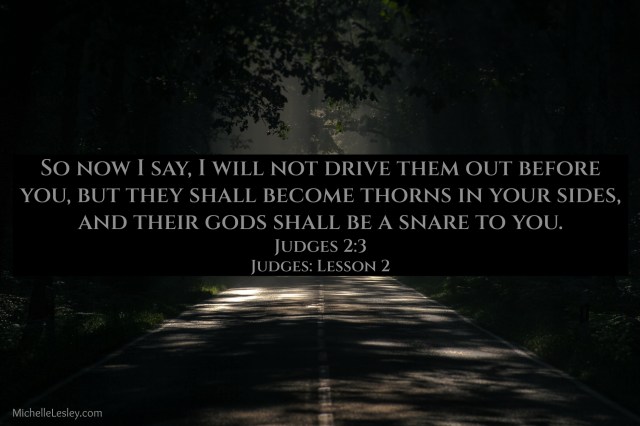
7. At the end of 2:3, what was God’s main concern with Israel’s failure to drive the pagan nations out of the Promised Land? Think about what you know of Old Testament history from this point on. How did the Canaanite gods become a “snare” to Israel?

8. Examine these New Testament passages. How is what God teaches Christians in the New Testament about avoiding false teachers and professing Christians who live in unrepentant sin similar to God’s commands in Deuteronomy and Judges about driving out the pagans so Israel wouldn’t be drawn away by sin and false gods?

9. What was the people’s response to God pronouncing the consequences of their sin in 2:4-5? Does it seem from these verses that this was a godly grief over their sin or a worldly grief over the consequences? What kind of grief does God want us to have when confronted with our sin? Does God always remove the consequences of our sin when we repent? Watch, as we continue our study in Judges, to see if God removes the consequences of Israel’s sin.

10. Today’s passage lays the foundation for what is to come in the book of Judges. Describe the foundation Israel laid, and what you expect to see happen when they build on that foundation in the chapters to come.


Homework

  • Think about your church. Is there any way part of the body is walking in disobedience? How? Commit to praying for your church about this, and prayerfully consider whether you should speak to your pastor about it, and how you might influence your brothers and sisters in Christ toward obedience to Scripture.
  • Consider your relationships and partnerships in light of the New Testament passages linked in #8. Is there any way you need to “come out from among them and be ye separate”? Pray about how God would have you be set apart to Him when it comes to these relationships and partnerships.

Suggested Memory Verse
Judges Bible Study

Judges ~ Lesson 1- Introduction

Welcome to our new study: Judges! The era of the judges was a dark time for the people of Israel – a time of rampant sin, idolatry, and rebellion against the God who loved them and kept calling them back to Himself. The theme verse of Judges paints a picture of just how bleak things really were:

In those days there was no king in Israel. Everyone did what was right in his own eyes.

Judges 21:25

The title pic for this study is meant to evoke the image of the people of God walking down a road broken by their sin, surrounding themselves with so much darkness and evil it all but blocks out the lamp for their feet and the light for their path. But we will see the love of God continuing to beam down on His people, dappling their darkness with spots of His marvelous light.

Could it be that Judges is just the book God’s people should be studying today?


If you’re new to using my Bible studies, just a few housekeeping items and helpful hints:

The studies Iโ€™ve written (you can find all of them at the Bible Studies tab in the blue menu bar at the top of this page) are like โ€œtraining wheelsโ€. Theyโ€™re designed to teach you how to study the Bible for yourself (or teach it to others) and what kinds of questions to ask of the text so that, when you get the hang of it, you wonโ€™t have to depend on other peopleโ€™s books and materials โ€“ even mine โ€“ any more. To that end, I do not provide answersย for the study questions in the studies Iโ€™ve written.

My studies are meant to be extremely flexible and self-paced so that you can use them in the way that works best for you. You can do an entire lesson in one day or work on the questions over the course of the week (or longer). You do not need to feel obligated to answer all (or any) of the questions. If the Holy Spirit parks you on one question for several days, enjoy digging deep into that one aspect of the lesson. If He shows you something I haven’t written a question about that captures your attention, dive in and study it! Those are ways the Holy Spirit speaks to us through His Word. This is your time to commune with the Lord, not a school assignment or work project you are beholden to complete in a certain way by a certain deadline.

I will post a new lesson on the blog every Wednesday, so there is nothing to sign up for or commit to. Simply stop by the blog each week, or subscribe to the blog via e-mail to have the lessons delivered to your inbox.

I use hyperlinks liberallyThe Scriptures for each lesson will be linked at the beginning of the lesson and in the lesson questions. As you’re reading the lesson, whenever you see a word in a different color text, click on it, and it will take you to a Scripture, article, or other resource that will help as you study.

All of the studies Iโ€™ve written are suitable for groups or individuals. You are welcome to use them as a Sunday school or Bible study class curriculum (for free) with proper attribution.

You are also welcome to print out any of my Bible studies (or any article Iโ€™ve written) for free and make as many copies as youโ€™d like, again, with proper attribution. Iโ€™ve explained more about that in this article (3rd section).


Introduction to Judges

Before we begin studying a book of the Bible, itโ€™s very important that we understand some things about that book. We need to knowโ€ฆ

Who the author was and anything we might be able to find out about him or his background.

Who the audience of the book is: Jews or Gentiles? Old Testament Israelites or New Testament Christians? This will help us understand the authorโ€™s purpose and approach to what heโ€™s writing.

What kind of biblical literature weโ€™re looking at. We approach books of history differently than books of wisdom, books of wisdom differently than books of prophecy, etc.

What the purpose of the book is. Was it written to encourage? Rebuke? Warn?

What the historical backdrop is for the book. Is Israel at war? At peace? In exile? Under a bad king? Good king? Understanding the historical events surrounding a piece of writing help us understand what was written and why it was written.

When the book was written. Where does the book fall on the timeline of biblical history? This is especially important for Old Testament books which are not always arranged in chronological order.

So this week, before we start studying the actual text of the book of Judges, we need to lay the foundation to understanding the book by finding the answers to these questions.

Read the following overviews of the book of Judges, taking notes on anything that might aid your understanding of the book, and answer the questions below:

Bible Introductions: Judgesย at Grace to You

Overview of the Book of Judgesย at Reformed Answers

Summary of the Book of Judgesย at Got Questions

1. Who wrote the book of Judges? How do we know (or why do we not know) this?

2. Approximately when was Judges written? What is the geographical setting of the book of Judges? Here are some maps (scroll down to โ€œJudgesโ€) that may be helpful as you study through the book of Judges.

3. Who is the original, intended audience of the book of Judges? Describe the historical setting (historic events, politics, sociology of the time, etc.) of Judges.

4. Whichย genre of biblical literature is the book of Judges: law, history, wisdom, poetry, narrative, epistles, or prophecy/apocalyptic? What does this tell us about the approach we should take when studying this book versus our approach to books of other genres?

5. What is the theme or purpose of the book of Judges?

6. What are some of the major topics of instruction or exhortation in the book of Judges? How do these topics relate to the theme of Judges?

7. What are some ways Judges points to and connects to Jesus?

8. What else did you learn about the setting of this book that might help you understand the text of the book better?

Take some time in prayer this week to begin preparing your heart for this study. Ask God to give you wisdom and understanding for the text, and an increased hatred for sin and hunger for holiness, as we study Judges together.

Uncategorized

The Word on Wednesdays

Hi ladies! I hope youโ€™ve been enjoying The Word on Wednesday Bible study lessons and resources, and that youโ€™re looking forward to our new study as much as I am.

Iโ€™ve been taking a break on Wednesdays getting ready for our new study. I hope youโ€™ll enjoy it and that it will edify you as you seek to grow in Christ and His Word. (The picture above does not mean we will be studying James. :0)

Unless Providentially hindered, I hope to announce the new study in the next few weeks. Stay tuned, and keep an eye on the blog on Wednesdays.

In the meantime, I’ll be posting some articles from the archives that I think youโ€™ll find helpful as we make our way toward our next study. Here is this weekโ€™s article:

Wednesday’s Word

Wednesday is Bible study day here on the blog. In my Wednesday’s Word Bible study series youโ€™ll find miscellaneous, one lesson Bible studies from each book of the Bible. One chapter of Scripture followed by study questions. This sampler series demonstrates that thereโ€™s nothing to be afraid of when approaching those โ€œlesser knownโ€ books and that every book of the Bible is valuable and worth studying.

Wednesday’s Word ~ Psalm 139

Oย Lord, you haveย searched me and known me!
2ย Youย know when I sit down and when I rise up;
ย ย ย ย youย discern my thoughts from afar.
3ย You search out my path and my lying down
ย ย ย ย and are acquainted with all my ways.
4ย Even before a word is on my tongue,
ย ย ย ย behold, Oย Lord,ย you know it altogether… Continue reading…

Sermon on the Mount Bible Study

The Sermon on the Mount ~ Lesson 14- Wrap Up

Previous Lessons: 1, 2, 3, 4, 5, 6, 7, 8, 9, 10, 11, 12, 13

Questions to Consider

1. Was there anything new God taught you in this study that particularly impacted you? What was it, and why was it so significant?

2. How is your walk with the Lord different after this study than it was before?

3. Which of the โ€œmiddle partsโ€ (ex: merciful, poor in spirit) of the Beatitudes do you seem to be maturing in? Which are areas of weakness for you? How did this study help you come to those conclusions?

4. What have you learned from this study about what it means to be salt and light in the world, and how, practically, to be saltier and brighter in your own life?

5. What did this study teach you about the posture of the heart as the motivator for our obedience to the commands of Scripture?

6. Have there been any passages or concepts in this study that God used to convict you of disobedience and lead you to repentance? How will you walk differently in this area from now on?

7. What have you learned about God and His nature and character from this study?


Homework

Spend some time in prayer this week asking God to show you how to put into practice one thing you learned from this study.

Recite all of your memory verses from this study. Which one is most meaningful to you right now?

Sermon on the Mount Bible Study

The Sermon on the Mount ~ Lesson 13

Be sure to come back next week for our “wrap up” lesson!

Previous Lessons: 1, 2, 3, 4, 5, 6, 7, 8, 9, 10, 11, 12

Matthew 7:24-29

Questions to Consider

1. Briefly review the “middle parts” (ex: merciful, poor in spirit) of the Beatitudes, the “salt and light” passage, and the “heart of the law” passage in Matthew 5:1-12, 13-16, 14-20. Now read 7:24-29 in light of those passages.

2. In the Beatitudes, Jesus lists the traits that define Christian character. In much of the rest of the Sermon on the Mount He fleshes out what many of these character traits look like when walked out in “real life”. Which of the traits (the “middle parts” – there could be several) listed in the Beatitudes is Jesus expanding on in today’s passage?

How do: being wise, obedient, “building your house on the rock,” and extolling Jesus’ authority make you salty and bright? (5:13-16)

3. Review from our previous lessons (links above) the idea that the Sermon on the Mount is to the New Testament / new covenant what the Ten Commandments were to the Old Testament / old covenant.

Zoom out and think “big picture” about the Sermon on the Mount and the Ten Commandments. How do they both reinforce the concept of God’s/Jesus’ authority (29) to direct our lives? How do they both impart the idea that we are to submit to Him and obey Him? How do they both demonstrate that God blesses our submission and obedience?

Despite having dropped the “You have heard it said…but I say to you…” framing of His teaching in chapter 6, how is Jesus still shifting the people’s focus from outward obedience to the letter of the law to zeroing in on the attitude of their hearts and the spirit of the law? How must being a genuinely regenerated Believer – being wise, building our lives on the rock of Christ, and bowing to the authority of Christ – be at the heart of our obedience to God?

4. Explain the parable in verses 24-27- What do the…

  • wise and foolish
  • the house
  • the rock and the sand
  • rain, floods, wind
  • the foundation

…represent?

5. How does 24-27 flow out of 21-23? In verse 24, how does the introductory phrase, โ€œeveryone thenโ€ function similarly to โ€œtherefore,โ€ and other summarizing or “pivot” words/phrases? How is 24-25 the remedy for 21-23? What are โ€œthese words of Mineโ€? (24) Compare 24-27 to these verses. What similarities do you see? Compare verse 23 with verse 27. What is the main idea both of these verses convey?

6. Consider the concepts of โ€œwise and foolishโ€ here in this passage in light of other Scriptures about wisdom and foolishness that you’re familiar with. (If you’re not familiar, start with these, and use your cross-references.) How do the wise man and foolish man in this passage fit in with Scripture’s overall teaching about wisdom and foolishness? Where does wisdom come from?

Compare the wisdom of the wise man in verses 24-25 to the amazing wisdom Christ displayed throughout the Sermon on the Mount.

7. When Jesus originally preached this sermon, did He mean verses 24-27 in a “big picture” way (believing / disbelieving the gospel) or a “little picture” way (trusting Christ / not having Christ to trust through the “storms of life”)? Is it reasonable, and rightly handling Scripture, for today’s Believer to understand and apply this passage both ways? Why or why not?

Big picture: What is the end result of a life founded on Christ versus a life founded on anything else (i.e. “all other ground is sinking sand”)?

Little picture: How do Believers weather the storms of life compared to unbelievers? What assurances and comforts do we have during difficult times? What are some of the temporal benefits and blessings of believing the gospel and obeying Christ?

8. In verses 28-29, explain the difference between Jesusโ€™ authoritative teaching and the scribesโ€™ non-authoritative teaching. Where did Jesus’ authority in teaching come from? Think about the people Jesus was speaking to, and try to put yourself in their shoes. Why would His speaking authoritatively have been โ€œastonishingโ€? (Don’t forget to use your cross-references.)


Homework

  • Imagine youโ€™re an average, first century Jew, trying to live faithfully while waiting for the Messiah to come. Youโ€™ve just finished listening to the Sermon on the Mount. Think back over everything youโ€™ve heard Jesus say in chapters 5-7. What are your 4-5 most important takeaways? Whatโ€™s your impression of Jesus?
  • You knew it was coming… :0)
When I was a kid, we only had the first two verses of this song.
I like the verses that have been added!

Suggested Memory Verse