Ruth Bible Study

Ruth: Lesson 2

Previous Lessons: 1

Ruth 1

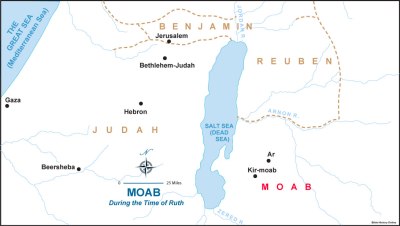
Photo courtesy of bible-history.com

In the days when the judges ruled there was a famine in the land, and a man of Bethlehem in Judah went to sojourn in the country of Moab, he and his wife and his two sons. 2 The name of the man was Elimelech and the name of his wife Naomi, and the names of his two sons were Mahlon and Chilion. They were Ephrathites from Bethlehem in Judah. They went into the country of Moab and remained there. 3 But Elimelech, the husband of Naomi, died, and she was left with her two sons. 4 These took Moabite wives; the name of the one was Orpah and the name of the other Ruth. They lived there about ten years, 5 and both Mahlon and Chilion died, so that the woman was left without her two sons and her husband.

6 Then she arose with her daughters-in-law to return from the country of Moab, for she had heard in the fields of Moab that the Lord had visited his people and given them food. 7 So she set out from the place where she was with her two daughters-in-law, and they went on the way to return to the land of Judah. 8 But Naomi said to her two daughters-in-law, “Go, return each of you to her mother’s house. May the Lord deal kindly with you, as you have dealt with the dead and with me. 9 The Lord grant that you may find rest, each of you in the house of her husband!” Then she kissed them, and they lifted up their voices and wept. 10 And they said to her, “No, we will return with you to your people.” 11 But Naomi said, “Turn back, my daughters; why will you go with me? Have I yet sons in my womb that they may become your husbands? 12 Turn back, my daughters; go your way, for I am too old to have a husband. If I should say I have hope, even if I should have a husband this night and should bear sons, 13 would you therefore wait till they were grown? Would you therefore refrain from marrying? No, my daughters, for it is exceedingly bitter to me for your sake that the hand of the Lord has gone out against me.” 14 Then they lifted up their voices and wept again. And Orpah kissed her mother-in-law, but Ruth clung to her.

15 And she said, “See, your sister-in-law has gone back to her people and to her gods; return after your sister-in-law.” 16 But Ruth said, “Do not urge me to leave you or to return from following you. For where you go I will go, and where you lodge I will lodge. Your people shall be my people, and your God my God. 17 Where you die I will die, and there will I be buried. May the Lord do so to me and more also if anything but death parts me from you.” 18 And when Naomi saw that she was determined to go with her, she said no more.

19 So the two of them went on until they came to Bethlehem. And when they came to Bethlehem, the whole town was stirred because of them. And the women said, “Is this Naomi?” 20 She said to them, “Do not call me Naomi; call me Mara, for the Almighty has dealt very bitterly with me. 21 I went away full, and the Lord has brought me back empty. Why call me Naomi, when the Lord has testified against me and the Almighty has brought calamity upon me?”

22 So Naomi returned, and Ruth the Moabite her daughter-in-law with her, who returned from the country of Moab. And they came to Bethlehem at the beginning of barley harvest.


The Holy Bible, English Standard Version. ESV® Permanent Text Edition® (2016). Copyright © 2001 by Crossway Bibles, a publishing ministry of Good News Publishers.


Questions to Consider

1.  Briefly review the background and setting of the book of Ruth from lesson 1 (link above).

2. What does verse 1 tell us about the period of Israel’s history in which the events of the book of Ruth take place? As we learned in lesson 1, Jair was most likely judging Israel at this time. What else does verse 1 tell us was happening in Israel as the story opens?

3. Describe the sequence of events in verses 1-5 in your own words. Who are each of the people in this passage, and how are they related to one another? What is an Ephrathite?

4. On the map, trace Naomi’s family’s journey to and from Moab. What does the Old Testament tell us about Moab and the Moabites? Were they enemies or allies of Israel? Were they worshipers of God or of idols? What had happened the last time Israel joined with Moab? Did God want His people mingling with the Moabites?

5. Compare Naomi and Ruth’s journey (6) from the pagan land of Moab back to Israel, the Promised Land of God’s people, with the prodigal son’s journey from the pig pen back to his father’s house. How can both of these stories symbolize passing from death in sin to life in Christ?

6. In verses 8-13, what is Naomi’s main concern for Ruth and Orpah? Considering the culture and socio-economic status of women at that time, was this a valid concern? But considering the fact that Ruth and Orpah would be returning to a life of idolatry (15) if they stayed in Moab, why didn’t Naomi concern herself more with their spiritual state and urge them to come back to Bethlehem with her? Is it possible Ruth was already a believer and didn’t want to stay in a land of idolatry? Could this have been one of the things on Ruth’s mind in verses 16-17? (Note Ruth’s mention of “God” in 16 and her invoking of “the Lord” in her vow in 17).

7. Look at the footnotes on verse 20. What do the names “Naomi” and “Mara” mean? Describe Naomi’s outlook and attitude in verses 20-21. The Bible tells us to give thanks in all circumstances. Naomi had certainly been through some sad and difficult times, but she had many things to be thankful for. What were some of those things? What impact might it have had on the women of Bethlehem (19) if Naomi had testified to God’s love, care, and faithfulness in her adversity instead of spewing bitterness?

8. Which of God’s attributes do we see displayed in this chapter? Point to examples in the text of God’s sovereignty, provision, guidance, and other attributes you see.


Homework

Like Naomi, sometimes we can get so wrapped up in our own problems and suffering that we don’t think about what our attitude, words, and demeanor are saying to others about God. Think about a difficult time you’ve experienced in the past (or may be experiencing now). How did you talk about it to others? With bitterness and complaints? What were some things you could have been thankful to God for in that situation? What impact might it have had on those around you if you had testified to God’s love, care and faithfulness instead? Might your testimony about God’s goodness during your suffering have led to an opportunity to share the gospel with someone?

Ruth Bible Study

Ruth: Lesson 1

Welcome to our new study of Ruth! There are so many captivating facets to the book of Ruth: it’s a snippet of Old Testament history, a beautiful romance, a demonstration of God’s love and value of women, a foreshadowing of Christ- our Redeemer. Over the next several weeks, we’ll be taking a look at all these treasures – and more – that God has for us to discover through Ruth’s story.

Let’s get started!

Introduction to the book of Ruth:

Before we begin studying a book of the Bible, it’s very important that we understand some things about that book. We need to know…

Who the author was and anything we might be able to find out about him or his background.

Who the audience of the book is: Jews or Gentiles? Old Testament Israelites or New Testament Christians? This will help us understand the author’s purpose and approach to what he’s writing.

What kind of biblical literature we’re looking at. We approach books of history differently than books of wisdom, books of wisdom differently than books of prophecy, etc.

What the purpose of the book is. Was it written to encourage? Rebuke? Warn?

What the historical backdrop is for the book. Is Israel at war? At peace? In exile? Under a bad king? Good king? Understanding the historical events surrounding a piece of writing help us understand what was written and why it was written.

When the book was written. Where does the book fall on the timeline of biblical history? This is especially important for Old Testament books which are not always arranged in chronological order.

So this week, before we start studying the actual text of the book of Ruth, we need to lay the foundation to understanding the book by finding the answers to these questions.

Read the following overviews of the book of Ruth, taking notes on anything that might aid your understanding of the book, and answer the questions below:

Bible Introductions: Ruth at Grace to You

Overview of the Book of Ruth at Reformed Answers

Book of Ruth at Got Questions

1. Who wrote the book of Ruth? Does the fact that we don’t definitively know the author’s name mean we can’t trust the biblicality of this book?

2. What is the approximate date Ruth was written? During what period of Israel’s history (kings, exile, judges, antediluvian, etc.) was Ruth written?

3. Considering the period of Israel’s history during which Ruth was written, who do you think is the intended audience of the book of Ruth? Why?

4. Which genre of biblical literature is the book of Ruth: law, history, wisdom, poetry, narrative, epistles, or prophecy/apocalyptic? What does this this tell us about the approach we should take when studying this book versus our approach to books of other genres?

5. What is the theme or purpose of the book of Ruth?

6. Who are the main characters in the book of Ruth?

7. Where do the events in the book of Ruth take place? (Sometimes, a good Bible map like this one or this one can be helpful.)

8. What else did you learn about Ruth or the setting of this book that might help you understand the text of the book better?

Ezra Bible Study

Ezra: Lesson 11

ezra-study-e1465330077513

Previous Lessons: 1, 2, 3, 4, 5, 6, 7, 8, 9, 10

Ezra 10

While Ezra prayed and made confession, weeping and casting himself down before the house of God, a very great assembly of men, women, and children, gathered to him out of Israel, for the people wept bitterly. And Shecaniah the son of Jehiel, of the sons of Elam, addressed Ezra: “We have broken faith with our God and have married foreign women from the peoples of the land, but even now there is hope for Israel in spite of this. Therefore let us make a covenant with our God to put away all these wives and their children, according to the counsel of my lord and of those who tremble at the commandment of our God, and let it be done according to the Law. Arise, for it is your task, and we are with you; be strong and do it.” Then Ezra arose and made the leading priests and Levites and all Israel take an oath that they would do as had been said. So they took the oath.

Then Ezra withdrew from before the house of God and went to the chamber of Jehohanan the son of Eliashib, where he spent the night, neither eating bread nor drinking water, for he was mourning over the faithlessness of the exiles. And a proclamation was made throughout Judah and Jerusalem to all the returned exiles that they should assemble at Jerusalem, and that if anyone did not come within three days, by order of the officials and the elders all his property should be forfeited, and he himself banned from the congregation of the exiles.

Then all the men of Judah and Benjamin assembled at Jerusalem within the three days. It was the ninth month, on the twentieth day of the month. And all the people sat in the open square before the house of God, trembling because of this matter and because of the heavy rain. 10 And Ezra the priest stood up and said to them, “You have broken faith and married foreign women, and so increased the guilt of Israel. 11 Now then make confession to the Lord, the God of your fathers and do his will.Separate yourselves from the peoples of the land and from the foreign wives.” 12 Then all the assembly answered with a loud voice, “It is so; we must do as you have said. 13 But the people are many, and it is a time of heavy rain; we cannot stand in the open. Nor is this a task for one day or for two, for we have greatly transgressed in this matter. 14 Let our officials stand for the whole assembly. Let all in our cities who have taken foreign wives come at appointed times, and with them the elders and judges of every city, until the fierce wrath of our God over this matter is turned away from us.” 15 Only Jonathan the son of Asahel and Jahzeiah the son of Tikvah opposed this, and Meshullam and Shabbethai the Levite supported them.

16 Then the returned exiles did so. Ezra the priest selected men, heads of fathers’ houses, according to their fathers’ houses, each of them designated by name. On the first day of the tenth month they sat down to examine the matter; 17 and by the first day of the first month they had come to the end of all the men who had married foreign women.

18 Now there were found some of the sons of the priests who had married foreign women: Maaseiah, Eliezer, Jarib, and Gedaliah, some of the sons of Jeshua the son of Jozadak and his brothers. 19 They pledged themselves to put away their wives, and their guilt offering was a ram of the flock for their guilt. 20 Of the sons of Immer: Hanani and Zebadiah. 21 Of the sons of Harim: Maaseiah, Elijah, Shemaiah, Jehiel, and Uzziah. 22 Of the sons of Pashhur: Elioenai, Maaseiah, Ishmael, Nethanel, Jozabad, and Elasah.

23 Of the Levites: Jozabad, Shimei, Kelaiah (that is, Kelita), Pethahiah, Judah, and Eliezer. 24 Of the singers: Eliashib. Of the gatekeepers: Shallum, Telem, and Uri.

25 And of Israel: of the sons of Parosh: Ramiah, Izziah, Malchijah, Mijamin, Eleazar, Hashabiah, and Benaiah. 26 Of the sons of Elam: Mattaniah, Zechariah, Jehiel, Abdi, Jeremoth, and Elijah. 27 Of the sons of Zattu: Elioenai, Eliashib, Mattaniah, Jeremoth, Zabad, and Aziza. 28 Of the sons of Bebai were Jehohanan, Hananiah, Zabbai, and Athlai. 29 Of the sons of Bani were Meshullam, Malluch, Adaiah, Jashub, Sheal, and Jeremoth. 30 Of the sons of Pahath-moab: Adna, Chelal, Benaiah, Maaseiah, Mattaniah, Bezalel, Binnui, and Manasseh. 31 Of the sons of Harim: Eliezer, Isshijah, Malchijah, Shemaiah, Shimeon, 32 Benjamin, Malluch, and Shemariah. 33 Of the sons of Hashum: Mattenai, Mattattah, Zabad, Eliphelet, Jeremai, Manasseh, and Shimei. 34 Of the sons of Bani: Maadai, Amram, Uel, 35 Benaiah, Bedeiah, Cheluhi, 36 Vaniah, Meremoth, Eliashib, 37 Mattaniah, Mattenai, Jaasu. 38 Of the sons of Binnui: Shimei, 39 Shelemiah, Nathan, Adaiah, 40 Machnadebai, Shashai, Sharai, 41 Azarel, Shelemiah, Shemariah, 42 Shallum, Amariah, and Joseph. 43 Of the sons of Nebo: Jeiel, Mattithiah, Zabad, Zebina, Jaddai, Joel, and Benaiah. 44 All these had married foreign women, and some of the women had even borne children.


The Holy Bible, English Standard Version Copyright © 2001 by Crossway Bibles, a publishing ministry of Good News Publishers.


Questions to Consider:

1. In chapter 9, Ezra prayed a beautiful prayer of repentance for Israel’s corporate sin, which you may wish to briefly review, as it led to the events in chapter 10. What specific sin do chapters 9 and 10 deal with? Why had God commanded His people not to commit this sin?

2. What does verse 1 say Ezra was doing? The people of Israel? Explain the impact and example Ezra’s genuine (6-7) repentance and contrition had on the people. Why is it important for our pastors, elders, and teachers to model contrition, repentance, and other godly traits and habits for us today? Do you set a godly example for others to imitate?

3. Why did Shecaniah say “even now there is hope for Israel in spite of [our sin]”? (2) What was Israel’s hope? Compare Israel’s hope for God’s mercy and forgiveness of sin in response to true repentance with 1 John 1:9. Why does God’s forgiveness bring hope? How does God’s response to repentance in both the Old and New Testament demonstrate His immutability?

4. What did the proclamation say would happen to anyone who failed to appear for the assembly? (7-8) How did the people respond? (9) How do the concepts of “covenant” (3), “oath” (5), and the details of, and Israel’s response to the proclamation indicate the gravity with which they regarded their sin? Why are gravity and grief proper responses to our sin?

5. In this chapter, God’s people divorced their unbelieving, pagan spouses. Is this chapter a command for Christians today to divorce their unbelieving spouses? How can we be sure it is not? How do these two passages on divorce (Ezra 10 and 1 Corinthians 7:12-16) demonstrate the importance of understanding the difference between descriptive and prescriptive passages? (For more on divorce in Ezra 10, click here and scroll about 2/3 of the way down to the paragraph that begins “And one issue comes to the floor…”) How does this chapter show us what it means to take the actions necessary to turn from our sin and walk in repentance?

6  Do verses 12-14 indicate that Israel was trying to put off repenting or that they wanted to go about repenting in a thorough and orderly way? How many months did the repentance and divorce process take? (16b-17a) Which classes of people went first in the repentance and divorce process? (18, 23) Followed by which class? (25) How does this order again stress that the leaders of God’s people must set a godly example?


Ezra Bible Study

Ezra: Lesson 10

ezra-study-e1465330077513

Previous Lessons: 1, 2, 3, 4, 5, 6, 7, 8, 9

Ezra 9

After these things had been done, the officials approached me and said, “The people of Israel and the priests and the Levites have not separated themselves from the peoples of the lands with their abominations, from the Canaanites, the Hittites, the Perizzites, the Jebusites, the Ammonites, the Moabites, the Egyptians, and the Amorites. For they have taken some of their daughters to be wives for themselves and for their sons, so that the holy race has mixed itself with the peoples of the lands. And in this faithlessness the hand of the officials and chief men has been foremost.” As soon as I heard this, I tore my garment and my cloak and pulled hair from my head and beard and sat appalled.Then all who trembled at the words of the God of Israel, because of the faithlessness of the returned exiles, gathered around me while I sat appalled until the evening sacrifice. And at the evening sacrifice I rose from my fasting, with my garment and my cloak torn, and fell upon my knees and spread out my hands to the Lord my God, saying:

“O my God, I am ashamed and blush to lift my face to you, my God, for our iniquities have risen higher than our heads, and our guilt has mounted up to the heavens. From the days of our fathers to this day we have been in great guilt. And for our iniquities we, our kings, and our priests have been given into the hand of the kings of the lands, to the sword, to captivity, to plundering, and to utter shame, as it is today. But now for a brief moment favor has been shown by the Lord our God, to leave us a remnant and to give us a secure hold within his holy place, that our God may brighten our eyes and grant us a little reviving in our slavery. For we are slaves. Yet our God has not forsaken us in our slavery, but has extended to us his steadfast love before the kings of Persia, to grant us some reviving to set up the house of our God, to repair its ruins, and to give us protection in Judea and Jerusalem.

10 “And now, O our God, what shall we say after this? For we have forsaken your commandments,11 which you commanded by your servants the prophets, saying, ‘The land that you are entering, to take possession of it, is a land impure with the impurity of the peoples of the lands, with their abominations that have filled it from end to end with their uncleanness. 12 Therefore do not give your daughters to their sons, neither take their daughters for your sons, and never seek their peace or prosperity, that you may be strong and eat the good of the land and leave it for an inheritance to your children forever.’ 13 And after all that has come upon us for our evil deeds and for our great guilt, seeing that you, our God, have punished us less than our iniquities deserved and have given us such a remnant as this, 14 shall we break your commandments again and intermarry with the peoples who practice these abominations? Would you not be angry with us until you consumed us, so that there should be no remnant, nor any to escape? 15 O Lord, the God of Israel, you are just, for we are left a remnant that has escaped, as it is today. Behold, we are before you in our guilt, for none can stand before you because of this.”


The Holy Bible, English Standard Version Copyright © 2001 by Crossway Bibles, a publishing ministry of Good News Publishers.


Questions to Consider:

1. Ezra and the second wave of exiles had made it back to Jerusalem safely, but everything was not hunky dory. In your own words, summarize the dilemma this chapter deals with.

2. Which specific sin does this chapter address? (1-2) Which classes of Israelites had intermarried with foreigners? (1) Which class was leading the way in the sin of intermarriage? (2b) How does it affect God’s people when their leaders set a bad example by sinning? Why is it important today that pastors and elders are required to be “above reproach“?

3. What was the first thing Ezra did when he was informed of the intermarriages? (3-4) What did the people who feared God and had not sinned by intermarrying do? (4) Why do you think they did this? What was the second thing Ezra did? (5) Compare and contrast Ezra’s leadership and example with the leadership and example of the “officials and chief men” (2).

4. Why did Ezra react with such grief and repentance over the intermarriages? (7, 10-12a, 14) What are the “abominations” referred to in verses 11 and 14? Read 2 Corinthians 7:10. Does Ezra’s grief seem godly (grief over offending God) or worldly (solely afraid of sin’s consequences)? Did Ezra confess and seek forgiveness for his own sin or the people’s sin?

5. In what (spiritual) posture does Ezra approach God in prayer? (6a) Ezra’s prayer can be broken down into several smaller sections:

6-7 Admission of Israel’s G____t

8-9- Acknowledgement of God’s G___ness

10-12- Confession of Israel’s specific S_n

13-14- Recognition that Israel deserves P_____ment

15- Petition for God’s M___y

How can Ezra’s prayer serve as a model to us when we repent of our sin and ask God’s forgiveness?

6. To whom does the phrase “holy race” (2) refer? Does the word “race” in this phrase mean skin color? Some people try to use verses like this to support the fale teaching of Kinism. Considering the historical background and context of this chapter, can verse 2 be used to support banning interracial marriage and segregating worship in the church today? Why not? How does this demonstrate the importance of understanding and using Scripture in context?

Ezra Bible Study

Ezra: Lesson 9

ezra-study-e1465330077513

Previous Lessons: 1, 2, 3, 4, 5, 6, 7, 8

Ezra 8

These are the heads of their fathers’ houses, and this is the genealogy of those who went up with me from Babylonia, in the reign of Artaxerxes the king: Of the sons of Phinehas, Gershom. Of the sons of Ithamar, Daniel. Of the sons of David, Hattush. Of the sons of Shecaniah, who was of the sons of Parosh, Zechariah, with whom were registered 150 men. Of the sons of Pahath-moab, Eliehoenai the son of Zerahiah, and with him 200 men. Of the sons of Zattu, Shecaniah the son of Jahaziel, and with him 300 men. Of the sons of Adin, Ebed the son of Jonathan, and with him 50 men. Of the sons of Elam, Jeshaiah the son of Athaliah, and with him 70 men. Of the sons of Shephatiah, Zebadiah the son of Michael, and with him 80 men. Of the sons of Joab, Obadiah the son of Jehiel, and with him 218 men. 10 Of the sons of Bani, Shelomith the son of Josiphiah, and with him 160 men. 11 Of the sons of Bebai, Zechariah, the son of Bebai, and with him 28 men. 12 Of the sons of Azgad, Johanan the son of Hakkatan, and with him 110 men. 13 Of the sons of Adonikam, those who came later, their names being Eliphelet, Jeuel, and Shemaiah, and with them 60 men. 14 Of the sons of Bigvai, Uthai and Zaccur, and with them 70 men.

15 I gathered them to the river that runs to Ahava, and there we camped three days. As I reviewed the people and the priests, I found there none of the sons of Levi. 16 Then I sent for Eliezer, Ariel, Shemaiah, Elnathan, Jarib, Elnathan, Nathan, Zechariah, and Meshullam, leading men, and for Joiarib and Elnathan, who were men of insight, 17 and sent them to Iddo, the leading man at the place Casiphia, telling them what to say to Iddo and his brothers and the temple servants at the place Casiphia, namely, to send us ministers for the house of our God. 18 And by the good hand of our God on us, they brought us a man of discretion, of the sons of Mahli the son of Levi, son of Israel, namely Sherebiah with his sons and kinsmen, 18; 19 also Hashabiah, and with him Jeshaiah of the sons of Merari, with his kinsmen and their sons, 20; 20 besides 220 of the temple servants, whom David and his officials had set apart to attend the Levites. These were all mentioned by name.

21 Then I proclaimed a fast there, at the river Ahava, that we might humble ourselves before our God,to seek from him a safe journey for ourselves, our children, and all our goods. 22 For I was ashamed to ask the king for a band of soldiers and horsemen to protect us against the enemy on our way, since we had told the king, “The hand of our God is for good on all who seek him, and the power of his wrath is against all who forsake him.” 23 So we fasted and implored our God for this, and he listened to our entreaty.

24 Then I set apart twelve of the leading priests: Sherebiah, Hashabiah, and ten of their kinsmen with them. 25 And I weighed out to them the silver and the gold and the vessels, the offering for the house of our God that the king and his counselors and his lords and all Israel there present had offered. 26 I weighed out into their hand 650 talents of silver, and silver vessels worth 200 talents, and 100 talents of gold, 27 20 bowls of gold worth 1,000 darics, and two vessels of fine bright bronze as precious as gold. 28 And I said to them, “You are holy to the Lord, and the vessels are holy, and the silver and the gold are a freewill offering to the Lord, the God of your fathers. 29 Guard them and keep them until you weigh them before the chief priests and the Levites and the heads of fathers’ houses in Israel at Jerusalem, within the chambers of the house of the Lord.” 30 So the priests and the Levites took over the weight of the silver and the gold and the vessels, to bring them to Jerusalem, to the house of our God.

31 Then we departed from the river Ahava on the twelfth day of the first month, to go to Jerusalem. The hand of our God was on us, and he delivered us from the hand of the enemy and from ambushes by the way. 32 We came to Jerusalem, and there we remained three days. 33 On the fourth day, within the house of our God, the silver and the gold and the vessels were weighed into the hands of Meremoth the priest, son of Uriah, and with him was Eleazar the son of Phinehas, and with them were the Levites, Jozabad the son of Jeshua and Noadiah the son of Binnui. 34 The whole was counted and weighed, and the weight of everything was recorded.

35 At that time those who had come from captivity, the returned exiles, offered burnt offerings to the God of Israel, twelve bulls for all Israel, ninety-six rams, seventy-seven lambs, and as a sin offering twelve male goats. All this was a burnt offering to the Lord. 36 They also delivered the king’s commissions to the king’s satraps and to the governors of the province Beyond the River, and they aided the people and the house of God.


The Holy Bible, English Standard Version Copyright © 2001 by Crossway Bibles, a publishing ministry of Good News Publishers.


Questions to Consider:

1. Ezra was about to return from Babylon to Jerusalem bringing the second wave of exiles with him. What are some practical reasons it might have been important for Ezra to make this list of returnees and their genealogy? (1-14) What are some other reasons God includes census lists and genealogies in the Bible? How does this list demonstrate that God is a God of order and detail? Can you think of other examples of God’s orderliness and attention to detail?

2. Stop and consider for a moment that each name listed in verses 1-14 represents a real, flesh and blood person that God loved and cared for individually. Now consider how He loves and cares for you in a personal, individual way and spend some time thanking and praising Him for that.

3. Who were the sons of Levi (15) and why was it important that they be found and brought along (17b)? Why couldn’t just any willing person do what the Levites had always done? Compare the Old Testament requirements for Levites with the New Testament requirements for pastors, elders, and deacons. How do these passages demonstrate to us that God wants the church to be structured and run, and for His people to conduct themselves, in a decent and orderly way?

4. What did Ezra lead the people to do before starting on their journey back to Jerusalem and why? (21-23) What does this passage teach us about the necessity of humility, prayer, and dependence on God? How did Ezra’s actions show concern for protecting God’s reputation and demonstrating His power in the sight of pagans? How did God answer their prayer? (31) Can you think of a comparable situation in your own life when you have depended on God and lost people were able to see God’s faithfulness, power, or protection as a result? How might this have been an opportunity to share the gospel with those lost people?

5. Summarize verses 24-34 in your own words. How is this another example of God’s people acting in an orderly way? Consider Ezra’s emphasis on holiness in verse 28. In what ways should we emphasize holiness in the church, in our pastors and other church leaders, and in our own lives today? Do we take our churches and our ministry responsibilities as seriously and reverently as the priests in this passage?

6. How did the people respond to God giving them a safe journey to Jerusalem? (35-36) Notice that this is a corporate (all the people gathered together) time of worship, thanksgiving, celebration, and repentance. Does your church have similar times of corporate worship and thanksgiving? How did/does this build fellowship and biblical unity among God’s people? How did it serve to remind Israel (and us today) that God alone gets the glory in all our circumstances?