Psalm 119 Bible Study

Psalm 119: The Glory of God’s Word ~ Lesson 2

Welcome, ladies! Just a reminder,ย please do not skip Lesson 1ย from last week (link below). Not only will it answer any questions you may have about the study itself, but if you want to study Psalm 119 properly, you must do the background work contained in Lesson 1.
Previous Lessons: 1

Read Psalm 119:1-16

Questions to Consider

1. Review your notes from last weekโ€™s introductory lesson. What are some things to keep in mind as you begin to study the text of Psalm 119 today?

As you study, it will probably help you grasp and absorb the psalmist’s meaning better if you read in complete sentences instead of stopping at the end of each verse. For example, notice the comma at the end of verse 2. Verse 2 is not the psalmist’s complete thought. Read all the way through to the period at the end of verse 3, and consider verses 2 and 3 together as the complete thought.

2. List all the synonyms for “Scripture” in this text. How many of the verses in this passage contain a term that means “Scripture”? How would you define each of these terms? Are there subtle shades of difference in what these various terms mean? (You may wish to use a lexicon such as Strong’s to check your work after you have defined these words.) Why would the psalmist choose so many different words that all essentially mean “Scripture”?

3. Do verses 1-3 remind you of another passage of Scripture? How are these verses structurally different from those verses? Why, how, and for what is a person blessed in verses 1-3? What does it mean for a person’s way to be “blameless”? (1)

4. What is the orientation of the psalmist’s heart toward keeping God’s law? Does he view it as a drudge and a burden? Does he want to obey God’s Word, or does he grudgingly do it because he has to? Which words and phrases from today’s passage support your answers? How does this compare to the New Testament’s view of obedience to Scripture? What is the orientation of your heart toward obeying Scripture?

5. How does the psalmist’s love for Scripture, and for obeying Scripture, impact his worship of God (7,12) and his love for God? Which words and phrases from today’s passage support your answers? How does this compare to the New Testament’s view of obedience to Scripture being an indicator of one’s love for God? What does your level of obedience to Scripture and your attitude toward obeying Scripture say about your love for God? Is your love for God reflected by your obedience to Scripture? Explain, in your own words, the relationship between loving and obeying Scripture and loving and obeying God.

6. Which parts of today’s passage can you accomplish in a way that’s pleasing to God without the indwelling and empowering of the Holy Spirit? Is it possible for a lost person to truly love and obey God’s Word? Is it possible for a saved person not to truly love and obey God’s Word? What does this tell you about people who claim to be Christians, yet live in unrepentant sin, or have an unbiblical worldview?

7. Notice the verses that mention body parts (eyes, heart, etc.). How does the psalmist use or relate each of those body parts to his love for Scripture? How does this reflect the idea that love for God isn’t just a private feeling we have internally, but that we use our bodies to love God externally by acting in obedience?

8. How does storing up God’s Word in our hearts guard us against sin? (11) How can we be intentional, purposeful, and proactive about storing up God’s Word in our hearts?

9. Connect today’s passage with the concept that Jesus is the Word.


Praying Psalm 119

Have you ever tried praying the psalms? I want to encourage you to try praying part of Psalm 119 back to God each week of this study. (If you’re familiar with my other studies, this will take the place of the weekly “Homework” section.)

The psalms are uniquely suited for praying back to God, both verbatim and conceptually, because they are often written as prayers – as though the psalmist is talking to God. Did you notice that about today’s passage? In which verses?

What is a concept or thought for your own life that the Holy Spirit impressed on your heart or convicted you about from today’s passage? Is there a particular verse(s), or maybe the whole passage, that you would like to pray back to God verbatim? Whatever your “prayer point” from today’s lesson, pray it at least daily until we get to the next lesson.


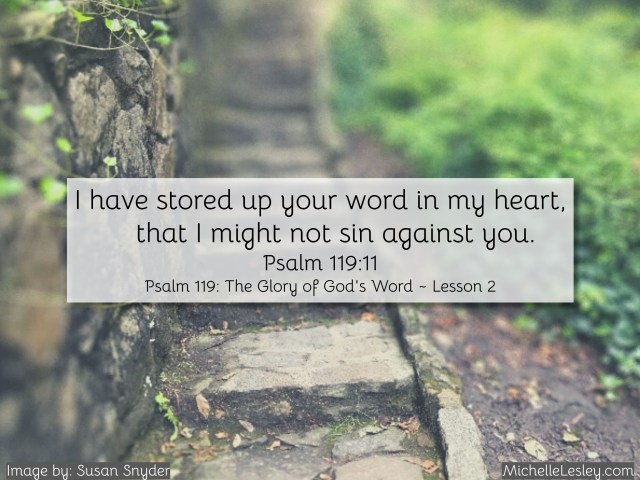
Suggested Memory Verse
Psalm 119 Bible Study

Psalm 119: The Glory of God’s Word ~ Lesson 1- Introduction

Welcome to our new study, Psalm 119: The Glory of God’s Word!

What does Godโ€™s Word teach us aboutโ€ฆitself? Weighing in at a hefty 176 verses, Psalm 119 is well known as the longest chapter in the Bible, and is similar in length to Philippians and James. Over the next several weeks as we make our way through this lovely psalm, youโ€™ll learn about loving Godโ€™s Word, the reliability of Godโ€™s Word, and the various ways Scripture helps us in our daily lives. But most importantly, youโ€™ll learn about and increase in your love for the God of the Word.

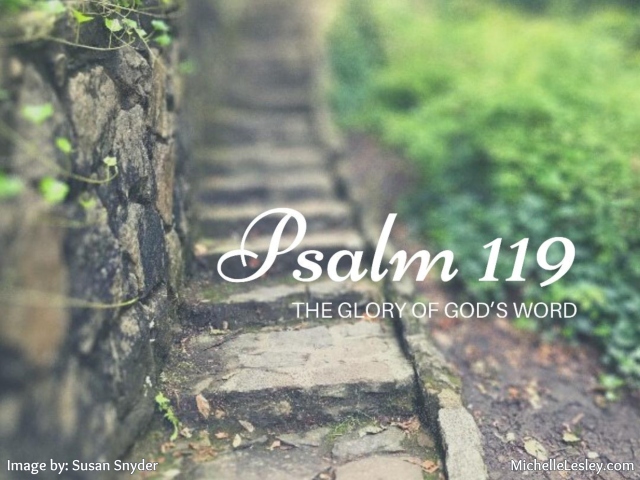
Our lovely title pic for the study was designed by Susan Snyder. The photo is her own, captured in beautiful Greenville, South Carolina. Susan says:

The psalmist loved God’s Word and wanted his life to reflect that love through obedience. The path of God’s commandments is delightful. I thought a nice-looking path might illustrate that thought…

Make me walk in the path of Your commandments, for I delight in it. Psalm 119:35

Many thanks to all of those who worked so hard on your entries for our title pic contest. You ladies were very creative and did some outstanding work!ย 

There were too many entries to share all of them with you, but here are a few “honorable mentions”:

Krista Soroka
Melissa Morris
Renรฉe
Robin Self
Kati Champlin

If you’re new to using my Bible studies, just a few housekeeping items and helpful hints:

The studies Iโ€™ve written (you can find all of them at the Bible Studies tab in the blue menu bar at the top of this page) are like โ€œtraining wheelsโ€. Theyโ€™re designed to teach you how to study the Bible for yourself and what kinds of questions to ask of the text so that, when you get the hang of it, you wonโ€™t have to depend on other peopleโ€™s books and materials โ€“ even mine โ€“ any more. To that end, I do not provide answers for the study questions in the studies Iโ€™ve written.

My studies are meant to be extremely flexible and self-paced so that you can use them in the way that works best for you. You can do an entire lesson in one day or work on the questions over the course of the week (or longer). You do not need to feel obligated to answer all (or any) of the questions. If the Holy Spirit parks you on one question for several days, enjoy digging deep into that one aspect of the lesson. If He shows you something I haven’t written a question about that captures your attention, dive in and study it! Those are ways the Holy Spirit speaks to us through His Word. This is your time to commune with the Lord, not a school assignment or work project you are beholden to complete in a certain way by a certain deadline.

I will post a new lesson on the blog every Wednesday, so there is nothing to sign up for or commit to. Simply stop by the blog each week, or subscribe to the blog via e-mail to have the lessons delivered to your inbox.

I use hyperlinks liberallyThe Scriptures for each lesson will be linked at the beginning of the lesson and in the lesson questions. As you’re reading the lesson, whenever you see a word in a different color text, click on it, and it will take you to a Scripture, article, or other resource that will help as you study.

All of the studies Iโ€™ve written are suitable for groups or individuals. You are welcome to use them as a Sunday school or Bible study class curriculum (for free) with proper attribution.

You are also welcome to print out any of my Bible studies (or any article Iโ€™ve written) for free and make as many copies as youโ€™d like, again, with proper attribution. Iโ€™ve explained more about that inย this articleย (3rd section).

From time to time I receive inquiries from men about using my studies for their personal quiet time or for teaching a co-ed or men’s Bible study class. It is my personal conviction that it is more in keeping with the spirit (though not the letter) of 1 Timothy 2:12, Titus 2:3-5, and related passages for men to use Bible study materials authored by men rather than by women. Therefore, on the honor system, I would request that men please not use my studies for personal use, or when teaching a class with male members. (Vetting the studies for your wife, daughter, or the women of your church, is, of course, fine. Encouraged, actually.)


Introduction to Psalm 119: The Glory of God’s Word

Before we begin studying a book of the Bible, itโ€™s very important that we understand some things about that book. But even though we’re not going to be studying the whole book this time, we still need to knowโ€ฆ

Who the author was and anything we might be able to find out about him or his background.

Who the audience of the book is: Jews or Gentiles? Old Testament Israelites or New Testament Christians? This will help us understand the authorโ€™s purpose and approach to what heโ€™s writing.

What kind of biblical literature weโ€™re looking at. We approach books of history differently than books of wisdom, books of wisdom differently than books of prophecy, etc.

What the purpose of the book is. Was it written to encourage? Rebuke? Warn?

What the historical backdrop is for the book. Is Israel at war? At peace? In exile? Under a bad king? Good king? Understanding the historical events surrounding a piece of writing help us understand what was written and why it was written.

When the book was written. Where does the book fall on the timeline of biblical history? This is especially important for Old Testament books which are not always arranged in chronological order.

So this week, before we start studying the actual text of Psalm 119, we need to lay the foundation to understanding it by finding the answers to these questions.

Read the following overviews of the book of Psalms, taking notes on anything that might aid your understanding of the book, and, particularly Psalm 119, and answer the questions below:

Bible Introductions: Psalms at Grace to You

Overview of the Book of Psalms at Reformed Answers

Summary of the Book of Psalmsย at Got Questions

You may also wish to read these resources on Psalm 119 itself:

What should we learn from Psalm 119? at Got Questions

What are the Acrostic Psalms? at Reformed Answers

The Greatness and Glory of God’s Word at Blue Letter Bible (I have vetted only the introduction of this resource, and I would encourage you to stop reading at the end of the introduction rather than continuing on through the commentary. That way you can begin the study of the text of Psalm 119 next week with no pre-conceived notions, ready for the Word of God itself to write on the blank slate of your heart.)

1. Who are some of the authors of Psalms? The author of Psalm 119?

2. Approximately when was Psalms written? What is the geographical setting of the book of Psalms?

3. Who is the original, intended audience of the book of Psalms? Describe the historical setting (historic events, politics, sociology of the time, etc.) of Psalms.

4. Whichย genre of biblical literature is the book of Psalms: law, history, wisdom, poetry, narrative, epistles, or prophecy/apocalyptic? What does this tell us about the approach we should take when studying from this book versus our approach to books of other genres?

5. What is the theme or purpose of the book of Psalms? Of Psalm 119?

6. What are some ways Psalms and Psalm 119 point to and connect to Jesus?

7. Describe the format and structure of Psalm 119. Why was it written this way?

8. What else did you learn about Psalms or the setting of this book that might help you understand Psalm 119 better?

Take some time in prayer this week to begin preparing your heart for this study. Ask God to grow your love for Him and His Word as we study Psalm 119: The Glory of God’s Word together.

Wednesday's Word

Wednesday’s Word ~ 1 John 4

For further study on the book of 1 John, try my study, Am I Really Saved?: A First John Checkup, from which this lesson is excerpted.

1 John 4

Beloved, do not believe every spirit, but test the spirits to see whether they are from God, for many false prophets have gone out into the world. By this you know the Spirit of God: every spirit that confesses that Jesus Christ has come in the flesh is from God, and every spirit that does not confess Jesus is not from God. This is the spirit of the antichrist, which you heard was coming and now is in the world already. Little children, you are from God and have overcome them, for he who is in you is greater than he who is in the world. They are from the world; therefore they speak from the world, and the world listens to them. We are from God. Whoever knows God listens to us; whoever is not from God does not listen to us. By this we know the Spirit of truth and the spirit of error.

Beloved, let us love one another, for love is from God, and whoever loves has been born of God and knows God. Anyone who does not love does not know God, because God is love. In this the love of God was made manifest among us, that God sent his only Son into the world, so that we might live through him. 10 In this is love, not that we have loved God but that he loved us and sent his Son to be the propitiation for our sins. 11 Beloved, if God so loved us, we also ought to love one another. 12 No one has ever seen God; if we love one another, God abides in us and his love is perfected in us.

13 By this we know that we abide in him and he in us, because he has given us of his Spirit. 14 And we have seen and testify that the Father has sent his Son to be the Savior of the world. 15 Whoever confesses that Jesus is the Son of God, God abides in him, and he in God. 16 So we have come to know and to believe the love that God has for us. God is love, and whoever abides in love abides in God, and God abides in him. 17 By this is love perfected with us, so that we may have confidence for the day of judgment, because as he is so also are we in this world. 18 There is no fear in love, but perfect love casts out fear. For fear has to do with punishment, and whoever fears has not been perfected in love. 19 We love because he first loved us. 20 If anyone says, โ€œI love God,โ€ and hates his brother, he is a liar; for he who does not love his brother whom he has seen cannot love God whom he has not seen. 21 And this commandment we have from him: whoever loves God must also love his brother.


The Holy Bible, English Standard Version Copyright ยฉ 2001 by Crossway Bibles, a publishing ministry of Good News Publishers.


Questions to Consider

1. What is the theme or purpose of theย bookย ofย 1 John? What is the historical backdrop for the book of 1 John?

2. Whichย Spiritย is controlling true Christian teachers? What spirit is controlling false teachers according to verse 3? True or false: If youโ€™re following a false teacher, youโ€™re following a demonic spirit. What does it mean to โ€œtest the spiritsโ€? (v1) How did the nobleย Bereansย test the spirits?

3. According to verses 7-8, who defines, originates, and is the embodiment of, love? How does this tell Christians Who and what is to motivate any love that we might feel or show to others? Is the โ€œloveโ€ that non-Christians feel or show to others motivated by God or by other factors such as affection, selfishness, lust, etc.? Can you truly love others if you do not know God? In verses 9-10, what is the ultimate definition and demonstration (what action did God take) of the phrase โ€œGod is loveโ€?

4. How do we know, according to verse 13, that we belong to Christ? How can we tell ifย we have the Spirit? In what ways do our actions show that we have the Holy Spirit?

5. What does our love (or lack of love) for others say about whether or not we truly know God? (20) What does verse 20 call people who claim to love God but do not love others? Are such people saved?

Bible Study

How to Study the Bible- and How Not To!

Originally published December 31, 2020

It’s almost the new year! Are you making a resolution to start having a personal, daily Bible study time? Would you like to improve on the way you study your Bible? Maybe you’re looking for a Bible reading plan, or maybe you’re just looking to change things up a little?

If that sounds like you, give a listen to this December 2020 episode of A Word Fitly Spoken:

How to Study the Bible – and How Not To!

Amy and I discuss what our own Bible study times look like, plus some other helpful methods and resources. We also discuss false doctrine and false teachers to avoid as you’re studying your Bible.

This episode is a great way to kick off the new year. And don’t forget to subscribe to A Word Fitly Spoken on your favorite podcast platform!

Additional Resources:

Bible Study Resourcesย (how to study the Bible)
Bible Studies
Bible Reading Plans for the New Year- 2022

Popular False Teachers & Unbiblical Trends

Judges Bible Study

Judges ~ Lesson 18- Wrap Up

Previous Lessons: 1, 2, 3, 4, 5, 6, 7, 8, 9, 10, 11, 12, 13, 14, 15, 16, 17

Wrap Up

Questions to Consider

1. Was there anything new God taught you in this study that particularly impacted you? What was it, and why was it so significant?

2. How is your walk with the Lord different after this study than it was before?

3. What are the reasons for, and the consequences of, “Everyone did what was right in his own eyes”? What are the implications of this mindset and posture of heart for God’s people, both individually and as the church, today?

4. What did you learn about idolatry and syncretism from this study, and how can you apply this to the church and Christian organizations?

5. What did this study teach you about trusting and obeying God?

6. Have there been any passages or concepts in this study that God used to convict you of disobedience and lead you to repentance? How will you walk differently in this area from now on?

7. What did this study teach you about the character of those who lead God’s people?

8. What have you learned about God and His nature and character from this study?


Homework

Spend some time in prayer this week asking God to show you how to put into practice one thing you learned from this study.

Recite all of your memory verses from this study. Which one is most meaningful to you right now?