Bible Study, Church

McBible Study and the Famine of God’s Word

“Why can’t we just be taught a book of the Bible?” I heard this again today from a Christian woman hungry for her church to teach her the truth of God’s word. It’s a cry being raised by women from all over, scrounging through the dumpster of “Bible” teaching their church currently offers, searching for something – anything – that will nourish their hearts, minds, and souls with biblical truth so that they might actually be able to grow in Christ.

What’s going on here, church? Pastors? Women’s ministries? Why are godly women starving for the word of God at their own churches? This is a problem. And it’s not a small one. And it’s not going away. It’s getting worse.

My family is a one income family. My husband works hard to provide for us, and we’ve made a lot of (completely worthwhile) sacrifices so I can stay home and raise and home school our children. One of those sacrifices is that we rarely get to eat out, even at a fast food restaurant. That means I cook. A lot. Fortunately, I happen to enjoy cooking, but it does take several hours of work a week. And sometimes, at the end of a long day, I’m tired and not particularly in the mood to spend a couple of hours on my feet chopping and mixing and sautรฉeing and stirring and roasting. I’d much rather chuck it and have my husband pick up McDonald’s on his way home. In fact, if we could afford it, and I couldn’t cook, and I thought it was healthy, my family would probably eat fast food for supper three or four times a week. I like fast food. My kids LOVE fast food. And why do all that work if you don’t have to and there’s an easier option, right?

But that’s no way to feed a family. It makes people obese and can lead to all kinds of other physical problems like heart disease, hypertension, and digestive ailments because the majority of fast food is high in the bad stuff (cholesterol, sodium, fat) and low in the good stuff (fiber, vitamins, minerals). Not to mention that having other people do the work God has assigned me is the lazy way out.

Yet while it’s easy to see how detrimental and unhealthy it is to feed a family a regular fare of fast food in the physical realm, this is exactly what most churches are doing in the spiritual realm when it comes to their Bible study menu.

“My pastor asked me to teach a women’s Bible study class. What’s a good book to use?”
“Why don’t you just teach them a book of the Bible?”
“Oh, I don’t feel equipped to do that.”

“Our Sunday School class is looking for a new curriculum. Any suggestions?”
“How about just working through a book of the Bible?”
“Our teacher works a lot of hours and doesn’t really have the time to study and prepare like that.”
screenshot-2016-11-10-at-12-31-44-pm-edited

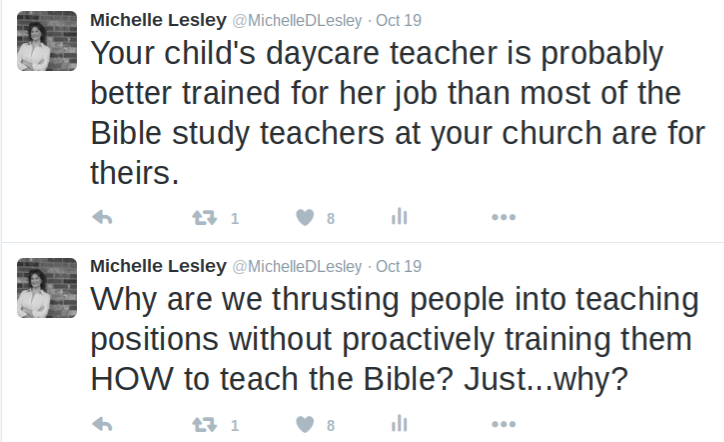
I hear this kind of thing over and over and over again. Churches aren’t even attempting to train people to properly teach the Bible, and Bible study “teachers,” (often through no fault of their own) either don’t know they need to be trained, or don’t have training available to them, or they’re unwilling or unable to put in the time and effort to be trained and to prepare lessons.

We have classes that need teachers, so we take whoever is available and willing, and we stick them in front of a group of people, hand them a take out bag of McBible Studies written by the celebrity Christian du jour and say, “Here. Feed the church family.”

That’s a problem in and of itself, first and foremost, because relying solely on pre-fab studies due to the fact that no one is trained to instruct the people of your church in the word of God isn’t biblical. The Bible says that pastors, elders, and teachers in the local church body should be “able to teach.” Not facilitate. Not read aloud what someone else wrote. Not “able to work a DVD player.” Teach.

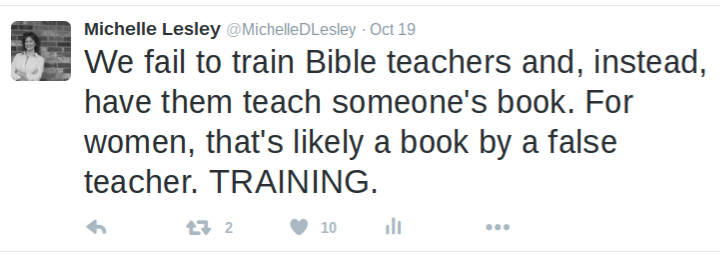
But recruiting “teachers” who are unskilled in handling God’s word to lead a pre-packaged study often morphs into another dangerous problem, especially in the area of women’s Bible study: importing false doctrine into your church. Here’s a list of LifeWay’s top selling books for 2015. Every single non-fiction book on this list that’s likely to be used for a women’s group or individual Bible study (seven of the twelve by my count- which is a staggering proportion considering LifeWay also sells men’s studies, theology books, training manuals, “Christian living” books, and a wide variety of other non-fiction topics, but I digress) is written by a false teacher. Every. single.one.
screenshot-2016-11-10-at-12-31-31-pm

In my research of women’s Bible study authors and teachers, I estimate that approximately ninety-five per cent of the the female authors and teachers on the shelves at your local Christian retailer are false teachers. That goes way beyond a biblical “diet” laden with cholesterol and fat. Now, we’re talking about spiritual food tainted with E.coli. If you’ve got a woman in your church who’s facilitating a class using materials by one of these false teachers because she’s not competent enough in God’s word to teach the Bible, how in the world is she going to be able to catch and correct the false doctrine these Christian celebrities are teaching her class?

The answer is: she’s not. In fact, her awareness of her own incompetence in Scripture and her assumption that the Christian celebrity knows what she’s talking about (Because, after all, she’s a celebrity and LifeWay sells her materials, so she must know what she’s talking about, right?) will have the exact opposite effect. She will downplay and keep quiet about any nagging doubts – assuming she knows her Bible well enough to even have those doubts – in her own mind that the Christian celebrity is teaching things contrary to sound doctrine, and she will affirm the false doctrine that’s being taught. Then, this harmful bacteria of false doctrine will spread from woman to woman and class to class, and discerning women, knowing that the kitchen is contaminated, will grow emaciated from a lack of clean cuisine to feed on. We end up with a church full of “Bible” study and Sunday School classes that teach fluff and false doctrine instead of the unadulterated word of God. To borrow from Coleridge: “Food, food, every where, nor any bite to eat.” We’ve got a famine of God’s word, right in His very own house.
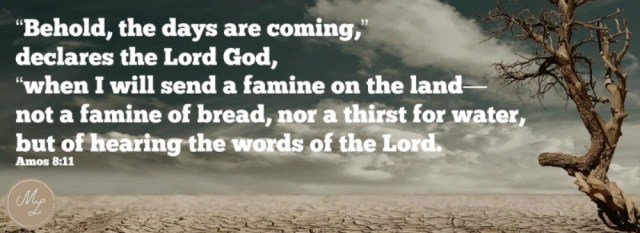
Church, pastors, women’s ministries- we’ve got to put a stop to this. People teaching Sunday School, Bible study classes, and, particularly, women’s Bible study classes must be trained in basic hermeneutics, the competent handling of God’s word in context, and the ability to teach sound doctrine as well as to refute the false. Do we not believe Scripture, or somehow think our church is exempt from it, when it says:

Do your best to present yourself to God as one approved, a worker who has no need to be ashamed, rightly handling the word of truth. 2 Timothy 2:15

or

Not many of you should become teachers, my brothers, for you know that we who teach will be judged with greater strictness. James 3:1

Where is our fear of God and our obedience to His word? We would never think of letting an untrained, incompetent teacher teach our children math or science in school when all that’s at stake is their academic education. Why are we satisfied to let untrained people teach the Bible at church when people’s eternities are at stake?

It doesn’t take years of seminary training. I never went to culinary school, but I’m still able to cook and feed my family a healthy diet because of what I’ve learned from others. Pastors can train teachers. Skilled Bible teachers can train others to teach. There are even great books and materials that can help as you teach people how to teach the Bible.

A doctrinally sound book study can be a fun, interesting, or useful supplement to the regular, straight teaching of Scripture in a Bible study class, but even these shouldn’t be used in place of training teachers. The best theologian out there isn’t a living and active member of that class. He doesn’t know the strengths and weaknesses of the class’s theology. He can’t address their current struggles and questions. He doesn’t love them, care about them, pray for them, and labor in the Word for them.

Only real life, trained, biblically competent teachers can do those things. They are vital and they are irreplaceable.

So let’s quit shoving Happy Meals into the hands of women who are starving for the pure milk and meat of God’s word. Let’s offer some cooking classes and set the table so the members of our churches can sit down to a healthy, home cooked diet of nourishing food that will help them grow to spiritual maturity in the grace and knowledge of the Lord Jesus Christ.

And, now, if you’ll excuse me, I’ve got to go start supper.
The Ten (10 Commandments Bible Study)

The Ten: Lesson 3

Previous Lessons: 1, 2

Exodus 20:1-3

And God spoke all these words, saying,

โ€œI am the Lord your God, who brought you out of the land of Egypt, out of the house of slavery.

โ€œYou shall have no other gods before me.

Matthew 4:9-10

And he said to him, โ€œAll these I will give you, if you will fall down and worship me.โ€ 10ย Then Jesus said to him, โ€œBe gone, Satan! For it is written,

โ€œโ€˜You shall worship the Lord your God
ย ย ย ย and him only shall you serve.โ€™โ€

Ezekiel 14:1-11

Then certain of the elders of Israel came to me and sat before me. And the word of the Lord came to me: โ€œSon of man, these men have taken their idols into their hearts, and set the stumbling block of their iniquity before their faces. Should I indeed let myself be consulted by them? Therefore speak to them and say to them, Thus says the Lord God: Any one of the house of Israel who takes his idols into his heart and sets the stumbling block of his iniquity before his face, and yet comes to the prophet, I the Lord will answer him as he comes with the multitude of his idols, that I may lay hold of the hearts of the house of Israel, who are all estranged from me through their idols.

โ€œTherefore say to the house of Israel, Thus says the Lord God: Repent and turn away from your idols, and turn away your faces from all your abominations. For any one of the house of Israel, or of the strangers who sojourn in Israel, who separates himself from me, taking his idols into his heart and putting the stumbling block of his iniquity before his face, and yet comes to a prophet to consult me through him, I the Lord will answer him myself. And I will set my face against that man; I will make him a sign and a byword and cut him off from the midst of my people, and you shall know that I am the Lord. And if the prophet is deceived and speaks a word, I, the Lord, have deceived that prophet, and I will stretch out my hand against him and will destroy him from the midst of my people Israel. 10 And they shall bear their punishmentโ€”the punishment of the prophet and the punishment of the inquirer shall be alikeโ€” 11 that the house of Israel may no more go astray from me, nor defile themselves anymore with all their transgressions, but that they may be my people and I may be their God, declares the Lord God.โ€

Matthew 19:16-30

And behold, a man came up to him, saying, โ€œTeacher, what good deed must I do to have eternal life?โ€17 And he said to him, โ€œWhy do you ask me about what is good? There is only one who is good. If you would enter life, keep the commandments.โ€ 18 He said to him, โ€œWhich ones?โ€ And Jesus said, โ€œYou shall not murder, You shall not commit adultery, You shall not steal, You shall not bear false witness, 19 Honor your father and mother, and, You shall love your neighbor as yourself.โ€ 20 The young man said to him, โ€œAll these I have kept. What do I still lack?โ€ 21 Jesus said to him, โ€œIf you would be perfect, go, sell what you possess and give to the poor, and you will have treasure in heaven; and come, follow me.โ€ 22 When the young man heard this he went away sorrowful, for he had great possessions.

23 And Jesus said to his disciples, โ€œTruly, I say to you, only with difficulty will a rich person enter the kingdom of heaven. 24 Again I tell you, it is easier for a camel to go through the eye of a needle than for a rich person to enter the kingdom of God.โ€ 25 When the disciples heard this, they were greatly astonished, saying, โ€œWho then can be saved?โ€ 26 But Jesus looked at them and said, โ€œWith man this is impossible, but with God all things are possible.โ€ 27 Then Peter said in reply, โ€œSee, we have left everything and followed you. What then will we have?โ€ 28 Jesus said to them, โ€œTruly, I say to you, in the new world, when the Son of Man will sit on his glorious throne, you who have followed me will also sit on twelve thrones, judging the twelve tribes of Israel. 29 And everyone who has left houses or brothers or sisters or father or mother or children or lands, for my nameโ€™s sake, will receive a hundredfold and will inherit eternal life. 30 But many who are first will be last, and the last first.


The Holy Bible, English Standard Version. ESVยฎ Permanent Text Editionยฎ (2016). Copyright ยฉ 2001 by Crossway Bibles, a publishing ministry of Good News Publishers.


Questions to Consider:

1. Take a moment to briefly review the previous lessons (links above). What are some of the major themes we have seen in God’s dealings with Israel so far in the book of Exodus? How does Exodus 20:1-2 serve as an introduction and foundation to the 10 Commandments, showcasing God’s goodness and His right to rule Israel?

2. What does the first Commandment, Exodus 20:3, mean? Is God saying it’s OK for His people to worship other gods as long as He has first place? Compare Exodus 20:3 with Matthew 4:9-10. What did Jesus understand the first Commandment to mean? Where does the temptation to worship other gods come from? Who is ultimately being worshiped when someone worships a false god?

3. Why do you think God made this the first Commandment? How is the first Commandment foundational to every other command or teaching in Scripture? Can you keep the first Commandment while breaking another biblical command? Why or why not?

4. How was Israel breaking the first Commandment in the Ezekiel 14 passage? How did God respond to their attempt to approach Him as their God while still embracing their foreign gods? (8-10) How did this impact their relationship with God? (5,7,11) What did God say the people should do? (6) What would be the result of Israel’s repentance from idolatry? (5,11)

5. In the Matthew 19 passage, which Commandments did Jesus tell the rich young ruler he should keep? (18-19) Which Commandments did Jesus not mention? Were the Commandments Jesus mentioned from the first or second table of the Law? How did the rich young ruler demonstrate that he was unwilling to keep the first Commandment? (20-22) What was his god? How did Peter’s response (27) to Christ differ from the rich young ruler’s response? How did the disciples keep the first Commandment by giving up everything to follow Christ?

6. In what ways do we break the first Commandment today? What are some other “gods” we love and dedicate ourselves to before, or in addition to, Christ? Review the questions in #4. How do these principles apply to Christians today? Think over all that Christ has done for you. How is it an act of worship and thanks to Him to keep the first Commandment?


Homework:

Give this song a listen. Could you sing these lyrics truthfully? In what ways does it exemplify the first Commandment? Are you breaking the first Commandment in any areas of your heart and life? Repent and receive Christ’s forgiveness.

The Ten (10 Commandments Bible Study)

The Ten: Lesson 2

Previous Lessons: 1

Exodus 19:

On the third new moon after the people of Israel had gone out of the land of Egypt, on that day they came into the wilderness of Sinai. They set out from Rephidim and came into the wilderness of Sinai, and they encamped in the wilderness. There Israel encamped before the mountain, while Moses went up to God. The Lord called to him out of the mountain, saying, โ€œThus you shall say to the house of Jacob, and tell the people of Israel: โ€˜You yourselves have seen what I did to the Egyptians, and how I bore you on eagles’ wings and brought you to myself. Now therefore, if you will indeed obey my voice and keep my covenant, you shall be my treasured possession among all peoples, for all the earth is mine; and you shall be to me a kingdom of priests and a holy nation.โ€™ These are the words that you shall speak to the people of Israel.โ€

So Moses came and called the elders of the people and set before them all these words that the Lord had commanded him. All the people answered together and said, โ€œAll that the Lord has spoken we will do.โ€ And Moses reported the words of the people to the Lord. And the Lord said to Moses, โ€œBehold, I am coming to you in a thick cloud, that the people may hear when I speak with you, and may also believe you forever.โ€

When Moses told the words of the people to the Lord, 10 the Lord said to Moses, โ€œGo to the people and consecrate them today and tomorrow, and let them wash their garments 11 and be ready for the third day. For on the third day the Lord will come down on Mount Sinai in the sight of all the people. 12 And you shall set limits for the people all around, saying, โ€˜Take care not to go up into the mountain or touch the edge of it. Whoever touches the mountain shall be put to death. 13 No hand shall touch him, but he shall be stoned or shot; whether beast or man, he shall not live.โ€™ When the trumpet sounds a long blast, they shall come up to the mountain.โ€ 14 So Moses went down from the mountain to the people and consecrated the people; and they washed their garments. 15 And he said to the people, โ€œBe ready for the third day; do not go near a woman.โ€

16 On the morning of the third day there were thunders and lightnings and a thick cloud on the mountain and a very loud trumpet blast, so that all the people in the camp trembled. 17 Then Moses brought the people out of the camp to meet God, and they took their stand at the foot of the mountain. 18 Now Mount Sinai was wrapped in smoke because the Lord had descended on it in fire. The smoke of it went up like the smoke of a kiln, and the whole mountain trembled greatly. 19 And as the sound of the trumpet grew louder and louder, Moses spoke, and God answered him in thunder. 20 The Lord came down on Mount Sinai, to the top of the mountain. And the Lord called Moses to the top of the mountain, and Moses went up.

21 And the Lord said to Moses, โ€œGo down and warn the people, lest they break through to the Lord to look and many of them perish. 22 Also let the priests who come near to the Lord consecrate themselves, lest the Lord break out against them.โ€ 23 And Moses said to the Lord, โ€œThe people cannot come up to Mount Sinai, for you yourself warned us, saying, โ€˜Set limits around the mountain and consecrate it.โ€™โ€ 24 And the Lord said to him, โ€œGo down, and come up bringing Aaron with you. But do not let the priests and the people break through to come up to the Lord, lest he break out against them.โ€ 25 So Moses went down to the people and told them.


The Holy Bible, English Standard Version. ESVยฎ Permanent Text Editionยฎ (2016). Copyright ยฉ 2001 by Crossway Bibles, a publishing ministry of Good News Publishers.


Questions to Consider:

1. Refresh your memory on the answers to the bullet point questions from Lesson 1 (link above). What are the major events that led Moses and Israel up to the point where they are now in chapter 19? Do you see the steps God has taken to call Israel out of slavery and begin establishing them as a nation? In what ways has God demonstrated that He has a right to rule over Israel? How does God’s right to rule Israel lay the foundation for God giving the 10 Commandments?

2. Briefly review Exodus 18:13-26. How would having a codified set of laws (i.e. the 10 Commandments) have helped the people as well as Moses and the elders as they judged cases? Do you see how this passage helps show the need for the 10 Commandments to be laid down?

3. In chapter 19, verses 3-6, which words and phrases show God’s goodness, kindness, tenderness, love, and care for His people? How do these verses indicate God’s authority over His people? Verses 5-6 outline what we now call the Mosaic Covenant. In this “if/then” pronouncement, what are the “ifs” required of the people and the “thens” God promises them in return? Is this a unilateral or bilateral covenant? What was the people’s response to the covenant? (7-8)

4. Did the Mosaic Covenant promise people right standing with God as long as they simply obeyed His laws with their outward behavior? How did faith and the attitude of the heart factor into Old Testament obedience and righteousness? How is this similar to God’s expectations of obedience for Christians today?

5. What actions were the people to take in preparation for God’s appearance on Mount Sinai? (10,14,15) How do verses 9-25 demonstrate God’s power and holiness? The seriousness and solemnity with which the people should treat His presence and His words? How did the people respond? Do you think the church today reveres God and His word as deeply as Israel did that day? Should we? Why or why not?

6. What does the word consecrate mean? How should physically consecrating themselves (10,14,15) have been an object lesson to Israel that they were to be spiritually consecrated to God as well? What does it mean for Christians to consecrate ourselves to the Lord?

7. How do verses 11, 16-17 give us a mini-foreshadowing of the resurrection of Christ?


Homework:

Ask God to reveal any areas of your life or worship in which…

…you do not treat Him or His word reverently and solemnly
or
…you need to consecrate yourself, or set yourself apart from worldliness, more for Him.

Repent where you have fallen short. Is there any tangible action you can take to help you revere God more or pursue holiness to a greater degree?

The Ten (10 Commandments Bible Study)

The Ten: Lesson 1

If you grew up in church, you probably learned them by heart in Sunday School. There are even little songs (here’s my favorite) and mnemonics to help you memorize them.

The Decalogue. The two tables of the Law. The Ten Commandments.

Sure, you can recite them forward and backward, and, if you can’t, you can probably name most of them even if you don’t get the order right. But have you ever slowed down and really studied them? What would all these “thou shalts” and “thou shalt nots” have meant to Moses and the people of Israel? How are they relevant to Christians today? And how do these ten laws demonstrate God’s goodness? We’ll be taking a look at these questions and others over the course of this study.

Background

We never parachute into a book or passage we’re going to study without first setting the stage. God didn’t give the Ten Commandments in a vacuum. What was going on at the time? To whom were the Commandments given? When? Why? Who were the main characters in the story? It’s time to do some homework.

If you’ve never read the book of Exodus from beginning to end before (or if it’s been a while), take as long as you need and read the first eighteen chapters of the book word for word. If you’re already fairly well versed in the storyline of Exodus, skim back over the first eighteen chapters to refresh your memory. As you read or skim, bullet-point the major events and information.

  • Who is this book about? Who are the main characters in the storyline?
  • When did these events occur relative to other major biblical events?
  • What was God’s “big picture” plan for the people of Israel during this time frame? What were the steps He took to carry out that plan?
  • Where, geographically, did these events take place?
  • Why was there a need for God to give codified laws to His people at this point in their history?
  • How does this story point us to Christ?

Read and listen through these additional resources to help set a good foundation for our study of the Ten Commandments:

Do the Ten Commandments apply to Christians today? at Grace to You

What are the Ten Commandments? What is the Decalogue? at Got Questions

The Preeminence of God’s Moral Law by Phil Johnson

Colossians Bible Study

Colossians: Lesson 7

Previous Lessons: 1, 2, 3, 4, 5, 6

Colossians 4:7-18

Tychicus will tell you all about my activities. He is a beloved brother and faithful minister and fellow servant in the Lord. 8ย I have sent him to you for this very purpose, that you may know how we are and that he may encourage your hearts, 9ย and with him Onesimus, our faithful and beloved brother, who is one of you. They will tell you of everything that has taken place here.

10ย Aristarchus my fellow prisoner greets you, and Mark the cousin of Barnabas (concerning whom you have received instructionsโ€”if he comes to you, welcome him), 11ย and Jesus who is called Justus. These are the only men of the circumcision among my fellow workers for the kingdom of God, and they have been a comfort to me. 12ย Epaphras, who is one of you, a servant of Christ Jesus, greets you, always struggling on your behalf in his prayers, that you may stand mature and fully assured in all the will of God. 13ย For I bear him witness that he has worked hard for you and for those in Laodicea and in Hierapolis. 14ย Luke the beloved physician greets you, as does Demas. 15ย Give my greetings to the brothers at Laodicea, and to Nympha and the church in her house. 16ย And when this letter has been read among you, have it also read in the church of the Laodiceans; and see that you also read the letter from Laodicea. 17ย And say to Archippus, โ€œSee that you fulfill the ministry that you have received in the Lord.โ€

18ย I, Paul, write this greeting with my own hand. Remember my chains. Grace be with you.


The Holy Bible, English Standard Version Copyright ยฉย 2001 by Crossway Bibles, a publishing ministry of Good News Publishers.


Questions to Consider:

1. What is the theme or purpose of this passage? With what sort of tone (rebuking, emphatic, compassionate, etc.) does Paul close out this epistle? Thinking back over the previous lessons, give a 3-5 sentence synopsis of Colossians in your own words.

2. List the people Paul mentions by name in this passage, noting the words of praise he has for each. Paul did not take those who served with him in ministry for granted. Are you thankful for those who serve in the various ministries of your church? What are some ways you can show appreciation to others who serve in ministry alongside you (and over you) at your church?

3. What else do we know about Tychicus, Onesimus, Aristarchus, Mark, Barnabas, Epaphras, Luke, Demas, and Archippus? How can cross-referencing give us a fuller picture and better understanding of a passage we’re studying?

4. Examine and describe the ministry roles each person in this passage fulfilled in the Body of Christ in light of 1 Corinthians 12:4-7. How does Colossians 4:7-18 demonstrate the need for various people to carry out various “services and activities”? How does this passage show value for a variety of servanthood roles and ministries, even those we might consider small or unimportant? Think about your church and Christianity at large. Do we place a greater value on those who serve in “spotlight” (“important”) roles compared to those who serve in obscure (“unimportant”) roles? How does 1 Corinthians 12:12-31 speak to this?

5. Note the words “encourage your hearts” (8), “they have been a comfort to me” (11), “struggling on your behalf in his prayers” (12), and “the church in her house” (15). How were encouragement, comfort, prayer, and hospitality crucial to the early church? Are they just as crucial to the church today? Is your church particularly strong or weak in any of these areas? How could your church improve in these areas?

Homework:

How can you serve your church in the areas of encouragement, comfort, prayer, and hospitality? Think of one specific thing you can do for your church or a particular person in your church in each of these four areas, and do them over the next week. For example:

Monday: Write an e-mail encouraging my pastor.
Tuesday: Visit one of my church’s members who is hospitalized or a shut-in.
Wednesday: Pray through my church’s prayer list.
Thursday: Invite the lady who visited my church on Sunday for coffee.