Obedience

Throwback Thursday ~ Faultfinders Contending With the Almighty

Originally published September 25, 2015

faultfinders

Nobody could ever accuse Christianity of being easy. A religion that tells you to die to self and take up your cross daily is no walk in the park. And there’s no magical moment in this life when you’ve suddenly “arrived” at the top level of spiritual 1 tim 2 12maturity where everything in the Bible makes perfect sense, your prayer life is phenomenal every day, obeying Christ’s commands is a breeze, and you’re floating around on a little cloud of holiness.

We are all messed up, muddling through, and constantly battling the flesh, from the person who got saved five minutes ago to the theologian who’s been walking with the Lord for decades.

It’s hard enough to obey the Scriptures we embrace – love one another, be kind, be matt 6 15truthful – but then we encounter Scriptures that, for whatever reason, we butt heads with. Scriptures to which our initial, fleshly reaction is, “No way. I’m not doing that.” We argue with them. We look for loopholes and ways we can get around them. We reason out all sorts of caveats as to why that Scripture doesn’t apply to us or why we don’t have to obey it.

My parents hurt me deeply. There’s no way I’m going to honor the people who did that to me.

God gave me a special gifting and called me to preach. It doesn’t matter that I’m a woman.

Why should I forgive him? He’s never even said he’s sorry!

You have no idea how badly she hurt me. I’ll never be able to love her or pray for her.

ex 20 12There’s no denying it, sometimes obeying a certain Scripture will be the hardest thing we ever do. But slaves to Christ are not given the option of saying “no” to their Master. If you’ll look in your Bible at the verse you’re struggling against, you’ll notice there’s no asterisk next to it that says, “except you.”

When we approach one of God’s commands to Christians and decide we’re not going to obey it because we don’t want to or shouldn’t have to or it’s too hard, what we’re really doing is setting ourselves above the Bible in judgment of it and coming to the conclusion that we know better 1 pet 3 1 2than God.

Yeah, that’s not a good idea. Especially for Christians.

Ever read the book of Job? Job went through some pretty awful stuff. Stuff that I certainly would have argued against and questioned God about just like he did. And yet, despite all of Job’s suffering, God didn’t give him a pass.

And the Lord said to Job:
“Shall a faultfinder contend with the Almighty?

He who argues with God, let him answer it.”

Then Job answered the Lord and said:
“Behold, I am of small account; what shall I answer you?

I lay my hand on my mouth.
I have spoken once, and I will not answer;
twice, but I will proceed no further.”
Job 40:1-5

 And how does this grab you?

But who are you, O man, to answer back to God? Will what is molded say to its molder, “Why have you made me like this?” Has the potter no right over the clay, to make out of the same lump one vessel for honorable use and another for dishonorable use?
Romans 9:20-21

Do you get the sense from these verses, which address very different situations, that God isn’t crazy about people questioning His sovereignty, His decisions, or His word, regardless of their circumstances?

God is God. We are not.

God sets the rules for Christianity, not “everyone doing whatever is right in his own eyes.”

matt 5 44Lots of times we think we have to “feel comfortable” with a certain Scripture if we’re to obey it, but the truth is just the opposite. When we say, “Lord, I don’t want to do this, but I’m going to do it anyway because I love You and Your word says so,” guess what happens? God begins to change our hearts. In time, He helps us grow to embrace the Scriptures we once rejected. He helps us to love others and see them through His eyes.

Yes, it is going to be hard. There are going to be times when we have to grit our teeth, hold our noses, and obey Christ even when everything inside us screams, “NO!

But we have a precious Savior who has promised to help us be content in any circumstance and will give us the strength to do anything He puts in front of us.

I can do all things through him who strengthens me. Philippians 4:13

I’ve fought. I’ve cried. I’ve whined, “I can’t!” And every time God has brought me back to this verse that says, “Yes, you can, and I’ll help you.” And you know what? He did.

Obedience is hard, but Christ is worth it.

Homosexuality, Salvation

Throwback Thursday ~ God Loves Gays

Originally published May 8, 2015god loves gays

Last week, as I was mindlessly flipping through Facebook, this picture caught my eye. It was attached to a news article about the Supreme Court’s hearing on same sex “marriage”. I was already at my saturation point with the reporting on the day’s events, but this picture just reached out and grabbed my heart.

“God loves gays,” the young man’s sign says. Rarely, perhaps never, has a statement been so beautifully true and so painfully false all at the same time.

For one will scarcely die for a righteous person—though perhaps for a good person one would dare even to die— but God shows his love for us in that while we were still sinners, Christ died for us.
Romans 5:7-8

It’s true. God does love gays. He doesn’t love them because He sees what they might someday become after leaving the lifestyle behind. He doesn’t love them because they’re great “fixer upper” projects. He doesn’t love them because He feels sorry for them. He just loves them. Right where they are. Not after they get cleaned up. Now.


 God shows his love for us in that while we were still sinners, Christ died for us.


Have you ever really thought about the implications of that statement?

God loves the homosexual man while he is sodomizing his partner.

God loves the gang banger while he is pulling the trigger of his gun.

God loves the prostitute while she is servicing her client.

God loves the child molester while he is violating that precious little one.

God loves the atheist soldier in a godless country while he is torturing Christians.

In the deepest, blackest night of our sin, God loves each and every one of us. Only a profoundly, unfathomably good and kind God could, or would, do such a thing.

But the story doesn’t end there.

You see, as unbelievable as it is that God could love someone so drenched in evil, He takes things a step further. God’s love motivated Him to act.


while we were still sinners, Christ died for us.


Rescue. Redemption. Salvation. However you want to put it, God personally came down and sacrificed Himself so that even the most wretched sinner would have a way out. No more enslavement to evil. No more being pawns of the devil in his never-ending quest for revenge against the King. No more separation from God, now, or in eternity.

God drove a cross-shaped stake into the ground at Calvary and said, “No more.”

God does love gays. And murderers. And child rapists. And hookers. And even prideful, rebellious, good little Sunday School girls like me. But not like this young man’s sign implies. He thinks God shows love by approving of his homosexuality. But an all-powerful God who would say He loves sinners and yet leave them to rot in their sin without lifting a finger to help them isn’t loving. Isn’t all-powerful. Isn’t God.

God does love you, my young friend. You simply have no idea how much.

Basic Training, Evangelism

Basic Training: The Great Commission

For more in the Basic Training series, click here.

Have you ever heard the phrase “The Great Commission“? Do you know what it means? If not, you’re not alone…
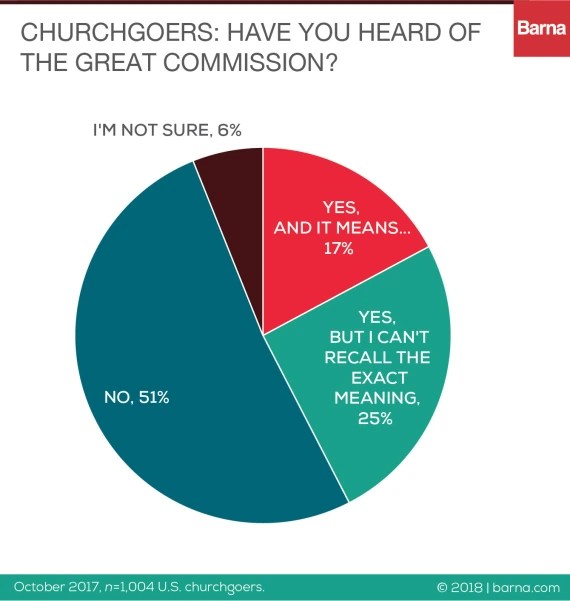
photo courtesy of barna.com

The Barna Group recently conducted a study asking churchgoers if they had previously “heard of the Great Commission.” In their report, 51% of Churchgoers Don’t Know of the Great Commission the results of the study were summarized thusly:

“…half of U.S. churchgoers (51%) say they do not know this term. It would be reassuring to assume that the other half who know the term are also actually familiar with the passage known by this name, but that proportion is low (17%). Meanwhile, ‘the Great Commission’ does ring a bell for one in four (25%), though they can’t remember what it is. Six percent of churchgoers are simply not sure whether they have heard this term ‘the Great Commission’ before.”

Now, if you know anything about statistics, you know how important it is to structure your questions carefully and get a representative sampling of the population you’re surveying in order to get the most accurate results. What does “churchgoer” mean? Is it possible people have never heard the term “The Great Commission” simply because churches don’t use this particular phrase any more? It’s important to take things like this into consideration because it affects the results of the survey. (You can find out more about Barna’s structuring process for this study at the end of the article linked above.) But even if the numbers of the Barna survey aren’t exact, I think it’s safe to say there are a lot of people out there in churchland who aren’t familiar with The Great Commission.

Just for fun, let’s see what the results would be if we surveyed readers of my blog:

The Great Commission refers to some of Jesus’ final words to the disciples before His ascension and is cited from Matthew 28:18-20:

And Jesus came and said to them, ‘All authority in heaven and on earth has been given to me. Go therefore and make disciples of all nations, baptizing them in the name of the Father and of the Son and of the Holy Spirit, teaching them to observe all that I have commanded you. And behold, I am with you always, to the end of the age.’

With these words Jesus commissioned the eleven remaining disciples to go out into the world and carry on His mission. Since every Christian is a disciple, or follower, of Christ, this is our commission from Him as well. Let’s examine what it says.

All authority in heaven and on earth has been given to Me.
Before commissioning his disciples, Jesus reminds them that everything He’s about to say is founded on and imbued with His authority. Jesus alone has the divine authority to establish the church and to dictate the way in which His church is to be set up and to grow.

We 21st century Christians would do well to keep forefront in our minds and hearts the authority of Christ over His church. There is no need for churches to “cast vision” or come up with mission statements. Christ is the head of the church and has already given us His vision for it. The Great Commission is His mission statement for the church.

Go therefore
“Therefore” in this little phrase refers back to what Christ has just said about His authority. In other words, because all authority in heaven and on earth has been given to Me, I am telling you to go.

“Go” is a very generic verb in English. We can “go” into the kitchen or we can “go” to the moon or we can “go” out and conquer the world. We can “go” anywhere from our own personal microcosm to the edges of the known universe. And that is the same sense the Greek word πορεύω captures: as you “go your way,” as you “go forth,” as you “walk”, as you “pursue the journey on which [you have] entered.” Wherever life takes us, whether it’s across the street or across the world, we go as ambassadors of Christ, carrying the good news of the gospel with us.

All nations
Revelation 7:9 tells us that God will save people from “every nation, from all tribes and peoples and languages.” So that’s who we share the gospel with as we go our way. Everybody. Regardless of where they’re from, what they look like, or how they talk. We are not to withhold the gospel from anyone, and we’re to make sure the church is proactively carrying the gospel to every populated geographical location on earth.

Make disciples…teaching them to observe all that I have commanded you
Notice the language Jesus uses here. He doesn’t say “make converts” or “make Christians”. He says “make disciples.”

Think about what the disciples did while Jesus was on earth. First, they answered His call to follow Him. Then, they began the journey of following Him wherever He went. He trained and equipped them day and night. They loved Him and worshiped Him. They imitated the things He did and said. They carried on His work after He ascended. Jesus is saying to the disciples, and to us, “Replicate yourselves. Make more like you.”

That means that the Great Commission starts with sharing the gospel with a lost person, but it doesn’t end there. There’s more to our mission than just evangelism. We are to train and equip Christians to follow Jesus daily, to love and worship Him, to imitate Him in obedience, and to carry on His work.

Baptizing them in the name of the Father and of the Son and of the Holy Spirit
After salvation, baptism is the first step a new Christian takes on the road of discipleship. It is not optional. Baptism publicly identifies a person – to the church and to the world – as a Christian, and is a personal pledge to follow Christ obediently all the days of one’s life.

Being baptized “in the name of the Father and of the Son and of the Holy Spirit” carries several layers of meaning.

💧Again, pay careful attention to the language in this phrase. Jesus does not say “in the nameS” – plural. He says, “in the name” – singular. This is a boldly Trinitarian statement directly from two of its members: Jesus, who spoke these words to the disciples, and the Holy Spirit, who breathed them out through the pen of Matthew. This is God Himself telling us who He is. Jesus spoke these words to good Jewish boys who were born and bred on the shema: “Hear, O Israel: The Lord our God, the Lord is one.” There was to be no confusion for new Believers back then, Believers today, or to the onlooking world, as to who these Christians are following. They are not following three different gods. They are following the one true God in three Persons: God the Father, God the Son, and God the Holy Spirit – the whole ball of wax.

💧Names meant far more in biblical times than they do to us today. We see God changing people’s names – Abram to Abraham, Jacob to Israel, Simon to Peter, etc. – when He commissioned them for a new mission or phase of life. Being baptized “in the name of” the Father, Son, and Holy Spirit echoes that tradition of God changing people’s names. You are no longer your own, you are Christ’s. You are no longer “Sinner”, you are “Saint”. You no longer go forth in your own name, but in the name of the Father, Son, and Holy Spirit as their emissary, endowed with the power and authority of God to live for Him and to proclaim the gospel to a lost and dying world.

💧Because Christians are, by definition, Trinitarians, and because baptizing a Believer is commissioning her to go forth into the world as a representative of Christ, it’s appropriate for pastors to take this verse literally when performing a baptism and verbalize its words: “I baptize you in the name of the Father, and of the Son, and of the Holy Spirit.”

Basic Training: Baptism

And behold, I am with you always, to the end of the age.
What a sweet promise, both to the disciples and to us today. Obediently following Christ in our daily lives, sharing the gospel, and making disciples can be lonely, exhausting, and discouraging at times. But we don’t have to do it alone, and we don’t have to do it in the flesh. Christ is with us and He knows all too well how hard it can be. God has given the Holy Spirit to indwell and empower Believers to live for Him and to carry out The Great Commission.

Additional Resources

What is the Great Commission? at Got Questions

The Great Commission by John MacArthur

The Great Commission by Burk Parsons

Mark Bible Study

Mark: Lesson 24

Previous Lessons: 1, 2, 3, 4, 5, 6, 7, 8, 9, 10, 11, 12, 13, 14, 15, 16, 17, 18, 19, 20, 21, 22, 23

Mark 16

When the Sabbath was past, Mary Magdalene, Mary the mother of James, and Salome bought spices, so that they might go and anoint him. And very early on the first day of the week, when the sun had risen, they went to the tomb. And they were saying to one another, “Who will roll away the stone for us from the entrance of the tomb?” And looking up, they saw that the stone had been rolled back—it was very large.And entering the tomb, they saw a young man sitting on the right side, dressed in a white robe, and they were alarmed. And he said to them, “Do not be alarmed. You seek Jesus of Nazareth, who was crucified. He has risen; he is not here. See the place where they laid him. But go, tell his disciples and Peter that he is going before you to Galilee. There you will see him, just as he told you.” And they went out and fled from the tomb, for trembling and astonishment had seized them, and they said nothing to anyone, for they were afraid.

[Some of the earliest manuscripts do not include 16:9–20.]

[[Now when he rose early on the first day of the week, he appeared first to Mary Magdalene, from whom he had cast out seven demons. 10 She went and told those who had been with him, as they mourned and wept. 11 But when they heard that he was alive and had been seen by her, they would not believe it.

12 After these things he appeared in another form to two of them, as they were walking into the country.13 And they went back and told the rest, but they did not believe them.

14 Afterward he appeared to the eleven themselves as they were reclining at table, and he rebuked them for their unbelief and hardness of heart, because they had not believed those who saw him after he had risen.15 And he said to them, “Go into all the world and proclaim the gospel to the whole creation. 16 Whoever believes and is baptized will be saved, but whoever does not believe will be condemned. 17 And these signs will accompany those who believe: in my name they will cast out demons; they will speak in new tongues;18 they will pick up serpents with their hands; and if they drink any deadly poison, it will not hurt them; they will lay their hands on the sick, and they will recover.”

19 So then the Lord Jesus, after he had spoken to them, was taken up into heaven and sat down at the right hand of God. 20 And they went out and preached everywhere, while the Lord worked with them and confirmed the message by accompanying signs.]]


The Holy Bible, English Standard Version. ESV® Permanent Text Edition® (2016). Copyright © 2001 by Crossway Bibles, a publishing ministry of Good News Publishers.


Questions to Consider

1. Jesus was crucified and buried on a Friday afternoon. What day did the women go to the tomb to anoint His body? (2) Why did they wait until Sunday instead of going on Friday evening or Saturday? (1) How does verse 1 say the women obtained the spices? Would they have been able to purchase them or do the work of anointing Jesus’ body on the Sabbath? What was the purpose of anointing a dead body with spices?

2. Read verses 1-5, focusing on the women’s actions and conversation. Do their words and behavior indicate that they expected Jesus to be dead or alive? Why would they not have expected His resurrection since He prophesied it multiple times?

3. Why was there a stone sealing the entrance to Jesus’ tomb? (3-4) Compare what Pilate and the chief priests believed about Jesus’ resurrection, and their subsequent actions, with what the women believed about Jesus’ resurrection, and their subsequent actions. How did the unbelief of the two groups differ?

4. Even though Jesus had prophesied his resurrection many times, the women didn’t have much of a frame of reference for someone rising from the dead. How does God sending the angel to explain things to them (5-7) instead of scolding them for their failure to grasp the situation demonstrate His mercy and understanding of their human frailty? What was their emotional reaction (8) to all these events? In light of the recent events of the crucifixion, and the actions of people such as Pilate and the Jewish leaders, explain why the women might have reacted (8) the way they did.

5. Imagine the book of Mark ends with verse 8. Who and what is the focus of the last chapter of Mark’s gospel? Why is Jesus’ resurrection crucial to the Christian faith, and to you personally as a Christian?

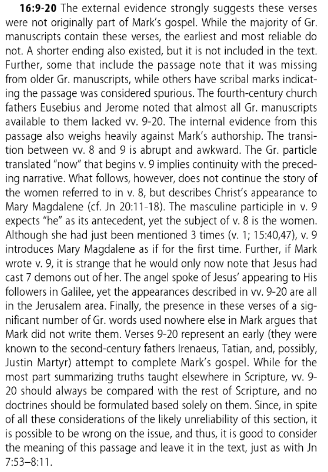
6. What does the notation between verses 8 and 9 mean? Read the following note on verses 9-20 from the MacArthur Study Bible¹

What evidence does Dr. MacArthur cite that Mark may not have written verses 9-20 and that it may have been added later? Does this in any way mean that the Bible is unreliable or inerrant? What are some precautions Dr. MacArthur suggests we should take with 9-20, and how should we handle this text comparatively?

7. Compare verses 9-20 with Matthew 28, Luke 24, and John 20, and any cross references (on 9-20) your Bible lists. Is there anything in verses 9-20 that isn’t mentioned elsewhere in Scripture? Is it “safe” to believe everything in 9-20 that matches up with other Scripture?

8. What has been the most important thing you’ve learned from our study of the book of Mark?


¹John MacArthur, The MacArthur Study Bible, English Standard Version, (Wheaton, IL: Crossway, 2010), p.1464-1465

Homework

Read the following resources on the ending of Mark:

The Fitting Ending to Mark’s Gospel by John MacArthur

The Ending of Mark by Robert Stein

Should Mark 16:9-20 be in the Bible? at Got Questions?


Suggested Memory Verse

And he said to them, “Do not be alarmed. You seek Jesus of Nazareth, who was crucified. He has risen; he is not here. See the place where they laid him.
Mark 16:6

Mark Bible Study

Mark: Lesson 23

Previous Lessons: 1, 2, 3, 4, 5, 6, 7, 8, 9, 10, 11, 12, 13, 14, 15, 16, 17, 18, 19, 20, 21, 22

Mark 15

And as soon as it was morning, the chief priests held a consultation with the elders and scribes and the whole council. And they bound Jesus and led him away and delivered him over to Pilate. And Pilate asked him, “Are you the King of the Jews?” And he answered him, “You have said so.” And the chief priests accused him of many things. And Pilate again asked him, “Have you no answer to make? See how many charges they bring against you.” But Jesus made no further answer, so that Pilate was amazed.

Now at the feast he used to release for them one prisoner for whom they asked. And among the rebels in prison, who had committed murder in the insurrection, there was a man called Barabbas. And the crowd came up and began to ask Pilate to do as he usually did for them. And he answered them, saying, “Do you want me to release for you the King of the Jews?” 10 For he perceived that it was out of envy that the chief priests had delivered him up. 11 But the chief priests stirred up the crowd to have him release for them Barabbas instead. 12 And Pilate again said to them, “Then what shall I do with the man you call the King of the Jews?” 13 And they cried out again, “Crucify him.” 14 And Pilate said to them, “Why? What evil has he done?” But they shouted all the more, “Crucify him.” 15 So Pilate, wishing to satisfy the crowd, released for them Barabbas, and having scourged Jesus, he delivered him to be crucified.

16 And the soldiers led him away inside the palace (that is, the governor’s headquarters), and they called together the whole battalion. 17 And they clothed him in a purple cloak, and twisting together a crown of thorns, they put it on him. 18 And they began to salute him, “Hail, King of the Jews!” 19 And they were striking his head with a reed and spitting on him and kneeling down in homage to him. 20 And when they had mocked him, they stripped him of the purple cloak and put his own clothes on him. And they led him out to crucify him.

21 And they compelled a passerby, Simon of Cyrene, who was coming in from the country, the father of Alexander and Rufus, to carry his cross. 22 And they brought him to the place called Golgotha (which means Place of a Skull). 23 And they offered him wine mixed with myrrh, but he did not take it. 24 And they crucified him and divided his garments among them, casting lots for them, to decide what each should take. 25 And it was the third hour when they crucified him. 26 And the inscription of the charge against him read, “The King of the Jews.” 27 And with him they crucified two robbers, one on his right and one on his left. 29 And those who passed by derided him, wagging their heads and saying, “Aha! You who would destroy the temple and rebuild it in three days, 30 save yourself, and come down from the cross!” 31 So also the chief priests with the scribes mocked him to one another, saying, “He saved others; he cannot save himself. 32 Let the Christ, the King of Israel, come down now from the cross that we may see and believe.” Those who were crucified with him also reviled him.

33 And when the sixth hour had come, there was darkness over the whole land until the ninth hour. 34 And at the ninth hour Jesus cried with a loud voice, “Eloi, Eloi, lema sabachthani?” which means, “My God, my God, why have you forsaken me?” 35 And some of the bystanders hearing it said, “Behold, he is calling Elijah.” 36 And someone ran and filled a sponge with sour wine, put it on a reed and gave it to him to drink, saying, “Wait, let us see whether Elijah will come to take him down.” 37 And Jesus uttered a loud cry and breathed his last. 38 And the curtain of the temple was torn in two, from top to bottom. 39 And when the centurion, who stood facing him, saw that in this way he breathed his last, he said, “Truly this man was the Son of God!”

40 There were also women looking on from a distance, among whom were Mary Magdalene, and Mary the mother of James the younger and of Joses, and Salome. 41 When he was in Galilee, they followed him and ministered to him, and there were also many other women who came up with him to Jerusalem.

42 And when evening had come, since it was the day of Preparation, that is, the day before the Sabbath,43 Joseph of Arimathea, a respected member of the council, who was also himself looking for the kingdom of God, took courage and went to Pilate and asked for the body of Jesus. 44 Pilate was surprised to hear that he should have already died. And summoning the centurion, he asked him whether he was already dead.45 And when he learned from the centurion that he was dead, he granted the corpse to Joseph. 46 And Joseph bought a linen shroud, and taking him down, wrapped him in the linen shroud and laid him in a tomb that had been cut out of the rock. And he rolled a stone against the entrance of the tomb. 47 Mary Magdalene and Mary the mother of Joses saw where he was laid.


The Holy Bible, English Standard Version. ESV® Permanent Text Edition® (2016). Copyright © 2001 by Crossway Bibles, a publishing ministry of Good News Publishers.


Questions to Consider

1. Study verses 1-5. Who was Pilate, and what was his position? What crime had the Sanhedrin decided Jesus was guilty of in Mark 14:64, and what sentence was to be carried out as His punishment? What did Levitical law say about this crime, its sentence, and how that sentence was to be carried out? Did the Sanhedrin follow this law? If the Sanhedrin was so concerned about Jesus breaking God’s law, why did they break God’s law by failing to carry out the death sentence according to the law? Why did they take Jesus to Pilate to enforce the death penalty instead?

2. Describe the scene in verses 6-15 in your own words. What motivated Pilate, the chief priests, and the crowd to do and say the things they did and said? What can you surmise about the personal character of Pilate, the chief priests, and the crowd? What part did power and position play in this part of the story? What part did both Jews and Gentiles play in this part of the story? What was Pilate’s perception of Jesus in verses 1-15? Where were the disciples during all of this?

3. Examine verses 16-20. Take a look at the footnote on verse 16. How many soldiers gathered around Jesus? Why were they mocking Him, and what did the mocking center around? Who created the thorn bush (17), the reed (18), the spit (18), and the soldiers themselves? When was the last time you used something for sinful purposes that God created for good?

4. In Gethsemane, Jesus rebuked Peter for fighting back against the arrest mob, saying, “Do you think that I cannot appeal to my Father, and he will at once send me more than twelve legions of angels?” At any step along the way – in Gethsemane, in His mock trial before the Sanhedrin, when judged by Pilate, when abused by the soldiers – Jesus had the power, and plenty of justification – as Creator of the universe and of the people mistreating Him – to turn Jerusalem into a crater. Why didn’t Jesus fight back or defend Himself? What does this teach us as Christians about laying aside our own rights, when necessary, for the sake of the gospel?

5. What impact did Christ’s crucifixion have on Rufus, and later, his mother (21)? The centurion? (39) Did everyone who witnessed the crucifixion become a Christian? Why or why not? Would the chief priests have believed Jesus was the Messiah and become His followers if he had come down off the cross? (31-32) Compare Rufus’ and the centurion’s belief in Christ with the mockers’ and chief priests’ disbelief. (21, 39, 29-32)

6. The mixture of wine and myrrh (23) was meant to be an anesthesia. What are some of the side effects of anesthesia? Why did Jesus refuse it?

7. What was the official charge against Jesus? (26) In what ways was this true? (2) In what ways was this false?

8. What were the mockers referring to in verse 29? What was the irony of their statement? (29-30)

9. What was the “curtain of the temple“? (38) What was the significance of its being torn, and its being torn from top to bottom?

10. Compare the scattering of the disciples with the gathering of the women (40-41) at the cross. How might their staying with Jesus through the crucifixion have been a comfort and encouragement to Him? How might witnessing the crucifixion have been a blessing to the women and emboldened their witness for Christ in the coming years? How can these women’s faithfulness to Christ serve as an example to us as Christian women today?

11. What position did Joseph of Arimathea hold? (43) Why would Joseph have needed to “take courage” with regard to approaching Pilate? (43) With regard to his place and reputation in the Sanhedrin? Why would it have been dangerous or detrimental to be seen as an associate or ally of Jesus?

12. Among those who deny that Christ’s resurrection actually happened are people who argue that on Easter morning, the women who found Jesus’ tomb empty had actually gone to the wrong tomb. How does verse 47 refute this theory?


Homework

Explain the events of Mark 15 in your own words as you would explain them to someone who has never heard the story of Christ’s crucifixion. Ask a lost friend or loved one to let you “practice” on her, if possible. As we saw in question 5, among those who were eyewitnesses to the crucifixion, some believed in Christ, and some did not. It is the same when we share the gospel today. Why do some believe the gospel and some don’t? List three ways grasping this truth can help as you share the gospel.


Suggested Memory Verse

And Pilate asked him, “Are you the King of the Jews?” And he answered him, “You have said so.” Mark 15:2