Ruth Bible Study

Ruth: Lesson 4

Previous Lessons: 1, 2, 3

Ruth 3

Then Naomi her mother-in-law said to her, “My daughter, should I not seek rest for you, that it may be well with you? Is not Boaz our relative, with whose young women you were? See, he is winnowing barley tonight at the threshing floor. Wash therefore and anoint yourself, and put on your cloak and go down to the threshing floor, but do not make yourself known to the man until he has finished eating and drinking. But when he lies down, observe the place where he lies. Then go and uncover his feet and lie down, and he will tell you what to do.” And she replied, “All that you say I will do.”

So she went down to the threshing floor and did just as her mother-in-law had commanded her. And when Boaz had eaten and drunk, and his heart was merry, he went to lie down at the end of the heap of grain. Then she came softly and uncovered his feet and lay down. At midnight the man was startled and turned over, and behold, a woman lay at his feet! He said, “Who are you?” And she answered, “I am Ruth, your servant. Spread your wings over your servant, for you are a redeemer.” 10 And he said, “May you be blessed by the Lord, my daughter. You have made this last kindness greater than the first in that you have not gone after young men, whether poor or rich. 11 And now, my daughter, do not fear. I will do for you all that you ask, for all my fellow townsmen know that you are a worthy woman. 12 And now it is true that I am a redeemer. Yet there is a redeemer nearer than I. 13 Remain tonight, and in the morning, if he will redeem you, good; let him do it. But if he is not willing to redeem you, then, as the Lord lives, I will redeem you. Lie down until the morning.”

14 So she lay at his feet until the morning, but arose before one could recognize another. And he said, “Let it not be known that the woman came to the threshing floor.” 15 And he said, “Bring the garment you are wearing and hold it out.” So she held it, and he measured out six measures of barley and put it on her. Then she went into the city. 16 And when she came to her mother-in-law, she said, “How did you fare, my daughter?” Then she told her all that the man had done for her, 17 saying, “These six measures of barley he gave to me, for he said to me, ‘You must not go back empty-handed to your mother-in-law.’” 18 She replied, “Wait, my daughter, until you learn how the matter turns out, for the man will not rest but will settle the matter today.”


The Holy Bible, English Standard Version. ESV® Permanent Text Edition® (2016). Copyright © 2001 by Crossway Bibles, a publishing ministry of Good News Publishers.


Questions to Consider

1. What did Naomi mean when she said she wanted to “seek rest” for Ruth?

2. In order to understand what is about to transpire between Ruth and Boaz in Ruth 3 and 4, it’s important to familiarize yourself with Deuteronomy 25:5-10, God’s instructions for levirate marriage. What was the purpose of levirate marriage? Why is it significant that Boaz was a relative of Naomi’s? (2) How was he related to her family? What did it mean that Boaz was a “redeemer,” and that there was a nearer redeemer than he? (9, 12-13)

3. Naomi’s instructions to Ruth (1-8) may seem a little odd, even inappropriate, to our Christian way of thinking. This is why it’s important, when studying God’s word, to understand, as best we can, the culture and customs of the audience of the book we’re studying. Read this commentary on Ruth 3:2-4. Were Ruth’s actions in any way immoral or inappropriate, biblically, or in her culture? What did Ruth mean when she said, “Spread your wings over your servant”? What was Ruth trying to convey to Boaz by her words and actions?

4. What are some ways Ruth demonstrates submission and humility in this passage? Compare Ruth’s demeanor with 1 Peter 3:4. How does Ruth model a “gentle and quiet spirit”?

5. Examine Naomi’s wisdom and counsel to Ruth in this chapter. How does Naomi exemplify the older “Titus 2 Woman“? How does Ruth exemplify the younger “Titus 2 Woman”?

6. If Boaz is a type (symbol, foreshadowing) of Christ, who does Ruth symbolize? Did Ruth have anything to offer Boaz that would make this marriage materially beneficial to him? When we come to Christ as sinners, do we have anything to offer Him that would make us “worthy” of saving? Compare Ruth’s humility and dependence on the good graces of Boaz to redeem her to our humility and dependence on God’s grace and mercy to redeem us. Compare verses 13b-14 to Ephesians 2:1,4-6. If Ruth represents us as sinners, what does her lying down for the night and rising at dawn symbolize?


Homework

Boaz points us to Christ as our redeemer. Look up the word “redeem” in a Bible dictionary and study these verses. What does it mean for Christ to “redeem” us- that He is our “Redeemer”?

Ruth Bible Study

Ruth: Lesson 3

Previous Lessons: 1, 2

Ruth 2

Now Naomi had a relative of her husband’s, a worthy man of the clan of Elimelech, whose name was Boaz. And Ruth the Moabite said to Naomi, “Let me go to the field and glean among the ears of grain after him in whose sight I shall find favor.” And she said to her, “Go, my daughter.” So she set out and went and gleaned in the field after the reapers, and she happened to come to the part of the field belonging to Boaz, who was of the clan of Elimelech. And behold, Boaz came from Bethlehem. And he said to the reapers, “The Lord be with you!” And they answered, “The Lord bless you.” Then Boaz said to his young man who was in charge of the reapers, “Whose young woman is this?” And the servant who was in charge of the reapers answered, “She is the young Moabite woman, who came back with Naomi from the country of Moab. She said, ‘Please let me glean and gather among the sheaves after the reapers.’ So she came, and she has continued from early morning until now, except for a short rest.”

Then Boaz said to Ruth, “Now, listen, my daughter, do not go to glean in another field or leave this one, but keep close to my young women. Let your eyes be on the field that they are reaping, and go after them. Have I not charged the young men not to touch you? And when you are thirsty, go to the vessels and drink what the young men have drawn.” 10 Then she fell on her face, bowing to the ground, and said to him, “Why have I found favor in your eyes, that you should take notice of me, since I am a foreigner?” 11 But Boaz answered her, “All that you have done for your mother-in-law since the death of your husband has been fully told to me, and how you left your father and mother and your native land and came to a people that you did not know before. 12 The Lord repay you for what you have done, and a full reward be given you by the Lord, the God of Israel, under whose wings you have come to take refuge!” 13 Then she said, “I have found favor in your eyes, my lord, for you have comforted me and spoken kindly to your servant, though I am not one of your servants.”

14 And at mealtime Boaz said to her, “Come here and eat some bread and dip your morsel in the wine.” So she sat beside the reapers, and he passed to her roasted grain. And she ate until she was satisfied, and she had some left over. 15 When she rose to glean, Boaz instructed his young men, saying, “Let her glean even among the sheaves, and do not reproach her. 16 And also pull out some from the bundles for her and leave it for her to glean, and do not rebuke her.”

17 So she gleaned in the field until evening. Then she beat out what she had gleaned, and it was about an ephah of barley. 18 And she took it up and went into the city. Her mother-in-law saw what she had gleaned. She also brought out and gave her what food she had left over after being satisfied. 19 And her mother-in-law said to her, “Where did you glean today? And where have you worked? Blessed be the man who took notice of you.” So she told her mother-in-law with whom she had worked and said, “The man’s name with whom I worked today is Boaz.” 20 And Naomi said to her daughter-in-law, “May he be blessed by the Lord, whose kindness has not forsaken the living or the dead!” Naomi also said to her, “The man is a close relative of ours, one of our redeemers.” 21 And Ruth the Moabite said, “Besides, he said to me, ‘You shall keep close by my young men until they have finished all my harvest.’” 22 And Naomi said to Ruth, her daughter-in-law, “It is good, my daughter, that you go out with his young women, lest in another field you be assaulted.” 23 So she kept close to the young women of Boaz, gleaning until the end of the barley and wheat harvests. And she lived with her mother-in-law.


The Holy Bible, English Standard Version. ESV® Permanent Text Edition® (2016). Copyright © 2001 by Crossway Bibles, a publishing ministry of Good News Publishers.


Questions to Consider

1. What is the backdrop of activity/time of year (23) as this chapter opens?

2. What is gleaning? Who was gleaning to provide for according to Levitical law? Where did Ruth and Naomi fit into this law? What sorts of things would Boaz have done to obey this law? (cf. 15,16) How is gleaning an example of God’s love and care for all of His people? How can the gleaning laws serve as an example to the church today?

3. Did Ruth know who Boaz was before she got home and Naomi told her? (19-20) Did Boaz know who Ruth was? How does this demonstrate God’s sovereignty, providence (2-3- Did Ruth really just “happen” to come to Boaz’s field?), the infallibility of His plans, and the truth of verses such as Proverbs 3:5-6?

4. Examine verses 1, 4, 8-16. Write a brief character sketch or description of Boaz. Boaz is a type of Christ. What are some aspects of Boaz’s character that point ahead to the character of Christ? How does Boaz’s (an Israelite) open arms welcome of Ruth (a non-Israelite foreigner) point ahead to God’s inclusion of Gentiles in salvation?

5. Since the story of Ruth and Boaz points so strongly to Christ and to the inclusion of Gentiles in salvation, may we assume that verses 10-12 mean that we will find favor with God, and that He will save us, on the basis of our own good works? Why not?

6. Compare verse 20 with Naomi’s outlook and attitude in chapter 1. How has her focus and perspective changed? How can thankfulness and recognizing how God has blessed us change us from bitter “Maras” to pleasant “Naomis”?

7. Which fruit of the Spirit is most prominently displayed by Ruth to Naomi and Boaz to Ruth? Ask God to grow you in this area and help you find ways to display it to others.


Homework

Boaz’s kindness toward Ruth gave Him an opportunity to “share the gospel” (12-13) – so to speak – with her. This week, look for opportunities to take the time to show kindness to others. Be ready to share the gospel, or even just a tract, with anyone who is receptive.

Wednesday's Word

Wednesday’s Word ~ James 4

james 4 4

James 4

What causes quarrels and what causes fights among you? Is it not this, that your passions are at war within you? You desire and do not have, so you murder. You covet and cannot obtain, so you fight and quarrel. You do not have, because you do not ask. You ask and do not receive, because you ask wrongly, to spend it on your passions. You adulterous people! Do you not know that friendship with the world is enmity with God? Therefore whoever wishes to be a friend of the world makes himself an enemy of God. Or do you suppose it is to no purpose that the Scripture says, “He yearns jealously over the spirit that he has made to dwell in us”? But he gives more grace. Therefore it says, “God opposes the proud, but gives grace to the humble.” Submit yourselves therefore to God. Resist the devil, and he will flee from you. Draw near to God, and he will draw near to you. Cleanse your hands, you sinners, and purify your hearts, you double-minded.Be wretched and mourn and weep. Let your laughter be turned to mourning and your joy to gloom. 10 Humble yourselves before the Lord, and he will exalt you.

11 Do not speak evil against one another, brothers. The one who speaks against a brother or judges his brother, speaks evil against the law and judges the law. But if you judge the law, you are not a doer of the law but a judge. 12 There is only one lawgiver and judge, he who is able to save and to destroy. But who are you to judge your neighbor?

13 Come now, you who say, “Today or tomorrow we will go into such and such a town and spend a year there and trade and make a profit”— 14 yet you do not know what tomorrow will bring. What is your life? For you are a mist that appears for a little time and then vanishes. 15 Instead you ought to say, “If the Lord wills, we will live and do this or that.” 16 As it is, you boast in your arrogance. All such boasting is evil. 17 So whoever knows the right thing to do and fails to do it, for him it is sin.


The Holy Bible, English Standard Version Copyright © 2001 by Crossway Bibles, a publishing ministry of Good News Publishers.


Questions to Consider:

1. Who wrote the book of James? What was his purpose in writing the book? To whom was it written? What type of literature (historical narrative, epistle, poetry, prophecy, etc.) is this book? Is James a mostly descriptive or prescriptive book?

2. In verses 1-10, what sin(s) does James indicate is at the root of our conflicts with others (1-2), problems in our prayer life (2-3), and rifts in our relationship with God (4-10)? How would you summarize this passage in one sentence?

3. What is “friendship with the world”? (4) Does this mean we can’t associate with lost people? Why does James call his audience “adulterous people”? (4) What Old Testament events or Scriptures might this term have brought to mind for James’ Jewish readers? Why does God make such a big deal about worldliness?

4. How do verses 11-12 fit with other New Testament passages on judging? Is it “speaking evil” of someone to lovingly call her to repentance?

5. In verses 13-16, is James saying we can never make plans in advance? What does this passage teach us about God’s sovereign control over the universe and our lives? What perspective should we have about our lives in relationship to God’s sovereignty, and how should this lead us to greater humility? How does verse 17 define the concept of a “sin of omission”?

Obedience, Old Testament, Sovereignty of God, Sunday School

David and God’s Big Picture ~ Sunday School Lesson ~ 5-11-14

sunday school

These are my notes from my ladies’ Sunday School class this morning. I’ll be posting the notes from my class here each week. Click here for last week’s lesson.

Through the Bible in 2014 ~ Week 19 ~ May 4-10
1 Chronicles 13-18, 2 Samuel 5:11-9, Psalm 1-2, 15, 22-25, 47, 68, 89, 96, 100-101, 105, 132, 29, 33, 36, 39, 50, 53, 60, 75
David and God’s Big Picture

2 Samuel 7/1 Chronicles 17
This passage is the institution of the Davidic covenant: God’s promise to establish the throne of David forever through the eventual birth and reign of Jesus. God, in His sovereignty, had a plan that David was part of. A plan with farther reaching impact than just David’s life. But God’s call on David’s life was the same as His call on our lives: to love and serve Him faithfully wherever He has put us.

crown-and-thorns

2 Samuel 5:12
Right from the beginning of David’s reign, he recognized two very important things about his life that we should also recognize:

1. God is sovereign (1 Samuel 16:1-13, 1 Peter 2:9).
It was God who had made David king over Israel, not anything intrinsically worthy in David himself. Remember that when God chose David to be king back in 1 Samuel 16, David was just a shepherd in his late teens or early 20s. Nothing special. Just an average guy. In fact, God told Samuel not to pay attention to outward signs of “specialness” in David’s older brothers. He had his own reasons for choosing David.

In the same way, when God calls us out of darkness and into His marvelous light (1 Pet.) for salvation, it’s not because there’s anything intrinsically good in us. In fact, everything’s bad about us because we are drenched in sin. But for His own reasons, whatever they are, God has called us out to save us.

2. David’s life was not his own (1 Corinthians 6:19-20, Matthew 20:28)
The second half of this verse does not say that “David knew… that the Lord had…exalted his kingdom” so David would be happy or comfortable or have a life of purpose. God established David’s kingdom “for the sake of His people Israel.” While God certainly blessed David along the way, God is about God. His main objective is His plans, His purposes, and His glory, not our happiness and contentment. This, of course, doesn’t mean He doesn’t care about us individually—far from it!

blurry-sky-cross1 Corinthians tells us our lives are not our own because we were bought with a price (the blood of Christ). We no longer belong to Satan, slaves of our sinful natures, living to gratify our own desires, pawns in his plan of trying to thwart God’s will. We belong to God to use as He sees fit for His plans and purposes.

One of the pitfalls of the American mindset is that it has taught us to focus on ourselves as individuals, often to the exclusion of what is good for our neighbors, our community, our state, nation, and world. We think in terms of “my rights,” “my enjoyment,” and “How will this affect me?” (Just so you know, I’m not a communist or a socialist when it comes to government. I’m just talking about this “me-centered” mentality.) This crosses over into our Christian lives. We often get so focused on our own lives, what we think God is or isn’t doing in them or with them, and how whatever He is doing is affecting us personally, that we forget that God has a huge plan for the entirety of human history and the universe. Whatever He’s up to right now may be about someone else, not you or me. We need to be more aware of God’s “big picture.”

As with David, God gives us our authority and circles of influence for the good of others, to bless them and serve them, even as Jesus came, not to be served but to serve, and to give His life for others (Matt. 20). The good news is that when we are on board with this, we get something much better than fleeting things like earthly happiness and comfort. We get eternal joy, peace, and a glimpse of the glory of God as we obey and cooperate with His plan.

You can’t always get what you want (2 Samuel 7:1- 7, 1 Samuel 13:14)
Because our lives are not our own, cooperating with God’s big picture plans sometimes means that we don’t get to do what we want to do, even if what we want to do is good and godly.

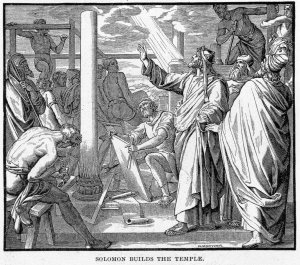
www-St-Takla-org--110--Solomon-Builds-the-Temple-3David was a “man after God’s own heart.” He loved the Lord and wanted to thank and honor Him by building Him a temple. What he wanted to do was an honorable and worshipful thing, and the motives of his heart were pure. But that was not the role God wanted David to play in the unfolding of His plan, nor was it the right time. The person God wanted to fulfill that part of His plan, at a later time, was Solomon.

As we discussed last week, seeking godly counsel is an important part of making godly decisions. David did this by consulting Nathan, the prophet. However, praying and asking for God’s guidance and wisdom is also essential before taking on something like building a temple, and both David and Nathan neglected to do so.

Graciously, even though they hadn’t come to God, God came to Nathan and explained things. God pointed out that in all this time, He had never asked anyone to build Him a permanent house. God had been just fine in a tent up to this point, and would be just fine until He decided it was time for Solomon to build the temple.

Sometimes, even if something is godly and part of God’s plan, He wants someone else to do it.

But you can always get what you need (2 Samuel 7:8-17, Luke 2: 26-33)
What David needed and what we need, is to be faithful and obedient to God wherever He has placed us. This doesn’t mean God will necessarily have us in the same place all our lives (though He might). After all, He took David from shepherd to warrior to king. But David served God faithfully in each of those positions for as long as God had him in those positions.

Ultimately, the role God wanted David to play in His plan was to be the king through whom God initiated the Davidic Covenant. Though David sought to build God a house, it was God who would build David a house (11, Luke 2). It would be an eternal house, first through his descendants who would be temporal kings, and, finally, through the Messiah, Jesus, who would reign forever and whose kingdom would know no end.

David’s Response (2 Samuel 7:18-29)

Humility (18-20)
David was overwhelmed by the fact that, though he wanted to do something big for God, God was going to do something big through him.

Exaltation (21-24)
David again recognized that it was God’s sovereignty that brought all this about, not his own awesomeness (21). He praised God’s greatness, holiness, and superiority to all else (22). He recounted God’s mighty deeds of the past and how He glorified Himself through His chosen people, Israel (23-24)

I’m in! (25-29)
David didn’t express doubt or hesitate to jump in with both feet. He didn’t whine that what he really wanted to do was build the temple. He embraced God’s plan obediently and joined in thankfully and wholeheartedly.

David glorified God for His “macro” plan (25-26) – the coming of the Messiah and everything leading up to it – and also for His “micro” plan (27-29) – realizing that if he cooperated with God’s plan, he and his family would be blessed along the way. Notice that David (29) did ask for God to bless his house and descendants, but not for personal/family gain. He asked that God would bless his family to fulfill and cooperate with God’s plan.

When God places us in any situation, whether blessing or hardship, our response should mirror David’s. We should be obedient to God, never stepping outside of His word to pursue things He doesn’t want for us, even if they seem godly. And, with humility and praise, we should embrace God’s plan, cooperating with Him joyfully.

What about all the non-Davids? (Exodus 12:37, Mark 7:37, 1 Thessalonians 4:9-12)
Sometimes when we read the Bible, we come to stories like David, Moses, Joshua, Noah, and Paul, and we can get the impression that God calls everyone to do great big things for Him as part of his plan. We tend to forget that when the Israelites left Egypt, there were likely 1.5 to 2 million of them. And only one Moses. By David’s time, there were likely several million Israelites. And only one David. What about the millions of Israelites who were born, grew up, got married, went to blue collar jobs every day, and died, having the-israelites-withoutlived lives of quiet faithfulness to God but never having had God make a covenant with them or being called to kill a giant or part a sea? Did God love them less? Value their love for Him less?

Why does God use some people in big, visible, fame-creating ways, and some in invisible ways? The answer, as is often the case when we’re dealing with God is, “I don’t know.” That’s one of the things that makes Him God and us not God. It’s his business, not ours. We trust that He does all things well (Mark 7) and that when He says that we are to “live quietly, and to mind your own affairs, and to work with your hands” (1 Thess. 4), He means it, and that lives of quiet faithfulness are precious in His eyes.


God has a plan. All of us who are His children have a part to play in that plan. Our part, whether big and visible or quiet and invisible, is to love and trust Him more each day and live obediently and faithfully wherever He places us.

Obedience, Old Testament, Sanctification, Sovereignty of God, Sunday School, Trust

Decisions, Decisions ~ Sunday School Lesson ~ 5-4-14

sunday school

These are my notes from my ladies’ Sunday School class this morning. I’ll be posting the notes from my class here each week. Click here for last week’s lesson.

Through the Bible in 2014 ~ Week 18 ~ Apr. 27-May 3
1 Chronicles 6-12, 2 Samuel 5:1-10, Psalm 81, 88, 92-93, 102-104, 133, 106-107
Decisions, Decisions

We all face difficult and confusing times of decision in our lives. Should I marry this guy or not? Which job should I take? What’s the best plan of action in X situation? How can we know for sure which decision God wants us to make?

1 Samuel 8:4-7, 2 Samuel 5:1-10
In these two passages, we see Israel’s decision to have a king to rule over them. In the first passage, which we studied a few weeks ago, the leaders wanted Saul (they didn’t know his name yet, but they sure had his résumé!). In the second, they wanted David. Two times when the government of Israel was at a crossroads. Two times when Israel’s leadership wanted a king. Two kings coronated. Similar circumstances, the same desire, similar outcomes. But even though the situations were so similar, were both decisions made the right and godly way?

Let’s take a look at some principles for godly decision-making and see how these principles worked themselves out in the Israelites’ situations with Saul and David.

MH900390083

Principles for Godly Decision-Making:
One thing we need to be careful about with the following principles is that we are not using them to manipulate God into making us make the right decision. Any time we modify our behavior in order to try to make God do what we want, we’re guilty of idolatry, even if what we want seems to be godly. The principles listed below are all things we should be doing or believing on a daily/regular basis because they are part of the obedient Christian walk, not just because we have a big decision to make. Godly decisions are a side effect of this kind of walk, not the end goal.

1. In order to make godly decisions, you must be saved (1 Corinthians 2:14-16, 2 Corinthians 5:17).
People who are unsaved aren’t capable of making godly decisions, because the motivation behind making godly decisions is the desire, from the heart, to please and be obedient to God. God, in His grace, may lead an unsaved person via his circumstances to make a certain decision, but the motive of his heart will still not be to please God. We are not capable of that motive unless we are saved.

2. Delight yourself in the Lord (Psalm 37:3-4).
Because Christians are new creatures with the mind of Christ, we have an inborn desire to love God, His word, and the things of God (godly preaching, books, music, friends, etc.). But this desire must be cultivated (3- New American Standard Bible translation) through a daily walk with the Lord, spending time in His word and prayer, and intentionally seeking out godly influences.

It’s like one of those “miraculous” weight loss stories we often hear. An extremely obese person decides he’s going to lose weight. The desire of his heart is there—he’s fed up with his looks and poor health, and he wants to tackle the problem and get healthy. But if he doesn’t intentionally do something, the weight isn’t going to come off, despite the desire. He starts off slowly. Maybe he cuts out cokes and walks around the block three times a week. As he progresses, his desire to cut bad things from his diet, add good things, and exercise more, builds. Not only does he see results, but he begins to enjoy the healthier diet and exercise more and more, and becomes even more committed to them. Eventually, he loses the weight and maintains a healthy lifestyle.

That’s how it is with delighting in the Lord. Through the power of the indwelling Holy Spirit, Christ helps us to intentionally cultivate faithfulness, and we grow in our love and affection for the Lord. As a result, He gives us the desires of our heart—to be more Christlike.

With Saul, were the Israelites delighting in the Lord? Definitely not. In fact, it was their lack of delighting in the Lord that led them to demand a king against God’s wishes. With David? Israel had just been through the consequences of having Saul as king and they knew God had ordained that David be the next king, plus he was a great military leader. Which of these motivated them the most? It’s hard to tell, but it feels like they were acquiescing to the inevitable, and the practical desire for military strength rather than repenting and taking an affirmative step towards godliness.

3. God’s word is sufficient for our every need (Hebrews 1:1-3a, 2 Timothy 3:16-17).
Often, when we read the Bible, it’s easy to long for God to speak to us one on one, through a burning bush, a fleece, a prophet, or some other form of direct revelation. But now that we have God’s complete written Word, we no longer need direct revelation, nor does God want us to seek that. Hebrews and Timothy tell us that God no longer speaks that MH900410128way and that His word is sufficient for our every need. Additionally, we now have access to God’s word any time we need it. We don’t have to wait for Him to miraculously show up. Finally, if we were to rely on signs or “hearing God’s voice,” how could we be sure we’re really hearing from God and not our own sinful inner voice, or worse, Satan? God’s word is absolutely trustworthy. When we read it, we can be 100% certain we’re hearing from God. And remember, Israel (and others in the Bible) did hear directly from God, and they still often disobeyed.

4. Know God’s word and study God’s word in context as it applies to your situation (Psalm 119:11, Deuteronomy 17:14-15).
We must study God’s word daily; even memorize it, so that we can apply it to every aspect of our lives. As we do, it’s very important to study it in context so we can be sure we’re applying the correct biblical principles.

Did Israel know God’s word as it applied to the situation with Saul? Yes. They certainly knew Deuteronomy 17, which predicted they would demand a king, and outlined the regulations for a king of God’s choosing. They also knew that God was, and always had been, the only king they needed, and that He did not want them to demand a king.

With David? Yes. Through Samuel’s prophecy, Israel already knew David was to be the next king and that he had already been anointed.

5. Obey God’s word (1 Samuel 15:22).
As we can see with Israel’s demand for a king (Saul), knowing God’s word isn’t enough. We also have to obey it. Sometimes it can seem like sin is the most practical way out of a situation, but it is only a temporary fix. Even when we try to put a godly spin on our disobedience, as Saul did in 1 Samuel 15, it is still disobedience. As Saul learned the hard way, God wants us to be obedient to Him regardless of our circumstances. With David, Israel, whatever her motivations were, obeyed God and made David king.

6. Know your “bent” (Psalm 139:13-14).
God has created each of us uniquely. We are all “bent” Bent_eye_cranked_bolt_profiletoward certain things and away from others. One of the ways God may show us the things He wants us to do and not do is through the talents, tastes, and abilities He has given us. If you can’t carry a tune in a bucket, that’s a pretty good indication God doesn’t want you to sing for a living. If you love numbers, that may be God’s way of leading you into a math-related field. Other times, we may be thrust into a situation in which we have to learn a new skill. We might just discover a talent we didn’t know we had!

7. Pray, and ask others to pray with you about the situation, especially for wisdom and guidance (James 1:5-6).
Some things we don’t need to pray about because they are clearly taught in God’s word. We don’t need to pray about whether we should attend church regularly, be faithful to our spouses, help those in need, etc. But, some situations aren’t as clear. James tells us that if we lack wisdom, all we have to do is ask God for it in faith, and He will give it to us. It’s a promise. We may not feel very wise, but we don’t operate on feelings. We take God at His word and trust Him as we continue to take the next step and the next.

With Saul, did Israel pray about the situation or ask God for wisdom in selecting a king? No. And even though God tried to provide them with wisdom- spelling out the consequences of their demand- they insisted on disobeying Him. They did not need to pray about making David king. God had already made it clear that he was the next to take the throne.

8. God has given you (and others) a brain for a reason (Proverbs 11:14, 24:5-6, 18:15)
Seek counsel from godly people you trust. Take what they say, make sure it matches up with Scripture, and pray about it. In other situations, such as a medical diagnosis, you may need to do some research and gather information so you can make an educated decision. Finally, trust that God, our wonderful Creator has hard wired you with the ability to process information and make the best decision you can with His help and guidance.

With Saul, God directly gave Israel godly counsel and information through Samuel. They chose to reject it and disobey, and suffered the consequences. With David, Israel also had all the information they needed to make the right decision. This time, they obeyed.

9. Trust in God’s sovereignty to direct your steps and work things out for your good (Proverbs 3:5-6; 16:9, Psalm 37:23-24, Romans 8:28).
Sometimes our desire to do what God wants us to do is so strong that we become paralyzed by the fear that we’re going MH900448357to do the wrong thing. When we do that, our trust is no longer in God’s sovereignty over the situation. We have shifted our trust from God—where it should be—to ourselves—where it should not be.

God’s sovereignty over situations does not rest on our actions. We can clearly see this in Israel’s situation with Saul. Even though they didn’t desire to please God, He had complete control of the situation and worked it out for His will to be done in the long run. How much more can we trust God to take care of our situations, if it is our desire to please Him, since He promises to do so?

10. Trust that God understands and has compassion on the frailty of His children (Psalm 103:14).
You aren’t God. You aren’t omniscient, knowing all the ins and outs of your situation. In most cases there is at least some aspect of the situation in which you are powerless. Every time you make a decision, you do it with only partial knowledge and partial control (at best). God knows all of this better than we do. That’s why He tells us to love Him, seek to honor Him, ask Him for wisdom, and trust Him.


One of the natural outgrowths of walking with the Lord is making more godly decisions. We must use the resources He has given us: His word, godly counsel, information, prayer, and wisdom, and trust Him to work everything out for our good.


Additional Resources:
The Problem with Seeking God’s Will by Matt Papa