
Holidays (Other), New Year's

The Mailbag: My word for the year is…

Originally published January 7, 2019

I can’t seem to find information on one topic that keeps coming up with women I am friends with. “One word” for the year. They are all waiting to “hear” from God what one word they need to focus on for the year. I have been asked what my word for the year is. I just think… the Word Of God is my word for every year. Do you happen to have any links, resources, or input?

I wish there weren’t any links or resources on this, but, unfortunately, it looks like a small cottage industry – both secular and evangelical – is growing up around this unbiblical concept. (I’m not going to give anyone free advertising and website hits by providing their links.)

The idea is pretty simple. You pick (or God “speaks” to you) a word that represents some sort of change you want to see in your life and you focus on that word, especially during situations when you want to see that change manifest itself, for the remainder of the year. For example, if you want to be a more peaceful person, you might choose “peace” as your word for the year. You find some way to think about or meditate on the word “peace” every day, but especially in worrisome or chaotic situations, and that’s supposed to make you a more peaceful person by the end of the year.

The only problem with this is – as with so many things in pop evangelicalism – the Bible.

You will not find this practice taught, endorsed, or even mentioned in the Bible. In fact, I suspect this idea traces its roots back to some form of Eastern mysticism. It’s a modern day twist on repeating a mantra. And somebody thought it would be a good idea to “Christianize” it – so she slapped a thin coat of “this is how God can speak to you and work in your life” paint over the surface of it.

That’s not how this works. That’s not how any of this works. You don’t just get to make up Christianity as you go along. That’s God’s job, not ours, and He already set it up exactly the way He wants it – in the Bible.

We know that God is not going to speak a certain “word for the year” to people for two reasons. First of all, extra-biblical revelation is unbiblical. God speaks to us through His all-sufficient written Word, not audibly. Which brings us to reason number two. Because God speaks to us through His written Word, and there’s nothing in His written Word about getting a word for the year, we can be certain that He’s not going to be whispering a word for the year in anybody’s ear.

OK, so let’s take the extra-biblical revelation component out of it. What if we go at it from a sanctification angle? Maybe I’ve noticed that I tend to worry too much, so I decide, for the sake of my own spiritual growth, that my word for the year is going to be “peace”, and I’m going to focus on that word this year?

Still not biblical. Not just because it’s not taught in the Bible (although that’s certainly reason enough), but for a host of other reasons as well.

For starters, we are not in charge of our sanctification, God is. He is the one who gets to decide what work He’s going to do in our hearts, and how He’s going to do that. And that’s a really good thing because He is infinitely wiser and more powerful than we are and He knows our hearts much better than we do. You probably won’t hear many of your girlfriends choosing words like “suffering”, “humility”, or “repentance” as their word for the year, but God knows that areas like these – the ones we often push back against with the greatest resistance – are the ones we usually need the most work on.

Next, sanctification isn’t linear. You don’t tackle peace, master it, then move on to patience, master it, and then move on to whatever’s next. And that’s how this “word for the year” thing is set up. This year, you choose the word “peace”. Next year, maybe you’ll choose “patience”, and so on. But what do you do when you get to the end of the year and you know you haven’t mastered peace yet? What then? Do you choose the word “peace” again? Give up on peace and choose another word?

Biblical sanctification is more like a big bowl of spaghetti noodles. Everything is all tangled up and inter-connected. At any given time, God could be working on one or five or a dozen different aspects of your character. And while you’ll rejoice when you occasionally look back over how much you’ve grown, you’ll never “master” any aspect of Christlikeness this side of Glory.

Finally, God has already prescribed our role in sanctification, and meditating on a particular word for the year is not even a little part of it. Our role in sanctification is to abide in Christ. How? We learn the “how” of abiding in Christ from studying our Bibles. John 15 offers us a little glimpse:

V.1: I [Jesus] am the true vine, and my Father is the vinedresser. Recognize that, as I mentioned, God is the vinedresser – the one who prunes, waters, fertilizes, harvests – not you.

V.2: …every branch that does bear fruit he prunes, that it may bear more fruit. Bear up under pruning as God conforms you to the image of Christ. Cooperate with whatever He’s working on in your life by obeying Him, thanking Him, and realizing that He’s doing it to make you more fruitful.

V.4: As the branch cannot bear fruit by itself, unless it abides in the vine, neither can you, unless you abide in me. Recognize and practice your dependence on Christ and His work for you and in you, not on a word you meditate on. You can’t be a fruitful Christian by coming up with your own way to grow in Christ. You can only do it His way.

V.7a: If you abide in me, and my words abide in you… To abide in Christ is simply to live for Him and commune with Him day by day. One of the ways we do that is to study “His words” – the Bible – so that those words will live in us. We ingest the words of Christ by studying our Bibles at home, with our Sunday School or Bible study class at church, sitting under good preaching at our church, and consuming other biblical materials during the week.

V.7b: …ask whatever you wish, and it will be done for you. If you’re abiding in Christ and His Word is abiding in you – what kinds of “whatever you wish” things do you think you’ll be asking Him for? Your foundational prayer to anything else you might ask for will be for God to be glorified and for Him to make you more like Christ. “Father, please heal me, but only if that will glorify You and make me more like Christ.” “Lord, I’d like You to take away this difficult situation at work, unless letting it continue would grow me to be more like Christ. Help me to glorify You no matter what.” Prayer is one of God’s prescribed methods of sanctification.

V.8: By this my Father is glorified, that you bear much fruit and so prove to be my disciples. Glorify God by bearing the fruit of the Spirit, displaying the fruit of obedience, harvesting the fruit of evangelism, and by doing so, displaying for the world what a real disciple of Christ looks like in order to point them to Him.

V.10,12,14: If you keep my commandments, you will abide in my love…This is my commandment, that you love one another as I have loved you…You are my friends if you do what I command you. Obey Christ’s commands and love others the way He loves you. That’s the heart of your role in sanctification. It’s an outward focus on how you can bring Him glory in any situation by obeying Him and loving others with a die-to-self love rather than a navel-gazing, self-centered, inward focus on “How can I be a better me?”.

V.11: These things I have spoken to you, that my joy may be in you, and that your joy may be full. Don’t forget the joy! What joy is there in a word that you focus on? How can you quantify whether or not you’re a better person at the end of the year and derive joy from that? Sanctification God’s way offers instant, daily gratification in the joy department. Joy dwells in us because the Holy Spirit dwells in us. Joy wells up when we see the hand of God at work in our hearts and lives, when He answers prayer, even just from spending time with Him in His Word, worship, and prayer. Joy is communion with a Person, not satisfaction over a job well done of pulling yourself up by your own boot straps.

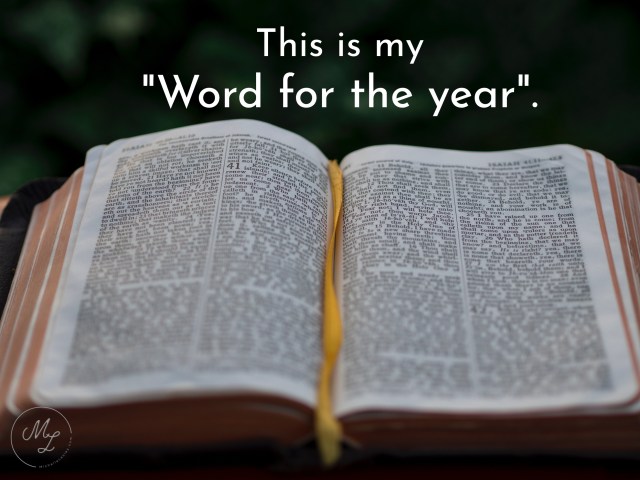
This “word for the year” thing is not necessary or biblical. When someone asks you what your word for the year is, just hold up your Bible and tell her, “All of these.”

This “word for the year” thing is not necessary, it’s not biblical, and it kicks God out of His rightful place of authority in sanctification and attempts to put self in the driver’s seat. You’re on the right track with your thinking. When someone asks you what your word for the year is, just hold up your Bible and tell her, “All of these.” After all, Christ gives us abundant life. Why would we limit ourselves to one measly little word when we can study all of God’s words?

If you have a question about: a Bible passage, an aspect of theology, a current issue in Christianity, or how to biblically handle a family, life, or church situation, comment below (I’ll hold all questions in queue {unpublished} for a future edition of The Mailbag) or send me an e-mail or private message. If your question is chosen for publication, your anonymity will be protected.

Mailbag

The Mailbag: Potpourri (Book reviews, statues, and conscience issues… Women giving pro-life talks in church)

Welcome to another “potpourri” edition of The Mailbag, where I give short(er) answers to several questions rather than a long answer to one question.

I like to take the opportunity in these potpourri editions to let new readers know about my comments/e-mail/messages policy. I’m not able to respond individually to most e-mails and messages, so here are some helpful hints for getting your questions answered more quickly. Remember, the search bar (at the very bottom of each page) can be a helpful tool!

Or maybe I answered your question already? Check out my article The Mailbag: Top 10 FAQs to see if your question has been answered and to get some helpful resources.


I occasionally help launch books by Christian authors. I recently signed on to promote a Christian historical fiction book, and I’m supposed to write an Amazon review about it. But I am in a dilemma. At the end of the book, one of the characters is miraculously healed from a gunshot wound and claims he heard god tell him that he [“god”] did it for the main character, who doesn’t believe in god. (Notice I’m not capitalizing “god” because I don’t believe God speaks to us audibly or in dreams.)

When I agreed to promote this book I had no idea this would be in it. Now I am feeling really conflicted. I can’t in good conscience recommend this book but I don’t want to write a negative review on Amazon. Thoughts?

(For readers who may not understand this sister’s dilemma, she is referring to the unbiblical idea of extra-biblical revelation.)

This is a great question, and it’s really awesome that you’re trying to think this through biblically.

What jumps out at me from your comment is that this is bothering your conscience to the point that: a) you’ve used the phrase, “I can’t, in good conscience…” and b) you purposefully didn’t capitalize “God”*. If you think this book is promoting a false god, it’s no wonder it’s bothering your conscience.

* The word “god,” uncapitalized, means “false god” or “idol”.

Romans 14:22b-23 says: Blessed is the one who has no reason to pass judgment on himself for what he approves. But whoever has doubts is condemned if he eats, because the eating is not from faith. For whatever does not proceed from faith is sin.

and James 4:17 says: So whoever knows the right thing to do and fails to do it, for him it is sin.

You should not sin against your conscience by reviewing and promoting this book as though there’s nothing wrong with it, and I think you would agree that option is off the table.

So what are your other options? I’m not sure exactly how this works, so I’m just throwing out a couple of ideas here:

  • Write an honest review praising the good parts of the book but explaining the biblical problems with the scene you mentioned, and agree to promote the book with that caveat included.
  • Write the aforementioned honest review but don’t promote the book at all.
  • Explain the problems with the scene to the author, tell her you’re willing (if you are) to do either of the above, and let her decide what she wants you to do.
  • Explain the problems to the author and tell her you can’t write a review or promote the book.

Personally, I think one of the first two options would make a greater impact for biblical truth on a larger number of people if you feel you can do it without sinning against your conscience. But you have to decide what’s right for your own walk with the Lord first.

I understand your concern about wanting to keep your word when you agreed to do something, but you have to keep in mind that – whether she realizes it or not – this was an unfair agreement on the author’s part. It’s like buying a car. She sold you a car giving you the impression it worked right and when you got it home you discovered it didn’t have a carburetor or whatever (I don’t know – I’m not good with car stuff). That nullifies your end of the agreement to buy the car.

Use biblical wisdom, pray about it, and don’t sin against your conscience.

In case it might help, here’s a critical review I wrote a while back: Redeeming Love: Rants, Raves, and Reviews


I have a statue of Joseph and Mary holding baby Jesus. It’s in a corner year round in my living room. As a former Catholic, I’m questioning myself if I should even have it at all??

As with the reader above, I think the fact that you’re starting to question this is an indication that it’s bothering your conscience. I would point you to the same Scriptures and counsel you not to sin against your conscience as I counseled the reader in the question above.

Some Christians consider any material representation of Christ to be a violation of the second Commandment. Personally, I don’t believe the context or cross-references of the second Commandment support this view. I’ve explained why, here. However, this is an issue you’ll want to study for yourself and be convinced of, one way or the other, by rightly handled, in context Scripture.

But, assuming there’s no second Commandment issue for you, and you’re not worshiping, venerating, or praying to the statue, or using it as some sort of “aid” to help you worship God – all of which all Christians would agree violate the first two Commandments against idolatry – and it’s just sitting there gathering dust in the corner like an umbrella stand or a fern, this is an issue of conscience.

I would suggest praying about it and discussing it with your husband (if you’re married) and then your pastor. You may also want to prayerfully consider…

Why do I still have the statue?

How do I feel about getting rid of it, and why?

What is the proactively good, biblical reason to keep this statue? (You might want to think of it like this: Would you recommend to your best friend that she buy and display a statue like yours? Why or why not?)

If it bothers your conscience and you can’t think of any good, biblical reason to keep it, get rid of it.

And get an umbrella stand or a fern.


Is it against 1 Timothy 2 for a woman to speak, not teach, during a Sunday morning worship service? She is not speaking as to teach or preach or pastor, but simply speaking on a topic to a congregation of men and women about her experiences as the head of a pregnancy resource center on Sanctity of Life Sunday. You say that this is unbiblical?

If she’s just giving a brief, personal testimony as a small part of the worship service, and the pastor will go on to preach his full sermon later in the service, that’s probably OK. (I’ve addressed women giving personal testimonies during the worship service here, #14.)

If her “testimony” is taking the place of the sermon, yes, it’s unbiblical, but not in the way you’re thinking. Someone giving a talk on an informational topic or her personal experiences that takes the place of the sermon is not so much a 1 Timothy 2:12, “women preaching/teaching to men” issue as it is a 2 Timothy 4:1-2 “pastors, preach the Word” issue.

Personal testimonies, speeches on non-biblical topics, panel discussions, interviews, etc. (from anyone, male or female), should not take the place of the preaching of the Word in the worship gathering. Additionally, due to the ignorance of the world and the majority of professing Christians who fail to distinguish between personal testimonies, TED talks, and preaching, a woman giving a personal testimony that takes the place of the sermon appears to most people as though she is preaching the sermon. We’re to avoid even the appearance of evil, so that’s another biblical reason not to do it.

May I make a suggestion? If your church is in need of someone to teach about the wickedness of abortion, contact an abolitionist organization such as Abolitionists Rising or Free the States. Because the abolition movement is church-based, they can put you in touch with a biblically qualified, doctrinally sound man (usually a pastor or elder) to come to your church and preach on the biblical reasons we should fight for the total eradication of abortion. We need to be convicted by Scripture on this issue, not swayed by an emotional response to someone’s subjective personal experiences.


If you have a question about: a Bible passage, an aspect of theology, a current issue in Christianity, or how to biblically handle a family, life, or church situation, comment below (I’ll hold all questions in queue {unpublished} for a future edition of The Mailbag) or send me an e-mail or private message. If your question is chosen for publication, your anonymity will be protected.

Mailbag

The Mailbag: Asked and Answered

Good Monday morning, readers. It is an honor and a joy to serve you in Christ. Welcome to all the newbies and to you seasoned veterans of the blog.

Because some of y’all are new, you aren’t yet aware of all of the resources here to help you. Or maybe you’ve been around a while and haven’t noticed something that might be helpful. Let’s remedy that!

First, if you’re new (or if you’ve never read it), check out Blog Orientation for New Readers and Old Friends. It’s like a CliffsNotes intro to the blog.

Second, be sure to familiarize yourself with all of the tabs in the blue menu bar at the top of the page. That’s where I keep the info I’m most frequently asked about.

Third, there’s a search bar at the bottom of every page (and one in the blue menu bar at the top of every page) which might help you find what you need.

Fourth, if you don’t find your question answered in one of these ways or below, you might want to check previous Asked & Answered articles and The Mailbag: Top 10 FAQs.

And finally, let me get you new readers some answers to the questions several of you have asked. Some of you long time friends may have missed these along the way, so I hope they’ll be helpful to you, too!


I’m a man who wants to use one of your Bible studies for my personal quiet time. Is that OK?

Is it OK for a man to teach one of your Bible studies to a co-ed class?

I don’t get this question frequently – maybe a handful of times a year – but that’s enough that I’ve added this statement to the Bible Studies tab (in the blue menu bar at the top of this page):

“From time to time I receive inquiries from men about using my studies for their personal quiet time or for teaching a co-ed or men’s Bible study class. It is my personal conviction that it is more in keeping with the spirit (though not the letter) of 1 Timothy 2:12, Titus 2:3-5, and related passages for men to use Bible study materials authored by men rather than by women. Therefore, on the honor system, I would request that men please not use my studies for personal use, or when teaching a class with male members. (Vetting the studies for your wife, daughter, or the women of your church, is, of course, fine. Encouraged, actually.)”


Is it biblical for a woman to pray at the opening of the church service?

Is it biblical for women to participate in gathering the giving on Sunday morning?

Is it OK for women to ask questions in a co-ed class or group if the pastor or teacher invites those present to do so?

Great questions! I’ve answered all of them in my article Rock Your Role FAQs. Numbers 15, 22, and 4, respectively.


Is The Bible Project a doctrinally sound teaching resource?

No. I’ve addressed that in this article. Pastor Gabe “WWUTT” Hughes has written an excellent article about the biblical (technically heretical on some points) issues with TBR. I went ahead and linked it at my Popular False Teachers and Unbiblical Trends tab in the blue menu bar at the top of this page.


You seem to be saying we should talk to God during prayer, but we should not try to listen for God’s guidance during prayer…But are we not supposed to pray about big decisions before we make them? If someone is deciding on taking a different job, or moving to another state, or getting married, isn’t that person supposed to pray about making the right decision? There isn’t a passage of Scripture that says “Jane Doe should marry John Smith in AD 2022.” What about pastors, who say God “called” them into ministry?

Do you think instead of praying specifically about a decision, we are supposed to pray for wisdom according to James 1 and then make our own decision, trusting God has given us the wisdom to choose correctly?

You’re circling the bullseye. I think my article Basic Training: 8 Steps to Finding God’s Will for Your Life will help. I didn’t specifically address pastors having some sort of Damascus Road-type “calling” to the ministry in that article, but the same principles apply. The Bible doesn’t say men will receive some sort of supernatural calling to the ministry. It says, “If any [man] aspires to the office of overseer, he desires a noble task,” (1 Timothy 3:1) and that he must meet certain biblical qualifications. If a man desires to be a pastor and he meets the biblical qualifications, he should start prayerfully putting the principles in that article into practice, trusting God to guide him in his pursuits.


As Christians, do we participate in celebratory life events of sin? For example- I had a family member (professes to follow Christ) throw a housewarming party for another family member living with her boyfriend. They bought a home together & are not married. I also had another family member (professor of Christ) become pregnant outside of marriage & naturally my family wanted to throw a big baby shower. How do those of us who honor Christ with our life handle such events?

It can be an uncomfortable invitation to receive, for sure. I’ve addressed the baby shower question in my article The Mailbag: Should I Attend the Baby Shower?. And let me just clarify a distinction between a shower for a woman who conceived out of wedlock and these other scenarios. A woman who conceived out of wedlock sinned – past tense. She may have since repented. Also, the purpose of a shower is to give her things she will need for the baby, not to celebrate or help perpetuate an ongoing sin such as the ones mentioned below. That is something to weigh if you’re trying to decide whether or not to attend a shower.

Amy and I briefly addressed the “housewarmings for shack ups” issue in our Pride, Pronouns, & Prodigals episode of A Word Fitly Spoken:

Let’s get things kicked off with a question that really came to the forefront a couple of years ago when same sex “marriage” became legal: Should Christians attend homosexual weddings?

And really, this answer also applies to any sort of event that celebrates, normalizes, or helps codify an ungodly union: events celebrating transsexualism, homosexual wedding receptions or showers, housewarming parties for a homosexual couple or even for a heterosexual couple that’s going to be living together, a celebration of adoption for a homosexual or non-married heterosexual couple, or even – I don’t know if these are still a thing or not, but divorce parties.

The short answer is, Christians should not be helping people celebrate their sin. We should be sharing the gospel with them so they can get saved out of their sin.

Attending a wedding or any of these other events implies that a person is in favor of the union or the sin that’s being committed, and no matter how much we love the person, Christ calls us to love Him more and not participate in or give approval to sin.

You might also wish to read my article The Mailbag: Should Christians Attend a Homosexual “Wedding”? since some of the same principles mentioned in it apply to these other scenarios.


You regard John MacArthur as someone who is biblically sound – I beg to differ with you, as he claims (and directly answered a question asked of him) if after taking the mark of the beast, can a person change their mind (claim Christ) and still get to heaven….his response was “yes.” Absolute unbiblical doctrine….that’s all I’m bringing up at this point – he is leading people to HELL!

No he isn’t “leading people to HELL!” and you’re making a slanderous false accusation against (assuming you’re a genuinely regenerated Believer) a brother in Christ. Repent.

This claim against John MacArthur is the urban legend that will not die, no matter how many times it’s clearly and biblically refuted (I guess because people with this attitude want to discredit him and will grasp at any straw to do so, no matter how flimsy.). It’s been going on for over ten years now. I get some form of the screaming neemie “JOHN MACARTHUR IS A FALSE TEACHER!!!!!” email or message several times a year. I’ve heard it all before and it’s all still a lie. No need to send me any more messages about it.

I’ve addressed this issue here.

Seriously, stop. Repent.


Is it wrong to bail on a Bible study if you find error in the teachings?

Nope. In fact, most of the time, I would recommend it, as long as you’re sure it’s the study, not your beliefs, that’s in error. You may find my article The Mailbag: Should I attend the “Bible” study to correct false doctrine? to be helpful.


I was wondering if you have any info on homeschooling on your site that is biblical?

Yep, on both of my sites. Amy and I recorded an A Word Fitly Spoken podcast episode on homeschooling called NOW are you ready to homeschool? And, a while back, my readers suggested some Christian homeschooling blogs here.


If you have a question about: a Bible passage, an aspect of theology, a current issue in Christianity, or how to biblically handle a family, life, or church situation, comment below (I’ll hold all questions in queue {unpublished} for a future edition of The Mailbag) or send me an e-mail or private message. If your question is chosen for publication, your anonymity will be protected.