Mailbag

The Mailbag: Second Degree / Secondary Separation?

In your articles about false teachers you state as one of your reasons for recommending against a teacher: “The pastor or teacher cannot currently and unrepentantly be partnering with or frequently appearing with false teachers. This is a violation of Scripture.”

You seem to be advocating what our church calls, ‘Second Degree Separation’.  An example would be, “We separate from Joel Osteen because he is a false teacher and we separate from Bob because Bob often appears with Joel Osteen.” Are you advocating Second Degree Separation?

I’ve never received this question before, but I thought it was a really good one, not just for those who might be wondering the same thing, but to explain a doctrine the average Christian probably isn’t familiar with.

If you’re not familiar with “Secondary” or “Second Degree” separation, the person who asked the question gave a very clear example of the gist of it. Got Questions provides a similar example, goes into a little more detail, and makes some very good points. (We’re going to circle back to that article in just a minute.)

The short answer to the reader’s question is “No.” I neither subscribe to, nor apply, the law of secondary separation when considering whether or not to recommend a teacher. I do exactly what I’ve always encouraged all of you to do: compare a teacher’s teaching and behavior to rightly handled Scripture.

Here is why I recommend that you not follow “Bob” (teachers who yoke in ministry with false teachers like “Joel Osteen”):

1. When “Bob” yokes with people he knows or has been biblically warned are false teachers, he is willfully and unrepentantly disobeying Scripture. I would warn women not to follow any teacher who’s willfully and unrepentantly, despite biblical warning and correction from others, participating in any sin. If, for example, Joyce Meyer were 100% doctrinally sound and yoked with no other false teachers, but were living in unrepentant adultery or embezzling, I would still warn women away from her.

And, I’d like to emphasize regarding all the “Bobs” I recommend against:

  • Yoking with false teachers is not a one time “oopsie” for “Bob”. All of these “Bobs” frequently yoke with false teachers. (Alistair Begg spoke at a 2019 conference that Beth Moore also spoke at, either because he didn’t realize the depths of the issues with her, or he didn’t know she was going to be asked to speak at the time he agreed to speak, or because once he found out she was going to speak, he considered it too late to cancel. To my knowledge, he hasn’t done so since, and he’s on my list of recommended Bible teachers1.) Doctrinally sound teachers make the occasional honest mistake. That’s not what we’re dealing with here. “Bob” doesn’t think yoking with these teachers is a mistake or a sin, and he keeps on doing it.
  • Even if “Bob” didn’t initially know “Joel Osteen” was a false teacher when he yoked with him the first time (which, as a responsible Bible teacher and Christian, he should have), he’s been informed, warned, and rebuked by multiple people. (When Alistair Begg1 decided to go through with speaking at the aforementioned conference, his followers came absolutely unglued, and he heard about it. I personally witnessed many people telling him he shouldn’t be appearing with her and why.)

2. On top of directly disobeying Scripture, habitually and unrepentantly yoking with false teachers demonstrates that “Bob” either does not understand Scripture and doctrine well enough, or does not care about Scripture and doctrine enough to be teaching it to anybody. Why? Because he either does not know or is ignoring the Scriptures that the false teachers he’s yoking with are violating. He is not doing his best to “present himself as one approved, a worker who has no need to be ashamed, rightly handling the word of truth” (2 Timothy 2:15), and he’s one of the “many” who should not become teachers because he can’t stand up to the stricter judgment James 3:1 talks about.

3. Particularly for pastors (but I see no biblical reason not to apply the same standard to other male and female Bible teachers), yoking with false teachers disqualifies him from the pastorate / eldership, and that’s not somebody I’m going to recommend that anyone follow. Titus 1:9, part of the biblical qualifications for pastors / elders, says: “He must hold firm to the trustworthy word as taught, so that he may be able to give instruction in sound doctrine and also to rebuke those who contradict it.” When “Bob” partners with false teachers, he’s not rebuking those who contradict sound doctrine, he’s giving approval to them and their false teaching. He is committing pastoral malpractice and betraying the God-given duty of his office. That’s not the kind of person anybody should be looking up to, following, or receiving teaching from.

4. False teachers influence those who keep company with them. When “Bob” yokes with “Joel Osteen”, “Joel’s” false doctrine is influencing “Bob”: Do not be deceived: โ€œBad company ruins good morals.โ€ 1 Corinthians 15:33 Birds of a feather flock together. When you lie down with the dogs, you get up with the fleas. I haven’t run across a single “Bob” who is doctrinally sound in all areas except for yoking with false teachers. All the “Bobs” I recommend against are biblically problematic in other areas of their theology as well.

And just to be clear, the “Bobs” I recommend against are not appearing at a conference with “Joel Osteen” or preaching at his “church” and rebuking him or correcting his false doctrine (see #3 above). “Bob” is either preaching basically the same thing as “Joel,” or his preaching is flying enough under the radar that “Joel” doesn’t think “Bob” is disagreeing with him. If “Joel” thought “Bob” was rebuking him, that would be the last time “Bob” was ever invited to speak at “Joel’s” conference or “church”.

And that’s what I want to circle back to in the Got Questions article linked above. The example of secondary separation they give is this:

Secondary separation works like this:
a) Mr. False is a heretic, teaching a false gospel.
b) We refuse to associate with Mr. False (and rightly so).
c) Mr. True, who is a sound, biblical teacher, speaks at a conference where Mr. False is also speaking.
d) We now refuse to associate with Mr. True, because of his association with Mr. False.

Point “c” is a false premise, because Secondary Separation assumes “Mr. True” is doctrinally sound. First of all, if “Mr. True” is known to be a doctrinally sound, Titus 1:9 preacher, he doesn’t get invited to speak at conferences that also invite heretics. Outside of debates (which are different from conferences), it just doesn’t happen. Second, I would challenge anyone to show me a “sound, biblical teacher” (“Mr. True”) who would knowingly (see #1 above) agree to speak at a conference with a heretic. Part of being a “sound, biblical teacher” is being discerning and obeying Titus 1:9 and all the other Scriptures that command us to rebuke, expose, and stay away from false teachers. In other words, if “Mr. True” is knowingly and non-rebukingly yoking with false teachers, he is, by definition, not a “sound, biblical teacher”.

5. Yoking with false teachers introduces “Bob’s” followers to those false teachers. When “Bob” yokes with “Joel Osteen,” his followers understand him to be saying, “I approve of Joel and agree (or at least don’t disagree much) with his teaching.”. “Bob” has just introduced his followers to a false teacher, and many of them will start following “Joel” and being deceived by him. This is one of the foundational reasons why Scripture tells us to stay away from false teachers – it’s confusing to others and can lead them astray.

So when I warn against “Bob” for yoking in ministry with “Joel,” I’m not making the statement, “I believe in and apply the law of Second Degree Separation.” It’s much more an issue of, “Is the type of person who habitually and unrepentantly yokes with false teachers really the type of person you should receive teaching from and be influenced by?”. I think the Bible’s answer to that question is a clear and resounding “No.”.

1UPDATE: Since the original publication of this article, I have removed Alistair Begg from my list of recommended teachers, not because of this incident, but because it has come to my attention that he believes it’s OK for women to preach to / teach men as long as they’re doing so “under the authority” of the pastor / elders. Although he still seems to be a generally doctrinally sound teacher, this idea is unbiblical, and I cannot proactively recommend someone who holds to it.

Additional Resources:

Justin Peters and Todd Friel on Secondary Separation

Popular False Teachers & Unbiblical Trends

Answering the Opposition- Responses to the Most Frequently Raised Discernment Objections

Is She a False Teacher? 7 Steps to Figuring It Out on Your Own


If you have a question about: a Bible passage, an aspect of theology, a current issue in Christianity, or how to biblically handle a family, life, or church situation, comment below (Iโ€™ll hold all questions in queue {unpublished} for a future edition of The Mailbag) or send me an e-mail or private message. If your question is chosen for publication, your anonymity will be protected.
Discernment, Speaking Engagements

Report Back & Video: Sister 2 Sister Meeting

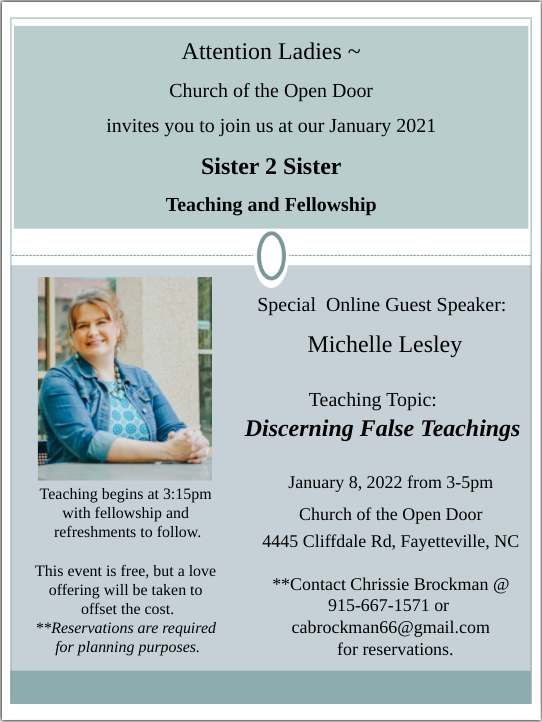
Over the weekend, I had the pleasure of speaking live, via Zoom, to Church of the Open Door’s quarterly Sister 2 Sister women’s meeting, held in Fayetteville, North Carolina.

As this was sort of a “micro-conference,” I taught for about 30 minutes on the topic of Discernment, followed by about 30 minutes of Q&A with some super questions from the ladies in attendance.

If you’d like to watch the video,
please click here.

If you’d like to access the handout that goes with
the teaching session, please click here.

Articles / resources mentioned or touched on in the video:

What is the New Apostolic Reformation?

Is She a False Teacher? 7 Steps to Figuring it Out on Your Own

The Mailbag: Potpourri (…Heretical book disposal) (I think this is the article I was thinking of and mentioned in answer to the first Q&A question.)

Women Preaching: Itโ€™s Not a Secondary Doctrinal Issue

Learning from the Sins of Others: Ravi Zacharias

Recommended Bible Teachers

Answering the Opposition- Responses to the Most Frequently Raised Discernmentย Objections #3, 8

Popular False Teachers & Unbiblical Trends

Tony Evans

Why Our Church No Longer Plays Bethel or Hillsong Music (or Elevation or Jesus Culture), and Neither Should Yours

The Mailbag: False Doctrine in Contemporary Christianย Music


If your church or organization is ever in need of a speaker for a womenโ€™s event, Iโ€™d love to come share with your ladies as well. Click here for more information.

Church, Discernment

Throwback Thursday ~ Build the Wall and Station a Guard: A Plea for Pastors to Protect 6 Areas of the Church Vulnerable to False Doctrine

Originally published August 5, 2016

The Great Wall of China

The Wailing Wall

The walls of Jericho

Walls. Sometimes they go up, and sometimes they come a tumblin’ down. When I was a kid it was, “Mr. Gorbachev, tear down this wall!” Now it’s, “Elect me and I’ll build a wall between the United States and Mexico.”

There was a time in history when it was common practice for a city to have a wall built around its perimeter. Walls have historically been built for protection, to keep inhabitants safe from attacking marauders. When Israel returned to Jerusalem after Babylonian captivity, their first priority was to rebuild the altar – their focal point of worship. Next came the temple – to consecrate, or set apart, their worship. And, finally, the city wall – which protected everything, including their worship.

Today, when Christians plant a church, we start off with our focal point of worship, the author and finisher of our faith, Jesus Christ. He is the foundation of the church, the center of our worship, our rallying point.

As the church grows, we consecrate it, setting it apart from other organizations and gatherings by buying or constructing its own special building. It’s not a store or an office or a restaurant. It’s a church. It’s where believers gather to worship, fellowship, and be trained in God’s word.

But somehow we never get around to protecting our churches from enemy attack. Indeed, it hardly ever occurs to most pastors and church members that there’s a need for a wall.

But there is. A huge need. And for some churches, it’s already too late.

Pastor, I plead with you- it’s time to build a wall around your church. A “walls of Jericho”-high wall. A chariot races on top- thick wall. And an armed guard posted at the gate. Not to keep out visitors or people who might look or act differently from your congregation- God forbid! It’s to keep out the false doctrine that’s infiltrating and attacking the Body in so many ways. And some areas of your wall are going to need extra fortification because they’re protecting these six vulnerable areas.

1. The Preaching of the Word

Pastor, the buck starts and stops with you. Are you preaching the Word? In season and out of season? Are you rightly handling God’s word? Preaching sound doctrine and rebuking those who contradict it? Declaring the whole counsel of God? Or is your focus on preaching to entertain, to keep people happy, to encourage giving, or to keep from rocking the boat? Only you can answer these questions. Strong preaching is the first step in building a strong wall to protect your church.

2. The Teaching of the Word

How much do you know about how, and what, your Sunday School, Bible study, or other small group leaders teach? Have you ever observed, evaluated, or interviewed any of your teachers? Does your church have any formal qualifications for teachers? Are they required to go through any sort of training? Who are their spiritual influencers? Which celebrity pastors and authors are they recommending to their classes?

A teacher who is listening to or reading materials by false teachers during the week is going to have her theology shaped by those false teachers, and she’s going to bring that warped theology into the classroom where it will infect the students. A teacher whose main discussion questions are, “How do you feel about this verse?” or “What does this verse mean to you?” is not handling God’s word properly and, thus, not properly training her students. Find out what’s going on in your Sunday School classrooms, and strengthen your wall by strengthening your teachers.

3. Sunday School/Small Group Curricula

Because so few teachers are properly trained, churches tend to rely heavily on the Sunday School curricula to do the actual teaching. Have you examined your curricula lately? Are the lessons anchored in copious amounts of rightly exposited Scripture or are they mainly comprised of inspirational stories and illustrations? Are the discussion questions watered down pablum or do they challenge people to think and search the Scriptures for understanding? Does the curriculum recommend supplementary materials or music from doctrinally sound, or questionable, sources? Does the curriculum recommend “homework assignments” that include unbiblical practices such as contemplative prayer or yoga? Build a solid wall with solid curricula.

4. Women’s Bible Study

This is an area of your wall which needs major fortification. In many churches, it is the primary avenue through which false teaching infiltrates the Body. Is your women’s ministry using studies or materials by a best selling author like Beth Moore, Priscilla Shirer, Christine Caine, Joyce Meyer, Lysa TerKeurst (Proverbs 31), Jen Hatmaker, Lisa Harper, Lisa Bevere, Victoria Osteen, Jennie Allen, Rachel Held Evans, Ann Voskamp, Sheila Walsh, or anyone with “Jakes” in her name? Are they attending conferences, retreats, or simulcasts headlined by any of these people? Then the women of your church are being taught false doctrine. Your men’s Bible study curriculum also needs to be examined, but women’s Bible study is a major foothold of false doctrine.

5. Music

If your church uses KLOVE’s playlist to formulate its worship set, you’re probably importing false doctrine right into your worship service. You’ve got to vet both the lyrics (hymns don’t get a pass on this, by the way) and the artists for sound theology. When it comes to contemporary worship music, the most popular and common sources of false doctrine are Hillsong, Elevation, and Bethel/Jesus Culture. Here’s another good resource.

6. Ecumenism

Is your church partnering or fellowshipping with other local churches outside your own denomination? Are you thoroughly familiar with their beliefs and practices? Are those beliefs and practices biblical? Where do they stand on female pastors, elders, and teachers? Homosexuals as church members or leaders? Abortion? The inerrancy, infallibility, and supremacy of Scripture? Extra-biblical revelation? Signs and wonders? Works righteousness? Do they have a biblical statement of faith “on paper” but stray from it in practice? Not every organization that calls itself a Christian church actually is one by biblical standards, and we are not to partner or fellowship with those whose beliefs and practices do not line up with Scripture.

That’s a lot of vetting to do for a pastor who’s probably already overwhelmed and stretched thin. May I make a suggestion? Don’t try to do it alone. After all, those cities with protective walls hired soldiers to guard the gates. Is there an associate pastor who could take on vetting curricula and fellow churches and conference speakers? Is there a mature, discerning layman or woman you trust who would be willing to lend a hand with researching your music or women’s Bible study books? Do you have a “master teacher” capable of training your Sunday School and small group teachers? Ask your people for help. Use the able. Train the willing. Get that wall built to shut out false doctrine, and station your armed guards at the gates to check out everything that comes in.

The enemy is out there, dear pastor. Let’s make sure that’s where he stays.

Mailbag

The Mailbag: When is it OK to leave a church that’s begun embracing false doctrine?

Originally published September 12, 2016

The elders and pastor of my church have made it clear that they aren’t interested in my husband’s and my concerns about, among other problems, a new women’s study (by a false teacher) starting this month. He told me he would read the articles I sent him but that I was wrong. Is it OK to leave this church, and, if so, when? How long do we wait and not see change?

That’s a great question, and I’m afraid there’s no “one size fits all” answer. When a church begins slipping, biblically, and there’s a Christian in that church who’s wise and discerning enough to see it, God has put that Christian in that church to help biblically solve that problem, or at least to serve as a prophetic warning as to what God’s Word says about the issue and what will happen if the church does not correct its course.

Our very first priority in this situation is prayer. We must pray fervently for God to change the hearts of the pastors and other leaders, for wisdom to know how to best approach the problem scripturally, and for God to give us wisdom about how long to stay and when to leave. (For us married ladies, that decision ultimately falls to our husbands, so we need to be praying for them, too.)

When you’ve done what you can to help biblically solve the problem(s) and have consistently been rebuffed (and it sounds like that’s about where you and your husband are with this church), it may be time to leave. It is perfectly biblical to leave a church that is embracing false doctrine despite scriptural warnings (Titus 3:10-11, Romans 16:17-18, 2 John 9-11, 2 Corinthians 11:12-15, Mark 6:11, Matthew 7:6).

Sometimes, God will make it exceedingly clear as to when you should leave because the church will ask you to leave or, in some way, make it impossible for you to stay.

It sounds like you and your husband have tried to help this church. Just continue to pray for your church and its leadership, and for wisdom (especially for your husband) about staying or leaving. Then trust God to direct you (Proverbs 3:5-6).

If you do end up having to leave, make sure you immediately begin your search for a doctrinally sound church to attend. No church is perfect, but we need to obey God’s mandate to be faithful members of a local body of believers.

Additional Resources:

The Mailbag: How should I approach my church leaders about a false teacher theyโ€™re introducing?

The Mailbag: How to Leave a Church

Searching for a new church?


If you have a question about: a Bible passage, an aspect of theology, a current issue in Christianity, or how to biblically handle a family, life, or church situation, comment below (Iโ€™ll hold all questions in queue {unpublished} for a future edition of The Mailbag) or send me an e-mail or private message. If your question is chosen for publication, your anonymity will be protected.

Mailbag

The Mailbag: Potpourri (Confessing past sin… Too much Calvinism?… “Fake it til you make it”)

Welcome to another โ€œpotpourriโ€ edition of The Mailbag, where I give short(er) answers to several questions rather than a long answer to one question.

I like to take the opportunity in these potpourri editions to let new readers know about my comments/e-mail/messages policy. Iโ€™m not able to respond individually to most e-mails and messages, so here are some helpful hints for getting your questions answered more quickly. Remember, the search bar (at the very bottom of each page) can be a helpful tool!

Or maybe I answered your question already? Check out my article The Mailbag: Top 10 FAQs to see if your question has been answered and to get some helpful resources.


I confessed and repented of a certain sin after I got saved, but my husband doesn’t know about it. Do I need to confess that sin to my husband in order to receive God’s blessings or be considered a Proverbs 31 wife? And should he also confess his past sins to me? By the way, my husband is a pastor.

What a beautiful heart you have – wanting to be clean before the Lord and wanting to please Him!

There might be a few very specific scenarios in which it would not be wise to bring up a past sin to your husband, but, generally speaking, in a Christian marriage yes, you should be able to talk to your husband about your past sins (and he should also be able to discuss his past sins with you). But not to get God’s blessings or to be a Proverbs 31 wife.

Marriage is about trust. In the same way that Christian husbands and wives should trust each other enough to feel comfortable being physically naked around one another, we should also trust each other enough to feel comfortable “baring it all” when it comes to our past sins.

It sounds like this is a sin you simply haven’t told him about, but it should go without saying that you should not be lying to him about it or trying to cover it up. Those are direct sins against him, and if you’re doing that, you definitely need to confess and repent to him.

All of that being said, there can be more helpful / wise ways and times to talk to your husband about your past sin and less helpful / wise ways and times to talk to him about it, and you may want to get some help figuring that out from someone who can be more objective about it than you can.

Normally, I would suggest setting up an appointment with your pastor to get some pastoral counsel about it, but since your husband is your pastor, I would suggest locating an ACBC certified Biblical Counselor (not the same thing as a “Christian counselor/therapist”) who is not a member of your church (you don’t want your husband to be embarrassed or make it difficult for the counselor to sit under her pastor’s leadership) and set up an appointment.

Some denominations offer counseling services to pastors and their families, so you may want to contact your denominational leadership to find out about that. (I’m not sure what to tell you about other denominations, but if you’re Southern Baptist, contact your local SBC association or state convention.)


Hello! I found your website while trying to see if a Christian singer was a false teacher. I started reading over your beliefs to make sure that you werenโ€™t a false teacher (I donโ€™t mean that in a rude way, itโ€™s just that I have to be really careful especially since I am only a teenager). I agree with everything except Calvinism. I was just wondering if our beliefs would still align enough to where your positions on whether or not people are false teachers would align with my beliefs. I can always ask my parents afterwards, but I just wanted to know basically if you talk about or reference Calvinist beliefs a lot. Thank you!

Wow. Just, WOW. Honey, your parents must be so proud of you. I know I would be if you were my daughter. I am thrilled – hear me: THRILLED – that you checked me out to make sure I’m not a false teacher before reading my stuff. Do you know how many adults don’t do that before following people? Most of them. I wish I had been as discerning as you are when I was your age.

Calvinism is not a factor when I sit down to evaluate whether or not someone is a false teacher, so that isn’t something you would need to worry about. In fact, there are some people on both my Popular False Teachers page and on my Recommended Bible Teachers page about whom I have no idea whether or not they’re Calvinists. There are even Calvinists I recommend against (such as Matt Chandler), or decline to proactively recommend (such as John Piper). I will say this, though – and, understand, this is a very general statement – having studied dozens of teachers, I find that those who adhere to Calvinism / Reformed theology are less likely, on the whole, to be false teachers than non-Calvinists.

I guess it depends on what you mean by talking about or referencing Calvinism “a lot”. From my perspective, I hardly ever mention it directly, but I’m sure it does come across indirectly in some of the terminology I use and the way I handle Scripture.

This is kind of humorous, but, probably about once a month or so, I get a message or an email from somebody saying, “Why don’t you talk about the false teaching of Calvinism?” or “I see you recommend John MacArthur. Don’t you know he’s one of those [gasp!] Calvinists?”. So I guess I’m not exactly beating people over the head with it if they didn’t know and I have to tell them straight out, “Yeah, I’m a Calvinist, too.”

I don’t know, I’m probably not the most objective person to answer this question. Let’s turn it over to my regular readers and you can see what they have to say in the comments section.

Readers – do you think I talk about
Calvinism “a lot” on the blog?

Answer in the comments, and help out this charming and discerning young lady.


Could you tell me where Scripture teaches โ€œfake it till you make itโ€ ?

โ€œfake it โ€™til you make itโ€. A phrase easier said than done. But where stands it written? I would say this is not true. Michelle I trust your wisdom and knowledge, but this phraseโ€ฆnot so much. I asked sarcastically where I could find it in Scripture knowing itโ€™s not written. I was hoping to have a response to my previous email, but no reply as yet. Godโ€™s word is based on truth not feelings. Trusting feelings when it comes to โ€œfake it โ€™til you make itโ€ I find is not sound wisdom. Allowing the Holy Spirit to change me is trusting in Him not myselfโ€ฆwhether itโ€™s fear or feelings.

These two comments (from the same commenter) were left on my article Fear Not: 9 Biblical Ways to Trade Worry for Trust regarding the phrase “fake it til you make it” in this paragraph:

Those worries may start creeping in, but you donโ€™t have to set the table and turn down the bed for them. Push them right out of your mind, slam the door behind them, and say (out loud is helpful), โ€œNo. Iโ€™m not going to worry. Iโ€™m going to trust the Lord.โ€ Youโ€™ll still feel worried at first, but โ€œfake it โ€™til you make it.โ€ Your feelings will eventually follow.

I’d like to address two issues regarding these comments, first the commenter’s attitude, then the content.

Attitude: First, I did not receive an email from you about this, so I can only assume “email” in your second comment actually refers to your first comment. However, if you had sent me an email, you would have to have obtained my email address here, where I clearly state (in bold type, no less):

I regret I am unable to answer most e-mails
unrelated to speaking engagements…”

So if you had emailed me, you shouldn’t have expected a reply at all, much less on your timetable.

Since you commented, you should have read – in large font directly above the comment box:

“Before commenting please see the ‘Welcome’ tab in the blue menu bar at the top of this page. Comments are handled manually, so there will be a delay before approved comments are posted.”

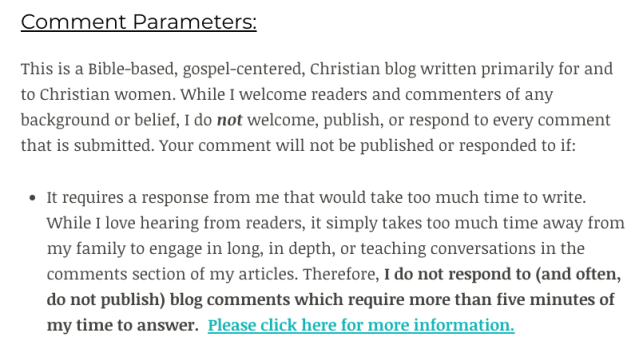
So, a) you should have expected some sort of delay, and b) if you had clicked on the Welcome tab as instructed, you would have seen this:

The “Please click here…” hyperlink goes to an article further explaining my email and comments policy and why emails and many comments usually go unanswered. I have bent over backwards to make it clear to my readers that I can’t answer most correspondence and why, even though I really wish I could.

Furthermore, you sent your first comment three weeks ago and your second comment a week later. To give you a little perspective, the first question I answered in this article was sent in almost a year ago. The second one, a month ago. Some people don’t get their questions answered for months. Others never get their questions answered, because I simply don’t have enough hours in the day to get to everyone’s questions. I hate that, but that’s just the way it has to be.

Not realizing your initial question was sarcastic, I had saved it in order to answer it in a Mailbag article, but I’ll be honest, when I got your second comment, my gut level reaction was to just delete both of them. Being impatient, demanding, and snarky when you’re asking someone else to do something for you (i.e. answer your question) is neither becoming of a Christian nor very effective.

But since I had already decided to address the content of your question, I decided to go ahead and do that and also add the part about your attitude as a teaching moment for you and anyone else to whom it might apply.

Content: I thought most people in my audience would be familiar with the phrase “fake it til you make it” (and, indeed, in the four times this article has run on my blog, you’re the only one who has commented objecting to it), but I can see where it might not be the clearest wording in the world, especially for people who aren’t familiar with the common usage of the phrase.

No one who has read the entire article could surmise that I was saying that “Godโ€™s word is based on feelings,” or that I was saying people should “[Trust] feelings when it comes to ‘fake it โ€™til you make it’โ€. (I’m not really even sure what that means since the theme of that paragraph, that section, and the entire article is that we should not trust or be controlled by our feelings.)

“Youโ€™ll still feel worried at first, but ‘fake it โ€™til you make it.’ Your feelings will eventually follow,” simply means that we should obey Scripture (in this case the Scriptures that tell us to trust God) regardless of how we feel about it and trust God to eventually line our feelings up with His Word. I thought that was clear from the context, but if it was not, I sincerely apologize. I have added a footnote to the article with this explanation in case it’s unclear to any other readers.

UPDATE (9/8/21)

I received what I thought was a very gracious response from this reader. With her permission, I share it here:

Dear Michelle,

โ€œfake it โ€˜til you make itโ€โ€ฆhereโ€ฆ

I ask your forgiveness. I had no intention of appearing impatient, nor demanding, nor snarky. Thank you for your very frank response and clarifying your answer to my question.

I am grateful for the knowledge and wisdom God has given you. My question was sincere as were my comments. And again Iโ€™m sorry if you took them as you did, as I had no intention to raise your ire in responding. I did indeed read the โ€œwelcomeโ€, and again didnโ€™t expect a response from your busy schedule and many emails you receive.

My heart was to speak as one sister to another. I have been told this phrase before. Words have consequences, and quite honestly for me, as I filter words and phrases through Godโ€™s Word, I am reminded to speak truth in love, not snarky, or demanding. We can all learn to be effective in our walk with the Lord by not jumping to conclusions that are incorrect, being teachable and gracious.

Blessings on you and your ministry.


If you have a question about: a Bible passage, an aspect of theology, a current issue in Christianity, or how to biblically handle a family, life, or church situation, comment below (Iโ€™ll hold all questions in queue {unpublished} for a future edition of The Mailbag) or send me an e-mail or private message. If your question is chosen for publication, your anonymity will be protected.