Christmas, Church

“If You Skip Church on Christmas You’re Probably Not Even Saved” and Other Holiday Nonsense

church-on-christmas

It happened in 2011, and it’s happening again this year in good old 2016. Christmas Day falls on a Sunday- and the spiritual lumps of coal are being lobbed all over the internet: If you’re a Christian who’s evenย thinking about taking the day off from church attendance or your church has decided to cancel services that day…well, you’ve firmly ensconced yourself on God’s “naughty” list.

So I’m innocently cruising around on social media, podcasts, and the blogosphere recently when what to my wondering eyes should appear, aspersions galore from those I hold dear. Seriously, scads of doctrinally sound Christians I love and respect have said things like, “Church attendance on Christmas will separate the wheat from the chaff,” and, “If your church is canceling services (or even modifying the regular Sunday schedule) on Christmas, it’s time to find a new church.”

Did I read that right? Are theologically-grounded Christiansย really questioning people’s salvation and the spiritual health of churches based solely on a once-every-five-to-eleven-years Christmas Day worship service?

I honestly don’t think I’m biblically out of bounds when I say that’s absurd and judgmental and it needs to stop. Like, yesterday.

Yes, probably a lot of the churches who are canceling services on Christmas are theologically wonky, but that’s because, statistically speaking, the majority of churches out there, period, are theologically wonky. Too many people areย post hoc ergo propter hocing thisย situation. Just because there are bad churches that are canceling services doesn’t mean every church that cancels services is a bad church. What about the rural church of 20 members (that hasn’t had a visitor since the last century) who have all informed the pastor they’ll be out of town for Christmas? Is he supposed to show up and preach to an empty room? What about churches who have moved their services to Christmas Eve so members can spend time with family on Christmas without missing weekly worship? Is there a passage of Scripture I’m not familiar with that prohibits a church from doing this every once in a blue moon?

Yes, there are doctrinally unsound churches out there, but they’re doctrinally unsound because they consistently teach unsound doctrine as measured by applicable Scripture, notย because they cancel a worship service or shift their normal schedule around for Christmas- an issue nowhere mentioned in Scripture.

As for judging people’s salvation (or love for Christ, love for the church, commitment, spiritual maturity, etc.) based on whether or not they attend church on Christmas- if you’re going to question a Christian’s salvation for skipping church that day, are you ready to pronounce a pagan saved if he shows up for services on Christmas Sunday?

Of course not. Because that’s not how this works. That’s not how any of this works.

The people who are using Christmas Day church attendance as a spiritual barometer would be the first to tell you – and rightly so – that going to church won’t save you. Neither will missing one service (or a dozen) “unsave” you. Salvation is determinedย onlyย by whether or not you’ve repented of your sin and placed your faith in the death, burial, and resurrection of Christ to redeem you. And sanctification (spiritual growth) is a lifelong process – a trajectory – of becoming more and more Christlike through the years. Church attendance on Christmas isn’t a make or break for your salvation or sanctification.

Earlier this week in The Ten,ย we studied the fourth Commandment: “Remember the Sabbath day and keep it holy.” We discovered that, while God’s intention for the Israelites was simply to abstain from working at their jobs, housework, and commerce in order to rest and worship Him, the Pharisees later came along and added all kinds of micro-managing rules defining “work.” So by the time Jesus came on the scene, things like picking (“harvesting,” according to the Pharisees) and eating grain as you walked along, and performing miracles of healing were considered “work”- thus breaking the Sabbath. But these were man-made laws, not God’s law. It was oppressive and robbed people of the joy of worship God intended His people to bask in each week. “The Sabbath was made for man,” Jesus said, “Not man for the Sabbath.”

mark-2-27

I can’t help but wonder if these “Real Christians will be at church on Christmas Day,” pronouncements aren’t similar. God has made no law for Christians that we must be at church on Christmas Day – or any other particular day – or we’re sinning. And, as for the churches who once every several years cancel services or shift their Sunday service to Christmas Eve, God has made no law that churchesย must meet on Sunday every single week or they’re in sin. What God has said for New Testament Christians is:

And let us consider how to stir up one another to love and good works, not neglecting to meet together, as is the habit of some, but encouraging one another, and all the more as you see the Day drawing near.
Hebrews 10:24-25

“Not neglecting to meet together.” Reminiscent of the paucity of Old Testament explanations of what constituted Sabbath work, God doesn’t give a definition of this phrase or quantify it with a specific number of allowable and acceptable missed Sundays per year. It is left to the conscience of each individual Christian and the agreement of each local body of believers (but I can scarcely believe that aย person who is at church every week unless Providentially hindered and opts to skip the Christmas service is “neglecting” to meet with the body by any stretch of the word). But when we by-pass issues of individual conscience and church agreement, make a law where no law exists in Scripture, and judge people’s relationships with God based on our own man-made law, are we not doing exactly what the Pharisees did?

What’s of far more concern than where your body is on Sunday, December 25, is where your heart is the other 364 days of the year. Do you love the body of Christ? Are you committed to serving the Lord and your brothers and sisters all year long at the church you’re a member of? Do you faithfully attend worship each week? Then deciding to spend Christmas Sunday at home with your family (especially if you’ve already attended the Christmas Eve service the night before) is not an indication that you’re backsliding or somehow “less” of a Christian than those decrying your absence.

But what if you answered “no” to those questions? What if you skip church as many or more Sundays as you attend because you just don’t feel like going, or you signed your kid up for a soccer team that plays on Sundays, or there’s a ball game on TV, or you’d rather go shopping, or you go out of town on pleasure trips a lot of weekends? What if your general attitude toward church is, “Meh, I’ll go when I feel like it and have nothing better to do.”?

That is much more problematic than skipping church the years Christmas falls on a Sunday. That’s an indicator that you need to examine your heartย to discover whether or not you’re in the faith. To love Christ is to love His bride, the church. People who are genuinely regenerated love the church. As a general rule, theyย want to be at church worshiping, serving, learning, growing, and fellowshipping with their brothers and sisters in Christ.

Why, between 2011 and 2016 haven’t I seen and heard these same folks who are judging Christians about Christmas church attendance speaking out equally as boldly, and in the same numbers, about people being sporadic in their attendance and uncommitted to the body the remaining Sundays of those years? As Christians, we celebrate Christ’s incarnationย every Sunday, not just when Christmas falls on a Sunday. Are those other Sundays somehow less important?

One day, out of the thousands that comprise your life span, is inconsequential. The Bible does not say that simply staying home from church on Sunday, December 25, is a sin. What’s important is pursuing Christ, hungering for holiness, and loving and serving the churchย every day, not just when Christmas Sunday rolls around.

The Ten (10 Commandments Bible Study)

The Ten: Lesson 6

Previous Lessons: 1, 2, 3, 4, 5

Exodus 20:8-11

โ€œRemember the Sabbath day, to keep it holy. Six days you shall labor, and do all your work, 10 but the seventh day is a Sabbath to the Lord your God. On it you shall not do any work, you, or your son, or your daughter, your male servant, or your female servant, or your livestock, or the sojourner who is within your gates. 11 For in six days the Lord made heaven and earth, the sea, and all that is in them, and rested on the seventh day. Therefore the Lord blessed the Sabbath day and made it holy.

Exodus 31:13-17

โ€œYou are to speak to the people of Israel and say, โ€˜Above all you shall keep my Sabbaths, for this is a sign between me and you throughout your generations, that you may know that I, theย Lord, sanctify you.14ย You shall keep the Sabbath, because it is holy for you. Everyone who profanes it shall be put to death. Whoever does any work on it, that soul shall be cut off from among his people.ย 15ย Six days shall work be done, but the seventh day is a Sabbath of solemn rest, holy to theย Lord. Whoever does any work on the Sabbath day shall be put to death.ย 16ย Therefore the people of Israel shall keep the Sabbath, observing the Sabbath throughout their generations, as a covenant forever.ย 17ย It is a sign forever between me and the people of Israel that in six days theย Lordย made heaven and earth, and on the seventh day he rested and was refreshed.โ€™โ€


Matthew 12:1-14

At that time Jesus went through the grain fields on the Sabbath. His disciples were hungry, and they began to pluck heads of grain and to eat. But when the Pharisees saw it, they said to him, โ€œLook, your disciples are doing what is not lawful to do on the Sabbath.โ€ He said to them, โ€œHave you not read what David did when he was hungry, and those who were with him: how he entered the house of God and ate the bread of the Presence, which it was not lawful for him to eat nor for those who were with him, but only for the priests? Or have you not read in the Law how on the Sabbath the priests in the temple profane the Sabbath and are guiltless? I tell you, something greater than the temple is here. And if you had known what this means, โ€˜I desire mercy, and not sacrifice,โ€™ you would not have condemned the guiltless. For the Son of Man is lord of the Sabbath.โ€

(And he said to them, โ€œThe Sabbath was made for man, not man for the Sabbath.โ€ Mark 2:27- This verse is included in Markโ€™s account of the grain story.)

9ย He went on from there and entered their synagogue.ย 10ย And a man was there with a withered hand. And they asked him, โ€œIs it lawful to heal on the Sabbath?โ€โ€”so that they might accuse him.ย 11ย He said to them,ย โ€œWhich one of you who has a sheep, if it falls into a pit on the Sabbath, will not take hold of it and lift it out?ย 12ย Of how much more value is a man than a sheep! So it is lawful to do good on the Sabbath.โ€13ย Then he said to the man,ย โ€œStretch out your hand.โ€ย And the man stretched it out, and it was restored, healthy like the other.ย 14ย But the Pharisees went out and conspired against him, how to destroy him.


Luke 13:10-17

Now he was teaching in one of the synagogues on the Sabbath. 11ย And behold, there was a woman who had had a disabling spirit for eighteen years. She was bent over and could not fully straighten herself.12ย When Jesus saw her, he called her over and said to her, โ€œWoman, you are freed from your disability.โ€13ย And he laid his hands on her, and immediately she was made straight, and she glorified God. 14ย But the ruler of the synagogue, indignant because Jesus had healed on the Sabbath, said to the people, โ€œThere are six days in which work ought to be done. Come on those days and be healed, and not on the Sabbath day.โ€ 15ย Then the Lord answered him, โ€œYou hypocrites! Does not each of you on the Sabbath untie his ox or his donkey from the manger and lead it away to water it? 16ย And ought not this woman, a daughter of Abraham whom Satan bound for eighteen years, be loosed from this bond on the Sabbath day?โ€ 17ย As he said these things, all his adversaries were put to shame, and all the people rejoiced at all the glorious things that were done by him.


Colossians 2:16-17

Therefore let no one pass judgment on you in questions of food and drink, or with regard to a festival or a new moon or a Sabbath. 17 These are a shadow of the things to come, but the substance belongs to Christ.

Acts 2:42,44

And they devoted themselves to the apostles’ teaching and the fellowship, to the breaking of bread and the prayers…44 And all who believed were together and had all things in common.

Hebrews 10:24-25

And let us consider how to stir up one another to love and good works, 25 not neglecting to meet together, as is the habit of some, but encouraging one another, and all the more as you see the Day drawing near.


The Holy Bible, English Standard Version. ESVยฎ Permanent Text Editionยฎ (2016). Copyright ยฉ 2001 by Crossway Bibles, a publishing ministry of Good News Publishers.


Questions to Consider:

1. Examine the two Exodus passages. What was the purpose of the Sabbath for humans? (15) What did God mean by “labor” and “work”? (9-10, 14-15) What was the penalty for breaking the Sabbath? (14-15) What two things was the Sabbath to remind Israel of? (11,17; 13) How would remembering these two things lead the people to worship and honor God? Which word do verses 8, 11, and 14 use to characterize the Sabbath day itself? How would having a holy day of rest and worship, a reminder of God as Creator and that Israel was specially set apart by God, be a witness to the one true God to the pagan nations surrounding Israel?

2. Study the Matthew and Luke passages. Jesus was frequently called on the carpet by the Pharisees for “working” on the Sabbath. Most of the Old Testament verses regarding the Sabbath don’t specify what constitutes “work,” but a few do. The Pharisees had made many additional and burdensome rules about what constituted “work”- you could only walk a certain number of steps, you couldn’t drag a chair across a dirt floor (it would create a furrow, and that was “plowing”), etc. Considering the verses linked above and the Exodus passages, was Jesus really “working” on the Sabbath in the Matthew and Luke passages? Whose rules was Jesus breaking- man’s or God’s? What did Jesus say it was lawful to do on the Sabbath? (Matt. 12:12)

3. Review the purposes of the Sabbath in question 1. What did Jesus mean when He said the Sabbath was made for man, not man for the Sabbath? (Mark 2:27) How might this idea relate to overextending yourself with church activities? How busy are your Sundays?

4. In the Matthew and Luke passages, Jesus gives two examples of how the Pharisees care for their animals on the Sabbath. What are those examples? What message was He trying to get across to them? Would you say the Pharisees cared more for rule-keeping or people? How might Jesus’ “breaking” of the Sabbath in such a public way have been a threat to the Pharisees power and position?

5. What does the Colossians passage tell us about the Old Testament feasts and the Sabbath? (17) If Christ is the fulfillment of these foreshadowings, must Christians still observe the Jewish Sabbath?

6. Which day of the week was the Old Testament Sabbath? (Ex. 31:15) Why? (Ex. 20:11) Which day of the week do Christians worship on? Why? Compare and contrast the Sabbath pointing to God as Creator and Christians’ Sunday worship pointing to Christ as Savior.

7. What components should characterize Christian worship, according to the Acts and Hebrews passages? What can we glean from God’s Old Testament instructions about the Sabbath about things like rest, worship, and holiness that still apply to our Christian worship today?

What does “not neglecting to meet together” mean? Why does God say it is important that we regularly meet together? What is the heart attitude of a “non-neglector”?
a) I love my church family, worship, serving, and being taught God’s word. Why would I want to miss all that?
b) I like church. I’ll go if nothing more important pops up. I’m there about half the time.
c) Church is OK. I go when I wake up on time and feel like it. That’s about once a month or so.
d) You don’t have to go to church to be a Christian, so I don’t really need it. Maybe on Christmas and Easter, but that’s about it.

Which of these most closely matches your heart attitude about attending church? Is your attitude about faithful church attendance pleasing to God?


Homework:

If you were to keep a calendar of your church attendance, what would it look like? Are you at church each week unless Providentially hindered (emergencies, illness, etc.)?

  • If you know your attendance could be better in God’s eyes, repent and commit to being at church every week. What are some practical, proactive steps you could take (setting an earlier alarm, laying your clothes out Saturday night, etc.) to set yourself up for success?
  • If you are already faithful in your church attendance, are there any areas of service at your church that you could fill?
  • Are you faithful in your church attendance, and overextending yourself in serving? Consider the importance God placed on the Sabbath being a day of rest. Do you need to cut back on the number of church activities you’re committed to?
Christmas, Evangelism, Missions, Throwback Thursday

10 Ways to Share the Gospel During the Holidays

With all the hustle and bustle during November and December, itโ€™s easy for the gospel to get lost in the shuffle. But the Great Commission never takes a vacation, and the holiday season provides some unique opportunities for sharing the gospel that we donโ€™t always have during the rest of the year.

The Great Commission never takes a vacation, and the holiday season provides some unique opportunities for sharing the gospel!

1.

If your family does the โ€œletโ€™s go around the table and say what weโ€™re thankful forโ€ thing at Thanksgiving, briefly express your thanks to Christ for His death, burial, and resurrection, and for saving you.

2.

If youโ€™re hosting Thanksgiving, place a slip of paper with a Bible verse on it about giving thanks at each place setting . Go around the table and let each person read his verse before the meal. Here are a few to get you started, or if you like it artsy, try these. If you’d like some gospel-centered place cards for a Christmas dinner or party, check these out. (And send me a picture of your table setting! I’d love to see it!)

3.

Give God’s Word to those around the world who need to hear the good news of Jesus. Give to HeartCry Missionary Society, or help establish indigenous churches by giving to The Master’s Academy International. And if your church supports a certain missionary or doctrinally sound missions organization, consider showing them a little extra financial love, too!

4.

Invite an unchurched friend to church with you. Lots of people are more open to dropping in on a worship service or attending a special church event (like a potluck Thanksgiving dinner, a Christmas cantata, or a nativity play) during the holidays than they are the rest of the year.

5.

Get a group from church together and go Christmas caroling. Choose songs whose lyrics showcase the gospel (Hark the Herald Angels Sing, Joy to the World, and O Holy Night are good ones!) Take some tracts, Bibles, or small gift baskets (containing tracts or Bibles) with you to leave at each home (and donโ€™t forget to invite them to church!).

6.

Donating to a toy drive? Tuck a tract inside your gift or consider donating a gospel-centered childrenโ€™s book or Bible. These Bibles and The Biggest Story are great, doctrinally sound choices. Or how about The Mission Ball?

7.

Contact your local college campus ministry and find out how to invite an international student to spend the holidays with your family. International students can be curious about the way Americans celebrate the holidays. Additionally, dorms often close during school breaks leaving students far from home with no place to stay. Take advantage of the time with your student to take him to church with you and share the gospel with him.

8.

If Christmas parades are a thing in your area, put a float together for your church and use some awesome gospel-themed throws like these gospel booklets from Wretched, or some eye catching tracts from Living Waters or One Million Tracts.

9.

Chat with your neighbors, even if you donโ€™t know them well. Shoveling snow together? Exchanging baked goodies? Slow down and take the time to talk (and really listen) with your neighbors. It is amazing how people often open up if someone just takes the time to listen to them. Ask how you can pray for them, and, if the situation is conducive, do it right then. You might even find it turning into a witnessing encounter.

10.

Tuck in a tract (see #8) with your Christmas cards, or print a QR code inside that goes to a gospel presentation like this one or this one. Or, do you send out an annual Christmas newsletter? This year, instead of making it about your familyโ€™s accomplishments, how about focusing on what God accomplished through the incarnation, life, death, and resurrection of Christ? Thatโ€™s the most important news your family could share.

Bonus!

Check out Unique Ways Christmas Helps us Share the Gospel* at A Word Fitly Spoken for more ideas for sharing the gospel during the holidays!

*In this episode (as well as in previous editions of this article), suggestion #3 was to give to the Southern Baptist Convention’s Lottie Moon Christmas Offering (International Mission Board). Due to pervasive corruption of various sorts in the SBC, I no longer recommend donating to any SBC entity including the IMB or LMCO.

What’s your favorite way to share the gospel during the holidays?

What’s your favorite way to
share the gospel during the holidays?

Mailbag

The Mailbag: Should Women Take Church Concerns to the Pastor?

mailbag

My pastor says we should come to him individually with concerns instead of talking behind his back, so I have taken a concern of mine to him. Because a pastor canโ€™t be alone with a woman, he had his wife at the first meeting and three members of the board at the second meeting. It then becomes a me vs. them argument with them saying, โ€œListen to the pastor, heโ€™s always right.โ€ Because he is the pastor and a man, should I not bring my concerns to him, even though he said we should?

Great question. It’s important that pastors and church members communicate clearly about any concerns that arise in the life of a church. In this situation, there are several things to sort out:

1. Any church member, male or female, should talk (kindly, lovingly, and respectfully, of course) to the pastor about any concerns. Your pastor is right to encourage you to bring concerns to him and to discourage gossip and backbiting. (There are some concerns that can be handled at a lower level initially, for example, going directly to a person committing a sin {Matthew 18:15-20}, or concerns that should first be taken to an elder in keeping with any existing church policies regarding this. This is not because of a male/female thing, but to keep the pastor from being overwhelmed. Kind of like the way Jethro told Moses he should get some elders to help him judge the people in Exodus 18.)

2. Your pastor is also right and wise not to meet alone with a woman. It protects him as well as the woman.

3. If the elders are literally saying “the pastor is always right,” that’s problematic. There are some things you’ll need to think about and ask about if that’s what they’re saying. Is it possible you misunderstood what was said or that the elder(s) misspoke? Is this their standard answer to every problem raised by a church member? Does the pastor know they’re saying this, and, if so, does he approve of them saying this or has he corrected them? If he knows this is the elders’ standard answer to people and he approves of it, that is not biblical. Pastors are not infallible dictators. Pastors are to be accountable to the elders; the elders are not to be a rubber stamp for the pastor.

On the other hand, you didn’t indicate what your concern was. Perhaps they were just saying the pastor was biblically right in your particular case. Perhaps you’ve brought a concern to the pastor that was an issue of personal preference instead of a biblical issue, and the pastor is going in a direction that is biblically correct but doesn’t sit well with your preferences. In those kinds of cases, Scripture does say that we’re to submit to our leaders (Hebrews 13:17). Maybe this is what they meant.

It’s great that you want to deal with your concerns in an above board, biblical way. Be prayerful about the situation and ask God to give you wisdom and a godly heart as you seek to work through the problem.


If you have a question about: a well known Christian author/leader, a Bible passage, an aspect of theology, a current issue in Christianity, or how to biblically handle a family, life, or church situation, comment below (Iโ€™ll hold all questions in queue {unpublished} for a future edition of The Mailbag) or send me an e-mail or private message. If your question is chosen for publication, your anonymity will be protected.

Bible Study, Church

McBible Study and the Famine of God’s Word

“Why can’t we just be taught a book of the Bible?” I heard this again today from a Christian woman hungry for her church to teach her the truth of God’s word. It’s a cry being raised by women from all over, scrounging through the dumpster of “Bible” teaching their church currently offers, searching for something – anything – that will nourish their hearts, minds, and souls with biblical truth so that they might actually be able to grow in Christ.

What’s going on here, church? Pastors? Women’s ministries? Why are godly women starving for the word of God at their own churches? This is a problem. And it’s not a small one. And it’s not going away. It’s getting worse.

My family is a one income family. My husband works hard to provide for us, and we’ve made a lot of (completely worthwhile) sacrifices so I can stay home and raise and home school our children. One of those sacrifices is that we rarely get to eat out, even at a fast food restaurant. That means I cook. A lot. Fortunately, I happen to enjoy cooking, but it does take several hours of work a week. And sometimes, at the end of a long day, I’m tired and not particularly in the mood to spend a couple of hours on my feet chopping and mixing and sautรฉeing and stirring and roasting. I’d much rather chuck it and have my husband pick up McDonald’s on his way home. In fact, if we could afford it, and I couldn’t cook, and I thought it was healthy, my family would probably eat fast food for supper three or four times a week. I like fast food. My kids LOVE fast food. And why do all that work if you don’t have to and there’s an easier option, right?

But that’s no way to feed a family. It makes people obese and can lead to all kinds of other physical problems like heart disease, hypertension, and digestive ailments because the majority of fast food is high in the bad stuff (cholesterol, sodium, fat) and low in the good stuff (fiber, vitamins, minerals). Not to mention that having other people do the work God has assigned me is the lazy way out.

Yet while it’s easy to see how detrimental and unhealthy it is to feed a family a regular fare of fast food in the physical realm, this is exactly what most churches are doing in the spiritual realm when it comes to their Bible study menu.

“My pastor asked me to teach a women’s Bible study class. What’s a good book to use?”
“Why don’t you just teach them a book of the Bible?”
“Oh, I don’t feel equipped to do that.”

“Our Sunday School class is looking for a new curriculum. Any suggestions?”
“How about just working through a book of the Bible?”
“Our teacher works a lot of hours and doesn’t really have the time to study and prepare like that.”

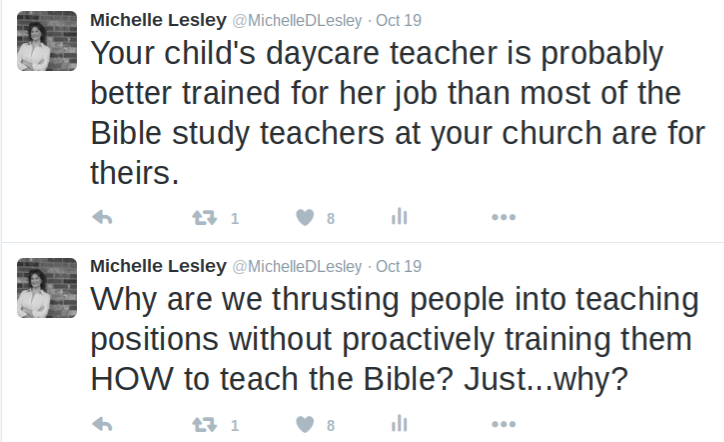
screenshot-2016-11-10-at-12-31-44-pm-edited

I hear this kind of thing over and over and over again. Churches aren’t even attempting to train people to properly teach the Bible, and Bible study “teachers,” (often through no fault of their own) either don’t know they need to be trained, or don’t have training available to them, or they’re unwilling or unable to put in the time and effort to be trained and to prepare lessons.

We have classes that need teachers, so we take whoever is available and willing, and we stick them in front of a group of people, hand them a take out bag of McBible Studies written by the celebrity Christian du jour and say, “Here. Feed the church family.”

That’s a problem in and of itself, first and foremost, because relying solely on pre-fab studies due to the fact that no one is trained to instruct the people of your church in the word of God isn’t biblical. The Bible says that pastors, elders, and teachers in the local church body should be “able to teach.” Not facilitate. Not read aloud what someone else wrote. Not “able to work a DVD player.” Teach.

But recruiting “teachers” who are unskilled in handling God’s word to lead a pre-packaged study often morphs into another dangerous problem, especially in the area of women’s Bible study: importing false doctrine into your church. Here’s a list of LifeWay’s top selling books for 2015. Every single non-fiction book on this list that’s likely to be used for a women’s group or individual Bible study (seven of the twelve by my count- which is a staggering proportion considering LifeWay also sells men’s studies, theology books, training manuals, “Christian living” books, and a wide variety of other non-fiction topics, but I digress) is written by a false teacher. Every. single.one.

screenshot-2016-11-10-at-12-31-31-pm

In my research of women’s Bible study authors and teachers, I estimate that approximately ninety-five per cent of the the female authors and teachers on the shelves at your local Christian retailer are false teachers. That goes way beyond a biblical “diet” laden with cholesterol and fat. Now, we’re talking about spiritual food tainted with E.coli. If you’ve got a woman in your church who’s facilitating a class using materials by one of these false teachers because she’s not competent enough in God’s word to teach the Bible, how in the world is she going to be able to catch and correct the false doctrine these Christian celebrities are teaching her class?

The answer is: she’s not. In fact, her awareness of her own incompetence in Scripture and her assumption that the Christian celebrity knows what she’s talking about (Because, after all, she’s a celebrity and LifeWay sells her materials, so she must know what she’s talking about, right?) will have the exact opposite effect. She will downplay and keep quiet about any nagging doubts – assuming she knows her Bible well enough to even have those doubts – in her own mind that the Christian celebrity is teaching things contrary to sound doctrine, and she will affirm the false doctrine that’s being taught. Then, this harmful bacteria of false doctrine will spread from woman to woman and class to class, and discerning women, knowing that the kitchen is contaminated, will grow emaciated from a lack of clean cuisine to feed on. We end up with a church full of “Bible” study and Sunday School classes that teach fluff and false doctrine instead of the unadulterated word of God. To borrow from Coleridge: “Food, food, every where, nor any bite to eat.” We’ve got a famine of God’s word, right in His very own house.

Church, pastors, women’s ministries- we’ve got to put a stop to this. People teaching Sunday School, Bible study classes, and, particularly, women’s Bible study classes must be trained in basic hermeneutics, the competent handling of God’s word in context, and the ability to teach sound doctrine as well as to refute the false. Do we not believe Scripture, or somehow think our church is exempt from it, when it says:

Do your best to present yourself to God as one approved, a worker who has no need to be ashamed, rightly handling the word of truth. 2 Timothy 2:15

or

Not many of you should become teachers, my brothers, for you know that we who teach will be judged with greater strictness. James 3:1

Where is our fear of God and our obedience to His word? We would never think of letting an untrained, incompetent teacher teach our children math or science in school when all that’s at stake is their academic education. Why are we satisfied to let untrained people teach the Bible at church when people’s eternities are at stake?

It doesn’t take years of seminary training. I never went to culinary school, but I’m still able to cook and feed my family a healthy diet because of what I’ve learned from others. Pastors can train teachers. Skilled Bible teachers can train others to teach. There are even great books and materials that can help as you teach people how to teach the Bible.

A doctrinally sound book study can be a fun, interesting, or useful supplement to the regular, straight teaching of Scripture in a Bible study class, but even these shouldn’t be used in place of training teachers. The best theologian out there isn’t a living and active member of that class. He doesn’t know the strengths and weaknesses of the class’s theology. He can’t address their current struggles and questions. He doesn’t love them, care about them, pray for them, and labor in the Word for them.

Only real life, trained, biblically competent teachers can do those things. They are vital and they are irreplaceable.

So let’s quit shoving Happy Meals into the hands of women who are starving for the pure milk and meat of God’s word. Let’s offer some cooking classes and set the table so the members of our churches can sit down to a healthy, home cooked diet of nourishing food that will help them grow to spiritual maturity in the grace and knowledge of the Lord Jesus Christ.

And, now, if you’ll excuse me, I’ve got to go start supper.