Then I saw a new heaven and a new earth, for the first heaven and the first earth had passed away, and the sea was no more. 2 And I saw the holy city, new Jerusalem, coming down out of heaven from God, prepared as a bride adorned for her husband. 3 And I heard a loud voice from the throne saying, “Behold, the dwelling place of God is with man. He will dwell with them, and they will be his people, and God himself will be with them as their God. 4 He will wipe away every tear from their eyes, and death shall be no more, neither shall there be mourning, nor crying, nor pain anymore, for the former things have passed away.”
5 And he who was seated on the throne said, “Behold, I am making all things new.” Also he said, “Write this down, for these words are trustworthy and true.” 6 And he said to me, “It is done! I am the Alpha and the Omega, the beginning and the end. To the thirsty I will give from the spring of the water of life without payment. 7 The one who conquers will have this heritage, and I will be his God and he will be my son. 8 But as for the cowardly, the faithless, the detestable, as for murderers, the sexually immoral, sorcerers, idolaters, and all liars, their portion will be in the lake that burns with fire and sulfur, which is the second death.”
9 Then came one of the seven angels who had the seven bowls full of the seven last plagues and spoke to me, saying, “Come, I will show you the Bride, the wife of the Lamb.” 10 And he carried me away in the Spirit to a great, high mountain, and showed me the holy city Jerusalem coming down out of heaven from God, 11 having the glory of God, its radiance like a most rare jewel, like a jasper, clear as crystal. 12 It had a great, high wall, with twelve gates, and at the gates twelve angels, and on the gates the names of the twelve tribes of the sons of Israel were inscribed— 13 on the east three gates, on the north three gates, on the south three gates, and on the west three gates. 14 And the wall of the city had twelve foundations, and on them were the twelve names of the twelve apostles of the Lamb.
15 And the one who spoke with me had a measuring rod of gold to measure the city and its gates and walls. 16 The city lies foursquare, its length the same as its width. And he measured the city with his rod, 12,000 stadia. Its length and width and height are equal. 17 He also measured its wall, 144 cubits by human measurement, which is also an angel’s measurement. 18 The wall was built of jasper, while the city was pure gold, like clear glass. 19 The foundations of the wall of the city were adorned with every kind of jewel. The first was jasper, the second sapphire, the third agate, the fourth emerald, 20 the fifth onyx, the sixth carnelian, the seventh chrysolite, the eighth beryl, the ninth topaz, the tenth chrysoprase, the eleventh jacinth, the twelfth amethyst. 21 And the twelve gates were twelve pearls, each of the gates made of a single pearl, and the street of the city was pure gold, like transparent glass.
22 And I saw no temple in the city, for its temple is the Lord God the Almighty and the Lamb. 23 And the city has no need of sun or moon to shine on it, for the glory of God gives it light, and its lamp is the Lamb. 24 By its light will the nations walk, and the kings of the earth will bring their glory into it, 25 and its gates will never be shut by day—and there will be no night there. 26 They will bring into it the glory and the honor of the nations. 27 But nothing unclean will ever enter it, nor anyone who does what is detestable or false, but only those who are written in the Lamb’s book of life.
1. What is the purpose of the book of Revelation? Which genre(s) of biblical literature (prophecy, epistle, narrative, wisdom, etc.) is the book of Revelation? What is the historical backdrop for this book?
2. What is the final, eternal dwelling place for Believers? (1-3) Compare and contrast the eternal reward of Believers (1-7) with the eternal punishment of unbelievers (8).
3. Study the verses that talk about the new heaven and new earth (1-7) and the new Jerusalem (10-27) and, in your own words, write a description of each, including both their physical appearances and characteristics.
4. How could verse 5 serve as a theme verse for this chapter? What is the significance of…
The new heaven, earth, and Jerusalem
God wiping away all tears, etc. (4)
God making His dwelling place with man
The glory of God giving light to the city
…and all the other elements of this chapter, to the theme of God making “all things new”?
5. Which aspect of the new heaven/earth/Jerusalem described in this chapter is most moving to you, and why?
I have a few Blog Swap slots to fill for November and December. If you’d be interested, please read the information below and drop me an e-mail. I’m especially looking for Thanksgiving and Christmas items (DIY, recipes, crafts, kids’ activities, party ideas, date night suggestions, creative writing, etc.) but other topics would be great, too.
Got a blog? How would you like a little more exposure? How about a blog swap?
Sometimes blog hops and link parties can have so many contributors that your blog/article gets lost in the shuffle and you end up reaching fewer people than you’d planned on. With a blog swap, you get 100% of the audience’s focus.
It’s essentially an exchange of guest posts. You post one of my articles (I’ve got nearly 400 to choose from) with a link back to my blog and I’ll post one of yours with a link back to your blog. It’s a win-win for reaching more people. (Quick stats: I’ve got 300+ subscribers here at the blog, 550+ followers on Facebook, and about 30 followers on Google+, and I do link Blog Swap articles to those two social media accounts.)
Details:
1. Blog Swaps run as a semi-regular weekly feature on Mondays (the day may change in the future).
2. I’d like for my article to run concurrently on your blog, but if you have a conflict, no problem. You can run it any time the week prior to the Monday your article is scheduled to run here.
3. Send me up to five of your best articles to choose from. You’re welcome to choose any of my articles you like. (Just let me know if you need help/suggestions.) Fair warning-if you’re new, you should know that nearly all of my articles have to do with biblical topics, and all are written from a biblical perspective.
4. Any subject matter is fine as long as neither your article nor your blog in general violate Scripture or scriptural principles. Recipes, crafts, DIY, marriage, home schooling, singles, parenting, book/movie reviews, men’s interest, photo blogging, nutrition, exercise, etc., are all welcome.
5. If you submit articles of a theological or biblical nature, please also include a statement of faith. (It’s fine to link to your denomination’s or church’s statement of faith on their web site and say, “I agree with this.” Click on my “Statement of Faith” tab above for an example.) I cannot publish articles/blogs that I find to be in contradiction to sound doctrine.
6. Got friends with blogs? Please share this around!
Think you’d be interested in doing a blog swap with me? E-mail me at MichelleLesley1@yahoo.com with your name, links to up to 5 articles, a brief description of your blog, and your statement of faith (if applicable).
It’s time for another awesome blog swap! Blog swaps give me the opportunity to share other talented bloggers with you, plus offer you fresh content that’s a great supplement to our regular fare here. If you’d like to do a swap, click on the link above for more information.
Once again, we’ve got a great article from Kaylene of Faithful Feat. Kaylene has written some insightful articles about marriage that will be especially helpful to Christian wives. Today, she’s sharing with us how to build up your husband by speaking words of approval to him.
You love your husband. You know it, he knows it, your kids know it, your friends and family know it….He kinda needs to hear you say it. A man likes that kind of thing. He won’t ask for it. He might not even know he craves your approval. But, he does.
Click here to continue reading, and don’t forget to subscribe and follow Faithful Feat on social media!
Election day, November 4, is right around the corner. How should Christians vote?
First things first. Christians, especially Christian women, should vote. Not voting would not only be an insult to the sacrifice of the dedicated men and women who have given their lives in the cause of freedom and suffrage over the years that we might have the luxury of having a voice in our governance, but voting is a gift from God. Should we treat this gift lightly by failing to exercise it?
If you have never had the opportunity to visit a country, such as those in the Middle East, in which basic freedoms and women’s rights are limited if in existence at all, I urge you to do so if at all possible. After I returned to the U.S. from a visit to the Middle East a few years ago, I realized just how much we take for granted what an enormous blessing it is that God has seen fit to place us in a land of liberty, abundance, and opportunity. When I vote, I see it as a way of returning thanks to God for the gift of freedom, and honoring those who have made the ultimate sacrifice to secure our liberties.
For whom should Christians vote? The Bible says in I Corinthians 10:31 that whatever we do, we should do all things for the glory of God. “Whatever” and “all things” includes voting. Christians should vote for the person they believe will bring the most glory to God. Considering the candidate options with which we’re often presented, this, at times, seems an impossible task.
How do we know which candidate to vote for? Like all other decisions in a Christian’s life, this one should be governed by God’s leading through prayer and Biblical principles. Ask God for wisdom (James 1:5) to make a Godly decision.
Study the candidate’s platform and where he stands on each issue. Is he a proponent of anything that clearly conflicts with Scripture? Would he push to legalize or undergird things God calls sin? Can we, as Christians– whose goal in life is supposed to be turning from sin and pursuing holiness –knowingly and intentionally disregard the fact that a candidate would stand in favor of sin rather than fighting against it, and give him our support?
Sometimes we lean towards voting for the candidate who would benefit us the most personally. Perhaps he has promised a tax cut for our particular bracket, or said he would improve the roads we use for traveling to work. In and of themselves, those are good things, but does his platform also include favoring things which would hurt others or be detrimental to the fabric of our society in general? In other words, should a Christian vote for something or someone who will benefit herself at the expense of harming others?
I don’t believe we can do that and remain true to Biblical principles such as:
Do nothing from selfishness or empty conceit, but with humility of mind regard one another as more important than yourselves; do not merely look out for your own personal interests, but also for the interests of others. Philippians 2:3-4
Now we who are strong ought to bear the weaknesses of those without strength and not just please ourselves. Each of us is to please his neighbor for his good, to his edification. For even Christ did not please Himself; Romans 15:1-3a
As is frequently the case these days, the person we vote for, believing he will make the most Christ-like decisions, loses the election. I don’t know about you, but I’m usually pretty disappointed when this happens.
I try to keep it in perspective, though. It’s within the realm of possibility that the person who won the election will get radically saved after taking office and make even more Godly decisions than the other candidate would have made. It’s also possible that he will unintentionally make the decisions God wants him to make for other reasons, such as political expediency or pleasing a particular special interest group. The Bible says in Proverbs 21:1, “The king’s heart is like channels of water in the hand of the LORD; He turns it wherever He wishes. ”
Not only should we pray before we vote, but we have a Biblical mandate to pray for the winner after the election is over:
First of all, then, I urge that entreaties and prayers, petitions and thanksgivings, be made on behalf of all men, for kings and all who are in authority, so that we may lead a tranquil and quiet life in all godliness and dignity. This is good and acceptable in the sight of God our Savior, who desires all men to be saved and to come to the knowledge of the truth.
I Timothy 2:1-4
Above all, we must remember that, while the upcoming elections may determine who will sit in the White House, the Congress, or the State House, they do not, nor will they ever, determine who sits on the throne of the universe as King.
These are my notes from my ladies’ Sunday School class this morning. I’ll be posting the notes from my class here each week. Click here for last week’s lesson.
Through the Bible in 2014 ~ Week 43 ~ Oct. 19-25 Matthew 15-18, Mark 7-9, Luke 9:18-11:54, John 7-10 Sin-opsis
Sin. That word can cause us to think of a lot of different things, from our sin, to people who have sinned against us, to forgiveness. Today, we’re going to hear what Jesus has to say about five different aspects of sin.
Matthew 18
Causing Another Believer to Sin (1-5, Matthew 20:20-24)
Have you ever noticed that the disciples asked a lot of interesting questions? Why do you think they wanted to know who would be the greatest in the kingdom of heaven? Pride? A desire for clout or recognition? The disciples and Jesus lived in a society in which people were acutely aware of who had rank, recognition, and power (the Pharisees, scribes, Saducees, lawyers, priests, and Levites), and who did not (everybody else, including Jesus and them), when it came to the way Judaism was structured. We talked last week about what people, even the disciples, expected the Messiah to be: a conquering king who would overthrow Rome and restore Israel to prominence and prosperity. Here, as in the case of Mrs. Sons of Thunder asking if her boys could sit on either side of Jesus’ throne (Matt. 20), they were likely thinking of their offices in the new government they imagined Jesus would head up once He reestablished the kingdom.
Once again, Jesus had to set them straight. “It’s not about how high on the power ladder you can climb, Boys. It’s about how humble you can be, as humble as a little child.” And why did Jesus have to set them straight? Because they had been, skandalizo, “entrapped” or “tripped up” as verse 6 puts it, by faulty teaching from those who were responsible to rightly handle God’s word. The disciples would soon be in the position of teacher and preacher themselves. It was imperative they had a correct understanding of God’s word and God’s ways so they could accurately teach the new “little children” coming into the church.
When we share the gospel with others, teach the Bible, offer others advice or counsel, etc., we must make absolutely certain we have a correct understanding of what God’s word says. Otherwise, we might be tripping others up by leading them to believe things that are in conflict with the Bible. Jesus takes that very seriously saying (7) “it would be better for him to have a great millstone fastened around his neck and to be drowned in the depth of the sea.” Pretty strong words.
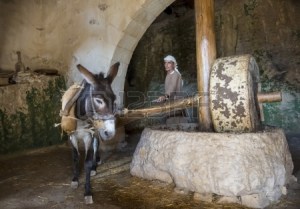
Recreation of a millstone used for pressing olives in Nazareth, Israel.
When I Am Tempted (7-9) What about when someone else tempts me to sin? Again, Jesus has strong words for anyone who entices someone into any kind of sin: “woe.” What are some ways we can cause people to sin or be drawn into someone else’s sin, even in the church? Gossip, adultery, inciting other church members against the pastor or other leaders, playing “politics”, etc.
But whether tempted by a church member or the world, Jesus paints a serious picture of how we should respond to that temptation. Now, Jesus isn’t suggesting we literally maim ourselves, because, if you think about it, even a blind person can lust. Sin is an issue of the heart. Jesus is saying that we are to get away from temptation to guard our hearts, whatever the cost. Your relationship with Christ is worth it.
What might “gouging your eye out” or “cutting your hand off” look like for someone facing a certain temptation? For a person tempted to drunkenness, it might mean not drinking at all or not going to certain social events where they know the booze will be flowing freely. A person tempted to lust and adultery might need to make certain she is never alone with a man she’s not married to. She may even have to avoid spending any time with certain men she’s attracted to. Sin is serious, and we sometimes have to take big, inconvenient steps to stay out of it, but our relationship with Christ is completely worth it.
When Another Christian Sins (10-14, Romans 8:1) Our brothers and sisters in Christ are going to sin. There’s just no way around it. How should we respond to a fellow Christian who has wandered off into sin? Ignore it and hope she’ll stop? Stop speaking to to her? Castigate her? No. We are to respond to her the same way Jesus does with the lost sheep:
10– We are not to treat any of our brothers or sisters unkindly; we are to treat all with kindness and love.
12– We remember that Christ came to save the lost from their sin. Of course, He does not want those He has saved to wander off back into their sin. Jesus goes after the wandering sheep to bring it back into the safety of the fold. We are to do the same. If someone wanders off, we don’t just let her go. We go after her in love and concern to bring her back to where she needs to be.
13-14– “If he finds it…” If is kind of an interesting word to use here, since Jesus is the shepherd in the story. Will there ever be a case in which Jesus can’t find someone who has wandered off? No. God is sovereign over all things. He knows where we are, what we’re doing, and the state of our hearts at all times. These verses are referring to the lost sheep who is willing to be found and return to the fold with Jesus. When a Christian repents and returns to Christ, Christ rejoices over her. While there may be consequences of the sin to face, “There is therefore now no condemnation for those who are in Christ Jesus.” (Rom.) Isn’t that awesome? When that repentant sheep comes back to the fold, we are to have the same loving, embracing, and forgiving attitude towards her that Christ has. Christ’s desire is always restoration and reconciliation, and that should be our desire as well.
When Another Christian Sins Against Me (15-20) One of the most important things we can focus on in this passage is the word “sins”. In the church body, there are going to be times when things happen to us that we don’t like. That doesn’t necessarily mean these things are SIN. Maybe we don’t like the style of music, or a particular mannerism of the pastor. Maybe somebody tells us a truth we need to hear that stings a little, or someone is annoying or inadvertently hurts our feelings. Our feelings don’t determine what sin is, the Bible does. When deciding whether to confront the person, we first need to determine if what she did is sin according to the Bible (not according to our opinion), or if it’s a non-sinful offense, and we can overlook it and extend grace, realizing that people have probably done the same for us on many occasions.
On the other hand, if the person IS sinning, we can’t shy away from an awkward conversation with her about it. Remember the wandering sheep? We need to have the same love for that wandering brother or sister and try to restore and reconcile him/her. First, we go to the person privately -not in front of a group, not on Facebook- one on one, and, remembering the way we would want someone to approach us, kindly and lovingly, yet firmly, talk to her about her sin. If she repents and returns, let the rejoicing and forgiving commence! If she persists, we take a couple of other Believers with us to kindly, lovingly, and firmly approach her again. If she still persists in her sin, the next appropriate and required step is to take the matter before the church body for disciplinary action. If the person still refuses to repent, we are to treat her as “a Gentile and a tax collector.”
What does that mean? Are we supposed to shun her? Hate her? No. Look how Jesus treated Gentiles and tax collectors (like Matthew and Zacchaeus). He loved them, shared the gospel with them, and called them to repent and believe in Him. In other words, He treated them like the unbelievers they were. People who persist in unrepentant sin show us that they are not Believers. When we have exhausted all attempts at restoration, we agree with their behavior that they are not Believers and treat them that way. We remove their names from church membership and remove them from any positions of leadership or responsibility in the church, but we keep loving them, keep sharing the gospel with them, and keep praying for their salvation.
Why We Forgive (21-35, Ephesians 4:32) This parable can be summed up in the words of Ephesians 4:32:
Be kind to one another, tenderhearted, forgiving one another, as God in Christ forgave you.
Who is the king in this parable? Jesus. Who is the first servant? Me. How big is our sin debt to Jesus? Verse 24 describes it as ten thousand talents. One talent was a unit of money equal to twenty years’ wages for a laborer. Therefore, ten thousand talents would have equaled 200,000 years’ worth of wages, an impossible amount to even begin to repay, just like our sin debt. But when we throw ourselves on the mercy of Christ and repent, He forgives us that enormous debt. Just wipes it right out. Any sin that anyone can commit against us, no matter how egregious, is peanuts (verse 28 calls it 100 denarii, or 100 days’ wages) compared to the grief and agony we put Christ through on the cross. How can we, knowing how hugely we have sinned against Christ, refuse to forgive others anything they might do to us?
The “Sin-Opsis” There’s an old Carman song that contains the line
“Black is black, and white is white.
And Hell is hot, and sin ain’t right.”
It’s a pretty good “sin-opsis” of the what sin is. It is Christ’s desire that we stay out of sin ourselves, not lead others into sin, rescue others who have fallen into sin, and forgive those who have sinned against us.